REVIEW 4 major objections 4 minor 54 references
Spacing gain and absorption in a simple $\mathcal{PT}$-symmetric model: spectral singularities and ladders of eigenvalues and resonances
T0 review · 4 major / 4 minor · reviewed 2026-08-14 · deepseek-v4-flash
Pith's one-line read Spacing the gain and loss elements of a PT-symmetric waveguide creates a ladder of resonances that can be converted to eigenvalues by tuning the gain-and-loss amplitude.
desk verdict Solid PT-symmetric waveguide paper with a real new ladder effect, but the sign claim for the full ladder and two headline applications are not as proven as the abstract suggests. read the letter →
The pith
A machine-rendered reading of the paper's core claim, the machinery that carries it, and where it could break.
The reading
What carries the argument
The load-bearing object is the entire function $F(k,\ell,\gamma)$ of equation (2.9). It encodes the continuity conditions for a solution across the two elements: the product $F_-F_+$ describes the two isolated elements, while $e^{-4ik\ell}F_0$ is the coupling through the gap, so the distance $\ell$ enters only through the phase $e^{-4ik\ell}$, making the spectral picture periodic in $\ell$. Lemma 4's expansion (3.10), with roots located near $\pi n/(2\ell)$, converts this equation into the ladder statement, and the change of variables (3.17), reducing real roots to equation (5.2), makes the spectral-singularity analysis tractable. The explicit constant $\Theta(\gamma)$ in (3.9) sets the size of the accumulation segment.
What would settle it
Numerically solve equation (2.9) at high precision for a fixed $\gamma$ with $\sin\sqrt{2\gamma}<0$, for several large values of $\ell$, and for every integer $n$ satisfying (3.9), concentrating on the outermost values $n\approx 2\Theta(\gamma)\ell/\pi$; if any of these roots has positive imaginary part, the claim that the whole ladder lies in the resonance half-plane fails.
Extended reading notes
Core claim
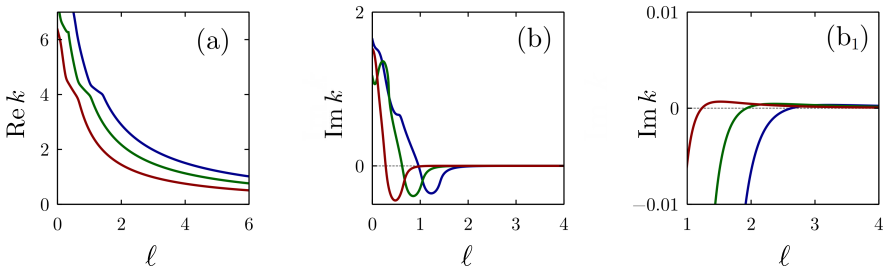
Working with a Schrödinger operator $-\psi''+V(x)\psi=k^2\psi$ whose potential is a rectangular gain element at $x\in(-\ell-1,-\ell)$ and its mirror-symmetric loss element, the authors reduce the spectral problem to a single equation $F(k,\ell,\gamma)=F_-(k,\gamma)F_+(k,\gamma)-e^{-4ik\ell}F_0(k,\gamma)=0$. Its roots $k$ describe all resonances, spectral singularities, and eigenvalues. For large $\ell$, the roots near the real axis form ladders: Lemma 4 places exactly one simple root $k_n(\ell,\gamma)$ in each disk around $\pi n/(2\ell)$, and the four-term expansion (3.10) shows that the imaginary part is governed at order $\ell^{-3}$ by $\sin\sqrt{2\gamma}$. Hence the ladder consists of resonances when $\sin\sqrt{2\gamma}<0$ and of eigenvalues when $\sin\sqrt{2\gamma}>0$, and both types accumulate on the segment $[-\Theta(\gamma),\Theta(\gamma)]$ with $O(\ell)$ members. In the same model, real roots of $F$, the spectral singularities, are analyzed through an auxiliary equation that allows one to engineer a singularity at any chosen real wavenumber and to make two distinct self-dual singularities coexist.
Load-bearing premise
The ladder's sign rule rests on treating the remainder in expansion (3.10) as $O(\ell^{-4})$ uniformly for every $n$ covered by condition (3.9), including $n$ proportional to $\ell$; the paper proves the expansion pointwise in $n$ and does not show uniformity, so the outermost rungs of the ladder are the fragile ones.
Editorial extensions
If this is right
- At fixed gain-and-loss amplitude, increasing $\ell$ creates more and more resonances or eigenvalues, with neighbouring rungs separated by distances of order $\ell^{-1}$ and imaginary parts tending to zero.
- A continuous change of $\gamma$ across values where $\sin\sqrt{2\gamma}$ changes sign transforms a ladder of resonances into a ladder of eigenvalues; at $\sin\sqrt{2\gamma}=0$ the ladder consists of nearly spectral singularities with imaginary parts of order $\ell^{-5}$.
- Choosing the separation appropriately yields a spectral singularity at any prescribed real wavenumber, and two such singularities can be made to occur simultaneously at different wavenumbers.
- The laser-antilaser (coherent-perfect-absorption) threshold decreases as the gain-to-loss distance grows, so spaced elements reach the lasing-absorbing regime at a smaller gain amplitude than adjacent elements.
- There is a forbidden band of gain amplitudes, $\pi^2/2<\gamma<\gamma_*\approx 11.561$, in which no spectral singularities exist even though ladders are still present.
Reading between the lines
- A testable extension the paper does not run: in a tunable photonic waveguide with fixed large $\ell$, sweeping $\gamma$ across a zero of $\sin\sqrt{2\gamma}$ should flip the imaginary parts of the ladder from one side of the real axis to the other, converting resonances into eigenvalues.
- The uniformity gap in the remainder suggests a targeted numerical check: track the outermost rung, $n\approx 2\Theta(\gamma)\ell/\pi$, as $\ell$ grows; its sign behaviour is where a failure of the ladder picture would first show up.
- Because the distance enters the governing equation only through the phase $e^{-4ik\ell}$, the same proof strategy should produce analogous ladders for other compactly supported gain-loss profiles $W(x)$, not just rectangular steps; the boundedness estimates in Lemma 4 are the only profile-dependent input.
Signed reviews
Editorial analysis
A structured set of objections, weighed in public.
Referee Report
Summary. The paper analyses a one-dimensional Schrödinger operator (2.1) with a PT-symmetric potential formed by two separated gain/loss elements, reducing the spectral problem to the scalar transcendental equation F(k,ℓ,γ)=0 in (2.9). It establishes, via a sequence of lemmata, that F is entire with countably many zeroes accumulating only at infinity, that all but finitely many zeroes lie in an explicit sector, and that for large separation ℓ there are O(ℓ) simple zeroes near the real segment [-Θ(γ), Θ(γ)], with a four-term asymptotic expansion (Lemma 4). It also studies zeroes of the separated one-step problems (Lemmata 5–6), proves the absence of pure imaginary eigenvalues (Lemma 7), and derives a forbidden gap with no spectral singularities (Lemma 11). Section 5 develops an algorithm for spectral singularities at prescribed wavenumbers and uses numerical continuation to describe the PT-breaking threshold as a function of ℓ and branches of spectral singularities. The authors interpret the large-ℓ ladder as a Wannier–Stark-like phenomenon, with the sign of the imaginary parts switchable between resonances and eigenvalues by varying sin√(2γ).
Significance. The paper is valuable as a simple, exactly tractable model in which spacing gain and loss produces qualitatively new spectral phenomena: a growing ladder of resonances or eigenvalues accumulating near an explicitly known real segment, and a mechanism for converting one kind of object into the other through the gain/loss amplitude. The derivation of (2.9) is clean, the asymptotic coefficients in (3.10) are computed rather than fitted, and the Rouché-based counting statements in Lemmata 4 and 6 are checkable and, in principle, machine-verifiable. The forbidden-gap statement (5.9) is crisp and sharp. The physical interpretation in terms of laser-absorber modes and PT-breaking is well grounded in the existing literature. The main caveat is that several headline claims—the full-ladder sign, the 'any wavenumber' spectral singularity, the monotone decrease of the threshold, and the O(ℓ^{-5}) case—are either not proved with uniformity or rest on numerical evidence.
major comments (4)
- [§3, Lemma 4 / Eq. (3.10)] Condition (3.9) permits |n| up to (2Θ(γ)/π)ℓ, i.e. n=O(ℓ), but the proof of (3.10) fixes n and expands (3.16) in ε=ℓ^{-1} around ξ=πn/2; no uniform bound for the remainder in that expansion over the full range of n is given. This matters because in §4.2 the sign of Im k_n for the whole ladder is read from the ℓ^{-3} term, which for n~ℓ is O(ℓ^{-1}), while a non-uniform remainder of order n^3 ε^3 or worse could be O(1) and would overwhelm the leading imaginary part. Please either prove uniformity over the range (3.9) using the explicit estimates already present in the proof, or restrict the sign/accumulation statement to a smaller range such as |n|≤Cℓ^{1-δ}, or reformulate the conclusion so that only existence and the four-term expansion for fixed n are claimed.
- [§5.3, Eqs. (5.11), (5.3)–(5.4)] The abstract and conclusion claim that a spectral singularity can be created at any wavenumber, but the only support is numerical: equation (5.11) is solved by dichotomy for k∈(0,10] with step Δk=0.01, and the admissible distances are then read from (5.3)–(5.4). No theorem states that for every k>0 there exists a suitable root β of (5.11) together with an integer n satisfying the sign condition (5.4). Please either prove existence, or qualify the claim as numerically demonstrated on a finite interval rather than as a proven result.
- [§5.4 / Fig. 5(a)] The assertion that the PT-breaking threshold decreases monotonically with ℓ, and hence that spaced gain/loss lowers the laser-absorber threshold, is supported only by numerical continuation from ℓ=0; no analytical bound or error estimate is supplied. Since this is highlighted as a practical consequence, either provide a proof for a stated parameter range or explicitly label the monotonicity as numerical evidence.
- [§4.2, paragraph after (3.10)] The sentence 'A delicate analysis shows that in this case the imaginary parts … amount to O(ℓ^{-5})' is asserted without proof or reference. This case is exactly where the leading imaginary part in (3.10) vanishes, so the assertion is needed for the claimed ladder of 'nearly spectral singularities' at sin√(2γ)=0. Please include the analysis or state the case as an open problem.
minor comments (4)
- [§4.1, near (3.6)] The text says the circle containing zeroes with Im k≤0 grows 'proportionally to γ', but from (3.6) r=max{39/20,√γ/2}, so for large γ the radius grows like √γ, not γ.
- [§3, proof of Lemma 3] In the display after (3.8), the notation |Q1(z,ℓ,μ)| should read |Q1(z,μ)|, since Q1 depends only on z and μ.
- [§4.2] The sentence 'the potentials V± were introduced in (3.17)' is confusing: (3.17) is the change of variables in Lemma 5, while the potentials V± are defined in the displayed formula immediately after Lemma 4.
- [Throughout] There are several typographical slips that should be corrected in a revision: 'Schrödiner' in the abstract, 'contionuous' in §2.1, and 'we use consider' in §5.3.
Circularity Check
No circularity: the ladder expansion is computed from the explicitly derived characteristic equation, not fitted or imported.
full rationale
The paper's central claim is the asymptotic ladder of resonances/eigenvalues in Lemma 4 and Section 4.2. The derivation is self-contained: the characteristic equation (2.9) is obtained by matching solutions across the two localized cells via equations (2.4)-(2.6), and the asymptotic expansion (3.10) is obtained by rescaling k = εξ, expanding equation (3.16) in ε, and equating coefficients. The parameters γ and ℓ are varied independently, and the coefficients in (3.10) are computed rather than fitted; in particular, the sign of Im k_n is determined by the explicit coefficient containing sin sqrt(2γ), not by any adjusted parameter. Self-citations such as [21] (norm-resolvent limit of distant perturbations) and [45,47] (phase transition through splitting of a self-dual spectral singularity) are prior independent results used for context or for the limiting comparison operator, and they do not supply the ladder expansion or the singularity equations. The numerical computations in Section 5 solve the analytically derived system (5.2)-(5.3), so they do not fit the target conclusions. Two rigor limitations are present but are not circularity: Lemma 4 does not prove uniformity in n of the O(ℓ^-4) remainder in (3.10) for n ~ ℓ, and the statement in Section 4.2 that a 'delicate analysis' gives Im k = O(ℓ^-5) when sin sqrt(2γ)=0 omits the promised analysis. Both are correctness/completeness concerns, not reductions of the prediction to its input. No circular step can be exhibited from the paper's own equations.
Assumptions & free parameters
assumptions (5)
- standard math Rouché theorem
- standard math Hadamard factorization theorem
- standard math Inverse function theorem (holomorphic version)
- standard math Maximum modulus principle
- domain assumption The one-dimensional Schrödinger equation with potential (2.2) is a valid model of a waveguide with gain and loss
Cite this review
Pith. "Pith review of Spacing gain and absorption in a simple $\mathcal{PT}$-symmetric model: spectral singularities and ladders of eigenvalues and resonances." pith.science (2026). https://pith.science/paper/PKFVTYO4
@misc{pith2026190806383,
  author       = {Pith},
  title        = {Pith review of: Spacing gain and absorption in a simple $\mathcalPT$-symmetric model: spectral singularities and ladders of eigenvalues and resonances},
  year         = {2026},
  howpublished = {\url{https://pith.science/paper/PKFVTYO4}},
  note         = {Machine review of arXiv:1908.06383}
}
abstract
We consider a parity-time ($\mathcal{PT}$-) symmetric waveguide consisting of a localized gain and loss elements separated by a variable distance. The situation is modelled by a Schr\"odiner operator with localized complex $\mathcal{PT}$-symmetric potential. Properties of the latter Hamiltonian are considered subject to the change of the gain-to-loss distance. Resonances, spectral singularities and eigenvalues are analyzed in detail and discussed in the context of the associated laser-absorber modes and $\mathcal{PT}$-symmetry breaking phase transition. Increasing gain-to-loss distance creates new resonances and spectral singularities which do not exist in the waveguide with adjacent gain and loss. In the limit of large gain-to-loss distance, the waveguide features a ladder of resonances which can be transformed to a ladder of complex eigenvalues by means of the change of the gain-and-loss amplitude.
Figures


Figures from the paper (5 more)


Reference graph
Works this paper leans on
-
[1]
Mostafazadeh A 2009 Spectral singularities of complex scatter ing potentials and infinite reflection and transmission coefficients at real energies Phys. Rev. Lett. 102 220402
work page 2009
-
[2]
Longhi S 2010 PT -symmetric laser absorber Phys. Rev. A 82 031801(R)
work page 2010
-
[3]
Peng B, ¨Ozdemir S ¸ K, Lei F, Monifi F, Gianfreda M, Long G, Fan S, Nori F, Ben der C M and Yang L 2014 Loss-induced suppression and revival of lasing Nat. Phys. 10 394
work page 2014
-
[4]
Lin Z, Ramezani H, Eichelkraut T, Kottos T, Cao H, and Christodo ulides D N 2011 Unidirectional invisibility induced by PT -symmetric periodic structures Phys. Rev. Lett. 106 213901
work page 2011
-
[5]
Bender C M, Berntson B K, Parker D and Samuel E 2013 Observat ion of PT phase transition in a simple mechanical system Am. J. Phys. 81 173-179
work page 2013
-
[6]
Ruschhaupt A, Delgado F and Muga J G 2005 Physical realization of PT -symmetric potential scattering in a planar slab waveguide J. Phys. A: Math. Gen. 38 L171-L176
work page 2005
-
[7]
El-Ganainy R, Makris K G, Christodoulides D N and Musslimani Z H 2007 Theory of coupled optical PT -symmetric structures Opt. Lett. 32 2632-2634
work page 2007
-
[8]
R¨ uter C E, Makris K G, El-Ganainy R, Christodoulides D N, Segev M a nd Kip D 2010 Observation of parity-time symmetry in optics Nat. Phys. 6 192-195
work page 2010
Show all 54 references
-
[9]
Zyablovsky A A, Vinogradov A P, Pukhov A A, Dorofeenko A V and L isyansky A A 2014 PT- symmetry in optics Physics – Uspekhi 57 1063–1082
2014
-
[10]
Konotop V V, Yang J and Zezyulin D A 2016 Nonlinear waves in PT -symmetric systems Rev. Mod. Phys. 88 035002 25
2016
-
[11]
Longhi S 2017 Parity-time symmetry meets photonics: A new tw ist in non-Hermitian optics EPL 120 64001
2017
-
[12]
Photonics 11 752762
Feng L, El-Ganainy R, and Ge L 2017 Non-Hermitian photonics bas ed on paritytime symmetry Nat. Photonics 11 752762
2017
-
[13]
and Christodoulides D N 2018 Non-Hermitian physics and PT symmetry Nat
El-Ganainy R, Makris K G, Khajavikhan M, Musslimani Z H, Rotter S . and Christodoulides D N 2018 Non-Hermitian physics and PT symmetry Nat. Phys. 14 11-19
2018
-
[14]
Gluck M, Kolovsky A R and Korsch H J 2002 WannierStark resonan ces in optical and semiconductor superlattices Phys. Rep. 366 103182
2002
-
[15]
Davies E B 1982 The twisting trick for double well Hamiltonians Comm. Math. Phys. 85 471–479
1982
-
[16]
Aventini P and Seiler R 1975 On the electronic spectrum of the dia tomic molecular ion Comm. Math. Phys. 41 119–134
1975
-
[17]
Harrell E M 1980 Double wells Comm. Math. Phys. 75 239–261
1980
-
[18]
Morgan III J D and Simon B 1980 Behavior of molecular potential e nergy curves for large nuclear separations Int. J. Quantum Chem. 17 1143–1166
1980
-
[19]
Klaus M and Simon B 1979 Binding of Schr¨ odinger particles throug h conspiracy of potential wells Ann. Ins. Henri Poincar´ e section A 30 83–87
1979
-
[20]
Graffi V, Harrell II E M and Silverstone H J 1985 The 1 R expansion forH + 2 : analyticity, summability and asymptotics Ann. Phys. 165 441–483
1985
-
[21]
Borisov D and Golovina A 2012 On the resolvents of periodic opera tors with distant perturbaions Ufa Math. J. 4 65-73
2012
-
[22]
Borisov D, Exner P and Golovina A 2012 Tunneling resonances in sy stems without a classical trapping J. Math. Phys. 54 012102
2012
-
[23]
Golovina A M 2012 On the resolvent of elliptic operators with distan t perturbations of whole space Russ. J. Math. Phys. 19 182–192
2012
-
[24]
Petersburg Math
Golovina A M 2014 On the spectrum of elliptic operators with distan t perturbation in the space St. Petersburg Math. J. 25 735–754
2014
-
[25]
Klopp F and Fedotov A A 2016 Stark–Wannier ladders and cubic ex ponential sums Funct. Anal. Appl. 50 233–236
2016
-
[26]
Buslaev V 1998 Imaginary parts of Stark–Wannier resonances J. Math. Phys. 39 2520
1998
-
[27]
Sacchetti A 2014 Existence of the Stark–Wannier quantum re sonances J. Math. Phys. 55 122104
2014
-
[28]
Buslaev V S and Dmitrieva L A 1990 A Bloch electron in an external fi eld Leningrad Math. J. 1 287–320
1990
-
[29]
Simon B and Herbst I 1978 Stark effect revisited Phys. Rev. Lett. 41 67-69
1978
-
[30]
Longhi S 2009 Bloch oscillations in complex crystals with PT -symmetry Phys. Rev. Lett. 103 123601
2009
-
[31]
Wimmer M, Miri M-A, Christodoulides D and Peschel U 2015 Observ ation of Bloch oscillations in complex PT -symmetric photonic lattices Sci. Rep. 5 17760 26
2015
-
[32]
Xu Y-L, Fegadolli W S, Gan L, Lu M-H, Liu X-P, Li Z-Y, Scherer A a nd Chen Y-F 2016 Ex- perimental realization of Bloch oscillations in a parity-time synthetic s ilicon photonic lattice Nat. Comm. 7 11319
2016
-
[33]
Ahmed Z 2009 Zero width resonance (spectral singularity) in a c omplex PT -symmetric potential J. Phys. A: Math. Theor. 42 472005
2009
-
[34]
Naimark M A 1954 Investigation of the spectrum and the expans ion in eigenfunctions of a non- selfadjoint operator of the second order on a semi-axis Tr. Mosk. Mat. Obs. 3 181–270
1954
-
[35]
Pure Appl
Schwartz J 1960 Some non-selfadjoint operators Comm. Pure Appl. Math. 13, 609
1960
-
[36]
Mostafazadeh A and Mehri-Dehnavi H 2009 Spectral singularit ies, biorthonormal systems and a two-parameter family of complex point interactions J. Phys. A: Math. Theor. 42 125303
2009
-
[37]
Mostafazadeh A 2015 Physics of spectral singularities , Trends in Mathematics 145 (Springer Inter- national Publishing, Switzerland)
2015
-
[38]
Chong Y D, Ge L and Stone A D 2011 PT -symmetry breaking and laser-absorber modes in optical scattering systems Phys. Rev. Lett. 106 093902
2011
-
[39]
Rosanov N N 2017 Antilaser: resonance absorption mode or coh erent perfect absorption? Physics – Uspekhi 60 818
2017
-
[40]
Chong Y D, Ge L, Cao H and Stone A D 2010 Coherent perfect abs orbers: Time-reversed lasers Phys. Rev. Lett. 105 053901
2010
-
[41]
Wan W, Chong Y, Ge L, Noh H, Stone A D and Cao H 2011 Time-rever sed lasing and interferometric control of absorption Science 331 889–892
2011
-
[42]
Baranov D G, Krasnok A, Shegai T, Al´ u A and Chong Y D 2017 Co herent perfect absorbers: linear control of light with light Nat. Rev. Mater. 2 17064
2017
-
[43]
Garmon S, Gianfreda M and Hatano N 2015 Bound states, scatt ering states, and resonant states in PT -symmetric open quantum systems Phys. Rev. A 92 022125
2015
-
[44]
Yang J 2017 Classes of non-parity-time-symmetric optical pot entials with exceptional-point-free phase transitions Opt. Lett. 42 4067
2017
-
[45]
Konotop V V and Zezyulin D A 2017 Phase transition through the s plitting of self-dual spectral singularity in optical potentials Opt. Lett. 42 5206; corrections: 2019 Opt. Lett. 44 1051
2017
-
[46]
Ahmed Z, Kumar S and Gosh D 2018 Three types of discrete ener gy eigenvalues in complex PT- symmetric scattering potentials Phys. Rev. A 98 042101
2018
-
[47]
Konotop V V and Zezyulin D A 2019 Spectral singularities of odd- PT -symmetric potentials Phys. Rev. A 99 013823
2019
-
[48]
Borisov D and Dmitriev D 2017 On the spectral stability of kinks in 2 D Klein-Gordon model with parity-time-symmetric perturbation Stud. Appl. Math. 138 317-342
2017
-
[49]
Kato T 1966 Perturbation theory for linear operators (Springer-Verlag, Berlin)
1966
-
[50]
Heiss W D 2011 The physics of exceptional points J. Phys. A: Math. Theor. 45 444016
2011
-
[51]
Ahmed Z 2014 Handedness of complex PT-symmetric potential b arriers Phys. Lett. A 324 152158
2014
-
[52]
Cartarius H and Wunner G 2012 Model of a PT -symmetric Bose–Einstein condensate in a δ-function double-well potential Phys. Rev. A 86 013612 27
2012
-
[53]
Zezyulin D A and Konotop V V 2016 Nonlinear currents in a ring-sha ped waveguide with balanced gain and dissipation Phys. Rev. A 94 043853
2016
-
[54]
Levin B Ya 1996 Lectures on entire functions . Amer. Math. Soc. (Providence, RI) 28
1996
Reviewed August 14, 2026 · model on record in the stance chip above.
Discussion (0). Continue with ORCID to comment.