Banded non-Hermitian random matrices, neural networks, and eigenvalue degeneracies
Pith reviewed 2026-05-20 07:56 UTC · model grok-4.3
The pith
Lyapunov exponents from random transfer matrices predict the contours of extended states in non-Hermitian banded matrices modeling neural networks.
A machine-rendered reading of the paper's core claim, the machinery that carries it, and where it could break.
Core claim
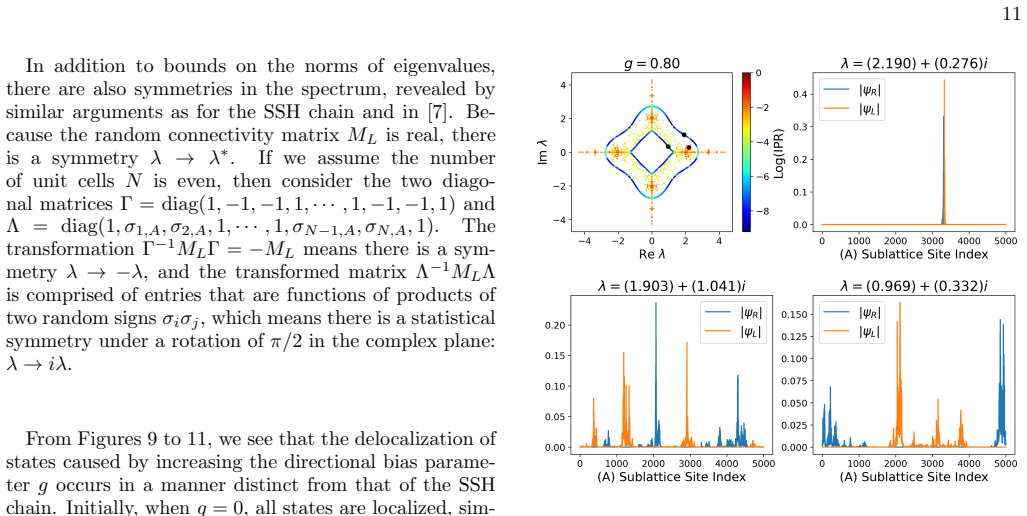
In these models the competition between directional bias and random sign disorder produces loops of extended eigenstates whose boundaries in the complex plane are located by the Lyapunov exponents computed from infinite products of random transfer matrices. The SSH chain yields a single loop that opens a central hole at large bias, while the ladder model exhibits two-stage delocalization that creates two separate loops with localized states between them. These Lyapunov predictions agree with numerical diagonalization of finite periodic systems, and the special eigenvalue degeneracies remain intact under disorder.
What carries the argument
Lyapunov exponents associated with products of random transfer matrices, which locate the contours separating extended and localized eigenstates in the complex plane.
Load-bearing premise
The infinite-system Lyapunov exponent calculation accurately locates the delocalization contours even for the finite periodic systems used in numerical diagonalization.
What would settle it
Numerical diagonalization of large finite matrices that shows delocalization boundaries deviating from the zero contours of the transfer-matrix Lyapunov exponents would falsify the prediction.
Figures




read the original abstract
We study two-banded, non-Hermitian random matrices inspired by sparse neural networks with a circular, 1d topology. We focus on two paradigmatic models, an SSH chain and a ladder model, which have both non-Hermitian directional bias and random sign disorder in the hoppings. The random sign disorder, which follows Dale's Law, leads to localization of the eigenstates, while the directional bias drives a delocalization transition in these states. The competition between disorder and directional bias results in rich eigenspectra with loops of extended states in the complex plane surrounded by regions of localized ones, and the eigenvalues are all confined to an annular region. Furthermore, the distinct band structures of the SSH chain and ladder model lead to different delocalization phenomena. Even in the absence of disorder, tuning the directional bias can lead to an eigenvalue degeneracy, which is an exceptional point for the SSH chain but a diabolic point for the ladder. In the presence of the disorder, these special eigenvalue degeneracies are preserved and also highlight key stages in the delocalization process. For both models, increasing the directional bias initially delocalizes states starting from within the bands. For the SSH chain, for large enough directional bias, the delocalized states open up a hole in the spectrum in the complex plane, similar to prior results for single band systems. But for the ladder model, as the directional bias is increased, the states delocalize in two stages, leading to two separate loops of extended states with localized states in between. The precise contours on which the extended states reside can be predicted from the Lyapunov exponents associated with products of random transfer matrices, in agreement with direct numerical diagonalization. Although we focus on periodic boundaries, results are discussed for open boundaries as well.
Editorial analysis
A structured set of objections, weighed in public.
Referee Report
Summary. The manuscript studies two-banded non-Hermitian random matrices modeling sparse neural networks on a circular 1D topology. It focuses on SSH-chain and ladder models incorporating both random sign disorder (following Dale's law) and non-Hermitian directional bias. The central claim is that disorder localizes eigenstates while bias induces delocalization, producing loops of extended states in the complex plane whose precise contours are predicted by Lyapunov exponents extracted from products of random transfer matrices; these predictions agree with direct numerical diagonalization. The work also examines how exceptional points (SSH) and diabolic points (ladder) survive disorder and mark stages of the delocalization transition, with the two models exhibiting qualitatively different sequences of delocalization as bias is increased.
Significance. If the central claim holds, the work supplies an analytic route, via infinite-system Lyapunov exponents, to locate delocalization contours in non-Hermitian disordered systems without fitting parameters. The explicit comparison between transfer-matrix predictions and numerical spectra, together with the model-specific distinction between one-stage (SSH) and two-stage (ladder) delocalization and the preservation of special eigenvalue degeneracies, constitutes a concrete advance at the intersection of random-matrix theory and non-Hermitian localization. The manuscript's strength lies in framing the result as a falsifiable prediction rather than a post-hoc fit.
major comments (1)
- [Transfer-matrix Lyapunov exponent calculation and numerical diagonalization sections] The Lyapunov-exponent contours are obtained in the infinite-system limit, yet the numerical diagonalization is performed on finite periodic chains. The manuscript reports agreement between the two but does not present finite-size scaling or quantitative error bounds on the contour match. This leaves open the possibility that O(1/N) corrections or periodic wrapping shift the apparent delocalization boundaries, especially near the exceptional/diabolic points. A dedicated finite-size analysis or explicit statement of the system sizes and ensemble statistics used for the comparison is required to substantiate the claimed agreement.
minor comments (2)
- [Discussion of open boundaries] The abstract states that results for open boundaries are discussed, but the main text provides no quantitative comparison or figures contrasting periodic and open spectra; a brief summary table or additional panel would clarify the robustness of the reported phenomena.
- [Numerical methods and figure captions] Ensemble sizes, number of disorder realizations, and error estimation for the numerical eigenvalue distributions and IPR calculations are not stated in the abstract or figure captions; inclusion of these details would strengthen the reproducibility of the reported agreement.
Simulated Author's Rebuttal
We thank the referee for their careful reading of the manuscript and for the positive assessment of its significance. We address the single major comment below.
read point-by-point responses
-
Referee: [Transfer-matrix Lyapunov exponent calculation and numerical diagonalization sections] The Lyapunov-exponent contours are obtained in the infinite-system limit, yet the numerical diagonalization is performed on finite periodic chains. The manuscript reports agreement between the two but does not present finite-size scaling or quantitative error bounds on the contour match. This leaves open the possibility that O(1/N) corrections or periodic wrapping shift the apparent delocalization boundaries, especially near the exceptional/diabolic points. A dedicated finite-size analysis or explicit statement of the system sizes and ensemble statistics used for the comparison is required to substantiate the claimed agreement.
Authors: We agree that a systematic finite-size analysis and explicit reporting of numerical parameters would strengthen the comparison. In the revised manuscript we will add a dedicated subsection (or appendix) presenting finite-size scaling of the delocalization contours for several chain lengths (N = 500, 1000, 2000, and 4000). We will specify the system sizes and ensemble sizes used throughout the numerics (typically 10^3 disorder realizations) and include quantitative error measures, such as the maximum radial deviation between the Lyapunov contour and the numerically observed boundary as a function of 1/N. These additions will allow us to bound O(1/N) corrections and to confirm that periodic-boundary effects remain negligible away from the exceptional and diabolic points. revision: yes
Circularity Check
No significant circularity; transfer-matrix Lyapunov prediction is independent of numerics
full rationale
The paper derives delocalization contours via Lyapunov exponents of random transfer-matrix products constructed directly from the SSH and ladder model Hamiltonians, then compares these analytic predictions to separate numerical diagonalization on finite periodic systems. This is a standard first-principles calculation from the ensemble definition, not a fit to eigenvalue data, not a self-definition, and not reliant on load-bearing self-citations that reduce the claim to unverified inputs. The method is externally falsifiable via the numerics and does not rename known results or smuggle ansatzes; the derivation chain remains self-contained against the model's own equations.
Axiom & Free-Parameter Ledger
axioms (1)
- domain assumption Random sign disorder obeying Dale's Law produces localization of eigenstates.
Lean theorems connected to this paper
-
IndisputableMonolith/Cost/FunctionalEquation.leanwashburn_uniqueness_aczel unclear?
unclearRelation between the paper passage and the cited Recognition theorem.
The precise contours on which the extended states reside can be predicted from the Lyapunov exponents associated with products of random transfer matrices, in agreement with direct numerical diagonalization.
-
IndisputableMonolith/Foundation/RealityFromDistinction.leanreality_from_one_distinction unclear?
unclearRelation between the paper passage and the cited Recognition theorem.
The Lyapunov exponent γ(λ) = lim (1/2N) Σ log |r⁺ⱼ r⁻ⱼ₊₁|
What do these tags mean?
- matches
- The paper's claim is directly supported by a theorem in the formal canon.
- supports
- The theorem supports part of the paper's argument, but the paper may add assumptions or extra steps.
- extends
- The paper goes beyond the formal theorem; the theorem is a base layer rather than the whole result.
- uses
- The paper appears to rely on the theorem as machinery.
- contradicts
- The paper's claim conflicts with a theorem or certificate in the canon.
- unclear
- Pith found a possible connection, but the passage is too broad, indirect, or ambiguous to say the theorem truly supports the claim.
Reference graph
Works this paper leans on
-
[1]
Banded non-Hermitian random matrices, neural networks, and eigenvalue degeneracies
and the fluttering of flags [22]), and they appear in contexts including, but not limited to, optics and pho- tonics [23], open quantum systems [24], and nonlinear and stochastic dynamics [25]. In this paper, inspired by neural network models, we will investigate the con- nections between localization, non-Hermitian eigenvalue degeneracies, and multi-band...
work page internal anchor Pith review Pith/arXiv arXiv 2026
-
[2]
Eugene P Wigner. On the distribution of the roots of certain symmetric matrices.Annals of Mathematics, 67(2):325–327, 1958
work page 1958
-
[3]
Absence of diffusion in certain ran- dom lattices.Physical Review, 109(5):1492, 1958
Philip W Anderson. Absence of diffusion in certain ran- dom lattices.Physical Review, 109(5):1492, 1958
work page 1958
-
[4]
Naomichi Hatano and David R Nelson. Localization tran- sitions in non-Hermitian quantum mechanics.Physical Review Letters, 77(3):570, 1996
work page 1996
-
[5]
Vortex pinning and non-Hermitian quantum mechanics.Physical Review B, 56(14):8651, 1997
Naomichi Hatano and David R Nelson. Vortex pinning and non-Hermitian quantum mechanics.Physical Review B, 56(14):8651, 1997
work page 1997
-
[6]
Spectrum of large ran- dom asymmetric matrices.Physical Review Letters, 60(19):1895, 1988
Hans Juergen Sommers, Andrea Crisanti, Haim Som- polinsky, and Yaakov Stein. Spectrum of large ran- dom asymmetric matrices.Physical Review Letters, 60(19):1895, 1988
work page 1988
-
[7]
Kanaka Rajan and Larry F Abbott. Eigenvalue spectra of random matrices for neural networks.Physical Review Letters, 97(18):188104, 2006
work page 2006
-
[8]
Non- Hermitian localization in biological networks.Physical Review E, 93(4):042310, 2016
Ariel Amir, Naomichi Hatano, and David R Nelson. Non- Hermitian localization in biological networks.Physical Review E, 93(4):042310, 2016
work page 2016
-
[9]
Grace H Zhang and David R Nelson. Eigenvalue repul- sion and eigenvector localization in sparse non-Hermitian random matrices.Physical Review E, 100(5):052315, 2019
work page 2019
-
[10]
Non-Hermitian quasilocalization and ring attractor neural networks
Hidenori Tanaka and David R Nelson. Non-Hermitian quasilocalization and ring attractor neural networks. Physical Review E, 99(6):062406, 2019
work page 2019
-
[11]
Non-Hermitian localization and population biology.Physical Review E, 58(2):1383, 1998
David R Nelson and Nadav M Shnerb. Non-Hermitian localization and population biology.Physical Review E, 58(2):1383, 1998
work page 1998
-
[12]
Winding num- bers, complex currents, and non-Hermitian localization
Nadav M Shnerb and David R Nelson. Winding num- bers, complex currents, and non-Hermitian localization. Physical Review Letters, 80(23):5172, 1998
work page 1998
-
[13]
Population dynamics and non-Hermitian localization
Karin A Dahmen, David R Nelson, and Nadav M Shnerb. Population dynamics and non-Hermitian localization. In Statistical Mechanics of Biocomplexity: Proceedings of the XV Sitges Conference Held at Sitges, Barcelona, Spain, 8–12 June 1998, pages 124–151. Springer, 2007
work page 1998
-
[14]
The stability–complexity relationship at age 40: a random matrix perspective
Stefano Allesina and Si Tang. The stability–complexity relationship at age 40: a random matrix perspective. Population Ecology, 57(1):63–75, 2015
work page 2015
-
[15]
John Carew Eccles. From electrical to chemical transmis- sion in the central nervous system: The closing address of the Sir Henry Dale Centennial Symposium Cambridge, 19 September 1975.Notes and records of the Royal Soci- ety of London, 30(2):219–230, 1976
work page 1975
-
[16]
Ring attractor dynamics in the drosophila central brain.Science, 356(6340):849–853, 2017
Sung Soo Kim, Herv´ e Rouault, Shaul Druckmann, and Vivek Jayaraman. Ring attractor dynamics in the drosophila central brain.Science, 356(6340):849–853, 2017
work page 2017
-
[17]
Tosio Kato.Perturbation theory for linear operators, vol- ume 132. Springer, 1966
work page 1966
-
[18]
WD Heiss. Exceptional points of non-Hermitian opera- tors.Journal of Physics A: Mathematical and General, 37(6):2455–2464, 2004
work page 2004
-
[19]
Physics of nonhermitian degenera- cies.Czechoslovak Journal of Physics, 54(10):1039–1047, 2004
Michael V Berry. Physics of nonhermitian degenera- cies.Czechoslovak Journal of Physics, 54(10):1039–1047, 2004
work page 2004
-
[20]
Diabolical conical intersections.Re- views of Modern Physics, 68(4):985, 1996
David R Yarkony. Diabolical conical intersections.Re- views of Modern Physics, 68(4):985, 1996
work page 1996
-
[21]
Non- Hermitian physics.Advances in Physics, 69(3):249–435, 2020
Yuto Ashida, Zongping Gong, and Masahito Ueda. Non- Hermitian physics.Advances in Physics, 69(3):249–435, 2020
work page 2020
-
[22]
Lev Davidovich Landau and Evgenii Mikhailovich Lif- shitz.Mechanics: Volume 1. Butterworth Heinemann, 1976
work page 1976
-
[23]
M´ ed´ eric Argentina and L Mahadevan. Fluid-flow-induced flutter of a flag.Proceedings of the National Academy of Sciences, 102(6):1829–1834, 2005
work page 2005
-
[24]
Exceptional points in optics and photonics.Science, 363(6422):eaar7709, 2019
Mohammad-Ali Miri and Andrea Alu. Exceptional points in optics and photonics.Science, 363(6422):eaar7709, 2019
work page 2019
-
[25]
WD Heiss, M M¨ uller, and I Rotter. Collectivity, phase transitions, and exceptional points in open quantum sys- tems.Physical Review E, 58(3):2894, 1998
work page 1998
-
[26]
Cheyne Weis, Michel Fruchart, Ryo Hanai, Kyle Kawa- goe, Peter B Littlewood, and Vincenzo Vitelli. Gener- alized exceptional points in nonlinear and stochastic dy- namics.Physical Review Research, 7(4):043157, 2025
work page 2025
-
[27]
Peter Dayan and Laurence F Abbott.Theoretical neu- roscience: computational and mathematical modeling of neural systems. MIT press, 2005
work page 2005
-
[28]
Soliton excitations in polyacetylene.Physical Review B, 22(4):2099, 1980
WP Su, JR Schrieffer, and AJ Heeger. Soliton excitations in polyacetylene.Physical Review B, 22(4):2099, 1980
work page 2099
-
[29]
Exceptional topology of non-Hermitian systems.Reviews of Modern Physics, 93(1):015005, 2021
Emil J Bergholtz, Jan Carl Budich, and Flore K Kunst. Exceptional topology of non-Hermitian systems.Reviews of Modern Physics, 93(1):015005, 2021
work page 2021
-
[30]
Non-Hermitian localization and delocalization.Physical Review E, 59(6):6433, 1999
Joshua Feinberg and A Zee. Non-Hermitian localization and delocalization.Physical Review E, 59(6):6433, 1999
work page 1999
-
[31]
Non-Hermitian delocalization and eigenfunctions.Physical Review B, 58(13):8384, 1998
Naomichi Hatano and David R Nelson. Non-Hermitian delocalization and eigenfunctions.Physical Review B, 58(13):8384, 1998
work page 1998
-
[32]
Extended states in a one-demensional system with off-diagonal disorder
George Theodorou and Morrel H Cohen. Extended states in a one-demensional system with off-diagonal disorder. Physical Review B, 13(10):4597, 1976
work page 1976
-
[33]
TP Eggarter and R Riedinger. Singular behavior of tight- binding chains with off-diagonal disorder.Physical Re- view B, 18(2):569, 1978
work page 1978
-
[34]
Localization and spectral singulari- ties in random chains.Physical Review Letters, 49(5):337, 1982
Timothy AL Ziman. Localization and spectral singulari- ties in random chains.Physical Review Letters, 49(5):337, 1982
work page 1982
-
[35]
The dynamics of a disordered linear chain.Physical Review, 92(6):1331, 1953
Freeman J Dyson. The dynamics of a disordered linear chain.Physical Review, 92(6):1331, 1953
work page 1953
-
[36]
Disordered one-dimensional crystals
Helmut Schmidt. Disordered one-dimensional crystals. Physical Review, 105(2):425, 1957
work page 1957
-
[37]
Bernard Derrida, Jesper Lykke Jacobsen, and Reuven Zeitak. Lyapunov exponent and density of states of a one- dimensional non-Hermitian Schr¨ odinger equation.Jour- nal of Statistical Physics, 98(1):31–55, 2000
work page 2000
-
[38]
Giancarlo Benettin, Luigi Galgani, Antonio Giorgilli, and Jean-Marie Strelcyn. Lyapunov characteristic exponents for smooth dynamical systems and for Hamiltonian sys- tems; a method for computing all of them. Part 1: The- ory.Meccanica, 15(1):9–20, 1980
work page 1980
-
[39]
Giancarlo Benettin, Luigi Galgani, Antonio Giorgilli, and Jean-Marie Strelcyn. Lyapunov characteristic exponents for smooth dynamical systems and for Hamiltonian sys- tems; a method for computing all of them. Part 2: Nu- merical application.Meccanica, 15(1):21–30, 1980
work page 1980
-
[40]
Shunyu Yao and Zhong Wang. Edge states and topologi- cal invariants of non-Hermitian systems.Physical Review 16 Letters, 121(8):086803, 2018
work page 2018
-
[41]
Heming Wang, Janet Zhong, and Shanhui Fan. Non- hermitian photonic band winding and skin effects: a tu- torial.Advances in Optics and Photonics, 16(3):659–748, 2024
work page 2024
discussion (0)
Sign in with ORCID, Apple, or X to comment. Anyone can read and Pith papers without signing in.