Out-of-equilibrium scaling of the particle density in quantum fermionic wires after a critical quenching of the chemical potential
Pith reviewed 2026-06-25 22:19 UTC · model grok-4.3
The pith
The difference between post-quench and critical particle density in fermionic wires scales with the dynamic variable θ = t/ξ^z.
A machine-rendered reading of the paper's core claim, the machinery that carries it, and where it could break.
Core claim
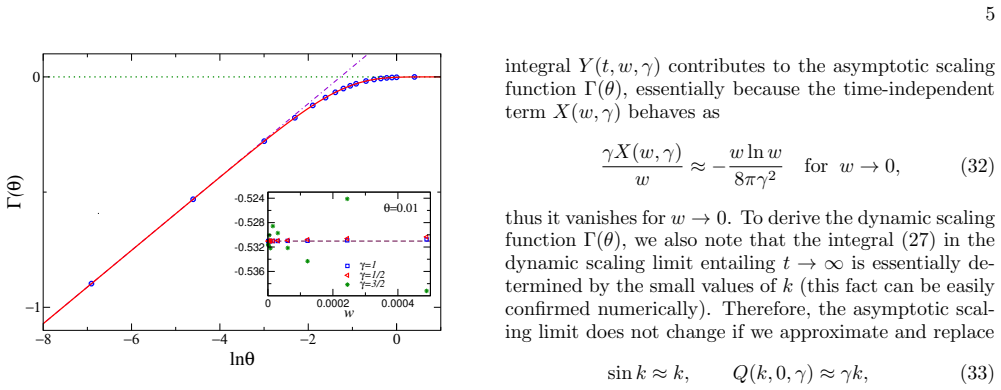
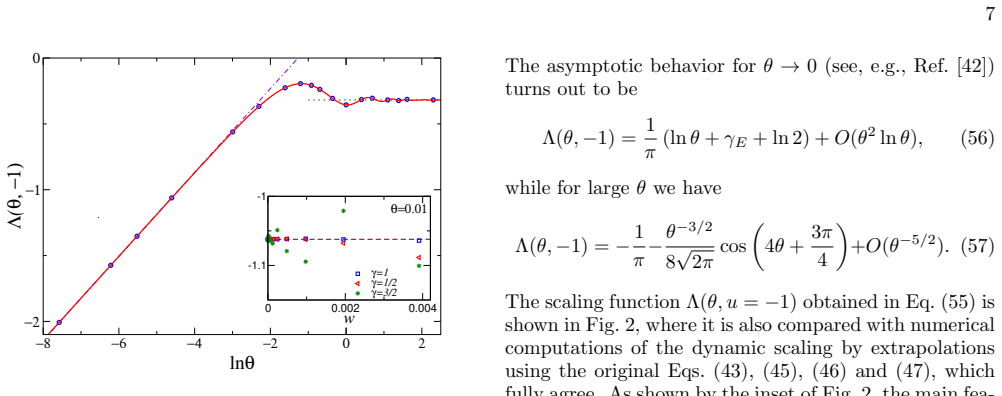
The difference between the post-QQ particle density and its critical value develops an out-of-equilibrium scaling behavior in terms of the dynamic scaling variable θ∼t/ξ^z. The scaling function has a peculiar singular behavior in the θ→0 limit, apparently related to the anomalous equilibrium scaling behavior of the particle density at the starting point of the QQ protocol. This provides analytical evidence of earlier conjectures on the general emergence of post-QQ dynamic scaling behaviors of the subtracted particle density, unlike their equilibrium counterpart which is dominated by nonuniversal contributions.
What carries the argument
The dynamic scaling variable θ ∼ t/ξ^z for the post-quench time evolution of the subtracted particle density.
If this is right
- The scaling function exhibits a singular behavior as θ approaches 0.
- This scaling is distinct from the equilibrium case dominated by nonuniversal terms.
- Analytical evidence supports conjectures on post-quench dynamic scaling of subtracted particle density.
- The emergence of scaling is tied to the initial state being within the critical region.
Where Pith is reading between the lines
- If this scaling holds, it suggests that quench protocols can isolate universal critical behavior in systems where equilibrium quantities are masked by analytic backgrounds.
- Extensions to other initial states or different quench protocols could test the generality of the singular θ→0 behavior.
- Similar subtracted quantities might reveal hidden scaling in other nonequilibrium critical dynamics.
Load-bearing premise
That the regular and logarithmic terms from mixing with the identity operator do not dominate the time-dependent difference in particle density after the quench.
What would settle it
Numerical computation of the particle density at small post-quench times showing that the subtracted density does not follow the predicted scaling function or its singular limit as θ→0.
Figures
read the original abstract
We study the out-of-equilibrium scaling behavior of the particle density in quantum fermionic Kitaev wires, after instantaneous quantum quenches (QQs) of the chemical potential within their quantum critical region. The critical scaling of the ground-state particle density is known to be subleading at its Ising-like quantum transition, hidden by regular and logarithmic terms arising from peculiar mixings with the identity operator. This situation changes along the out-of-equilibrium dynamics arising from QQs of the chemical potential to the critical point, starting from the ground state for Hamiltonian parameters within the critical region. We analytically show that the difference between the post-QQ particle density and its critical value develops an out-of-equilibrium scaling behavior, in terms of the dynamic scaling variable $\theta\sim t/\xi^z$ (where $t>0$ is the post-QQ time, $\xi$ is the length scale of the initial state, and $z$ is the dynamic critical exponent) associated with the post-QQ time evolution. The scaling function turns out to have a peculiar singular behavior in the $\theta\to 0$ limit, apparently related to the anomalous equilibrium scaling behavior of the particle density at the starting point of the QQ protocol. This provides analytical evidence of earlier conjectures on the general emergence of post-QQ dynamic scaling behaviors of the subtracted particle density (supported by numerical finite-size scaling analyses), unlike their equilibrium counterpart which turns out to be dominated by nonuniversal contributions.
Editorial analysis
A structured set of objections, weighed in public.
Referee Report
Summary. The manuscript examines the out-of-equilibrium dynamics of the particle density in Kitaev fermionic wires following an instantaneous quench of the chemical potential to the critical point, starting from the ground state inside the critical region. It claims an analytical derivation that the subtracted density Δn(t) = n(t) − n_crit obeys dynamic scaling in the variable θ ∼ t/ξ^z (with z the dynamic exponent), and that the associated scaling function is singular as θ → 0, in contrast to the equilibrium density which is dominated by regular and logarithmic contributions from identity-operator mixing.
Significance. If the explicit cancellation of non-universal terms is demonstrated, the result supplies analytical evidence that post-quench subtracted observables can exhibit clean dynamic scaling even when their equilibrium counterparts are masked by operator mixing. This would support earlier numerical conjectures and illustrate how time evolution can isolate universal pieces that are inaccessible at equilibrium.
major comments (2)
- [out-of-equilibrium dynamics section (referenced in abstract)] The central analytical claim rests on showing that the regular and logarithmic identity-mixing contributions to the equilibrium density cancel (or become ξ-independent) in the post-quench difference Δn(t). The out-of-equilibrium section must contain the explicit mode-sum (or CFT) calculation demonstrating that the time-evolution operator applied to the initial state does not reintroduce time-dependent pieces proportional to these operators that survive subtraction for finite t; without this step the clean θ scaling is not established.
- [scaling-function analysis] The singular θ → 0 behavior of the scaling function is asserted to be related to the anomalous equilibrium scaling at the initial point. The derivation must explicitly connect the small-θ expansion to the known equilibrium mixing coefficients; otherwise the claimed relation remains conjectural rather than derived.
minor comments (2)
- Clarify the precise definition of the initial length scale ξ and the dynamic exponent z used in θ; state whether they are taken from the equilibrium Ising universality class or renormalized by the quench protocol.
- Provide the explicit form of the scaling function f(θ) or at least its leading small-θ and large-θ asymptotics to allow direct comparison with future numerics.
Simulated Author's Rebuttal
We thank the referee for the careful reading and constructive suggestions. We agree that the out-of-equilibrium section requires more explicit derivations to fully substantiate the analytical claims. We will revise the manuscript to incorporate the requested calculations.
read point-by-point responses
-
Referee: [out-of-equilibrium dynamics section (referenced in abstract)] The central analytical claim rests on showing that the regular and logarithmic identity-mixing contributions to the equilibrium density cancel (or become ξ-independent) in the post-quench difference Δn(t). The out-of-equilibrium section must contain the explicit mode-sum (or CFT) calculation demonstrating that the time-evolution operator applied to the initial state does not reintroduce time-dependent pieces proportional to these operators that survive subtraction for finite t; without this step the clean θ scaling is not established.
Authors: We agree that an explicit mode-sum calculation is essential. In the revised manuscript we will add the full fermionic mode expansion (Bogoliubov-de Gennes quasiparticles) for the post-quench time evolution, explicitly demonstrating the cancellation of the regular and logarithmic identity-mixing terms in Δn(t) and confirming that no time-dependent non-universal contributions survive the subtraction for finite t. revision: yes
-
Referee: [scaling-function analysis] The singular θ → 0 behavior of the scaling function is asserted to be related to the anomalous equilibrium scaling at the initial point. The derivation must explicitly connect the small-θ expansion to the known equilibrium mixing coefficients; otherwise the claimed relation remains conjectural rather than derived.
Authors: We accept that the connection must be derived rather than asserted. The revised version will contain an explicit small-θ expansion of the scaling function, obtained from the mode-sum expression, and will directly match its leading singular term to the known equilibrium mixing coefficients of the identity operator at the initial point. revision: yes
Circularity Check
No significant circularity; analytical derivation stands independently
full rationale
The paper claims an explicit analytical demonstration that the subtracted post-quench density difference Δn(t) = n(t) − n_crit obeys dynamic scaling in θ = t/ξ^z, with a singular θ→0 limit. This is presented as arising from the mode-sum or CFT time evolution applied to the initial critical-region ground state, after the identity-mixing terms that dominate equilibrium are subtracted. No equation is shown reducing the scaling function to a fitted parameter or to a prior self-citation by definition. The reference to 'earlier conjectures' (supported by numerics) is contextual; the present work supplies the independent analytical step. The derivation chain therefore remains self-contained against external benchmarks and does not collapse by construction.
Axiom & Free-Parameter Ledger
axioms (2)
- domain assumption The Kitaev wire exhibits an Ising-like quantum critical point with known dynamic exponent z
- domain assumption The initial state is the ground state inside the critical region before the instantaneous quench
Reference graph
Works this paper leans on
-
[1]
Rossini and E
D. Rossini and E. Vicari, Coherent and dissipative dy- namics at quantum phase transitions, Phys. Rep.936, 1 (2021)
2021
-
[2]
Campostrini, A
M. Campostrini, A. Pelissetto, and E. Vicari, Finite-size scaling at quantum transitions, Phys. Rev. B89, 094516 (2014)
2014
-
[3]
K. G. Wilson and J. Kogut, The renormalization group and theϵexpansion, Phys. Rep.12, 75 (1974)
1974
-
[4]
M. E. Fisher, The renormalization group in the theory of critical behavior, Rev. Mod. Phys.46, 597 (1974)
1974
-
[5]
F. J. Wegner, The critical state, general aspects, inPhase transitions and critical phenomena, C. Domb and J. L. Lebowitz, (Academic Press, 1976, London)
1976
-
[6]
Pelissetto and E
A. Pelissetto and E. Vicari, Critical phenomena and renormalization group theory, Phys. Rep.368, 549 (2002)
2002
-
[7]
Rossini and E
D. Rossini and E. Vicari, Interplay between short- range and critical long-range fluctuations in the out-of- equilibrium behavior of the particle density at quantum transitions, Phys. Rev. B110, 035126 (2024)
2024
-
[8]
A. Yu. Kitaev, Unpaired Majorana fermions in quantum wires, Phys. Usp.44, 131 (2001)
2001
-
[9]
Sachdev,Quantum Phase Transitions, (Cambridge University, Cambridge, England, 1999)
S. Sachdev,Quantum Phase Transitions, (Cambridge University, Cambridge, England, 1999)
1999
-
[10]
Caselle, M
M. Caselle, M. Hasenbusch, A. Pelissetto, and E. Vicari, Irrelevant operators in the two-dimensional Ising model, J. Phys. A: Math. Gen.35, 4861 (2002)
2002
-
[11]
Panagopoulos and E
H. Panagopoulos and E. Vicari, Out-of-equilibrium scal- ing of the energy density along the critical relaxational flow after a quench of the temperature, Phys. Rev. E 109, 064107 (2024)
2024
-
[12]
Bonati, H
C. Bonati, H. Panagopoulos, and E. Vicari, Out-of- equilibrium critical dynamics of the three-dimensionalZ 2 gauge model along critical relaxational flows, Phys. Rev. E111, 054107 (2025)
2025
-
[13]
Bonati, H
C. Bonati, H. Panagopoulos, and E. Vicari, Critical 9 relaxational dynamics of three-dimensional latticeZ N gauge models and the inverted XY universality class, Phys. Rev. E112, 024125 (2025)
2025
-
[14]
Bonati, A
C. Bonati, A. Pelissetto, and E. Vicari, Three- dimensional Abelian and non-Abelian gauge Higgs theo- ries, Phys. Rep.1133, 1 (2025)
2025
-
[15]
R. Agrawal, L. F. Cugliandolo, and M. Picco, Critical quench dynamics of Wegner’sZ 2 gauge model: a geo- metric perspective, arXiv:2605.15841
-
[16]
Barouch, B
E. Barouch, B. M. McCoy, and M. Dresden, Statistical Mechanics of theXYmodel. I, Phys. Rev. A2, 1075 (1970)
1970
-
[17]
E. Lieb, T. Schultz, and D. Mattis, Two soluble models of an antiferromagnetic chain, Ann. Physics16, 407 (1961)
1961
-
[18]
Katsura, Statistical mechanics of the anisotropic linear Heisenberg model, Phys
S. Katsura, Statistical mechanics of the anisotropic linear Heisenberg model, Phys. Rev.127, 1508 (1962); (Erra- tum) Phys. Rev.129, 2835 (1963)
1962
-
[19]
Pfeuty, The one-dimensional Ising model with a trans- verse field, Ann
P. Pfeuty, The one-dimensional Ising model with a trans- verse field, Ann. Physics57, 79 (1970)
1970
-
[20]
T. W. Burkhardt and I. Guim, Finite-size scaling of the quantum Ising chain with periodic, free, and antiperiodic boundary conditions, J. Phys. A: Math. Gen.18, L33 (1985)
1985
-
[21]
Salas and A
J. Salas and A. D. Sokal, Universal amplitude ratios in the critical two-dimensional Ising model on a torus, J. Stat. Phys.98, 551 (2000)
2000
-
[22]
S. L. A. de Queiroz, Finite size scaling corrections in two- dimensional Ising and Potts ferromagnets, J. Phys. A33, 721 (2000)
2000
-
[23]
Salas, Exact finite-size-scaling corrections to the crit- ical two-dimensional Ising model on a torus, J
J. Salas, Exact finite-size-scaling corrections to the crit- ical two-dimensional Ising model on a torus, J. Phys. A 34, 1311 (2001)
2001
-
[24]
Orrick, B
W. Orrick, B. Nickel, A. J. Guttman, and J. H. H. Perk, The susceptibility of the square lattice Ising model: New developments, J. Stat. Phys.102, 795 (2001)
2001
-
[25]
N. Sh. Izmailian and C.-K. Hu, Exact amplitude ratio and finite-size corrections for theM×Nsquare lattice Ising model, Phys. Rev. E65, 036103 (2002)
2002
-
[26]
N. Sh. Izmailian and C.-K. Hu, Boundary conditions and amplitude ratios for finite-size corrections of a one- dimensional quantum spin model, Nucl. Phys. B808, 613 (2009)
2009
-
[27]
Y. Chan, A. J. Guttman, B. Nickel, and J. H. H. Perk, The Ising susceptibility scaling function, J. Stat. Phys. 145, 549 (2011)
2011
-
[28]
N. Sh. Izmailian, Universal amplitude ratios for scaling corrections on Ising strips with fixed boundary condi- tions, Nucl. Phys. B854, 184 (2012)
2012
-
[29]
X. Wu, N. Izmailian, and W. Guo, Finite-size behav- ior of the critical Ising model on a rectangle with free boundaries, Phys. Rev. E86, 041149 (2012); Shape- dependent finite-size effect of the critical two-dimensional Ising model on a triangular lattice, Phys. Rev. E87, 022124 (2013)
2012
-
[30]
M. E. Fisher and M. N. Barber, Scaling theory for finite- size effects in the critical region, Phys. Rev. Lett.28, 1516 (1972)
1972
-
[31]
M. N. Barber, Finite-size scaling, inPhase transitions and critical phenomena, vol. 8, p. 145, edited by C. Domb and J. L. Lebowitz (Academic Press, London, 1983)
1983
-
[32]
Privman (Ed.),Finite size scaling and numerical sim- ulation of statistical systems(World Scientific, Singapore, 1990)
V. Privman (Ed.),Finite size scaling and numerical sim- ulation of statistical systems(World Scientific, Singapore, 1990)
1990
-
[33]
Cardy (Ed.)Finite-size scaling(North Holland, Ams- terdam, 1988)
J. Cardy (Ed.)Finite-size scaling(North Holland, Ams- terdam, 1988)
1988
-
[34]
Calabrese, F
P. Calabrese, F. H. L. Essler, and M. Fagotti, Quantum quenches in the transverse field Ising chain: II. Stationary state properties, J. Stat. Mech. (2012) P07022
2012
-
[35]
Rossini and E
D. Rossini and E. Vicari, Dynamics after quenches in one-dimensional quantum Ising-like systems, Phys. Rev. B102, 054444 (2020)
2020
-
[36]
P. C. Hohenberg and B. I. Halperin, Theory of dynamic critical phenomena, Rev. Mod. Phys.49, 435 (1977)
1977
-
[37]
Ma,Modern theory of critical phenomena(Rout- ledge Editor, New York, 2001)
S.-k. Ma,Modern theory of critical phenomena(Rout- ledge Editor, New York, 2001)
2001
-
[38]
Dziarmaga, Dynamics of a quantum phase transition: Exact solution of the quantum Ising model, Phys
J. Dziarmaga, Dynamics of a quantum phase transition: Exact solution of the quantum Ising model, Phys. Rev. Lett.95, 245701 (2005)
2005
-
[39]
Chandran, A
A. Chandran, A. Erez, S. S. Gubser, and S. L. Sondhi, Kibble-Zurek problem: Universality and the scaling limit, Phys. Rev. B86, 064304 (2012)
2012
-
[40]
Pelissetto, D
A. Pelissetto, D. Rossini, and E. Vicari, Dynamic finite- size scaling after a quench at quantum transitions, Phys. Rev. E97, 052148 (2018)
2018
-
[41]
Tarantelli and E
F. Tarantelli and E. Vicari, Out-of-equilibrium dynamics arising from slow round-trip variations of Hamiltonian parameters across quantum and classical critical points, Phys. Rev. B105, 235124 (2022)
2022
-
[42]
The Mathematical Function Site, Wolfram Research
-
[43]
J. D. Sau and S. Das Sarma, Realizing a robust practical Majorana chain in a quantum-dot-superconductor linear array, Nat. Commun.3, 964 (2012)
2012
-
[44]
Pan and S
H. Pan and S. Das Sarma, Majorana nanowires, Ki- taev chains, and spin models, Phys. Rev. B107, 035440 (2023)
2023
-
[45]
Dviret al., Realization of a minimal Kitaev chain in coupled quantum dots, Nature614, 445 (2023)
T. Dviret al., Realization of a minimal Kitaev chain in coupled quantum dots, Nature614, 445 (2023)
2023
-
[46]
Iizuka, H
T. Iizuka, H. Yuan, Y. Mita, A. Higo, S. Yasunaga, and M. Ezawa, Experimental demonstration of position- controllable topological interface states in high-frequency Kitaev topological integrated circuits, Commun. Phys.6, 279 (2023)
2023
-
[47]
Huanget al., Emulating quantum teleportation of a Majorana zero mode qubit, Phys
H.-L. Huanget al., Emulating quantum teleportation of a Majorana zero mode qubit, Phys. Rev. Lett.126, 090502 (2021)
2021
-
[48]
J. P. T. Stenger, N. T. Bronn, D. J. Egger, and D. Pekker, Simulating the dynamics of braiding of Majorana zero modes using an IBM quantum computer, Phys. Rev. Res. 3, 033171 (2021)
2021
-
[49]
M. J. Ranˇ ci´ c, Exactly solving the Kitaev chain and gener- ating Majorana-zero-modes out of noisy qubits, Sci. Rep. 12, 19882 (2022)
2022
-
[50]
Miet al., Noise-resilient edge modes on a chain of superconducting qubits, Science378, 785 (2022)
X. Miet al., Noise-resilient edge modes on a chain of superconducting qubits, Science378, 785 (2022)
2022
-
[51]
Weinberg,The Quantum Theory of Fields
S. Weinberg,The Quantum Theory of Fields. Volume I. Foundations(Cambridge University Press, Cambridge, 2005);The Quantum Theory of Fields. Volume II. Mod- ern Applications(Cambridge University Press, Cam- bridge, 2005)
2005
-
[52]
Creutz,Quarks, Gluons and Lattices(Cambridge Uni- versity Press, Cambridge, 1983)
M. Creutz,Quarks, Gluons and Lattices(Cambridge Uni- versity Press, Cambridge, 1983)
1983
-
[53]
L¨ uscher, Properties and uses of the Wilson flow in lattice QCD, JHEP 08 (2010) 071
M. L¨ uscher, Properties and uses of the Wilson flow in lattice QCD, JHEP 08 (2010) 071
2010
-
[54]
L¨ uscher and P
M. L¨ uscher and P. Weisz, Perturbative analysis of the gradient flow in non-abelian gauge theories, JHEP 02 (2011) 051
2011
-
[55]
R. V. Harlander and T. Neumann, The perturbative QCD gradient flow to three loops, JHEP 06, 161 (2016). 10
2016
-
[56]
Makino and H
H. Makino and H. Suzuki, Renormalizability of the gra- dient flow in the 2DO(N) non-linear sigma model, Prog. Theor. Exp. Phys.3, 033B08 (2015)
2015
-
[57]
H. Makino. F. Sugino, and H. Suzuki, Large-Nlimit of the gradient flow in the 2DO(N) nonlinear sigma model, Prog. Theor. Exp. Phys.4, 043B07 (2015)
2015
-
[58]
Bonati and E
C. Bonati and E. Vicari, Finite-temperature topological transitions in the presence of quenched uncorrelated dis- order, Phys. Rev. E113, 064123 (2026)
2026
discussion (0)
Sign in with ORCID, Apple, or X to comment. Anyone can read and Pith papers without signing in.