REVIEW 4 major objections 5 minor 98 references
MANTIS: Detection of Zero-Day Malicious Domains Leveraging Low Reputed Hosting Infrastructure
T0 review · 4 major / 5 minor · reviewed 2026-08-07 · deepseek-v4-flash
Pith's one-line read A system called MANTIS detects newly hosted malicious domains, before they serve any content, by tracking the hosting infrastructure that attackers reuse: it achieves 99.7% precision and 0.1% false positives while flagging roughly 19,000…
desk verdict Serious applied system paper worth refereeing, but the headline precision/FPR claims are not actually pinned by the paper's own sanity check: only 164/1000 domains were manually verified and the rest are scored malicious on signals the paper admits are inconclusive. read the letter →
The pith
A machine-rendered reading of the paper's core claim, the machinery that carries it, and where it could break.
The reading
What carries the argument
The load-bearing mechanism is the guided expansion of a heterogeneous passive-DNS graph: starting from attacker-owned seed domains (filtered to exclude compromised and web-hosting domains), the system crawls recently seen resolutions two hops out, domain to IP to domain, restricted to the 200 most recent domains per IP, producing a graph roughly 5% the size of the full active-resolution graph but with much higher toxicity. Node features are lexical (brand-like tokens, subdomain structure), hosting (query counts, number of IPs and nameservers, duration), and novel IP-side features (number of apex domains hosted, query counts, duration). A semi-supervised heterogeneous GraphSAGE model with neighbor sampling and a final layer aggregating layer embeddings classifies unlabeled nodes; for on-demand use, embeddings from four weekly models are concatenated and fed to a Random Forest meta-learner, enabling inductive prediction on domains outside the training graph. A graph-neighborhood-based imputation fills missing features for nodes absent from the 7-day PDNS window.
What would settle it
Take a fresh set of MANTIS predictions that VirusTotal and GSB never flag, and run the paper's own manual verification on a larger sample than 1,000 domains, checking for independent signs of phishing or malware (parked or empty content, NX resolution patterns, brand impersonation). If the fraction of verified false positives exceeds the claimed 0.1% by an order of magnitude, the FPR claim is overstated. Alternatively, deploy the pipeline on a six-hour cadence and measure whether detection lead over VirusTotal grows; if it does not, the 'days to weeks' lead is partly an artifact of daily batch timing.
Extended reading notes
Core claim
MANTIS's central claim is that attacker-created malicious domains are detectable at hosting time from infrastructure reuse patterns alone, without looking at web content. Concretely, the paper reports that over 80% of IPs hosting malicious domains on a given day were reused from the previous 7 days, and that the toxicity of neighborhoods around previously malicious IPs is about 31.5 times higher than the global average. On a graph built by expanding from daily seed domains through passive DNS resolutions, a semi-supervised heterogeneous GraphSAGE model with lexical and hosting features achieves a test-time precision of 99.0% and recall of 95.6% at 0.5% FPR, and post-deployment precision of 99.7% with recall 86.9% at 0.1% FPR. The on-demand classifier, an ensemble of four weekly GNN models feeding a Random Forest meta-learner, classifies domains not present in the training graph, with AUC 0.998 across months. The paper's own sanity checking of 1,000 random predictions found 12 false positives, an FPR near 0.1%.
Load-bearing premise
That VirusTotal's consensus (at least five scanners) is a trustworthy oracle for what is malicious, and that the curated top-list and heuristic set is trustworthy for what is benign; if those labels are biased or delayed for certain attack types, the reported precision and recall overstate real-world performance.
Editorial extensions
If this is right
- Security teams can generate a fresh blocklist in about two hours per day, flagging roughly 19,000 new attacker-owned domains before they serve content.
- MANTIS is several days ahead of VirusTotal and Google Safe Browsing for domains it flags, and it catches domains those services never report: about 18% of its predictions are marked by GSB the first day, rising only about 12 points over the next two months.
- The method degrades gracefully under practical adversarial manipulation (MimicIP and MintA), remaining above 90% accuracy at 15% perturbation, and adversarial training essentially restores clean performance.
- The approach does not detect compromised domains or malicious content on web-hosting services; those require complementary detectors, as the paper states in its limitations.
Reading between the lines
- If the infrastructure-reuse premise holds across time, the same guided-expansion graph could be applied to other abuse signals such as certificate transparency logs, WHOIS registration clustering, or redirection chains, which the paper itself suggests as extensions.
- The emphasis on attacker-owned domains means the roughly 18% of malicious domains that are compromised are out of scope; a defender pairing MANTIS with a compromised-domain detector would cover the full daily malicious set.
- A testable extension would run the pipeline at 6-hour or shorter intervals; the paper notes the one-day cadence is a practical choice, not a hard limit, and faster cadence may improve proactive detection.
- Because the benign ground truth is deliberately built from unpopular, newly observed domains as well as top lists, the reported 0.1% FPR may transfer better to long-tail benign domains than models trained on top lists alone; this is an assertion that could be checked on a separate long-tail corpus.
Editorial analysis
A structured set of objections, weighed in public.
Referee Report
Summary. The paper presents MANTIS, a content-agnostic system for early detection of attacker-created malicious domains. It constructs a heterogeneous graph from passive DNS and VirusTotal-derived seed domains, with nodes for domains, IPs, subnets, and ASNs, and uses lexical, hosting, and IP features. A semi-supervised GraphSAGE model is trained on weekly graphs for daily blocklist generation, while an ensemble of four weekly GNN encoders with a random-forest meta-learner supports inductive on-demand predictions for domains outside the training graph. The evaluation includes three temporally separated training windows with next-day held-out tests, next-month on-demand tests, comparisons against prior methods, adversarial robustness experiments, and a manual sanity check of 1,000 predictions from one day. The paper claims an average of about 19K malicious domains detected per day, over five times the daily VirusTotal volume, with precision 99.7%, recall 86.9%, FPR 0.1%, and detections days to weeks before popular blocklists.
Significance. If the precision and early-detection claims are validated, MANTIS would be a significant practical contribution: it has been operational for over a year, the code and daily blocklists are released, and the evaluation is more thorough than typical domain-reputation papers, with temporally separated train/test splits, next-month on-demand tests, feature-importance analysis, and robustness to two recent adversarial DNS attacks. However, the headline numbers rest on VirusTotal-derived ground truth and on a manual sanity check that verifies only 164 of 1,000 sampled predictions, so the independent validation is currently too weak to support the claimed 0.1% FPR and the 19K/day operational figure.
major comments (4)
- [§6.2, Table 9] The sanity-check precision of 0.988 is not an empirically measured precision. Only 164 of the 1,000 randomly sampled domains were manually verified; the remaining 836 are labeled malicious from NXDomain (653), no content (134), parked (14), and brand-impersonation (35) signals, and the text explicitly states that these signals 'are not concluding evidences for the maliciousness of domains.' All 12 false positives were found among the 164 manually verified domains, giving a manual-subset precision of 152/164 = 92.7%; if the same false-positive rate were applied to the 836 unverified domains, the overall precision would be roughly 92.7%, not 98.8%. Since the 19K/day and 5x-VirusTotal claims are counts of these same predictions, the central operational claim is not established by the presented validation. Please report precision on a larger independently verified random sample with binomial confidence intervals, or provide a validated labeling protocol for the non-manual categories.
- [§6.2] The FPR estimate 12/10,000 ≈ 0.1% is unexplained. The denominator 10,000 is never defined in the manuscript; it is not the number of benign domains in the September 8, 2022 test set (Table 1 lists 1,842 benign test domains), nor is it described as a separate random benign sample. If the denominator is the benign ground truth from the training set, the FPR is circular with respect to the VirusTotal-based ground truth. Please specify the composition and collection of the 10,000-domain set and justify the calculation.
- [Abstract and §5.4/Table 2] The headline metrics in the abstract (precision 99.7%, recall 86.9%, FPR 0.1%) do not match any single operating point reported in the experimental tables. Table 2 reports testing precision between 0.981 and 0.990 with recall between 0.898 and 0.921 at 0.5% FPR; §5.4 gives recall 86.9% at 0.1% FPR but does not state the corresponding precision. Please state explicitly which operating point produces the abstract's precision and recall, report the full precision/recall/FPR triple at that threshold, and provide confidence intervals.
- [§4.1] Training and evaluation share the same label source: seed domains, malicious ground truth, and test labels are all derived from VirusTotal with a five-engine threshold. Consequently, the reported precision and recall largely measure agreement with VirusTotal's aggregated scanner labels rather than with an independent ground truth. This is standard supervised practice, but it means the only genuinely independent validation is the §6.2 sanity check, which is insufficient as detailed above. To support the zero-day claim, please report daily-blocklist performance against independent sources (e.g., GSB, PhishTank, OpenPhish) using a protocol like that in Table 6, and make explicit how many of the daily predictions are first seen by MANTIS rather than already present in the VirusTotal feed.
minor comments (5)
- [§6.4] The reference to 'Figure 6.1' should be 'Figure 14.'
- [Table 8] The column headers in Table 8 are concatenated and hard to read (e.g., 'FreenomBrand SquattingADNS ResolvesParkingContent LengthVT Pos.'); please use separate columns with clear labels.
- [Conclusion and §6.2] The conclusion states that VT and GSB have a blind spot for at least 20% of detected malicious domains, but §6.2 reports that 17.7% of the 1,000-sample domains are not marked by any VT engine; please reconcile these numbers or clarify that the 20% refers to the combined blind spot of VT and GSB.
- [Appendix F] The response to the meta-review claims that ground truth from small oracles such as PhishTank 'can still detect malicious domains with over 90% precision and recall,' but no experiment in the paper directly supports this claim; please add the supporting result or soften the statement.
- [§3.1] The phrase 'we crawl PDNS of recently hosted domains' should read 'we crawl PDNS records of recently hosted domains' for clarity.
Circularity Check
No significant circularity: the derivation is a standard supervised temporal holdout evaluation, and no claim reduces by construction to its inputs.
full rationale
MANTIS's derivation chain is a conventional supervised machine-learning pipeline: VirusTotal-based labels define the operational ground truth for both training and evaluation, and the reported precision, recall, and FPR are measured on temporally held-out test graphs rather than on the training labels themselves. Sharing the label source between training and evaluation is a validity limitation (the metrics partly measure agreement with VirusTotal rather than an independent oracle), but it is not a circular reduction, because the model's predictions are not defined in terms of the same per-domain labels used to score them, and the paper includes a separate sanity check on previously unseen predictions (Section 6.2). The authors' self-citations, e.g., [20], [27], and [38], are prior-work baselines, thresholds, or data sources, not load-bearing uniqueness arguments, and no ansatz is smuggled in solely through those citations. The Section 6.2 validation is weaker than the headline claims (only 164 of 1000 domains manually verified, and the FPR denominator of 10,000 is unexplained), but that is a correctness and robustness concern, not a circularity of the derivation chain. The core graph-expansion and inductive GNN contributions are self-contained and are not equivalent to their inputs by construction.
Assumptions & free parameters
free parameters (5)
- VT scanner threshold for malicious ground truth =
5 engines (and 3 for active scan)
- FPR operating threshold =
0.1%
- PDNS expansion rate =
200 recent domains per IP
- Training window size =
7 days
- Number of ensemble GNN encoders =
4
assumptions (5)
- domain assumption Attackers reuse and rotate hosting infrastructure, so new malicious domains concentrate around IPs that recently hosted malicious domains.
- domain assumption Farsight passive DNS covers about 90% of domains and its records are representative of actual domain-to-IP mappings.
- domain assumption VirusTotal aggregation of at least five scanners is a reliable indicator of maliciousness.
- domain assumption Domains consistently in top lists for 30 days are benign, and curated heuristics can produce an unbiased benign set.
- domain assumption After pruning public hosting domains, the DNS hosting graph preserves homophily for attacker-created domains.
Cite this review
Pith. "Pith review of MANTIS: Detection of Zero-Day Malicious Domains Leveraging Low Reputed Hosting Infrastructure." pith.science (2026). https://pith.science/paper/PLACG4VM
@misc{pith2026250209788,
  author       = {Pith},
  title        = {Pith review of: MANTIS: Detection of Zero-Day Malicious Domains Leveraging Low Reputed Hosting Infrastructure},
  year         = {2026},
  howpublished = {\url{https://pith.science/paper/PLACG4VM}},
  note         = {Machine review of arXiv:2502.09788}
}
read the original abstract
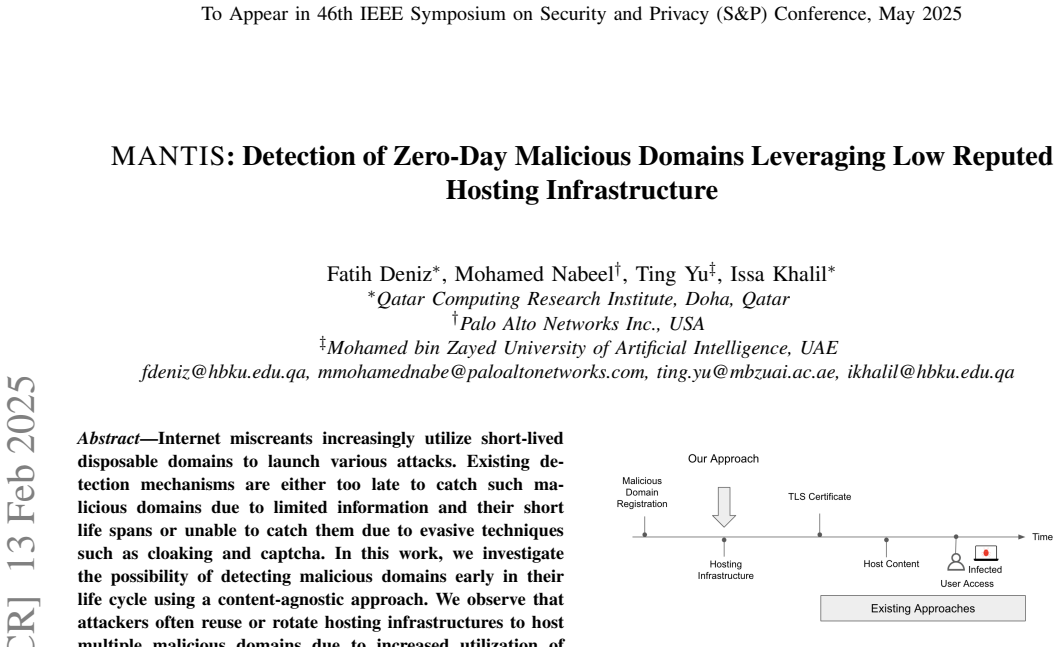
Internet miscreants increasingly utilize short-lived disposable domains to launch various attacks. Existing detection mechanisms are either too late to catch such malicious domains due to limited information and their short life spans or unable to catch them due to evasive techniques such as cloaking and captcha. In this work, we investigate the possibility of detecting malicious domains early in their life cycle using a content-agnostic approach. We observe that attackers often reuse or rotate hosting infrastructures to host multiple malicious domains due to increased utilization of automation and economies of scale. Thus, it gives defenders the opportunity to monitor such infrastructure to identify newly hosted malicious domains. However, such infrastructures are often shared hosting environments where benign domains are also hosted, which could result in a prohibitive number of false positives. Therefore, one needs innovative mechanisms to better distinguish malicious domains from benign ones even when they share hosting infrastructures. In this work, we build MANTIS, a highly accurate practical system that not only generates daily blocklists of malicious domains but also is able to predict malicious domains on-demand. We design a network graph based on the hosting infrastructure that is accurate and generalizable over time. Consistently, our models achieve a precision of 99.7%, a recall of 86.9% with a very low false positive rate (FPR) of 0.1% and on average detects 19K new malicious domains per day, which is over 5 times the new malicious domains flagged daily in VirusTotal. Further, MANTIS predicts malicious domains days to weeks before they appear in popular blocklists.
Figures


Figures from the paper (13 more)


Reference graph
Works this paper leans on
-
[1]
Janos, F
S. Janos, F. Shehroze, and M. Nabeel. (2023) Toward Ending the Domain Wars: Early Detection of Malicious Stockpiled Domains. https://tinyurl.com/5xnh5d39. Accessed: 28-04-2024
2023
-
[2]
(2023) Cost of a Data Breach Report 2023
IBM. (2023) Cost of a Data Breach Report 2023. https://www.ibm. com/reports/data-breach/. Accessed: 16-01-2024
2023
-
[3]
Premadoma: An operational solution for dns registries to prevent malicious domain registrations,
J. Spooren, T. Vissers, P. Janssen, W. Joosen, and L. Desmet, “Premadoma: An operational solution for dns registries to prevent malicious domain registrations,” in ACSAC, 2019
2019
-
[4]
Detection of algorithmically generated domain names used by bot- nets: a dual arms race,
J. Spooren, D. Preuveneers, L. Desmet, P. Janssen, and W. Joosen, “Detection of algorithmically generated domain names used by bot- nets: a dual arms race,” in ACM/SIGAPP SAC, 2019
2019
-
[5]
Assessing the effec- tiveness of domain blacklisting against malicious dns registrations,
T. Vissers, P. Janssen, W. Joosen, and L. Desmet, “Assessing the effec- tiveness of domain blacklisting against malicious dns registrations,” in IEEE Security and Privacy Workshops (SPW) , 2019
2019
-
[6]
Real- time content-based cyber threat detection with machine learning,
E. Kocyigit, M. Korkmaz, O. K. Sahingoz, and B. Diri, “Real- time content-based cyber threat detection with machine learning,” in Intelligent Systems Design and Applications . Springer, 2021
2021
-
[7]
High- performance content-based phishing attack detection,
B. Wardman, T. Stallings, G. Warner, and A. Skjellum, “High- performance content-based phishing attack detection,” in2011 eCrime Researchers Summit. IEEE, 2011, pp. 1–9
2011
-
[8]
Phishskape: A content based approach to escape phishing attacks,
A. K. Jain, S. Parashar, P. Katare, and I. Sharma, “Phishskape: A content based approach to escape phishing attacks,” Procedia Computer Science, vol. 171, pp. 1102–1109, 2020
2020
Show all 98 references
-
[9]
Crawlphish: Large-scale analysis of client-side cloaking techniques in phishing,
P. Zhang, A. Oest, H. Cho, Z. Sun, R. Johnson, B. Wardman et al., “Crawlphish: Large-scale analysis of client-side cloaking techniques in phishing,” in IEEE Symposium on Security and Privacy (SP), 2021
2021
-
[10]
Finding the linch- pins of the dark web: A study on topologically dedicated hosts on malicious web infrastructures
Z. Li, S. Alrwais, Y . Xie, F. Yu, and X. Wang, “Finding the linch- pins of the dark web: A study on topologically dedicated hosts on malicious web infrastructures.” IEEE Computer Society, 2013
2013
-
[11]
(2024) Phishing Campaigns Targeting USPS See as Much Web Traffic as the USPS Itself
Stijn, Tilborghs and Connor, Faulkner. (2024) Phishing Campaigns Targeting USPS See as Much Web Traffic as the USPS Itself. https: //tinyurl.com/4a7a7mhz. Accessed: 28-04-2024
2024
-
[12]
Shehroze, T
F. Shehroze, T. Howard, S. Alex, M. Nabeel, R. Lu, and Z. Chen. (2024) ApateWeb: An Evasive Large-Scale Scareware and PUP Deliv- ery Campaign. https://tinyurl.com/ycxtwyrc. Accessed: 28-04-2024
2024
-
[13]
Building a Dynamic Reputation System for DNS,
M. Antonakakis, R. Perdisci, D. Dagon, W. Lee, and N. Feamster, “Building a Dynamic Reputation System for DNS,” in Proceedings of the 19th USENIX Conference on Security , 2010, pp. 273–290
2010
-
[14]
Expo- sure: A passive dns analysis service to detect and report malicious domains,
L. Bilge, S. Sen, D. Balzarotti, E. Kirda, and C. Kruegel, “Expo- sure: A passive dns analysis service to detect and report malicious domains,” ACM Transactions on Information Systems Security , 2014
2014
-
[15]
A lexical approach for classifying malicious urls,
M. Darling, H. Greg, G. Gressel, A. Ashok, and P. Poornachandran, “A lexical approach for classifying malicious urls,” in HPCS, 2015
2015
-
[16]
Domain classifier: Compromised machines versus malicious regis- trations,
S. L. Page, G. Jourdan, G. von Bochmann, I. Onut, and J. Flood, “Domain classifier: Compromised machines versus malicious regis- trations,” in 19th International Conference Web Engineering , 2019
2019
-
[17]
{FANCI}: Feature-based automated {NXDomain} classification and intelli- gence,
S. Sch ¨uppen, D. Teubert, P. Herrmann, and U. Meyer, “ {FANCI}: Feature-based automated {NXDomain} classification and intelli- gence,” in 27th USENIX Security Symposium , 2018, pp. 1165–1181
2018
-
[18]
Polonium: Tera-scale graph mining and inference for malware detection,
D. H. Chau, C. Nachenberg, J. Wilhelm, A. Wright, and C. Falout- sos, “Polonium: Tera-scale graph mining and inference for malware detection,” in SIAM International Conference on Data Mining , 2011
2011
-
[19]
Nazca: Detecting malware distribution in large-scale networks
L. Invernizzi, S. Miskovic, R. Torres, C. Kruegel, S. Saha, G. Vigna, S.-J. Lee, and M. Mellia, “Nazca: Detecting malware distribution in large-scale networks.” in NDSS, vol. 14, 2014, pp. 23–26
2014
-
[20]
Following passive dns traces to detect stealthy malicious domains via graph inference,
M. Nabeel, I. M. Khalil, B. Guan, and T. Yu, “Following passive dns traces to detect stealthy malicious domains via graph inference,” ACM Trans. Priv. Secur., vol. 23, no. 4, 2020
2020
-
[21]
Marmite: spreading malicious file reputation through download graphs,
G. Stringhini, Y . Shen, Y . Han, and X. Zhang, “Marmite: spreading malicious file reputation through download graphs,” in ACSAC, 2017
2017
-
[22]
Node2vec: Scalable feature learning for networks,
A. Grover and J. Leskovec, “Node2vec: Scalable feature learning for networks,” in ACM SIGKDD, ser. KDD ’16, 2016
2016
-
[23]
Practical attacks against dns reputation systems,
T. Galloway, K. Karakolios, Z. Ma, R. Perdisci, A. Keromytis, and M. Antonakakis, “Practical attacks against dns reputation systems,” in IEEE Symposium on Security and Privacy (SP) , 2024
2024
-
[24]
Phishing url detection: A network-based approach robust to evasion,
T. Kim, N. Park, J. Hong, and S.-W. Kim, “Phishing url detection: A network-based approach robust to evasion,” in ACM CCS, 2022
2022
-
[25]
Ringer: Systematic mining of malicious domains by dynamic graph convolutional net- work,
Z. Liu, S. Li, Y . Zhang, X. Yun, and C. Peng, “Ringer: Systematic mining of malicious domains by dynamic graph convolutional net- work,” in ICCS. Springer International Publishing, 2020
2020
-
[26]
Hgdom: Heterogeneous graph convolutional networks for malicious domain detection,
X. Sun, J. Yang, Z. Wang, and H. Liu, “Hgdom: Heterogeneous graph convolutional networks for malicious domain detection,” in IEEE/IFIP NOMS, 2020
2020
-
[27]
Compromised or Attacker-Owned: A large scale classifi- cation and study of hosting domains of malicious URLs,
R. D. Silva, M. Nabeel, C. Elvitigala, I. Khalil, T. Yu, and C. Keppi- tiyagama, “Compromised or Attacker-Owned: A large scale classifi- cation and study of hosting domains of malicious URLs,” in USENIX Security Symposium, 2021, pp. 3721–3738
2021
-
[28]
Classifying phishing urls using recurrent neural networks,
A. C. Bahnsen, E. C. Bohorquez, S. Villegas, J. Vargas, and F. A. Gon- zalez, “Classifying phishing urls using recurrent neural networks,” in eCrime, 2017, pp. 1–8
2017
-
[29]
Inductive representation learning on large graphs,
W. Hamilton, Z. Ying, and J. Leskovec, “Inductive representation learning on large graphs,” in NIPS, 2017
2017
-
[30]
Heterogeneous graph trans- former,
Z. Hu, Y . Dong, K. Wang, and Y . Sun, “Heterogeneous graph trans- former,” in WWW, 2020
2020
-
[31]
Semi-Supervised Classification with Graph Convolutional Networks,
T. Kipf and M. Welling, “Semi-Supervised Classification with Graph Convolutional Networks,” in ICLR, 2017
2017
-
[32]
Modeling relational data with graph convolutional networks,
M. Schlichtkrull, T. Kipf, P. Bloem, R. van den Berg, I. Titov, and M. Welling, “Modeling relational data with graph convolutional networks,” in The Semantic Web, 2018, pp. 593–607
2018
-
[33]
Graph attention networks,
P. Veli ˇckovi´c, G. Cucurull, A. Casanova, A. Romero, P. Li `o, and Y . Bengio, “Graph attention networks,” in ICLR, 2018
2018
-
[34]
(2022) DNS Database
Farsight Security, Inc. (2022) DNS Database. https://www.dnsdb.info/. Accessed: 28-09-2023
2022
-
[35]
Online Virus, Malware and URL Scanner,
VirusTotal, “Online Virus, Malware and URL Scanner,” https://www. virustotal.com/, 2023, Accessed: 04-03-2023
2023
-
[36]
Google Safe Browsing,
Google, “Google Safe Browsing,” https://developers.google.com/ safe-browsing/, 2016, accessed: 10-08-2023
2016
-
[37]
PhishTank,
OpenDNS, “PhishTank,” https://www.phishtank.com/, 2023, ac- cessed: 16-02-23
2023
-
[38]
Content-agnostic detection of phishing domains using certificate transparency and passive dns,
M. AlSabah, M. Nabeel, Y . Boshmaf, and E. Choo, “Content-agnostic detection of phishing domains using certificate transparency and passive dns,” in RAID, 2022
2022
-
[39]
Alexa Top Sites,
Alexa, “Alexa Top Sites,” http://aws.amazon.com/alexa-top-sites/, 2022, Accessed: 30-03-2022
2022
-
[40]
Cisco Umbrella,
Cisco, “Cisco Umbrella,” https://umbrella.cisco.com/, 2022, Ac- cessed: 30-09-2022
2022
-
[41]
Tranco: A research-oriented top sites ranking hard- ened against manipulation,
V . L. Pochat, T. Van Goethem, S. Tajalizadehkhoob, M. Korczy ´nski, and W. Joosen, “Tranco: A research-oriented top sites ranking hard- ened against manipulation,” arXiv preprint arXiv:1806.01156 , 2018
2018 arXiv
-
[42]
The Chrome User Experience Report,
Google, “The Chrome User Experience Report,” https://developer. chrome.com/docs/crux/, 2022, Accessed: 28-12-2023
2022
-
[43]
Majestic Million,
Majestic, “Majestic Million,” https://majestic.com/reports/ majestic-million/, 2023, Accessed: 05-02-2023
2023
-
[44]
Top- pling top lists: Evaluating the accuracy of popular website lists,
K. Ruth, D. Kumar, B. Wang, L. Valenta, and Z. Durumeric, “Top- pling top lists: Evaluating the accuracy of popular website lists,” in ACM IMC, 2022
2022
-
[45]
Getting under alexa’s umbrella: Infiltration attacks against internet top domain lists,
W. Rweyemamu, T. Lauinger, C. Wilson, W. Robertson, and E. Kirda, “Getting under alexa’s umbrella: Infiltration attacks against internet top domain lists,” in Information Security (ISC) , 2019
2019
-
[46]
Handling missing data with graph representation learning,
J. You, X. Ma, Y . Ding, M. Kochenderfer, and J. Leskovec, “Handling missing data with graph representation learning,” in NeurIPS, 2020. To Appear in 46th IEEE Symposium on Security and Privacy (S&P) Conference, May 2025
2020
-
[47]
(2023) Public suffix list
Mozilla Foundation. (2023) Public suffix list. https://publicsuffix.org/. Accessed: 15-08-2023
2023
-
[48]
We know it before you do: predicting malicious domains,
W. Xu, K. Sanders, and Y . Zhang, “We know it before you do: predicting malicious domains,” in Virus Bulletin Conference, 2014
2014
-
[49]
The Real Yellow Pages,
Thryv, LLC, “The Real Yellow Pages,” https://www.yellowpages. com/, 2023, Accessed: 04-08-2023
2023
-
[50]
Segugio: Efficient Behavior-Based Tracking of Malware-Control Domains in Large ISP Networks,
B. Rahbarinia, R. Perdisci, and M. Antonakakis, “Segugio: Efficient Behavior-Based Tracking of Malware-Control Domains in Large ISP Networks,” in Dependable Systems and Networks (DSN) , 2015
2015
-
[51]
Exposure: Finding malicious domains using passive dns analysis,
L. Bilge, E. Kirda, C. Kruegel, and M. Balduzzi, “Exposure: Finding malicious domains using passive dns analysis,” in NDSS, 2011
2011
-
[52]
(2024) SinkDB
AbuseCH. (2024) SinkDB. https://sinkdb.abuse.ch/. Accessed: 20-01- 2024
2024
-
[53]
(2024) MISP Threat Sharing
MISP Project. (2024) MISP Threat Sharing. https://github.com/MISP/ misp-warninglists/tree/main/lists/sinkholes/. Accessed: 20-01-2024
2024
-
[54]
Modeling relational data with graph convolutional networks,
M. Schlichtkrull, T. N. Kipf, P. Bloem, R. Van Den Berg, I. Titov, and M. Welling, “Modeling relational data with graph convolutional networks,” in The Semantic Web. Springer, 2018
2018
-
[55]
Semi-supervised random forests,
C. Leistner, A. Saffari, J. Santner, and H. Bischof, “Semi-supervised random forests,” in ICCV, 2009
2009
-
[56]
Xgboost: A scalable tree boosting system,
T. Chen and C. Guestrin, “Xgboost: A scalable tree boosting system,” in ACM SIGKDD, 2016, pp. 785–794
2016
-
[57]
Lightgbm: A highly efficient gradient boosting decision tree,
G. Ke, Q. Meng, T. Finley, T. Wang, W. Chen, W. Ma, Q. Ye, and T.-Y . Liu, “Lightgbm: A highly efficient gradient boosting decision tree,” NeurIPS, vol. 30, 2017
2017
-
[58]
Lakemeyer and B
G. Lakemeyer and B. Nebel, Exploring artificial intelligence in the new millennium. Morgan Kaufmann, 2003
2003
-
[59]
Handom: Heterogeneous attention network model for malicious domain detection,
Q. Wang, C. Dong, S. Jian, D. Du, Z. Lu, Y . Qi, D. Han, X. Ma, F. Wang, and Y . Liu, “Handom: Heterogeneous attention network model for malicious domain detection,” Computers & Security, 2023
2023
-
[60]
Blocklist-Forecast: Proactive Domain Blocklisting by Identifying Malicious Hosting In- frastructure,
U. Kumarasinghe, M. Nabeel, and C. Elvitigala, “Blocklist-Forecast: Proactive Domain Blocklisting by Identifying Malicious Hosting In- frastructure,” in RAID, October 2024
2024
-
[61]
Multi- instance adversarial attack on gnn-based malicious domain detection,
M. Nazzal, I. Khalil, A. Khreishah, N. Phan, and Y . Ma, “Multi- instance adversarial attack on gnn-based malicious domain detection,” in IEEE Symposium on Security and Privacy (SP) , 2024
2024
-
[62]
Everybody’s got ml, tell me what else you have: Practitioners’ perception of ml-based security tools and explanations,
J. Mink, H. Benkraouda, L. Yang, A. Ciptadi, A. Ahmadzadeh, D. V otipka, and G. Wang, “Everybody’s got ml, tell me what else you have: Practitioners’ perception of ml-based security tools and explanations,” in IEEE Symposium on Security and Privacy , 2023
2023
-
[63]
Gnnex- plainer: Generating explanations for graph neural networks,
R. Ying, D. Bourgeois, J. You, M. Zitnik, and J. Leskovec, “Gnnex- plainer: Generating explanations for graph neural networks,”NeurIPS, vol. 32, 2019
2019
-
[64]
Captum: A unified and generic model interpretability library for pytorch,
N. Kokhlikyan, V . Miglani, M. Martin, E. Wang et al., “Captum: A unified and generic model interpretability library for pytorch,” arXiv preprint arXiv:2009.07896, 2020
2009 arXiv
-
[65]
Exploring the ecosystem of malicious domain registrations in the. eu tld,
T. Vissers, J. Spooren, P. Agten, D. Jumpertz, P. Janssen, M. Van, F. Piessens, W. Joosen, and L. Desmet, “Exploring the ecosystem of malicious domain registrations in the. eu tld,” in RAID, 2017
2017
-
[66]
Understanding the domain registration behavior of spammers,
S. Hao, M. Thomas, V . Paxson, N. Feamster, C. Kreibich, C. Grier, and S. Hollenbeck, “Understanding the domain registration behavior of spammers,” in ACM IMC, 2013
2013
-
[67]
Sunrise to sunset: Analyzing the end-to-end life cycle and effectiveness of phishing attacks at scale,
A. Oest, P. Zhang, B. Wardman, E. Nunes, J. Burgis, A. Zand, K. Thomas, A. Doup ´e, and G.-J. Ahn, “Sunrise to sunset: Analyzing the end-to-end life cycle and effectiveness of phishing attacks at scale,” in USENIX Security Symposium , 2020
2020
-
[68]
Phishnet: Pre- dictive blacklisting to detect phishing attacks,
P. Prakash, M. Kumar, R. Kompella, and M. Gupta, “Phishnet: Pre- dictive blacklisting to detect phishing attacks,” in INFOCOM, 2010
2010
-
[69]
On the potential of proactive domain blacklisting,
M. Felegyhazi, C. Kreibich, and V . Paxson, “On the potential of proactive domain blacklisting,” in Large-Scale Exploits and Emergent Threats: Botnets, Spyware, Worms, and More , ser. LEET’10, 2010
2010
-
[70]
Evilseed: A guided approach to finding malicious web pages,
L. Invernizzi, P. M. Comparetti, S. Benvenuti, C. Kruegel, M. Cova, and G. Vigna, “Evilseed: A guided approach to finding malicious web pages,” in IEEE Symposium on Security and Privacy , 2012
2012
-
[71]
PREDATOR: Proactive Recognition and Elimination of Domain Abuse at Time-Of-Registration,
S. Hao, A. Kantchelian, B. Miller, V . Paxson, and N. Feamster, “PREDATOR: Proactive Recognition and Elimination of Domain Abuse at Time-Of-Registration,” in ACM SIGSAC CCS , 2016
2016
-
[72]
Beyond blacklists: Learning to detect malicious web sites from suspicious urls,
J. Ma, L. K. Saul, S. Savage, and G. M. V oelker, “Beyond blacklists: Learning to detect malicious web sites from suspicious urls,” in ACM SIGKDD, ser. KDD ’09, 2009
2009
-
[73]
Detecting Malicious Activity with DNS Backscatter,
K. Fukuda and J. Heidemann, “Detecting Malicious Activity with DNS Backscatter,” in ACM IMC, 2015, pp. 197–210
2015
-
[74]
DeepDGA: Adversarially-Tuned Domain Generation and Detection,
H. S. Anderson, J. Woodbridge, and B. Filar, “DeepDGA: Adversarially-Tuned Domain Generation and Detection,” in ACM Workshop on Artificial Intelligence and Security , 2016
2016
-
[75]
A Method for Detecting DGA Botnet Based on Semantic and Cluster Analysis,
V . Tong and G. Nguyen, “A Method for Detecting DGA Botnet Based on Semantic and Cluster Analysis,” in SOICT, 2016
2016
-
[76]
Who is .com?: Learning to parse whois records,
S. Liu, I. Foster, S. Savage, G. M. V oelker, and L. K. Saul, “Who is .com?: Learning to parse whois records,” in ACM IMC, 2015
2015
-
[77]
Towards Systematic Evaluation of the Evadability of Bot/Botnet Detection Methods,
E. Stinson and J. C. Mitchell, “Towards Systematic Evaluation of the Evadability of Bot/Botnet Detection Methods,” in USENIX Workshop on Offensive Technologies, 2008
2008
-
[78]
Who controls the internet? analyzing global threats using property graph traversals,
M. Simeonovski, G. Pellegrino, C. Rossow, and M. Backes, “Who controls the internet? analyzing global threats using property graph traversals,” in WWW, 2017
2017
-
[79]
Malrank: A measure of maliciousness in siem-based knowledge graphs,
P. Najafi, A. M ¨uhle, W. P ¨unter, F. Cheng, and C. Meinel, “Malrank: A measure of maliciousness in siem-based knowledge graphs,” in ACSAC, 2019
2019
-
[80]
Hindom: A robust malicious domain detection system based on heterogeneous information network with transductive classification,
X. Sun, M. Tong, J. Yang, L. Xinran, and L. Heng, “Hindom: A robust malicious domain detection system based on heterogeneous information network with transductive classification,” in RAID, 2019
2019
-
[81]
Deepdom: Malicious do- main detection with scalable and heterogeneous graph convolutional networks,
X. Sun, Z. Wang, J. Yang, and X. Liu, “Deepdom: Malicious do- main detection with scalable and heterogeneous graph convolutional networks,” Computers and Security , 2020
2020
-
[82]
Attributed heterogeneous graph neural network for malicious domain detection,
S. Zhang, Z. Zhou, D. Li, Y . Zhong, Q. Liu, W. Yang, and S. Li, “Attributed heterogeneous graph neural network for malicious domain detection,” in CSCWD, 2021
2021
-
[83]
The Spamhaus Project,
Spamhaus, “The Spamhaus Project,” https://www.spamhaus.org/, 2022, accessed: 25-08-2022
2022
-
[84]
Computer Incident Response Center Luxembourg,
CIRCL, “Computer Incident Response Center Luxembourg,” https: //circl.lu/, 2019, Accessed: 27-05-2019
2019
-
[85]
Rapid7: Endpoint to Cloud, Command Your Attack Sur- face,
Rapid7, “Rapid7: Endpoint to Cloud, Command Your Attack Sur- face,” https://www.rapid7.com/, 2022, Accessed: 29-06-2022
2022
-
[86]
Comar: Classification of compromised versus maliciously registered domains,
S. Maroofi, M. Korczy ´nski, C. Hesselman, B. Ampeau, and A. Duda, “Comar: Classification of compromised versus maliciously registered domains,” in 2020 IEEE EuroS&P , 2020, pp. 607–623
2020
-
[87]
Hiding in plain sight: A longitudinal study of combosquatting abuse,
P. Kintis, M. Najmeh, C. Lever, Y . Chen, R. Romero, N. Pitropakis, N. Nikiforakis, and A. Manos, “Hiding in plain sight: A longitudinal study of combosquatting abuse,” in ACM SIGSAC CCS , 2017
2017
-
[88]
Phishing catcher using certstream,
Phishing Catcher, “Phishing catcher using certstream,” https://github. com/x0rz/phishing catcher, 2015, Accessed: 20-09-2023. Appendix A. Graph Toxicity A key conceptual novelty in our work is the automated construction of a graph around attack domains and the guided graph exp...
2015
-
[89]
Proactive detection: MANTIS can predict malicious domains days to weeks before they appear on popular blocklists, highlighting its proactive nature
-
[90]
The paper also reports the computa- tional performance
Comprehensive evaluation: the paper performs a com- prehensive set of experiments and conducts a baseline comparison with existing ML approaches and SoTA (Tables 4 and 5). The paper also reports the computa- tional performance
-
[91]
High accuracy: the reported precision, recall, low false positive rate, and adversarial robustness support prac- tical applications
-
[92]
Operational system: Mantis has been already opera- tional for over a year, consistently detecting a sig- nificant number of malicious domains daily, which underscores its practicality. E.4. Noteworthy Concerns
-
[93]
The paper acknowledges this and dis- cusses potential solutions that are left for future work
Detection limitations: the focus on attacker-created do- mains might overlook the importance of detecting com- promised domains, which are also significant in real- world scenarios. The paper acknowledges this and dis- cusses potential solutions that are left for future work. ...
-
[94]
Novel attack vectors that differ significantly from the training data may not be detected
The detection performance of the system requires reli- able ground truth data from large scale oracles. Novel attack vectors that differ significantly from the training data may not be detected
-
[95]
Appendix F
The practical potential of the proactive detection possi- ble by the framework is estimated (i.e., detection at the time of hosting setup) but not empirically evaluated. Appendix F. Response to the Meta-Review
-
[96]
One may devise novel graph based approaches to im- prove existing compromised and/or rentable domain detectors
Detection limitation: As we discuss in the Limitations Section, our approach augments the existing compro- mised domain detectors and rentable domain detectors. One may devise novel graph based approaches to im- prove existing compromised and/or rentable domain detectors
-
[97]
Similar to other DL based approaches, if the attack vector is completely novel from the training data, it is likely to have a blind spot
Large oracles: While GT from large oracles greatly improves the performance in terms of precision and recall, GT from small oracles such as PhishTank can still detect malicious domains with over 90% precision and recall. Similar to other DL based approaches, if the attack vect...
-
[98]
In order to fur- ther improve the proactiveness, one may execute our pipeline at intervals shorter than 1 day, for example, every 6 hours
Proactive detection: In Section 6.3, we show our ap- proach is several days more proactive compared to VirusTotal, which is the most popular and the largest domain maliciousness lookup service. In order to fur- ther improve the proactiveness, one may execute our pipeline at in...
Reviewed August 7, 2026 · model on record in the stance chip above.
Discussion (0). Continue with ORCID to comment.