REVIEW 4 major objections 4 minor 68 references
On the multifractal dimensions and statistical properties of critical ensembles characterized by the three classical Wigner-Dyson symmetry classes
T0 review · 4 major / 4 minor · reviewed 2026-08-14 · deepseek-v4-flash
Pith's one-line read The paper introduces a symplectic power-law banded random matrix model and shows that the heuristic multifractal and spectral-statistics relations previously checked for the orthogonal and unitary Wigner-Dyson classes also describe this…
desk verdict Workmanlike completion of the PBRM program: the new β=4 symplectic ensemble is numerically characterized, but the abstract overstates the agreement in the intermediate-b regime. read the letter →
The pith
A machine-rendered reading of the paper's core claim, the machinery that carries it, and where it could break.
The reading
What carries the argument
The central object is the periodic power-law banded random matrix (PBRM) ensemble of Eq. (1): random matrices with independent Gaussian entries whose variance decays as a power law in the chord distance on a ring, with exponent $2\mu$ and effective bandwidth $b$. For $\beta = 4$ the Hamiltonian is written in quaternion units, making it Hermitian self-dual and preserving the two-fold degeneracy of every eigenvalue required by time-reversal symmetry. The load-bearing identities are the heuristic relations: $D_q \approx [1 + (\alpha_q b)^{-1}]^{-1}$, $\chi \approx (1-D_q)/(1+(q-1)D_q)$, and the two-branch relation between $D_q$ and $D_1$ given by Eqs. (9) and (10). These relations connect the spatial multifractality of eigenstates to spectral statistics, and the paper's numerical work tests them against the new $\beta = 4$ ensemble.
What would settle it
Run the $\beta = 4$ PBRM model at $b = 1$ with system sizes beyond $N = 2^{13}$ and check whether $D_q$ converges to the value predicted by Eq. (6); if the deviation seen in the paper's intermediate range $0.04 < b < 2$ persists or grows, the heuristic relation fails for the symplectic class.
Extended reading notes
Core claim
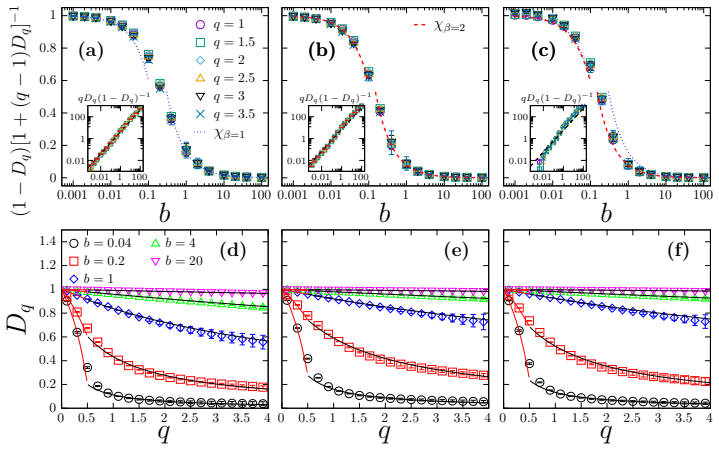
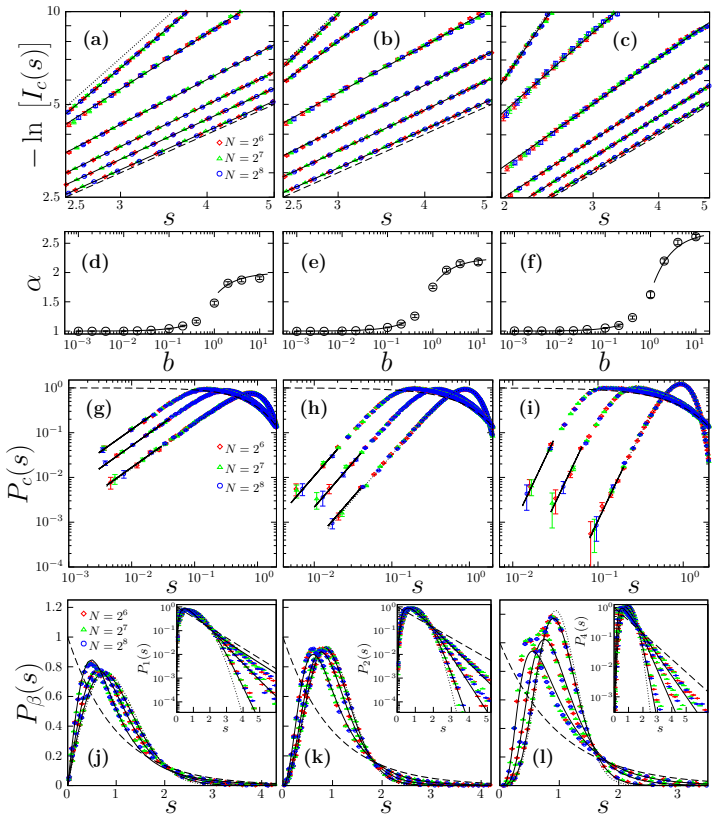
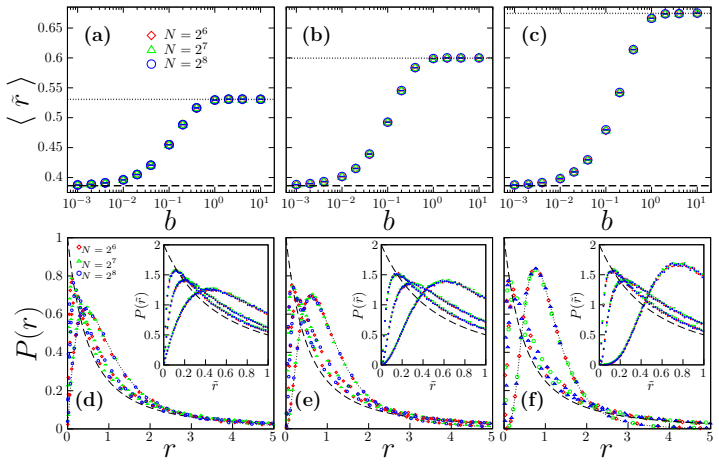
The paper's central claim is that the power-law banded random matrix ensemble, extended to the symplectic class by taking $2N \times 2N$ Hermitian self-dual quaternion-real matrices with the power-law decaying variance of Eq. (1), has its metal-insulator transition at $\mu = 1$, and that at this critical point its eigenstate and eigenenergy statistics follow the same heuristic relations as the $\beta = 1$ and $\beta = 2$ cases. Numerically, the multifractal dimensions extracted from the scaling of inverse participation numbers agree with $D_q \approx [1 + (\alpha_q b)^{-1}]^{-1}$ in the limits $b \ll 1$ and $b \gg 1$, and the relations connecting $D_q$ to the information dimension $D_1$ and to the level compressibility $\chi$ hold across the studied range of $q$. The level spacing distribution shows the expected Poisson-to-Wigner-Dyson crossover in $b$, and in the small-$s$ regime it is consistent with the analytical critical estimates of Refs. [58,59]. The paper notes a genuine limitation: for the symplectic case, $D_q$ grows faster than Eq. (6) predicts in the intermediate bandwidth range $0.04 < b < 2$.
Load-bearing premise
The load-bearing premise is that the new quaternion-based random matrix ensemble belongs to the same universality class as the two-dimensional symplectic metal-insulator transition, since the paper locates its own critical point by finite-size scaling rather than by matching a lattice spin-orbit model.
Editorial extensions
If this is right
- The $\beta = 4$ PBRM ensemble gives the third Wigner-Dyson class a numerically tractable critical random-matrix model, so spin-orbit disordered systems can be studied with the same tools as orthogonal and unitary ones.
- The validity of Eqs. (8)-(10) across all three symmetry classes indicates that the connection between eigenstate multifractality and spectral compressibility at criticality does not depend on the Dyson symmetry index.
- The deviations from Eq. (6) at $0.04 < b < 2$ mark a concrete parameter window where the symplectic class needs a modified heuristic, not just a re-fit of $\alpha_q$.
- The finite-size scaling result that $\mu = 1$ is critical for $\beta = 4$ means the localization-delocalization transition occurs at the same power-law exponent as in the orthogonal and unitary PBRM models.
- The large-$b$ level spacing exponent for $\beta = 4$ fits $\alpha = 2.7 - a_4/b$ with $a_4 = 1.05$, extending the stretched-exponential form of the critical spacing distribution to the symplectic class.
Reading between the lines
- If the $\beta = 4$ PBRM model lies in the universality class of the two-dimensional symplectic metal-insulator transition, then the same heuristic relations should appear in tight-binding models with spin-orbit coupling; testing that directly would either confirm the transfer or expose a non-universal feature of the PBRM construction.
- The intermediate-$b$ deviation could be a sign that the symplectic class has a wider crossover region rather than a failure of the one-parameter heuristic; a finite-size study of $D_q$ at fixed $b$ would show whether the deviation shrinks with system size.
- The fitted exponent $\alpha = 2.7 - a_4/b$ for large $b$ is presented as a fitting parameter; if it can be connected to the correlation-length exponent of the symplectic transition, it would turn an empirical curve into a scaling prediction.
Signed reviews
Editorial analysis
A structured set of objections, weighed in public.
Referee Report
Summary. The paper introduces a power-law banded random matrix (PBRM) model for the symplectic symmetry class (β=4), corresponding to time-reversal-symmetric systems with strong spin-orbit coupling. The authors study the multifractal dimensions of eigenvectors and the spectral statistics of this model at the putative critical point µ=1, and they compare the results with heuristic relations previously proposed for β=1 and β=2. In particular, they test the relation D_q ≈ [1+(α_q b)^{-1}]^{-1}, the relation between level compressibility and multifractal dimensions, the generalized dimension relations for q<1/2 and q>1/2, and the Nishigaki expressions for the level-spacing distribution. They also present a multifractal analysis and finite-size scaling (MFA-FSS) study in Appendix A to support the claim that the critical point of the β=4 model is µ=1. The paper concludes that the existing heuristic relations also describe the β=4 model 'for some ranges of the model parameters,' a statement that is more cautious than the abstract's unqualified 'good agreement.'
Significance. If the claims are established, the paper provides a numerically accessible random-matrix model for the symplectic Anderson transition and completes the PBRM picture for the three Wigner-Dyson symmetry classes. The main strengths are the introduction of the β=4 PBRM model, the MFA-FSS evidence in Appendix A that µ=1 is critical for β=4, and the systematic review of spectral statistics including ratio distributions and Nishigaki comparisons. The paper also reproduces earlier β=1,2 results, which is useful for completeness. However, the central verification of the heuristic relations is based on fitting free parameters, and the abstract overstates the agreement relative to the deviations reported in the text. These issues make the current version suitable for major revision rather than acceptance.
major comments (4)
- [Abstract and Sec. 3.2] The abstract claims 'good agreement with heuristic relations for the eigenstate and eigenenergy statistics at criticality' without qualification, but Sec. 3.2 and Fig. 1(f) explicitly state that for β=4 the numerical D_q deviate from Eq. (6) in the intermediate range 0.04 < b < 2, with D_q growing faster than expected; agreement is claimed only for b ≪ 1 and b ≫ 1. This is a load-bearing scope problem because the central claim of the paper is precisely the validity of these relations for β=4. The abstract and conclusion must be aligned: the conclusion's 'for some ranges of the model parameters' is accurate, the abstract is not.
- [Sec. 3.2, Eq. (6), Fig. 1(d)-(f)] The validation of Eq. (6) for β=4 is underdetermined because α_q is a free parameter fitted to the same D_q(b) data that are then used to claim agreement; the reported error bars are reduced rms fit residuals rather than statistical uncertainties, and no fit ranges, raw data, or code are provided. As a result, the 'agreement' is at best a goodness-of-fit statement, not a predictive test of the relation. The authors should report fit ranges, parameter uncertainties, and a quantitative measure of how much of the b-axis is actually described by Eq. (6) within the stated error bars, especially in the intermediate-b regime where the deviations are visible.
- [Sec. 4.3, Fig. 2(c)] The verification of Eq. (8) for β=4 is indirect because Eq. (7) provides analytical expressions for χ only for β=1 and β=2; the text states the dots are compared with 'the level compressibility χ given by the analytical expression of equation (7)', but for β=4 there is no such expression. In Fig. 2(c) the β=4 data are shown together with the β=1 and β=2 curves, which does not constitute a quantitative check of Eq. (8) for β=4. The authors should either compute χ directly from the number variance for β=4 or explicitly weaken the claim that Eq. (8) is verified for the symplectic case.
- [Sec. 4.3, Fig. 3(l)] The Nishigaki comparison for β=4 is limited to s ≪ 1 and uses the fitted parameter a; the agreement is not demonstrated over the full range of s, as the text acknowledges ('the correspondence between both models in the symplectic case is guaranteed only for s ≪ 1'). Since the abstract claims 'good agreement' for 'eigenenergy statistics', this limitation should be stated in the abstract and conclusion as well, not only in the detailed numerical section.
minor comments (4)
- [Sec. 4.3, Eq. (14), Fig. 3(e)-(f)] For β=2 and β=4 the asymptotic large-b behavior of the exponent α is fitted as α=2.25−a2/b and α=2.7−a4/b, respectively, which differs from the β=1 form α=2−a/b in Eq. (14); the text notes this but should present it more prominently as an extension of Eq. (14) rather than a confirmation of it.
- [Sec. 2, Eq. (2)] The definition of the quaternion-real structure uses 'H = H^R' with H^R called the dual of H, but the dual is not explicitly defined; for readers unfamiliar with quaternion matrices, the relation between H^† and H^R and the Kramers degeneracy would benefit from a brief explanation.
- [Sec. 3.2] The sentence 'The reported error bars are the reduced rms error of the fittings between the numerical data and the corresponding analytical expression' conflates the error-bar definition with the goodness-of-fit; a standard statistical uncertainty would be more informative and should be stated explicitly.
- [General] The paper would be strengthened by a data-availability statement and a note on whether the numerical codes are available; as a numerical study, reproducibility is a key part of the contribution.
Circularity Check
Minor circularity: the qD_q(1-D_q)^{-1}=alpha_1 b inset restates Eq. (6) with fitted alpha_q, while the main beta=4 tests of the heuristics are independent; abstract overstates agreement.
-
fitted input called prediction
[Section 3.2, discussion of the insets of Fig. 2 (Eigenstate multifractal dimensions of the PBRM model)]
"In insets of panels (a)-(c) of Figure 2 we show qDq(1−Dq)−1 (dots) as a function of b. The red-dashed lines correspond to α1b. From those figures we can see that qDq(1−Dq)−1≈α1b and therefore it does not dependent on q."
The parameter alpha_1 is not an independent input: it is the fitting constant obtained by fitting the same D_q(b) data to Eq. (6), D_q=[1+(alpha_q b)^{-1}]^{-1}. Rearranging Eq. (6) gives qD_q(1-D_q)^{-1} = q/(alpha_q b). Because the paper separately observes alpha_q≈alpha_1/q, the inset 'result' qD_q(1-D_q)^{-1}≈alpha_1 b is algebraically forced by the fit, not an independent verification. The agreement shown in the insets is therefore a restatement of the fitted Eq. (6) rather than a prediction from the data.
full rationale
The paper's main new content is a beta=4 PBRM model and a test of heuristic multifractal/spectral relations. The D_q values used in the central checks are extracted directly from the scaling of ln<sum|Psi|^2q> vs ln N via Eqs. (4)-(5), not from Eq. (6); the coefficients alpha_q in Eq. (6) are fit constants representing those extracted D_q. The tests of Eqs. (8)-(10) in Fig. 2 use the scaling-extracted D_q and D_1 with no fitted parameters in Eqs. (9)-(10), so those checks are not circular. The spectral-statistics comparisons (Nishigaki expressions, Wigner-Dyson and ratio distributions) fit free parameters such as a and C but explicitly report that these are fitting parameters and note the limited range of validity (e.g., for beta=4 agreement with Nishigaki holds only for s<<1). The one constructional circularity is the inset of Fig. 2: qD_q(1-D_q)^{-1}≈alpha_1 b is a direct rearrangement of Eq. (6) using alpha_q values fitted to the same D_q data, so the apparent collapse is forced by the fit rather than being an independent test. The self-citations [25,26] supply the heuristic relations, but the beta=4 numerics constitute independent evidence for them, so this self-citation is not load-bearing by itself. Separately, the abstract's unqualified 'good agreement' conflicts with the body's explicit admission that for beta=4, Eq. (6) deviates in the range 0.04<b<2 (D_q grows faster than expected); this is a scope/overclaim issue, not circularity, but it tempers the headline. Overall, the central claim is not reduced to a fit or a self-citation chain, so a score of 4 is appropriate.
Assumptions & free parameters
free parameters (4)
- α_q =
varies with q; for β=4 lies between the β=1 and β=2 curves (Fig. 1(i))
- a (Nishigaki parameter) =
β=4: 4.38±0.05 (b=0.2), 2.12±0.02 (b=0.4), 0.747±0.032 (b=1); β=1 and β=2 values also reported
- a_2, a_4 =
a_2=0.48±0.02, a_4=1.05±0.04
- c =
not reported numerically
assumptions (5)
- domain assumption The Wigner-Dyson symmetry classification and the PBRM model definitions for β=1 and β=2 are taken as given (Sec. 2).
- standard math Multifractal scaling ansatz: mean inverse participation numbers scale as N^{-(q-1)D_q} (Eq. 4).
- ad hoc to paper Heuristic relations Eqs. (6), (8)-(10), (13)-(14), and Nishigaki expressions (17)-(19) are imported from prior works.
- domain assumption The PBRM model at µ=1 with β=4 lies at the Anderson critical point and in the symplectic universality class.
- domain assumption Finite-size and ensemble averages (N=2^8..2^13, N×M=2^16) are sufficient for convergence of D_q and spectral statistics.
Cite this review
Pith. "Pith review of On the multifractal dimensions and statistical properties of critical ensembles characterized by the three classical Wigner-Dyson symmetry classes." pith.science (2026). https://pith.science/paper/PM7E5E6N
@misc{pith2026190807950,
  author       = {Pith},
  title        = {Pith review of: On the multifractal dimensions and statistical properties of critical ensembles characterized by the three classical Wigner-Dyson symmetry classes},
  year         = {2026},
  howpublished = {\url{https://pith.science/paper/PM7E5E6N}},
  note         = {Machine review of arXiv:1908.07950}
}
read the original abstract
We introduce a power-law banded random matrix model for the third of the three classical Wigner-Dyson ensembles, i.e., the symplectic ensemble. A detailed analysis of the statistical properties of its eigenvectors and eigenvalues, at criticality, is presented. This ensemble is relevant for time-reversal symmetric systems with strong spin-orbit interaction. For the sake of completeness, we also review the statistical properties of eigenvectors and eigenvalues of the power-law random banded matrix model for the corresponding systems in the presence and absence of time reversal invariance, previously considered in the literature. Our results show a good agreement with heuristic relations for the eigenstate and eigenenergy statistics at criticality, proposed in previous studies. With this, we provide a full picture of the power-law random banded matrix model corresponding to the three classical Wigner-Dyson ensembles.
Figures

Figures from the paper (1 more)
Reference graph
Works this paper leans on
-
[1]
P. W. Anderson, Absence of diffusion in certain random lattices, Phys. Rev. 109 (1958) 1492. doi:10.1103/PhysRev.109.1492
-
[2]
P. A. Lee, T. V. Ramakrishnan, Disordered electronic systems, Rev. Mod. Phys. 57 (1985) 287. doi:10.1103/RevModPhys.57.287
-
[3]
B. Kramer, A. MacKinnon, Localization: theory and experiment, Rep. Prog. Phys. 56 (1993) 1469. doi:10.1088/0034-4885/56/12/ 001
-
[4]
Janssen, Statistics and scaling in disordered mesoscopic electron systems, Phys
M. Janssen, Statistics and scaling in disordered mesoscopic electron systems, Phys. Rep. 295 (1998) 1. doi:10.1016/S0370-1573(97) 00050-1
-
[5]
Janssen, Multifractal analysis of broadly-distributed observables at criticality, Int
M. Janssen, Multifractal analysis of broadly-distributed observables at criticality, Int. J. Mod. Phys. B 8 (1994) 943. doi:10.1142/ S021797929400049X
work page 1994
-
[6]
M. A. Paalanen, R. N. Bhatt, Transport and thermodynamic properties across the metal-insulator transition, Physica B 169 (1991)
work page 1991
-
[7]
P. P. Edwards, C. N. R. Rao, N. F. Mott, Metal-Insulator Transitions Revisited, London: Taylor & Francis, 1995
work page 1995
-
[8]
A. Rodriguez, L. J. Vasquez, K. Slevin, R. A. Römer, Critical parameters from a generalized multifractal analysis at the anderson transition, Phys. Rev. Lett. 105 (2010) 046403. doi:10.1103/PhysRevLett.105.046403
Show all 68 references
-
[9]
Rodriguez, L
A. Rodriguez, L. J. Vasquez, K. Slevin, R. A. Römer, Multifractal finite-size scaling and universality at the anderson transition., Phys. Rev. B 84 (2011) 134209. doi:10.1103/PhysRevB.84.134209
2011 doi
-
[10]
Evers, A
F. Evers, A. D. Mirlin, Anderson transitions, Rev. Mod. Phys. 80 (2008) 1355. doi:10.1103/RevModPhys.80.1355
2008 doi
-
[11]
Huckestein, Scaling theory of the integer quantum Hall effect, Rev
B. Huckestein, Scaling theory of the integer quantum Hall effect, Rev. Mod. Phys. 67 (1995) 357. doi:10.1103/RevModPhys.67.357
1995 doi
-
[12]
Bäcker, M
A. Bäcker, M. Haque, I. M. Khaymovich, Multifractal dimensions for random matrices, chaotic quantum maps, and many-body systems, Phys. Rev. E 100 (2019) 032117. doi:10.1103/PhysRevE.100.032117
2019 doi
-
[13]
E. G. Carnio, N. D. M. Hine, R. A. Römer, Multifractality of ab initio wave functions in doped semiconductors, Physica E 111 (2019)
2019
-
[14]
T. Guhr, A. Müller-Groeling, H. A. Weidenmüller, Random-matrix theories in quantum physics: common concepts, Phys. Rep. 299 (1998) 189. doi:10.1016/S0370-1573(97)00088-4
1998 doi
-
[15]
M. L. Mehta, Random Matrices and the Statistical Theory of Energy Levels, Academic Press, New York, 2004
2004
-
[16]
F. J. Dyson, Statistical theory of the energy levels of complex systems. I, J. Math. Phys. 3 (1962) 140. doi:10.1063/1.1703773
1962 doi
-
[17]
F. J. Dyson, Statistical theory of the energy levels of complex systems. II, J. Math. Phys. 3 (1962) 157. doi:10.1063/1.1703774
1962 doi
-
[18]
Bogomolny, O
E. Bogomolny, O. Giraud, Eigenfunction entropy and spectral compressibility for critical random matrix ensembles, Phys. Rev. Lett. 106 (2011) 044101. doi:10.1103/PhysRevLett.106.044101
2011 doi
-
[19]
Bogomolny, O
E. Bogomolny, O. Giraud, Perturbation approach to multifractal dimensions for certain critical random-matrix ensembles, Phys. Rev. E 84 (2011) 036212. doi:10.1103/PhysRevE.84.036212
2011 doi
-
[20]
Rushkin, A
I. Rushkin, A. Ossipov, Y. V. Fyodorov, Universal and non-universal features of the multifractality exponents of critical wavefunctions, J. Stat. Mech. (2011) L03001doi:10.1088/1742-5468/2011/03/l03001
2011 doi
-
[21]
Bogomolny, O
E. Bogomolny, O. Giraud, Multifractal dimensions for all moments for certain critical random-matrix ensembles in the strong multi- fractality regime, Phys. Rev. E 85 (2012) 046208. doi:10.1103/PhysRevE.85.046208
2012 doi
-
[22]
A. D. Mirlin, Y. V. Fyodorov, F. M. Dittes, J. Quezada, T. H. Seligman, Transition from localized to extended eigenstates in the ensemble of power-law random banded matrices, Phys. Rev. E 54 (1996) 3221. doi:10.1103/PhysRevE.54.3221
1996 doi
-
[23]
V. E. Kravtsov, Critical spectral statistics as the Luttinger liquid of energy levels at a finite temperature, Ann. Phys. 8 (1999) 621. doi:10.1002/(SICI)1521-3889(199911)8:7/9<621::AID-ANDP621>3.0.CO;2-A
1999 doi
-
[24]
Varga, D
I. Varga, D. Braun, Critical statistics in a power-law random-banded matrix ensemble, Phys. Rev. B 61 (2000) R11859.doi:10.1103/ PhysRevB.61.R11859. 11
2000
-
[25]
J. A. Méndez-Bermúdez, A. Alcazar-López, I. Varga, Multifractal dimensions for critical random matrix ensembles, EPL 98 (2012) 37006. doi:10.1209/0295-5075/98/37006
2012 doi
-
[26]
J. A. Méndez-Bermúdez, A. Alcazar-López, I. Varga, On the generalized dimensions of multifractal eigenstates, J. Stat. Mech. (2014) P11012doi:10.1088/1742-5468/2014/11/p11012
2014 doi
-
[27]
S. N. Evangelou, T. Ziman, The anderson transition in two dimensions in the presence of spin-orbit coupling, J. Phys. C 20 (1987) L235. doi:10.1088/0022-3719/20/13/004
1987 doi
-
[28]
S. N. Evangelou, Anderson transition, scaling, and level statistics in the presence of spin orbit coupling, Phys. Rev. Lett. 75 (1995)
1995
-
[29]
Fastenrath, G
U. Fastenrath, G. Adams, R. Bundschuh, T. Hermes, B. Raab, I. Schlosser, T. Wehner, T. Wichmann, Universality in the 2D localization problem, Physica A 172 (1991) 302. doi:10.1016/0378-4371(91)90384-O
1991 doi
-
[30]
Fastenrath, Localization properties of 2D systems with spin-orbit coupling: new numerical results, Physica A 189 (1992) 27
U. Fastenrath, Localization properties of 2D systems with spin-orbit coupling: new numerical results, Physica A 189 (1992) 27. doi:10.1016/0378-4371(92)90125-A
1992 doi
-
[31]
J. T. Chalker, G. J. Daniell, S. N. Evangelou, I. H. Nahm, Eigenfunction fluctuations and correlations at the mobility edge in a two-dimensional system with spin-orbit scattering, J. Phys.: Condens. Matter 5 (1993) 485. doi:10.1088/0953-8984/5/4/016
1993 doi
-
[32]
Schweitzer, I
L. Schweitzer, I. K. Zharekeshev, Scaling of level statistics and critical exponent of disordered two-dimensional symplectic systems, J. Phys.: Condens. Matter 9 (1997) L441. doi:10.1088/0953-8984/9/33/001
1997 doi
-
[33]
Ohtsuki, Y
T. Ohtsuki, Y. Ono, Critical level statistics in two-dimensional disordered electron systems, J. Phys. Soc. Jap. 64 (1995) 4088. doi: 10.1143/JPSJ.64.4088
1995 doi
-
[34]
Mark ˇos, L
P. Mark ˇos, L. Schweitzer, Critical regime of two-dimensional Ando model: relation between critical conductance and fractal dimension of electronic eigenstates, J. Phys. A: Math. Gen. 39 (2006) 3221. doi:10.1088/0305-4470/39/13/003
2006 doi
-
[35]
A. D. Mirlin, Statistics of energy levels and eigenfunctions in disordered systems, Phys. Rep. 326 (2000) 259. doi:10.1016/ S0370-1573(99)00091-5
2000
-
[36]
V. E. Kravtsov, K. A. Muttalib, New class of random matrix ensembles with multifractal eigenvectors, Phys. Rev. Lett. 79 (1997) 1913. doi:10.1103/PhysRevLett.79.1913
1997 doi
-
[37]
V. E. Kravtsov, A. M. Tsvelik, Energy level dynamics in systems with weakly multifractal eigenstates: equivalence to one-dimensional correlated fermions at low temperatures, Phys. Rev. B 62 (2000) 9888. doi:10.1103/PhysRevB.62.9888
2000 doi
-
[38]
Cuevas, M
E. Cuevas, M. Ortuño, V. Gasparian, A. Pérez-Garrido, Fluctuations of the correlation dimension at metal-insulator transitions, Phys. Rev. Lett. 88 (2001) 016401. doi:10.1103/PhysRevLett.88.016401
2001 doi
-
[39]
Varga, Fluctuation of correlation dimension and inverse participation number at the Anderson transition, Phys
I. Varga, Fluctuation of correlation dimension and inverse participation number at the Anderson transition, Phys. Rev. B 66 (2002) 094201. doi:10.1103/PhysRevB.66.094201
2002 doi
-
[40]
J. A. Méndez-Bermúdez, T. Kottos, Probing the eigenfunction fractality using Wigner delay times, Phys. Rev. B 72 (2005) 064108. doi:10.1103/PhysRevB.72.064108
2005 doi
-
[41]
J. A. Méndez-Bermúdez, T. Kottos, D. Cohen, Parametric invariant random matrix model and the emergence of multifractality, Phys. Rev. E 73 (2006) 036204. doi:10.1103/PhysRevE.73.036204
2006 doi
-
[42]
J. A. Méndez-Bermúdez, I. Varga, Scattering at the Anderson transition: power-law banded random matrix model, Phys. Rev. B 74 (2006) 125114. doi:10.1103/PhysRevB.74.125114
2006 doi
-
[43]
J. A. Méndez-Bermúdez, V. A. Gopar, I. Varga, Conductance distribution at criticality: one-dimensional Anderson model with random long-range hopping, Ann. Phys. (Berlin) 18 (2009) 891. doi:10.1002/andp.200910390
2009 doi
-
[44]
Alcázar-López, J
A. Alcázar-López, J. A. Méndez-Bermúdez, I. Varga, Broken time-reversal symmetry scattering at the Anderson transition, Ann. Phys. (Berlin) 18 (2009) 896. doi:10.1002/andp.200910375
2009 doi
-
[45]
Hashimoto, C
K. Hashimoto, C. Sohrmann, J. Wiebe, T. Inaoka, F. Meier, Y. Hirayama, R. A. Römer, R. Wiesendanger, M. Morgenstern, Quantum Hall transition in real space: from localized to extended states, Phys. Rev. Lett. 101 (2008) 256802. doi:10.1103/PhysRevLett.101. 256802
2008 doi
-
[46]
S. Faez, A. Strybulevych, J. H. Page, A. Lagendijk, B. A. v. Tiggelen, Observation of multifractality in Anderson localization of ultrasound, Phys. Rev. Lett. 103 (2009) 155703. doi:10.1103/PhysRevLett.103.155703
2009 doi
-
[47]
Richardella, P
A. Richardella, P. Roushan, S. Mack, B. Zhou, D. A. Huse, D. D. Awschalom, A. Yazdani, Visualizing critical correlations near the metal-insulator transition in Ga1-xMnxAs, Science 327 (2010) 665. doi:10.1126/science.1183640
2010 doi
-
[48]
J. T. Chalker, V. E. Kravtsov, I. V. Lerner, Spectral rigidity and eigenfunction correlations at the Anderson transition, JETP Lett. 64 (1996) 386. doi:10.1134/1.567208
1996 doi
-
[49]
Klesse, M
R. Klesse, M. Metzler, Spectral compressibility at the metal-insulator transition of the quantum Hall effect, Phys. Rev. Lett. 79 (1997)
1997
-
[50]
V. E. Kravtsov, O. M. Yevtushenko, E. Cuevas, Level compressibility in a critical random matrix ensemble: the second virial coeffi- cient, J. Phys. A: Math. Gen. 39 (2006) 2021. doi:10.1088/0305-4470/39/9/003
2006 doi
-
[51]
V. E. Kravtsov, O. M. Yevtushenko, E. Cuevas, Level compressibility in a critical random matrix ensemble: the second virial coefficient (corrigendum), J. Phys. A: Math. Theor. 44 (2011) 189501. doi:10.1088/1751-8113/44/18/189501
2011 doi
-
[52]
M. V. Berry, M. Tabor, J. M. Ziman, Level clustering in the regular spectrum, Proceedings of the Royal Society of London. A. Mathe- matical and Physical Sciences 356 (1977) 375. doi:10.1098/rspa.1977.0140
1977
-
[53]
Bohigas, M
O. Bohigas, M. J. Giannoni, C. Schmit, Characterization of chaotic quantum spectra and universality of level fluctuation laws, Phys. Rev. Lett. 52 (1984) 1. doi:10.1103/PhysRevLett.52.1
1984 doi
-
[54]
A. G. Aronov, V. E. Kravtsov, I. V. Lerner, Level spacing distribution near the Anderson transition, JETP Lett. 59 (1994) 39. URL http://www.jetpletters.ac.ru/ps/1295/article_19561.shtml
1994
-
[55]
A. G. Aronov, V. E. Kravtsov, I. V. Lerner, Spectral correlations in disordered electronic systems: crossover from metal to insulator regime, Phys. Rev. Lett. 74 (1995) 1174. doi:10.1103/PhysRevLett.74.1174
1995 doi
-
[56]
V. E. Kravtsov, I. V. Lerner, Effective plasma model for the level correlations at the mobility edge, J. Phys. A: Math. Gen. 28 (1995)
1995
-
[57]
Cuevas, Critical level spacing distribution in long-range hopping Hamiltonians, EPL 67 (2004) 84
E. Cuevas, Critical level spacing distribution in long-range hopping Hamiltonians, EPL 67 (2004) 84. doi:10.1209/epl/ i2004-10048-2
2004 doi
-
[58]
S. M. Nishigaki, Level spacing distribution of critical random matrix ensembles, Phys. Rev. E 58 (1998) R6915. doi:10.1103/ PhysRevE.58.R6915
1998
-
[59]
S. M. Nishigaki, Level spacings at the metal-insulator transition in the Anderson Hamiltonians and multifractal random matrix ensembles, Phys. Rev. E 59 (1999) 2853. doi:10.1103/PhysRevE.59.2853
1999 doi
-
[60]
Oganesyan, D
V. Oganesyan, D. A. Huse, Localization of interacting fermions at high temperature, Phys. Rev. B 75 (2007) 155111. doi:10.1103/ PhysRevB.75.155111
2007
-
[61]
Y. Y. Atas, E. Bogomolny, O. Giraud, G. Roux, Distribution of the ratio of consecutive level spacings in random matrix ensembles, Phys. Rev. Lett. 110 (2013) 084101. doi:10.1103/PhysRevLett.110.084101
2013 doi
-
[62]
Y. Y. Atas, E. Bogomolny, O. Giraud, P. Vivo, E. Vivo, Joint probability densities of level spacing ratios in random matrices, J. Phys. A: Math. Theor. 46 (2013) 355204. doi:10.1088/1751-8113/46/35/355204
2013 doi
-
[63]
D. A. Vega-Oliveros, J. A. Méndez-Bermúdez, F. A. Rodrigues, Multifractality in random nerworks with power-law decaying bond strengths, Phys. Rev. E 99 (2019) 042303. doi:10.1103/PhysRevE.99.042303. 12
2019 doi
-
[141]
doi:10.1016/j.physe.2019.02.020
2019 doi
-
[223]
doi:10.1016/0921-4526(91)90233-5
-
[721]
doi:10.1103/PhysRevLett.79.721
-
[2550]
doi:10.1103/PhysRevLett.75.2550
-
[3623]
doi:10.1088/0305-4470/28/13/008
Reviewed August 14, 2026 · model on record in the stance chip above.
Discussion (0). Continue with ORCID to comment.