REVIEW 3 major objections 6 minor 49 references
Crowd Counting with Deep Structured Scale Integration Network
T0 review · 3 major / 6 minor · reviewed 2026-08-14 · deepseek-v4-flash
Pith's one-line read A network that refines multi-scale features through conditional random fields and trains with a dilated multi-scale structural-similarity loss achieves lower crowd-counting errors than previous methods on four benchmarks.
desk verdict Solid crowd-counting architecture with strong internal ablations, but the SOTA numbers are not independently checkable — no code, no error bars, and a small random-split benchmark makes the UCF CC 50 gain fragile. read the letter →
The pith
A machine-rendered reading of the paper's core claim, the machinery that carries it, and where it could break.
The reading
What carries the argument
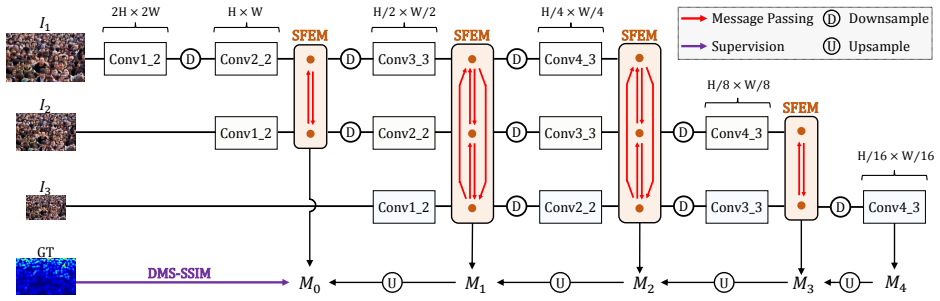
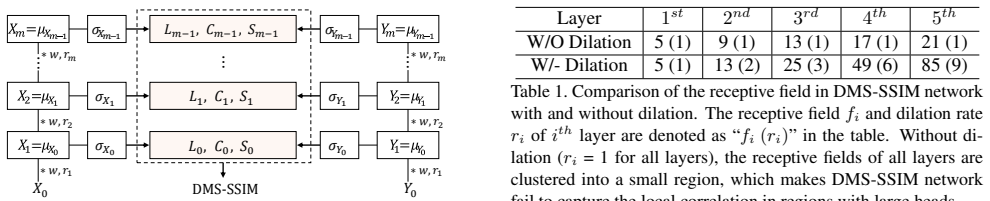
The load-bearing mechanism is the Structured Feature Enhancement Module (SFEM): a continuous conditional random field in which each scale-specific feature is a random variable, the unary potential ties the refined feature to its original form, and pairwise bilinear potentials allow each scale to pass complementary information to every other scale. Mean-field inference reduces to the iterative update $h_i^t = f_i + \sum_{j \neq i} W_{ij} h_j^{t-1}$, implemented with shared $1\times1$ convolutions; the paper uses two iterations. The second mechanism is the DMS-SSIM loss, a five-layer dilated convolutional network with fixed Gaussian kernels and dilation rates 1, 2, 3, 6, 9, so that per-pixel structural similarity, a standard image-quality measure comparing luminance, contrast, and structure, is measured in regions whose receptive fields grow from $5\times5$ to $85\times85$; the loss is $1 - \prod_i \text{SSIM}(X_i,Y_i)^{\alpha_i}$.
What would settle it
Re-implement DSSINet with the published architecture and train on ShanghaiTech Part A twice, once with the DMS-SSIM loss and once with the Euclidean loss while keeping all other settings identical; if the Euclidean-trained model matches or beats the DMS-SSIM model, the claimed role of the structured loss collapses. Similarly, setting the CRF iteration count to 2 versus 3 should reproduce the reported 60.63 versus 63.80 MAE gap; failure to reproduce these two ablations would undermine the central claim.
Extended reading notes
Core claim
The paper's central claim is that a crowd-counting network can be improved on both sides of the pipeline: instead of fusing multi-scale features by concatenation or weighted averaging, the features are mutually refined by a CRF-based Structured Feature Enhancement Module, and instead of a pixel-wise Euclidean loss, training uses a Dilated Multiscale Structural Similarity (DMS-SSIM) loss. With these two components, DSSINet estimates crowd density maps whose integral gives the count, and the reported experiments on ShanghaiTech, UCF-QNRF, UCF CC 50, and WorldExpo'10 show consistent reductions in MAE and MSE over published methods. The ablation study attributes the gain specifically to the two components: removing the feature refinement raises MAE from 60.63 to 68.85 on ShanghaiTech Part A, replacing it with concatenation raises it to 67.11, and replacing the DMS-SSIM loss with a Euclidean loss raises it to 67.68.
Load-bearing premise
The comparisons assume that every method, including DSSINet, was trained and evaluated under identical preprocessing, patch sampling, and hyperparameter conditions, and with no released code this cannot be independently verified.
Editorial extensions
If this is right
- On the four benchmarks reported, DSSINet produces lower MAE and MSE than the published methods it compares against; the headline numbers are 60.63 on ShanghaiTech Part A, 99.1 on UCF-QNRF, 216.9 on UCF CC 50, and an average of 6.67 on WorldExpo'10.
- The CRF-based mutual refinement is doing real work: the ablations show MAE 68.85 without refinement, 67.11 with concatenation-based refinement, and 60.63 with SFEM, all on ShanghaiTech Part A.
- The dilated multi-scale loss is doing real work: with the same network, the Euclidean loss gives 67.68, undilated MS-SSIM-5 gives 63.51, and DMS-SSIM-5 gives 60.63.
- Two CRF iterations are optimal; a third iteration degrades MAE to 63.80, suggesting that the features become over-mixed and lose their own semantic meaning.
- The whole network has 8.85 million parameters, roughly half of the compared CSRNet model, and the paper reports a processing time of 450 ms per 720x576 frame, which it argues is fast enough for practical surveillance use.
Reading between the lines
- A direct extension is to treat the SFEM update as a linear dynamical system: because the iteration is linear, the refined features form a fixed linear combination of the original features, so one could analyze the spectral properties of the weight matrix or make the message passing input-dependent.
- The same two-part recipe, mutual CRF refinement of multi-scale features plus a dilated multi-scale structural-similarity loss, could transfer to other dense prediction tasks with large intra-image scale variation, such as cell counting, vehicle counting, or medical lesion segmentation, where local object sizes are also correlated.
- The ablation pattern, where the dilation schedule matters and too many scales hurt, predicts that the exact dilation schedule, not just the number of scales, is the sensitive ingredient; varying the schedule while holding the number of layers at five should produce measurable changes in MAE.
- Because the paper reports that three CRF iterations degrade performance, a natural next step would be to learn the iteration count per image or to gate the message passing so that features that are already consistent receive less mixing.
Signed reviews
Editorial analysis
A structured set of objections, weighed in public.
Referee Report
Summary. The paper proposes DSSINet, a deep network for crowd counting that combines three shared-parameter VGG16 subnetworks fed with a three-level image pyramid, a CRF-based Structured Feature Enhancement Module (SFEM) that mutually refines multiscale features via learned 1x1 convolutions, and a Dilated Multiscale Structural Similarity (DMS-SSIM) loss that encourages locally consistent density maps. The authors claim state-of-the-art results on four benchmarks: Shanghaitech Part A/B, UCF-QNRF, UCF CC 50, and WorldExpo'10, with relative MAE improvements of 9.5% on Shanghaitech Part A and 24.9% on UCF-QNRF over the best prior methods. Ablation studies in Section 4.4 evaluate the contribution of each component and support the design choices, and a complexity analysis in Table 9 reports parameter efficiency relative to several baselines.
Significance. If the empirical claims are substantiated, the paper makes a useful contribution to crowd counting. The SFEM is a parameter-efficient mechanism for integrating multiscale features, and the DMS-SSIM loss is an interesting adaptation of a classic image-quality metric to a high-level task. The ablations in Tables 6, 7, and 8 consistently show gains from each proposed component, and the parameter count comparison is a clear strength. However, the central claim is an empirical state-of-the-art claim that currently rests on single-run benchmark numbers without error bars, and the model-selection protocol raises concerns about the unbiasedness of the reported Shanghaitech Part A result. The paper is technically sound in its architecture and loss design, but the empirical validation needs to be made statistically and reproducibly rigorous.
major comments (3)
- [Section 4.4, Tables 6-8] The final configuration (CRF-2, three pyramid scales, DMS-SSIM-5) is selected by comparing test-set MAE on Shanghaitech Part A and then reported as the final Part A result in Table 2. Using the test set for model selection makes the reported 9.5% improvement over SANet optimistic and not an unbiased estimate of generalization. The authors should either use a held-out validation split for hyperparameter selection or report both validation and test results, and they should discuss the potential selection bias introduced by this protocol.
- [Tables 2-5] All reported numbers are single runs with no error bars or significance tests. This is especially problematic for UCF CC 50, which contains only 50 images and uses a random five-fold split; the claimed 19.1% MAE improvement over SANet could fall within split-to-split variance. I request the authors to report means and standard deviations over at least several random seeds or splits, and where feasible to include paired tests between DSSINet and the strongest baselines, to establish that the observed differences are not noise.
- [Section 4.1 and WorldExpo'10 experiment] The evaluation protocol is underspecified for reproduction. The paper reports patch size, optimizer, and initial learning rate, but not the number of training epochs, the learning-rate schedule, data augmentation, or the way the WorldExpo'10 Region of Interest is applied when computing MAE. Since no code or pretrained models are released, these details are necessary for an independent check of the comparison with prior baselines. Please provide a complete training and evaluation protocol, or release the code and models.
minor comments (6)
- [Section 3.3, Eq. (11)] The notation sigma^2_{XiYi} is used for a covariance, but the superscript 2 is misleading; use sigma_{XiYi} for the covariance term.
- [Section 3.2, Eq. (3)] The pairwise potential sum is written as sum_{i,j}, which implicitly includes i=j, whereas the inference update in Eq. (6) uses j does not equal i. The summation range should be made explicit and consistent.
- [Table 4] The caption states that the top two performances are highlighted in red and blue, but the table contains no visual highlighting. The text also says thirteen methods are compared, but the table lists nine; please align the text and table.
- [Section 4.4, paragraph on image-pyramid scales] The sentence 'Since the computation was too large when the scale ratio was set to 4 or larger, we did not include more' is vague; please specify the computational cost or runtime for larger scale ratios to justify the omission.
- [Section 3.1, Eq. (1)] The symbol w_i used for the 3x3 fusion convolutional layers collides with the pairwise weights w_i^j introduced in Section 3.2; using distinct notations would reduce confusion.
- [Section 3.3, Eq. (7)] The fixed-point iteration h^t_i = f_i + sum_{j does not equal i} w_i^j h^{t-1}_j is presented as mean-field inference for the CRF, but no convergence or contraction condition is given. With n=2 the update is a truncated expansion; a short derivation or a clarifying statement about this approximation would make the connection to the CRF formulation more precise.
Circularity Check
No circularity: DSSINet's structured feature module and DMS-SSIM loss are derived from external CRF/MS-SSIM machinery, and all headline numbers are external-benchmark evaluations.
full rationale
The paper's derivation chain is self-contained against external machinery rather than reducing to its own inputs. The Structured Feature Enhancement Module is defined by a CRF energy (Eqs. 2-5) and solved by mean-field inference, yielding the message-passing update in Eqs. 6-7; the update is a learned convolutional operation whose parameters are trained, not set to reproduce the evaluation metric. The DMS-SSIM loss is a dilated reimplementation of the standard MS-SSIM loss of Wang et al. [39] with fixed Gaussian kernels and dilation rates; its weights alpha_i are taken from [39], so the loss is not fitted to the reported MAE values. Ground-truth density maps use the standard geometry-adaptive Gaussian construction of Zhang et al. [47], and the estimated count is the integral of the predicted density map, not a quantity inserted into the loss or architecture. The headline results are measured against published numbers on four external benchmarks (Tables 2-5), with no equation in the paper that takes the benchmark MAE as an input and returns it as an output. A mild evaluation caveat is that several hyperparameters (CRF iterations, pyramid scales, DMS-SSIM depth) are selected on Shanghaitech Part A in Section 4.4 and then the same Part A result is reported as headline; this is a benchmark-tuning/reproducibility concern rather than a definitional circularity, because the selected configurations are still trained and evaluated under the standard protocol and the claimed gains on UCF-QNRF, UCF CC 50, and WorldExpo'10 are not used in the selection. Absence of code and error bars affects verifiability, not circularity.
Assumptions & free parameters
free parameters (6)
- Image pyramid scale ratios =
2, 1, 0.5
- CRF iteration count n =
2
- DMS-SSIM dilation rates =
[1, 2, 3, 6, 9]
- DMS-SSIM number of scales m =
5
- DMS-SSIM Gaussian kernel sigma =
1.0
- Geometry-adaptive kernel spread factor =
0.3 (sigma = 0.3 * mean distance to 3 nearest neighbors)
assumptions (4)
- domain assumption Ground-truth density maps are generated with geometry-adaptive Gaussian kernels where sigma is 30% of the mean distance to the three nearest neighbors (Section 4.1).
- domain assumption The DMS-SSIM loss, which averages luminance, contrast, and structure over multiple dilated scales, is an appropriate objective for learning accurate density maps (Section 3.3).
- ad hoc to paper The fixed-point iteration in Eq. (7) with n=2 and shared 1x1 convolutions approximates the continuous CRF solution well enough to improve the features (Section 3.2).
- domain assumption A VGG-16 network pretrained on ImageNet provides a suitable initialization for the three shared-parameter subnetworks (Section 4.1).
Cite this review
Pith. "Pith review of Crowd Counting with Deep Structured Scale Integration Network." pith.science (2026). https://pith.science/paper/PMV5CEYI
@misc{pith2026190808692,
  author       = {Pith},
  title        = {Pith review of: Crowd Counting with Deep Structured Scale Integration Network},
  year         = {2026},
  howpublished = {\url{https://pith.science/paper/PMV5CEYI}},
  note         = {Machine review of arXiv:1908.08692}
}
read the original abstract
Automatic estimation of the number of people in unconstrained crowded scenes is a challenging task and one major difficulty stems from the huge scale variation of people. In this paper, we propose a novel Deep Structured Scale Integration Network (DSSINet) for crowd counting, which addresses the scale variation of people by using structured feature representation learning and hierarchically structured loss function optimization. Unlike conventional methods which directly fuse multiple features with weighted average or concatenation, we first introduce a Structured Feature Enhancement Module based on conditional random fields (CRFs) to refine multiscale features mutually with a message passing mechanism. In this module, each scale-specific feature is considered as a continuous random variable and passes complementary information to refine the features at other scales. Second, we utilize a Dilated Multiscale Structural Similarity loss to enforce our DSSINet to learn the local correlation of people's scales within regions of various size, thus yielding high-quality density maps. Extensive experiments on four challenging benchmarks well demonstrate the effectiveness of our method. Specifically, our DSSINet achieves improvements of 9.5% error reduction on Shanghaitech dataset and 24.9% on UCF-QNRF dataset against the state-of-the-art methods.
Figures


Figures from the paper (2 more)

Reference graph
Works this paper leans on
-
[1]
Divide and grow: Capturing huge diversity in crowd images with incrementally growing cnn
Deepak Babu Sam, Neeraj N Sajjan, R Venkatesh Babu, and Mukundhan Srinivasan. Divide and grow: Capturing huge diversity in crowd images with incrementally growing cnn. In CVPR, pages 3618–3626, 2018
work page 2018
-
[2]
Segnet: A deep convolutional encoder-decoder architecture for image segmentation
Vijay Badrinarayanan, Alex Kendall, and Roberto Cipolla. Segnet: A deep convolutional encoder-decoder architecture for image segmentation. arXiv preprint arXiv:1511.00561, 2015
arXiv 2015
-
[3]
Crowdnet: A deep convolutional network for dense crowd counting
Lokesh Boominathan, Srinivas SS Kruthiventi, and R Venkatesh Babu. Crowdnet: A deep convolutional network for dense crowd counting. In ACM MM , pages 640–644. ACM, 2016
work page 2016
-
[4]
Scale aggregation network for accurate and efficient crowd count- ing
Xinkun Cao, Zhipeng Wang, Yanyun Zhao, and Fei Su. Scale aggregation network for accurate and efficient crowd count- ing. In ECCV, pages 734–750, 2018
work page 2018
-
[5]
Liang-Chieh Chen, George Papandreou, Iasonas Kokkinos, Kevin Murphy, and Alan L Yuille. Deeplab: Semantic image segmentation with deep convolutional nets, atrous convolu- tion, and fully connected crfs. PAMI, 40(4):834–848, 2018
work page 2018
-
[6]
Crf-cnn: Modeling structured information in human pose estimation
Xiao Chu, Wanli Ouyang, Xiaogang Wang, et al. Crf-cnn: Modeling structured information in human pose estimation. In NIPS, pages 316–324, 2016
work page 2016
-
[7]
Pcc net: Perspective crowd counting via spatial convolutional network
Junyu Gao, Qi Wang, and Xuelong Li. Pcc net: Perspective crowd counting via spatial convolutional network. TCSVT, 2019
work page 2019
-
[8]
Marked point processes for crowd counting
Weina Ge and Robert T Collins. Marked point processes for crowd counting. In CVPR, pages 2913–2920. IEEE, 2009
work page 2009
Show all 49 references
-
[9]
Deep residual learning for image recognition
Kaiming He, Xiangyu Zhang, Shaoqing Ren, and Jian Sun. Deep residual learning for image recognition. In CVPR, pages 770–778, 2016
2016
-
[10]
Densely connected convolutional net- works
Gao Huang, Zhuang Liu, Laurens Van Der Maaten, and Kil- ian Q Weinberger. Densely connected convolutional net- works. In CVPR, volume 1, page 3, 2017
2017
-
[11]
Multi-source multi-scale counting in extremely dense crowd images
Haroon Idrees, Imran Saleemi, Cody Seibert, and Mubarak Shah. Multi-source multi-scale counting in extremely dense crowd images. In CVPR, pages 2547–2554, 2013
2013
-
[12]
Composition loss for counting, density map estima- tion and localization in dense crowds
Haroon Idrees, Muhmmad Tayyab, Kishan Athrey, Dong Zhang, Somaya Al-Maadeed, Nasir Rajpoot, and Mubarak Shah. Composition loss for counting, density map estima- tion and localization in dense crowds. In ECCV, 2018
2018
-
[13]
Crowd counting by adaptively fusing predictions from an image pyramid
Di Kang and Antoni Chan. Crowd counting by adaptively fusing predictions from an image pyramid. In BMVC, 2018
2018
-
[14]
Adam: A method for stochastic optimization
Diederik Kingma and Jimmy Ba. Adam: A method for stochastic optimization. arXiv:1412.6980, 2014
2014 arXiv
-
[15]
Efficient inference in fully connected crfs with gaussian edge potentials
Philipp Kr ¨ahenb¨uhl and Vladlen Koltun. Efficient inference in fully connected crfs with gaussian edge potentials. In Ad- vances in neural information processing systems, pages 109– 117, 2011
2011
-
[16]
Conditional random fields: Probabilistic models for seg- menting and labeling sequence data
John Lafferty, Andrew McCallum, and Fernando CN Pereira. Conditional random fields: Probabilistic models for seg- menting and labeling sequence data. 2001
2001
-
[17]
Csrnet: Di- lated convolutional neural networks for understanding the highly congested scenes
Yuhong Li, Xiaofan Zhang, and Deming Chen. Csrnet: Di- lated convolutional neural networks for understanding the highly congested scenes. In CVPR, pages 1091–1100, 2018
2018
-
[18]
Feature pyramid networks for object detection
Tsung-Yi Lin, Piotr Doll ´ar, Ross Girshick, Kaiming He, Bharath Hariharan, and Serge Belongie. Feature pyramid networks for object detection. In CVPR, pages 2117–2125, 2017
2017
-
[19]
Decidenet: Counting varying density crowds through attention guided detection and density estimation
Jiang Liu, Chenqiang Gao, Deyu Meng, and Alexander G Hauptmann. Decidenet: Counting varying density crowds through attention guided detection and density estimation. In CVPR, pages 5197–5206, 2018
2018
-
[20]
Crowd counting using deep recurrent spatial- aware network
Lingbo Liu, Hongjun Wang, Guanbin Li, Wanli Ouyang, and Liang Lin. Crowd counting using deep recurrent spatial- aware network. In IJCAI, 2018
2018
-
[21]
Attentive crowd flow machines
Lingbo Liu, Ruimao Zhang, Jiefeng Peng, Guanbin Li, Bowen Du, and Liang Lin. Attentive crowd flow machines. In ACM MM, pages 1553–1561. ACM, 2018
2018
-
[22]
Adcrowdnet: An attention-injective deformable convolutional network for crowd understanding
Ning Liu, Yongchao Long, Changqing Zou, Qun Niu, Li Pan, and Hefeng Wu. Adcrowdnet: An attention-injective deformable convolutional network for crowd understanding. arXiv preprint arXiv:1811.11968, 2018
2018 arXiv
-
[23]
Geometric and physical constraints for drone- based head plane crowd density estimation
Weizhe Liu, Krzysztof Maciej Lis, Mathieu Salzmann, and Pascal Fua. Geometric and physical constraints for drone- based head plane crowd density estimation. In IROS, 2019
2019
-
[24]
Context- aware crowd counting
Weizhe Liu, Mathieu Salzmann, and Pascal Fua. Context- aware crowd counting. arXiv preprint arXiv:1811.10452 , 2018
2018 arXiv
-
[25]
Towards perspective-free object counting with deep learning
Daniel Onoro-Rubio and Roberto J L ´opez-Sastre. Towards perspective-free object counting with deep learning. In ECCV, pages 615–629. Springer, 2016
2016
-
[26]
Automatic differentiation in pytorch
Adam Paszke, Sam Gross, Soumith Chintala, Gregory Chanan, Edward Yang, Zachary DeVito, Zeming Lin, Al- ban Desmaison, Luca Antiga, and Adam Lerer. Automatic differentiation in pytorch. 2017
2017
-
[27]
Crowd counting via multi-view scale aggre- gation networks
Zhilin Qiu, Lingbo Liu, Guanbin Li, Qing Wang, Nong Xiao, and Liang Lin. Crowd counting via multi-view scale aggre- gation networks. In ICME, 2019
2019
-
[28]
Iterative crowd counting
Viresh Ranjan, Hieu Le, and Minh Hoai. Iterative crowd counting. In ECCV, 2018
2018
-
[29]
Continuous conditional random fields for efficient regression in large fully connected graphs
Kosta Ristovski, Vladan Radosavljevic, Slobodan Vucetic, and Zoran Obradovic. Continuous conditional random fields for efficient regression in large fully connected graphs. In AAAI, 2013
2013
-
[30]
Switching convolutional neural network for crowd counting
Deepak Babu Sam, Shiv Surya, and R Venkatesh Babu. Switching convolutional neural network for crowd counting. In CVPR, volume 1, page 6, 2017
2017
-
[31]
Crowd counting via adversarial cross-scale consistency pursuit
Zan Shen, Yi Xu, Bingbing Ni, Minsi Wang, Jianguo Hu, and Xiaokang Yang. Crowd counting via adversarial cross-scale consistency pursuit. In CVPR, pages 5245–5254, 2018
2018
-
[32]
Crowd count- ing with deep negative correlation learning
Zenglin Shi, Le Zhang, Yun Liu, Xiaofeng Cao, Yangdong Ye, Ming-Ming Cheng, and Guoyan Zheng. Crowd count- ing with deep negative correlation learning. In CVPR, pages 5382–5390, 2018
2018
-
[33]
Very deep convo- lutional networks for large-scale image recognition
Karen Simonyan and Andrew Zisserman. Very deep convo- lutional networks for large-scale image recognition. arXiv preprint arXiv:1409.1556, 2014
2014 arXiv
-
[34]
Cnn-based cas- caded multi-task learning of high-level prior and density esti- mation for crowd counting
Vishwanath A Sindagi and Vishal M Patel. Cnn-based cas- caded multi-task learning of high-level prior and density esti- mation for crowd counting. In AVSS, pages 1–6. IEEE, 2017
2017
-
[35]
Generating high- quality crowd density maps using contextual pyramid cnns
Vishwanath A Sindagi and Vishal M Patel. Generating high- quality crowd density maps using contextual pyramid cnns. In ICCV, pages 1879–1888. IEEE, 2017
2017
-
[36]
Learning to count with cnn boosting
Elad Walach and Lior Wolf. Learning to count with cnn boosting. In ECCV, pages 660–676. Springer, 2016
2016
-
[37]
Di- viding and aggregating network for multi-view action recog- nition
Dongang Wang, Wanli Ouyang, Wen Li, and Dong Xu. Di- viding and aggregating network for multi-view action recog- nition. In ECCV, pages 451–467, 2018
2018
-
[38]
Image quality assessment: from error visibility to structural similarity
Zhou Wang, Alan C Bovik, Hamid R Sheikh, Eero P Simon- celli, et al. Image quality assessment: from error visibility to structural similarity. TIP, 2004
2004
-
[39]
Multi- scale structural similarity for image quality assessment
Zhou Wang, Eero P Simoncelli, and Alan C Bovik. Multi- scale structural similarity for image quality assessment. In Asilomar Conference on Signals, Systems and Computers , volume 2, pages 1398–1402. Ieee, 2003
2003
-
[40]
Spatiotempo- ral modeling for crowd counting in videos
Feng Xiong, Xingjian Shi, and Dit-Yan Yeung. Spatiotempo- ral modeling for crowd counting in videos. In ICCV. IEEE, 2017
2017
-
[41]
Learning deep struc- tured multi-scale features using attention-gated crfs for con- tour prediction
Dan Xu, Wanli Ouyang, Xavier Alameda-Pineda, Elisa Ricci, Xiaogang Wang, and Nicu Sebe. Learning deep struc- tured multi-scale features using attention-gated crfs for con- tour prediction. In NIPS, pages 3961–3970, 2017
2017
-
[42]
Multi-scale convolutional neural networks for crowd counting
Lingke Zeng, Xiangmin Xu, Bolun Cai, Suo Qiu, and Tong Zhang. Multi-scale convolutional neural networks for crowd counting. In ICIP, pages 465–469. IEEE, 2017
2017
-
[43]
Cross-scene crowd counting via deep convolutional neural networks
Cong Zhang, Hongsheng Li, Xiaogang Wang, and Xiaokang Yang. Cross-scene crowd counting via deep convolutional neural networks. In CVPR, pages 833–841, 2015
2015
-
[44]
A bi-directional message passing model for salient object de- tection
Lu Zhang, Ju Dai, Huchuan Lu, You He, and Gang Wang. A bi-directional message passing model for salient object de- tection. In CVPR, pages 1741–1750, 2018
2018
-
[45]
Crowd counting via scale-adaptive convolutional neural network
Lu Zhang, Miaojing Shi, and Qiaobo Chen. Crowd counting via scale-adaptive convolutional neural network. In WACV. IEEE, 2018
2018
-
[46]
Understanding traffic density from large- scale web camera data
Shanghang Zhang, Guanhang Wu, Joao P Costeira, and Jose MF Moura. Understanding traffic density from large- scale web camera data. In CVPR, ICME2017
-
[47]
Single-image crowd counting via multi-column convolutional neural network
Yingying Zhang, Desen Zhou, Siqin Chen, Shenghua Gao, and Yi Ma. Single-image crowd counting via multi-column convolutional neural network. In CVPR, pages 589–597, 2016
2016
-
[48]
Loss functions for image restoration with neural networks
Hang Zhao, Orazio Gallo, Iuri Frosio, and Jan Kautz. Loss functions for image restoration with neural networks. TCI, 2017
2017
-
[49]
Conditional random fields as re- current neural networks
Shuai Zheng, Sadeep Jayasumana, Bernardino Romera- Paredes, Vibhav Vineet, Zhizhong Su, Dalong Du, Chang Huang, and Philip HS Torr. Conditional random fields as re- current neural networks. In ICCV, pages 1529–1537, 2015
2015
Reviewed August 14, 2026 · model on record in the stance chip above.
Discussion (0). Continue with ORCID to comment.