REVIEW 4 major objections 5 minor 66 references
Secure Cloud Assisted Smart Cars Using Dynamic Groups and Attribute Based Access Control
T0 review · 4 major / 5 minor · reviewed 2026-08-14 · deepseek-v4-flash
Pith's one-line read The paper proposes CV-ABACG, a formal attribute-based access control model with dynamic GPS-derived groups for connected cars, and demonstrates it on a cloud IoT platform with simulated vehicles and performance metrics.
desk verdict A legitimate extension of the authors' earlier ABAC-for-cars work with a genuine AWS prototype, but the 'dynamic groups' are implemented rather than formally modeled, and the evaluation is too thin to support the stronger claims. read the letter →
The pith
A machine-rendered reading of the paper's core claim, the machinery that carries it, and where it could break.
The reading
What carries the argument
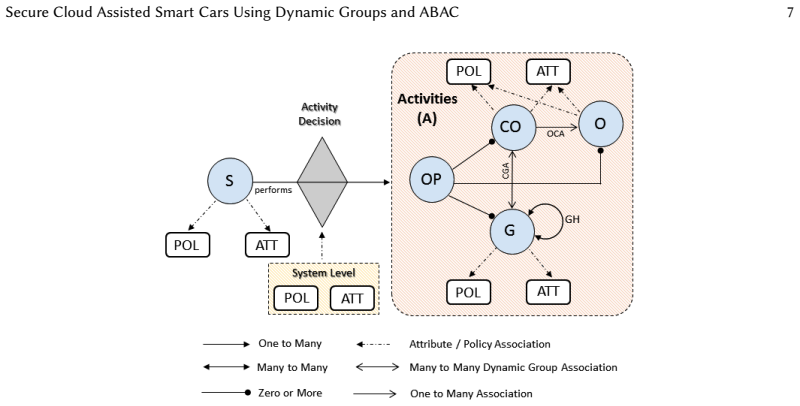
The load-bearing mechanism is the group hierarchy together with effective-attribute derivation. Groups (G) with a partial order GH allow attributes and alerts to inherit from parent to child, and the functions effGatt, effCOatt, and effOatt compute the effective attribute set of each group, clustered object, and object by unioning or overwriting inherited values. Dynamic membership is realized by directG, which maps each clustered object to one group at each hierarchy level from current attributes such as GPS coordinates. These derived attributes feed authorization functions Authop(s, ob), propositional-logic policies over effective attributes, so group membership, user preferences, and system policy all reduce to the same attribute-evaluation machinery.
What would settle it
Spoof one vehicle's reported location so that it enters a different location group while its true position remains fixed, then generate a group-scoped alert; if the car receives or is denied the alert based on the false group, the trust assumption has been violated and the model's decisions no longer track reality.
Extended reading notes
Core claim
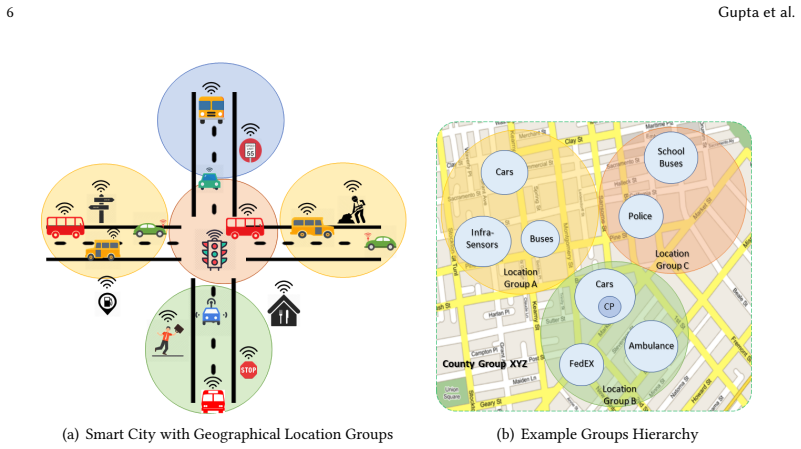
The central claim is that authorization in a connected-vehicle ecosystem can be expressed as a pure attribute-based model with dynamic groups. In CV-ABACG, sources (users, applications, sensors, cars) initiate activities; clustered objects (cars, traffic lights) contain individual objects (sensors, ECUs, applications); and groups are logical collections of clustered objects arranged in a partial-order hierarchy. A moving car is assigned to exactly one group at each hierarchy level through a directG function based on reported attributes, and effective attributes are derived by inheriting group attributes down the hierarchy: set-valued attributes are unioned, while atomic attributes take the most recently updated non-null value from a parent group. An activity is allowed only if every authorization policy Authop for its operations evaluates to true, combining system-wide policies with user privacy preferences. The cloud prototype shows that this design scopes deer-threat alerts and car-pooling requests to relevant subgroups and enforces privacy filters locally at the vehicle, while deliberately not collecting persistent vehicle location data in the central cloud.
Load-bearing premise
The model assumes the attributes reported by cars and sensors are truthful, for example that a car's GPS coordinates are its actual coordinates, and if that fails, dynamic group assignment and all downstream authorization decisions can be wrong.
Editorial extensions
If this is right
- Location-group membership reduces broadcast alerts to the set of vehicles for which an alert is relevant, so a deer-threat warning reaches cars near the sensor rather than every car in the city.
- A second authorization layer at the vehicle, using local policy evaluation, lets a driver decline car-pooling requests or marketing notifications even when the central policy has already selected the car's group.
- Administrators can change an attribute once on a parent group, such as setting Deer_Threat to ON, and have it propagate to every child group and member vehicle through inheritance.
- Because the policy engine is external to the cloud IoT broker, the same CV-ABACG policies can be re-hosted on equivalent cloud or edge platforms without changing the model.
- The reported policy-evaluation times, roughly 0.08 to 0.52 milliseconds for 10 to 50 requests, indicate that the authorization check itself is not the dominant latency in cloud-assisted notification delivery.
Reading between the lines
- A consequence the paper leaves implicit is that the trust assumption on reported attributes creates an attack point: if a vehicle spoofs its GPS coordinates, it can be moved into a different group and either receive alerts it should not see or miss alerts it should see, so real deployments would need a separate attestation or anomaly-detection layer.
- The same group-inheritance machinery could be applied inside the vehicle, treating ECUs as objects whose parent clustered object propagates context attributes, to enforce isolation between infotainment and safety-critical subsystems.
- Dynamic groups keyed to speed as well as location could support time-critical applications such as emergency-vehicle preemption, provided the group-assignment latency stays within the application's deadline.
- A testable extension would measure the false-notification rate under adversarial attribute injection by comparing group-assignment decisions against ground-truth positions, directly quantifying the cost of the trust assumption.
Signed reviews
Editorial analysis
A structured set of objections, weighed in public.
Referee Report
Summary. The paper presents CV-ABACG, an attribute-based access control model for connected vehicles that augments ABAC with a group hierarchy and 'dynamic groups' assigned to vehicles based on attributes such as GPS coordinates and speed. It formalizes sources, clustered objects, objects, groups, operations, activities, policies, and attributes (Tables 1-2), and describes an AWS IoT prototype (Section 5) implementing dynamic group assignment and attribute inheritance, with two use cases (deer-threat notification and car-pooling) and performance metrics showing policy evaluation time and notification scoping. The central claim is that this model enforces multi-layer authorization policies, including user privacy preferences, in a cloud-assisted smart-car ecosystem, and that the prototype demonstrates real-world viability.
Significance. If the model and implementation were fully substantiated, the paper would be a useful contribution to access control for vehicular IoT, combining a group hierarchy with attribute inheritance and user-privacy policies in a practically motivated setting. The paper is clearly written and transparent about its scope: it explicitly acknowledges the trusted-attribute assumption and the proof-of-concept nature of the AWS evaluation. The formal definitions in Section 4.2 provide a concrete policy language and inheritance rules, and the prototype description includes enough detail (sequence diagrams, policy snippets, group snapshots) to be reproducible in principle. However, the paper provides no machine-checked proofs or public code, and no security or safety properties are formally established; the significance thus rests on the plausibility of the model and the illustrative evaluation rather than on verified guarantees.
major comments (4)
- [Section 4.2, Table 1] The formal model defines directG : CO -> G as a static mapping and supplies no transition rule, administrative operation, or authorization policy that changes group membership as attributes such as GPS coordinates or speed change. Because the paper's central claim is a 'formalized dynamic groups' model, and because the authorization decisions in Section 5 (e.g., which location group receives a deer-threat alert) depend on the current value of directG, this is a load-bearing omission: correctness over time cannot be established, and no invariant or safety property about group membership is proved. The dynamic behavior appears only in Section 5.3 as an external smart-car controller implemented with Boto/AWS SDK calls. The authors should either formally extend the model with group-assignment and group-removal operations (with preconditions and effects) or revise the claim to describe a static ABAC model with a group hierarchy plus a separate implementation of dynamic membership.
- [Section 4.2, Table 1 (effGatt for atomic attributes)] The atomic-attribute inheritance rule selects the parent group whose effective attribute value is 'updated most recently,' but the formal model defines no update timestamps, version numbers, or ordering on attribute updates. As a result, the recursive definition of effGatt is underspecified and the claimed inheritance semantics (e.g., the Deer_Threat example in Section 5.2) cannot be evaluated formally. A formal account of recency—for example, a global or per-attribute partial order on updates—is needed for the definitions to be unambiguous.
- [Section 5.4] The experimental evaluation uses 50 simulated vehicles, reports policy-enforcement times without repeated trials or confidence intervals in Table 3 and Figure 12, and compares only against a 'no policy' condition rather than against prior access-control approaches or simpler group-free ABAC baselines. The notification-scoping result in Figure 11 largely restates the intended logic of the location-based policies, so it is a demonstration of the policy semantics rather than an independent performance or relevance benchmark. The paper should either provide a more rigorous evaluation (repeated runs, error bars, and appropriate baselines) or explicitly characterize the metrics as illustrative proof-of-concept measurements, which would weaken the 'detailed performance metrics' claim in the abstract.
- [Section 4.2 (trust assumption)] The model assumes that attributes reported by sources and objects are trusted, as stated explicitly in Section 4.2. A concrete risk is GPS spoofing: a vehicle reporting false coordinates can be assigned to the wrong location group and receive (or be denied) notifications, and a malicious sensor could set Deer_Threat to ON for a group it does not actually observe. Because the paper acknowledges this as out of scope, it is a scope limitation rather than an inconsistency, but it should be weighed in the security claims; a brief discussion of possible mitigations (e.g., SCMS-style message authentication, plausibility checks on reported coordinates) would help position the model in practice.
minor comments (5)
- [Table 2] In the definition of Authorization(a, s), the expression ends with 'Authopn(s : S , x3)'; this should presumably be 'Authopn(s : S , xn)', and the comma-separated list of Authop conjuncts should be joined by an explicit logical conjunction to avoid ambiguity.
- [Section 5.4] The paragraph preceding Figure 12 contains grammatical errors ('The X axis is each graph shows') and Figure 11's text says the cars for both use cases are 'clubbed together,' which makes the figure harder to interpret; separating the deer-threat and car-pool results would improve clarity.
- [References] Reference [63] misspells 'Security Credential Management System' as 'Securty Credential Management System,' and several AWS references contain 'A WS' with an unintended space.
- [Section 4.1] The requirement that 'a vehicle or CO can be direct member of only one group at same hierarchy level' is not captured by the formal definition of directG as a single function CO -> G, which does not reference hierarchy levels; the constraint should be stated as an explicit axiom on directG and GH.
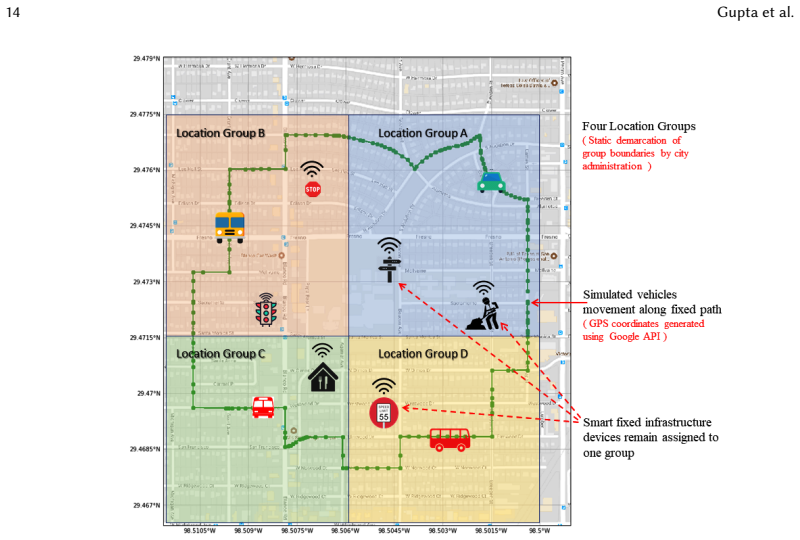
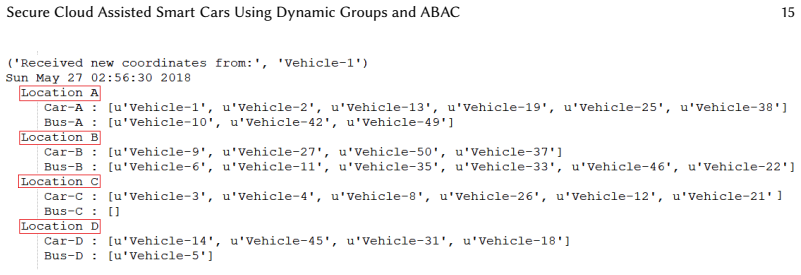
- [Section 5.3] The example says Vehicle-1, initially in Location-D, publishes coordinates and 'its new location changes to Location-A,' but the relationship between the given coordinate pair and Location-A is not shown in Figure 6; a cross-reference or a small table would make the demonstration easier to follow.
Circularity Check
No significant circularity; the formal model is self-contained and the implementation metrics are demonstrations of the policies, not fitted predictions.
full rationale
The formal model in Tables 1 and 2 defines effective attributes recursively with base cases from the group hierarchy partial order; no definition reduces to the target result. Dynamic group assignment is described in Section 4.1 but not formalized as a transition rule in Table 1, so the 'dynamic' behavior is implemented in AWS (Section 5.3) rather than derived in the formal model; this is an internal completeness gap, not a circular reduction. The relevance metric in Figure 11 counts vehicles selected by the explicit policies defined in Section 5.3, so the reduced count is entailed by those policy definitions; this is a demonstration of intended behavior, not a fitted parameter renamed as a prediction. Self-citations (E-ACO architecture [42], the prior CODASPY version [36]) provide architectural context and are not load-bearing for the formal ABAC definitions, which are presented and justified in this paper. The explicit trust assumption (Section 4.2) is a stated limitation, not a circularity.
Assumptions & free parameters
free parameters (1)
- Location group boundaries and center coordinates =
e.g., Location-A Center-Latitude 29.4745, Center-Longitude -98.503
assumptions (3)
- domain assumption Attributes supplied by sources and objects are trusted, such as GPS coordinates reported by a car or data from a sensor.
- domain assumption No policies or attributes change during the evaluation of an activity.
- standard math Group hierarchy is a partial order, so recursive attribute inheritance is well-defined.
Cite this review
Pith. "Pith review of Secure Cloud Assisted Smart Cars Using Dynamic Groups and Attribute Based Access Control." pith.science (2026). https://pith.science/paper/PN56VTVP
@misc{pith2026190808112,
  author       = {Pith},
  title        = {Pith review of: Secure Cloud Assisted Smart Cars Using Dynamic Groups and Attribute Based Access Control},
  year         = {2026},
  howpublished = {\url{https://pith.science/paper/PN56VTVP}},
  note         = {Machine review of arXiv:1908.08112}
}
read the original abstract
Future smart cities and intelligent world will have connected vehicles and smart cars as its indispensable and most essential components. The communication and interaction among such connected entities in this vehicular internet of things (IoT) domain, which also involves smart traffic infrastructure, road-side sensors, restaurant with beacons, autonomous emergency vehicles, etc., offer innumerable real-time user applications and provide safer and pleasant driving experience to consumers. Having more than 100 million lines of code and hundreds of sensors, these connected vehicles (CVs) expose a large attack surface, which can be remotely compromised and exploited by malicious attackers. Security and privacy are serious concerns that impede the adoption of smart connected cars, which if not properly addressed will have grave implications with risk to human life and limb. In this research, we present a formalized dynamic groups and attribute-based access control (ABAC) model (referred as \cvac) for smart cars ecosystem, where the proposed model not only considers system wide attributes-based security policies but also takes into account the individual user privacy preferences for allowing or denying service notifications, alerts and operations to on-board resources. Further, we introduce a novel notion of groups in vehicular IoT, which are dynamically assigned to moving entities like connected cars, based on their current GPS coordinates, speed or other attributes, to ensure relevance of location and time sensitive notification services to the consumers, to provide administrative benefits to manage large numbers of smart entities, and to enable attributes and alerts inheritance for fine-grained security authorization policies. We present proof of concept implementation of our model in AWS cloud platform demonstrating real-world uses cases along with performance metrics.
Figures

Figures from the paper (9 more)




Reference graph
Works this paper leans on
-
[1]
Connected Vehicles and Your Privacy
2014. Connected Vehicles and Your Privacy. https://www.its.dot.gov/factsheets/pdf/Privacy_factsheet.pdf
work page 2014
-
[2]
2017 Roundup Of Internet Of Things Forecasts
2017. 2017 Roundup Of Internet Of Things Forecasts . https://www.forbes.com/sites/louiscolumbus/2017/12/10/2017- roundup-of-internet-of-things-forecasts/#67005b6a1480 [Online; Accessed: 2018-05-03]
work page 2017
-
[3]
2018. A WS. https://aws.amazon.com/ [Online; Accessed: 2018-05-09]
work page 2018
-
[4]
2018. A WS Greengrass. https://aws.amazon.com/greengrass/ [Online; Accessed: 2018-05-27]
work page 2018
- [5]
-
[6]
2018. A WS Lambda. https://aws.amazon.com/lambda/ [Online; Accessed: 2018-05-20]
work page 2018
-
[7]
2018. A WS SDK for Python (Boto3). https://aws.amazon.com/sdk-for-python/ [Online; Accessed: 2018-05-23]
work page 2018
-
[8]
A WS Simple Notification Service
2018. A WS Simple Notification Service. https://aws.amazon.com/sns/ [Online; Accessed: 2018-05-20]
work page 2018
Show all 66 references
-
[9]
Cloud IoT Core
2018. Cloud IoT Core. [Accessed: 2019-06-05]
2018
-
[10]
2018. Connected Car Market by Service (Connected Services, Safety & Security, and Autonomous Driving), Form (Embedded, Tethered, and Integrated), Network (DSRC, and Cellular), End Market, Transponder, Hardware, and Region - Global Forecast to 2025. https://www.researchandmarke...
2018
-
[11]
Device Shadow Service for A WS IoT
2018. Device Shadow Service for A WS IoT. https://docs.aws.amazon.com/iot/latest/developerguide/iot-device-shadows. html [Online; Accessed: 2019-06-19]
2018
-
[12]
Google Maps Platform
2018. Google Maps Platform. https://cloud.google.com/maps-platform/ [Online; Accessed: 2018-05-09]
2018
-
[13]
Microsoft Azure IoT Hub
2018. Microsoft Azure IoT Hub. [Accessed: 2019-05-01]
2018
-
[14]
Openstack
2018. Openstack. [Accessed: 2019-07-01]
2018
-
[15]
Security and Identity for A WS IoT
2018. Security and Identity for A WS IoT. https://docs.aws.amazon.com/iot/latest/developerguide/iot-security-identity. html [Online; Accessed: 2019-06-19]
2018
-
[16]
Shadow MQTT Topics
2018. Shadow MQTT Topics. https://docs.aws.amazon.com/iot/latest/developerguide/device-shadow-mqtt.html [Online; Accessed: 2019-06-19]
2018
-
[17]
Thing Groups
2018. Thing Groups. https://docs.aws.amazon.com/iot/latest/developerguide/thing-groups.html [Online; Accessed: 2019-06-19]
2018
-
[18]
2018. Topics. https://docs.aws.amazon.com/iot/latest/developerguide/topics.html [Online; Accessed: 2019-06-19]
2018
-
[19]
Uber Self-Driving Car Crash: What Really Happened
2018. Uber Self-Driving Car Crash: What Really Happened . https://www.forbes.com/sites/meriameberboucha/2018/05/ 28/uber-self-driving-car-crash-what-really-happened/#32fff20a4dc4 [Online; Accessed: 2019-06-18]
2018
-
[20]
Vehicular ad hoc networks
2018. Vehicular ad hoc networks. https://en.wikipedia.org/wiki/Vehicular_ad_hoc_network [Online; Accessed: 2018-05- 30]
2018
-
[21]
Aazam and et al
M. Aazam and et al. 2014. Cloud of Things: Integrating Internet of Things and cloud computing and the issues involved. In Proc. of IBCAST. 414–419
2014
-
[22]
Al-Fuqaha and et al
A. Al-Fuqaha and et al. 2015. Internet of things: A survey on enabling technologies, protocols, and applications. IEEE Comm. Surveys & Tutorials (2015), 2347–2376
2015
-
[23]
Asma Alshehri and Ravi Sandhu. 2016. Access control models for cloud-enabled internet of things: A proposed architecture and research agenda. In Proc. of IEEE CIC . 530–538
2016
-
[24]
Luigi Atzori, Antonio Iera, and Giacomo Morabito. 2010. The internet of things: A survey. Computer networks 54, 15 (2010), 2787–2805
2010
-
[25]
Jim Barbaresso and et al. 2014. USDOT’s Intelligent Transportation Systems ITS Strategic Plan 2015- 2019. (2014)
2014
-
[26]
Bhatt, F
S. Bhatt, F. Patwa, and R. Sandhu. 2017. An Access Control Framework for Cloud-Enabled Wearable Internet of Things. In Proc. of IEEE CIC . 328–338
2017
-
[27]
Smriti Bhatt, Farhan Patwa, and Ravi Sandhu. 2017. Access Control Model for AWS Internet of Things. In Proc. of NSS. Springer, 721–736
2017
-
[28]
Botta, W
A. Botta, W. de Donato, V. Persico, and A. PescapÃľ. 2014. On the Integration of Cloud Computing and Internet of Things. In Proc. of IEEE FiCLOUD . 23–30
2014
-
[29]
Mohamed Eltoweissy and et al. 2010. Towards Autonomous Vehicular Clouds. In Ad Hoc Networks. Springer, 1–16
2010
-
[30]
ENISA. 2017. Cyber Security and Resilience of smart cars: Good practices and recommendations . https://www.enisa. europa.eu/publications/cyber-security-and-resilience-of-smart-cars [Online; Accessed: 2018-01-27]
2017
-
[31]
David F Ferraiolo, Ravi Sandhu, Serban Gavrila, D Richard Kuhn, and Ramaswamy Chandramouli. 2001. Proposed NIST standard for role-based access control. ACM Transactions on Information and System Security (TISSEC) 4, 3 (2001), 224–274
2001
-
[32]
2016, March
US GAO. 2016, March. Vehicle Cybersecurity . GAO-16-350 (2016, March). https://www.gao.gov/assets/680/676064.pdf
2016
-
[33]
Gerla, E
M. Gerla, E. Lee, G. Pau, and U. Lee. 2014. Internet of vehicles: From intelligent grid to autonomous cars and vehicular clouds. In Proc. of IEEE WF-IoT. 241–246
2014
-
[34]
Gubbi and et al
J. Gubbi and et al. 2013. Internet of Things (IoT): A vision, architectural elements, and future directions. Future generation computer systems 29, 7 (2013), 1645–1660. , Vol. 1, No. 1, Article . Publication date: August 2019. Secure Cloud Assisted Smart Cars Using Dynamic Gro...
2013
-
[35]
Maanak Gupta. 2018. Secure Cloud Assisted Smart Cars and Big Data: Access Control Models and Implementation . Ph.D. Dissertation. The University of Texas at San Antonio
2018
-
[36]
Maanak Gupta, James Benson, Farhan Patwa, and Ravi Sandhu. 2019. Dynamic Groups and Attribute-Based Access Control for Next-Generation Smart Cars. In Proceedings of the Ninth ACM Conference on Data and Application Security and Privacy (CODASPY ’19). ACM, New York, NY, USA, 61–...
2019
-
[37]
Gupta and et al
M. Gupta and et al. 2017. Multi-Layer Authorization Framework for a Representative Hadoop Ecosystem Deployment. In Proc. of ACM SACMAT. 183–190
2017
-
[38]
Maanak Gupta, Farhan Patwa, and Ravi Sandhu. 2017. Object-Tagged RBAC Model for the Hadoop Ecosystem. In Proc. of DBSec. Springer, 63–81
2017
-
[39]
Maanak Gupta, Farhan Patwa, and Ravi Sandhu. 2017. POSTER: Access control model for the Hadoop Ecosystem. In Proceedings of the 22nd ACM on Symposium on Access Control Models and Technologies . ACM, 125–127
2017
-
[40]
Maanak Gupta, Farhan Patwa, and Ravi Sandhu. 2018. An Attribute-Based Access Control Model for Secure Big Data Processing in Hadoop Ecosystem. In Proc. of the Third ACM Workshop on Attribute-Based Access Control . 13–24
2018
-
[41]
Maanak Gupta and Ravi Sandhu. 2016. The GURAG Administrative Model for User and Group Attribute Assignment. In Proc. of NSS. Springer, 318–332
2016
-
[42]
Maanak Gupta and Ravi Sandhu. 2018. Authorization Framework for Secure Cloud Assisted Connected Cars and Vehicular Internet of Things. In Proc. of ACM SACMAT. 193–204
2018
-
[43]
Maanak Gupta and Ravi Sandhu. 2018. POSTER: Access Control Needs in Smart Cars. https://www.ieee-security.org/ TC/SP2018/poster-abstracts/oakland2018-paper26-poster-abstract.pdf. (2018). [Online; Accessed: 2018-10-04]
2018
-
[44]
Per Hallgren, Martin Ochoa, and Andrei Sabelfeld. 2015. Innercircle: A parallelizable decentralized privacy-preserving location proximity protocol. In Privacy, Security and Trust (PST), 2015 13th Annual Conference on . IEEE, 1–6
2015
-
[45]
Vincent C Hu, David Ferraiolo, Rick Kuhn, Arthur R Friedman, Alan J Lang, Margaret M Cogdell, Adam Schnitzer, Kenneth Sandlin, Robert Miller, and Karen Scarfone. 2014. Guide to attribute based access control (ABAC) definition and considerations. NIST Special Publication 800-162 (2014)
2014
-
[46]
Vincent C Hu, D Richard Kuhn, and David F Ferraiolo. 2015. Attribute-based access control. IEEE Computer 2 (2015), 85–88
2015
-
[47]
Rasheed Hussain and et al. 2012. Rethinking vehicular communications: Merging VANET with cloud computing. In Proc. of IEEE CloudCom . 606–609
2012
-
[48]
Xin Jin, Ram Krishnan, and Ravi Sandhu. 2012. A unified attribute-based access control model covering DAC, MAC and RBAC. In DBSec. Springer, 41–55
2012
-
[49]
Lea and M
R. Lea and M. Blackstock. 2014. City Hub: A Cloud-Based IoT Platform for Smart Cities. In Proc. of IEEE CloudCom . 799–804
2014
-
[50]
Arvind Narayanan, Narendran Thiagarajan, Mugdha Lakhani, Michael Hamburg, Dan Boneh, et al. 2011. Location Privacy via Private Proximity Testing.. In NDSS, Vol. 11
2011
-
[51]
NHTSA. 2016. NHTSA and Vehicle CyberSecurity. NHTSA Report (2016)
2016
-
[52]
2016, October
NHTSA. 2016, October. Cybersecurity Best Practices for Modern Vehicles. NHTSA Report No. DOT HS 812 333 (2016, October)
2016
-
[53]
Nitti and et al
M. Nitti and et al. 2016. The virtual object as a major element of the internet of things: a survey. IEEE Comm. Surveys & Tutorials (2016), 1228–1240
2016
-
[54]
Stephan Olariu and et al. 2011. Taking VANET to the clouds. International Journal of Pervasive Computing and Communications 7, 1 (2011), 7–21
2011
-
[55]
Jaehong Park, Ravi Sandhu, and Yuan Cheng. 2011. Acon: Activity-centric access control for social computing. In Proc. of IEEE ARES. 242–247
2011
-
[56]
Jaehong Park, Ravi Sandhu, and Yuan Cheng. 2011. A user-activity-centric framework for access control in online social networks. IEEE Internet Computing 15, 5 (2011), 62–65
2011
-
[57]
Ravi S Sandhu, Edward J Coyne, Hal L Feinstein, and Charles E Youman. 1996. Role-based access control models. Computer 29, 2 (1996), 38–47
1996
-
[58]
Ravi S Sandhu and Pierangela Samarati. 1994. Access control: principle and practice. IEEE communications magazine 32, 9 (1994), 40–48
1994
-
[59]
Daniel Servos and Sylvia L Osborn. 2014. HGABAC: Towards a Formal Model of Hierarchical Attribute-Based Access Control. In International Symposium on Foundations and Practice of Security . Springer, 187–204
2014
-
[60]
European Union. 2017. Certificate Policy for Deployment and Operation of European Cooperative Intelligent Transport Systems (C-ITS). https://ec.europa.eu/transport/sites/transport/files/c-its_certificate_policy_release_1.pdf
2017
-
[61]
European Union. 2017. Security Policy & Governance Framework for Deployment and Operation of European Cooperative Intelligent Transport Systems (C-ITS) . https://ec.europa.eu/transport/sites/transport/files/c-its_security_policy_release_ 1.pdf
2017
-
[62]
USAToday. 2017. Chinese group hacks a Tesla for the second year in a row . , Vol. 1, No. 1, Article . Publication date: August 2019. 24 Gupta et al
2017
-
[63]
USDOT. 2016. Securty Credential Management System . https://www.its.dot.gov/resources/scms.htm [Online; Accessed: 2018-01-13]
2016
-
[64]
Md Whaiduzzaman and et al. 2014. A survey on vehicular cloud computing. Journal of Network and Computer Applications 40 (2014), 325–344
2014
-
[65]
Wired. 2015. Hackers Remotely Kill a Jeep on the Highway-With Me in It
2015
-
[66]
Ge Zhong, Ian Goldberg, and Urs Hengartner. 2007. Louis, lester and pierre: Three protocols for location privacy. In International Workshop on Privacy Enhancing Technologies. Springer, 62–76. , Vol. 1, No. 1, Article . Publication date: August 2019
2007
Reviewed August 14, 2026 · model on record in the stance chip above.
Discussion (0). Continue with ORCID to comment.