Horizon absorption in eccentric precessing binary black hole inspirals and its importance for gravitational wave data analysis
Pith reviewed 2026-06-27 09:22 UTC · model grok-4.3
The pith
Horizon absorption in eccentric precessing black hole binaries produces detectable parameter biases at moderate signal-to-noise ratios.
A machine-rendered reading of the paper's core claim, the machinery that carries it, and where it could break.
Core claim
We derive, for the first time and at leading order in the post-Newtonian expansion, the effect of horizon absorption in binary black hole inspirals with both orbital eccentricity and spin-induced precession, and we incorporate these corrections into the waveform model. We then quantify their impact through analytical estimates of the orbital dephasing, waveform mismatches, and Bayesian parameter-estimation studies. The effect is largest for systems with large spin components (anti-)aligned with the orbital angular momentum, highly unequal mass ratios, and long inspirals spanning a wide frequency range. For such systems, neglecting horizon absorption biases the recovered binary parameters at
What carries the argument
Leading-order post-Newtonian horizon absorption fluxes for energy and angular momentum that account for both eccentricity and precession.
If this is right
- Systems with aligned spins near extremal, mass ratios far from unity, and inspirals spanning many frequency octaves show the strongest orbital dephasing from horizon absorption.
- Waveform mismatches grow when the absorption terms are omitted, reaching levels that matter for current and future detectors.
- Bayesian analyses recover biased values for masses and spins when the model lacks the absorption corrections.
- The bias remains visible at moderate signal-to-noise ratios only when eccentricity is present; circular signals hide it through parameter degeneracies.
Where Pith is reading between the lines
- Waveform models used for eccentric signals in upcoming observing runs should include these absorption terms to prevent systematic offsets in catalogued parameters.
- Future lower-frequency detectors could measure the effect more readily because they capture longer inspirals where the accumulated dephasing is larger.
- Observed deviations from absorption predictions might indicate that the compact objects are not standard black holes.
Load-bearing premise
The richer morphology of eccentric signals breaks degeneracies so that horizon absorption produces observable biases instead of being absorbed into adjustments of other parameters.
What would settle it
A parameter-estimation study on simulated signals from eccentric precessing binaries that include horizon absorption, performed both with and without the absorption terms in the recovery model, at signal-to-noise ratios around 20-50, checking whether the recovered parameters shift outside their statistical uncertainties.
Figures
read the original abstract
During the evolution of a binary black hole, energy and angular momentum are exchanged between the orbital motion and the individual black holes through horizon absorption, modifying both the binary dynamics and the black hole masses and spins. This leaves an imprint on the emitted gravitational waves that may be relevant for the accurate modeling of signals observed by current and future detectors, while also offering a probe of the nature of compact objects. In this work, we derive, for the first time and at leading order in the post-Newtonian expansion, the effect of horizon absorption in binary black hole inspirals with both orbital eccentricity and spin-induced precession, and we incorporate these corrections into the pyEFPEHM waveform model. We then quantify their impact through analytical estimates of the orbital dephasing, waveform mismatches, and Bayesian parameter-estimation studies. The effect is largest for systems with large spin components (anti-)aligned with the orbital angular momentum ($|\vec{\chi}_i \cdot \hat{l}| \sim 1$), highly unequal mass ratios ($q=m_2/m_1 \ll 1$), and long inspirals spanning a wide frequency range ($\log(f_\mathrm{max}/f_\mathrm{min}) \gg 1$). For such systems, neglecting horizon absorption biases the recovered binary parameters at moderate signal-to-noise ratios. In quasi-circular binaries these biases largely absorb the effect, rendering it difficult to detect. In eccentric binaries, however, the richer signal morphology breaks this degeneracy, making horizon absorption potentially measurable in high signal-to-noise-ratio events.
Editorial analysis
A structured set of objections, weighed in public.
Referee Report
Summary. The paper claims to derive, for the first time at leading post-Newtonian order, the effects of horizon absorption on the dynamics and gravitational waveforms of eccentric, precessing binary black hole inspirals. These corrections are incorporated into the pyEFPEHM waveform model. The impact is quantified using orbital dephasing estimates, waveform mismatches, and Bayesian parameter estimation studies, showing that the effects can cause parameter biases in eccentric systems at moderate SNRs due to the richer signal morphology breaking degeneracies, unlike in quasi-circular binaries.
Significance. If the derivation and studies hold, this provides the first such corrections for non-quasi-circular systems, filling a modeling gap relevant for LIGO/Virgo and future detectors, as well as for probing black hole nature via GWs. The combination of analytical leading-PN construction, model implementation, and multi-method quantification (dephasing, mismatches, PE) is a strength.
minor comments (2)
- [Abstract] Abstract: the statement that 'the richer signal morphology breaks this degeneracy' is central to the claim of measurability in eccentric cases; a brief cross-reference to the specific PE result (e.g., the posterior shift magnitude or overlap with other parameters) would strengthen the abstract.
- [Abstract] The frequency-range condition log(f_max/f_min) ≫ 1 is used to identify systems where the effect is largest, but no concrete example values or integration limits from the dephasing or mismatch calculations are quoted; adding one numerical illustration would improve clarity.
Simulated Author's Rebuttal
We thank the referee for their positive assessment of the manuscript, including the significance of the leading-PN derivation for eccentric precessing systems and the multi-method quantification of effects. The report recommends minor revision but lists no specific major comments requiring point-by-point response.
Circularity Check
No significant circularity in derivation chain
full rationale
The paper's central claim is a first-time leading-order PN derivation of horizon absorption for eccentric precessing BBH systems, followed by incorporation into pyEFPEHM and impact quantification. No quoted equations or steps reduce the new derivation to fitted inputs, self-definitions, or load-bearing self-citations by construction. The pyEFPEHM update is an application step, not a redefinition of the derived effect. The degeneracy-breaking argument for eccentric systems follows from signal morphology rather than circular premise. The derivation chain is self-contained against external benchmarks with no exhibited reduction to inputs.
Axiom & Free-Parameter Ledger
Reference graph
Works this paper leans on
-
[1]
The tensorE ab in Eq
˙E a bEac ˆSbc 1 − 2 3 χ3 1 ˙EacEbdˆsa 1ˆsb 1 ˆScd 1 # ,(1) wherem i are the component masses,χ i =S i/m2 i are the dimensionless spin magnitudes, ˆs a i are unit vectors aligned with the component spins, and ˆSab i =ϵ abcˆsc i are the associated spin tensors. The tensorE ab in Eq. (1) is the tidal field acting on black hole 1, which for a binary, at lead...
-
[2]
In the top panel we show ∆λ H from pyEFPEHMtogether with the analytical prediction of Eq
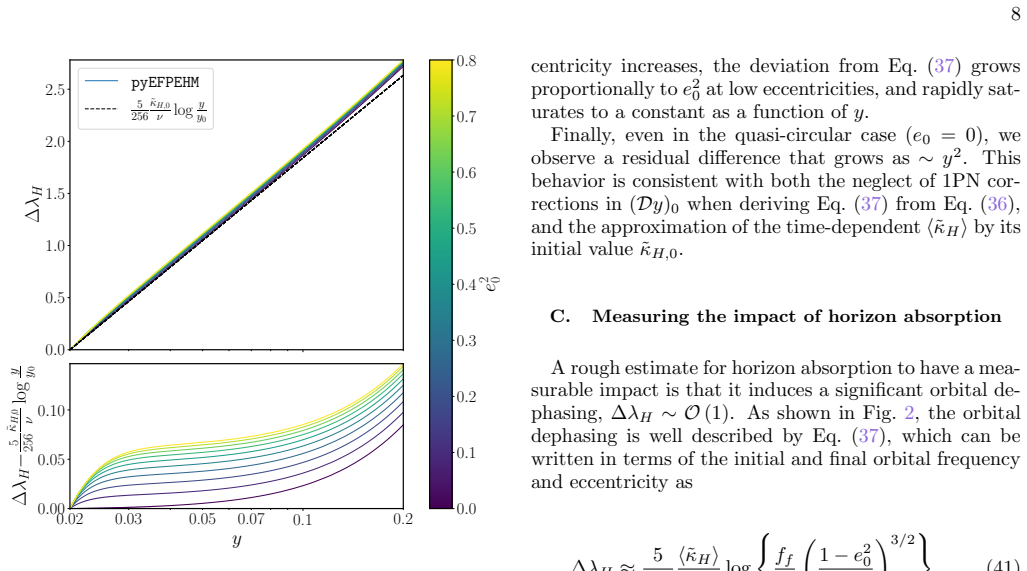
We consider a representative system with mass ratio q=m 2/m1 = 0.1, and initial spinsχ 1,0 = [−0.2,0.3,0.9] and χ2,0 = [−0.4,−0.4,0.8]. In the top panel we show ∆λ H from pyEFPEHMtogether with the analytical prediction of Eq. (37), while in the bottom panel we show their difference. bH 5 =−e 2 44 5 + 66 5 e2 + 11 10 e4 ⟨˜κH ⟩,(40b) where ˜κH is defined in...
-
[3]
nuisance
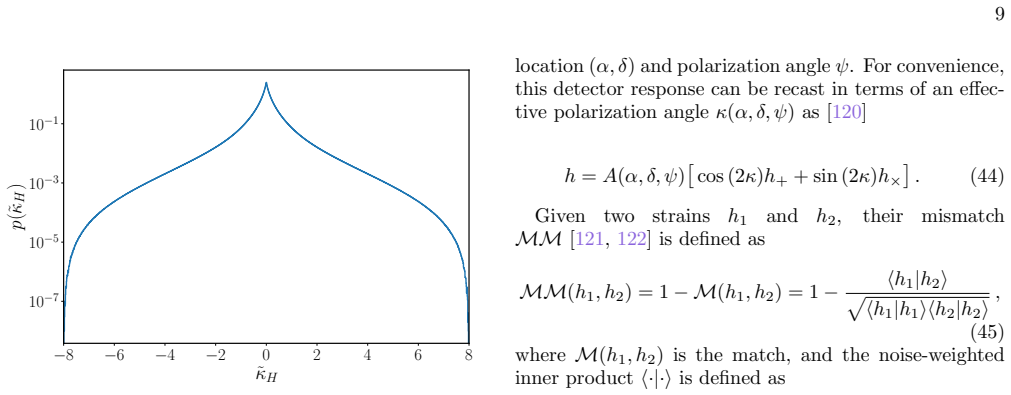
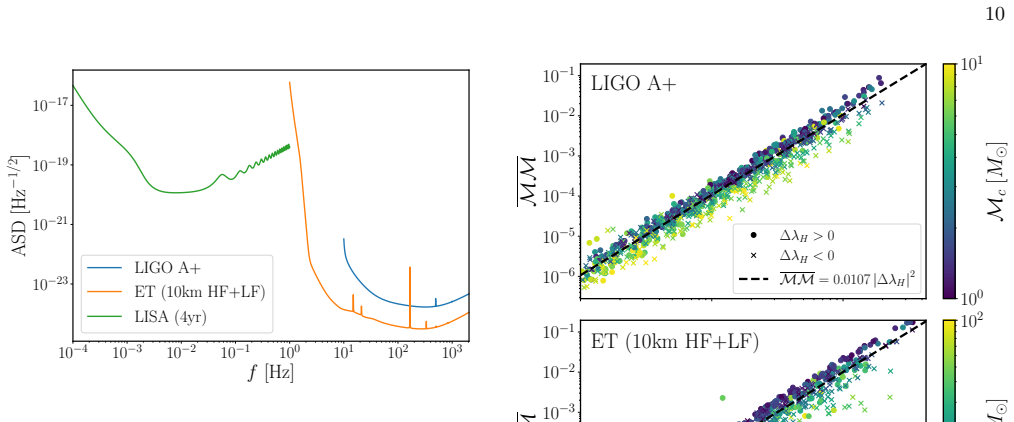
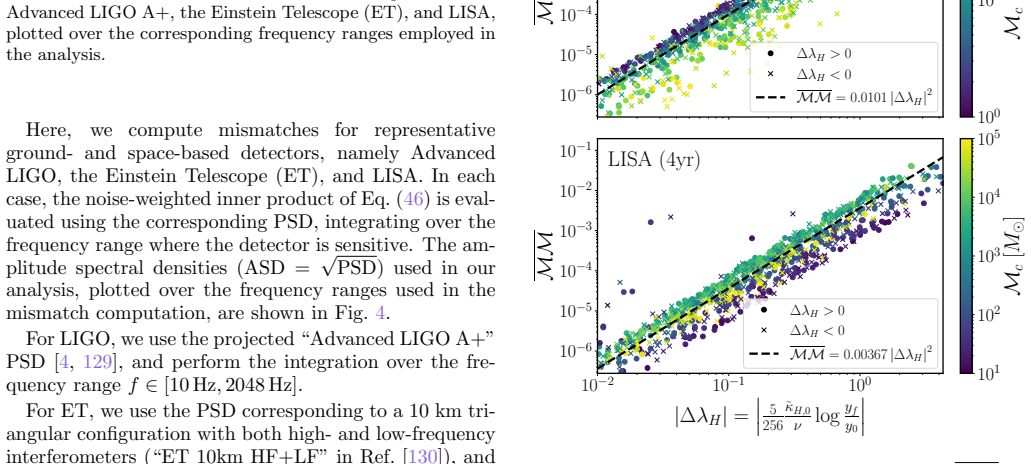
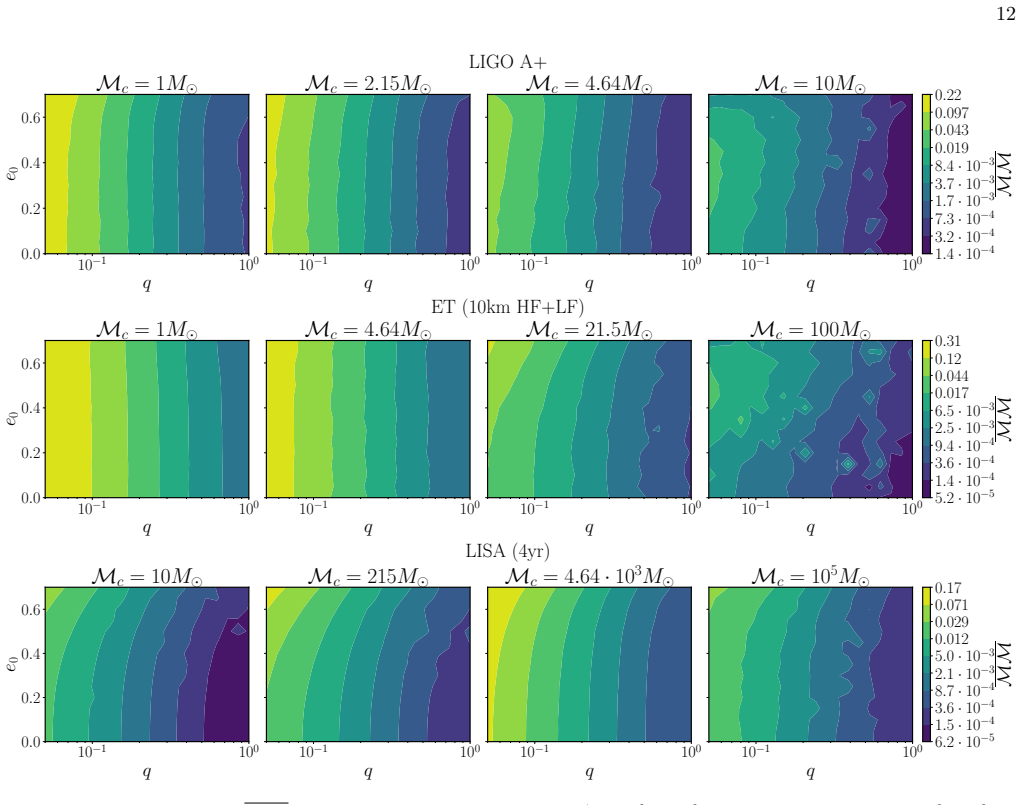
Mismatch studies While the orbital dephasing provides useful intuition about the distinguishability between waveforms, a more quantitative measure of waveform difference is the mis- match. The relevant quantity to compare is the detector strain, which, in the long-wavelength approximation [119] can be written as h=F +(α, δ, ψ)h+ +F ×(α, δ, ψ)h× ,(43) wher...
2048
-
[4]
HA”) are shown with solid lines, while the ones without (la- beled “no HA
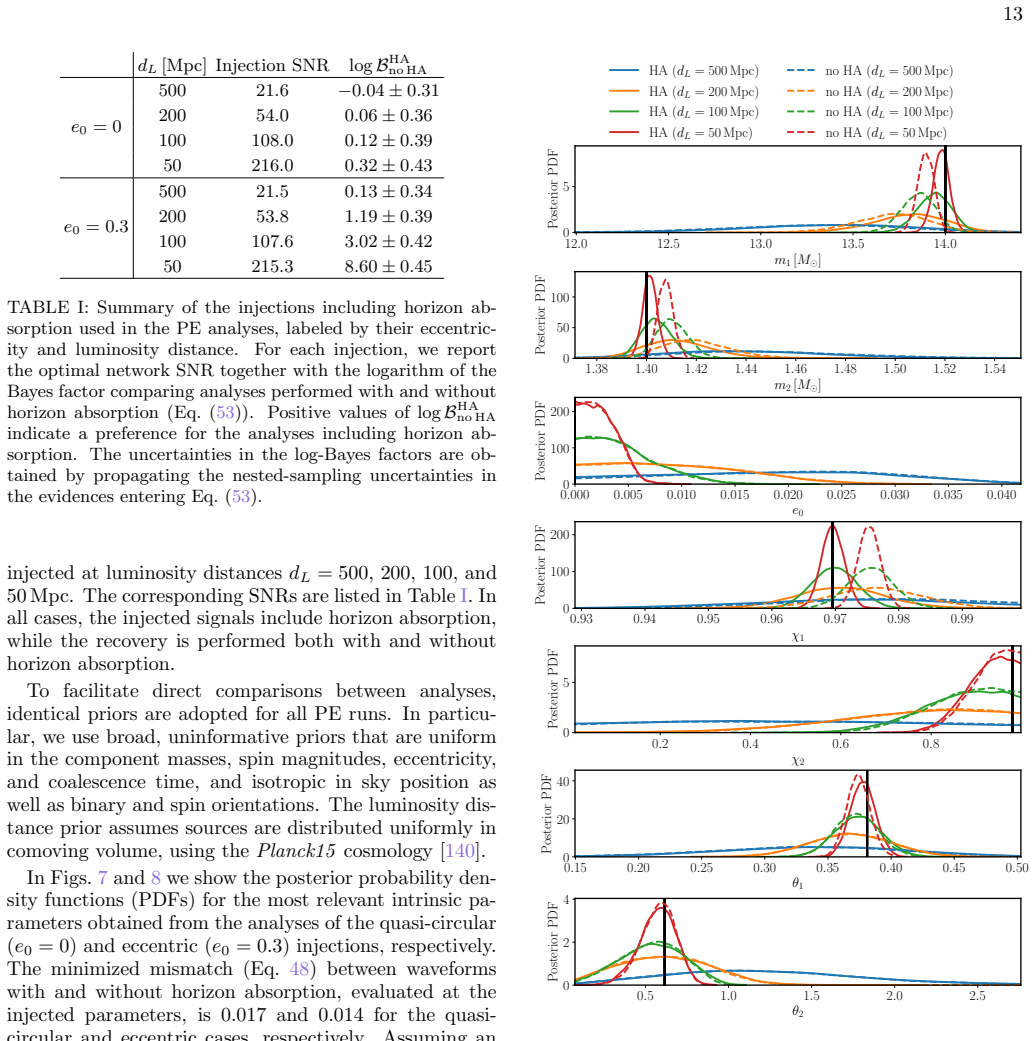
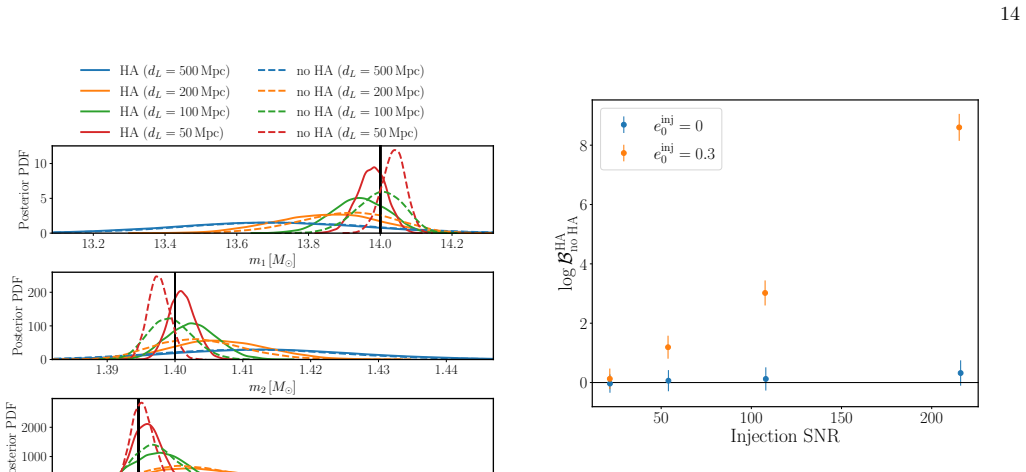
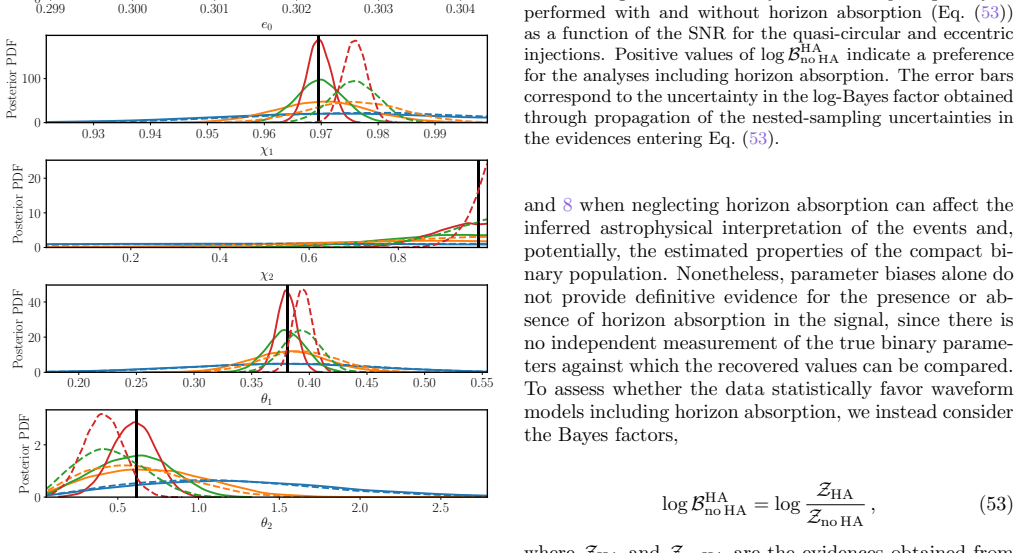
Parameter estimation studies Bayesian parameter estimation (PE) is the primary method used to analyze compact binary coalescence sig- nals observed by GW detectors [132, 133]. While the mismatches studied in Sec. III C 1 provide a rough indi- cation of when signals with and without horizon absorp- tion may become distinguishable, they are not sufficient t...
-
[5]
Aasiet al.(LIGO Scientific), Advanced LIGO, Class
J. Aasiet al.(LIGO Scientific), Advanced LIGO, Class. Quant. Grav.32, 074001 (2015), arXiv:1411.4547 [gr- qc]
Pith/arXiv arXiv 2015
-
[6]
F. Acerneseet al.(VIRGO), Advanced Virgo: a second- generation interferometric gravitational wave detector, Class. Quant. Grav.32, 024001 (2015), arXiv:1408.3978 [gr-qc]
Pith/arXiv arXiv 2015
-
[7]
T. Akutsuet al.(KAGRA), KAGRA: 2.5 Generation In- terferometric Gravitational Wave Detector, Nature As- tron.3, 35 (2019), arXiv:1811.08079 [gr-qc]
arXiv 2019
-
[8]
B. P. Abbottet al.(KAGRA, LIGO Scientific, Virgo), Prospects for observing and localizing gravitational- wave transients with Advanced LIGO, Advanced Virgo and KAGRA, Living Rev. Rel.19, 1 (2016), arXiv:1304.0670 [gr-qc]
Pith/arXiv arXiv 2016
-
[9]
B. P. Abbottet al.(LIGO Scientific, Virgo), GWTC- 1: A Gravitational-Wave Transient Catalog of Compact Binary Mergers Observed by LIGO and Virgo during the First and Second Observing Runs, Phys. Rev. X9, 031040 (2019), arXiv:1811.12907 [astro-ph.HE]
Pith/arXiv arXiv 2019
-
[10]
R. Abbottet al.(LIGO Scientific, Virgo), GWTC-2: Compact Binary Coalescences Observed by LIGO and Virgo During the First Half of the Third Observing Run, Phys. Rev. X11, 021053 (2021), arXiv:2010.14527 [gr- qc]
Pith/arXiv arXiv 2021
-
[11]
R. Abbottet al.(KAGRA, VIRGO, LIGO Scientific), GWTC-3: Compact Binary Coalescences Observed by LIGO and Virgo during the Second Part of the Third Observing Run, Phys. Rev. X13, 041039 (2023), arXiv:2111.03606 [gr-qc]
Pith/arXiv arXiv 2023
-
[12]
A. G. Abacet al.(LIGO Scientific, VIRGO, KAGRA), GWTC-4.0: Updating the Gravitational-Wave Tran- sient Catalog with Observations from the First Part of the Fourth LIGO-Virgo-KAGRA Observing Run, (2025), arXiv:2508.18082 [gr-qc]
Pith/arXiv arXiv 2025
-
[13]
GWTC-5.0: Observations from the Second Part of the Fourth LIGO-Virgo-KAGRA Observing Run and Updates to the Gravitational-Wave Transient Catalog, (2026), arXiv:2605.27225 [gr-qc]
Pith/arXiv arXiv 2026
-
[14]
R. Abbottet al.(LIGO Scientific, Virgo), GW190521: A Binary Black Hole Merger with a Total Mass of 150M⊙, Phys. Rev. Lett.125, 101102 (2020), arXiv:2009.01075 [gr-qc]
arXiv 2020
-
[15]
A. G. Abacet al.(LIGO Scientific, VIRGO, KAGRA), GW231123: A Binary Black Hole Merger with Total Mass 190–265 M⊙, Astrophys. J. Lett.993, L25 (2025), arXiv:2507.08219 [astro-ph.HE]
Pith/arXiv arXiv 2025
-
[16]
A. G. Abacet al.(LIGO Scientific, Virgo, KAGRA), GW241011 and GW241110: Exploring Binary Forma- tion and Fundamental Physics with Asymmetric, High- spin Black Hole Coalescences, Astrophys. J. Lett.993, L21 (2025), arXiv:2510.26931 [astro-ph.HE]
arXiv 2025
-
[17]
D. Gerosa and M. Fishbach, Hierarchical mergers of stellar-mass black holes and their gravitational-wave sig- natures, Nature Astron.5, 749 (2021), arXiv:2105.03439 [astro-ph.HE]
arXiv 2021
-
[18]
C. A. ´Alvarez, H. W. Y. Wong, A. Liu, and J. Calder´ on Bustillo, Kicking Time Back in Black Hole Mergers: Ancestral Masses, Spins, Birth Recoils, and Hierarchical-formation Viability of GW190521, As- trophys. J.977, 220 (2024), arXiv:2404.00720 [astro- ph.HE]
arXiv 2024
-
[19]
Y.-J. Li, Y.-Z. Wang, S.-P. Tang, and Y.-Z. Fan, Aligned Hierarchical Black Hole Mergers in AGN disks revealed by GWTC-4, (2025), arXiv:2509.23897 [astro-ph.HE]
Pith/arXiv arXiv 2025
-
[20]
V. Gayathri, J. Healy, J. Lange, B. O’Brien, M. Szczep- anczyk, I. Bartos, M. Campanelli, S. Klimenko, C. O. Lousto, and R. O’Shaughnessy, Eccentricity estimate for black hole mergers with numerical relativity simula- tions, Nature Astron.6, 344 (2022), arXiv:2009.05461 [astro-ph.HE]
arXiv 2022
- [21]
-
[22]
I. M. Romero-Shaw, P. D. Lasky, and E. Thrane, Four Eccentric Mergers Increase the Evidence that LIGO–Virgo–KAGRA’s Binary Black Holes Form Dynamically, Astrophys. J.940, 171 (2022), arXiv:2206.14695 [astro-ph.HE]
arXiv 2022
-
[23]
N. Gupteet al., Evidence for eccentricity in the population of binary black holes observed by LIGO- Virgo-KAGRA, Phys. Rev. D112, 104045 (2025), arXiv:2404.14286 [gr-qc]
Pith/arXiv arXiv 2025
-
[24]
M. d. L. Planas, A. Ramos-Buades, C. Garc´ ıa-Quir´ os, H. Estell´ es, S. Husa, and M. Haney, Reanalysis of bi- nary black hole gravitational wave events for orbital ec- centricity signatures, Phys. Rev. D112, 123004 (2025), arXiv:2504.15833 [gr-qc]
arXiv 2025
-
[25]
I. Romero-Shaw, J. Stegmann, H. Tagawa, D. Gerosa, J. Samsing, N. Gupte, and S. R. Green, GW200208 222617 as an eccentric black-hole binary merger: Properties and astrophysical implications, Phys. Rev. D112, 063052 (2025), arXiv:2506.17105 [astro-ph.HE]
arXiv 2025
-
[26]
L. Pompili, A. Gamboa, and A. Buonanno, Eccen- tric and unbound compact binaries in the LIGO- Virgo-KAGRA catalog: parameter estimation and waveform systematics with SEOBNRv6EHM, (2026), arXiv:2605.28716 [gr-qc]
Pith/arXiv arXiv 2026
-
[27]
J. Lange, D. Chiaramello, P. Lott, C. Henshaw, A. Na- gar, R. O’Shaughnessy, and L. Cadonati, Gravitational Wave Hyperbolic Catalog: Reanalyzing High-Mass Gravitational Wave Signals Using Hyperbolic Wave- forms, (2026), arXiv:2605.21640 [gr-qc]
Pith/arXiv arXiv 2026
- [28]
-
[29]
M. d. L. Planas, S. Husa, A. Ramos-Buades, and J. Va- lencia, First Eccentric Inspiral–Merger–Ringdown Anal- ysis of Neutron Star–Black Hole Mergers, Astrophys. J. 995, 47 (2025), arXiv:2506.01760 [astro-ph.HE]
arXiv 2025
- [30]
-
[31]
K. Kacanja, K. Soni, and A. H. Nitz, Eccentricity sig- natures in LIGO-Virgo-KAGRA’s binary neutron star and neutron-star black holes, Phys. Rev. D112, 122007 (2025), arXiv:2508.00179 [gr-qc]
arXiv 2025
-
[32]
A. Tiwari, S. A. Bhat, M. A. Shaikh, and S. J. Kapa- dia, Testing the Nature of GW200105 by Probing the Frequency Evolution of Eccentricity, Astrophys. J.995, 48 (2025), arXiv:2509.26152 [astro-ph.HE]
Pith/arXiv arXiv 2025
-
[33]
K. S. Phukon, P. Schmidt, G. Morras, and G. Prat- ten, Detection of GW200105 with a targeted ec- centric search, Phys. Rev. D113, 103023 (2026), arXiv:2512.10803 [gr-qc]
Pith/arXiv arXiv 2026
-
[34]
A. G. Abacet al.(LIGO Scientific, VIRGO, KAGRA), GWTC-4.0: Population Properties of Merging Compact Binaries, (2025), arXiv:2508.18083 [astro-ph.HE]
Pith/arXiv arXiv 2025
-
[35]
J. Stegmann and J. Klencki, Orbital Eccentricity and Spin–Orbit Misalignment Are Evidence that Neu- tron Star–Black Hole Mergers Form through Triple Star Evolution, Astrophys. J. Lett.991, L54 (2025), arXiv:2506.09121 [astro-ph.HE]
arXiv 2025
-
[36]
I. Romero-Shaw, J. Stegmann, G. Morras, A. Dorozs- mai, and M. Zevin, Astrophysical implications of eccen- tricity in gravitational waves from neutron star-black hole binaries, Monthly Notices of the Royal Astronom- ical Society547, stag323 (2026), arXiv:2512.16289
arXiv 2026
-
[37]
J. Stegmann, F. Antonini, A. Olejak, S. Biscov- eanu, V. Raymond, S. Rinaldi, and E. Flanagan, Gravitational-wave Observations Suggest Most Black Hole Mergers Form in Triples, Astrophys. J. Lett.1000, L59 (2026), arXiv:2512.15873 [astro-ph.HE]
arXiv 2026
-
[38]
von Zeipel, Sur l’application des s´ eries de M
H. von Zeipel, Sur l’application des s´ eries de M. Lind- stedt ` a l’´ etude du mouvement des com` etes p´ eriodiques, Astron. Nachr.183, 34 (1910)
1910
-
[39]
M. L. Lidov, The evolution of orbits of artificial satel- lites of planets under the action of gravitational per- turbations of external bodies, Planet. Space Sci.9, 719 (1962)
1962
-
[40]
Kozai, Secular perturbations of asteroids with high inclination and eccentricity, Astron
Y. Kozai, Secular perturbations of asteroids with high inclination and eccentricity, Astron. J.67, 591 (1962)
1962
-
[41]
M. Maggioreet al.(ET), Science Case for the Ein- stein Telescope, JCAP03, 050, arXiv:1912.02622 [astro- ph.CO]
Pith/arXiv arXiv 1912
-
[42]
M. Branchesiet al., Science with the Einstein Tele- scope: a comparison of different designs, JCAP07, 068, arXiv:2303.15923 [gr-qc]
-
[43]
Abacet al.(ET), The Science of the Einstein Tele- scope, JCAP03, 081, arXiv:2503.12263 [gr-qc]
A. Abacet al.(ET), The Science of the Einstein Tele- scope, JCAP03, 081, arXiv:2503.12263 [gr-qc]
-
[44]
Reitzeet al., Cosmic Explorer: The U.S
D. Reitzeet al., Cosmic Explorer: The U.S. Contribu- tion to Gravitational-Wave Astronomy beyond LIGO, Bull. Am. Astron. Soc.51, 035 (2019), arXiv:1907.04833 [astro-ph.IM]
Pith/arXiv arXiv 2019
-
[45]
M. Evanset al., A Horizon Study for Cosmic Ex- plorer: Science, Observatories, and Community, (2021), arXiv:2109.09882 [astro-ph.IM]
Pith/arXiv arXiv 2021
-
[46]
P. Amaro-Seoaneet al.(LISA), Laser Interferome- ter Space Antenna, (2017), arXiv:1702.00786 [astro- ph.IM]
Pith/arXiv arXiv 2017
-
[47]
Colpiet al.(LISA), LISA Definition Study Report, (2024), arXiv:2402.07571 [astro-ph.CO]
M. Colpiet al.(LISA), LISA Definition Study Report, (2024), arXiv:2402.07571 [astro-ph.CO]
Pith/arXiv arXiv 2024
-
[48]
R. H. Price and K. S. Thorne, Membrane Viewpoint on Black Holes: Properties and Evolution of the Stretched Horizon, Phys. Rev. D33, 915 (1986)
1986
-
[49]
E. Poisson and M. Sasaki, Gravitational radiation from a particle in circular orbit around a black hole. 5: Black hole absorption and tail corrections, Phys. Rev. D51, 5753 (1995), arXiv:gr-qc/9412027
Pith/arXiv arXiv 1995
-
[50]
H. Tagoshi, S. Mano, and E. Takasugi, PostNewtonian expansion of gravitational waves from a particle in circu- lar orbits around a rotating black hole: Effects of black hole absorption, Prog. Theor. Phys.98, 829 (1997), arXiv:gr-qc/9711072
Pith/arXiv arXiv 1997
-
[51]
Alvi, Energy and angular momentum flow into a black hole in a binary, Phys
K. Alvi, Energy and angular momentum flow into a black hole in a binary, Phys. Rev. D64, 104020 (2001), arXiv:gr-qc/0107080
Pith/arXiv arXiv 2001
-
[52]
E. Poisson, Absorption of mass and angular momen- tum by a black hole: Time-domain formalisms for gravitational perturbations, and the small-hole / slow- motion approximation, Phys. Rev. D70, 084044 (2004), arXiv:gr-qc/0407050
Pith/arXiv arXiv 2004
-
[53]
W. H. Press and S. A. Teukolsky, Floating Orbits, Su- perradiant Scattering and the Black-hole Bomb, Nature 238, 211 (1972)
1972
-
[54]
S. A. Teukolsky and W. H. Press, Perturbations of a rotating black hole. III - Interaction of the hole with gravitational and electromagnetic radiation, Astrophys. J.193, 443 (1974)
1974
-
[55]
A. Taracchini, A. Buonanno, S. A. Hughes, and G. Khanna, Modeling the horizon-absorbed gravita- tional flux for equatorial-circular orbits in Kerr space- time, Phys. Rev. D88, 044001 (2013), [Erratum: Phys.Rev.D 88, 109903 (2013)], arXiv:1305.2184 [gr-qc]
Pith/arXiv arXiv 2013
-
[56]
R. Fujita, Gravitational Waves from a Particle in Cir- cular Orbits around a Rotating Black Hole to the 11th Post-Newtonian Order, PTEP2015, 033E01 (2015), arXiv:1412.5689 [gr-qc]
Pith/arXiv arXiv 2015
- [57]
-
[58]
S. Comeau and E. Poisson, Tidal interaction of a small black hole in the field of a large Kerr black hole, Phys. Rev. D80, 087501 (2009), arXiv:0908.4518 [gr-qc]
Pith/arXiv arXiv 2009
-
[59]
E. Poisson and I. Vlasov, Geometry and dynamics of a tidally deformed black hole, Phys. Rev. D81, 024029 (2010), arXiv:0910.4311 [gr-qc]
Pith/arXiv arXiv 2010
-
[60]
Poisson, Tidal deformation of a slowly rotating black hole, Phys
E. Poisson, Tidal deformation of a slowly rotating black hole, Phys. Rev. D91, 044004 (2015), arXiv:1411.4711 [gr-qc]
Pith/arXiv arXiv 2015
-
[61]
A. G. Shah, Gravitational-wave flux for a particle or- biting a Kerr black hole to 20th post-Newtonian order: a numerical approach, Phys. Rev. D90, 044025 (2014), arXiv:1403.2697 [gr-qc]
Pith/arXiv arXiv 2014
-
[62]
E. Poisson and E. Corrigan, Nonrotating black hole in a post-Newtonian tidal environment II, Phys. Rev. D97, 124048 (2018), arXiv:1804.01848 [gr-qc]
Pith/arXiv arXiv 2018
- [63]
-
[64]
N. Warburton, Gravitational radiation from hyper- bolic orbits: Comparison between self-force, post- Minkowskian, post-Newtonian, and numerical rela- tivity results, Phys. Rev. D113, 084059 (2026), arXiv:2512.02274 [gr-qc]. 18
Pith/arXiv arXiv 2026
-
[65]
A. Balivada, A. Hegade K. R., and N. Yunes, A New Spin on Dissipative Tides: First-Post-Newtonian Effects in Compact Binary Inspirals, (2026), arXiv:2604.21990 [gr-qc]
Pith/arXiv arXiv 2026
-
[66]
K. Chatziioannou, E. Poisson, and N. Yunes, Tidal heat- ing and torquing of a Kerr black hole to next-to-leading order in the tidal coupling, Phys. Rev. D87, 044022 (2013), arXiv:1211.1686 [gr-qc]
Pith/arXiv arXiv 2013
-
[67]
K. Chatziioannou, E. Poisson, and N. Yunes, Improved next-to-leading order tidal heating and torquing of a Kerr black hole, Phys. Rev. D94, 084043 (2016), arXiv:1608.02899 [gr-qc]
Pith/arXiv arXiv 2016
-
[68]
M. V. S. Saketh, J. Steinhoff, J. Vines, and A. Buo- nanno, Modeling horizon absorption in spinning binary black holes using effective worldline theory, Phys. Rev. D107, 084006 (2023), arXiv:2212.13095 [gr-qc]
arXiv 2023
-
[69]
D. Chiaramello and R. Gamba, Horizon absorption on noncircular, planar binary black hole dynamics, Phys. Rev. D111, 024024 (2025), arXiv:2408.15322 [gr-qc]
arXiv 2025
-
[70]
C. R. T. Jones and M. S. Ruf, Absorptive effects and classical black hole scattering, JHEP03, 015, arXiv:2310.00069 [hep-th]
-
[71]
Y. F. Bautista, Y.-T. Huang, and J.-W. Kim, Absorp- tive effects in black hole scattering, Phys. Rev. D111, 044043 (2025), arXiv:2411.03382 [hep-th]
arXiv 2025
-
[72]
A. Cipriani, F. Fucito, C. Heissenberg, J. F. Morales, and R. Russo, ”Waveforms” at the Horizon, (2026), arXiv:2602.05766 [gr-qc]
arXiv 2026
-
[73]
L. Barack and A. Pound, Self-force and radiation reac- tion in general relativity, Rept. Prog. Phys.82, 016904 (2019), arXiv:1805.10385 [gr-qc]
Pith/arXiv arXiv 2019
-
[74]
A. Pound and B. Wardell, Black hole perturbation theory and gravitational self-force 10.1007/978-981-15- 4702-7 38-1 (2021), arXiv:2101.04592 [gr-qc]
-
[75]
S. Bernuzzi, A. Nagar, and A. Zenginoglu, Horizon- absorption effects in coalescing black-hole binaries: An effective-one-body study of the non-spinning case, Phys. Rev. D86, 104038 (2012), arXiv:1207.0769 [gr-qc]
Pith/arXiv arXiv 2012
- [76]
-
[77]
S. Jaraba and J. Garcia-Bellido, Black hole induced spins from hyperbolic encounters in dense clusters, Phys. Dark Univ.34, 100882 (2021), arXiv:2106.01436 [gr-qc]
arXiv 2021
-
[78]
P. E. Nelson, Z. B. Etienne, S. T. McWilliams, and V. Nguyen, Induced Spins from Scattering Experiments of Initially Nonspinning Black Holes, Phys. Rev. D100, 124045 (2019), arXiv:1909.08621 [gr-qc]
arXiv 2019
-
[79]
J. L. Rodr´ ıguez-Monteverde, S. Jaraba, and J. Garc´ ıa- Bellido, Spin induction from scattering of two spinning black holes in dense clusters, Phys. Dark Univ.47, 101776 (2025), arXiv:2410.11634 [gr-qc]
arXiv 2025
-
[80]
J. L. Rodr´ ıguez-Monteverde, S. Jaraba, and J. Garc´ ıa- Bellido, Effects of dynamical capture on two equal-mass nonspinning black holes, Phys. Rev. D113, 024052 (2026), arXiv:2510.19699 [gr-qc]
arXiv 2026
discussion (0)
Sign in with ORCID, Apple, or X to comment. Anyone can read and Pith papers without signing in.