Graph Cascades: Contagion-Based Mesoscopic Rewiring for Structure-Aware Graph Machine Learning
Pith reviewed 2026-06-28 07:35 UTC · model grok-4.3
The pith
Graph Cascades rewires graphs via contagion diffusion to promote label-aligned mesoscopic edges over direct adjacency.
A machine-rendered reading of the paper's core claim, the machinery that carries it, and where it could break.
Core claim
Graph Cascades constructs an auxiliary graph in O(|V|+|E|) time where contagion diffusion promotes node pairs supported by repeated multi-hop reinforcement to direct neighbors; under the stated sufficient conditions this reinforcement-based selection is more label-aligned than direct adjacency, witnessed by an SBM in which two-hop reinforcement is perfectly homophilic and formalized through graph effective resistance.
What carries the argument
Contagion-based diffusion process that identifies and promotes reinforced multi-hop connections into an auxiliary edge set.
If this is right
- Node-classification performance rises for multiple GNN and sparse-GT backbones.
- Gains appear most reliably on heterophilic graphs and moderate- to high-degree homophilic graphs.
- The method underperforms on low-degree regular graphs and graphs containing structural bottlenecks, matching the theoretical regimes.
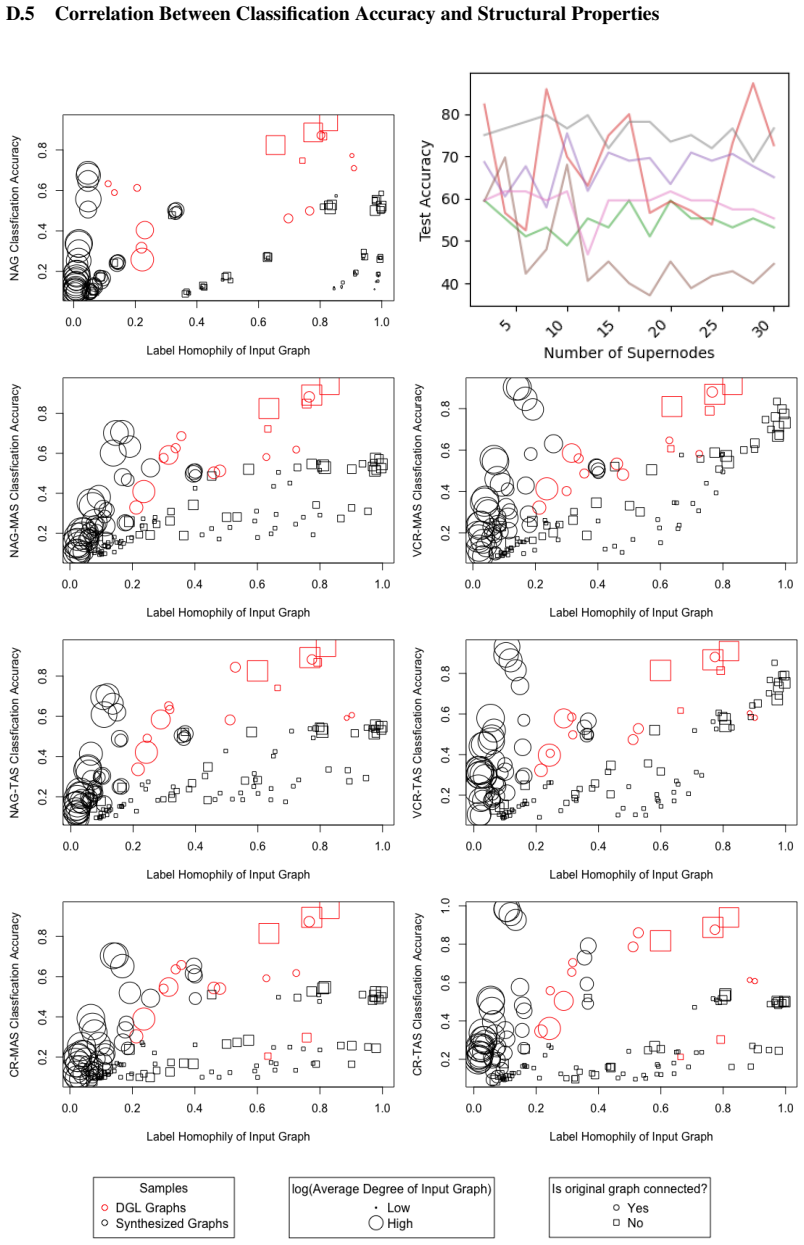
- Performance tracks structural properties of the rewired graphs.
Where Pith is reading between the lines
- The same reinforcement principle might extend to link-prediction or graph-level tasks if label alignment generalizes beyond nodes.
- Combining the rewiring with bottleneck-handling techniques could broaden the set of graphs where gains appear.
- The linear-time construction invites direct tests on graphs orders of magnitude larger than current benchmarks.
Load-bearing premise
Sufficient conditions exist under which reinforcement-based edge selection is more label-aligned than direct adjacency.
What would settle it
If node-classification accuracy fails to improve on heterophilic graphs or if the SBM witness shows two-hop reinforcement is not homophilic, the central claims would be falsified.
Figures
read the original abstract
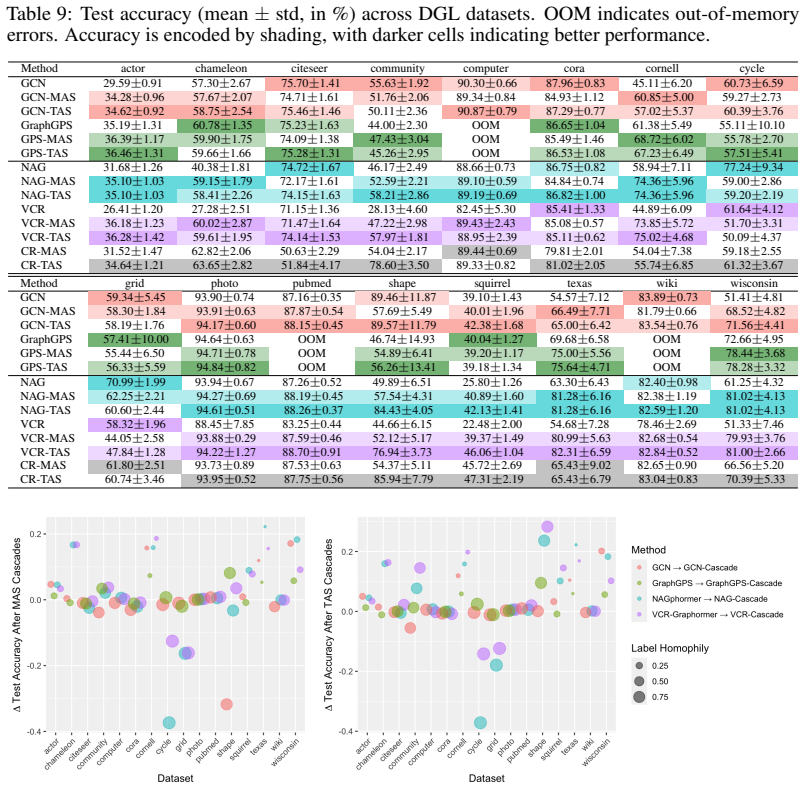
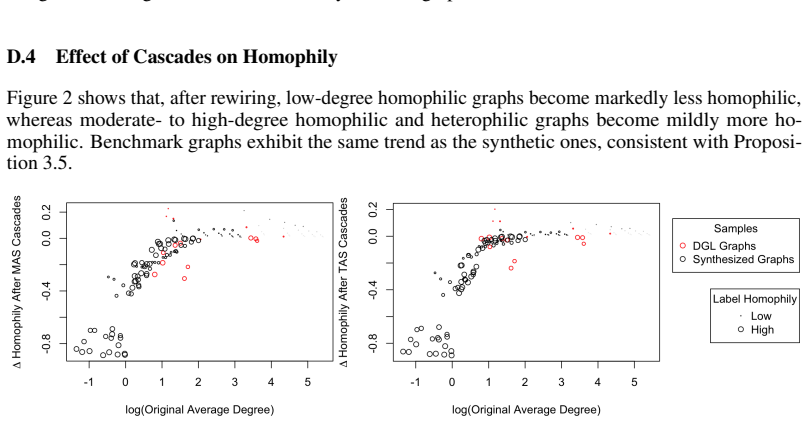
We introduce Graph Cascades, a mesoscopic rewiring strategy for Graph Neural Networks (GNNs) and Graph Transformers (GTs) that captures intermediate-scale graph structure beyond purely local edges or fully global attention. Using contagion-based diffusion processes, Graph Cascades constructs, in O(|V|+|E|) time, an auxiliary graph where node pairs supported by repeated multi-hop reinforcement are promoted to direct neighbors. We theoretically characterize when reinforcement-based rewiring helps: sufficient conditions under which reinforcement-based edge selection is more label-aligned than direct adjacency, an SBM witness in which two-hop reinforcement is perfectly homophilic, and a formalization of mesoscopic connectivity via graph effective resistance. Empirically, across node-classification benchmarks, Graph Cascades improves multiple GNN and sparse-GT backbones, with the most reliable gains observed on heterophilic and moderate- to high-degree homophilic graphs. The theoretical conditions also identify regimes where mesoscopic rewiring is unlikely to be beneficial -- low-degree regular graphs and graphs with structural bottlenecks -- and these predictions match the observed failures. We additionally observe tight correlations between performance and structural properties in the rewired graphs.
Editorial analysis
A structured set of objections, weighed in public.
Referee Report
Summary. The paper introduces Graph Cascades, a mesoscopic rewiring strategy for GNNs and GTs using contagion-based diffusion processes to construct an auxiliary graph in O(|V|+|E|) time by promoting node pairs with repeated multi-hop reinforcement. It theoretically characterizes when this helps via sufficient conditions for label-aligned reinforcement-based edge selection over direct adjacency, an SBM witness where two-hop reinforcement is perfectly homophilic, and a formalization via graph effective resistance. Empirically it reports improvements on node-classification benchmarks for multiple backbones, strongest on heterophilic and moderate- to high-degree homophilic graphs, while identifying failure regimes (low-degree regular graphs, structural bottlenecks) that match observations, plus correlations between performance and rewired-graph properties.
Significance. If the theoretical conditions and SBM witness hold with explicit verification, the method provides an efficient, structure-aware preprocessing step that could benefit GNNs and sparse GTs on heterophilic data without high computational cost. The explicit identification of failure regimes and observed structural correlations strengthen the contribution by making the claims falsifiable. The O(|V|+|E|) complexity and use of effective resistance are attractive formal elements if the label-alignment argument generalizes.
major comments (1)
- [Theoretical characterization (SBM witness)] Theoretical characterization (SBM witness section): The claim that two-hop reinforcement is perfectly homophilic requires explicit parameter verification of intra-/inter-block probabilities and community sizes to confirm that the reinforcement step selects only intra-block pairs; without this, the sufficient condition for label-alignment may not generalize beyond the toy case and the effective-resistance formalization may not bridge to empirical regimes.
Simulated Author's Rebuttal
We thank the referee for their constructive feedback. We address the single major comment below and will revise the manuscript to incorporate the requested clarification.
read point-by-point responses
-
Referee: Theoretical characterization (SBM witness section): The claim that two-hop reinforcement is perfectly homophilic requires explicit parameter verification of intra-/inter-block probabilities and community sizes to confirm that the reinforcement step selects only intra-block pairs; without this, the sufficient condition for label-alignment may not generalize beyond the toy case and the effective-resistance formalization may not bridge to empirical regimes.
Authors: We agree that the SBM witness would benefit from explicit parameters to make the homophily claim verifiable. In the revised manuscript we will add concrete values (e.g., two equal-sized blocks of 200 nodes each, intra-block probability p=0.85, inter-block probability q=0.05) and show that the two-hop reinforcement step selects exclusively intra-block pairs under these parameters. This will also make explicit how the witness instantiates the general label-alignment sufficient conditions and how the effective-resistance view extends the same structural argument. revision: yes
Circularity Check
No circularity; derivation self-contained with external theoretical grounding
full rationale
The paper introduces Graph Cascades as an explicit new construction (contagion-based diffusion in O(|V|+|E|) time) and separately states sufficient conditions, an SBM witness example, and effective-resistance formalization as theoretical characterization. No quoted step reduces a claimed prediction or uniqueness result to a fitted parameter, self-citation chain, or definitional renaming. Empirical gains are reported on external benchmarks and correlated with structural properties of the rewired graphs, independent of the theory. The SBM witness is presented as one illustrative case under which two-hop reinforcement is homophilic, not as a load-bearing self-definition or imported uniqueness theorem. This matches the default expectation that most papers are non-circular.
Axiom & Free-Parameter Ledger
Reference graph
Works this paper leans on
-
[1]
Communication, Simulation, and Intelligent Agents: Implications of Personal Intelligent Machines for Medical Education
Clancey, William J. Communication, Simulation, and Intelligent Agents: Implications of Personal Intelligent Machines for Medical Education. Proceedings of the Eighth International Joint Conference on Artificial Intelligence (IJCAI-83)
-
[2]
Classification Problem Solving
Clancey, William J. Classification Problem Solving. Proceedings of the Fourth National Conference on Artificial Intelligence
-
[3]
, title =
Robinson, Arthur L. , title =. 1980 , doi =. https://science.sciencemag.org/content/208/4447/1019.full.pdf , journal =
1980
-
[4]
New Ways to Make Microcircuits Smaller---Duplicate Entry
Robinson, Arthur L. New Ways to Make Microcircuits Smaller---Duplicate Entry. Science
-
[5]
Clancey and Glenn Rennels , abstract =
Diane Warner Hasling and William J. Clancey and Glenn Rennels , abstract =. Strategic explanations for a diagnostic consultation system , journal =. 1984 , issn =. doi:https://doi.org/10.1016/S0020-7373(84)80003-6 , url =
-
[6]
and Rennels, Glenn R
Hasling, Diane Warner and Clancey, William J. and Rennels, Glenn R. and Test, Thomas. Strategic Explanations in Consultation---Duplicate. The International Journal of Man-Machine Studies
-
[7]
Poligon: A System for Parallel Problem Solving
Rice, James. Poligon: A System for Parallel Problem Solving
-
[8]
Transfer of Rule-Based Expertise through a Tutorial Dialogue
Clancey, William J. Transfer of Rule-Based Expertise through a Tutorial Dialogue
-
[9]
The Engineering of Qualitative Models
Clancey, William J. The Engineering of Qualitative Models
-
[10]
2017 , eprint=
Attention Is All You Need , author=. 2017 , eprint=
2017
-
[11]
Pluto: The 'Other' Red Planet
NASA. Pluto: The 'Other' Red Planet
-
[12]
Proceedings of the 26th International Conference on World Wide Web , pages=
Scalable Motif-Aware Graph Clustering , author=. Proceedings of the 26th International Conference on World Wide Web , pages=
-
[13]
Proceedings of the 27th ACM SIGKDD Conference on Knowledge Discovery & Data Mining , pages=
Triangle-Aware Spectral Sparsifiers and Community Detection , author=. Proceedings of the 27th ACM SIGKDD Conference on Knowledge Discovery & Data Mining , pages=
-
[14]
Chaitanya, Meher and Jaglan, Kshitijaa and Brandes, Ulrik , journal=
-
[15]
Theoretical Computer Science , volume=
Combinatorial Model and Bounds for Target Set Selection , author=. Theoretical Computer Science , volume=. 2010 , publisher=
2010
-
[16]
International AAAI Conference on Web and Social Media , pages=
Al Zamal, Faiyaz and Liu, Wendy and Ruths, Derek , title =. International AAAI Conference on Web and Social Media , pages=
-
[17]
Nature Human Behaviour , volume=
Social Influence Maximization Under Empirical Influence Models , author=. Nature Human Behaviour , volume=. 2018 , publisher=
2018
-
[18]
Romantic Partnerships and the Dispersion of Social Ties: A Network Analysis of Relationship Status on
Backstrom, Lars and Kleinberg, Jon , journal=. Romantic Partnerships and the Dispersion of Social Ties: A Network Analysis of Relationship Status on
-
[19]
Nature Human Behaviour , volume=
Information Flow Reveals Prediction Limits in Online Social Activity , author=. Nature Human Behaviour , volume=. 2019 , publisher=
2019
-
[20]
Knowledge and Information Systems , pages=
A Survey on Influence Maximization in a Social Network , author=. Knowledge and Information Systems , pages=. 2020 , volume=
2020
-
[21]
PLOS ONE , volume=
The Critical Periphery in the Growth of Social Protests , author=. PLOS ONE , volume=. 2015 , publisher=
2015
-
[22]
and Everett, Martin G
Borgatti, Stephen P. and Everett, Martin G. and Shirey, Paul R. , journal=. 1990 , publisher=
1990
-
[23]
Methodological Innovations , volume=
Network Positions , author=. Methodological Innovations , volume=
-
[24]
2018 , publisher=
How Behavior Spreads: The Science of Complex Contagions , author=. 2018 , publisher=
2018
-
[25]
Nature Human Behaviour , volume=
Influential Networks , author=. Nature Human Behaviour , volume=. 2019 , publisher=
2019
-
[26]
2016 , publisher=
The Probabilistic Method , author=. 2016 , publisher=
2016
-
[27]
Specformer: Spectral
Bo, Deyu and Shi, Chuan and Wang, Lele and Liao, Renjie , booktitle=. Specformer: Spectral
-
[28]
Wu, Qitian and Zhao, Wentao and Yang, Chenxiao and Zhang, Hengrui and Nie, Fan and Jiang, Haitian and Bian, Yatao and Yan, Junchi , journal=
-
[29]
Ma, Jiahong and He, Mingguo and Wei, Zhewei , booktitle=
-
[30]
Bohang Zhang and Shengjie Luo and Liwei Wang and Di He , booktitle=
-
[31]
Nature Communications , volume=
Topological Measures for Identifying and Predicting the Spread of Complex Contagions , author=. Nature Communications , volume=. 2021 , publisher=
2021
-
[32]
Complex Networks & Their Applications X: Volume 2, Proceedings of the Tenth International Conference on Complex Networks and Their Applications COMPLEX NETWORKS 2021 10 , pages=
Hardness Results for Seeding Complex Contagion with Neighborhoods , author=. Complex Networks & Their Applications X: Volume 2, Proceedings of the Tenth International Conference on Complex Networks and Their Applications COMPLEX NETWORKS 2021 10 , pages=. 2022 , organization=
2021
-
[33]
Proceedings of the International AAAI Conference on Web and Social Media , volume=
Tight Sampling in Unbounded Networks , author=. Proceedings of the International AAAI Conference on Web and Social Media , volume=
-
[34]
Least Squares Quantization in
Lloyd, Stuart , journal=. Least Squares Quantization in. 1982 , publisher=
1982
-
[35]
Wiley Interdisciplinary Reviews: Data Mining and Knowledge Discovery , volume=
Algorithms for Hierarchical Clustering: An Overview , author=. Wiley Interdisciplinary Reviews: Data Mining and Knowledge Discovery , volume=. 2012 , publisher=
2012
-
[36]
Understanding Popularity, Reputation, and Social Influence in the
Garcia, David and Mavrodiev, Pavlin and Casati, Daniele and Schweitzer, Frank , journal=. Understanding Popularity, Reputation, and Social Influence in the. 2017 , publisher=
2017
-
[37]
Proceedings of the 18th International Conference on World Wide Web , pages=
To Join or Not to Join: The Illusion of Privacy in Social Networks with Mixed Public and Private User Profiles , author=. Proceedings of the 18th International Conference on World Wide Web , pages=
-
[38]
Science , volume=
The Spread of Behavior in an Online Social Network Experiment , author=. Science , volume=. 2010 , publisher=
2010
-
[39]
1978 , author=
Matrix Tree Theorems , journal=. 1978 , author=
1978
-
[40]
Approximation, Randomization, and Combinatorial Optimization
On Approximating Target Set Selection , author=. Approximation, Randomization, and Combinatorial Optimization. Algorithms and Techniques , year=
-
[41]
Proceedings of the Nineteenth Annual ACM-SIAM Symposium on Discrete Algorithms , pages=
On the Approximability of Influence in Social Networks , author=. Proceedings of the Nineteenth Annual ACM-SIAM Symposium on Discrete Algorithms , pages=. 2008 , publisher=
2008
-
[42]
Theory of Computing Systems , volume=
Constant Thresholds Can Make Target Set Selection Tractable , author=. Theory of Computing Systems , volume=. 2014 , publisher=
2014
-
[43]
Current Biology , volume=
Collective Animal Migration , author=. Current Biology , volume=
-
[44]
1978 , publisher=
Granovetter, Mark , journal=. 1978 , publisher=
1978
-
[45]
New England Journal of Medicine , volume=
The Spread of Obesity in a Large Social Network Over 32 Years , author=. New England Journal of Medicine , volume=. 2007 , publisher=
2007
-
[46]
Journal of the American Statistical Association , volume=
Reaching a Consensus , author=. Journal of the American Statistical Association , volume=. 1974 , publisher=
1974
-
[47]
Discrete Applied Mathematics , volume=
Irreversible k -Threshold Processes: Graph-Theoretical Threshold Models of the Spread of Disease and of Opinion , author=. Discrete Applied Mathematics , volume=. 2009 , publisher=
2009
-
[48]
Networks , volume=
The Graph Voronoi Diagram with Applications , author=. Networks , volume=. 2000 , publisher=
2000
-
[49]
Kernelization: Theory of Parameterized Preprocessing , author=
-
[50]
Studies in Social Power , pages=
The Bases of Social Power , author=. Studies in Social Power , pages=
-
[51]
Psychological Review , volume=
A Formal Theory of Social Power , author=. Psychological Review , volume=. 1956 , publisher=
1956
-
[52]
The Journal of Mathematical Sociology , volume=
A Formal Theory of Social Power , author=. The Journal of Mathematical Sociology , volume=. 1986 , publisher=
1986
-
[53]
EPJ Data Science , volume=
Collective Aspects of Privacy in the Twitter Social Network , author=. EPJ Data Science , volume=. 2018 , publisher=
2018
-
[54]
Lim, Derek and Robinson, Joshua and Zhao, Lingxiao and Smidt, Tess and Sra, Suvrit and Maron, Haggai and Jegelka, Stefanie , journal=
-
[55]
Proceedings of the 20th International Conference Companion on World Wide Web , pages=
CELF++: Optimizing the Greedy Algorithm for Influence Maximization in Social Networks , author=. Proceedings of the 20th International Conference Companion on World Wide Web , pages=
-
[56]
Networks & Heterogeneous Media , volume=
Opinion Dynamics Under the Influence of Radical Groups, Charismatic Leaders, and Other Constant Signals: A Simple Unifying Model , author=. Networks & Heterogeneous Media , volume=. 2015 , publisher=
2015
-
[57]
PLOS ONE , volume=
One Plus One Makes Three (for Social Networks) , author=. PLOS ONE , volume=. 2012 , publisher=
2012
-
[58]
Public Opinion Quarterly , volume=
The Two-Step Flow of Communication: An Up-to-Date Report on an Hypothesis , author=. Public Opinion Quarterly , volume=. 1957 , publisher=
1957
-
[59]
International Colloquium on Automata, Languages, and Programming , pages=
Influential Nodes in a Diffusion Model for Social Networks , author=. International Colloquium on Automata, Languages, and Programming , pages=. 2005 , organization=
2005
-
[60]
Proceedings of the Ninth ACM SIGKDD International Conference on Knowledge Discovery and Data Mining , pages=
Maximizing the Spread of Influence through a Social Network , author=. Proceedings of the Ninth ACM SIGKDD International Conference on Knowledge Discovery and Data Mining , pages=
-
[61]
Inductive Representation Learning on Large Graphs , volume =
Hamilton, Will and Ying, Zhitao and Leskovec, Jure , booktitle =. Inductive Representation Learning on Large Graphs , volume =
-
[62]
Kipf and Max Welling , booktitle=
Thomas N. Kipf and Max Welling , booktitle=
-
[63]
2008 , publisher=
Ghosh, Arpita and Boyd, Stephen and Saberi, Amin , journal=. 2008 , publisher=
2008
-
[64]
Maximizing the Spread of Influence through a Social Network , year =
Kempe, David and Kleinberg, Jon and Tardos,. Maximizing the Spread of Influence through a Social Network , year =. Theory of Computing , volume =
-
[65]
Information Processing Letters , volume=
Hardness Results and Approximation Algorithms of K-Tuple Domination in Graphs , author=. Information Processing Letters , volume=. 2004 , publisher=
2004
-
[66]
1981 , publisher=
Rational Consensus in Science and Society: A Philosophical and Mathematical Study , author=. 1981 , publisher=
1981
-
[67]
Proceedings of the 13th ACM SIGKDD International Conference on Knowledge Discovery and Data Mining , pages=
Cost-Effective Outbreak Detection in Networks , author=. Proceedings of the 13th ACM SIGKDD International Conference on Knowledge Discovery and Data Mining , pages=
-
[68]
New Journal of Physics , volume=
Opinion Control in Complex Networks , author=. New Journal of Physics , volume=. 2015 , publisher=
2015
-
[69]
International Conference on Foundations of Software Technology and Theoretical Computer Science , pages=
On the Hardness of Approximating Minimum Monopoly Problems , author=. International Conference on Foundations of Software Technology and Theoretical Computer Science , pages=. 2002 , organization=
2002
-
[70]
PLOS ONE , volume=
Social Influence and the Collective Dynamics of Opinion Formation , author=. PLOS ONE , volume=. 2013 , publisher=
2013
-
[71]
Mathematical Programming , volume=
An Analysis of Approximations for Maximizing Submodular Set Functions—I , author=. Mathematical Programming , volume=. 1978 , publisher=
1978
-
[72]
Social Network Analysis and Mining , volume=
On Tractable Cases of Target Set Selection , author=. Social Network Analysis and Mining , volume=. 2013 , publisher=
2013
-
[73]
Simmelian Backbones: Amplifying Hidden Homophily in Facebook Networks , year =
Nick, Bobo and Lee, Conrad and Cunningham, P. Simmelian Backbones: Amplifying Hidden Homophily in Facebook Networks , year =
-
[74]
International Journal of Modern Physics C , volume=
From Classical to Modern Opinion Dynamics , author=. International Journal of Modern Physics C , volume=. 2020 , publisher=
2020
-
[75]
Annals of the International Communication Association , volume=
A Multitheoretical, Multilevel, Multidimensional Network Model of the Media System: Production, Content, and Audiences , author=. Annals of the International Communication Association , volume=. 2013 , publisher=
2013
-
[76]
Theoretical Computer Science , volume=
Local Majorities, Coalitions and Monopolies in Graphs: A Review , author=. Theoretical Computer Science , volume=. 2002 , publisher=
2002
-
[77]
2007 , publisher=
The Science of Social Influence: Advances and Future Progress , author=. 2007 , publisher=
2007
-
[78]
International Conference on Combinatorial Optimization and Applications , pages=
Parameterized Algorithms for Generalized Domination , author=. International Conference on Combinatorial Optimization and Applications , pages=. 2008 , organization=
2008
-
[79]
Discrete Mathematics , volume=
New Bounds for Contagious Sets , author=. Discrete Mathematics , volume=. 2012 , publisher=
2012
-
[80]
Iowa Agriculture and Home Economics Experiment Station Research Bulletin , volume=
Acceptance and Diffusion of Hybrid Corn Seed in Two Iowa Communities , author=. Iowa Agriculture and Home Economics Experiment Station Research Bulletin , volume=
discussion (0)
Sign in with ORCID, Apple, or X to comment. Anyone can read and Pith papers without signing in.