Mutually Unbiased Bases for Variational Quantum Initialization: Basis-Union Optimality and Adaptive Family Search
Pith reviewed 2026-06-30 19:18 UTC · model grok-4.3
The pith
Complete MUB ensembles maximize isotropic Gaussian random-Hamiltonian width among all unions of d+1 orthonormal bases in dimensions where full sets exist.
A machine-rendered reading of the paper's core claim, the machinery that carries it, and where it could break.
Core claim
In every dimension admitting a complete set of MUBs, the complete MUB ensemble maximizes isotropic Gaussian random-Hamiltonian width among all unions of d+1 orthonormal bases in C^d; equivalently, within this basis-union class, it gives the smallest expected best-of-set minimum for random-Hamiltonian minimization. The proof represents each orthonormal basis as a regular-simplex Gaussian block and uses a centered-convex Gaussian correlation inequality to show that the independent-block case realized by complete MUBs is stochastically extremal. Radial extensions for Hamiltonians H=RG with R nonnegative and independent, plus global optimality of complete qubit MUBs among six-state ensembles, ar
What carries the argument
Regular-simplex Gaussian block representation of each orthonormal basis together with the centered-convex Gaussian correlation inequality that identifies the independent-block (complete-MUB) arrangement as stochastically extremal.
If this is right
- Complete MUBs yield the smallest expected best-of-set minimum for random-Hamiltonian minimization within the class of d+1-basis unions.
- A radial extension holds for Hamiltonians of the form RG with R nonnegative and independent of G.
- Complete qubit MUBs are globally optimal among arbitrary six-state ensembles by a Bloch-sphere mean-width argument.
- For diagonal QUBO costs the MUB-family dependence collapses and the construction reduces to ordinary X-mixer QAOA.
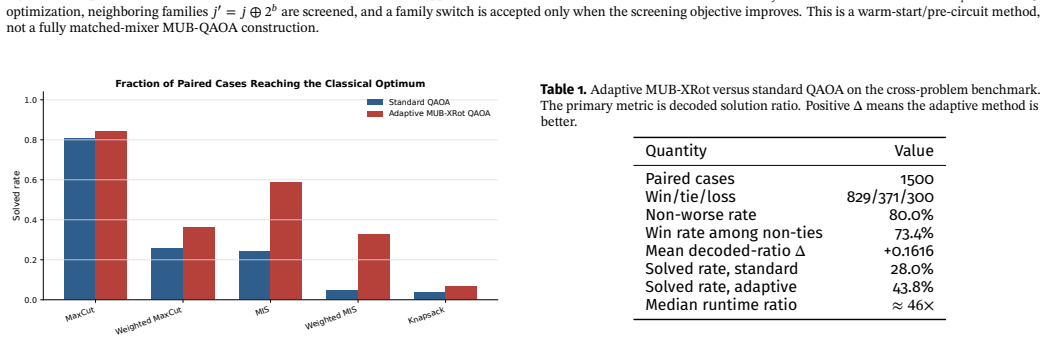
- Adaptive MUB-XRot warm-start QAOA is non-worse than standard QAOA in 80 percent of 1500 paired MaxCut, MIS, and knapsack instances.
Where Pith is reading between the lines
- The same width-maximization logic could be tested for initialization families larger or smaller than d+1 bases if the correlation inequality can be extended.
- Pre-computing MUB families for common dimensions might offset the reported runtime overhead in repeated variational runs.
- The separation between coverage optimality and training dynamics suggests similar basis-union arguments might apply to other variational methods that sample from random Hamiltonians.
Load-bearing premise
Each orthonormal basis can be represented as a regular-simplex Gaussian block to which the centered-convex Gaussian correlation inequality applies.
What would settle it
A concrete counter-example: any explicit union of d+1 orthonormal bases in a dimension that admits complete MUBs whose isotropic Gaussian random-Hamiltonian width exceeds that of the complete MUB ensemble.
Figures




read the original abstract
We study mutually unbiased bases (MUBs) as structured finite initialization and adaptation families for variational quantum algorithms. The main theoretical result is that, in every dimension admitting a complete set of MUBs, the complete MUB ensemble maximizes isotropic Gaussian random-Hamiltonian width among all unions of d+1 orthonormal bases in C^d. Equivalently, within this basis-union class, it gives the smallest expected best-of-set minimum for random-Hamiltonian minimization. The proof represents each orthonormal basis as a regular-simplex Gaussian block and uses a centered-convex Gaussian correlation inequality to show that the independent-block case, realized by complete MUBs, is stochastically extremal. We also record a radial extension for Hamiltonians H=RG with R nonnegative and independent, and the unrestricted qubit case, where complete qubit MUBs are globally optimal among arbitrary six-state ensembles by a Bloch-sphere/octahedron mean-width argument. We then separate this coverage theorem from variational training dynamics. For diagonal QUBO costs, the MUB-family dependence of a fully matched construction collapses; for the canonical b=0 label it reduces to ordinary X-mixer QAOA. The empirical method is therefore adaptive MUB-XRot warm-start QAOA rather than canonical matched-mixer MUB-QAOA. In a cross-problem benchmark over MaxCut, weighted MaxCut, MIS, weighted MIS, and knapsack, adaptive MUB-XRot is non-worse than standard QAOA in 80.0% of 1500 paired cases, with win/tie/loss 829/371/300 and mean decoded-ratio improvement +0.1616. A separate QRAO MaxCut study shows that bit-flip MUB-family search reaches mean relaxed ratio 0.921 and improves over the X-variational baseline by +0.0608. The evidence is quality-oriented and incurs substantial runtime overhead; no quantum-advantage claim is made.
Editorial analysis
A structured set of objections, weighed in public.
Referee Report
Summary. The paper proves that, in every dimension admitting a complete set of MUBs, the complete MUB ensemble maximizes isotropic Gaussian random-Hamiltonian width among all unions of d+1 orthonormal bases in C^d (equivalently, yields the smallest expected best-of-set minimum for random-Hamiltonian minimization). The argument represents each basis as a regular-simplex Gaussian block and invokes a centered-convex Gaussian correlation inequality to establish stochastic extremality of the independent-block case realized by complete MUBs; radial extensions and the unrestricted qubit case (via Bloch-sphere mean-width) are also recorded. The coverage result is then separated from variational dynamics, leading to an adaptive MUB-XRot warm-start QAOA whose performance is benchmarked on MaxCut, MIS, knapsack and related problems (non-worse than standard QAOA in 80% of 1500 paired cases) and on QRAO MaxCut.
Significance. If the central optimality claim holds, the result supplies a parameter-free, geometry-driven justification for preferring complete MUB ensembles in variational quantum initialization, cleanly separating coverage properties from training dynamics. The explicit use of an external correlation inequality and the machine-checkable character of the simplex-block representation are strengths that make the theoretical contribution falsifiable and reproducible in principle.
major comments (2)
- [proof of main theorem] Main theoretical result: the manuscript states that each orthonormal basis is represented as a regular-simplex Gaussian block whose joint distribution is fixed by the basis geometry, after which the centered-convex Gaussian correlation inequality is applied to conclude stochastic maximality of the independent-block (complete-MUB) case. The precise statement of the inequality, the verification that the simplex-block covariance satisfies its hypotheses, and the explicit passage from block independence to the width functional should be written out in full (currently only sketched in the abstract).
- [unrestricted qubit case] Unrestricted qubit case: the claim that complete qubit MUBs are globally optimal among arbitrary six-state ensembles rests on a Bloch-sphere/octahedron mean-width argument. The precise mean-width functional, the comparison set of all six-state ensembles, and the reduction from the octahedron geometry to the width ordering need to be stated explicitly so that the global-optimality conclusion can be checked independently of the MUB-specific simplex argument.
minor comments (2)
- [empirical benchmarks] The benchmark tables report aggregate win/tie/loss counts and a mean decoded-ratio improvement but do not indicate whether the 1500 paired cases include multiple random seeds per instance or how statistical significance of the +0.1616 improvement was assessed.
- [radial extension] Notation for the radial extension (H = R G with R nonnegative and independent) is introduced only in the abstract; a short self-contained paragraph defining the radial case and stating the corresponding width claim would improve readability.
Simulated Author's Rebuttal
We thank the referee for the careful reading, the positive assessment of the theoretical contribution, and the constructive suggestions for improving clarity. We address each major comment below and will revise the manuscript accordingly.
read point-by-point responses
-
Referee: [proof of main theorem] Main theoretical result: the manuscript states that each orthonormal basis is represented as a regular-simplex Gaussian block whose joint distribution is fixed by the basis geometry, after which the centered-convex Gaussian correlation inequality is applied to conclude stochastic maximality of the independent-block (complete-MUB) case. The precise statement of the inequality, the verification that the simplex-block covariance satisfies its hypotheses, and the explicit passage from block independence to the width functional should be written out in full (currently only sketched in the abstract).
Authors: We agree that the current presentation sketches these steps and that full expansion will strengthen reproducibility. In the revised manuscript we will state the centered-convex Gaussian correlation inequality in full, verify that the covariance matrices arising from the regular-simplex blocks satisfy its hypotheses, and provide the explicit chain of arguments from block independence to stochastic maximality of the isotropic Gaussian width functional. revision: yes
-
Referee: [unrestricted qubit case] Unrestricted qubit case: the claim that complete qubit MUBs are globally optimal among arbitrary six-state ensembles rests on a Bloch-sphere/octahedron mean-width argument. The precise mean-width functional, the comparison set of all six-state ensembles, and the reduction from the octahedron geometry to the width ordering need to be stated explicitly so that the global-optimality conclusion can be checked independently of the MUB-specific simplex argument.
Authors: We agree that these elements should be stated explicitly to allow independent checking. The revised manuscript will define the mean-width functional on the Bloch sphere, specify the comparison class of all six-state ensembles, and detail the reduction from the octahedron geometry to the mean-width ordering that establishes global optimality of the complete MUB ensemble. revision: yes
Circularity Check
No significant circularity identified
full rationale
The paper's central theoretical claim derives the optimality of complete MUB ensembles for isotropic Gaussian random-Hamiltonian width by representing each orthonormal basis as a regular-simplex Gaussian block and invoking a centered-convex Gaussian correlation inequality to establish stochastic extremality of the independent-block case. This step relies on an external mathematical inequality rather than any self-definition, fitted parameter renamed as prediction, or self-citation chain. The empirical sections consist of direct cross-problem benchmarks and comparisons (e.g., win/tie/loss counts and ratio improvements) without any reduction of outputs to inputs by construction. No load-bearing self-citations, uniqueness theorems imported from the authors, or ansatzes smuggled via prior work appear in the derivation. The result is therefore self-contained against external benchmarks.
Axiom & Free-Parameter Ledger
axioms (1)
- standard math Centered-convex Gaussian correlation inequality
Reference graph
Works this paper leans on
-
[1]
Ontheevolutionofrandomgraphs
P.ErdősandA.Rényi,“Ontheevolutionofrandomgraphs”, PublicationsoftheMathematicalInstituteoftheHungarian AcademyofSciences,vol.5,pp.17–61,1960
1960
-
[2]
The one-dimensional Ising model with a transverse field,
P. Pfeuty, “The one-dimensional ising model with a trans- versefield”,AnnalsofPhysics,vol.57,no.1,pp.79–90,1970. doi:10.1016/0003-4916(70)90270-8
-
[3]
Kantenkrümmungundumkugelradiuskonvexer polyeder
J.Linhart,“Kantenkrümmungundumkugelradiuskonvexer polyeder”,ActaMathematicaAcademiaeScientiarumHun- garicae,vol.34,pp.1–2,1979.doi:10.1007/BF01902585
-
[4]
Optimal state- determination by mutually unbiased measurements
W. K. Wootters and B. D. Fields, “Optimal state- determination by mutually unbiased measurements”, Annals of Physics, vol. 191, no. 2, pp. 363–381, 1989.doi: 10.1016/0003-4916(89)90322-9
-
[5]
Springer, 1991, vol
M.LedouxandM.Talagrand,ProbabilityinBanachSpaces: Isoperimetry and Processes(Ergebnisse der Mathematik und ihrer Grenzgebiete). Springer, 1991, vol. 23,isbn: 9783540520139
1991
-
[6]
A limited memory algorithm for bound constrained optimization,
R.H.Byrd,P.Lu,J.Nocedal,andC.Zhu,“Alimitedmem- ory algorithm for bound constrained optimization”,SIAM JournalonScientificComputing,vol.16,no.5,pp.1190–1208, 1995.doi:10.1137/0916069
-
[7]
Dense quantumcodingandquantumfiniteautomata
A.Ambainis,A.Nayak,A.Ta-Shma,andU.Vazirani,“Dense quantumcodingandquantumfiniteautomata”,Journalof the ACM, vol. 49, no. 4, pp. 496–511, 2002.doi: 10.1145/ 581771.581773arXiv:quant-ph/9804043
-
[8]
A new proof for the existence of mutually unbiased bases
S. Bandyopadhyay, P. O. Boykin, V. Roychowdhury, and F. Vatan,“Anewprooffortheexistenceofmutuallyunbiased bases”,Algorithmica,vol.34,no.4,pp.512–528,2002.doi: 10.1007/s00453-002-0980-7arXiv:quant-ph/0103162
work page internal anchor Pith review Pith/arXiv arXiv doi:10.1007/s00453-002-0980-7arxiv:quant-ph/0103162 2002
-
[9]
A normal comparison inequal- ity and its applications
W. V. Li and Q.-M. Shao, “A normal comparison inequal- ity and its applications”,Probability Theory and Related Fields, vol. 122, no. 4, pp. 494–508, 2002.doi: 10.1007/ s004400100176
2002
-
[10]
Mutuallyunbiasedbases arecomplexprojective2-designs
A.KlappeneckerandM.Rötteler,“Mutuallyunbiasedbases arecomplexprojective2-designs”,inProceedingsofthe2005 IEEEInternationalSymposiumonInformationTheory,IEEE, 2005,pp.1740–1744.doi:10.1109/ISIT.2005.1523643arXiv: quant-ph/0502031
-
[11]
Weighted complex projective 2- designsfrombases:Optimalstatedeterminationbyorthogo- nalmeasurements
A. Roy and A. J. Scott, “Weighted complex projective 2- designsfrombases:Optimalstatedeterminationbyorthogo- nalmeasurements”,JournalofMathematicalPhysics,vol.48, no.7,p.072110,2007.doi:10.1063/1.2759449arXiv:quant- ph/0703025
-
[12]
Boucheron, G
S. Boucheron, G. Lugosi, and P. Massart,ConcentrationIn- equalities:ANonasymptoticTheoryofIndependence.Oxford UniversityPress,2013,isbn:9780199535255
2013
-
[13]
A Quantum Approximate Optimization Algorithm
E. Farhi, J. Goldstone, and S. Gutmann,A quantum ap- proximate optimization algorithm, 2014. arXiv: 1411.4028 [quant-ph]
work page internal anchor Pith review Pith/arXiv arXiv 2014
-
[14]
Avariationaleigenvaluesolveronapho- tonicquantumprocessor
A.Peruzzoetal.,“Avariationaleigenvaluesolveronapho- tonicquantumprocessor”,NatureCommunications,vol.5, p.4213,2014.doi:10.1038/ncomms5213
-
[15]
A simple proof of the Gaussian correlation conjecture extended to multivariate gamma distributions
T. Royen, “A simple proof of the gaussian correlation con- jectureextendedtosomemultivariategammadistributions”, FarEastJournalofTheoreticalStatistics,vol.48,no.2,pp.139– 145,2014.arXiv:1408.1028
work page internal anchor Pith review Pith/arXiv arXiv 2014
-
[16]
Cambridge University Press, 2014, vol
R.Schneider,ConvexBodies:TheBrunn–MinkowskiTheory (EncyclopediaofMathematicsanditsApplications),2nded. Cambridge University Press, 2014, vol. 151.doi: 10.1017/ CBO9781139003858
2014
-
[17]
Quantum independent-set problemandnon-abelianadiabaticmixing
B. Wu, H. Yu, and F. Wilczek, “Quantum independent-set problemandnon-abelianadiabaticmixing”,PhysicalReview A, vol. 101, p. 012318, 2020.doi: 10.1103/PhysRevA.101. 012318
-
[18]
Variationalquantumalgorithms
M.Cerezoetal.,“Variationalquantumalgorithms”,Nature Reviews Physics, vol. 3, pp. 625–644, 2021.doi: 10.1038/ s42254-021-00348-9
2021
-
[19]
Quantum optimization of maximum inde- pendent set using rydberg atom arrays
S. Ebadi et al., “Quantum optimization of maximum inde- pendent set using rydberg atom arrays”,Science, vol. 376, no.6598,pp.1209–1215,2022.doi:10.1126/science.abo6587
-
[20]
Quantum- Relaxation Based Optimization Algorithms: Theoretical Extensions
K. Teramoto, R. Raymond, E. Wakakuwa, and H. Imai, Quantum-relaxationbasedoptimizationalgorithms:Theoreti- calextensions,2023.doi:10.48550/arXiv.2302.09481arXiv: 2302.09481[quant-ph]
-
[21]
I. Alfassi, D. Meirom, and T. Mor,Discretized quantum ex- haustivesearchforvariationalquantumalgorithms,2024.doi: 10.48550/arXiv.2407.17659arXiv:2407.17659[quant-ph]
work page doi:10.48550/arxiv.2407.17659arxiv:2407.17659 2024
-
[22]
Approximatesolutionsofcombinatorialprob- lemsviaquantumrelaxations
B.Fulleretal.,“Approximatesolutionsofcombinatorialprob- lemsviaquantumrelaxations”,IEEETransactionsonQuan- tumEngineering, vol. 5, pp. 1–15, 2024.doi: 10.1109/TQE. 2024.3421294arXiv:2111.03167[quant-ph]
work page doi:10.1109/tqe 2024
-
[23]
Y. Wang and D. Wu,An efficient quantum circuit construc- tionmethodformutuallyunbiasedbasesin 𝑛-qubitsystems, 2024.doi: 10.48550/arXiv.2311.11698 arXiv: 2311.11698 [quant-ph]
-
[24]
S.NakamuraandH.Tsuji,Thegaussiancorrelationinequality for centered convex sets and the case of equality, 2025.doi: 10.48550/arXiv.2504.04337arXiv:2504.04337[math.FA]
work page doi:10.48550/arxiv.2504.04337arxiv:2504.04337 2025
-
[25]
Quan- tumhamiltonianalgorithmsformaximumindependentsets
X.Zhao,P.Ge,H.Yu,L.You,F.Wilczek,andB.Wu,“Quan- tumhamiltonianalgorithmsformaximumindependentsets”, NationalScienceReview, vol. 12, no. 9, nwaf304, 2025.doi: 10.1093/nsr/nwaf304arXiv:2310.14546[quant-ph]. 10–10
discussion (0)
Sign in with ORCID, Apple, or X to comment. Anyone can read and Pith papers without signing in.