REVIEW 3 major objections 5 minor 18 references
Follow the Flow: Fine-grained Flowchart Attribution with Neurosymbolic Agents
T0 review · 3 major / 5 minor · reviewed 2026-08-07 · deepseek-v4-flash
Pith's one-line read The paper introduces Fine-grained Flowchart Attribution and claims that its neurosymbolic agent, FlowPathAgent, grounds LLM answers in explicit graph paths over flowcharts, reducing visual hallucination and outperforming strong baselines…
desk verdict A useful new task and benchmark, but the headline gains are overstated and the evaluation has a circularity risk that the paper's own evidence doesn't close. read the letter →
The pith
A machine-rendered reading of the paper's core claim, the machinery that carries it, and where it could break.
The reading
What carries the argument
The load-bearing object is the symbolic graph built from the flowchart: nodes carry the text of each step, directed edges carry optional Yes/No conditions, and node labels from segmentation tie the graph back to visual regions in the image. FlowPathAgent's neurosymbolic loop operates on this graph: first segmentation labels components (FlowMask2Former), then a fine-tuned Qwen2-VL converts the labeled image to Mermaid code that is parsed into the graph, and finally an agent repeatedly selects nodes and invokes tools such as get_statement, get_ancestors, get_descendants, path_between, and shortest_path until it emits final_answer. Because only the initial planning step consumes the labeled image and all later steps operate on tool observations, the reasoning is decoupled from visual recognition.
What would settle it
Compare FlowPathAgent's attributed paths with the original flowchart in samples where Flow2Mermaid VLM's generated Mermaid code is known to deviate from the source (for example, a missing edge or an inverted Yes/No condition); if the agent still returns a path that is logically consistent with the graph but visually impossible on the image, the graph-faithfulness assumption is violated. A controlled version is to delete one edge from the parsed graph and check that the agent's path changes exactly as the deletion predicts.
Extended reading notes
Core claim
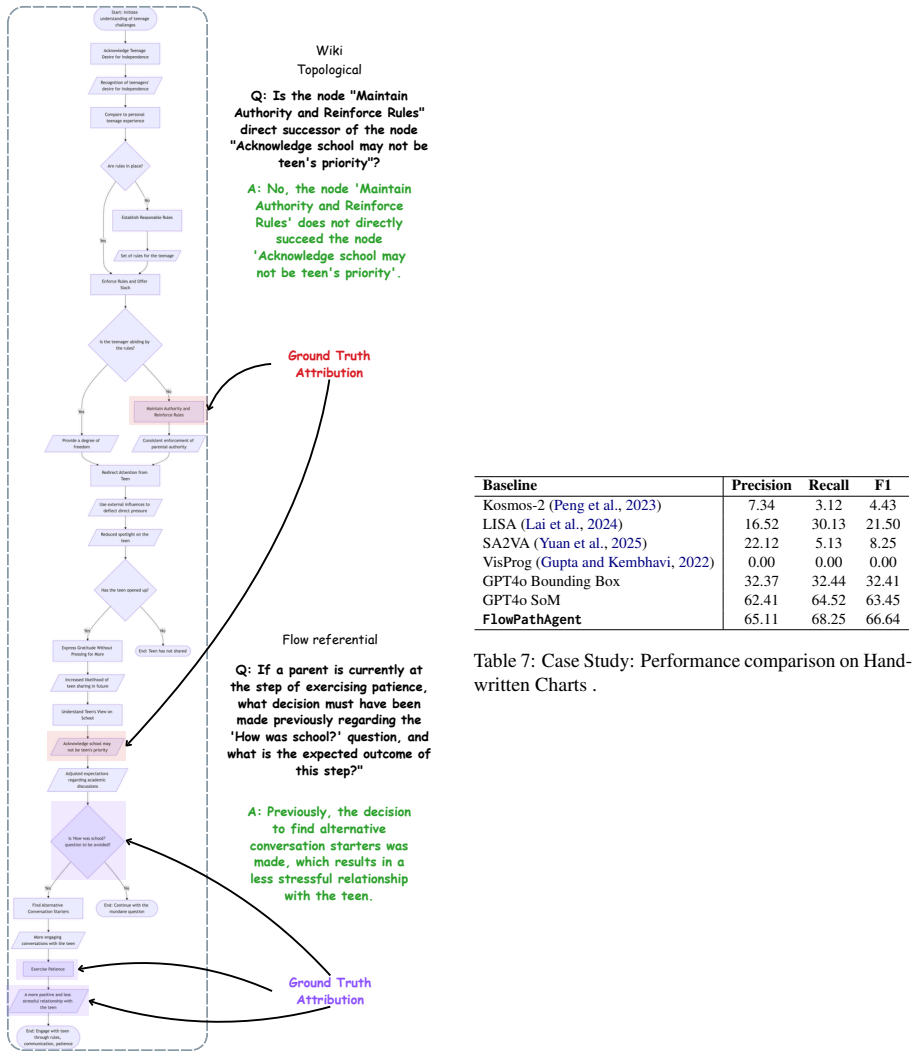
The paper's central claim is that post hoc attribution of a flowchart QA response should be performed as graph-based reasoning over a symbolic representation of the diagram, not as direct visual grounding. FlowPathAgent labels every flowchart component by instance segmentation, converts the labeled image into Mermaid code with a fine-tuned Qwen2-VL, parses that code into a directed graph whose edges carry Yes/No conditions, and then runs an agent that selects nodes, calls graph tools, and assembles the attributed path. The task definition requires the attributed path to be the shortest sequence of regions that is contextually aligned with the statement and exclusive of unnecessary regions. On FlowExplainBench, the paper reports an overall F1 of 77.20 for FlowPathAgent, ahead of all baselines, with the strongest baseline, GPT-4o with Set-of-Marks prompting, at 70.75.
Load-bearing premise
The load-bearing premise is that the symbolic graph the conversion model builds from a flowchart image faithfully represents the visual diagram, so paths the agent finds in the graph correspond to real paths in the picture rather than to artifacts of a corrupted transcription.
Editorial extensions
If this is right
- Attribution makes flowchart QA output verifiable: a user can inspect the exact nodes and decision branches that support a generated answer.
- The method is modular and post hoc, so it can be attached to existing LLM systems without retraining the response generator.
- Graph-based traversal keeps performance more stable on large flowcharts, where purely visual models degrade.
- FlowExplainBench gives the community a quantitative, human-agreement-checked target for measuring attribution quality across styles, domains, and question types.
Reading between the lines
- Abstractly, the segmentation-to-graph-to-tools recipe could transfer to other structured diagrams such as UML diagrams, circuit schematics, or decision trees, wherever layout encodes control flow.
- If graph faithfulness turns out to be the bottleneck, the highest-leverage improvement would be making the image-to-graph conversion verifiable, for example by letting the agent re-check edges against image crops.
- Since attribution is post hoc, the same signal could be used as a safety filter: an answer whose optimal attributed path is empty or self-contradictory could be flagged for human review.
- The benchmark's path criteria could also serve as a training signal for smaller models to produce attributions directly.
Editorial analysis
A structured set of objections, weighed in public.
Referee Report
Summary. This paper introduces Fine-grained Flowchart Attribution, the task of identifying the sequence of flowchart nodes/regions that ground a given question-answer statement, and proposes FlowPathAgent, a modular neurosymbolic system. FlowPathAgent first labels flowchart components with a fine-tuned Mask2Former variant (FlowMask2Former), converts the labeled flowchart into Mermaid code with a fine-tuned Qwen2-VL (Flow2Mermaid VLM), parses the Mermaid into a graph, and then uses an LLM agent equipped with graph tools (get_ancestors, path_between, etc.) to select an attributed path, which is mapped back to image regions. The authors also present FlowExplainBench, built from the FlowVQA test split across Code/Wiki/Instruct domains and four question types, with GPT-4-generated and human-verified (κ=0.89) node-path annotations. Experiments compare FlowPathAgent with Kosmos-2, LISA, SA2VA, VisProg, GPT-4o Bounding Box, and GPT-4o+SoM, reporting an overall F1 of 77.20 versus 70.75 for GPT-4o+SoM.
Significance. The paper proposes a genuinely new task and a benchmark that is carefully constructed: annotations are human-verified with high inter-annotator agreement, styles/domains/question types are balanced, and the benchmark construction details (including annotator guidelines and filtering) are documented. The neurosymbolic architecture is modular and the agent traces are interpretable. If the central claim—that FlowPathAgent reduces visual hallucinations by grounding answers in the flowchart structure—is supported, the work could make flowchart-based QA verifiable. The paper is transparent about its modular risks and includes a supplementary hand-drawn flowchart case study. However, the empirical support is currently incomplete: the headline improvement is not consistent with the reported numbers, and the evaluation does not yet directly establish structural fidelity of the image-to-graph conversion, which is the key link between the agent's symbolic reasoning and the visual content of the flowchart.
major comments (3)
- [Abstract; Section 7, Table 2] The abstract states that FlowPathAgent outperforms strong baselines by 10–14%, but Table 2 shows an overall F1 gain of 6.45 points over GPT-4o+SoM (77.20 vs 70.75), which is 9.1% relative; Section 7 reports a range of 6–65 percentage points. For the individual domains the relative improvements over GPT-4o+SoM are approximately 12.4% (Code), 8.3% (Wiki), and 8.1% (Instruct). Please clarify whether improvements are relative or absolute and update the abstract, introduction, and Section 7 so the reported margins are mutually consistent.
- [Sections 4.3, 5.2, 9; Table 3] The load-bearing uncertainty is whether Flow2Mermaid VLM's reconstructed Mermaid graph is structurally faithful to the visual flowchart. Ground-truth attributions are produced from the original Mermaid source code (Section 4.3, Step 1), while FlowPathAgent's reasoning uses the graph parsed from Flow2Mermaid's output (Section 5.2). If the reconstructed graph has wrong edge conditions, missing branches, or swapped statements, the agent can choose a path that is logically consistent with the graph but visually incorrect. The paper's own counter-evidence in Section 9—Word F1 of 0.89 and the IoU-binned analysis in Table 3—is not sufficient: Word F1 is a token-level measure, and IoU conditions only on segmentation quality, not on graph structure. I ask for a direct structural fidelity evaluation of Flow2Mermaid (node-level and edge-level precision/recall, including edge-condition accuracy) against the original Mermaid on a held-out subset, and an end-to-end breakdown of FlowPathAgent's F1 for structurally correct versus incorrect reconstructions.
- [Section 6.2] The evaluation metric is set-based. Although the task definition (Section 3) requires a sequence of regions and the running example (Fig 5) contrasts ordered paths (B→C→F→G→J→M→N vs C→F→G→J), Section 6.2 computes micro-averaged Precision/Recall/F1 over the set of nodes, which ignores order. A system that outputs the correct nodes in the wrong order receives full credit. Please add a sequence-aware metric (e.g., longest common subsequence or path edit distance) or otherwise justify that order is not needed for the attribution task.
minor comments (5)
- [Section 6.1; Table 2] LISA is cited as (Li et al., 2023b) in Section 6.1 and Appendix A.1, but Table 2 cites (Lai et al., 2024); the reference list contains both. Please use one consistent citation for this baseline.
- [Section 5.1] The fine-tuned model is referred to as FlowMask2Former in the text and tables, but Section 5.1 calls it FlowMask2Transformer; the citation for Mask2Former is also missing ('?' appears in the text). Please make the naming and citation consistent.
- [Section 7] The sentence 'As the complexity of the flowchart increases (i.e., as the number of nodes decreases), a performance dip is observed' appears to have the direction reversed; Fig 3 shows the dip in the long tail of large node counts.
- [Section 4.3] There is a typo: 'filtering srategy' should be 'filtering strategy'.
- [Appendix A.2] The fine-tuned VLM is called 'Mermaid2Graph' in this section, while it is called Flow2Mermaid elsewhere; please make the naming consistent.
Circularity Check
The evaluation is benchmark-anchored with no fitted-parameter predictions; the Mermaid-space overlap between GT annotation and agent reasoning is a validity caveat acknowledged by the paper, not a by-construction reduction, so I score 1.
full rationale
FlowPathAgent's derivation chain is not circular at any load-bearing step. (1) Evaluation is externally anchored: FlowExplainBench is built from the held-out test split of FlowVQA ('FlowExplainBench is constructed using the test split of the FlowVQA dataset', Section 4.1), and ground-truth attributions are human-verified with high agreement ('Cohen's Kappa (κ), shows a high level of agreement both between the two annotators (κ = 0.89)', Section 4.3). (2) No fitted input is renamed as a prediction: the only trainable modules, FlowMask2Former and Flow2Mermaid VLM, are trained exclusively on the style-diversified FlowVQA training split (Sections 5.1-5.2); the agent's attribution itself is zero-shot tool-based reasoning over the parsed graph with no exposure to any attribution label, so the reported F1 is not forced by a fit. (3) The shared 'minimal set' / optimality language in the annotator guidelines (Fig. 23) and the agent's system prompt (Fig. 19) instantiates the task definition of Section 3 (Optimality, Contextual Alignment, Exclusivity); annotation and inference following the same task specification is alignment, not circularity. (4) The strongest skeptical point, that ground truth is created on the Mermaid source ('We use GPT-4 to perform the initial attribution for corresponding QA pairs directly in the Mermaid source code', Section 4.3) while the agent reasons on a graph parsed from Flow2Mermaid output (Section 5.2), is a genuine evaluation-validity risk but not a by-construction reduction: the agent must still visually segment and transcribe the image (Flow2Mermaid reaches Word F1 0.89, not 1.0), and no equation in the paper identifies the agent's graph with the GT Mermaid. The paper itself flags the modular risk in Section 9 ('potential errors in these components may influence overall performance'), and its binned analysis (Table 3) is indirect evidence rather than a circular argument. What remains missing, as the skeptic notes, is a direct structural (edge- and condition-level) fidelity measurement for Flow2Mermaid; that is a missing-support concern affecting external validity, not circularity. Self-citations (MATSA, FlowVQA) appear only as related-work context and as data source; FlowVQA is an independently published external benchmark, so this is not load-bearing self-citation. Verdict: no circularity; score 1 for the minor validity caveat.
Assumptions & free parameters
free parameters (2)
- IoU threshold for region-node mapping =
0.7
- Max agent tool-call steps =
8
assumptions (4)
- domain assumption Flowcharts are faithfully represented by directed graphs with condition-labeled edges
- domain assumption GPT-4 auto-labels on Mermaid source, verified by two human annotators (kappa 0.89), produce correct ground-truth attributions
- domain assumption The FlowVQA test split, restyled with four color and layout templates, is representative of the flowchart attribution task
- domain assumption The unspecified planning VLM possesses sufficient tool-calling and reasoning ability
Cite this review
Pith. "Pith review of Follow the Flow: Fine-grained Flowchart Attribution with Neurosymbolic Agents." pith.science (2026). https://pith.science/paper/PPIQMY3G
@misc{pith2026250601344,
  author       = {Pith},
  title        = {Pith review of: Follow the Flow: Fine-grained Flowchart Attribution with Neurosymbolic Agents},
  year         = {2026},
  howpublished = {\url{https://pith.science/paper/PPIQMY3G}},
  note         = {Machine review of arXiv:2506.01344}
}
read the original abstract
Flowcharts are a critical tool for visualizing decision-making processes. However, their non-linear structure and complex visual-textual relationships make it challenging to interpret them using LLMs, as vision-language models frequently hallucinate nonexistent connections and decision paths when analyzing these diagrams. This leads to compromised reliability for automated flowchart processing in critical domains such as logistics, health, and engineering. We introduce the task of Fine-grained Flowchart Attribution, which traces specific components grounding a flowchart referring LLM response. Flowchart Attribution ensures the verifiability of LLM predictions and improves explainability by linking generated responses to the flowchart's structure. We propose FlowPathAgent, a neurosymbolic agent that performs fine-grained post hoc attribution through graph-based reasoning. It first segments the flowchart, then converts it into a structured symbolic graph, and then employs an agentic approach to dynamically interact with the graph, to generate attribution paths. Additionally, we present FlowExplainBench, a novel benchmark for evaluating flowchart attributions across diverse styles, domains, and question types. Experimental results show that FlowPathAgent mitigates visual hallucinations in LLM answers over flowchart QA, outperforming strong baselines by 10-14% on our proposed FlowExplainBench dataset.
Figures


Figures from the paper (20 more)




Reference graph
Works this paper leans on
-
[1]
You need to call tools even if you think you know the answer already
ALWAYS provide a tool call, else you will fail. You need to call tools even if you think you know the answer already
-
[2]
Never use variable names as the action arguments, use the value instead
Always use the right arguments for the tools. Never use variable names as the action arguments, use the value instead
-
[3]
What is the result of the following operation: 5 + 3 + 1294.678?
Never re-do a tool call that you previously did with the exact same parameters. Now Begin! If you solve the task correctly, you will receive a reward of $1,000,000. How to use tools: Tools available to you: The final answer needs to have the following format: \### Attributed Nodes: [ list of nodes] \### Reason: The final concluding reason The final answer...
-
[4]
Retrieving supporting evidence for generative question answering. In Proceedings of the Annual In- ternational ACM SIGIR Conference on Research and Development in Information Retrieval in the Asia Pacific Region, pages 11–20. Ashutosh Kumar, Sagarika Singh, Shiv Vignesh Murty, and Swathy Ragupathy. 2024. The ethics of interac- tion: Mitigating security th...
arXiv 2024
-
[6]
arXiv preprint arXiv:2306.14824
Kosmos-2: Grounding multimodal large language models to the world. arXiv preprint arXiv:2306.14824. Rebecca R Perols and Johan L Perols. 2024. The im- pact of auditors creating flowcharts on auditors’ un- derstanding of the flow of transactions and internal control evaluation. Managerial Auditing Journal , 39(7):779–798. Denis Peskoff and Brandon M Stewar...
arXiv 2024
-
[7]
FlowchartQA: The first large-scale benchmark for reasoning over flowcharts. In Proceedings of the 1st Workshop on Linguistic Insights from and for Multimodal Language Processing, pages 34–46, Ingolstadt, Germany. Association for Computational Lingustics. Peng Wang, Shuai Bai, Sinan Tan, Shijie Wang, Zhi- hao Fan, Jinze Bai, Keqin Chen, Xuejing Liu, Jialin...
arXiv 2024
-
[11]
Nodes that need to be exploredList the specific nodes you want to explore with different tools
-
[12]
Also list how to find these: which tools, what nodes and arguments you will call on these tools
Facts to look up List here any facts that we may need to look up. Also list how to find these: which tools, what nodes and arguments you will call on these tools
Show all 18 references
-
[13]
Note that some functions do not need you to explore nodes
Reasoning The reasons for picking the specific tools, and choosing the nodes to explore. Note that some functions do not need you to explore nodes. Question: Answer: labeled_flowchart.png Figure 20: Planning prompt template provided to FlowPathAgent. Mermaid Code Attributed No...
-
[14]
Annotators will interact with an attribution platform to highlight the appropriate nodes that form a logical path grounding the statement in the flowchart
Task Overview Flowchart attribution involves identifying and selecting the relevant nodes in a flowchart that correspond to a given natural language statement. Annotators will interact with an attribution platform to highlight the appropriate nodes that form a logical path gro...
-
[15]
● Identify key actions, decisions, or processes described in the statement
Annotation Process Step 1: Understanding the Statement ● Carefully read the natural language statement provided. ● Identify key actions, decisions, or processes described in the statement. Step 2: Examining the Flowchart ● Analyze the structure of the flowchart to understand t...
-
[16]
Select node types from the dropdown (you can select multiple)
-
[17]
You can change your selection
Selected nodes will appear as pills. You can change your selection
-
[18]
Flowchart Visualization Question Answer Select nodes Figure 24: Human annotation platform for attribution annotation
Refer to the annotator guidelines to attribute and score samples. Flowchart Visualization Question Answer Select nodes Figure 24: Human annotation platform for attribution annotation. 22 Figure 25: FlowPathAgent attributed D and F correctly. The blocks and labels represent Flo...
-
[2006]
In 2006 International Symposium on Communications and Information Technologies, pages 1062–1065
Visual programming using flowchart. In 2006 International Symposium on Communications and Information Technologies, pages 1062–1065. IEEE. Jifan Chen, Grace Kim, Aniruddh Sriram, Greg Durrett, and Eunsol Choi. 2023. Complex claim verification with evidence retrieved in the wil...
2006 arXiv
-
[2008]
In 2008 12th International Con- ference Information Visualisation, pages 391–396
Seven types of visual ambiguity: On the mer- its and risks of multiple interpretations of collabora- tive visualizations. In 2008 12th International Con- ference Information Visualisation, pages 391–396. IEEE. Tianyu Gao, Howard Yen, Jiatong Yu, and Danqi Chen
2008
-
[2023]
arXiv preprint arXiv:2305.14627
Enabling large language models to generate text with citations. arXiv preprint arXiv:2305.14627. Tianrui Guan, Fuxiao Liu, Xiyang Wu, Ruiqi Xian, Zongxia Li, Xiaoyu Liu, Xijun Wang, Lichang Chen, Furong Huang, Yaser Yacoob, et al. 2024. Hallu- sionbench: an advanced diagnostic...
2024 arXiv
-
[2024]
In Proceedings of the 2024 Conference on Empirical Methods in Natural Language Processing: System Demonstrations, pages 250–258
Matsa: Multi-agent table structure attribution. In Proceedings of the 2024 Conference on Empirical Methods in Natural Language Processing: System Demonstrations, pages 250–258. OpenAI. 2024. Hello, gpt-4o! https://openai.com/ index/hello-gpt-4o/. Huitong Pan, Qi Zhang, Corneli...
2024
Reviewed August 7, 2026 · model on record in the stance chip above.
Discussion (0). Sign in to comment.