REVIEW 3 major objections 4 minor 87 references
Relaxation Dynamics of Entangled Linear Polymer Melts via Molecular Dynamics Simulations
T0 review · 3 major / 4 minor · reviewed 2026-08-12 · deepseek-v4-flash
Pith's one-line read In entangled polymer melts, long-time stress relaxation tracks the square of the chain's orientation memory, not the memory itself.
desk verdict Solid MD consolidation of double-reptation scaling, but the central G(t)∝P(t)² claim rests on visual comparison rather than quantitative fits. read the letter →
The pith
A machine-rendered reading of the paper's core claim, the machinery that carries it, and where it could break.
The reading
What carries the argument
The central object is the surviving tube fraction $\mu(t)$, the fraction of a chain still inside its original tube, together with the fixed-tube identity $\mu(t) = P(t)$. The paper's argument is a comparison of three observables the tube model ties to $\mu(t)$: the end-to-end autocorrelation $P(t)$, the single-chain dynamic structure factor $S(q,t)$, and the shear stress relaxation modulus $G(t)$. The load-bearing identity is the empirical late-time law $G(t) \approx G_N^0 P(t)^2$, which matches double reptation, where stress relaxes only when two constraints both release, and dynamic tube dilation, where the effective tube widens as constraints disappear. This replaces the no-constraint-release prediction $G(t) \propto P(t)$ and carries the paper's interpretation of constraint release.
What would settle it
Measure the exponent $\beta$ in $G(t)/G_N^0 \approx P(t)^\beta$ for longer chains (e.g., $N = 2000$ to $4000$) in the same bead-spring model, and in melts where constraint release is suppressed by embedding probe chains in a matrix of much longer chains; the paper's claim predicts $\beta$ stays near $2$, whereas fixed-tube reptation predicts $\beta = 1$, so a clear drift of $\beta$ toward $1$ under constraint-release suppression would falsify the double-reptation interpretation.
Extended reading notes
Core claim
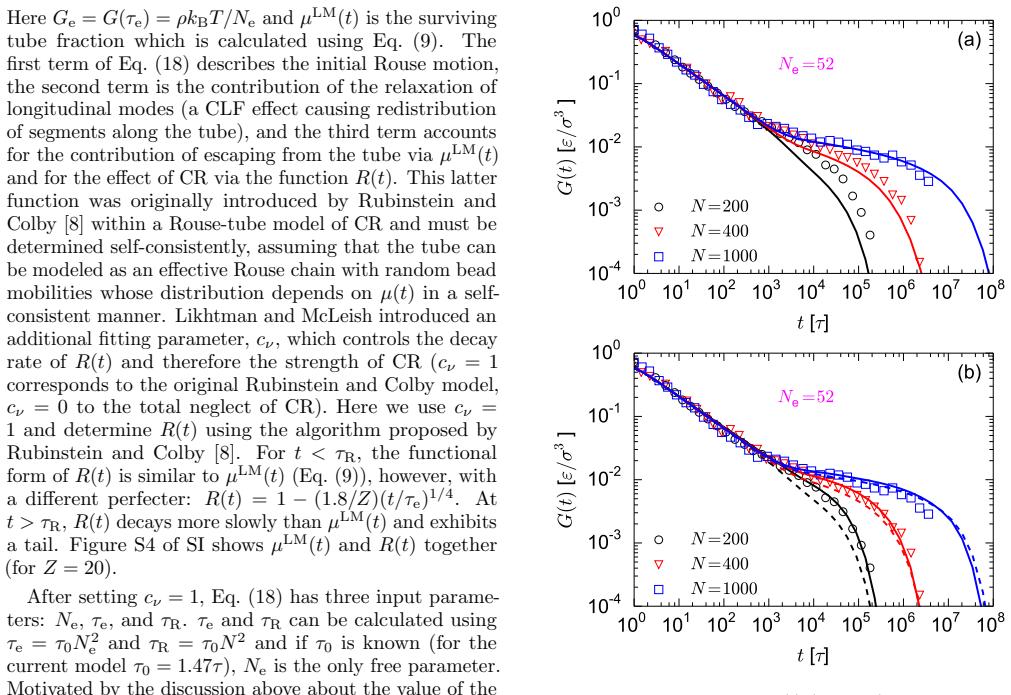
The paper's claim, stated on its own terms, is that the fixed-tube identity $P(t) = \mu(t)$ does not govern the late-time relaxation of either $S(q,t)$ or $G(t)$ in entangled linear melts. Direct comparison of simulation data for $N = 200$, $400$, and $1000$ shows $S(q,t)$ decaying noticeably faster than $P(t)$, and $G(t)$ following $G_N^0 P(t)^2$ rather than $G_N^0 P(t)$. The paper interprets this as evidence that constraint release actively relaxes stress and density correlations in monodisperse linear melts, and that the double reptation or dynamic tube dilation approximation, rather than the fixed-tube approximation, captures the constraint-release effect. It further shows that a quantitative tube model for $G(t)$ describes the longest chains when the entanglement length is set to $N_e = 52$ from the plateau modulus, and that replacing the model's constraint-release factor with $P(t)^2$ reproduces $G(t)$ for all studied chain lengths.
Load-bearing premise
The interpretation assumes the tube-model identity $P(t) = \mu(t)$ in a fixed tube, so any extra decay in $G(t)$ or $S(q,t)$ is attributed to constraint release; if chain orientation can also decorrelate by other means, the square law would not uniquely diagnose constraint release.
Editorial extensions
If this is right
- If $G(t) \approx G_N^0 P(t)^2$ holds generally, rheological models of monodisperse linear melts can use the double-reptation closure instead of a full self-consistent constraint-release calculation.
- The failure of $S(q,t) \propto P(t)$ means neutron spin-echo measurements of entangled melts should be interpreted with constraint release included, not with the fixed-tube creep amplitude.
- The plateau modulus consistent with $G(t)$ implies $N_e \approx 52$ for this bead-spring model, so entanglement lengths from primitive path analysis underestimate the plateau modulus and should not be used in rheological fits.
- The non-local mobility functions $\Lambda(q)$ computed from $S(q,t)$ give dynamic density functional theory a simulation-based input for entangled inhomogeneous melts.
Reading between the lines
- Beyond the paper, the same $G(t) \propto P(t)^2$ law suggests a practical route to predict terminal rheology from dielectric or fluorescence measurements of $P(t)$, without modeling constraint release microscopically.
- Beyond the paper, the comparison could be sharpened in bidisperse blends, where the constraint-release environment changes systematically; the square law predicts a modified effective exponent whenever the matrix relaxation differs from $P(t)$.
- Beyond the paper, the identity could be tested in the same bead-spring model with chain stiffness varied; a deviation from the square law at higher stiffness would indicate the exponent is not universal.
Signed reviews
Editorial analysis
A structured set of objections, weighed in public.
Referee Report
Summary. This manuscript reports molecular dynamics simulations of Kremer-Grest bead-spring melts for chain lengths N=10 to 1000 and presents a joint analysis of monomer and center-of-mass mean-square displacements, end-to-end vector autocorrelation P(t), single-chain dynamic structure factor S(q,t), shear stress relaxation modulus G(t), and derived quantities such as relaxation times and non-local mobility functions. The authors identify signatures of contour-length fluctuation in (1-P(t))~t^{1/4}, show that S(q,t) decays faster than the fixed-tube prediction, and make the central empirical claim that at late times G(t) is approximately G0_N P(t)^2, consistent with double reptation or dynamic tube dilation. They also argue on self-consistency grounds that Ne=52 is the appropriate entanglement length for this model, in contrast to the primitive-path value Ne~87.
Significance. If the central relation G(t)≈G0_N P(t)^2 is quantitatively correct, it provides a direct, simulation-based confirmation of double-reptation/dynamic-tube-dilation physics in monodisperse linear melts and gives a practical way to estimate the terminal viscoelastic response from the much more easily measured end-to-end autocorrelation. The paper's strengths are its unusually long trajectories up to terminal relaxation, the systematic comparison of several independent observables in a single model, and the explicit self-consistency check of the plateau modulus. The supporting calculation of chain-length-dependent mobility functions is also a useful contribution to dynamic density functional theory of inhomogeneous entangled melts.
major comments (3)
- [Section III D, Fig. 14] The central claim G(t)≈G0_N P(t)^2 is supported only by visual overlap. No exponent α in a fit G(t)=A P(t)^α is reported, no confidence interval is given, and the text does not compare the quality of the α=2 hypothesis with α=1 or other alternatives. This matters because Fig. 14(c) shows substantial scatter at late times for N=1000, and the paper states that for this system the long-time G(t) was replaced by G0_N P(t)^2 in the viscosity integral; that substitution cannot serve as independent evidence. The prefactor G0_N is also imported from a slip-link parameterization and the G(t) curves do not show a clean plateau (Section III D), so the absolute normalization of the comparison is not anchored by the same simulation data. I recommend fitting G(t)=A P(t)^α in a defined terminal window for N=200, 400, and 1000, reporting bootstrap or block estimates of A and α, and testing whether the data exclude α=1 or α=2.5. If α=2 is confirmed within uncertainty, the claim can be stated quantitatively; if not, the conclusion should be softened.
- [Section III C, Fig. 10] The quantitative inference that constraint release is needed to describe S(q,t) rests on fits in which Ne is a free parameter (Ne=156 for pure reptation, Ne=100 for CLF for N=1000 and Ne=88 for N=400). The manuscript does not specify the fitting protocol: the q-range and time window used, the error metric, or the sensitivity of the fitted Ne to those choices. Since the argument compares these fitted values with Ne=52, the authors should state how the fits were performed and provide at least rough uncertainties on Ne; otherwise the 'important effect of CR' conclusion is not separately quantified beyond the direct visual mismatch in Fig. 8(c).
- [Section III B and III C, Fig. 8] The interpretation of the S(q,t)/P(t) mismatch as CR uses the tube-model equality P(t)=µ(t) in a fixed tube. The manuscript explicitly notes that this equality ignores the very short-time Rouse decay of P(t) (Section III B), arguing that it is small for long chains. Because the comparison in Fig. 8(c) is made at long times but P(t) is not corrected for the initial decay, the authors should quantify the size of that neglected contribution, for example by extrapolating the late-time P(t) back to t=0 or by comparing S(q,t) with a version of P(t) that excludes sub-τe decorrelation. Without this, part of the observed mismatch could in principle come from the high-frequency Rouse contribution rather than from CR.
minor comments (4)
- [Throughout] There are several typographical errors, including 'single-chin' in Section I, 'perfecter' in Section III D, and 'sales' in the discussion of Fig. 7; these should be corrected.
- [Fig. 3 caption] The caption for panel (b) reads 'Same data vs. τ/τch' but the axis and text use t/τch; the caption should be made consistent.
- [Section III C] Equation (14) is plotted beyond its range of formal validity t<τR; although the text cautions the reader, marking the τR boundary in Fig. 10(d) would clarify which parts of the comparison are extrapolations.
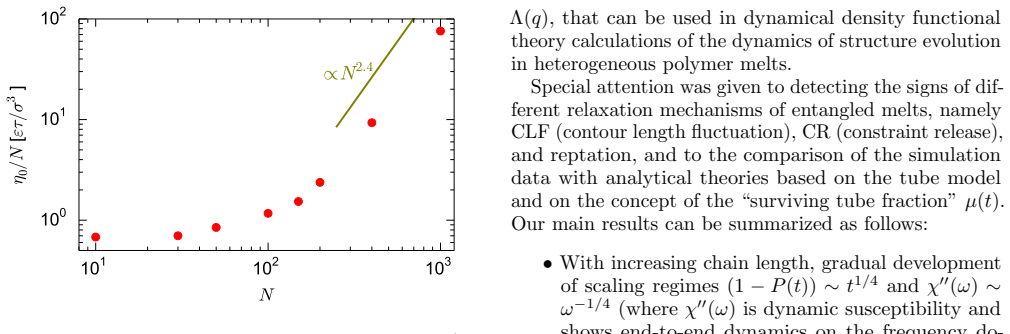
- [Figs. 6 and 17] The estimates of τch, τ1, D, and η0 are reported without statistical uncertainties; given the long run times, at least block-error estimates for the longest chains would strengthen the scaling claims made in these figures.
Circularity Check
No significant circularity: the central G(t) ~ P(t)^2 result is a direct comparison of independently measured correlation functions, with only a minor non-load-bearing self-citation in the mobility-function section.
full rationale
The central claim of the paper, G(t) proportional to P(t)^2 at late times, is established by directly comparing two quantities measured from the same MD trajectories (Section III D, Fig. 14). No parameter is fitted to force this proportionality: the prefactor G0_N is imported from an independent slip-link parameterization (Ne = 52, Ref. [14]), and the paper explicitly shows that the alternative prefactor G0_N,ppa and the linear relation G0_N P(t) fail to describe the data, so the comparison has discriminating content. The theory comparisons that do involve free parameters (Ne for S(q,t) in Section III C; alpha = 0.35 for the modified Likhtman-McLeish P(t) description) are clearly presented as fitting exercises and are not used to derive the central G(t)-P(t) relation. The assumption P(t) = mu(t) in the absence of constraint release is standard tube-model input, not a relation constructed from the paper's own outputs. The only notable self-citation is the mobility-function formula Lambda(q) = S(q,0)/(kBT q^2 N tau(q)) from Mantha, Qi, and Schmid (Ref. [76]); it is an application/definition used in the Lambda(q) section, not load-bearing for the main relaxation claim, and it does not invoke a self-authored uniqueness theorem. The paper's admitted use of G0_N P(t)^2 to estimate the late-time tail of G(t) for N = 1000 when computing the viscosity integral is a data-processing choice for a derived quantity (eta_0), not a backward derivation of the proportionality itself. Overall, the derivation is self-contained with respect to the simulation data, and no circular reduction is exhibited.
Assumptions & free parameters
free parameters (4)
- Ne (pure reptation fit for S(q,t)) =
156
- Ne (CLF fit for S(q,t)) =
100
- alpha (modified LM integration bound) =
0.35
- c_nu (CR coupling in LM model) =
0.1
assumptions (5)
- domain assumption In the absence of constraint release, the end-to-end autocorrelation P(t) equals the surviving tube fraction mu(t) (fixed tube in space).
- domain assumption The analytical S(q,t) decomposition of Eq. (11)-(14) (local reptation contribution plus escaped-segment contribution) is an accurate representation of the simulated chain dynamics.
- standard math The identity a^2 = Ne b^2 and tau_e = tau_0 Ne^2 connects the tube diameter and entanglement time to Ne.
- domain assumption The plateau modulus is given by G0_N = (4/5) rho kBT/Ne and can be identified with G0_N = 0.013 from the slip-link model of Likhtman et al.
- domain assumption The Likhtman-McLeish expressions for mu(t) (Eq. 9) and G(t) (Eq. 18) are valid tube-model predictions.
Cite this review
Pith. "Pith review of Relaxation Dynamics of Entangled Linear Polymer Melts via Molecular Dynamics Simulations." pith.science (2026). https://pith.science/paper/PQGXB4ZG
@misc{pith2026241117953,
  author       = {Pith},
  title        = {Pith review of: Relaxation Dynamics of Entangled Linear Polymer Melts via Molecular Dynamics Simulations},
  year         = {2026},
  howpublished = {\url{https://pith.science/paper/PQGXB4ZG}},
  note         = {Machine review of arXiv:2411.17953}
}
abstract
We present an extensive analysis of the relaxation dynamics of entangled linear polymer melts via long-time molecular dynamics simulations of a generic bead-spring model. We study the mean-squared displacements, the autocorrelation function of the end-to-end vector, $P(t)$, the single-chain dynamic structure factor, $S(q,t)$, and the linear viscoelastic properties, especially the shear stress relaxation modulus, $G(t)$. The simulation data are compared with the theoretically expected scaling laws for different time regimes of entangled melts, and with analytical expressions that account for different relaxation mechanisms in the tube model, namely, reptation, contour length fluctuation (CLF), and constraint release (CR). CLF involves a $t^{1/4}$ scaling regime in the time-dependence of $(1-P(t))$. With increasing chain length, a gradual development of this scaling regime is observed. In the absence of CR, the tube model further predicts that at long times, the chain dynamics is governed by one central quantity, the ``surviving tube fraction'' $\mu(t)$. As a result, one expects $S(q,t) \propto G(t) \propto P(t)$ in that time regime. We test this prediction by comparing $S(q,t)$ and $G(t)$ with $P(t)$. For both quantities, proportionality with $P(t)$ is not observed, indicating that CR has an important effect on the relaxation of these two quantities. Instead, to a very good approximation, we find $G(t)\propto P(t)^{2}$ at late times, which is consistent with the dynamic tube dilation or double reptation approximations for the CR process. In addition, we calculate non-local mobility functions, which can be used in dynamic density functional theories for entangled inhomogeneous polymer blends, and discuss the effect of entanglements on the shape of these functions.
Figures


Figures from the paper (13 more)



Reference graph
Works this paper leans on
-
[1]
Reptation of a polymer chain in the presence of fixed obstacles,
Pierre-Giles De Gennes, “Reptation of a polymer chain in the presence of fixed obstacles,” J. Chem. Phys. 55, 572–579 (1971)
1971
-
[2]
73 (oxford university press, 1988)
Masao Doi, Sam F Edwards, and Samuel Frederick Ed- wards, The theory of polymer dynamics , Vol. 73 (oxford university press, 1988)
1988
-
[3]
23 (Oxford university press New York, 2003)
Michael Rubinstein and Ralph H Colby, Polymer physics , Vol. 23 (Oxford university press New York, 2003)
2003
-
[4]
Tube theory of entangled polymer dynamics,
Tom CB McLeish, “Tube theory of entangled polymer dynamics,” Adv. Phys. 51, 1379–1527 (2002)
2002
-
[5]
Masao Doi, Introduction to polymer physics (Oxford uni- versity press, 1996)
1996
-
[6]
Explanation for the 3.4-power law for viscos- ity of polymeric liquids on the basis of the tube model,
Masao Doi, “Explanation for the 3.4-power law for viscos- ity of polymeric liquids on the basis of the tube model,” J. Polym. Sci., Polym. Phys. Ed. 21, 667–684 (1983)
1983
-
[7]
Theory of polydispersity effects of polymer rheology: bi- nary distribution of molecular weights,
Michael Rubinstein, Eugene Helfand, and Dale S Pearson, “Theory of polydispersity effects of polymer rheology: bi- nary distribution of molecular weights,” Macromolecules 20, 822–829 (1987)
1987
-
[8]
Michael Rubinstein and Ralph H Colby, “Self-consistent theory of polydisperse entangled polymers: Linear vis- coelasticity of binary blends,” J. Chem. Phys. 89, 5291– 5306 (1988)
work page 1988
Show all 87 references
-
[9]
Relaxation by reptation and tube enlarge- ment: A model for polydisperse polymers,
G Marrucci, “Relaxation by reptation and tube enlarge- ment: A model for polydisperse polymers,” J. Polym. Sci., Polym. Phys. Ed. 23, 159–177 (1985)
1985
-
[10]
Slow dynamics in homopolymer liq- uids,
Hiroshi Watanabe, “Slow dynamics in homopolymer liq- uids,” Polym. J. 41, 929–950 (2009)
2009
-
[11]
Dynamics of entangled linear polymer melts: A molecular-dynamics simulation,
Kurt Kremer and Gary S Grest, “Dynamics of entangled linear polymer melts: A molecular-dynamics simulation,” J. Chem. Phys. 92, 5057–5086 (1990)
1990
-
[12]
What is the entanglement length in a polymer melt?
Mathias P¨ utz, Kurt Kremer, and Gary S Grest, “What is the entanglement length in a polymer melt?” Europhys. Lett. 49, 735 (2000)
2000
-
[13]
Direct calculation of the tube potential confining entangled polymers,
Qiang Zhou and Ronald G Larson, “Direct calculation of the tube potential confining entangled polymers,” Macro- molecules 39, 6737–6743 (2006)
2006
-
[14]
Linear viscoelasticity from molecular dynamics simulation of entangled polymers,
Alexei E Likhtman, Sathish K Sukumaran, and Jorge Ramirez, “Linear viscoelasticity from molecular dynamics simulation of entangled polymers,” Macromolecules 40, 6748–6757 (2007)
2007
-
[15]
Quantifying chain reptation in entangled polymer melts: Topological and dynamical mapping of atomistic simulation results onto the tube model,
Pavlos S Stephanou, Chunggi Baig, Georgia Tsolou, Vla- sis G Mavrantzas, and Martin Kr¨ oger, “Quantifying chain reptation in entangled polymer melts: Topological and dynamical mapping of atomistic simulation results onto the tube model,” J. Chem. Phys. 132 (2010)
2010
-
[16]
Segmental dynamics in entangled linear polymer melts,
Zuowei Wang, Alexei E Likhtman, and Ronald G Larson, “Segmental dynamics in entangled linear polymer melts,” Macromolecules 45, 3557–3570 (2012)
2012
-
[17]
Resolving dynamic properties of polymers through coarse-grained computational studies,
K Michael Salerno, Anupriya Agrawal, Dvora Perahia, and Gary S Grest, “Resolving dynamic properties of polymers through coarse-grained computational studies,” Phys. Rev. Lett. 116, 058302 (2016)
2016
-
[18]
Static and dynamic properties of large polymer melts in equilibrium,
Hsiao-Ping Hsu and Kurt Kremer, “Static and dynamic properties of large polymer melts in equilibrium,” J. Chem. Phys. 144 (2016)
2016
-
[19]
Realistic coarse-grain model of cis-1, 4- polybutadiene: from chemistry to rheology,
K Kempfer, J Dev´ emy, Alain Dequidt, M Couty, and P Malfreyt, “Realistic coarse-grain model of cis-1, 4- polybutadiene: from chemistry to rheology,” Macro- molecules 52, 2736–2747 (2019)
2019
-
[20]
Characteristic time and length scales in melts of kremer–grest bead– spring polymers with wormlike bending stiffness,
Carsten Svaneborg and Ralf Everaers, “Characteristic time and length scales in melts of kremer–grest bead– spring polymers with wormlike bending stiffness,” Macro- molecules 53, 1917–1941 (2020)
2020
-
[21]
Dynamics and rheology of poly- mer melts via hierarchical atomistic, coarse-grained, and slip-spring simulations,
Alireza F Behbahani, Ludwig Schneider, Anastassia Ris- sanou, Anthony Chazirakis, Petra Bacova, Pritam Kumar Jana, Wei Li, Manolis Doxastakis, Patrycja Polinska, Craig Burkhart, et al. , “Dynamics and rheology of poly- mer melts via hierarchical atomistic, coarse-grained, and ...
2021
-
[22]
Dynamics of long entangled poly- isoprene melts via multiscale modeling,
Wei Li, Pritam K Jana, Alireza F Behbahani, Georgios Kritikos, Ludwig Schneider, Patrycja Polinska, Craig Burkhart, Vagelis A Harmandaris, Marcus M¨ uller, and Manolis Doxastakis, “Dynamics of long entangled poly- isoprene melts via multiscale modeling,” Macromolecules 54, 869...
2021
-
[23]
Rheological evidence for a dynamical crossover in polymer melts via nonequi- 20 librium molecular dynamics,
Martin Kr¨ oger and Siegfried Hess, “Rheological evidence for a dynamical crossover in polymer melts via nonequi- 20 librium molecular dynamics,” Phys. Rev. Lett. 85, 1128 (2000)
2000
-
[24]
Crossover from the rouse to the entan- gled polymer melt regime: signals from long, detailed atomistic molecular dynamics simulations, supported by rheological experiments,
VA Harmandaris, VG Mavrantzas, DN Theodorou, Mar- tin Kr¨ oger, J Ramirez, Hans Christian ¨Ottinger, and D Vlassopoulos, “Crossover from the rouse to the entan- gled polymer melt regime: signals from long, detailed atomistic molecular dynamics simulations, supported by rheolog...
2003
-
[25]
Onset of entanglements revisited. dynamical analysis,
F Lahmar, C Tzoumanekas, Doros N Theodorou, and B Rousseau, “Onset of entanglements revisited. dynamical analysis,” Macromolecules 42, 7485–7494 (2009)
2009
-
[26]
Molecular simu- lation of tracer diffusion and self-diffusion in entangled polymers,
Sachin Shanbhag and Zuowei Wang, “Molecular simu- lation of tracer diffusion and self-diffusion in entangled polymers,” Macromolecules 53, 4649–4658 (2020)
2020
-
[27]
Detailed analysis of rouse mode and dynamic scattering function of highly entangled polymer melts in equilibrium,
Hsiao-Ping Hsu and Kurt Kremer, “Detailed analysis of rouse mode and dynamic scattering function of highly entangled polymer melts in equilibrium,” Euro. Phys. J., Spec. Top. 226, 693–703 (2017)
2017
-
[28]
Neutron spin echo in polymer systems,
Dieter Richter, Michael Monkenbusch, Arantxa Arbe, and Juan Colmenero, “Neutron spin echo in polymer systems,” Neutron Spin Echo in Polymer Systems: -/- , 1–221 (2005)
2005
-
[29]
Direct assessment of tube dilation in entangled polymers,
BJ Gold, Wim Pyckhout-Hintzen, Andreas Wischnewski, Aurel Radulescu, Michael Monkenbusch, J Allgaier, Ingo Hoffmann, Daniele Parisi, Dimitris Vlassopoulos, and Dieter Richter, “Direct assessment of tube dilation in entangled polymers,” Phys. Rev. Lett. 122, 088001 (2019)
2019
-
[30]
Dynamic structure factors of polymer melts as observed by neutron spin echo: Direct comparison and reevaluation,
Michael Monkenbusch, Margarita Kruteva, and Dieter Richter, “Dynamic structure factors of polymer melts as observed by neutron spin echo: Direct comparison and reevaluation,” J. Chem. Phys. 159 (2023)
2023
-
[31]
Cooperative dynamics of highly entangled lin- ear polymers within the entanglement tube,
Margarita Kruteva, J¨ urgen Allgaier, Michael Monken- busch, Rustem Valiullin, Ingo Hoffmann, and Dieter Richter, “Cooperative dynamics of highly entangled lin- ear polymers within the entanglement tube,” ACS Macro Letters 13, 335–340 (2024)
2024
-
[32]
Coherent scattering by one reptating chain,
PG De Gennes, “Coherent scattering by one reptating chain,” Journal de Physique 42, 735–740 (1981)
1981
-
[33]
John D Ferry, Viscoelastic properties of polymers (John Wiley & Sons, 1980)
1980
-
[34]
The melt viscosity-molecular weight relationship for linear polymers,
Ralph H Colby, Lewis J Fetters, and William W Graessley, “The melt viscosity-molecular weight relationship for linear polymers,” Macromolecules 20, 2226–2237 (1987)
1987
-
[35]
Eval- uation of reptation models for predicting the linear vis- coelastic properties of entangled linear polymers,
Evelyne Van Ruymbeke, Roland Keunings, Vincent St´ ephenne, A Hagenaars, and Christian Bailly, “Eval- uation of reptation models for predicting the linear vis- coelastic properties of entangled linear polymers,” Macro- molecules 35, 2689–2699 (2002)
2002
-
[36]
Linear and non- linear shear flow behavior of monodisperse polyisoprene melts with a large range of molecular weights,
Dietmar Auhl, Jorge Ramirez, Alexei E Likhtman, Pierre Chambon, and Christine Fernyhough, “Linear and non- linear shear flow behavior of monodisperse polyisoprene melts with a large range of molecular weights,” J. Rheo. 52, 801–835 (2008)
2008
-
[37]
Stress relaxation in entangled polymer melts,
Ji-Xuan Hou, Carsten Svaneborg, Ralf Everaers, and Gary S Grest, “Stress relaxation in entangled polymer melts,” Phys. Rev. Lett. 105, 068301 (2010)
2010
-
[38]
i-rheo gt: Transforming from time to frequency domain without artifacts,
Manlio Tassieri, Jorge Ram´ ırez, Nikos Ch Karayiannis, Sathish K Sukumaran, and Yuichi Masubuchi, “i-rheo gt: Transforming from time to frequency domain without artifacts,” Macromolecules 51, 5055–5068 (2018)
2018
-
[39]
Multiscale rheology model for entangled nylon 6 melts,
Heyi Liang, Kenji Yoshimoto, Masahiro Kitabata, Umi Yamamoto, and Juan J de Pablo, “Multiscale rheology model for entangled nylon 6 melts,” J. Polym. Sci. 60, 3071–3084 (2022)
2022
-
[40]
Linear viscoelastic shear and bulk relax- ation moduli in poly (tetramethylene oxide)(ptmo) using united-atom molecular dynamics,
Zakiya Shireen, Elnaz Hajizadeh, Peter Daivis, and Chris- tian Brandl, “Linear viscoelastic shear and bulk relax- ation moduli in poly (tetramethylene oxide)(ptmo) using united-atom molecular dynamics,” Comput. Mater. Sci. 216, 111824 (2023)
2023
-
[41]
Dielectric relaxation of type-a poly- mers in melts and solutions,
Hiroshi Watanabe, “Dielectric relaxation of type-a poly- mers in melts and solutions,” Macromol. Rapid Commun. 22, 127–175 (2001)
2001
-
[42]
From rouse to fully established entan- glement dynamics: a study of polyisoprene by dielectric spectroscopy,
A Abou Elfadl, R Kahlau, A Herrmann, VN Novikov, and EA Rossler, “From rouse to fully established entan- glement dynamics: a study of polyisoprene by dielectric spectroscopy,” Macromolecules 43, 3340–3351 (2010)
2010
-
[43]
Unified description of the viscoelastic and dielectric global chain motion in terms of the tube theory,
T Glomann, GJ Schneider, AR Br´ as, W Pyckhout- Hintzen, A Wischnewski, R Zorn, J Allgaier, and D Richter, “Unified description of the viscoelastic and dielectric global chain motion in terms of the tube theory,” Macromolecules 44, 7430–7437 (2011)
2011
-
[44]
Understanding effect of constraint release environment on end-to-end vec- tor relaxation of linear polymer chains,
Maksim E Shivokhin, Daniel J Read, Dimitris Koulouma- sis, Rok Kocen, Flanco Zhuge, Christian Bailly, Nikos Hadjichristidis, and Alexei E Likhtman, “Understanding effect of constraint release environment on end-to-end vec- tor relaxation of linear polymer chains,” Macromolecul...
2017
-
[45]
Contour length fluctuations and constraint release in entangled polymers: Slip-spring simulations and their implications for binary blend rheology,
Daniel J Read, Maksim E Shivokhin, and Alexei E Likht- man, “Contour length fluctuations and constraint release in entangled polymers: Slip-spring simulations and their implications for binary blend rheology,” J. Rheol. 62, 1017–1036 (2018)
2018
-
[46]
Segment connectivity, chain-length breathing, segmental stretch, and constraint release in reptation models. i. theory and single-step strain predictions,
Chi C Hua and Jay D Schieber, “Segment connectivity, chain-length breathing, segmental stretch, and constraint release in reptation models. i. theory and single-step strain predictions,” J. Chem. Phys. 109, 10018–10027 (1998)
1998
-
[47]
Brownian simulations of a network of reptating primitive chains,
Yuichi Masubuchi, Jun-Ichi Takimoto, Kiyohito Koyama, Giovanni Ianniruberto, Giuseppe Marrucci, and Francesco Greco, “Brownian simulations of a network of reptating primitive chains,” J. Chem. Phys. 115, 4387– 4394 (2001)
2001
-
[48]
Single-chain slip-link model of en- tangled polymers: Simultaneous description of neutron spin- echo, rheology, and diffusion,
Alexei E Likhtman, “Single-chain slip-link model of en- tangled polymers: Simultaneous description of neutron spin- echo, rheology, and diffusion,” Macromolecules 38, 6128–6139 (2005)
2005
-
[49]
Model- ing entangled dynamics: comparison between stochastic single-chain and multichain models,
Sathish K Sukumaran and Alexei E Likhtman, “Model- ing entangled dynamics: comparison between stochastic single-chain and multichain models,” Macromolecules 42, 4300–4309 (2009)
2009
-
[50]
Translationally invariant slip-spring model for entangled polymer dynamics,
Veronica C Chappa, David C Morse, Annette Zippelius, and Marcus M¨ uller, “Translationally invariant slip-spring model for entangled polymer dynamics,” Phys. Rev. Lett. 109, 148302 (2012)
2012
-
[51]
Multi-chain slip-spring model for entangled polymer dynamics,
Takashi Uneyama and Yuichi Masubuchi, “Multi-chain slip-spring model for entangled polymer dynamics,” J. Chem. Phys. 137 (2012)
2012
-
[52]
Recovering the reptation dy- namics of polymer melts in dissipative particle dynamics simulations via slip-springs,
Michael Langeloth, Yuichi Masubuchi, Michael C B¨ ohm, and Florian M¨ uller-Plathe, “Recovering the reptation dy- namics of polymer melts in dissipative particle dynamics simulations via slip-springs,” J. Chem. Phys. 138 (2013)
2013
-
[53]
A multi-chain polymer slip- spring model with fluctuating number of entanglements: Density fluctuations, confinement, and phase separation,
Abelardo Ram´ ırez-Hern´ andez, Brandon L Peters, Lud- wig Schneider, Marat Andreev, Jay D Schieber, Marcus M¨ uller, and Juan J de Pablo, “A multi-chain polymer slip- spring model with fluctuating number of entanglements: Density fluctuations, confinement, and phase separatio...
2017
-
[54]
Equation of state based slip spring model for entangled polymer dynamics,
Georgios G Vogiatzis, Grigorios Megariotis, and Doros N Theodorou, “Equation of state based slip spring model for entangled polymer dynamics,” Macromolecules 50, 3004–3029 (2017)
2017
-
[55]
Comparison of dielectric and viscoelastic relaxation functions of cis- polyisoprenes: Test of tube dilation molecular picture,
Y Matsumiya, H Watanabe, and K Osaki, “Comparison of dielectric and viscoelastic relaxation functions of cis- polyisoprenes: Test of tube dilation molecular picture,” Macromolecules 33, 499–506 (2000)
2000
-
[56]
Quantitative theory for linear dynamics of linear entangled polymers,
Alexei E Likhtman and Tom CB McLeish, “Quantitative theory for linear dynamics of linear entangled polymers,” Macromolecules 35, 6332–6343 (2002)
2002
-
[57]
Role of Repulsive Forces in Determining the Equilibrium Structure of Simple Liquids,
John D. Weeks, David Chandler, and Hans C. Andersen, “Role of Repulsive Forces in Determining the Equilibrium Structure of Simple Liquids,” J. Phys. Chem. 54, 5237– 5247 (1971)
1971
-
[58]
Lammps-a flexible simulation tool for particle-based materials modeling at the atomic, meso, and continuum scales,
Aidan P Thompson, H Metin Aktulga, Richard Berger, Dan S Bolintineanu, W Michael Brown, Paul S Crozier, Pieter J In’t Veld, Axel Kohlmeyer, Stan G Moore, Trung Dac Nguyen, et al. , “Lammps-a flexible simulation tool for particle-based materials modeling at the atomic, meso, an...
2022
-
[59]
Nanoparti- cle effect on the dynamics of polymer chains and their en- tanglement network,
Ying Li, Martin Kr¨ oger, and Wing Kam Liu, “Nanoparti- cle effect on the dynamics of polymer chains and their en- tanglement network,” Physical review letters 109, 118001 (2012)
2012
-
[60]
Rouse mode analysis of chain relaxation in homopolymer melts,
Jagannathan T Kalathi, Sanat K Kumar, Michael Rubin- stein, and Gary S Grest, “Rouse mode analysis of chain relaxation in homopolymer melts,” Macromolecules 47, 6925–6931 (2014)
2014
-
[61]
Rheology and microscopic topology of entangled polymeric liquids,
Ralf Everaers, Sathish K Sukumaran, Gary S Grest, Carsten Svaneborg, Arvind Sivasubramanian, and Kurt Kremer, “Rheology and microscopic topology of entangled polymeric liquids,” Science 303, 823–826 (2004)
2004
-
[62]
Direct equilibration and char- acterization of polymer melts for computer simulations,
Livia A Moreira, Guojie Zhang, Franziska M¨ uller, Torsten Stuehn, and Kurt Kremer, “Direct equilibration and char- acterization of polymer melts for computer simulations,” Macromol. Theory Simul. 24, 419–431 (2015)
2015
-
[63]
Topological analysis of polymeric melts: Chain- length effects and fast-converging estimators for entangle- ment length,
Robert S Hoy, Katerina Foteinopoulou, and Martin Kr¨ oger, “Topological analysis of polymeric melts: Chain- length effects and fast-converging estimators for entangle- ment length,” Phys. Rev. E 80, 031803 (2009)
2009
-
[64]
Note: Determine entanglement length through monomer mean-square displacement,
Ji-Xuan Hou, “Note: Determine entanglement length through monomer mean-square displacement,” J. Chem. Phys. 146 (2017)
2017
-
[65]
Intermolecular effects in the center-of- mass dynamics of unentangled polymer fluids,
Marina Guenza, “Intermolecular effects in the center-of- mass dynamics of unentangled polymer fluids,” Macro- molecules 35, 2714–2722 (2002)
2002
-
[66]
Reconciliation of the molecular weight dependence of diffusion and viscosity in entangled poly- mers,
Timothy P Lodge, “Reconciliation of the molecular weight dependence of diffusion and viscosity in entangled poly- mers,” Phys. Rev. Lett. 83, 3218 (1999)
1999
-
[67]
Diffusivity and viscosity of concentrated hydrogenated polybutadiene solutions,
Hui Tao, Timothy P Lodge, and Ernst D Von Meerwall, “Diffusivity and viscosity of concentrated hydrogenated polybutadiene solutions,” Macromolecules 33, 1747–1758 (2000)
2000
-
[68]
1.06-viscoelasticity and molecular rhe- ology,
AE Likhtman, “1.06-viscoelasticity and molecular rhe- ology,” Polymer science: a comprehensive reference 1, 133–79 (2012)
2012
-
[69]
Molecular dy- namics in bulk cis-polyisoprene as studied by dielectric spectroscopy,
Diethelm Boese and Friedrich Kremer, “Molecular dy- namics in bulk cis-polyisoprene as studied by dielectric spectroscopy,” Macromolecules 23, 829–835 (1990)
1990
-
[70]
Dielectric relaxation of monodisperse linear polyisoprene: Contribu- tion of constraint release,
Yumi Matsumiya, Kazuki Kumazawa, Masahiro Nagao, Osamu Urakawa, and Hiroshi Watanabe, “Dielectric relaxation of monodisperse linear polyisoprene: Contribu- tion of constraint release,” Macromolecules 46, 6067–6080 (2013)
2013
-
[71]
Dielectric relaxation as an independent examination of relaxation mechanisms in entangled polymers using the discrete slip-link model,
Ekaterina Pilyugina, Marat Andreev, and Jay D Schieber, “Dielectric relaxation as an independent examination of relaxation mechanisms in entangled polymers using the discrete slip-link model,” Macromolecules 45, 5728–5743 (2012)
2012
-
[72]
Dielectric nor- mal mode process in undiluted cis-polyisoprene,
Keiichiro Adachi and Tadao Kotaka, “Dielectric nor- mal mode process in undiluted cis-polyisoprene,” Macro- molecules 18, 466–472 (1985)
1985
-
[73]
Localization of chain dynamics in entangled polymer melts,
MG Guenza, “Localization of chain dynamics in entangled polymer melts,” Physical Review E 89, 052603 (2014)
2014
-
[74]
Ef- fects of chain length on rouse modes and non-gaussianity in linear and ring polymer melts,
Shota Goto, Kang Kim, and Nobuyuki Matubayasi, “Ef- fects of chain length on rouse modes and non-gaussianity in linear and ring polymer melts,” J. Chem. Phys. 155 (2021)
2021
-
[75]
Molecular observation of contour-length fluctuations limiting topo- logical confinement in polymer melts,
A Wischnewski, M Monkenbusch, L Willner, D Richter, AE Likhtman, TCB McLeish, and B Farago, “Molecular observation of contour-length fluctuations limiting topo- logical confinement in polymer melts,” Physical review letters 88, 058301 (2002)
2002
-
[76]
Bottom-up construction of dynamic density functional theories for inhomogeneous polymer systems from mi- croscopic simulations,
Sriteja Mantha, Shuanhu Qi, and Friederike Schmid, “Bottom-up construction of dynamic density functional theories for inhomogeneous polymer systems from mi- croscopic simulations,” Macromolecules 53, 3409–3423 (2020)
2020
-
[77]
Dynamics of fluctuations and spinodal decomposition in polymer blends,
Pierre-Gilles de Gennes, “Dynamics of fluctuations and spinodal decomposition in polymer blends,” J. Chem. Phys. 72, 4756–4763 (1980)
1980
-
[78]
Dynamics of fluctuations and spinodal decomposition in polymer blends. ii,
Phillip Pincus, “Dynamics of fluctuations and spinodal decomposition in polymer blends. ii,” J. Chem. Phys. 75, 1996–2000 (1981)
1981
-
[79]
Incorporating fluctuations and dynamics in self-consistent field theories for polymer blends,
Marcus M¨ uller and Friederike Schmid, “Incorporating fluctuations and dynamics in self-consistent field theories for polymer blends,” Advanced Computer Simulation Approaches for Soft Matter Sciences II , 1–58 (2005)
2005
-
[80]
Dynamic self-consistent field approach for studying kinetic processes in multiblock copolymer melts,
Friederike Schmid and Bing Li, “Dynamic self-consistent field approach for studying kinetic processes in multiblock copolymer melts,” Polymers 12, 2205 (2020)
2020
-
[81]
Why polymer chains in a melt are not random walks,
JP Wittmer, P Beckrich, A Johner, AN Semenov, SP Obukhov, H Meyer, and J Baschnagel, “Why polymer chains in a melt are not random walks,” Europhys. Lett. 77, 56003 (2007)
2007
-
[82]
Efficient on the fly calculation of time correlation functions in computer simulations,
Jorge Ram´ ırez, Sathish K Sukumaran, Bart Vorselaars, and Alexei E Likhtman, “Efficient on the fly calculation of time correlation functions in computer simulations,” J. Chem. Phys. 133 (2010)
2010
-
[83]
Local viscoelastic properties and shear stress propagation in bulk and confined polymer melts and low-molecular weight liquids,
Alireza F Behbahani, Petra Baˇ cov´ a, Patrycja Poli´ nska, Craig Burkhart, Manolis Doxastakis, and Vagelis Har- mandaris, “Local viscoelastic properties and shear stress propagation in bulk and confined polymer melts and low-molecular weight liquids,” Phys. Rev. Res. 6, 023161 (2024)
2024
-
[84]
Double reptation vs. simple reptation in polymer melts,
J Des Cloizeaux, “Double reptation vs. simple reptation in polymer melts,” Europhys. Lett. 5, 437 (1988)
1988
-
[85]
Relaxation of entangled polymers in melts,
J Des Cloizeaux, “Relaxation of entangled polymers in melts,” Macromolecules 23, 3992–4006 (1990)
1990
-
[86]
En- tangled polymers: Constraint release, mean paths, and tube bending energy,
D. J. Read, K. Jagannathan, and A. E. Likhtman, “En- tangled polymers: Constraint release, mean paths, and tube bending energy,” Macromolecules 41, 6843–6853 (2008)
2008
-
[87]
Reptate rheology software: Toolkit for the analysis of theories and experiments,
Victor AH Boudara, Daniel J Read, and Jorge Ram´ ırez, “Reptate rheology software: Toolkit for the analysis of theories and experiments,” J. Rheol. 64, 709–722 (2020). 22 Supporting Information: Relaxation Dynamics of Entangled Linear Polymer Melts via Molecular Dynamics Simul...
2020 arXiv
Reviewed August 12, 2026 · model on record in the stance chip above.
Discussion (0). Continue with ORCID to comment.