REVIEW 3 major objections 4 minor 51 references
Chiral crossover characterized by Mott transition at finite temperature
T0 review · 3 major / 4 minor · reviewed 2026-08-14 · deepseek-v4-flash
Pith's one-line read The paper argues that the chiral crossover should be defined by the Mott transition at which $m_\pi=2m_q$, not by the maximum change of the chiral condensate.
desk verdict The Mott-transition criterion is a reasonable model observable, but the paper's claim that it follows from Goldstone's theorem doesn't survive contact with the real-world case. read the letter →
The pith
A machine-rendered reading of the paper's core claim, the machinery that carries it, and where it could break.
The reading
What carries the argument
The engine of the argument is the Mott transition of the pseudo-Goldstone pion: the temperature at which the pion pole, obtained from the RPA meson propagator, crosses the two-quark threshold $2m_q(T)$, turning a bound pion into a resonant state with a decay width. The calculation is carried by a Pauli-Villars regularized two-flavor NJL model, where the gap equation (3) determines the dynamical quark mass and the RPA pole equation (6) determines the pion mass; the threshold condition (1) then defines $T_m$. The infrared singularity of the quark bubble at $p_z\to0$ in a magnetic field makes the pion mass jump at $T_m$, so the transition is sharp even though the crossover is smooth.
What would settle it
Measure the pion mass and the quark threshold $2m_q(T)$ in lattice QCD at physical quark masses, using quark propagator or screening masses: if $m_\pi(T)$ never crosses $2m_q(T)$ near the crossover, or if the crossing coincides with the condensate inflection point within errors, the Mott criterion adds no distinguishable information.
Extended reading notes
Core claim
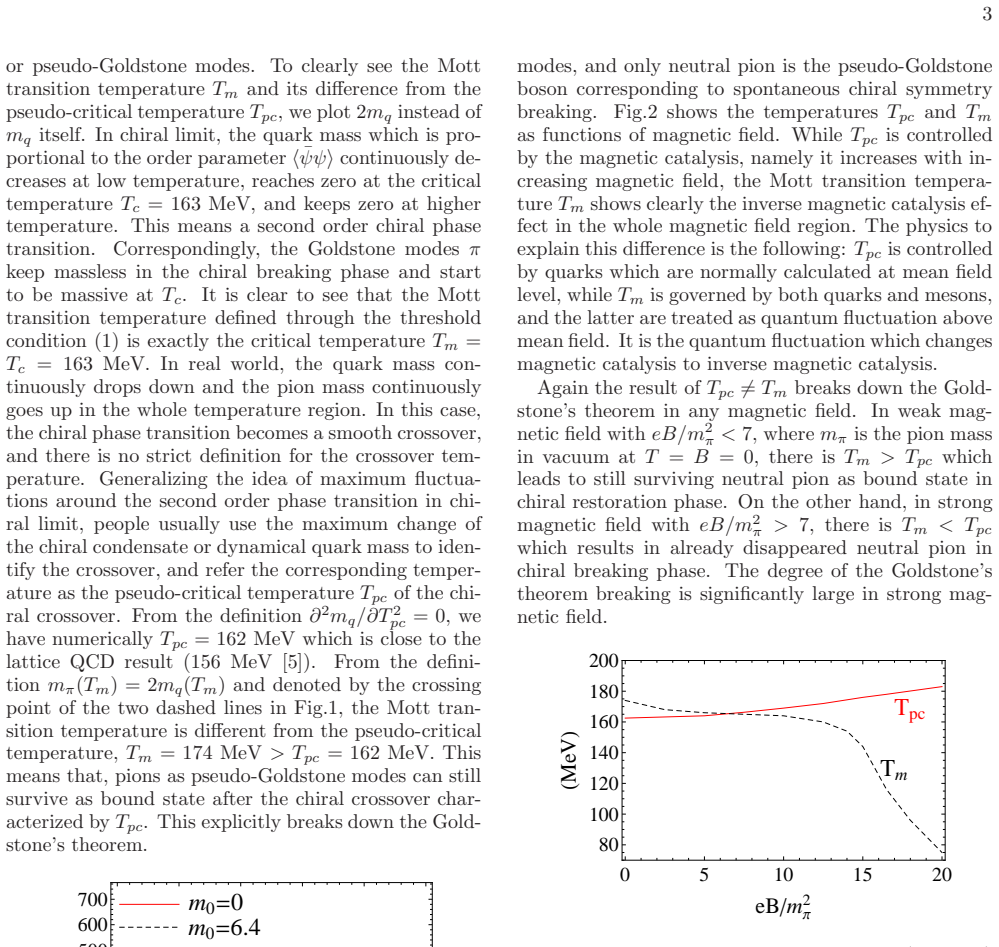
The central claim is a criterion: the chiral crossover should be pinned by the Mott transition of pseudo-Goldstone bosons, $m_\pi(T_m)=2m_q(T_m)$, because this condition by construction keeps Goldstone's theorem intact at the crossover. The paper shows analytically in the chiral limit of the NJL model that the criterion reproduces the critical temperature, with $m_{\pi^0}=0$, $m_\sigma=2m_q$ in the broken phase and $m_{\pi^0}=m_\sigma\neq 0$ in the restored phase. For a finite current quark mass, the criterion gives $T_m$ distinct from $T_{pc}$: numerically $T_m=174$ MeV versus $T_{pc}=162$ MeV at $B=0$. In an external magnetic field the calculated $T_m$ falls with growing $eB$, showing inverse magnetic catalysis, while $T_{pc}$ from the same mean-field treatment rises; when the lattice $T_{pc}(B)$ is fed into a field-dependent coupling, both temperatures fall and $T_m$ again differs from $T_{pc}$.
Load-bearing premise
The load-bearing assumption is that Goldstone's theorem requires pseudo-Goldstone pions to be bound states below the chiral crossover and resonant states above it, so that the dissociation temperature is the correct crossover label, even though this requirement is not a theorem for a nonzero quark mass.
Editorial extensions
If this is right
- The physical crossover should be associated with pion dissociation, so a measurement of the pion mass and the quark threshold near the crossover can locate it more directly than the condensate inflection.
- In the NJL model the pion remains a bound state between $T_{pc}=162$ MeV and $T_m=174$ MeV at zero field, so pion-related observables should show hadronic structure above the condensate-based crossover.
- Under an external magnetic field $T_m$ decreases with $eB$, meaning the Mott criterion reproduces inverse magnetic catalysis even in a model whose mean-field condensate predicts magnetic catalysis.
- Lattice-versus-model comparisons of the crossover should report $T_m$ and $T_{pc}$ separately; part of the magnetic-catalysis controversy may be a definitional artifact.
- Whenever both temperatures are available, the difference $T_m-T_{pc}$ measures the width of the crossover region, and in strong fields $T_m<T_{pc}$ would mean the pion is already a resonant state while the condensate is still large.
Reading between the lines
- A testable extension is to look for a sharp onset of the pion decay width at $2m_q(T)$ in lattice QCD or in effective-model spectral functions; an abrupt threshold would confirm the Mott criterion.
- The quark mass entering $m_\pi=2m_q$ is not uniquely defined; using pole, screening, or constituent masses could shift $T_m$, and the proposal should be tested against each choice.
- For $N_f=2+1$ QCD the same logic would give Mott conditions for kaons and etas, so the chiral crossover could become flavour-dependent rather than a single temperature.
- The inverse magnetic catalysis of $T_m$ may indicate that magnetic fields first strengthen fluctuations in the meson sector even where the mean-field quark condensate is enhanced.
Signed reviews
Editorial analysis
A structured set of objections, weighed in public.
Referee Report
Summary. The paper proposes that the chiral crossover in QCD with nonzero quark masses should be defined by the Mott transition temperature Tm, fixed by the condition m_pi(Tm)=2m_q(Tm), rather than by the usual pseudo-critical temperature Tpc defined from the inflection point of the chiral condensate. The motivation is stated as Goldstone's theorem: pions as pseudo-Goldstone modes should be bound states below the crossover and resonant states above it, so defining the crossover by the bound-to-resonant transition would 'guarantee' the theorem. The authors compute m_q and m_pi in a Pauli-Villars regularized two-flavor NJL model in mean-field and RPA approximations, both at zero and nonzero magnetic field. In the chiral limit they recover Tm=Tc; for m0=6.4 MeV at B=0 they find Tm=174 MeV versus Tpc=162 MeV. In a magnetic field with constant coupling G, Tpc shows magnetic catalysis while Tm decreases, and in Table II a B-dependent coupling G(B) fitted to lattice Tpc values is used to obtain a decreasing Tm as a model-oriented comparison. The central claim is that the difference Tm≠Tpc 'breaks down Goldstone's theorem' and that choosing Tm resolves the apparent discrepancy between lattice QCD and effective models on inverse magnetic catalysis.
Significance. The numerical work is competent: the gap equation and RPA pole equations are standard, the Pauli-Villars regularization and Landau-level summations are specified, the chiral-limit analytic results in Eqs. (8)-(9) correctly exhibit the Goldstone/Higgs pattern, and the parameter set in Table I is adequate for a model study. If the central definitional claim were valid, the proposal would give a new, physically motivated label for the chiral crossover and would reinterpret the lattice-versus-model discrepancy as a definitional artifact. However, the load-bearing premise—that Goldstone's theorem forces pseudo-Goldstone pions to be bound states below the crossover and resonant states above it for nonzero current quark mass—is not a consequence of the theorem. Without that premise, Eq. (1) is a kinematic threshold condition inside one model, and the claim that Tm is 'the proper definition' that 'guarantees' chiral restoration is unsupported. The paper is therefore more a model exercise in computing a Mott threshold than a demonstration that the standard Tpc definition is conceptually wrong.
major comments (3)
- [Introduction, Eq. (1)] The paper's central premise is that Goldstone's theorem requires pions to be bound states in the chiral-breaking phase and resonant states in the chiral-restoration phase, so the crossing m_pi(Tm)=2m_q(Tm) is the correct chiral-crossover condition. This is not a valid deduction for nonzero current quark mass. Goldstone's theorem applies to exact spontaneous symmetry breaking; when m0 is nonzero the chiral symmetry is explicitly broken, and the theorem imposes no statement on whether the pseudo-Goldstone pion pole lies below or above the two-quark threshold. Consequently, the statement that Tpc≠Tm 'breaks down Goldstone's theorem' is not a valid physical deduction, and Eq. (1) remains a model-specific kinematic threshold rather than a condition that 'by definition guarantees' chiral restoration. Since the title, abstract, and conclusions rest on this definitional claim, this is a load-bearing issue.
- [Fig. 2 and Table II] The conclusion that the lattice-versus-model discrepancy for inverse magnetic catalysis is a definitional artifact is not supported by the comparison presented. In Fig. 2 the model Tpc increases with eB (magnetic catalysis) while lattice QCD Tpc decreases (inverse magnetic catalysis), so the two temperatures are not being compared under the same physical conditions. Table II then introduces G(B) fitted to the lattice Tpc values, so the resulting Tm(B) values are outputs partly conditioned on the fitted input; the three points in Table II do not establish the behavior 'in the whole magnetic field region.' The claim that the discrepancy disappears when Tm is used would require a controlled comparison in which the same G(B) is used consistently for both Tpc and Tm, with the model Tpc itself reproducing the lattice trend.
- [Eq. (10) and surrounding text] The analytic support for the proposal is limited to the chiral limit, where Tm=Tc is expected because the pion is an exact Goldstone mode, and to a low-temperature perturbative expansion around the vacuum. Equation (10) is derived near zero temperature and does not control the behavior near the crossover temperature. It therefore cannot serve as an analytic demonstration that the Mott transition temperature is the correct label for the chiral crossover in the physical case m0≠0.
minor comments (4)
- [Eq. (10)] The notation δ^2_{π0} is ambiguous: it should be written as (δ_{π0})^2 or defined explicitly as the quadratic correction to m_{π0}.
- [Fig. 2 discussion] The phrase 'in any magnetic field' after Fig. 2 goes beyond the computed range of eB/m_pi^2 up to 20; please restrict the claim to the plotted region or provide a separate justification for the extrapolation.
- [Fig. 1] The figure labels and line-type identification are hard to parse in the typeset version; an explicit legend identifying m_q vs. m_pi and 2m_q for both m0=0 and m0=6.4 MeV would improve reproducibility.
- [References] References 3 and 4 are incomplete preprint numbers and should be completed or updated before publication.
Circularity Check
Definitional circularity in the Goldstone-theorem rationale; magnetic-field Tm is partly conditioned by a fit to lattice Tpc, while the NJL numerics remain independent.
-
self definitional
[Abstract; Introduction, second paragraph before Eq. (1)]
"Different from the usually used maximum change of chiral condensate, we propose to define the crossover temperature by the Mott transition of pseudo-Goldstone bosons, which, by definition, guarantees the Goldstone's theorem. ... According to the Goldstone's theorem, in the chiral breaking phase at low temperature pions as pseudo-Goldstone modes should be in bound states, and in the chiral restoration phase at high temperature pions should be in resonant states with nonzero width."
The paper's 'guarantee' of Goldstone's theorem is built into the proposal: the crossover is defined as the Mott (bound-to-resonant) transition, while Goldstone's theorem is simultaneously asserted to require exactly that bound/resonance distinction. The conclusion that Tpc != Tm 'breaks down the Goldstone's theorem' therefore restates the assumed equivalence between chiral phase and pion bound/resonant status rather than deriving it from the theorem. Since the premise and the conclusion are the same condition, the definitional claim is circular. The non-circular residue is the independent NJL calculation that the two temperatures differ and that Tm shows a magnetic-field dependence.
-
fitted input called prediction
[Magnetic-field section; Table II and the paragraph introducing G(B)]
"We introduce a magnetic field dependent coupling constant G(B) in the gap equation (3) and fix it by fitting the lattice simulated Tpc(B)/Tpc(B = 0) [16]. With this B-dependent coupling, we recalculate the quark mass mq, pion mass mπ, and the Mott transition temperature Tm. ... Tpc(B)/Tpc(B = 0) is the input from the lattice QCD simulation, G(B) is the output of the gap equation (3), and Tm is the output of the pole equation (6)."
The Table II Tm values are not an out-of-sample prediction: G(B) is tuned at each field to reproduce the lattice Tpc(B) ratios, and Tm is then computed with that tuned coupling. The displayed 'inverse magnetic catalysis' of Tm is therefore partially inherited from the fitted input rather than independently derived. It is not a full reduction because Tm is a different pole condition (1) and Fig. 2 with constant G gives independent evidence; however, the passage overstates the conclusion by claiming the Tm behavior is 'independent of magnetic catalysis or inverse magnetic catalysis for Tpc' when the table's Tm values are conditioned on a Tpc-based fit.
full rationale
The core NJL demonstration is self-contained: gap equation (3), RPA pole equation (6), and the Mott condition (1) are solved with vacuum-fitted parameters, producing Tm=174 MeV vs Tpc=162 MeV at B=0 and a decreasing Tm in Fig. 2 with B-independent G. That part is honest model output, not circular. The circularity burden sits in the interpretive framing: the crossover is defined as the Mott transition and then 'by definition' said to guarantee Goldstone's theorem, after the theorem was assumed to insist on bound states below and resonances above; the 'breaking down' of the theorem is thus a definitional consequence of that assumption, not a theorem violation. The G(B)-fitted Table II calculation is partially conditioned on lattice Tpc inputs, so its Tm result should not be read as an independent prediction, though Tm is not equal to Tpc by construction. Self-citations to Refs. [41,48,49] are technical (regularization and quark-bubble infrared behavior) and are not the source of the central definitional claim. Overall: one genuine definitional circularity plus a partially fitted magnetic-field exercise, with substantial independent model content; score 4.
Assumptions & free parameters
free parameters (4)
- current quark mass m0 =
6.4 MeV (real case), 0 (chiral limit)
- NJL coupling G =
4.9 GeV^-2 (real), 5.03 GeV^-2 (chiral)
- Pauli-Villars mass Lambda =
977.3 MeV
- magnetic-field dependent coupling G(B)/G(0) =
0.97 at eB/m_pi^2=10; 0.90 at 20
assumptions (3)
- domain assumption Goldstone's theorem constrains the bound versus resonant character of pseudo-Goldstone pions across the chiral crossover.
- domain assumption The Pauli-Villars regularized NJL model in mean field plus RPA is a reliable proxy for QCD chiral dynamics.
- ad hoc to paper A magnetic-field dependent coupling G(B) can be introduced and fixed by lattice Tpc data.
Cite this review
Pith. "Pith review of Chiral crossover characterized by Mott transition at finite temperature." pith.science (2026). https://pith.science/paper/PQHCJNMC
@misc{pith2026190802851,
  author       = {Pith},
  title        = {Pith review of: Chiral crossover characterized by Mott transition at finite temperature},
  year         = {2026},
  howpublished = {\url{https://pith.science/paper/PQHCJNMC}},
  note         = {Machine review of arXiv:1908.02851}
}
read the original abstract
We discuss the proper definition for the chiral crossover at finite temperature, based on the Goldstone's theorem. Different from the usually used maximum change of chiral condensate, we propose to define the crossover temperature by the Mott transition of pseudo-Goldstone bosons, which, by definition, guarantees the Goldstone's theorem. We analytically and numerically demonstrate this property in frame of a Pauli-Villars regularized NJL model. In external magnetic field, we find that the Mott transition temperature shows an inverse magnetic catalysis effect.
Figures

Reference graph
Works this paper leans on
-
[1]
singularity of the quark bubble Π m(mm, 0) [48–50]. For the pseudo-Goldstone mode π0, the infrared sin- gularity of Π π 0(mπ 0, 0) happens at the Mott transi- tion temperature Tm where the mass mπ 0 jumps up from mπ 0 < 2mq to mπ 0 > 2mq. This indicates a sudden transition from a bound state to a resonant state [48, 50]. Now we do numerical calculations o...
-
[2]
M.L.Goldberger and S.B.Treiman, Phys. Rev. 110, 1178(1958)
work page 1958
-
[3]
M.Gell-Mann, R.Oakes and B.Renner, Phys. Rev. 175, 2195(1968)
work page 1968
- [4]
- [5]
-
[6]
A.Bazavov, et al. [HotQCD Collaboration], Phys. Lett. B795, 15-21(2019)
work page 2019
- [7]
-
[8]
J.Goldstone, A.Salam and S.Weinberg, Phys. Rev. 127, 965-970(1962)
work page 1962
Show all 51 references
-
[9]
N.F.Mott, Rev. Mod. Phys. 40, 677(1968)
1968
-
[10]
J.Huefner, S.Klevansky and P.Rehberg, Nucl. Phys. A606, 260(1996)
1996
-
[11]
P.Costa, M.Ruivo, and Y.Kalinovsky, Phys. Lett. B560, 171(2003)
2003
-
[12]
Y.Nambu and G.Jona-Lasinio, Phys. Rev. 122, 345(1961) and 124, 246(1961)
1961
-
[13]
S.P.Klevansky, Rev. Mod. Phys. 64, 649(1992)
1992
-
[14]
M.K.Volkov, Phys. Part. Nucl. 24, 35(1993)
1993
-
[15]
T.Hatsuda and T.Kunihiro, Phys. Rep. 247, 221(1994)
1994
-
[16]
M.Buballa, Phys. Rep. 407, 205(2005)
2005
-
[17]
G.S.Bali, F.Bruckmann, G.Endrodi, Z.Fodor, S.D.Katz, S.Krieg, A.Schafer and K.K.Szabo, JHEP1202, 044(2012)
2012
-
[18]
G.S.Bali, F.Bruckmann, G.Endrodi, Z.Fodor, S.D.Katz and A.Schafer, Phys. Rev. D86, 071502(2012)
2012
-
[19]
G.S.Bali, F.Bruckmann, G.Endrodi, F.Gruber and A.Schaefer, JHEP1304, 130(2013)
2013
-
[20]
Y.Hidaka and A.Yamatomo, Phys. Rev. D87, 094502(2013)
2013
-
[21]
V.Bornyakov, P.Buividovich, N.Cundy, O.Kochetkov and A.Schaefer, Phys. Rev. D90, 034501(2014)
2014
-
[22]
M.D’Elia, F.Manigrasso, F.Negro and F.Sanfilippo, Phys. Rev. D98, 054509(2018)
2018
-
[23]
G.Endroedi, M.Giordano, S.D.Katz, T.G.Kov´ acs and F.Pittler, arXiv: 1904.10296
1904 arXiv
-
[24]
S.P.Klevansky and R.H.Lemmer, Phys. Rev. D39, 3478(1989)
1989
-
[25]
K.G.Klimenko, Theor. Math. Phys. 89, 1161(1992)
1992
-
[26]
Shovkovy, Nucl
V.P.Gusynin, V.A.Miransky and I.A. Shovkovy, Nucl. Phys. B462, 249(1996)
1996
-
[27]
V.A.Miransky and I.A.Shovkovy, Phys. Rep. 576, 1(2015)
2015
-
[28]
J.O.Anderson and W.R.Naylor, Rev. Mod. Phys. 88, 025001(2016)
2016
-
[29]
K.Fukushima and Y.Hidaka, Phys. Rev. Lett 110, 031601(2013)
2013
-
[30]
K.Kamikado and T.Kanazawa, JHEP1403, 009(2014)
2014
-
[31]
J.Y.Chao, P.C.Chu and M.Huang, Phys. Rev. D88, 054009(2013)
2013
-
[32]
F.Preis, A.Rebhan and A.Schmitt, JHEP1103, 033(2011)
2011
-
[33]
J.Braun, W.A.Mian and S.Rechenberger, Phys. Lett. B755, 265(2016)
2016
-
[34]
N.Mueller and J.M.Pawlowski, Phys. Rev. D91, 116010(2015)
2015
-
[35]
T.Kojo and N.Su, Phys. Lett. B720, 192(2013)
2013
-
[36]
F.Bruckmann, G.Endrodi and T.G.Kovacs, JHEP1304, 112(2013)
2013
-
[37]
A.Ayala, C.A.Dominguez, L.A.Hernandez, M.Loewe and R.Zamora, Phys. Rev. D92, 096011(2015); Phys. Lett. B759, 99(2016)
2015
-
[38]
A.Ayala, M.Loewe, A.J.Mizher and R.Zamora, Phys. Rev. D90, 036001(2014)
2014
-
[39]
A.Ayala, L.A.Hernandez, A.J.Mizher, J.C.Rojas and C.Villavicencio, Phys. Rev. D89, 116017(2014)
2014
-
[40]
R.L.S.Farias, K.P.Gomes, G.Krein and M.B.Printo, Phys. Rev. C90, 025203(2014)
2014
-
[41]
M.Ferreira, P.Costa, O.Lourenco, T.Frederico, C.Providencia, Phys. Rev. D89, 116011(2014)
2014
-
[42]
Mao, Phys
S.J. Mao, Phys. Lett. B758, 195(2016); Phys. Rev. D94, 036007(2016); Phys. Rev. D97, 5 011501(R)(2018)
2016
-
[43]
69, 555(1972)
V.I.Ritus, Annals Phys. 69, 555(1972)
1972
-
[44]
C.N.Leung and S.Y.Wang, Nucl. Phys. B747, 266(2006)
2006
-
[45]
Elizalde, E.J
E. Elizalde, E.J. Ferrer, V. de la Incera, Ann. Phys. (N.Y.) 295, 33(2002)
2002
-
[46]
D.P.Menezes, M.B.Pinto, S.S.Avancini, A.P.Mart ´inez and C.Providˆencia, Phys. Rev. C79, 035807(2009)
2009
-
[47]
E.J.Ferrer, V.L.Incera, J.P.Keith, I.Portillo and P.L.Springsteen, Phys. Rev. C82, 065802(2010)
2010
-
[48]
K.Fukushima, D.E.Kharzeev and H.J.Warringa, Nucl. Phys. A836, 311(2010)
2010
-
[49]
S.J.Mao and Y.X.Wang, Phys. Rev. D96, 034004(2017)
2017
-
[50]
S.J.Mao, Phys. Rev. D99, 056005(2019)
2019
-
[51]
Tavares, Phys
S.S.Avancini, R.L.S.Farias and W.R. Tavares, Phys. Rev. D99, 056009(2019)
2019
Reviewed August 14, 2026 · model on record in the stance chip above.
Discussion (0). Continue with ORCID to comment.