REVIEW 5 major objections 5 minor 15 references
Cinematic Compositing Using Character-Environment-Harmonized Video Generation Models
T0 review · 5 major / 5 minor · reviewed 2026-08-02 · deepseek-v4-flash
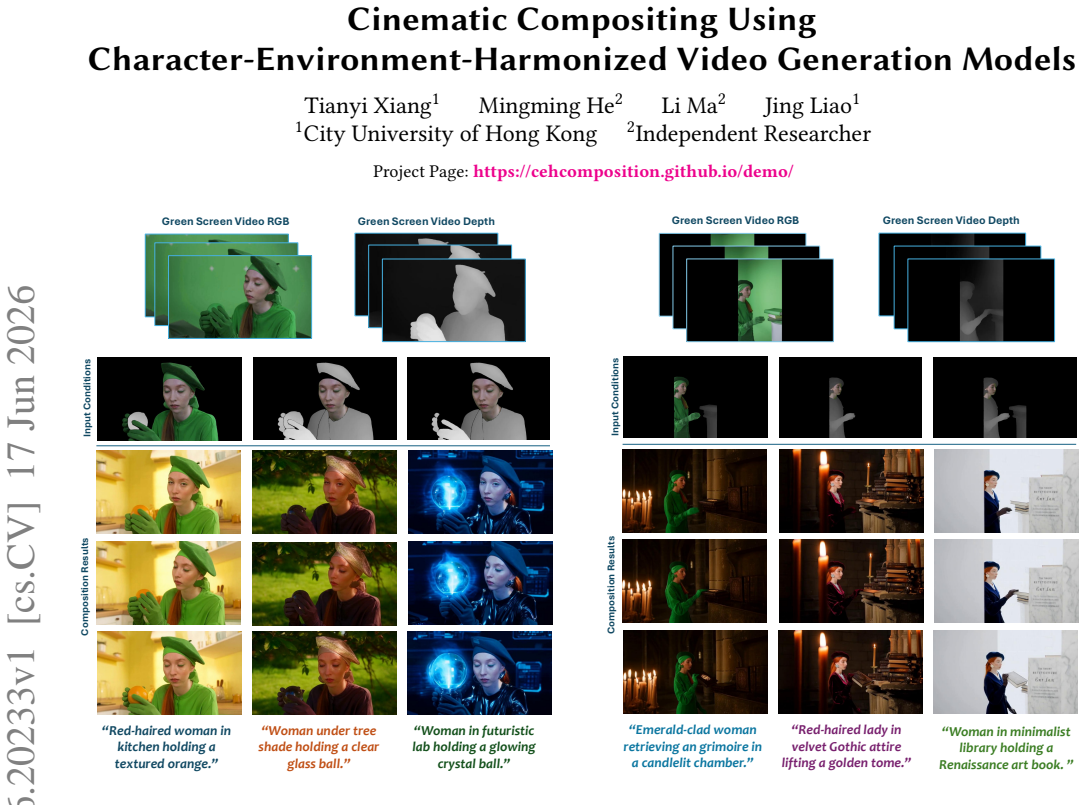
Pith's one-line read The paper claims that green-screen video compositing can be solved by a single video diffusion model that jointly handles background synthesis, actor relighting, and three modes of prop handling, via a tri-mask-guided RGB-D architecture.
desk verdict Unified tri-mask RGB-D green-screen compositing is a genuine and useful contribution, but the relighting evaluation is partly student–teacher circularity; the paper deserves a serious referee but needs an external benchmark. read the letter →
The pith
A machine-rendered reading of the paper's core claim, the machinery that carries it, and where it could break.
The reading
What carries the argument
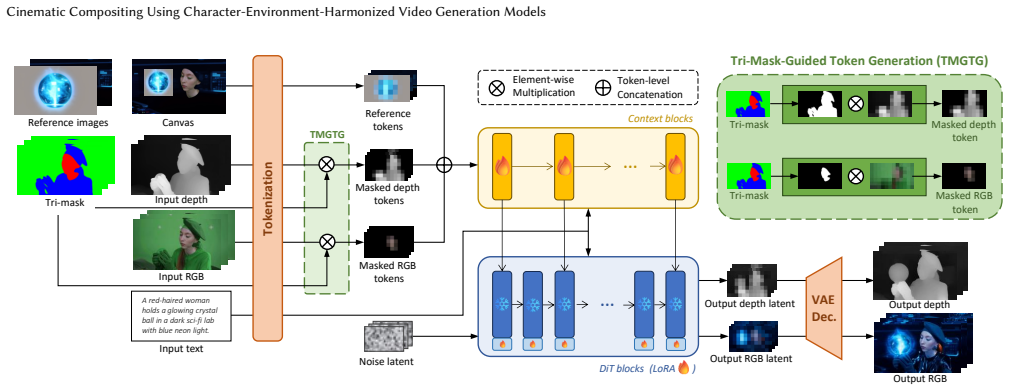
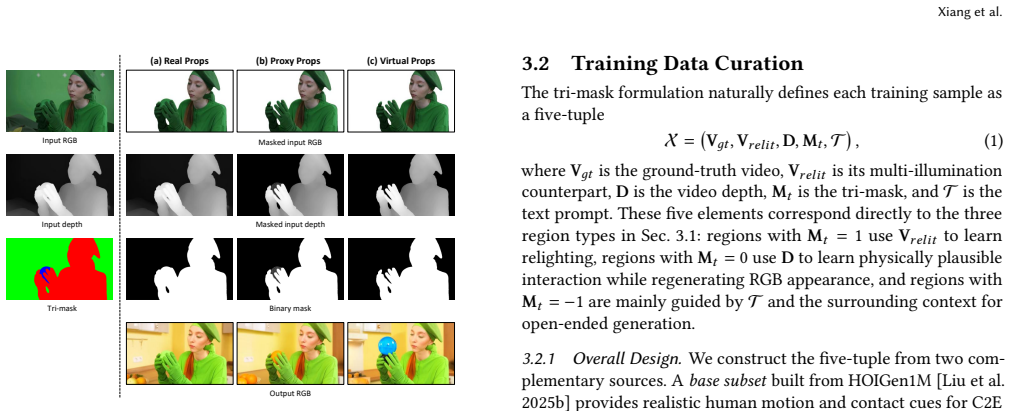
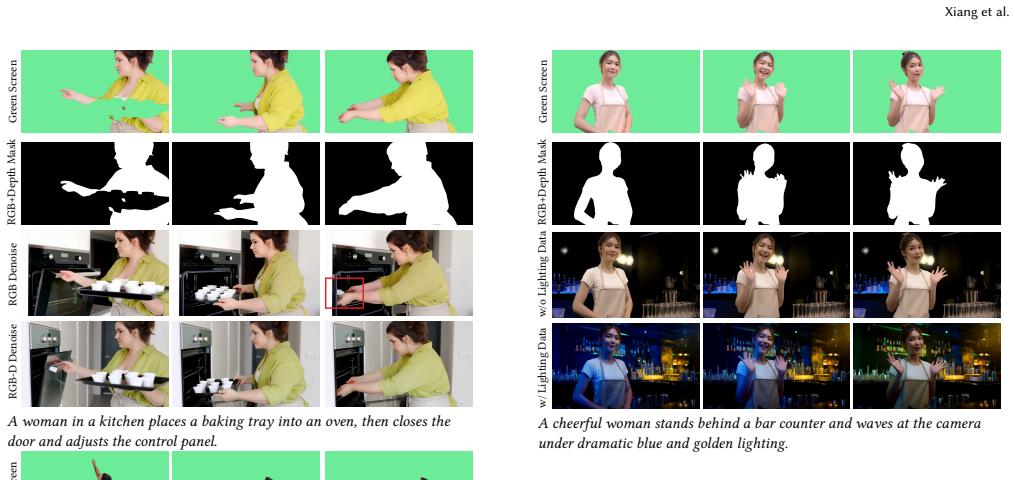
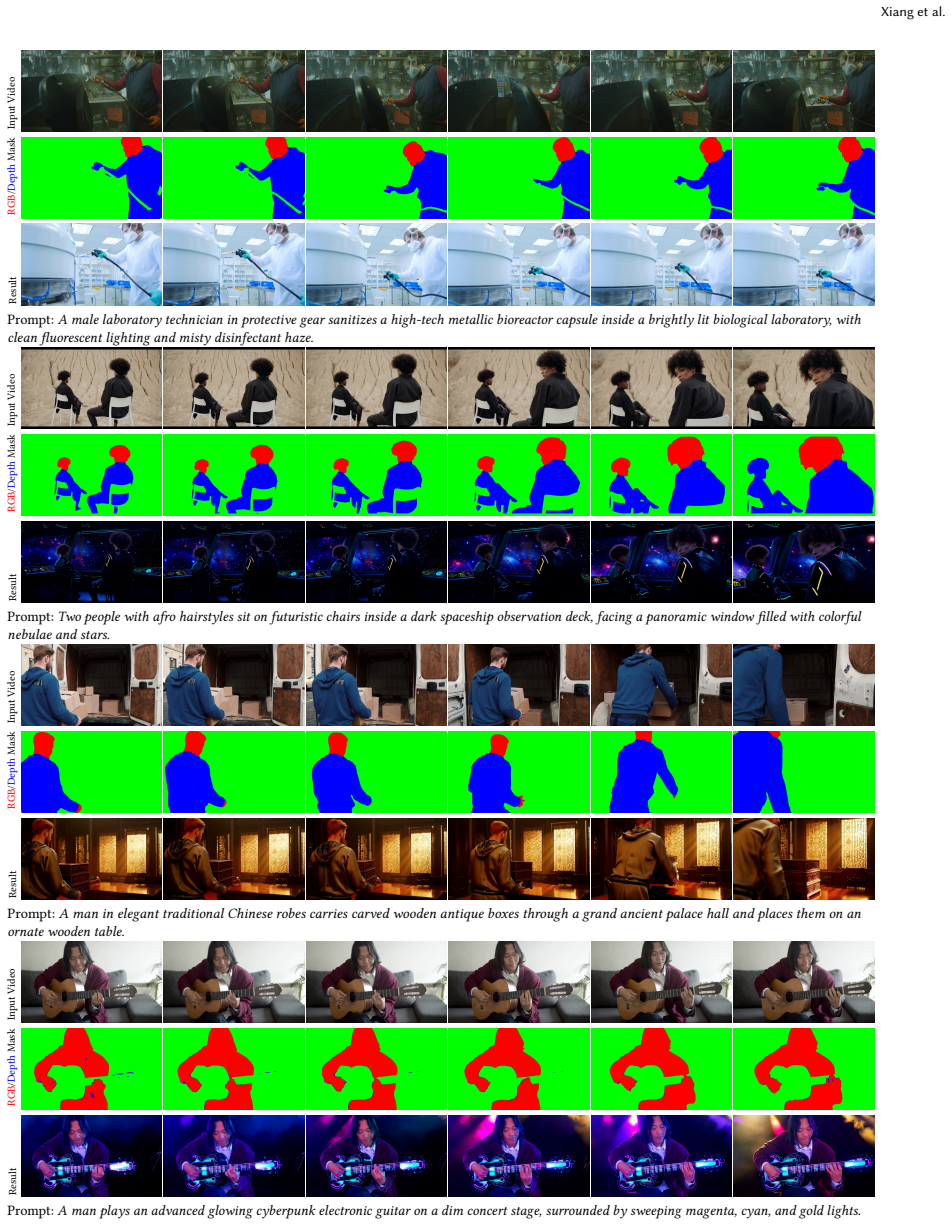
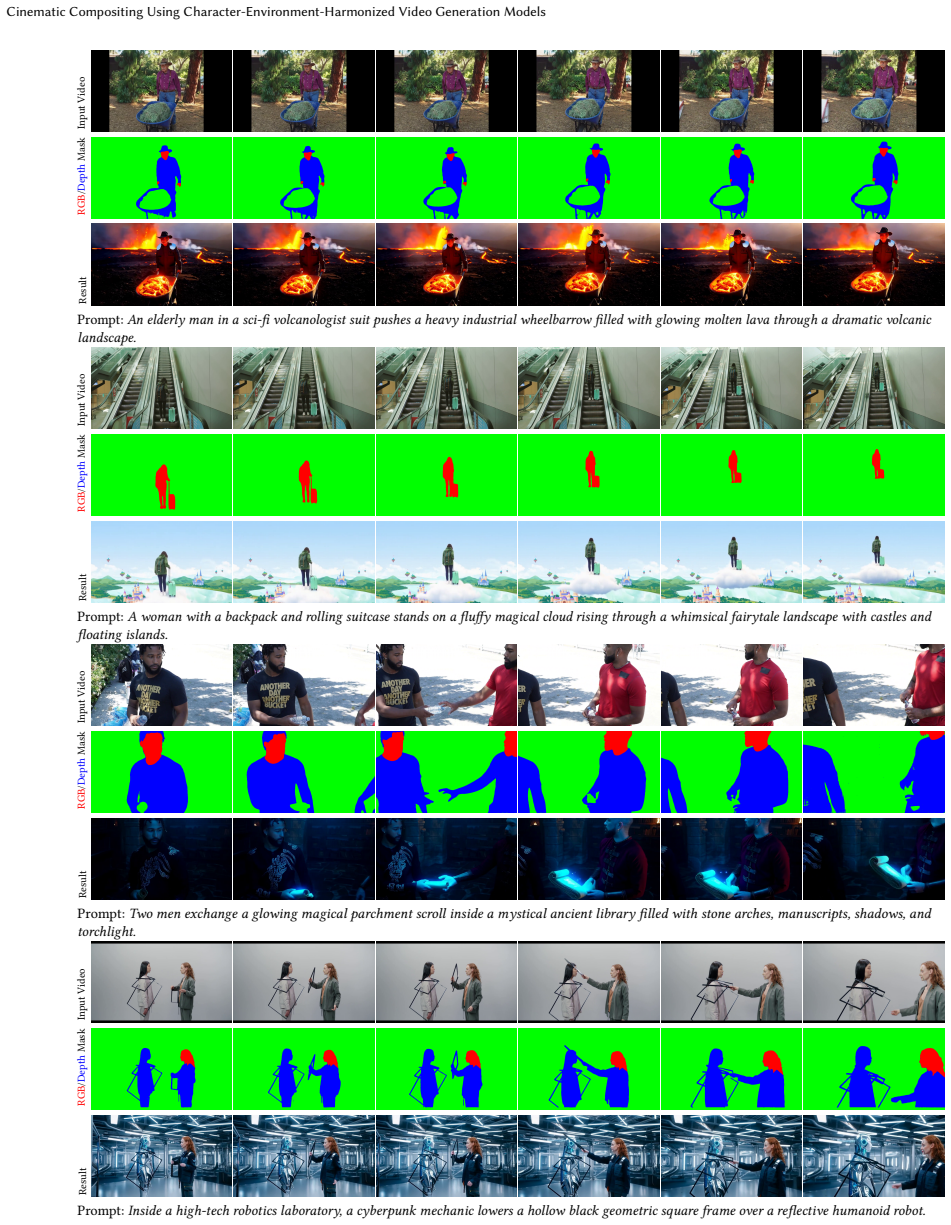
The central mechanism is the tri-mask, which assigns each pixel one of three states: preserve-and-relight (mask value 1), geometry-preserving regeneration (mask value 0), or full generation (mask value -1). The tri-mask is converted into separate RGB-preservation and depth-preservation masks, and the masked RGB and depth sequences are jointly denoised in a single latent trajectory by a Diffusion Transformer. This lets the model explicitly use depth as a geometric anchor while regenerating appearance, and lets it adaptively choose the right conditioning per region. The training signal is organized as a five-tuple (ground-truth video, relit counterpart, depth, tri-mask, text prompt) built thro
What would settle it
Take a set of real green-screen clips with measured environment lighting (for example, using a light probe), have the model composite each actor into that environment, and compare the output to ground-truth footage of the same actor shot in the same physical environment. If the model cannot reproduce the measured lighting direction and color within a defined tolerance, the claim of genuine environment-to-character harmonization is weakened. A complementary check is to train the model with physically rendered relighting targets instead of algorithm-generated ones and see whether the gap over th
Extended reading notes
Core claim
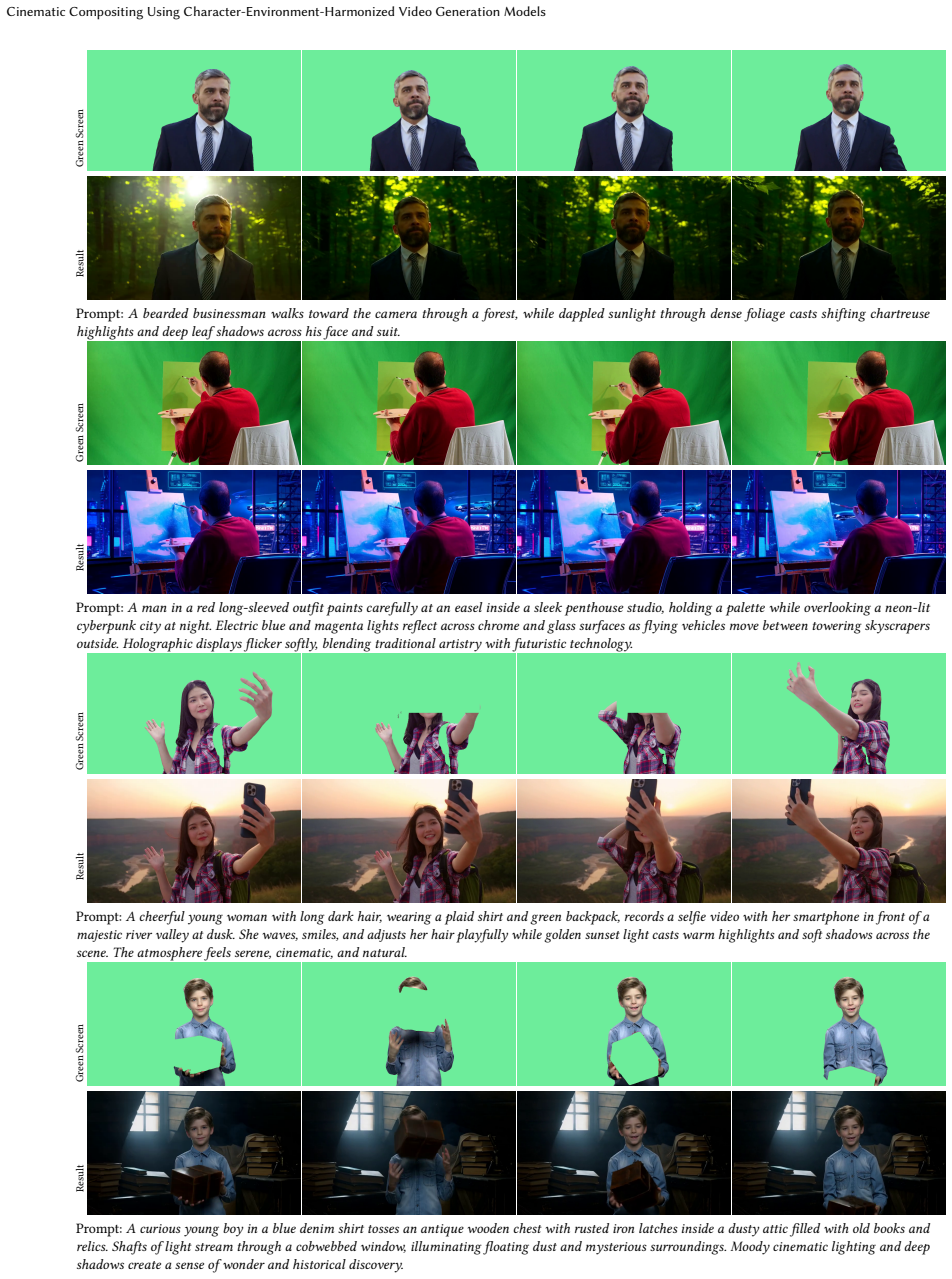
The central claim is that a unified video diffusion model can jointly model character-to-environment physical interaction (C2E) and environment-to-character lighting harmonization (E2C), including interactive props, more effectively than cascaded pipelines. The authors assert that a tri-mask-guided architecture with joint RGB-D denoising produces composite videos where the background responds to actor motion and geometry, the actor is relit coherently with the new environment, and props can be preserved, replaced, or generated according to three mask states. They report that the method outperforms first-frame editing plus animation, inpainting-only, and inpainting-plus-relighting baselines o
Load-bearing premise
The model learns relighting from training pairs in which the correct relit result is produced by an image relighting algorithm, so if that algorithm systematically biases or degrades illumination, the model's relighting ability is capped by that bias and part of the measured improvement over baselines could be imitation of the teacher rather than genuinely better harmonization.
Editorial extensions
If this is right
- A single model instance can replace the conventional cascade of matting, background inpainting, and relighting for dynamic green-screen shots, reducing error accumulation between stages.
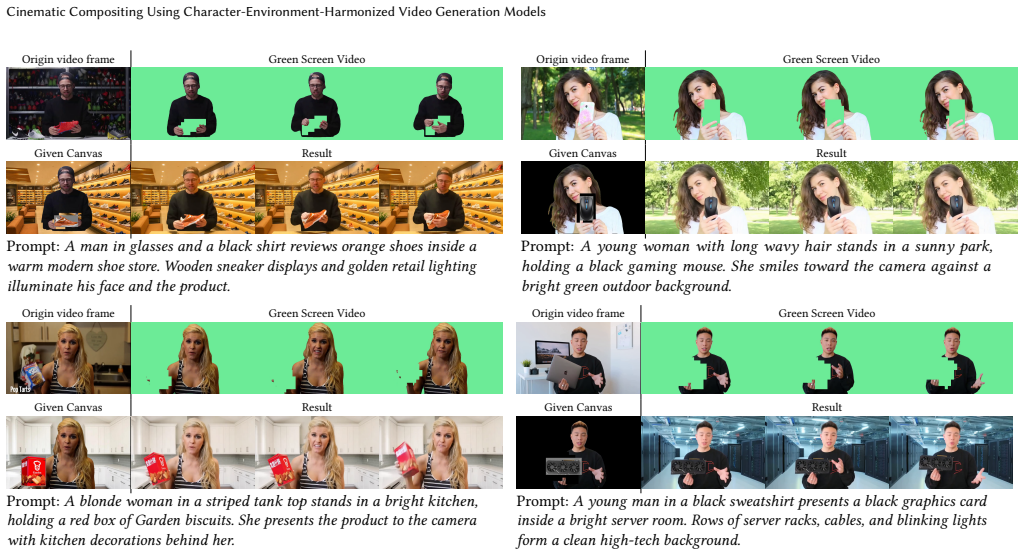
- The tri-mask interface lets an artist decide per region whether to keep the captured actor's appearance (with relighting), keep only geometry (for prop replacement), or let the model generate content from scratch.
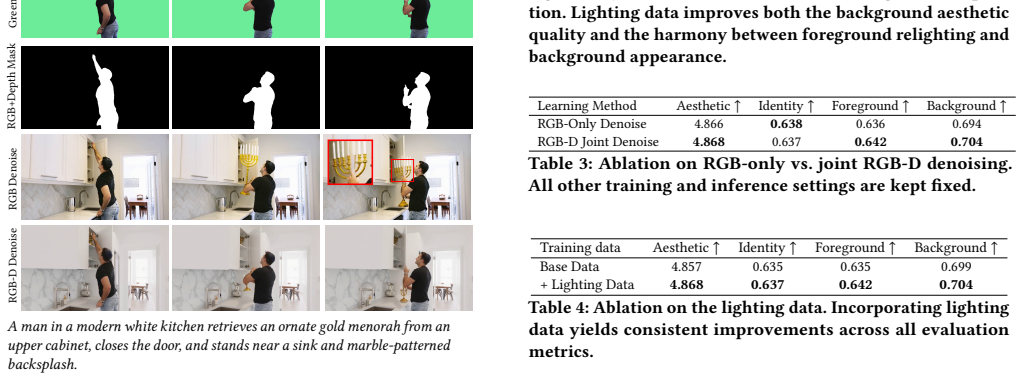
- Joint RGB-D denoising gives the model an explicit geometric anchor, which should improve hand-object contact and body-environment occlusion plausibility in generated composite video.
- The prior-driven data pipeline offers a way to build large relighting supervision sets without game-engine rendering, which could be reused for other video harmonization and editing tasks.
- Reference-conditioned generation with a first-frame canvas enables spatially controlled prop placement and environment customization, supporting product placement and directed scene changes.
Reading between the lines
- If the model's relighting quality is bounded by the relighting prior used to generate training targets, then training on physically rendered relighting pairs could reveal larger gains over the same baselines; the current benchmark may understate the method's true ceiling.
- The tri-mask formulation is a general region-semantics interface that could be adopted by other generative video editing tasks that need to mix preservation, partial regeneration, and full generation in one pass.
- Because the model trusts monocular depth as a geometric anchor, its interaction quality likely degrades when depth estimation is wrong; testing on foregrounds with known synthetic depth would isolate that sensitivity.
- The reference canvas injection suggests a path toward interactive editing tools where artists compose a rough layout and the model generates temporally consistent video around it, potentially extendable to multiple reference objects with explicit occlusion ordering.
Signed reviews
Editorial analysis
A structured set of objections, weighed in public.
Referee Report
Summary. The paper proposes an end-to-end video diffusion framework for green-screen compositing that models both character-to-environment (C2E) physical interaction and environment-to-character (E2C) lighting harmonization in a single model. The method introduces a tri-mask conditioning interface distinguishing preserve-and-relight, geometry-preserving replace, and full-generation regions; a joint RGB-D denoising strategy built on a DiT backbone; a prior-driven data curation pipeline that uses IC-Light relighting and AI-generated multi-illumination clips to construct training pairs; and a reference-conditioned mechanism for controllable environment and prop generation. Experiments are reported on a synthetic benchmark of 100 HOIGen1M clips and a user study on 10 real green-screen videos, with quantitative metrics showing gains over several cascaded baselines.
Significance. If the claims are substantiated, the paper makes a useful contribution by packaging C2E occlusion/interaction and E2C relighting into a single tri-mask-guided video diffusion interface, which is more unified than current cascaded pipelines. The RGB-D joint denoising is a technically sensible departure from RGB-only inpainting, and the data-curation pipeline is a reasonable attempt to avoid expensive rendered relighting pairs. The strongest parts are the problem decomposition and the coherent training/inference interface. However, the central quantitative claim of superior relighting and physical consistency rests on a benchmark that shares its relighting teacher with the training supervision and on a small, unmeasured user study; these issues must be addressed before the state-of-the-art claim is credible.
major comments (5)
- [Sec. 4.2, Sec. 3.2.2, Table 1] The synthetic benchmark is circular with respect to the main claim about E2C relighting. The training target V_relit is generated with IC-Light (Sec. 3.2.2), and the benchmark inputs are 'augmented using the same strategy introduced in Sec. 3.2' (Sec. 4.2). Therefore the Foreground Similarity metric primarily measures fidelity to IC-Light outputs, not physical or perceptually correct relighting. The gap over VACE+Relighting, which uses IC-Light only as a post-hoc step, is expected from a model directly trained to match IC-Light on the same augmentation distribution. The benchmark also samples from the same HOIGen1M base dataset with the same filtering criteria used in training, so the in-domain nature of the task further inflates the reported numbers. To support the claim of superior relighting and physical consistency, the authors should evaluate on independent ground truth (e.g., rende
- [Sec. 4.4, Table 2] The user study on the real green-screen benchmark is too weak to support the strong preference claims. It uses 10 videos and reports percentage preferences without participant count, error bars, confidence intervals, or significance tests. The 61–69% preference ratios look suggestive, but with a small number of videos and evaluators, a few outliers can dominate. The current presentation does not rule out chance-level agreement or a strong ordering bias. At minimum, the paper should report the number of participants, number of comparisons per video, inter-rater agreement (e.g., Fleiss' kappa), and a statistical test (e.g., binomial test or Wilcoxon) for the preference margins. Without this, Table 2 should not be described as evidence that users 'consistently favor' the method.
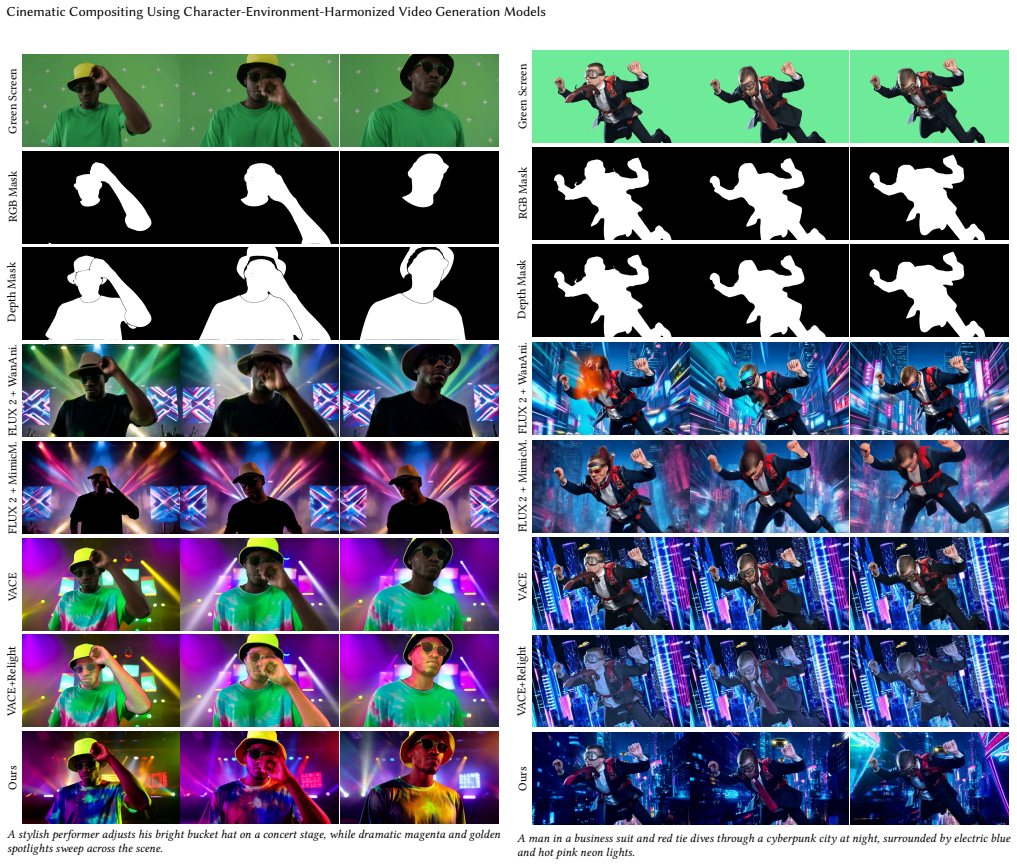
- [Sec. 2, Sec. 4.2] The baseline comparison omits the most relevant task-specific methods. The paper compares against generic image-editing-plus-animation cascades and vanilla VACE, but the related work lists video relighting methods (RelightVid, Light-A-Video, LightCtrl), subject-aware background generation (ActAnywhere), and interactive character generation (Animate Anyone 2, MoCha). None of these are included as baselines. The claim of 'significantly outperforming existing methods' in cinematic compositing is therefore not established against the strongest prior work. The authors should compare against at least one state-of-the-art video relighting model and one subject-aware background synthesis model, even if adapted to the green-screen setting, or explicitly justify why such comparisons are not feasible.
- [Sec. 3.2.2] The E2C supervision is generated by applying IC-Light to each frame independently. IC-Light is an image-based relighting model and is not designed to enforce temporal coherence across video frames. The paper does not analyze the temporal consistency of the relit training targets, nor does it report any temporal metrics on the generated videos. Given that the task is dynamic video compositing, unstable per-frame relighting supervision could teach the model to produce flickering illumination. The authors should either verify that their IC-Light-generated targets are temporally stable, or add a temporal consistency metric (e.g., warped-frame error or CLIP temporal consistency) on outputs.
- [Sec. 4.2, Table 1] The objective metrics are reported without variance or statistical significance. The differences between the best and second-best methods are small (e.g., Foreground Similarity 0.642 vs 0.629, Background Similarity 0.704 vs 0.688), and the synthetic benchmark has only 100 clips. Without confidence intervals or a paired test, it is unclear whether these gaps are robust. This is especially important given the benchmark's dependence on the same relighting teacher, as a small in-domain advantage could be an artifact of the training/evaluation overlap.
minor comments (5)
- [Figure 1 caption] Typo: 'proprelighting' should be 'prop relighting'.
- [Sec. 4.3] The Aesthetic Score is computed with a LAION aesthetic predictor designed for images. The paper does not explain how it is aggregated over video frames or whether any temporal aggregation is used. Please clarify.
- [Sec. 4.2] The VACE+Relighting baseline removes the foreground with Attentive Eraser before relighting. This may introduce artifacts and unfairly disadvantage the baseline. Please report or discuss the impact of the eraser step, or use a cleaner foreground-removal method.
- [Sec. 4.1] The paper states that the model is fine-tuned on 65-frame clips, while Sec. 3.2.2 says the retained clips are trimmed to 81 frames. The relationship between these numbers is not explained; please clarify.
- [Sec. 3.2.2] The multi-illumination subset is generated with Wan 2.2 T2V and then used as 'ground truth' in the five-tuple. Calling AI-generated video 'ground truth' is misleading; consider calling it 'source video' or 'synthesized reference'.
Circularity Check
No significant circularity: relighting supervision uses IC-Light pseudo-labels, but evaluation includes real-video ground truth and an independent human user study.
full rationale
The claimed derivation chain is not circular in the sense required by the review rules. The training target for E2C harmonization is indeed generated by IC-Light (Sec. 3.2.2: 'We first generate V_relit using IC-Light [Zhang et al. 2025] conditioned on diverse background images'), and the synthetic benchmark is augmented with the same pipeline (Sec. 4.2: 'input videos of this benchmark are augmented using the same strategy introduced in Sec. 3.2'). This creates a distributional overlap between training supervision and the synthetic test augmentation. However, the benchmark explicitly states that 'their original videos serve as ground truth for objective evaluation,' so the reported Foreground/Background/Identity metrics are computed against real original videos, not against IC-Light outputs. The model is therefore not predicting its own teacher by construction. IC-Light quality may bound the attainable relighting fidelity, but that is a data-quality or correctness-risk concern rather than a definitional circularity. Independent external evidence is also present: the real green-screen benchmark is evaluated by a human user study (Sec. 4.4), and the qualitative results on real videos provide an outside check. No load-bearing self-citation chain, imported uniqueness theorem, or ansatz smuggled in via citation was found; VACE is used as a standard architectural prior and also as a baseline, which is normal practice. The paper's stated limitation (no 4K or long-form support) is a capability limitation, not a circular step. Overall, the central claims are not forced by the paper's own definitions or fitted inputs.
Assumptions & free parameters
free parameters (4)
- foreground emphasis scale s =
10
- LoRA rank for base DiT fine-tuning =
32
- base vs multi-illumination dataset sampling probability =
0.8 / 0.2
- training frame counts and resolution =
17 then 65 frames; 480x832
assumptions (4)
- domain assumption IC-Light relighting produces high-quality ground-truth multi-illumination foregrounds
- domain assumption Monocular depth from Video Depth Anything is accurate enough to serve as a geometric anchor for interactions
- domain assumption HOIGen1M filtered clips plus Wan 2.2-generated clips cover the space of cinematic interactions and lighting
- domain assumption Pre-trained Wan 2.1 VACE-14B weights and public tools (IC-Light, Video Depth Anything, Grounded SAM 2, Qwen3, BLIP-2) are available and behave as expected
Cite this review
Pith. "Pith review of Cinematic Compositing Using Character-Environment-Harmonized Video Generation Models." pith.science (2026). https://pith.science/paper/PQNYTR4O
@misc{pith2026260620233,
  author       = {Pith},
  title        = {Pith review of: Cinematic Compositing Using Character-Environment-Harmonized Video Generation Models},
  year         = {2026},
  howpublished = {\url{https://pith.science/paper/PQNYTR4O}},
  note         = {Machine review of arXiv:2606.20233}
}
read the original abstract
Cinematic compositing aims to integrate green-screen characters into novel environments while maintaining physical and photometric realism. Previous methods often fail to capture the complex bidirectional interactions between characters and their surroundings, which we characterize as Character-to-Environment (C2E) physical interaction and Environment-to-Character (E2C) lighting harmonization. To address this, we propose an end-to-end video diffusion framework that jointly models C2E and E2C interactions, specifically handling the challenges of interactive props. Our approach introduces a tri-mask-guided architecture with RGB-D joint denoising to ensure physically consistent interactions among the character, props, and environment. We further develop an efficient prior-driven data curation pipeline to construct high-quality relighting pairs without expensive rendering. Finally, a reference-conditioned mechanism enables controllable environment synthesis and precise prop replacement. Extensive experiments demonstrate that our framework significantly outperforms existing methods in cinematic-quality dynamic video compositing.
Figures
Figures from the paper (7 more)
Reference graph
Works this paper leans on
-
[2]
RelightVid: Temporal-Consistent Diffusion Model for Video Relighting.arXiv preprint arXiv:2501.16330(2025). Kai He, Ruofan Liang, Jacob Munkberg, Jon Hasselgren, Nandita Vijaykumar, Alexander Keller, Sanja Fidler, Igor Gilitschenski, Zan Gojcic, and Zian Wang
arXiv 2025
-
[7]
Grounding dino: Marrying dino with grounded pre-training for open-set object detection.arXiv preprint arXiv:2303.05499 (2023). Tianqi Liu, Zhaoxi Chen, Zihao Huang, Shaocong Xu, Saining Zhang, Chongjie Ye, Bohan Li, Zhiguo Cao, Wei Li, Hao Zhao, and Ziwei Liu
arXiv 2023
-
[9]
SAM 2: Segment Anything in Images and Videos. arXiv:2408.00714 [cs.CV] https://arxiv.org/abs/2408.00714 Mengwei Ren, Wei Xiong, Jae Shin Yoon, Zhixin Shu, Jianming Zhang, HyunJoon Jung, Guido Gerig, and He Zhang
-
[10]
Wan: Open and Advanced Large-Scale Video Generative Models.arXiv preprint arXiv:2503.20314(2025). Weiqing Xiao, Hong Li, Xiuyu Yang, Houyuan Chen, Yi Wen, Tianqi Liu, Shaocong Xu, Chongjie Ye, Hao Zhao, and Beibei Wang
arXiv 2025
-
[11]
Relit-LiVE: Relight Video by Jointly Learning Environment Video.arXiv preprint arXiv:2605.06658(2026). Hu Xu, Gargi Ghosh, Po-Yao Huang, Dmytro Okhonko, Armen Aghajanyan, Florian Metze, Luke Zettlemoyer, and Christoph Feichtenhofer
arXiv 2026
-
[12]
InProceedings of the 2021 conference on empirical methods in natural language processing
VideoCLIP: Con- trastive Pre-training for Zero-shot Video-Text Understanding. InProceedings of the 2021 conference on empirical methods in natural language processing. 6787–6800. Ziyi Xu, Ziyao Huang, Juan Cao, Yong Zhang, Xiaodong Cun, Qing Shuai, Yuchen Wang, Linchao Bao, and Fan Tang. 2026a. AnchorCrafter: Animate cyber-anchors selling your products vi...
arXiv 2021
-
[13]
InProceedings of the IEEE/CVF Conference on Computer Vision and Pattern Recognition (CVPR)
MatAnyone 2: Scaling Video Matting via a Learned Quality Evaluator. InProceedings of the IEEE/CVF Conference on Computer Vision and Pattern Recognition (CVPR). Peiqing Yang, Shangchen Zhou, Jixin Zhao, Qingyi Tao, and Chen Change Loy. 2025c. MatAnyone: Stable Video Matting with Consistent Memory Propagation.arXiv preprint arXiv:2501.14677(2025). Mingshuai...
arXiv 2025
-
[14]
Lvmin Zhang, Anyi Rao, and Maneesh Agrawala
Beyond Static Scenes: Camera-controllable Background Generation for Human Motion.arXiv preprint arXiv:2504.02004(2025). Lvmin Zhang, Anyi Rao, and Maneesh Agrawala
arXiv 2025
Show all 15 references
-
[15]
InThe Thirteenth International Conference on Learning Representations
Scaling In-the-Wild Training for Diffusion-based Illumination Harmonization and Editing by Imposing Con- sistent Light Transport. InThe Thirteenth International Conference on Learning Representations. Yuang Zhang, Jiaxi Gu, Li-Wen Wang, Han Wang, Junqi Cheng, Yuefeng Zhu, and ...
2024 arXiv
-
[2021]
Li Hu, Guangyuan Wang, Zhen Shen, Xin Gao, Dechao Meng, Lian Zhuo, Peng Zhang, Bang Zhang, and Liefeng Bo
LoRA: Low-Rank Adaptation of Large Language Models.arXiv preprint arXiv:2106.09685(2021). Li Hu, Guangyuan Wang, Zhen Shen, Xin Gao, Dechao Meng, Lian Zhuo, Peng Zhang, Bang Zhang, and Liefeng Bo. 2025b. Animate Anyone 2: High-Fidelity Character Image Animation with Environmen...
2021 arXiv
-
[2022]
Shanchuan Lin et al
Bridging composite and real: towards end-to-end deep image matting.International Journal of Computer Vision130, 2 (2022), 246–266. Shanchuan Lin et al
2022
-
[2023]
Jizhizi Li, Jing Zhang, Stephen J Maybank, and Dacheng Tao
BLIP-2: Bootstrapping Language-Image Pre-training with Frozen Image Encoders and Large Language Models.arXiv preprint arXiv:2301.12597(2023). Jizhizi Li, Jing Zhang, Stephen J Maybank, and Dacheng Tao
2023 arXiv
-
[2024]
Yizuo Peng, Xuelin Chen, Kai Zhang, and Xiaodong Cun
Actanywhere: Subject-aware video background generation.Advances in Neural Information Processing Systems37 (2024), 29754– 29776. Yizuo Peng, Xuelin Chen, Kai Zhang, and Xiaodong Cun
2024
-
[2025]
Ye Fang, Zeyi Sun, Shangzhan Zhang, Tong Wu, Yinghao Xu, Pan Zhang, Jiaqi Wang, Gordon Wetzstein, and Dahua Lin
Wan-animate: Unified character animation and replacement with holistic replication.arXiv preprint arXiv:2509.14055 (2025). Ye Fang, Zeyi Sun, Shangzhan Zhang, Tong Wu, Yinghao Xu, Pan Zhang, Jiaqi Wang, Gordon Wetzstein, and Dahua Lin
2025
-
[2026]
Bangya Liu, Xinyu Gong, Zelin Zhao, Ziyang Song, Yulei Lu, Suhui Wu, Jun Zhang, Suman Banerjee, and Hao Zhang
EditCtrl: Disentangled Local and Global Control for Real-Time Generative Video Editing.arXiv preprint arXiv:2602.15031 (2026). Bangya Liu, Xinyu Gong, Zelin Zhao, Ziyang Song, Yulei Lu, Suhui Wu, Jun Zhang, Suman Banerjee, and Hao Zhang. 2025a. ByteLoom: Weaving Geometry-Consi...
2026
Reviewed August 2, 2026 · model on record in the stance chip above.
Discussion (0). Continue with ORCID to comment.