Pulsar searches of Fermi-LAT gamma-ray sources with the MWA
Pith reviewed 2026-06-27 21:25 UTC · model grok-4.3
The pith
Survey of 308 Fermi-LAT sources at 154 MHz finds no new pulsars and sets flux limits of 30-220 mJy.
A machine-rendered reading of the paper's core claim, the machinery that carries it, and where it could break.
Core claim
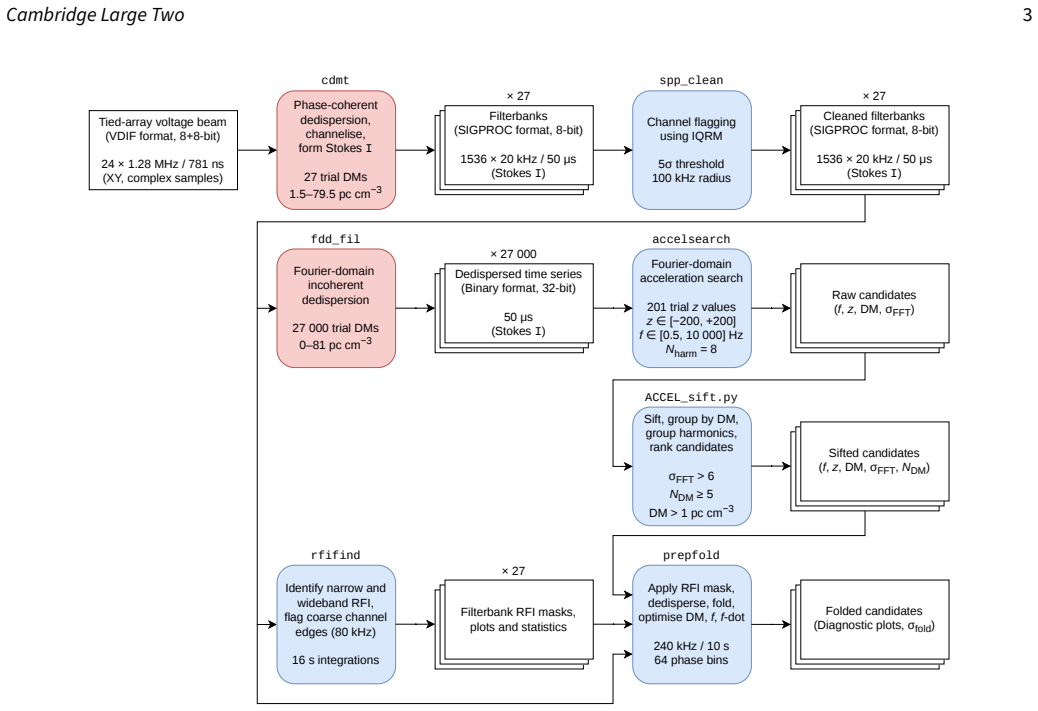
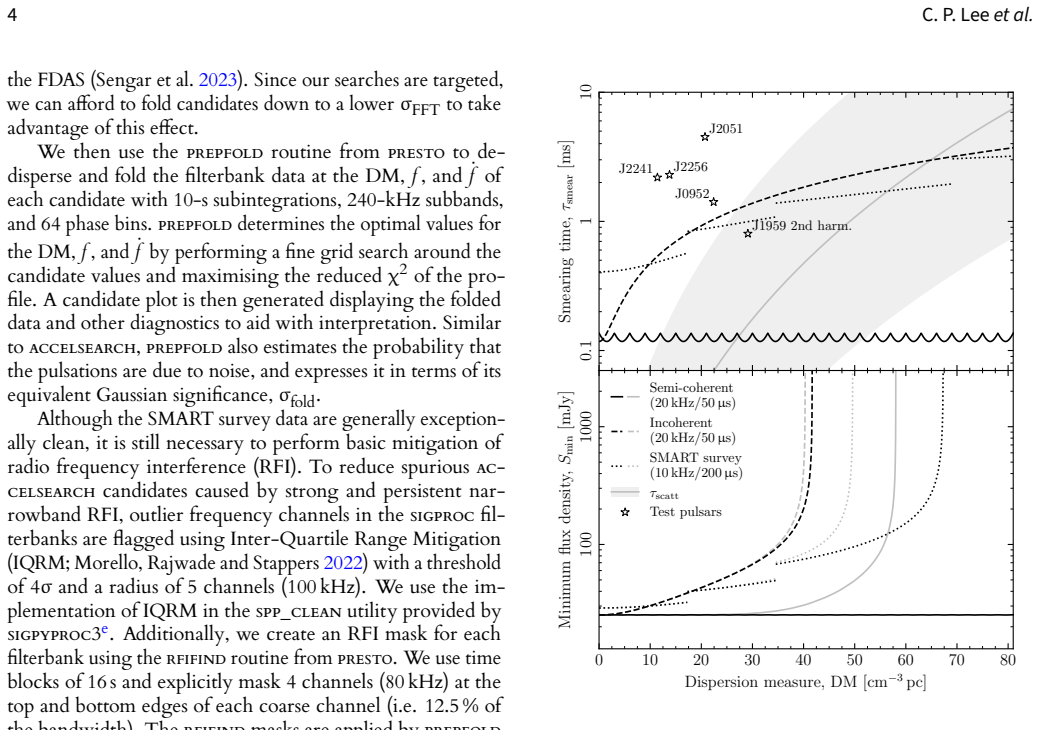
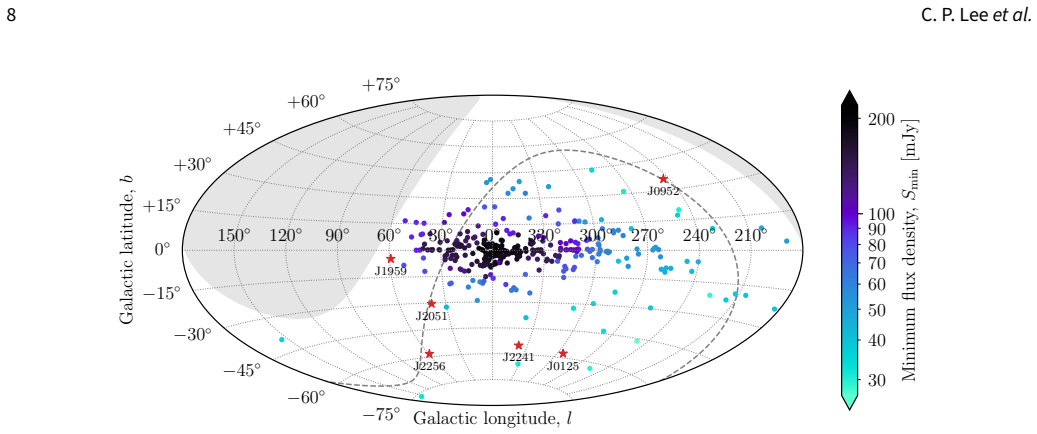
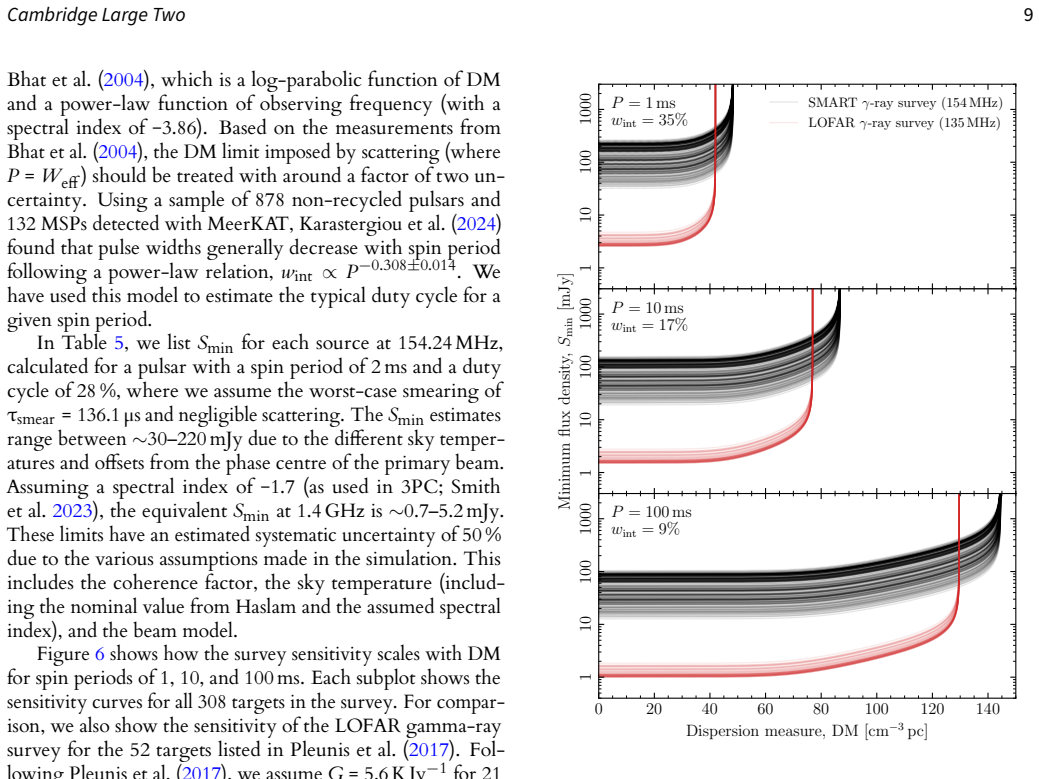
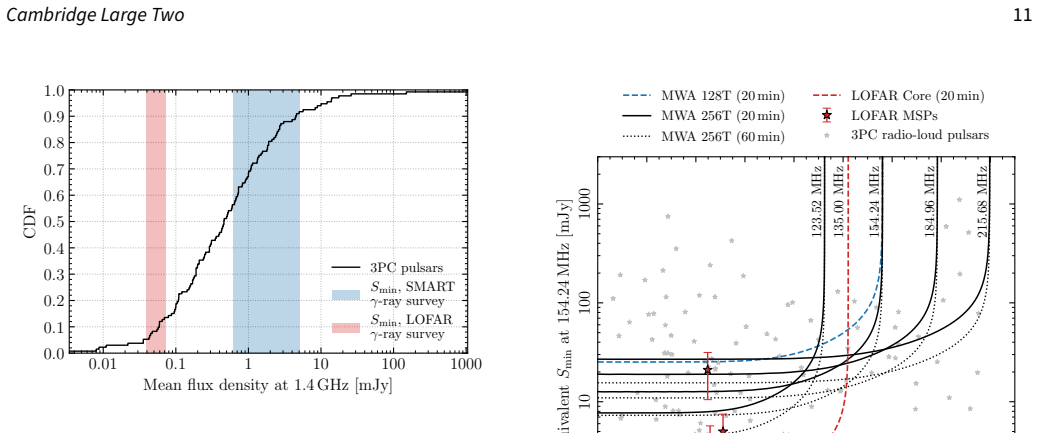
No new pulsars were identified in the survey, which the authors attribute to insufficient sensitivity. Flux density limits are estimated at approximately 30-220 mJy at 154 MHz (equivalent to 0.7-5.2 mJy at 1.4 GHz) for a 2 ms spin period and 28 percent duty cycle. The survey is the largest radio search of unassociated Fermi-LAT sources conducted below 300 MHz and employed a semi-coherent dispersion removal scheme that yields 2-3 times better sensitivity than fully incoherent removal for dispersion measures between 20 and 40 pc cm^{-3}.
What carries the argument
semi-coherent dispersion removal scheme applied to digitally beamformed MWA tile voltages, which improves sensitivity to millisecond pulsars over fully incoherent methods for moderate dispersion measures
If this is right
- The MWA Phase III upgrade is projected to increase the number of detectable gamma-ray pulsars by about 30 percent for the same integration time.
- The semi-coherent pipeline can be applied to pulsar searches in supernova remnants, globular clusters, and candidates from imaging surveys.
- Results from this survey help calibrate expectations for the yield of future low-frequency surveys with SKA-Low.
Where Pith is reading between the lines
- Deeper or longer integrations at 154 MHz may still be needed to match the pulsar discovery rate achieved at higher radio frequencies.
- Many unassociated Fermi-LAT sources could be either radio-quiet or require different search techniques such as targeted timing or multi-frequency follow-up.
- The pipeline's utility extends to any low-frequency data set where dispersion smearing is the dominant sensitivity limiter.
Load-bearing premise
The semi-coherent dispersion removal scheme actually delivers the claimed 2-3 times sensitivity gain without substantial loss of real signals or introduction of false negatives that would explain the null result.
What would settle it
Detection of a pulsar in any of the 308 targets at a flux density below the stated 30-220 mJy limit at 154 MHz, or reprocessing of the same data with an independent pipeline that recovers a signal missed by the semi-coherent search.
Figures
read the original abstract
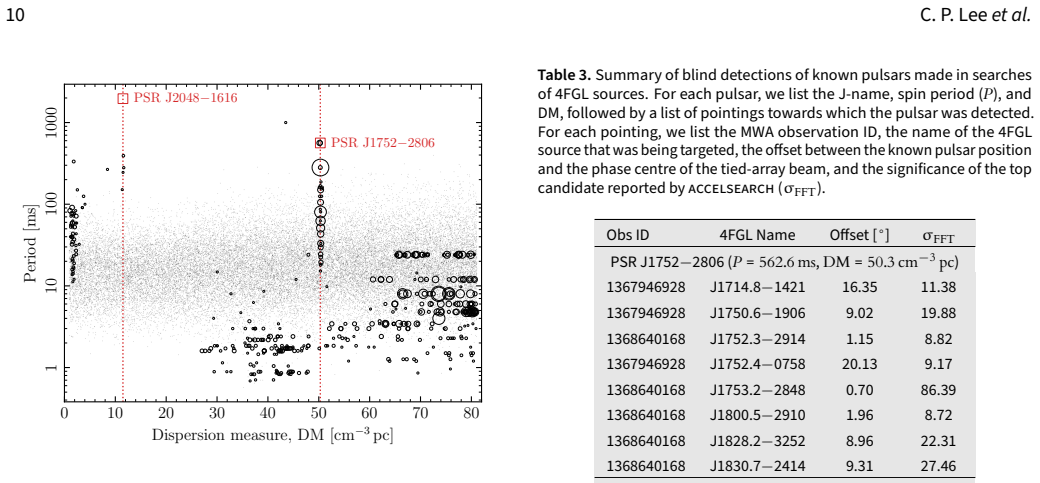
Searches of unassociated gamma-ray sources in the Fermi-LAT catalogues have led to the discoveries of around a fifth of all known millisecond pulsars (MSPs). These searches have almost exclusively been performed at radio frequencies above 300 MHz, where dispersion and scattering in the interstellar medium are less significant. We report on a shallow survey for pulsars targeting 308 unassociated Fermi-LAT sources in archival Murchison Widefield Array (MWA) observations from the Southern-sky MWA Rapid Two-metre (SMART) pulsar survey at 154 MHz. This is the largest radio survey of unassociated Fermi-LAT sources to date, and only the second to be conducted below 300 MHz after a survey with the Low Frequency Array (LOFAR) that discovered three MSPs. Each source was observed for 20 min by digitally beamforming the MWA tile voltages. Searches were then performed using a new pipeline that implements a semi-coherent dispersion removal scheme for MWA data, enabling greater sensitivities to MSPs than is possible with fully-incoherent dispersion removal (e.g. 2-3 times better sensitivity for dispersion measures between 20-40 pc/cm^3). No new pulsars were identified in the survey, which we attribute to insufficient sensitivity. We estimate flux density limits of approximately 30-220 mJy at 154 MHz (or 0.7-5.2 mJy at 1.4 GHz) for a spin period of 2 ms and a duty cycle of 28%. We discuss how the improved instantaneous sensitivity from the Phase III upgrade of the MWA will increase the number of detectable gamma-ray pulsars by ~30% for the same integration time. The semi-coherent search pipeline we have developed will also be useful for searches of supernova remnants, globular clusters, and pulsar candidates identified in imaging surveys, all of which will help to inform the significance of future surveys with SKA-Low.
Editorial analysis
A structured set of objections, weighed in public.
Referee Report
Summary. The manuscript reports results from a shallow pulsar survey of 308 unassociated Fermi-LAT gamma-ray sources using 20-minute archival MWA observations at 154 MHz. A new semi-coherent dispersion removal pipeline is introduced that is stated to provide 2-3 times better sensitivity to MSPs than incoherent dedispersion for DMs of 20-40 pc cm^{-3}. No new pulsars are detected; the authors attribute this null result to insufficient sensitivity and quote flux density limits of approximately 30-220 mJy at 154 MHz (0.7-5.2 mJy at 1.4 GHz) for P=2 ms and 28% duty cycle. The paper also discusses gains expected from the MWA Phase III upgrade and the broader utility of the pipeline.
Significance. If the pipeline performance claims hold, this is the largest low-frequency survey of unassociated Fermi-LAT sources and supplies useful upper limits on MSP detectability below 300 MHz, complementing existing higher-frequency searches and informing SKA-Low strategies. The pipeline itself represents a methodological advance applicable to other targets such as supernova remnants and globular clusters.
major comments (1)
- [Abstract and pipeline description section] Abstract and pipeline description section: the stated 2-3 times sensitivity gain of the semi-coherent dispersion removal scheme for DM 20-40 pc cm^{-3} is presented without quantitative support such as injection-recovery fractions, false-negative rates, or side-by-side metrics versus incoherent dedispersion. This validation is required to support the central attribution of the null result to sensitivity alone rather than possible pipeline limitations.
minor comments (2)
- [Abstract] Abstract: the quoted flux-density limits lack uncertainties, explicit calculation details, or sensitivity to the chosen spin period and duty cycle assumptions.
- [Abstract] Abstract: no information is given on the fraction of sources with usable data or any exclusion criteria applied to the 308 targets.
Simulated Author's Rebuttal
We thank the referee for their constructive review and for highlighting the significance of the survey and pipeline. We address the single major comment below.
read point-by-point responses
-
Referee: [Abstract and pipeline description section] Abstract and pipeline description section: the stated 2-3 times sensitivity gain of the semi-coherent dispersion removal scheme for DM 20-40 pc cm^{-3} is presented without quantitative support such as injection-recovery fractions, false-negative rates, or side-by-side metrics versus incoherent dedispersion. This validation is required to support the central attribution of the null result to sensitivity alone rather than possible pipeline limitations.
Authors: We agree that the manuscript presents the 2-3 times sensitivity gain without the quantitative validation requested. The figure originates from the expected performance of the semi-coherent dedispersion algorithm relative to incoherent methods, but we will add an appendix containing injection-recovery tests on simulated MSP signals (including recovery fractions, false-negative rates, and direct comparisons to incoherent dedispersion) specifically for DMs of 20-40 pc cm^{-3}. This addition will directly support the attribution of the null result to sensitivity. revision: yes
Circularity Check
No circularity: observational survey with direct empirical results
full rationale
This is an observational radio survey paper reporting a null detection from archival MWA data on 308 Fermi-LAT sources. The central claims (no new pulsars found; flux density limits of 30-220 mJy at 154 MHz) are direct outputs of applying the search pipeline to the observations, with no mathematical derivations, parameter fits presented as predictions, or self-referential steps. The semi-coherent dispersion removal scheme is described as new and enabling 2-3x sensitivity gain, but this performance statement is not derived from or equivalent to the survey results themselves; it is an input assumption whose validation is external to any derivation chain in the paper. No load-bearing self-citations, ansatzes, or renamings of known results appear. The paper is self-contained against external benchmarks of prior surveys and sensitivity estimates.
Axiom & Free-Parameter Ledger
free parameters (2)
- duty cycle =
28%
- spin period =
2 ms
axioms (1)
- domain assumption Dispersion and scattering in the interstellar medium can be mitigated by the semi-coherent removal scheme to achieve the stated sensitivity gain.
Reference graph
Works this paper leans on
-
[1]
Fermi Large Area Telescope Fourth Source Catalog Data Release 4 (4FGL-DR4)
Fermi Large Area Telescope Fourth Source Catalog Data Release 4 (4FGL-DR4).arXiv e-prints(July): arXiv:2307.12546. https://doi.org/ 10.48550/arXiv.2307.12546. arXiv: 2307.12546[astro-ph.HE]. Bangale, P., B. Bhattacharyya, F. Camilo, C. J. Clark, I. Cognard, M. E. DeCesar, E. C. Ferrara et al. 2024. A 350 MHz Green Bank Telescope Survey of Unassociated Fer...
work page internal anchor Pith review Pith/arXiv arXiv doi:10.48550/arxiv.2307.12546 2024
-
[2]
Fourier-domain dedispersion. A&A 657 (January): A46. https : / / doi . org / 10 . 1051 / 0004 - 6361 / 202142099. arXiv: 2110 . 03482 [astro-ph.IM]. Bhat, N. D. R., N. A. Swainston, S. J. McSweeney, M. Xue, B. W. Meyers, S. Kudale, S. Dai et al. 2023a. The Southern-sky MW A Rapid Two- metre (SMART) pulsar survey—I. Survey design and processing pipeline. P...
-
[3]
Parkes radio searches of Fermi gamma-ray sources and millisecond pulsar discoveries
https://doi.org/10.1088/0004-637X/810/2/85. arXiv: 1507.04451 [astro-ph.HE]. Clark, C. J., R. P. Breton, E. D. Barr, M. Burgay, T. Thongmeearkom, L. Nieder, S. Buchner et al. 2023. The TRAPUM L-band survey for pulsars in Fermi-LA T gamma-ray sources. MNRAS 519, no. 4 (March): 5590–
work page internal anchor Pith review Pith/arXiv arXiv doi:10.1088/0004-637x/810/2/85 2023
-
[4]
arXiv: 2212.08528 [astro-ph.HE]
https://doi.org/10.1093/mnras/stac3742. arXiv: 2212.08528 [astro-ph.HE]. Cognard, I., L. Guillemot, T. J. Johnson, D. A. Smith, C. Venter, A. K. Hard- ing, M. T. W olff et al. 2011. Discovery of Two Millisecond Pulsars in Fermi Sources with the Nançay Radio Telescope. ApJ 732, no. 1 (May):
-
[5]
Discovery of two millisecond pulsars in Fermi sources with the Nancay Radio Telescope
https://doi.org/10.1088/0004-637X/732/1/47. arXiv: 1102.4192 [astro-ph.HE]. Cromartie, H. T., F. Camilo, M. Kerr, J. S. Deneva, S. M. Ransom, P. S. Ray, E. C. Ferrara, P. F. Michelson and K. S. W ood. 2016. Six New Milli- second Pulsars from Arecibo Searches of Fermi Gamma-Ray Sources. ApJ 819, no. 1 (March): 34. https://doi.org/10.3847/0004-637X/819/1/
work page internal anchor Pith review Pith/arXiv arXiv doi:10.1088/0004-637x/732/1/47 2016
-
[6]
Six New Millisecond Pulsars from Arecibo Searches of Fermi Gamma-Ray Sources
arXiv: 1601.05343[astro-ph.HE]. Das, Jyotirmoy, Jayanta Roy, Paulo C. C. Freire, Scott M. Ransom, Bhaswati Bhattacharyya, Karel Adámek, Wes Armour, Sanjay Kudale and Mekhala V. Muley. 2025. Globular Clusters GMRT Pulsar Search (GCGPS). I. Survey Description, Discovery and Timing of the First Pulsar in NGC6093 (M80). ApJ 988, no. 2 (August): 161. https://d...
work page internal anchor Pith review Pith/arXiv arXiv doi:10.1038/nbt.3820 2025
-
[7]
https : / / doi . org / 10 . 1093 / mnras / stv1604. arXiv: 1507 . 03732 [astro-ph.GA]. Kuzmin, A. D. and B. Ya. Losovsky. 2001. No low-frequency turn-over in the spectra of millisecond pulsars. A&A 368 (March): 230–238. https: //doi.org/10.1051/0004-6361:20000507. Lee, C. P., N. D. R. Bhat, B. W. Meyers, S. J. McSweeney, W. van Straten, C. M. Tan, M. Xue...
-
[8]
arXiv: 2401.05475 [astro-ph.GA]
https://doi.org/10.3847/2515-5172/ad1bf 1. arXiv: 2401.05475 [astro-ph.GA]. . 2026. NE2025: An Updated Electron Density Model for the Galactic Interstellar Medium. ApJ 1002, no. 1 (May): 3. https://doi.org/10.3847/ 1538-4357/ae5825. arXiv: 2602.11838[astro-ph.GA]. Ord, S. M., S. E. Tremblay, S. J. McSweeney, N. D. R. Bhat, C. Sobey, D. A. Mitchell, P. J. ...
-
[9]
arXiv: 2003.02335 [astro-ph.HE]
https://doi.org/10.1093/mnras/staa596. arXiv: 2003.02335 [astro-ph.HE]. Ransom, S. M., P. S. Ray, F. Camilo, M. S. E. Roberts, Ö. Çelik, M. T. W olff, C. C. Cheung et al. 2011. Three Millisecond Pulsars in Fermi LA T Unassociated Bright Sources. ApJ 727, no. 1 (January): L16. https://doi. org/10.1088/2041-8205/727/1/L16. arXiv: 1012.2862 [astro-ph.HE]. Ra...
-
[10]
arXiv: 1205.3089[astro-ph.HE]. Remazeilles, M., C. Dickinson, A. J. Banday, M. -A. Bigot-Sazy and T. Ghosh
-
[11]
An improved source-subtracted and destriped 408 MHz all-sky map
An improved source-subtracted and destriped 408-MHz all-sky map. MNRAS 451, no. 4 (August): 4311–4327. https://doi.org/10.1093/ mnras/stv1274. arXiv: 1411.3628[astro-ph.IM]. Ridolfi, A., T. Gautam, P. C. C. Freire, S. M. Ransom, S. J. Buchner, A. Possenti, V. Venkatraman Krishnan et al. 2021. Eight new millisecond pulsars from the first MeerKA T globular ...
work page internal anchor Pith review Pith/arXiv arXiv doi:10.1093/mnras/stab790 2021
discussion (0)
Sign in with ORCID, Apple, or X to comment. Anyone can read and Pith papers without signing in.