REVIEW 4 major objections 4 minor 28 references
Seq-SG2SL: Inferring Semantic Layout from Scene Graph Through Sequence to Sequence Learning
T0 review · 4 major / 4 minor · reviewed 2026-08-14 · deepseek-v4-flash
Pith's one-line read Inferring a semantic layout from a scene graph is best posed as sequence-to-sequence translation between relationship fragments and layout-building code segments, a formulation that the paper shows outperforms a graph-convolution baseline…
desk verdict Novel sequence-based formulation for scene graph to layout, but the headline result rests on an unfair baseline and an unvalidated metric; the method and ablations are worth a serious look. read the letter →
The pith
A machine-rendered reading of the paper's core claim, the machinery that carries it, and where it could break.
The reading
What carries the argument
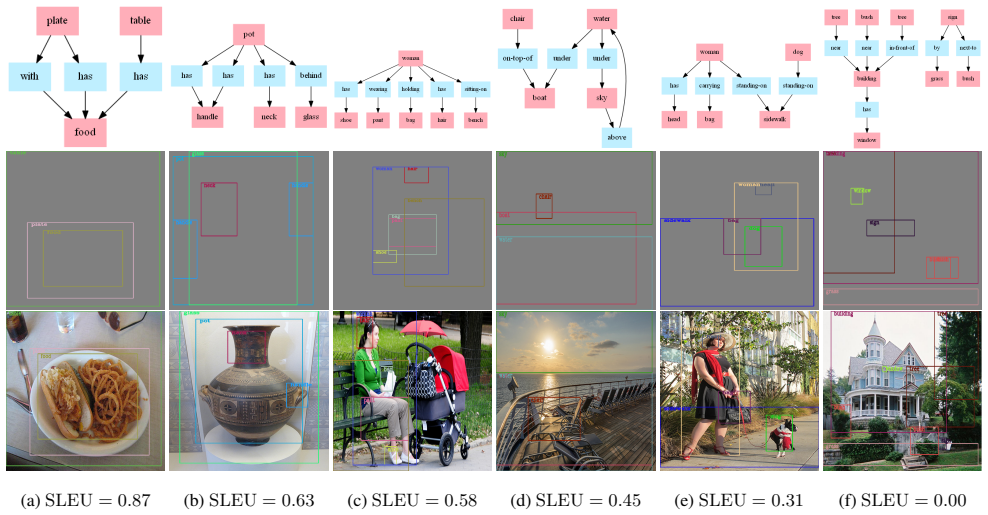
The brick-action code segment (BACS) is the mechanism that carries the argument. It is a ten-word sequence per relationship: five words specify the subject bounding box in absolute coordinates (class, x, y, width, height), and five specify the object bounding box relative to the subject (class, relative x, relative y, width, height), with an optional leading word for the layout aspect ratio. BACS turns layout prediction into a vocabulary-bounded translation problem while encoding the visual predicate through relative position. The corresponding input token is the semantic fragment (SF), a concatenation of subject, predicate, and object for one relationship. The Transformer's encoder-decoder learns the mapping from SF sequences to BACS sequences, and at inference the decoded BACS are executed step by step to restore the layout.
What would settle it
Present human annotators with pairs of predicted layouts from Seq-SG2SL and the baseline for the same scene graphs and have them choose which layout better matches the scene graph; if human preference does not track mean-SLEU ordering, or if the baseline wins at or above chance rates, the claimed significant margin is not established.
Extended reading notes
Core claim
The core discovery is that the combinatorial explosion that limits graph-convolution layout models can be avoided by decomposing the scene graph into relationship-level semantic fragments (SF) and treating each layout as the result of executing brick-action code segments (BACS). A BACS contains ten words per relationship: five define the subject box (class, absolute x and y position, width, height) and five define the object box (class, x and y relative to the subject, width, height), with an optional leading word for layout aspect ratio. Because the object is placed relative to its subject, the visual predicate is encoded directly in the output code. A Transformer translates the SF sequence into the BACS sequence, and the predicted actions are executed to reconstruct the layout, merging boxes that correspond to the same object node. On Visual Genome, the model achieves higher mean-SLEU than the graph-convolution baseline at all IoU thresholds except IoU 0.0 on the test set, where its score is negligibly lower. The large gap on the training set is presented as evidence of expressiveness: the same scene graph admits several valid layouts, and the sequence model reproduces its reference layout far more closely.
Load-bearing premise
The reported advantage over the baseline rests on SLEU being a valid automatic measure of layout quality, but the paper states that SLEU's correlation with human judgment still needs investigation.
Editorial extensions
If this is right
- A sequence model using the same decomposition but a weaker LSTM still outperforms the graph-convolution baseline on training-set mean-SLEU, indicating that the expressiveness gain comes largely from the sequential formulation rather than from the Transformer alone.
- Encoding the object's box relative to the subject's box is important; replacing it with absolute coordinates lowers training-set mean-SLEU substantially under every IoU threshold.
- SLEU gives a direct, automatic, reproducible evaluation of semantic layout prediction, replacing indirect signals such as inception score or image-captioning score for this task.
- Because BACS are executable actions, the framework extends naturally to additive layout generation, where relationships are added one at a time to an evolving layout.
- Beam search with top-1 selection produces slightly higher mean-SLEU than greedy decoding, so inference search strategy matters for final layout quality.
Reading between the lines
- The paper's decomposition implies relationship ordering is a free design choice; testing different orderings could show how much of the gain comes from the decomposition itself rather than from the learned attention, a distinction the paper does not isolate.
- Since SLEU takes the maximum over reference layouts, adding multiple references per test scene graph should raise scores and could change the relative ranking of methods; a multi-reference evaluation would be a direct test of whether the single-reference comparison is stable.
- The BACS vocabulary size grows with the quantization grid, so the framework predicts a resolution-versus-learnability trade-off; sweeping the maximum side length beyond 40 would reveal whether the reported gains persist at higher spatial precision.
Signed reviews
Editorial analysis
A structured set of objections, weighed in public.
Referee Report
Summary. The paper proposes Seq-SG2SL, a sequence-to-sequence framework for predicting a semantic layout from a scene graph. A scene graph is decomposed into a sequence of semantic fragments (SF), one per relationship, and a layout is encoded as a sequence of brick-action code segments (BACS) that specify class, position, and scale of object bounding boxes. A Transformer-based seq-to-seq model translates SF sequences to BACS sequences. The paper also introduces SLEU, a BLEU-inspired automatic metric for semantic layout evaluation, and reports experiments on Visual Genome showing that Seq-SG2SL outperforms the graph-convolution baseline of Johnson et al. [10] on mean-SLEU, with additional ablations on relative position encoding, network architecture, and beam search.
Significance. If the quantitative claims were fully validated, this would be a useful contribution: it is a conceptually simple reformulation of a structured prediction task as sequence transduction, and SLEU is a plausible step toward automated evaluation of semantic layout prediction. The paper also ships a complete experimental pipeline and several ablations that support the internal design choices (relative position encoding, Transformer over LSTM, beam search). However, the central claim of outperforming the state of the art is currently measured only with a self-proposed, unvalidated metric against a baseline that is not retrained for the task, so the empirical significance is not yet established.
major comments (4)
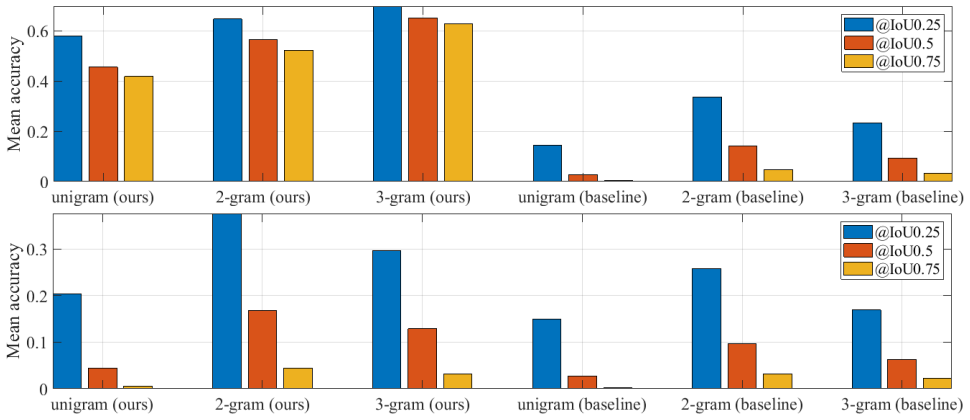
- [§4.2.4, §5.3] The paper's quantitative comparisons rest entirely on mean-SLEU, yet Section 4.2.4 states that SLEU's correlation with human judgement 'is still desirable for future investigation.' Because SLEU is introduced and parameterized in this paper (N=3 chosen 'experimentally' in §4.2.3, IoU thresholds varied in Tables 2–5), the reported improvements over the baseline are not anchored to any external or human-validated measure. Please provide at least a human study on a sample of predictions, or compare against an existing metric, before claiming that the margin is meaningful.
- [§5.3, Table 2; §5.1] The comparison with Johnson et al. [10] is not controlled. Section 5.3 states that 'the pretrained model of the baseline is applied to generate layouts for benchmarking,' meaning the baseline was not retrained for semantic layout prediction; its layout branch was originally trained only indirectly through image reconstruction. Moreover, Section 5.1 notes that scene graphs are truncated to at most 9 relationships, a setting different from the baseline's original training regime. The large training-set gap in Table 2 may therefore reflect objective mismatch and input distribution mismatch rather than any deficiency of the non-sequential formulation. Please retrain the baseline under identical data constraints and with direct layout supervision, or clearly report the comparison as a preliminary benchmark rather than a head-to-head evaluation.
- [§5.3 (training-set analysis)] The argument that the training-set mean-SLEU gap 'offers insight for model expressiveness' is not convincing. Seq-SG2SL is trained with cross-entropy supervision on BACS tokens that directly encode the reference layouts, whereas the pretrained baseline was never trained to minimize layout error on these references. A model that memorizes the single reference per training scene graph could achieve a large training-set score without demonstrating superior expressiveness. The claim that the advantage originates from avoiding combinatorial explosion is therefore not established by the reported training numbers.
- [Tables 2–5] No error bars, confidence intervals, or significance tests are reported. Several test-set differences are numerically small (e.g., IoU=0.75: 0.0039 vs. 0.0020 in Table 2; IoU=0.5: 0.0344 vs. 0.0335 in Table 5), and without estimates of variance it is impossible to judge whether these differences are meaningful. Please report standard errors over multiple runs and, where appropriate, paired significance tests.
minor comments (4)
- [§3.4] Several free parameters (maximum quantized side length 40, aspect-ratio quantization interval 0.05 and minimum 0.5, maximum 9 relationships, beam size 4, length penalty 0.6) are introduced without sensitivity analysis; a short discussion or supplementary figure showing robustness to these choices would strengthen the paper.
- [§4.2.3] The statement that N=3 is 'chosen experimentally' is vague; please describe the experiment or criterion used to select N.
- [§5.1] The truncation rule 'simply keep the first 9 while discard the rest' is presented without justification; the paper should acknowledge that this limits the scope of the method and analyze how often the truncation discards relationships.
- [Abstract and §1] The contribution bullet says 'outperforms the non-sequential state-of-the-art model by a significant margin,' but given the evaluation concerns in the major comments, a more cautious claim such as 'shows promising results on the proposed SLEU metric' would be more appropriate.
Circularity Check
No significant circularity: Seq-SG2SL's supervised SF-to-BACS transduction is self-contained, and SLEU is a symmetric evaluation metric rather than an input-equivalent construction.
full rationale
The paper's main derivation chain is not circular. Seq-SG2SL is a sequence-to-sequence transducer: scene graphs are decomposed into SF sequences, and the model is trained under cross-entropy to map these SF sequences to BACS sequences, which deterministically restore a layout. The training objective is cross-entropy on BACS tokens, not SLEU, and SLEU is not defined in terms of the model's trainable parameters or outputs. The reported comparisons use mean-SLEU symmetrically on the proposed model and the baseline; introducing a new metric and using it to evaluate one's own method is a validation concern, not a definitional circularity. The paper explicitly acknowledges the metric's limitation: 'its correlation with human judgement is still desirable for future investigation' (Section 4.2.4). That is a missing external-validation step, but it does not make any equation equal to its inputs by construction. The paper contains no load-bearing self-citations: references to Johnson et al. [10], Vaswani et al. [21], and OpenNMT [12] are external works, and no argument reduces to a prior result by the same authors. The concern that the baseline was applied as a pretrained model rather than retrained for layout prediction, and the concern that training-set scores reflect memorization, are experimental-control and fairness questions, not circularity. No Eq. X = Eq. Y by construction or fitted-parameter-renamed-as-prediction was found, so the appropriate circularity score is 0.
Assumptions & free parameters
free parameters (7)
- SLEU n-gram order N =
3
- SLEU weights w_n =
1/N for each n
- IoU thresholds T_IoU =
0.0, 0.25, 0.5, 0.75
- Maximum quantized layout side length =
40
- Aspect ratio quantization interval and minimum =
0.05 and 0.5
- Maximum relationships per scene graph =
9
- Beam size and length penalty =
4 and 0.6
assumptions (5)
- domain assumption A semantic layout is determined only by objects participating in relationships; attributes and isolated objects can be dropped.
- domain assumption A layout can be serialized as an ordered sequence of independent per-relationship brick-action code segments (BACS), with duplicate objects merged afterward using a node sequence.
- domain assumption The n-gram Markov assumption used in SLEU: the placement of a visual relationship depends on at most n-1 other relationships.
- domain assumption Closer to a human-prepared reference layout implies higher quality.
- ad hoc to paper Keeping the first 9 relationships in a scene graph is sufficient for evaluation.
invented entities (3)
-
Semantic Fragment (SF)
-
Brick-Action Code Segment (BACS)
-
SLEU metric
Cite this review
Pith. "Pith review of Seq-SG2SL: Inferring Semantic Layout from Scene Graph Through Sequence to Sequence Learning." pith.science (2026). https://pith.science/paper/PRN35J7W
@misc{pith2026190806592,
  author       = {Pith},
  title        = {Pith review of: Seq-SG2SL: Inferring Semantic Layout from Scene Graph Through Sequence to Sequence Learning},
  year         = {2026},
  howpublished = {\url{https://pith.science/paper/PRN35J7W}},
  note         = {Machine review of arXiv:1908.06592}
}
read the original abstract
Generating semantic layout from scene graph is a crucial intermediate task connecting text to image. We present a conceptually simple, flexible and general framework using sequence to sequence (seq-to-seq) learning for this task. The framework, called Seq-SG2SL, derives sequence proxies for the two modality and a Transformer-based seq-to-seq model learns to transduce one into the other. A scene graph is decomposed into a sequence of semantic fragments (SF), one for each relationship. A semantic layout is represented as the consequence from a series of brick-action code segments (BACS), dictating the position and scale of each object bounding box in the layout. Viewing the two building blocks, SF and BACS, as corresponding terms in two different vocabularies, a seq-to-seq model is fittingly used to translate. A new metric, semantic layout evaluation understudy (SLEU), is devised to evaluate the task of semantic layout prediction inspired by BLEU. SLEU defines relationships within a layout as unigrams and looks at the spatial distribution for n-grams. Unlike the binary precision of BLEU, SLEU allows for some tolerances spatially through thresholding the Jaccard Index and is consequently more adapted to the task. Experimental results on the challenging Visual Genome dataset show improvement over a non-sequential approach based on graph convolution.
Figures

Reference graph
Works this paper leans on
-
[10]
Image gener- ation from scene graphs
Justin Johnson, Agrim Gupta, and Li Fei-Fei. Image gener- ation from scene graphs. In CVPR, pages 1219–1228, June 2018
work page 2018
-
[1]
Spice: Semantic propositional image cap- tion evaluation
Peter Anderson, Basura Fernando, Mark Johnson, and Stephen Gould. Spice: Semantic propositional image cap- tion evaluation. In ECCV, pages 382–398, 2016
work page 2016
-
[2]
Neural machine translation by jointly learning to align and translate
Dzmitry Bahdanau, Kyunghyun Cho, and Yoshua Bengio. Neural machine translation by jointly learning to align and translate. CoRR, arXiv:1409.0473, 2014
arXiv 2014
-
[3]
Denny Britz, Anna Goldie, Minh-Thang Luong, and Quoc V . Le. Massive exploration of neural machine translation archi- tectures. CoRR, arXiv:1703.03906, 2017
arXiv 2017
-
[4]
Learning phrase representations using RNN encoder- decoder for statistical machine translation
Kyunghyun Cho, Bart van Merrienboer, C ¸ aglar G ¨ulc ¸ehre, Fethi Bougares, Holger Schwenk, and Yoshua Ben- gio. Learning phrase representations using RNN encoder- decoder for statistical machine translation. CoRR, arXiv:1406.1078, 2014
arXiv 2014
-
[5]
Empirical evaluation of gated re- current neural networks on sequence modeling
Junyoung Chung, C ¸ aglar G ¨ulc ¸ehreand KyungHyun Cho, and Yoshua Bengio. Empirical evaluation of gated re- current neural networks on sequence modeling. CoRR, arXiv:1412.3555, 2014
arXiv 2014
-
[6]
Centernet: Keypoint triplets for object detection
Kaiwen Duan, Song Bai, Lingxi Xie, Honggang Qi, Qing- ming Huang, and Qi Tian. Centernet: Keypoint triplets for object detection. CoRR, arXiv:1904.08189, 2019
arXiv 1904
-
[7]
Generat- ing multiple objects at spatially distinct locations
Tobias Hinz, Stefan Heinrich, and Stefan Wermter. Generat- ing multiple objects at spatially distinct locations. In ICLR, 2019
work page 2019
Show all 28 references
-
[8]
Long short-term memory
Sepp Hochreiter and Jrgen Schmidhuber. Long short-term memory. Neural Computation, 8(8):1735–1780, Nov. 1997
1997
-
[9]
Inferring semantic layout for hierarchical text- to-image synthesis
Seunghoon Hong, Dingdong Yang, Jongwook Choi, and Honglak Lee. Inferring semantic layout for hierarchical text- to-image synthesis. In CVPR, pages 7986–7994, June 2018
2018
-
[11]
Image retrieval using scene graphs
Justin Johnson, Ranjay Krishna, Michael Stark, Li-Jia Li, David Shamma, Michael Bernstein, and Li Fei-Fei. Image retrieval using scene graphs. In CVPR, pages 3668–3678, June 2015
2015
-
[12]
Guillaume Klein, Yoon Kim, Yuntian Deng, Josep Maria Crego, Jean Senellart, and Alexander M. Rush. Opennmt: Open-source toolkit for neural machine translation. CoRR, arXiv:1709.03815, 2017
2017 arXiv
-
[13]
Shamma, Michael S
Ranjay Krishna, Yuke Zhu, Oliver Groth, Justin Johnson, Kenji Hata, Joshua Kravitz, Stephanie Chen, Yannis Kalan- tidis, Li-Jia Li, David A. Shamma, Michael S. Bernstein, and Li Fei-Fei. Visual genome: Connecting language and vision using crowdsourced dense image annotations. ...
2017
-
[14]
Visual relationship detection with language priors
Cewu Lu, Ranjay Krishna, Michael Bernstein, and Li Fei- Fei. Visual relationship detection with language priors. In ECCV, pages 852–869, 2016
2016
-
[15]
Bleu: A method for automatic evaluation of machine translation
Kishore Papineni, Salim Roukos, Todd Ward, and Wei-Jing Zhu. Bleu: A method for automatic evaluation of machine translation. In ACL, pages 311–318, 2002
2002
-
[16]
Mirrorgan: Learning text-to-image generation by redescrip- tion
Tingting Qiao, Jing Zhang, Duanqing Xu, and Dacheng Tao. Mirrorgan: Learning text-to-image generation by redescrip- tion. In CVPR, June 2019
2019
-
[17]
Sequence level training with recurrent neural networks
Marc’Aurelio Ranzato, Sumit Chopra, Michael Auli, and Wojciech Zaremba. Sequence level training with recurrent neural networks. CoRR, arXiv:1511.06732, 2015
2015 arXiv
-
[18]
Sebastian Schuster, Ranjay Krishna, Angel Chang, Li Fei- fei, and Christopher D. Manning. Generating semantically precise scene graphs from textual descriptions for improved image retrieval. In EMNLP, 2015
2015
-
[19]
Sequence to sequence learning with neural networks
Ilya Sutskever, Oriol Vinyals, and Quoc V Le. Sequence to sequence learning with neural networks. In NIPS, pages 3104–3112. 2014
2014
-
[20]
Text2scene: Generating compositional scenes from textual descriptions
Fuwen Tan, Song Feng, and Vicente Ordonez. Text2scene: Generating compositional scenes from textual descriptions. In CVPR, pages 6710–6719, June 2019
2019
-
[21]
Attention is all you need
Ashish Vaswani, Noam Shazeer, Niki Parmar, Jakob Uszko- reit, Llion Jones, Aidan N Gomez, Ł ukasz Kaiser, and Illia Polosukhin. Attention is all you need. In NIPS, pages 5998–
-
[22]
Yonghui Wu, Mike Schuster, and Zhifeng et al. Chen. Google’s neural machine translation system: Bridging the gap between human and machine translation. CoRR, arXiv:1609.08144, 2016
2016 arXiv
-
[23]
Choy, and Li Fei-Fei
Danfei Xu, Yuke Zhu, Christopher B. Choy, and Li Fei-Fei. Scene graph generation by iterative message passing. In CVPR, pages 5410–5419, July 2017
2017
-
[24]
Han Zhang, Tao Xu, Hongsheng Li, Shaoting Zhang, Xiao- gang Wang, Xiaolei Huang, and Dimitris N. Metaxas. Stack- gan: Text to photo-realistic image synthesis with stacked generative adversarial networks. In ICCV, Oct. 2017
2017
-
[25]
Bridging the gap between training and inference for neural machine translation
Wen Zhang, Yang Feng, Fandong Meng, Di You, and Quan Liu. Bridging the gap between training and inference for neural machine translation. In ACL, July 2019
2019
-
[26]
Image generation from layout
Bo Zhao, Lili Meng, Weidong Yin, and Leonid Sigal. Image generation from layout. In CVPR, June 2019
2019
-
[27]
C. L. Zitnick and Devi Parikh. Bringing semantics into focus using visual abstraction. In CVPR, pages 3009–3016, June 2013
2013
-
[28]
C. L. Zitnick, Devi Parikh, and Lucy Vanderwende. Learning the visual interpretation of sentences. In ICCV, pages 1681– 1688, Dec. 2013
2013
Reviewed August 14, 2026 · model on record in the stance chip above.
Discussion (0). Continue with ORCID to comment.