REVIEW 4 major objections 7 minor 48 references
Power Allocation for Delay Optimization in Device-to-Device Networks: A Graph Reinforcement Learning Approach
T0 review · 4 major / 7 minor · reviewed 2026-08-15 · deepseek-v4-flash
Pith's one-line read A graph-embedded PPO agent allocates D2D transmit powers to cut average delay by about 56% over the ITLinQ baseline in simulation.
desk verdict Useful GNN+PPO recipe for D2D delay-aware power allocation, but the paper's own tables disagree about the headline delay numbers, so the empirical claims need repair before they can be trusted. read the letter →
The pith
A machine-rendered reading of the paper's core claim, the machinery that carries it, and where it could break.
The reading
What carries the argument
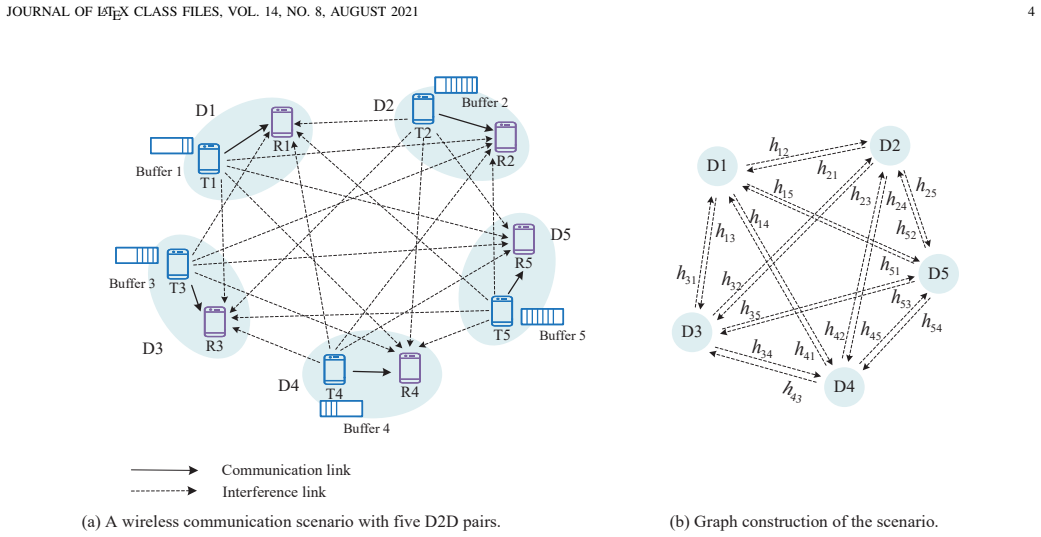
The engine of the approach is a bidirectional GNN–PPO architecture. The D2D network is modeled as a directed graph whose vertices are the communication pairs and whose edges are interference links, with normalized channel gains as edge features and, per node, a proportional-fairness ratio, a normalized delay, a normalized backlog count, and a normalized transmitted-packet count as initial features. Message passing follows the ASAP local extremum operator, and the final node embeddings feed both the actor (which outputs a multivariate Gaussian over transmit powers, clipped to [0, Pmax]) and the critic. The reward is R_n = -Σ_i J_i[n], where J_i[n] is the number of accumulated packets in buffer i at slot n. Proposition 1 connects this reward to the average-delay objective via the identity that summing per-slot buffer occupancy over time equals the sum of per-packet queueing delays, while Proposition 2 guarantees permutation equivariance, the property that makes the policy transferable to arbitrary node orderings.
What would settle it
Run the identical training procedure with finite buffers that drop packets on overflow and with packet lengths large enough that transmission delay is not negligible; if the policy selected by the surrogate reward no longer minimizes measured average delay, or if the identity in equation (27) does not hold numerically, the reward-equivalence claim falls.
Extended reading notes
Core claim
On its own terms, the central discovery is that a delay-aware state representation plus a GNN-augmented PPO agent can solve the average-delay power allocation problem in a way that rate-maximizing methods cannot. In simulations with six D2D pairs in a 500 m by 500 m cell, the proposed agent achieves about a 56% reduction in average delay over the best conventional baseline (ITLinQ), transmits more packets (5261 vs 5144 for ITLinQ and 4639 for WMMSE over 300 slots), and leaves fewer packets in buffer (142 vs 271 and 834). The agent maintains low 95th-percentile delay, the metric associated with fairness, and keeps rates fluctuating across users rather than letting weak users starve. Two formal results underpin the method: Proposition 1 states that maximizing the cumulative reward (negative accumulated buffer packets) is asymptotically equivalent to minimizing average delay, and Proposition 2 proves that the GNN–RL policy is permutation-equivariant, which is what allows the trained policy to generalize to different numbers of nodes without retraining.
Load-bearing premise
The whole method leans on the claim that punishing the total number of packets sitting in buffers is effectively the same as minimizing true average delay, but that equivalence is proved with approximations and silently assumes buffers never overflow and transmission time is negligible compared with waiting time.
Editorial extensions
If this is right
- A single trained agent can be deployed on networks with 12, 24, and even 54 D2D pairs at similar density without retraining, with average delay climbing only mildly (5.374 ms trained at 6 pairs, 6.319 ms at 54 pairs).
- Rate-maximizing resource allocation is the wrong objective for delay: WMMSE leaves 834 packets buffered after 300 slots and its average delay degrades steeply as networks densify.
- Including buffer delay, backlog, and transmitted-packet counts in the state is what lets the agent adapt power to queue states, preventing the starvation that fixed or rate-maximizing policies produce.
- The permutation-equivariance guarantee means deployment does not require re-indexing users when the network changes, removing a practical obstacle to transferring learned policies.
Reading between the lines
- The paper positions its centralized controller as an upper bound; a natural next test is whether a decentralized variant with local message passing can approach the same delay–fairness trade-off under partial observability.
- The reward equivalence in Proposition 1 is approximate; before deployment, the gap between surrogate reward and true delay should be measured under heavier traffic, finite buffers, and non-Poisson arrivals, which the simulations do not stress.
- The same graph encoding of interference topology could be reused for other per-link decisions, such as sub-band or time-slot assignment, since the architecture only requires node and edge features.
- The reported 56% improvement is over ITLinQ in one simulation configuration; the robustness claim would be stronger if the baselines were tuned for delay rather than rate, as WMMSE and ITLinQ were not designed for queue-aware control.
Signed reviews
Editorial analysis
A structured set of objections, weighed in public.
Referee Report
Summary. The paper proposes a centralized power-allocation method for D2D networks that combines proximal policy optimization (PPO) with graph neural network layers embedded in both the actor and critic. The state includes channel gains, packet delay, backlogged packets, and transmitted packets; the reward is the negative sum of buffer lengths, which Proposition 1 claims is asymptotically equivalent to minimizing average delay. The authors report simulation results showing lower average delay than ITLinQ, WMMSE, max power, random power, plain PPO, PPO+GraphSAGE, and TD3+ASAP, along with fairness improvements and scalability/generalization to unseen network sizes, densities, and user distributions.
Significance. If the reported results are correct, the paper offers a timely integration of GNNs inside an RL actor-critic loop for delay-aware power control, rather than using GNNs only as a preprocessing feature extractor. The evaluation is broader than many RL resource-allocation papers: it covers varying network sizes, densities, and user distributions, and the qualitative trends in Tables III–V and Figures 6–11 are consistent with the claimed advantages. However, the paper does not ship code or machine-checked proofs, the theoretical equivalence in Proposition 1 is explicitly approximate, and the empirical tables contain inconsistencies that currently prevent a reader from trusting the headline numbers. The central idea is defensible, but the numerical evidence needs substantial reconciliation before the claims can be accepted.
major comments (4)
- [§IV.A, Tables II–V] The default configuration described in Section IV.A (M=6, λ=3, T_sum=300, feature dimension 64, K=2) is reported with average delay 1.096 ms in Table II but 5.374 ms in Tables III, IV, and V. The same M=6 row also gives inconsistent Max power values (12.664 ms in Table III versus 14.660 ms in Table IV). Since Section IV.A states that all parameters take the Table I values unless a figure or table explicitly overrides them, and no such override is stated for these tables, at most one of these numbers can describe the default experiment. The authors must reconcile these figures or explicitly identify the setting differences that produce the discrepancy; without this, the numerical basis of the paper's central empirical claim is not self-consistent.
- [§IV.C] The text states that the proposed method achieves 'approximately a 56% improvement over the ITLinQ method.' Using the M=6 rows of Tables III and IV, the proposed method gives 5.374 ms and ITLinQ gives 7.078 ms, which corresponds to about 24.1% reduction, not 56%. Please correct the percentage or provide the data underlying the 56% figure.
- [§III.C and Appendix A] Proposition 1 and its proof in Eqs. (27)–(28) rely on two unstated approximations. First, the cumulative sum of buffer lengths is equated to the sum of queueing delays, which is only exact for stable lossless discrete-time queues with appropriate boundary handling; the proof does not address truncation at the end of the communication duration or the effect of packets still in buffers. Second, transmission delay is discarded because it is less than 1 ms, even though the objective in (6) explicitly includes transmission delay. Additionally, J_i[n] in Eq. (8) is never precisely defined relative to q_i[n] in Eq. (5) or Δ_i[n] in Eq. (14). Either justify these approximations formally or restate Proposition 1 as a heuristic reward-shaping argument rather than an equivalence claim.
- [§IV.E and §IV.F] Tables III–V and Figures 6–11 report average-delay values without error bars, confidence intervals, or the number of random seeds used. Since channel realizations and Poisson arrivals create noticeable run-to-run variability, single point estimates per configuration are insufficient to establish the claimed quantitative superiority, scalability, and generalization. Please report means and variances over multiple independent seeds, especially for the M=6 default configuration that appears in three different tables.
minor comments (7)
- [Fig. 4] The captions of panels (a) and (b) appear swapped relative to their axes: panel (a) plots average delay versus episode but is captioned 'training speed,' while panel (b) plots return versus episode but is captioned 'average delay.' The main text also refers to these panels in a way that is inconsistent with the captions.
- [§IV.C] The same figure number 'Fig. 6' is used for both the baseline performance comparison and the subsequent ablation study; please renumber so that each experiment refers to a distinct figure.
- [§IV.D] The sentence 'we compare in Fig. 11 the instantaneous rates of all D2D pairs ... in the same episode as Fig. 7' appears to reference the wrong figure; the episode is presumably the one shown in Fig. 10, which depicts remaining packets per buffer for the proposed method and WMMSE.
- [§III.C, Eqs. (8), (13)–(15)] The notation for buffer occupancy is inconsistent: J_i[n], q_i[n], and Δ_i[n] are used for conceptually overlapping quantities, and the time indexing (beginning of slot, end of slot, before/after arrivals) is not stated. Please define each quantity exactly and use consistent notation throughout.
- [Algorithm 1] The algorithm input refers to N_tra but the training loop uses N_t, and the number of agent update times K is not defined in the input list; also 'experience date' should be 'experience data.'
- [References] References [43]–[45] do not appear to be cited in the body of the manuscript; please check the citation list.
- [Throughout] There are typographical errors such as 'emdeddings,' 'lagers,' and 'date' that should be corrected in a revision.
Circularity Check
No circularity: the queue-length reward is a surrogate with an explicit (if approximate) equivalence proof, and performance claims are evaluated against external baselines.
full rationale
The paper's central derivation is the reward design in Eq. (8), R_n = -sum_i J_i[n], which is claimed in Proposition 1 to be asymptotically equivalent to the average-delay objective in Eq. (6). This is reward shaping rather than circular reasoning: J_i[n] is a buffer-occupancy count, not the delay objective by construction, and the proof in Appendix A attempts an analytical bridge through the queueing identity between cumulative queue lengths and waiting times. The approximations in that proof, including the use of the simulation statement that the minimum average delay is about 5 ms, are correctness concerns, not reductions of the prediction to its input. The GNN update (Eq. 17) is adopted from external work [41], PPO from [42], and simulation parameters from [28] and [34]; no load-bearing claim rests on a self-citation. Generalization and scalability are tested on unseen network sizes, densities, and user distributions against external baselines (ITLinQ, WMMSE, PPO, TD3+ASAP), so there is no fitted-parameter loop. The internal numerical inconsistency between Table II (1.096 ms for feature dimension 64) and Tables III/IV (5.374 ms for the trained M=6 case) is an evidence-quality problem, not circularity, and does not raise the circularity score.
Assumptions & free parameters
free parameters (3)
- Number of GNN layers K =
2
- GNN feature dimension F1=F2 =
64
- PPO hyperparameters (clip, discount, GAE) =
0.2, 0.99, 0.95
assumptions (5)
- domain assumption Packet arrivals are Poisson and buffers are infinite, so no packets are dropped.
- domain assumption The wireless channel is block-fading within each 1 ms slot and Shannon capacity is achieved.
- domain assumption Minimizing the sum of buffer lengths (reward) is asymptotically equivalent to minimizing average packet delay.
- domain assumption The interference graph with edge weights captures the topology relevant for power allocation, and two GNN message-passing hops are sufficient.
- domain assumption The environment is a Markov decision process with full state observability at the central controller.
Cite this review
Pith. "Pith review of Power Allocation for Delay Optimization in Device-to-Device Networks: A Graph Reinforcement Learning Approach." pith.science (2026). https://pith.science/paper/PS7B36SI
@misc{pith2026250512902,
  author       = {Pith},
  title        = {Pith review of: Power Allocation for Delay Optimization in Device-to-Device Networks: A Graph Reinforcement Learning Approach},
  year         = {2026},
  howpublished = {\url{https://pith.science/paper/PS7B36SI}},
  note         = {Machine review of arXiv:2505.12902}
}
read the original abstract
The pursuit of rate maximization in wireless communication frequently encounters substantial challenges associated with user fairness. This paper addresses these challenges by exploring a novel power allocation approach for delay optimization, utilizing graph neural networks (GNNs)-based reinforcement learning (RL) in device-to-device (D2D) communication. The proposed approach incorporates not only channel state information but also factors such as packet delay, the number of backlogged packets, and the number of transmitted packets into the components of the state information. We adopt a centralized RL method, where a central controller collects and processes the state information. The central controller functions as an agent trained using the proximal policy optimization (PPO) algorithm. To better utilize topology information in the communication network and enhance the generalization of the proposed method, we embed GNN layers into both the actor and critic networks of the PPO algorithm. This integration allows for efficient parameter updates of GNNs and enables the state information to be parameterized as a low-dimensional embedding, which is leveraged by the agent to optimize power allocation strategies. Simulation results demonstrate that the proposed method effectively reduces average delay while ensuring user fairness, outperforms baseline methods, and exhibits scalability and generalization capability.
Figures


Figures from the paper (7 more)


Reference graph
Works this paper leans on
-
[1]
H. ElSawy, E. Hossain, and M. -S. Alouini, “Analytical modeling of mode selection and power control for underlay D2D communication in cellular JOURNAL OF LATEX CLASS FILES, VOL. 14, NO. 8, AUGUST 2021 15 TABLE IV SCALABILITY OF OUR METHOD ON AVERAGE DELAY FOR LARGE NETWORK SIZE AND HIGHER NETWORK DENSITY. M Area (m 2) Our method (ms) PPO+GraphSAGE TD3+ASA...
work page 2021
-
[2]
Next generation 5G wireless networks: A comprehensive survey,
M. Agiwal, A. Roy, and N. Saxena, “Next generation 5G wireless networks: A comprehensive survey,”IEEE Commun. Surveys Tuts., vol. 18, no. 3, pp. 1617-1655, Feb. 2016
work page 2016
-
[3]
White paper on 5G bearer require- ments,
IMT-2020 (5G) Promotion Group, “White paper on 5G bearer require- ments,” CAICT, Jun. 2018
work page 2020
-
[4]
On the road to 6G: Visions, requirements, key technologies, and testbeds,
C. -X. Wang, X. You, X. Gao, et al., “On the road to 6G: Visions, requirements, key technologies, and testbeds,”IEEE Commun. Surveys Tuts., vol. 25, no. 2, pp. 905-974, Feb. 2023
work page 2023
-
[5]
NR: The new 5G radio access technology,
S. Parkvall, E. Dahlman, A. Furuskar, and M. Frenne, “NR: The new 5G radio access technology,”IEEE Commun. Stand. Mag., vol. 1, no. 4, pp. 24-30, Dec. 2017
work page 2017
-
[6]
O. Liberg, C. Hoymann, C. Tidestav, D. C. Larsson, I. Rahman, R. Blasco, S. Falahati, and Y . Blankenship, “Introducing 5G advanced,”IEEE Commun. Stand. Mag., vol. 8, no. 1, pp. 52-57, Mar. 2024
work page 2024
-
[7]
Multiple access integrated adaptive finite blocklength for ultra-low delay in 6G wireless networks,
Y . Zhang, W. Cheng, and W. Zhang, “Multiple access integrated adaptive finite blocklength for ultra-low delay in 6G wireless networks,”IEEE Trans. Wireless Commun., vol. 23, no. 3, pp. 1670-1683, Mar. 2024
work page 2024
-
[8]
C. Guo, L. Liang and G. Y . Li, “Resource allocation for high-reliability low-latency vehicular communications with packet retransmission,”IEEE Trans. V eh. Technol., vol. 68, no. 7, pp. 6219-6230, Jul. 2019
work page 2019
Show all 48 references
-
[9]
A comprehensive survey on mobility-aware D2D communications: Princi- ples, practice and challenges,
M. Waqas, Y . Niu, Y . Li, M. Ahmed, D. Jin, S. Chen, and Z. Han, “A comprehensive survey on mobility-aware D2D communications: Princi- ples, practice and challenges,”IEEE Commun. Surveys Tuts., vol. 22, no. 3, pp. 1863-1886, Jun. 2019
2019
-
[10]
Delay optimal scheduling for ARQ-aided power-constrained packet transmission over multi-state fading channels,
J. Liu, W. Chen, and K. B. Letaief, “Delay optimal scheduling for ARQ-aided power-constrained packet transmission over multi-state fading channels,”IEEE Trans. Wireless Commun., vol. 16, no. 11, pp. 7123-7137, Nov. 2017
2017
-
[11]
Optimal delay-power tradeoff in wireless transmission with fixed modulation,
W. Chen, Z. Cao, and K. B. Letaief, “Optimal delay-power tradeoff in wireless transmission with fixed modulation,” inProc. IWCLD, 2007, pp. 60-64
2007
-
[12]
Resource allocation for D2D-enabled vehicular communications,
L. Liang, G. Y . Li, and W. Xu, “Resource allocation for D2D-enabled vehicular communications,”IEEE Trans. Commun., vol. 65, no. 7, pp. 3186-3197, Jul. 2017
2017
-
[13]
Joint rate control and power allocation for non-orthogonal multiple access systems,
W. Bao, H. Chen, Y . Li, and B. Vucetic, “Joint rate control and power allocation for non-orthogonal multiple access systems,”IEEE J. Sel. Areas Commun., vol. 35, no. 12, pp. 2798-2811, Dec. 2017
2017
-
[14]
Joint power control and rate allocation enabling ultra-reliability and energy efficiency in SIMO wireless networks,
O. L. Alcaraz L ´opez, H. Alves, and M. Latva-aho, “Joint power control and rate allocation enabling ultra-reliability and energy efficiency in SIMO wireless networks,”IEEE Trans. Commun., vol. 67, no. 8, pp. 5768-5782, Aug. 2019
2019
-
[15]
Resource allocation for low-latency vehicular communications: An effective capacity perspective,
C. Guo, L. Liang, and G. Y . Li, “Resource allocation for low-latency vehicular communications: An effective capacity perspective,”IEEE J. Sel. Areas Commun., vol. 37, no. 4, pp. 905-917, Apr. 2019
2019
-
[16]
Deep reinforcement learning based resource allocation for V2V communications,
H. Ye, G. Y . Li, and B. -H. F. Juang, “Deep reinforcement learning based resource allocation for V2V communications,”IEEE Trans. V eh. Technol., vol. 68, no. 4, pp. 3163-3173, Apr. 2019
2019
-
[17]
Spectrum sharing in vehicular networks based on multi-agent reinforcement learning,
L. Liang, H. Ye, and G. Y . Li, “Spectrum sharing in vehicular networks based on multi-agent reinforcement learning,”IEEE J. Sel. Areas Com- mun., vol. 37, no. 10, pp. 2282-2292, Oct. 2019
2019
-
[18]
Intelligent delay-aware partial computing task offloading for multiuser industrial internet of things through edge computing,
X. Deng, J. Yin, P. Guan, N. N. Xiong, L. Zhang, and S. Mumtaz, “Intelligent delay-aware partial computing task offloading for multiuser industrial internet of things through edge computing,”IEEE Internet Things J., vol. 10, no. 4, pp. 2954-2966, Feb. 2023
2023
-
[19]
SOQ: Structural reinforcement learning for constrained delay minimization with channel state information,
Y . Zhao, Y . Kim, and J. Lee, “SOQ: Structural reinforcement learning for constrained delay minimization with channel state information,”IEEE Internet Things J., vol. 11, no. 3, pp. 4628-4644, Feb. 2024
2024
-
[20]
Semi-supervised classification with graph convolutional networks,
T. N. Kipf and M. Welling, “Semi-supervised classification with graph convolutional networks,” inProc. ICLR, 2017
2017
-
[21]
Graph attention networks,
P. Veli ˇckovi´c, G. Cucurull, A. Casanova, A. Romero, P. Li `o, and Y . Bengio, “Graph attention networks,” inProc. ICLR, 2018
2018
-
[22]
Graph neural networks: A review of methods and applications,
J. Zhou, G. Cui, S. Hu, Z. Zhang, C. Yang, Z. Liu, L. Wang, C. Li, and M. Sun, “Graph neural networks: A review of methods and applications,” AI Open, vol. 1, pp. 57-81, 2020
2020
-
[23]
Learning decentralized wireless resource allocations with graph neural networks,
Z. Wang, M. Eisen, and A. Ribeiro, “Learning decentralized wireless resource allocations with graph neural networks,”IEEE Trans. Signal Process., vol. 70, pp. 1850-1863, 2022
2022
-
[24]
Optimal wireless resource allocation with random edge graph neural networks,
M. Eisen and A. Ribeiro, “Optimal wireless resource allocation with random edge graph neural networks,”IEEE Trans. Signal Process., vol. 68, pp. 2977-2991, 2020
2020
-
[25]
Graph neural networks for scalable radio resource management: Architecture design and theoretical analysis,
Y . Shen, Y . Shi, J. Zhang, and K. B. Letaief, “Graph neural networks for scalable radio resource management: Architecture design and theoretical analysis,”IEEE J. Sel. Areas Commun., vol. 39, no. 1, pp. 101-115, Jan. 2021
2021
-
[26]
Decentralized inference with graph neural networks in wireless communication systems,
M. Lee, G. Yu, and H. Dai, “Decentralized inference with graph neural networks in wireless communication systems,”IEEE Trans. Mobile Comput., vol. 22, no. 5, pp. 2582-2598, May 2023
2023
-
[27]
Graph neural networks for wireless communications: From theory to practice,
Y . Shen, J. Zhang, S. H. Song, and K. B. Letaief, “Graph neural networks for wireless communications: From theory to practice,”IEEE Trans. Wireless Commun., vol. 22, no. 5, pp. 3554-3569, May 2023
2023
-
[28]
Learning resilient radio resource management policies with graph neural networks,
N. NaderiAlizadeh, M. Eisen and A. Ribeiro, “Learning resilient radio resource management policies with graph neural networks,”IEEE Trans. Signal Process., vol. 71, pp. 995-1009, 2023
2023
-
[29]
Learning repre- sentations by back-propagating errors,
D. E. Rumelhart, G. E. Hinton, and R. J. Williams, “Learning repre- sentations by back-propagating errors,”Nature, vol. 323, no. 6088, pp. 533-536, 1986
1986
-
[30]
Long short-term memory,
S. Hochreiter and J. Schmidhuber, “Long short-term memory,”Neural Comput., vol. 9, no. 8, pp. 1735-1780, 1997
1997
-
[31]
Attention is all you need,
A. Vaswani et al., “Attention is all you need,” inProc. NeurIPS, vol. 30, 2017, pp. 5998–6008
2017
-
[32]
Graph representation learning for wireless communications,
M. Mohsenivatani, S. Ali, V . Ranasinghe, N. Rajatheva and M. Latva- Aho, “Graph representation learning for wireless communications,”IEEE Commun. Mag., vol. 62, no. 1, pp. 141-147, Jan. 2024
2024
-
[33]
Graph neural networks for wireless networks: Graph representation, architecture and evaluation,
Y . Lu, Y . Li, R. Zhang, W. Chen, B. Ai and D. Niyato, “Graph neural networks for wireless networks: Graph representation, architecture and evaluation,”IEEE Wireless Commun., vol. 32, no. 1, pp. 150-156, Feb. 2025
2025
-
[34]
State-augmented learn- able algorithms for resource management in wireless networks,
N. NaderiAlizadeh, M. Eisen, and A. Ribeiro, “State-augmented learn- able algorithms for resource management in wireless networks,”IEEE Trans. Signal Process., vol. 70, pp. 5898-5912, 2022
2022
-
[35]
Large-scale graph reinforcement learning in wireless control systems,
V . Lima, M.Eisen, K. Gatsis, and A. Ribeiro, “Large-scale graph reinforcement learning in wireless control systems,”arXiv preprint, arXiv:2201.09859v2, 2022
2022 arXiv
-
[36]
Mutual-interference-aware through- put enhancement in massive IoT: A graph reinforcement learning frame- work,
F. Yang, C. Yang, J. Huang, et al., “Mutual-interference-aware through- put enhancement in massive IoT: A graph reinforcement learning frame- work,”IEEE Internet Things J., vol. 11, no. 18, pp. 30341-30353, Sep. 2024
2024
-
[37]
Graph-reinforcement-learning-based task offloading for multiaccess edge computing,
Z. Sun, Y . Mo and C. Yu, “Graph-reinforcement-learning-based task offloading for multiaccess edge computing,”IEEE Internet of Things J., vol. 10, no. 4, pp. 3138-3150, Feb. 2023
2023
-
[38]
Multi-flow transmission in wireless interference networks: A convergent graph learning approach,
R. Paul, K. Cohen, and G. Kedar, “Multi-flow transmission in wireless interference networks: A convergent graph learning approach,”IEEE Trans. Wireless Commun., vol. 23, no. 4, pp. 3691-3705, Apr. 2024
2024
-
[39]
Graph neural network meets multi- agent reinforcement learning: Fundamentals, applications, and future directions,
Z. Liu, J. Zhang, E. Shi, et al., “Graph neural network meets multi- agent reinforcement learning: Fundamentals, applications, and future directions,”IEEE Wireless Commun., vol. 31, no. 6, pp. 39-47, Dec. 2024
2024
-
[40]
Task placement and resource allocation for edge machine learning: A GNN-based multi- agent reinforcement learning paradigm,
Y . Li, X. Zhang, T. Zeng, J. Duan, C. Wu, and D. Wu, “Task placement and resource allocation for edge machine learning: A GNN-based multi- agent reinforcement learning paradigm,”IEEE Trans. Parallel Distrib. Syst., vol. 34, no. 12, pp. 3073-3089, Dec. 2023. JOURNAL OF LATEX C...
2023
-
[41]
ASAP: Adaptive structure aware pooling for learning hierarchical graph representations,
E. Ranjan, S. Sanyal, and P. Talukdar, “ASAP: Adaptive structure aware pooling for learning hierarchical graph representations,” inProc. AAAI, vol. 34, no. 04, pp. 5470–5477, 2020
2020
-
[42]
Prox- imal policy optimization algorithms,
J. Schulman, F. Wolski, P. Dhariwal, A. Radford, and O. Klimov, “Prox- imal policy optimization algorithms,”arXiv preprint, arXiv:1707.06347, 2017
2017 arXiv
-
[43]
Resource man- agement with deep reinforcement learning,
H. Mao, M. Alizadeh, I. Menache, and S. Kandula, “Resource man- agement with deep reinforcement learning,” inProc. HotNets, 2016, pp. 50-56
2016
-
[44]
Downlink cellular network analysis with multi-slope path loss models,
X. Zhang and J. G. Andrews, “Downlink cellular network analysis with multi-slope path loss models,”IEEE Trans. Commun., vol. 63, no. 5, pp. 1881–1894, 2015
2015
-
[45]
Are we approaching the fundamental limits of wireless network densification?
J. G. Andrews, X. Zhang, G. D. Durgin, and A. K. Gupta, “Are we approaching the fundamental limits of wireless network densification?” IEEE Commun. Mag., vol. 54, no. 10, pp. 184–190, 2016
2016
-
[46]
ITLinQ: A new approach for spectrum sharing in device-to-device communication systems,
N. Naderializadeh and A. S. Avestimehr, “ITLinQ: A new approach for spectrum sharing in device-to-device communication systems,”IEEE J. Sel. Areas Commun., vol. 32, no. 6, pp. 1139–1151, 2014
2014
-
[47]
An iteratively weighted MMSE approach to distributed sum-utility maximization for a MIMO interfering broadcast channel,
Q. Shi, M. Razaviyayn, Z.-Q. Luo, and C. He, “An iteratively weighted MMSE approach to distributed sum-utility maximization for a MIMO interfering broadcast channel,”IEEE Trans. Signal Process., vol. 59, no. 9, pp. 4331–4340, Sep. 2011
2011
-
[48]
Addressing function approxi- mation error in actor-critic methods,
S. Fujimoto, H. Hoof, and D. Meger, “Addressing function approxi- mation error in actor-critic methods,” inProc. Int. Conf. Mach. Learn. (ICML), 2018, pp. 1587-1596. APPENDIXA PROOF OF PROPOSITION 1 According to the reward function in (8), for each episode that covers the comm...
2018
Reviewed August 15, 2026 · model on record in the stance chip above.
Discussion (0). Continue with ORCID to comment.