REVIEW 4 major objections 7 minor 6 references
Reinforcement Learning for Target Zone Blood Glucose Control
T0 review · 4 major / 7 minor · reviewed 2026-08-06 · deepseek-v4-flash
Pith's one-line read This paper claims that blood glucose control with two time scales of insulin action reduces to a constrained Markov decision process that a single switching policy can learn, with theoretical guarantees and reduced clinical violations.
desk verdict Novel dual-control RL framework for insulin timing, but the convergence proof rests on a false lemma and the empirical claim conflates two different metrics. read the letter →
The pith
A machine-rendered reading of the paper's core claim, the machinery that carries it, and where it could break.
The reading
What carries the argument
The load-bearing objects are the intervention operators M_long and M_fast, which compute the expected future reward of immediately executing a long-acting or fast-acting intervention minus its cost. A switcher policy g compares these operators with the value of doing nothing, so the agent learns both intervention magnitudes and intervention times; Proposition 1 turns this comparison into an online condition for when to act. A state-augmentation step tracks remaining intervention budgets as extra state components, and a model-predictive shielding step rejects proposals whose K-step lookahead would enter a constraint violation. Theorem 1 shows the Q-learning update built on these operators is a stochastic approximation whose Bellman operator is a contraction, yielding almost-sure convergence.
What would settle it
Run the Theorem 1 Q-learning update with unequal costs, say $\alpha=2\beta$, on the AGVP scenario; if the iteration does not converge to a fixed point, the almost-sure guarantee fails outside the equal-cost assumption.
Extended reading notes
Core claim
The central claim is that target-zone control with two temporally distinct intervention types reduces to a constrained MDP whose optimal value can be learned by a single switching policy. The framework couples impulse controls for fast-acting interventions with switching controls for long-acting interventions whose effect decays through a spectral process, and a switcher policy g decides at each state whether to execute the fast policy, the long policy, or nothing. The authors' Theorem 1 states that their Q-learning variant converges with probability 1 to the optimal value function, and Theorem 2 shows the budgeted, state-augmented problem satisfies the Bellman equation. Empirically, the paper reports that this jointly learned switching schedule eliminates hypoglycemia and achieves the highest time-in-range scores on all three simulated scenarios.
Load-bearing premise
The convergence theorem assumes long-acting and fast-acting intervention costs are equal ($0<\beta=\alpha:=c$), even though the paper's own clinical motivation says long-acting insulin is more dangerous and therefore costlier if misapplied, so the proven guarantee does not cover the regime the paper cares about.
Editorial extensions
If this is right
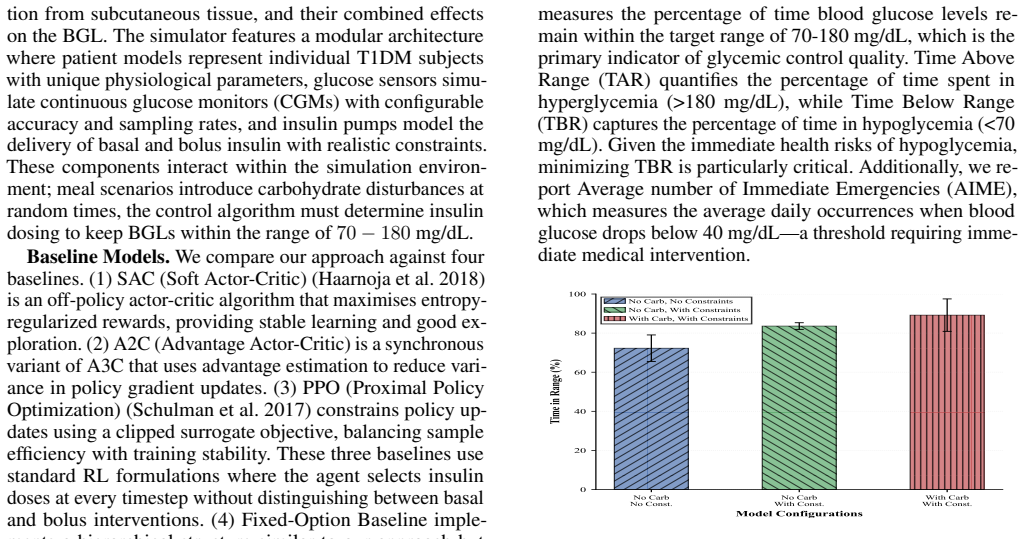
- Time in range reaches 86.5%, 89.2%, and 76.2% on the CMP, AGVP, and PHC scenarios, with 0.0% time below range in every one.
- Hard limits on the number of interventions can be enforced during learning without giving up the Markov assumption, because the remaining budget is made part of the state.
- The switcher's ability to do nothing is what explains the elimination of hypoglycemic episodes: standard fixed-timestep baselines spend 12.8-27.4% of time below range.
- The same formulation applies to other multi-timescale treatment decisions, since the impulse/switching dichotomy is not specific to insulin.
Reading between the lines
- The convergence theorem is proven only for equal intervention costs ($\beta=\alpha$), so the clinically motivated case where long-acting insulin is the costlier, riskier action remains an open theoretical gap; a Q-learning implementation with unequal costs would test whether the guarantee transfers.
- The empirical system uses PPO and SAC, not the Q-learning variant analyzed in Theorem 1, so the measured 89.2% time in range is a separate claim from the convergence result; re-running the architecture with Q-learning would connect the two.
- The paper's stated limitation on missing carbohydrate observations suggests a testable extension: withholding meal information entirely and checking whether the spectral-decay switcher can infer meal times from glucose trends alone.
- The spectral decay model for long-acting insulin could be fitted to real basal insulin pharmacokinetic data, turning the assumed decay distribution into a measurable object rather than a design choice.
Editorial analysis
A structured set of objections, weighed in public.
Referee Report
Summary. The paper proposes a constrained reinforcement-learning framework for target-zone blood glucose control in Type 1 diabetes. It combines impulse control for fast-acting insulin and switching control for long-acting insulin, models the decay of long-acting effects through a stochastic spectral process, and enforces intervention budgets and safety constraints via state augmentation and a model-predictive shielding mechanism. The authors report a Q-learning convergence theorem for a stylized discrete variant, a budgeted-MDP convergence result based on prior work, and empirical results on the GlucoEnv simulator showing higher time-in-range and zero time-below-range relative to PPO, SAC, A2C, and a fixed-option baseline. The empirical table is internally coherent, but the central theoretical guarantee is not established by the submitted proof.
Significance. If the convergence claims were valid, the framework would offer a useful template for multi-timescale, budgeted RL in healthcare: it explicitly separates when to act from which intervention to apply, incorporates decay dynamics absent from standard options frameworks, and demonstrates strong simulated glucose control with no hypoglycemia in the reported tasks. The paper has real strengths: it uses a public simulator, reports computational cost and hyperparameters, includes ablations, and makes a falsifiable empirical comparison. However, the significance is currently limited by two load-bearing gaps: the contraction proof of the main convergence theorem relies on a false lemma, and the proved result covers an equal-cost version of the problem that contrasts with the paper's own clinical motivation. The theoretical claims therefore need substantial repair before the paper can be judged on its merits.
major comments (4)
- [Supplementary Material, Proof of Theorem 3, Lemma 3] Lemma 3 is false as stated: take f(a,b)=g(a,b)=b on {0,1}^2; then the left-hand side is |max_a max_b b - max_a min_b b| = |1-0| = 1, while the right-hand side is max_{a,b}|b-b| = 0. The proof of Lemma 5, Case 2 of part (i) explicitly invokes Lemma 3 to bound a difference of max/min expressions, so the inequality |M_iQ - M_jQ'| <= gamma ||v-v'|| is not established, and the contraction of the Bellman operator T in Theorem 3 does not follow from the written argument. Since Theorem 1 is proved via the Jaakkola-Jordan-Singh conditions using this contraction, Contribution 4 is currently unsupported. A direct contraction proof of T, or a corrected intermediate inequality, is required.
- [Case B: Fast-Acting and Long-Acting Interventions; Supplementary Assumption 6] The main-text objective distinguishes long-acting and fast-acting intervention costs, alpha and beta, and the Introduction motivates long-acting insulin as more costly because misapplication can cause dangerous hypoglycaemia. Supplementary Assumption 6 instead sets 0<beta=alpha:=c, and the contraction argument in Lemma 5 repeatedly subtracts this common cost. The theorem therefore covers only the equal-cost case, which the paper itself presents as clinically unrealistic. The authors must either prove convergence for alpha != beta or state in the main text that the theoretical guarantee is restricted to the equal-cost setting and adjust the corresponding claims.
- [Theoretical Analysis, Theorem 1; Framework Architecture] The theoretical guarantee is proved for the specific Q-learning update defined in Theorem 1, but the implemented framework in Algorithm 2 uses PPO for the intervention policies, SAC for the switching policy, and a model-predictive shielding filter. No argument transfers the Q-learning convergence result to these actor-critic algorithms or accounts for the shield's rejections within the analyzed Bellman operator. Therefore the statement that 'we prove that our framework converges' is not supported for the concrete framework evaluated in Table 1. The paper should either analyze the implemented algorithm or explicitly scope the theory to a stylized Q-learning variant.
- [Proof of Theorem 2 (Supplementary Material); Handling Budget Constraints] The proof of Theorem 2 consists of a single sentence citing Theorem 2 of Sootla et al. (2022), and the state-augmentation construction in Equations (3)-(4) is the same as in that prior work. Because Contribution 3 claims a tractable method for enforcing hard safety and resource constraints, the submission should verify the hypotheses of the cited theorem for this specific MDP (for example, finiteness or ergodicity assumptions and boundedness of the reshaped reward) or provide a self-contained proof. As written, the hard-constraint guarantee rests on an external result without a check of its conditions.
minor comments (7)
- [Table 1] The table header uses 'ANIE' while the text defines the metric as 'AIME' (Average number of Immediate Emergencies); please unify the notation.
- [Figures 2 and 3] The text around Figures 2 and 3 contains raw '/uni...' glyph codes rather than rendered labels, which obscures the ablation results and prevents the reader from verifying the reported values.
- [Table 3 and budget ablation] The budget ablation reports only time-in-range; since the paper's central safety claim is zero time-below-range, please add TBR and TAR to this table.
- [Abstract and Table 1] The abstract's 'reducing blood glucose level violations from 22.4% to 10.8%' should be tied explicitly to the AGVP row, where 22.4% is A2C's TBR and 10.8% is the proposed method's TAR; as written the comparison is ambiguous.
- [Case B definitions] The notation for the spectral decay process is under-specified: the finite set E, the asymmetric distribution F, and the transition E_t ~ max(F(E), 1 - eta^L_{t-1}) are described informally, and the term 'spectra levels' is used inconsistently with 'spectral levels'.
- [Algorithm 2] Line 10 of Algorithm 2 contains 'Apply(z eta^L)_t', which appears to be a typo and should read 'Apply (z eta^L)_t' or similar.
- [Proof of Theorem 2 (Supplementary Material)] The sentence 'by Theorem 2, Switching agent's problem can be solved using a dynamic programming principle' appears inside the proof of Theorem 2 but seems to refer to Theorem 3 or Proposition 2; please correct the cross-reference.
Circularity Check
Theorem 2's budgeted-MDP convergence is imported from the authors' own Sootla et al. 2022, making part of the convergence guarantee a load-bearing self-citation; the rest of the derivation is not circular.
-
self citation load bearing
[Supplementary Material, Proof of Theorem 2; main text 'Handling Budget Constraints']
"The proof immediately by application of Theorem 2 in (Sootla et al. 2022)."
Theorem 2 is the paper's stated guarantee that the budgeted, state-augmented MDP satisfies the Bellman equation and converges to the optimal value function. Instead of a proof, the paper says the result follows directly from Theorem 2 of Sootla et al. 2022. That prior work shares author Mguni with the present paper, and the state-augmentation construction used to define the budgeted MDP is also taken from that same paper ('we use a state-augmentation technique (Sootla et al. 2022)'). Thus the budgeted-convergence contribution is not independently derived here; it is a restatement/import of the authors' own prior theorem.
full rationale
Most of the paper's technical content is self-contained: the principal Q-learning convergence claim (Theorem 1) is attacked via a Bellman contraction argument (Theorem 3) plus Jaakkola, Jordan, and Singh's stochastic approximation theorem, and the empirical improvements are benchmarked against standard RL baselines in a simulator, so they are not a fitted-input-renamed-as-prediction. The one concrete circular element is Theorem 2: its proof is not given in this paper but is directly delegated to Theorem 2 of Sootla et al. (2022), with whom author Mguni overlaps, and the state-augmentation mechanism is likewise imported from Sootla et al. Therefore the budgeted-MDP convergence guarantee reduces to a load-bearing self-citation. Separately, the supplementary proof contains an invalid inequality (Lemma 3, per the counterexample with f(a,b)=g(a,b)=b), which undermines the written contraction proof of Theorem 3; that is a correctness defect, not a self-referential reduction, so it is not scored as circularity but does weaken the claimed independent proof. Overall score 4: some load-bearing self-citation in the budgeted-convergence theorem, while the main Q-learning convergence claim retains independent (though currently flawed) content.
Assumptions & free parameters
free parameters (7)
- alpha (long-acting intervention cost)
- beta (fast-acting intervention cost)
- ell (tolerance range half-width)
- N0 (violation tolerance)
- nZ (intervention budget)
- Delta (constraint violation penalty)
- Spectral decay set E and distribution F
assumptions (5)
- standard math Assumptions A.1-A.5 (ergodicity, L2 rewards, finite moments, and related regularity from Bertsekas 2012) hold for the induced stochastic process.
- ad hoc to paper Assumption 6: intervention costs are equal, 0<beta=alpha:=c.
- domain assumption The spectral decay process E_t ~ max(F(E), 1 - etaL_{t-1}) with support on levels no higher than E_{t-1} accurately models basal insulin decay.
- domain assumption The UVA/Padova model implemented in GluCoEnv faithfully reproduces patient glucose-insulin dynamics for evaluating control policies.
- standard math The Bellman operator T defined with intervention operators M_long and M_fast has a unique fixed point and is a contraction on L2.
invented entities (1)
-
Spectral decay levels E_t (finite set E in [0,1]) with asymmetric transition distribution F
Cite this review
Pith. "Pith review of Reinforcement Learning for Target Zone Blood Glucose Control." pith.science (2026). https://pith.science/paper/PSDR4ZBO
@misc{pith2026250803875,
  author       = {Pith},
  title        = {Pith review of: Reinforcement Learning for Target Zone Blood Glucose Control},
  year         = {2026},
  howpublished = {\url{https://pith.science/paper/PSDR4ZBO}},
  note         = {Machine review of arXiv:2508.03875}
}
read the original abstract
Managing physiological variables within clinically safe target zones is a central challenge in healthcare, particularly for chronic conditions such as Type 1 Diabetes Mellitus (T1DM). Reinforcement learning (RL) offers promise for personalising treatment, but struggles with the delayed and heterogeneous effects of interventions. We propose a novel RL framework to study and support decision-making in T1DM technologies, such as automated insulin delivery. Our approach captures the complex temporal dynamics of treatment by unifying two control modalities: \textit{impulse control} for discrete, fast-acting interventions (e.g., insulin boluses), and \textit{switching control} for longer-acting treatments and regime shifts. The core of our method is a constrained Markov decision process augmented with physiological state features, enabling safe policy learning under clinical and resource constraints. The framework incorporates biologically realistic factors, including insulin decay, leading to policies that better reflect real-world therapeutic behaviour. While not intended for clinical deployment, this work establishes a foundation for future safe and temporally-aware RL in healthcare. We provide theoretical guarantees of convergence and demonstrate empirical improvements in a stylised T1DM control task, reducing blood glucose level violations from 22.4\% (state-of-the-art) to as low as 10.8\%.
Figures


Figures from the paper (3 more)


Reference graph
Works this paper leans on
-
[3]
To prove the Theorem 1, we make use of the following result: Theorem 4(Theorem 1, pg 4 in (Jaakkola, Jordan, and Singh 1994)).Let Ξt(y) be a random process that takes values in Rn and given by the following: Ξt+1(y) = (1−α t(y)) Ξt(y)αt(y)Lt(y),(16) thenΞ t(y)converges to0with probability1under the following conditions: i)0≤α t ≤1, P t αt =∞and P t αt <∞ ...
work page 1994
-
[4]
InInternational Conference on Machine Learning, 20423–20443
Sauté rl: Almost surely safe reinforcement learning using state aug- mentation. InInternational Conference on Machine Learning, 20423–20443. PMLR. Sutton, R. S.; and Barto, A. G. 2018.Reinforcement learning: An introduction. MIT press. Sutton, R. S.; Precup, D.; and Singh, S
work page 2018
-
[6]
+E . . .+γl−1E R(yτ1−1,η τ1−1) +γ T vπ,˜g (yτ1 ) =v(y) where the first inequality is true by assumption on Mi. This is a contradiction since g′ is an optimal policy for the Switching agent. Using analogous reasoning, we deduce the same result for τ ′ k < τk after which deduce the result. Moreover, by invoking the same reasoning, we can conclude that it mu...
work page 2022
-
[2010]
On the one-dimensional optimal switching problem.Mathematics of Operations Re- search, 35(1): 140–159. Bertsekas, D. P. 2012.Approximate dynamic programming. Athena scientific Belmont. Brekke, K. A.; and Øksendal, B
work page 2012
-
[2017]
arXiv preprint arXiv:1707.06347
Proximal Policy Optimization Algorithms. arXiv preprint arXiv:1707.06347. Sootla, A.; Cowen-Rivers, A. I.; Jafferjee, T.; Wang, Z.; Mguni, D. H.; Wang, J.; and Ammar, H
-
[2022]
https:// github.com/chirathyh/GluCoEnv
GluCoEnv v0.1.0(2022). https:// github.com/chirathyh/GluCoEnv. Jaakkola, T.; Jordan, M. I.; and Singh, S. P
work page 2022
Reviewed August 6, 2026 · model on record in the stance chip above.
Discussion (0). Sign in to comment.