REVIEW 3 major objections 5 minor 34 references
Radioastron probing the fine structure of the flaring H2O maser in star-forming region G25.65+1.05
T0 review · 3 major / 5 minor · reviewed 2026-08-07 · deepseek-v4-flash
Pith's one-line read A 55.8 km/s water maser in G25.65+1.05 stays unresolved on baselines of about 2.5 gigawavelengths, and the pre-flare double structure of the 43 km/s flaring feature shifts by 4.3 mas over 8.3 months, supporting the moving-sheets model of…
desk verdict A genuinely missing pre-flare epoch with a solid compact maser detection; the 4.3 mas moving-sheets claim is real but rests on an unverified cross-epoch reference. read the letter →
The pith
A machine-rendered reading of the paper's core claim, the machinery that carries it, and where it could break.
The reading
What carries the argument
The technical device is space-ground Very Long Baseline Interferometry: correlating a 10 m space antenna with a ground array produces baselines up to about 2.7 Earth diameters (roughly 2.5 gigawavelengths), giving an angular resolution of about 80 microarcseconds that resolves maser spots ground-only arrays cannot. The physical mechanism is the moving-sheets model, in which a maser super-flare occurs when two maser-emitting sheets cross along the observer's line of sight; the paper tracks this process by imaging individual 7.8 kHz spectral channels around 42–44 km/s, measuring the separation and sky position of the double flaring spot 'c' in both epochs, and registering both epochs to the same reference maser feature.
What would settle it
Re-align the two epochs to an external absolute reference, such as a phase-referenced observation tied to an extragalactic calibrator, and measure the absolute position of both the reference feature and the flaring double spot; if the reference itself moved by ~4.3 mas between epochs, the moving-sheets interpretation collapses. A second decisive test would be to monitor the 42–44 km/s double spot at several epochs through a future flare: the overlap model predicts that its component separation shrinks toward zero near the flare peak and grows again afterward.
Extended reading notes
Core claim
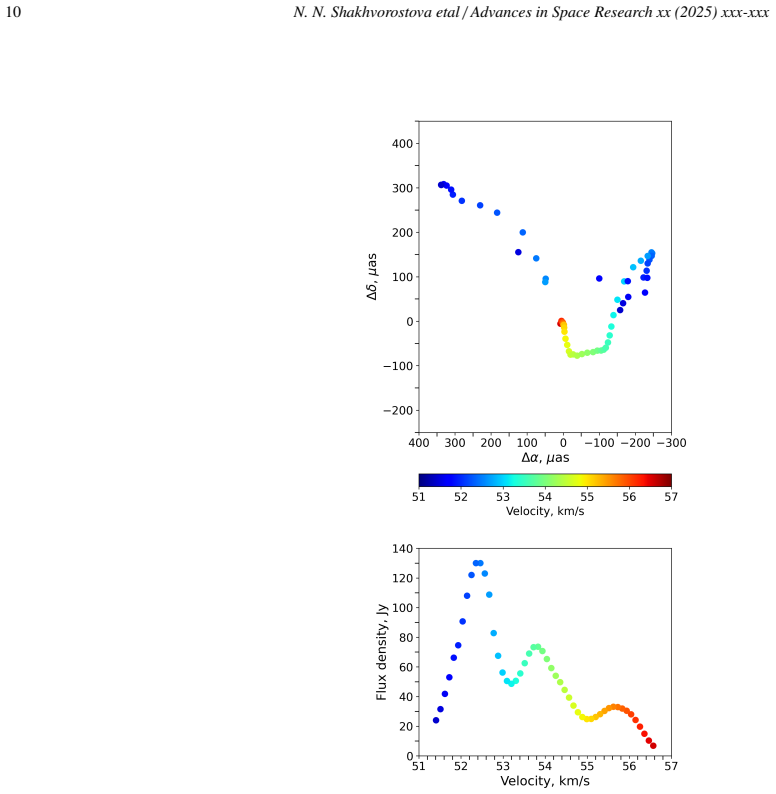
In the pre-flare epoch (10 August 2017), the 42–44 km/s 'bursting' feature that later super-flared consisted of several spatially distinct maser spots, including a candidate flare spot whose two components were separated by about 1 mas. At the post-flare epoch (18 April 2018), this double spot was still present, but its separation had shrunk by a factor of 2.8 to about 0.36 mas and its position had changed by 4.3 mas. The authors read this as direct evidence that the flare was produced when two moving maser sheets crossed along the line of sight, and they note that the implied sky-plane speed of the crossing point is close to the upper limit of 0.8–4.1 mas/yr predicted by earlier VLBI work. Independently, the red feature at 55.8 km/s is described as super-compact: it is unresolved on baselines up to about 2.5 gigawavelengths (about 2.7 Earth diameters), has a brightness temperature of $5.2\times10^{12}$ K, and forms an arc about 60 microarcseconds (0.18 AU at the adopted 2.5 kpc distance) across, possibly a rotating turbulent vortice or a disk around a hidden low-mass protostar.
Load-bearing premise
The moving-sheets conclusion assumes that both observing epochs are aligned to the same stationary reference maser feature in the sky; if that reference moved, or if the second epoch actually used a different feature (a 52.2 km/s feature appears as the reference in the second-epoch figure), the measured 4.3 mas shift would not prove real motion of the flaring spot.
Editorial extensions
If this is right
- If the moving-sheets interpretation is correct, the G25.65+1.05 super-flares were geometric line-of-sight alignments, not episodic accretion bursts, so the flare mechanism should be sought in the kinematics of the maser cloud rather than in sudden changes of the central young stellar object.
- The measured 4.3 mas shift over 8.3 months gives a sky-plane velocity for the sheet crossing point that can be compared with, and quantitatively tested against, the 0.8–4.1 mas/yr range predicted by the earlier VLBI model.
- The 55.8 km/s maser spot, unresolved at 2.5 gigawavelengths, sets a lower limit on its brightness temperature and an upper limit on its angular size near 60 microarcseconds; longer or future space baselines could resolve it directly.
- The large-scale maser distribution remained stable over 8 months while individual features vanished or brightened, implying that only a subset of maser spots participates in the flare-related changes.
Reading between the lines
- Editorial inference: the 55.8 km/s compact arc and the 42–44 km/s flaring sheets probably trace different dynamical structures (a small rotating vortice or disk versus large-scale shock sheets); the paper does not establish a single model linking them.
- Editorial inference: because the second epoch lost the space antenna and used a different ground array, and because the figure for that epoch labels a 52.2 km/s feature as the reference while the text says the reference is the same 55.8 km/s feature, the 4.3 mas shift rests on an astrometric alignment that should be re-verified with absolute phase-referenced observations.
- Editorial inference: if the moving-sheets model is right, the 4.3 mas sky-plane shift and the roughly 1 km/s velocity offset between pre-flare and flare epochs should combine into a single 3D sheet velocity; future observations can test this by requiring the two projections to agree.
- Editorial inference: a direct multi-epoch monitoring campaign of the 42–44 km/s double spot through a future flare would test the overlap model dynamically, since the model predicts the component separation shrinks to zero near flare maximum and grows afterward.
Editorial analysis
A structured set of objections, weighed in public.
Referee Report
Summary. The paper reports two epochs of 22 GHz H2O maser VLBI observations toward G25.65+1.05: a pre-flare epoch (10 Aug 2017) using the RadioAstron space telescope together with the VLBA, and a post-flare epoch (18 Apr 2018) using only ground-based antennas (GBT, Svetloe, Medicina, Torun) after the space data were lost. The central observational result is the detection of a super-compact maser feature at +55.8 km/s that is unresolved on space-ground baselines up to 2.5 Mλ, with a brightness temperature of 5.2×10^12 K and a projected size of about 0.18 AU at an adopted distance of 2.5 kpc. The paper also identifies a double structure in the bursting 42–44 km/s feature at both epochs and interprets a 4.3 mas positional change of this double spot over 8.3 months as support for the moving-sheets model of the 2017 super-flare.
Significance. If the compact maser detection is confirmed, it is a valuable space-VLBI result that adds to the small sample of sun-sized water maser structures resolved with baselines of several Earth diameters (e.g., Cepheus A). The detection is direct, based on correlated flux density measurements on all space baselines, and does not rely on fitted model parameters. The broader interpretation involving moving sheets is more ambitious, but its confirmation depends on a cross-epoch astrometric registration that is not demonstrated in the manuscript. The paper's observational content is worthy of publication, but the interpretive claim needs substantial additional support.
major comments (3)
- [Section 3.2 and Figure 12] The 4.3 mas shift and the moving-sheets conclusion are not established because the two epochs are not tied to a common astrometric reference. At Epoch I the reference feature is +55.8 km/s (Figures 4–6, 13, 17), while at Epoch II the caption to Figure 12 identifies the reference as the +52.2 km/s feature, and the +55.8 km/s feature had disappeared by Epoch II (Section 3.1). The text in Section 3.2 states that the offsets are 'from the reference feature, which is the same as at Epoch I', but no cross-epoch tie is described: the phase-reference calibrator J1821-0502 was not detected on most baselines (Section 2), the two epochs used different arrays (VLBA+SRT vs GBT+Svetloe+Medicina+Torun), and no absolute astrometric registration to VLA 1A or another continuum source is reported. The relative position of the +52.2 km/s and +55.8 km/s features at Epoch I, and the uncertainties on the Epoch II positions, are not given. Consequently, the measured '4.3 mas' shift cannot be interpreted as a physical motion, and the confirmation of the moving-sheets model (third bullet of the Conclusions) is not supported by the presented data.
- [Section 3.2] The claimed agreement between the derived angular velocity and the predicted range is arithmetically inconsistent. The paper states that the angular velocity is 'close to the upper limit of the value 0.8−4.1 mas yr−1' predicted by Burns et al. (2020a). However, 4.3 mas over 8.3 months corresponds to 6.2 mas/yr, which is about 50% larger than the upper limit of 4.1 mas/yr. This discrepancy should be acknowledged and corrected, or the comparison should be removed.
- [Section 4 and Table 4] The optical depths listed in Table 4 are not reproducible because the adopted kinetic temperature T_kin is never stated. The relation T_B = T_kin e^|τ| is used to derive τ values of roughly 19–23, but the text only says that a 'probable gas temperature' was adopted from theoretical models (Nesterenok 2022). Without the value of T_kin, and without justification for the unsaturated-maser assumption, the derived optical depths and the claimed 1.2-fold increase in optical depth between epochs are not verifiable.
minor comments (5)
- [Sections 1 and 4] The distance to G25.65+1.05 is given as 2.08 kpc when describing the earlier RadioAstron result of Bayandina et al. (2020), but the present analysis adopts 2.5 kpc from Sunada et al. (2007). Since the quoted linear sizes (0.15 vs 0.18 AU) depend on this choice, the paper should state unambiguously which distance is used in this work and why it differs from the earlier value.
- [Section 3.2] The 4.3 mas shift is quoted without any uncertainty. Even after the registration issue is resolved, this measurement should include a propagated error that accounts for both the Gaussian-fitting uncertainties and the systematic astrometric registration uncertainty.
- [Section 3.1 and Section 4] The description of the 'arc structure' is ambiguous: the +55.8 km/s spot is said to be unresolved on space baselines, while the ensemble of spots across +51.4 to +56.6 km/s is described as forming an arc of about 60 μas. The paper should clarify whether the 60 μas is the extent of the channel-to-channel position offsets (e.g., in Table 3 or Figure 11) or a model-dependent size, and how this relates to the diffraction-limited beam of 0.11×0.36 mas.
- [Section 3.1] The sentence 'It is appears to be almost unresolved on space baselines' contains a typo and should read 'It appears to be almost unresolved on space baselines.'
- [Figure 10 caption] The order of the panels in Figure 10 is confusing; the caption should explicitly state the velocity corresponding to each panel (e.g., top left: +54.5 km/s, top right: +53.6 km/s, bottom left: +52.5 km/s, bottom right: +51.8 km/s).
Circularity Check
No circular derivation: the compact-maser detection and brightness temperatures are direct VLBI measurements; the moving-sheets inference depends on an unverified cross-epoch reference registration, which is an observational-validity issue rather than a circular step.
full rationale
Steps is empty because no load-bearing derivation reduces to its own input. The main quantitative results are direct interferometric measurements: the 55.8 km/s feature is detected on space-ground baselines up to 2.5 Mλ with visibility amplitudes that remain roughly constant (Figure 7), and the brightness temperature of 5.2e12 K follows from the measured peak flux and synthesized beam via standard radiometry; no fitted parameter is renamed as a prediction. The optical-depth table uses an adopted kinetic temperature and T_B = T_kin exp(|τ|), so τ values are model-dependent inputs, but they do not feed back into any claimed prediction. The moving-sheets interpretation compares the newly observed pre-flare double structure and the 4.3 mas offset change with previously published EVN/VLA results (Burns et al. 2020a); it is a consistency argument, not a self-citation chain. The self-citations present (e.g., Bayandina et al. 2020, Shakhvorostova et al. 2018) supply monitoring and prior RadioAstron context and are not load-bearing. The one substantive weakness is an unverified registration rather than circularity: Section 3.2 states 'The offsets from the reference feature, which is the same as at Epoch I', while Section 3.1 reports that '+55.8 km/s disappeared' at Epoch II and Figure 12 labels 'the reference spectral feature is the feature at 52.2 km/s'. The 4.3 mas shift therefore depends on the assumption that the two epochs share a stationary reference, which is not demonstrated; this is a correctness and systematic-error concern, not a circular derivation. The paper is self-contained against external benchmarks in the sense that the compact-structure detection and its angular scale are obtained from the measured visibilities and beam, independent of any fitted model.
Assumptions & free parameters
free parameters (2)
- Kinetic gas temperature T_kin =
Not stated in text; adopted from shock models (Nesterenok 2022)
- Distance to G25.65+1.05 =
2.5 kpc (from Sunada et al. 2007); 2.08 kpc also cited in Section 1
assumptions (4)
- domain assumption T_B = T_kin * exp(|tau|) holds for each maser component with a single adopted kinetic temperature.
- domain assumption The H2O masers form behind a shock front, with maser spots tracing shock-compressed sheets whose geometry can be read from sky positions.
- domain assumption The Epoch I double feature at 41.9 to 43.9 km/s is the same physical maser as the EVN flare feature at 40.9 to 41.6 km/s (Burns et al. 2020a) and as the Epoch II feature at 42.5 to 43 km/s.
- domain assumption The astrometric reference feature is stable and common to both epochs.
Cite this review
Pith. "Pith review of Radioastron probing the fine structure of the flaring H2O maser in star-forming region G25.65+1.05." pith.science (2026). https://pith.science/paper/PSGB5S7J
@misc{pith2026250601053,
  author       = {Pith},
  title        = {Pith review of: Radioastron probing the fine structure of the flaring H2O maser in star-forming region G25.65+1.05},
  year         = {2026},
  howpublished = {\url{https://pith.science/paper/PSGB5S7J}},
  note         = {Machine review of arXiv:2506.01053}
}
read the original abstract
The paper describes a Space-VLBI observation of the 22 GHz H2O masers in the massive star-forming region G25.65+1.05, using the 10-m space antenna of Radioastron together with the ground-based VLBA array. Two observing epochs at the pre-flare and post-flare state of the maser source are presented. Leveraging the exceptional angular resolution provided by space-ground baselines along with the broad UV coverage from VLBA baselines, we gained a detailed perspective on the area associated with the maser flare events.
Figures


Figures from the paper (14 more)




Reference graph
Works this paper leans on
-
[1]
author Ashimbaeva , N. T. , author Krasnov , V. V. , author Lekht , E. E. et al. ( year 2020 ). title Structure and Evolution of Powerful H _ 2 O Maser Flares in the Protostellar Object IRAS 18316-0602 (G25.65+1.05) . journal Astronomy Reports \/ , volume 64 \/ issue (1) , pages 15--22 . :10.1134/S1063772920010011
-
[2]
author Ashimbaeva , N. T. , author Platonov , M. A. , author Rudnitskij , G. M. et al. ( year 2017 ). title The H2O Maser G25.65+1.05 Flared Again . journal The Astronomer's Telegram \/ , volume 11042 \/ , pages 1
work page 2017
-
[3]
author Bayandina , O. S. , author Burns , R. A. , author Kurtz , S. E. et al. ( year 2023 ). title Nature of continuum emission in the source of the water maser super-flare G25.65+1.04 . journal Astronomy & Astrophysics \/ , volume 673 \/ , pages A60 . :10.1051/0004-6361/202346023
-
[4]
author Bayandina , O. S. , author Burns , R. A. , author Kurtz , S. E. et al. ( year 2019 ). title VLA Overview of the Bursting H2O Maser Source G25.65+1.05 . journal The Astrophysical Journal \/ , volume 884 \/ issue (2) , pages 140 . :10.3847/1538-4357/ab3fa4. arXiv:1812.11353 http://arxiv.org/abs/1812.11353
work page Pith review arXiv 2019
-
[5]
author Bayandina , O. S. , author Shakhvorostova , N. N. , author Alakoz , A. V. et al. ( year 2020 ). title RadioAstron reveals super-compact structures in the bursting H _ 2 O maser source G25.65+1.05 . journal Advances in Space Research \/ , volume 65 \/ issue (2) , pages 763--771 . :10.1016/j.asr.2019.03.011
-
[6]
author Brogan , C. L. , author Hunter , T. R. , author Towner , A. P. M. et al. ( year 2019 ). title Sub-arcsecond (Sub)millimeter Imaging of the Massive Protocluster G358.93-0.03: Discovery of 14 New Methanol Maser Lines Associated with a Hot Core . journal The Astrophysical Journal Letters \/ , volume 881 \/ issue (2) , pages L39 . :10.3847/2041-8213/ab...
work page Pith review arXiv 2019
-
[7]
author Burns, R. A. , author Bayandina, O. , author Orosz, G. et al. ( year 2018 ). title Multi-epoch vlbi of a double maser super burst . https://arxiv.org/abs/1812.09454. arXiv:1812.09454 http://arxiv.org/abs/1812.09454
work page Pith review arXiv 2018
-
[8]
author Burns , R. A. , author Orosz , G. , author Bayandina , O. et al. ( year 2020 a ). title VLBI observations of the G25.65+1.05 water maser superburst . journal Monthly Notices of the Royal Astronomical Society \/ , volume 491 \/ issue (3) , pages 4069--4075 . :10.1093/mnras/stz3172. arXiv:1911.12634 http://arxiv.org/abs/1911.12634
work page Pith review arXiv 2020
Show all 34 references
-
[9]
author Burns , R. A. , author Sugiyama , K. , author Hirota , T. et al. ( year 2020 b ). title A heatwave of accretion energy traced by masers in the G358-MM1 high-mass protostar . journal Nature Astronomy \/ , volume 4 \/ , pages 506--510 . :10.1038/s41550-019-0989-3
2020 doi
-
[10]
, author Stecklum , B
author Caratti o Garatti , A. , author Stecklum , B. , author Garcia Lopez , R. et al. ( year 2017 ). title Disk-mediated accretion burst in a high-mass young stellar object . journal Nature Physics \/ , volume 13 \/ issue (3) , pages 276--279 . :10.1038/nphys3942. arXiv:1704....
2017 arXiv
-
[11]
, author Ashimbaeva , N
author Colom , P. , author Ashimbaeva , N. T. , author Lekht , E. E. et al. ( year 2019 ). title Observations of Maser Emission in the Star-Forming Region G43.8-0.1. II. H _ 2 O Maser Emission at 1.35 cm . journal Astronomy Reports \/ , volume 63 \/ issue (10) , pages 814--829...
2019 doi
-
[12]
author Davis, J. L. , author Herring, T. A. , author Shapiro, I. I. et al. ( year 1985 ). title Geodesy by radio interferometry: Effects of atmospheric modeling errors on estimates of baseline length . journal Radio Science \/ , volume 20 \/ issue (6) , pages 1593--1607 . :htt...
1985 doi
-
[13]
, author Hollenbach , D
author Elitzur , M. , author Hollenbach , D. J. , & author McKee , C. F. ( year 1989 ). title H _ 2 O Masers in Star-forming Regions . journal Astrophysical Journal \/ , volume 346 \/ , pages 983 . :10.1086/168080
1989 doi
-
[14]
, author Tsuboi , M
author Hirota , T. , author Tsuboi , M. , author Fujisawa , K. et al. ( year 2011 ). title Identification of Bursting Water Maser Features in Orion KL . journal The Astrophysical Journal Letters \/ , volume 739 \/ issue (2) , pages L59 . :10.1088/2041-8205/739/2/L59. arXiv:110...
2011 arXiv
-
[15]
, author Tsuboi , M
author Hirota , T. , author Tsuboi , M. , author Kurono , Y. et al. ( year 2014 ). title VERA and ALMA observations of the H _ 2 O supermaser burst in Orion KL . journal Publications of the Astronomical Society of Japan \/ , volume 66 \/ issue (6) , pages 106 . :10.1093/pasj/p...
2014 arXiv
-
[16]
, author Elitzur , M
author Hollenbach , D. , author Elitzur , M. , & author McKee , C. F. ( year 2013 ). title Interstellar H _ 2 O Masers from J Shocks . journal Astrophysical Journal \/ , volume 773 \/ issue (1) , pages 70 . :10.1088/0004-637X/773/1/70. arXiv:1306.5276 http://arxiv.org/abs/1306.5276
2013 arXiv
-
[17]
author Kardashev , N. S. , author Alakoz , A. V. , author Andrianov , A. S. et al. ( year 2017 ). title RadioAstron Science Program Five Years after Launch: Main Science Results . journal Solar System Research \/ , volume 51 \/ issue (7) , pages 535--554 . :10.1134/S0038094617070085
2017 doi
-
[18]
author Kardashev , N. S. , author Khartov , V. V. , author Abramov , V. V. et al. ( year 2013 ). title ``RadioAstron''-A telescope with a size of 300 000 km: Main parameters and first observational results . journal Astronomy Reports \/ , volume 57 \/ issue (3) , pages 153--19...
2013 arXiv
-
[19]
author Lekht , E. E. , author Pashchenko , M. I. , author Rudnitskii , G. M. et al. ( year 2018 ). title Superflares of H _ 2 O Maser Emission Toward the Protostellar Object G25.65+1.05 (IRAS 18316-0602) . journal Astronomy Reports \/ , volume 62 \/ issue (3) , pages 213--224 ...
2018 arXiv
-
[20]
author Likhachev , S. F. , author Kostenko , V. I. , author Girin , I. A. et al. ( year 2017 ). title Software Correlator for Radioastron Mission . journal Journal of Astronomical Instrumentation \/ , volume 6 \/ issue (3) , pages 1750004--131 . :10.1142/S2251171717500040. arX...
2017 arXiv
-
[21]
, & author Gwinn, C
author Liljeström, T. , & author Gwinn, C. R. ( year 2000 ). title Water masers diagnosing postshocked conditions in w49n . journal The Astrophysical Journal \/ , volume 534 \/ , pages 781–800 . :10.1086/308781. note ADS Bibcode: 2000ApJ...534..781L
2000 doi
-
[22]
author Murray, F. W. ( year 1967 ). title On the computation of saturation vapor pressure . journal Journal of Applied Meteorology and Climatology \/ , volume 6 \/ issue (1) , pages 203 -- 204 . :10.1175/1520-0450(1967)006<0203:OTCOSV>2.0.CO;2
1967 doi
-
[23]
author Nesterenok , A. V. ( year 2022 ). title Collisional Pumping of H\ \ _ 2 O and CH\ \ _ 3 OH Masers in C-Type Shock Waves . journal Astronomy Letters \/ , volume 48 \/ issue (6) , pages 345--359 . :10.1134/S1063773722060044. arXiv:2208.00201 http://arxiv.org/abs/2208.00201
2022 arXiv
-
[24]
author Niell, A. E. ( year 1996 ). title Global mapping functions for the atmosphere delay at radio wavelengths . journal Journal of Geophysical Research: Solid Earth \/ , volume 101 \/ issue (B2) , pages 3227--3246 . :https://doi.org/10.1029/95JB03048
1996 doi
-
[25]
( year 1972 )
author Saastamoinen, J. ( year 1972 ). title Atmospheric correction for the troposphere and stratosphere in radio ranging satellites . In booktitle The Use of Artificial Satellites for Geodesy \/ (pp. pages 247--251 ). publisher American Geophysical Union (AGU) . :https://doi....
1972 doi
-
[26]
author Shakhvorostova , N. N. , author Vol'vach , L. N. , author Vol'vach , A. E. et al. ( year 2018 ). title Search for H _ 2 O Maser Flares in Regions of Formation of Massive Stars . journal Astronomy Reports \/ , volume 62 \/ issue (9) , pages 584--608 . :10.1134/S1063772918090081
2018 doi
-
[27]
, author Kobayashi , H
author Shimoikura , T. , author Kobayashi , H. , author Omodaka , T. et al. ( year 2005 ). title VLBA Observations of a Bursting Water Maser in Orion KL . journal The Astrophysical Journal \/ , volume 634 \/ issue (1) , pages 459--467 . :10.1086/432865
2005 doi
-
[28]
author Sobolev , A. M. , author Moran , J. M. , author Gray , M. D. et al. ( year 2018 ). title Sun-sized Water Vapor Masers in Cepheus A . journal Astrophysical Journal \/ , volume 856 \/ issue (1) , pages 60 . :10.3847/1538-4357/aab096. arXiv:1802.06756 http://arxiv.org/abs/...
2018 arXiv
-
[29]
, author Saito , Y
author Sugiyama , K. , author Saito , Y. , author Yonekura , Y. et al. ( year 2019 ). title Bursting activity of the 6.668-GHz CH3OH maser detected in G 358.93-00.03 using the Hitachi 32-m . journal The Astronomer's Telegram \/ , volume 12446 \/ , pages 1
2019
-
[30]
, author Nakazato , T
author Sunada , K. , author Nakazato , T. , author Ikeda , N. et al. ( year 2007 ). title Water Maser and Ammonia Survey toward IRAS Sources in the Galaxy I. H _ 2 O Maser Data . journal PASJ \/ , volume 59 \/ , pages 1185 . :10.1093/pasj/59.6.1185
2007 doi
-
[31]
author Volvach , A. E. , author Volvach , L. N. , author MacLeod , G. et al. ( year 2017 a ). title Detection of a Second Bright H2O Maser Burst from G25.65+1.05 at the Simeiz RT-22 and HartRAO Radio Telescopes . journal The Astronomer's Telegram \/ , volume 10853 \/ , pages 1
2017
-
[32]
author Volvach , A. E. , author Volvach , L. N. , author MacLeod , G. et al. ( year 2017 b ). title Detection of a Bright H2O Maser Burst from G25.65+1.05 at the Simeiz Radio Telescope RT-22 . journal The Astronomer's Telegram \/ , volume 10728 \/ , pages 1
2017
-
[33]
author Vol'vach , L. N. , author Vol'vach , A. E. , author Larionov , M. G. et al. ( year 2019 ). title A Giant Water Maser Flare in the Galactic Source IRAS 18316-0602 . journal Astronomy Reports \/ , volume 63 \/ issue (1) , pages 49--65 . :10.1134/S1063772919010062
2019 doi
-
[34]
write newline
" write newline "" before.all 'output.state := FUNCTION n.dashify 't := "" t empty not t #1 #1 substring "-" = t #1 #2 substring "--" = not "--" * t #2 global.max substring 't := t #1 #1 substring "-" = "-" * t #2 global.max substring 't := while if t #1 #1 substring * t #2 gl...
Reviewed August 7, 2026 · model on record in the stance chip above.
Discussion (0). Sign in to comment.