REVIEW 4 major objections 4 minor 42 references
Preserving Semantic and Temporal Consistency for Unpaired Video-to-Video Translation
T0 review · 4 major / 4 minor · reviewed 2026-08-14 · deepseek-v4-flash
Pith's one-line read Optical flow and a learned fusion mask make unpaired video translation semantically and temporally coherent.
desk verdict Solid architectural contribution to unpaired video translation, but the temporal-consistency win may be partly a metric-alignment artifact; the semantic/segmentation gains are the sturdier result. read the letter →
The pith
A machine-rendered reading of the paper's core claim, the machinery that carries it, and where it could break.
The reading
What carries the argument
The central object is the recurrent generator with its fusion block. The fusion block computes a soft per-pixel mask from the difference between the newly translated frame and the flow-warped previous output, then outputs mask times warped plus one-minus-mask times new. This single mechanism does both jobs: it makes the video temporally stable by reusing reliable warped pixels and compensates the intrinsic error of the off-the-shelf flow estimator (FlowNet2) by falling back to freshly synthesized pixels where the warp is wrong. The two loss functions—the instance-normalized VGG content loss and the masked flow-warping temporal loss—train this block and the generators jointly.
What would settle it
On the VIPER benchmark, ground-truth optical flow is available. Retrain the full model with the temporal-consistency loss computed from ground-truth source flow instead of FlowNet2 estimates, keeping everything else fixed. If the reported gains in mean IoU and temporal warping error persist or improve, the assumption that source-flow motion transfers to translated video is sound; if they degrade, the flow-transfer assumption is the weak link and the fusion block's error compensation, not the flow itself, carries the temporal consistency.
Extended reading notes
Core claim
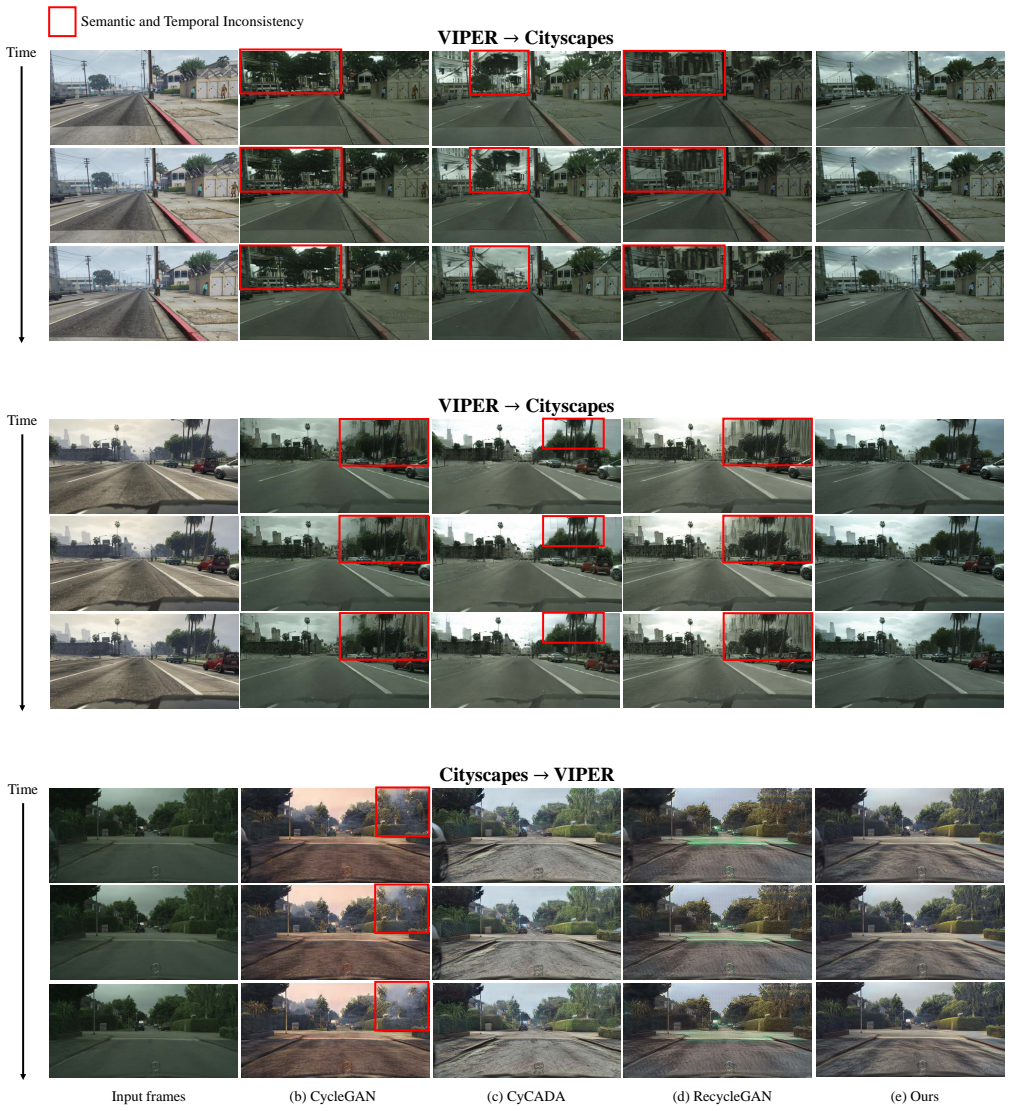
The paper's claim is that the two failure modes of prior unpaired video translation—semantic label flipping and temporal flicker—have a common remedy: make generation recurrent in pixel space and impose consistency in both content and time. Its generator takes the current source frame, the previous source frame, and the previous output frame; a pretrained flow network estimates motion from the two source frames, the previous output is warped forward, and a small fusion network predicts a soft mask that blends warped pixels with freshly generated pixels. Because traceable pixels are reused rather than resynthesized, flicker drops; because the freshly synthesized pixels fill occlusions and newly visible regions, the output does not smear. A content-preserving loss on instance-normalized VGG features keeps semantic labels from flipping, and a flow-warping temporal loss with an occlusion mask keeps consecutive outputs consistent. The paper reports the best semantic segmentation scores and lowest flow-warping error among the compared methods on VIPER to Cityscapes, and better domain adaptation than training on source frames alone.
Load-bearing premise
The whole pipeline assumes that optical flow computed on source-domain frames (by a network trained on synthetic data) still describes the motion that should connect the translated target-domain frames; if appearance transfer makes those flows wrong, the temporal loss penalizes correct synthesis and the fusion block blends on the basis of bad warps.
Editorial extensions
If this is right
- If correct, per-frame unpaired translation methods with temporal post-processing are dominated: they can smooth flicker but cannot recover semantic consistency, whereas the proposed joint spatio-temporal training achieves both in one pass.
- The framework gives a label-free replacement for semantic-loss-based adaptation, since content preservation uses instance-normalized features rather than source semantic labels.
- Domain adaptation for segmentation from synthetic to real video improves: a segmentation model trained on translated frames outperforms models trained on raw source frames or on translations from cycle-consistency baselines.
- The approach transfers to other video domains where motion is simple, and the authors argue it matters most when the translation task is hard.
- Recycling pixels through optical flow yields smoother videos than predicting every frame from scratch, so the recurrent-warping design is a general alternative to learned future-frame predictors.
Reading between the lines
- The method's reliance on source-flow to warp target-domain pixels is an unstated pressure point: if the visual gap between domains changes motion statistics, the same FlowNet2 flow may not describe target motion. A testable extension is to fine-tune the flow estimator on translated frames and check whether temporal error falls further.
- The fusion block learns an error and occlusion map implicitly. This same learned soft-blending recipe could transfer to other recurrent video tasks such as inpainting, super-resolution, or frame interpolation, where warping errors accumulate over time.
- The fixed occlusion weight $\alpha=50$ is a manually chosen hyperparameter; a learned occlusion predictor might make the temporal loss more robust, and the ablation table's rule-based-mask failure suggests the mask design is delicate.
- A label-free content-preserving loss of this kind, if it transfers, would allow semantic consistency to be imposed in domains where neither source nor target has semantic labels, which the paper notes but does not test.
Signed reviews
Editorial analysis
A structured set of objections, weighed in public.
Referee Report
Summary. The paper addresses unpaired video-to-video translation, proposing a recurrent generator that combines a per-frame image generator with a FlowNet2-based flow estimator and a learned fusion mask, trained with adversarial, cycle-consistency, content-preserving (VGG with instance normalization), and temporal warping losses. Experiments on VIPER to Cityscapes and Cityscapes to VIPER compare against CycleGAN, CyCADA, RecycleGAN, and blind temporal-consistency post-processing, using PSPNet-based semantic segmentation scores, flow warping error, user preference, and a domain adaptation segmentation benchmark. The paper also includes ablations of the content/temporal losses and the fusion block and reports in Appendix A.1 that a high content loss weight collapses to identity mapping.
Significance. If the reported results hold, the paper makes a useful contribution: it is among the first to use optical flow as a temporal prior in unpaired video translation, and its gains on VIPER to Cityscapes (35.14 vs. 30.75 mIoU over CyCADA) and in downstream domain adaptation are large and consistently in one direction across Tables 1, 2, and 4. The ablations are informative, and the appendix's disclosure of the identity-mapping failure mode and the fusion-block baselines is a sign of honest reporting. However, the central temporal-consistency claim currently rests on a metric that is closely aligned with the training objective, and none of the quantitative comparisons include variance estimates or significance tests.
major comments (4)
- [§3.5 and §4.3 (Eq. 7, Table 2)] The temporal metric in Table 2 is not independent of the training objective: L_temp in Eq. (7) penalizes the pixel-wise difference between the current output and the flow-warped previous output, and Table 2 measures the same quantity with the same recurrent architecture, differing mainly in the flow source (FlowNet2 during training vs. ground-truth VIPER flow at evaluation) and the occlusion mask. Because the fusion block and recurrent generator are optimized to minimize exactly this error, the 0.000437 vs. 0.000829 gap partially reflects successful minimization of the evaluation metric rather than an independent demonstration of reduced flicker. I ask for a temporal-consistency measure that is not a training objective, e.g., using flow estimated on the translated video itself, or a flicker-specific human rating.
- [Tables 1–5] All quantitative claims are reported as point estimates from what appears to be a single training run. The headline claim that the method outperforms all baselines in all evaluation metrics (Tables 1 and 2) and the large user-preference differences in Table 5 should be accompanied by either multiple seeds with standard deviations or a significance test, since GAN training is known to be run-dependent and the mIoU gaps (e.g., 35.14 vs. 30.75) are not obviously outside plausible training noise.
- [§3.1 and §3.5] The framework assumes that FlowNet2, pre-trained on FlyingChairs and FlyingThings and frozen, estimates motion on source frames that remains valid after appearance translation. If the domain shift changes texture or illumination, flow errors contaminate both the warped pixels used in Eq. (2) and the L_temp loss in Eq. (7), and Table 2 shares this bias because it uses the same warping paradigm with ground-truth flow. The paper should provide evidence that the estimated flow is accurate on the translated outputs, or compare against a variant that estimates flow on the target-like frame.
- [§4.5, Table 5] The user study asks participants which result they prefer overall, not whether one video has less flicker, so it does not isolate the temporal-consistency claim; the forward-direction preference of 79.78% versus 41.78% backward also shows strong direction dependence and is reported without raw counts or any uncertainty. A flicker-specific forced-choice question or a scoring rubric for temporal artifacts would directly support the abstract's claim.
minor comments (4)
- [Appendix A.1] The note that increasing the content loss weight leads to an identity-mapping collapse is important and should be moved to the main text, with a discussion of how lambda_cont=1 was selected and how sensitive the results are to that choice.
- [§4.6] There is a typo: 'vanila baseline' should be 'vanilla baseline'.
- [§3.7 and Table 1] The training resolution is stated as 256x512 in §3.7, while Table 1 is labeled as 512x1024; please clarify whether translated frames are upsampled before PSPNet evaluation or whether evaluation is performed at a different resolution.
- [Table 4] The 'Oracle - Target' row in Table 4 is not defined in §4.6; the text should state how the oracle model is trained, beyond saying that it has access to target-domain data.
Circularity Check
No significant circularity: the paper's claims are supported by external segmentation benchmarks and training objectives, not by a derivation that reduces to its inputs.
full rationale
The paper is an empirical video-to-video translation system; it does not claim a first-principles derivation whose output is equivalent to its input. The content-preserving loss (Eq. 6) and temporal consistency loss (Eq. 7) are training objectives, and the main semantic evidence is an external pretrained PSPNet applied to translated frames (Table 1) plus a domain-adaptation segmentation benchmark (Table 4), both outside the training objectives. Although the temporal warping error in Table 2 closely resembles the temporal consistency loss minimized in Eq. (7), the metric uses ground-truth VIPER optical flow on test videos and measures a quantity the model was explicitly trained to reduce; this is a limitation of metric alignment, not a by-construction circular step. Citations to FlowNet2, CycleGAN, CyCADA, RecycleGAN, and PSPNet are external, and no load-bearing self-citation or imported uniqueness theorem is used. The derivation chain is therefore self-contained with respect to the circularity criteria.
Assumptions & free parameters
free parameters (5)
- lambda_cyc =
10
- lambda_cont =
1
- lambda_temp =
10
- alpha =
50
- K =
3
assumptions (4)
- domain assumption Markovian assumption: x_hat_T,t depends only on x_S,t, x_S,t-1, and x_hat_T,t-1 (Eq. (1)).
- domain assumption FlowNet2 optical flow transfers to VIPER and Cityscapes and is accurate enough for pixel warping.
- domain assumption Instance-normalized VGG-19 relu5_3 features represent semantic content independent of style.
- domain assumption Cycle consistency is a sufficient constraint for learning unpaired translations.
Cite this review
Pith. "Pith review of Preserving Semantic and Temporal Consistency for Unpaired Video-to-Video Translation." pith.science (2026). https://pith.science/paper/PSJV33X4
@misc{pith2026190807683,
  author       = {Pith},
  title        = {Pith review of: Preserving Semantic and Temporal Consistency for Unpaired Video-to-Video Translation},
  year         = {2026},
  howpublished = {\url{https://pith.science/paper/PSJV33X4}},
  note         = {Machine review of arXiv:1908.07683}
}
read the original abstract
In this paper, we investigate the problem of unpaired video-to-video translation. Given a video in the source domain, we aim to learn the conditional distribution of the corresponding video in the target domain, without seeing any pairs of corresponding videos. While significant progress has been made in the unpaired translation of images, directly applying these methods to an input video leads to low visual quality due to the additional time dimension. In particular, previous methods suffer from semantic inconsistency (i.e., semantic label flipping) and temporal flickering artifacts. To alleviate these issues, we propose a new framework that is composed of carefully-designed generators and discriminators, coupled with two core objective functions: 1) content preserving loss and 2) temporal consistency loss. Extensive qualitative and quantitative evaluations demonstrate the superior performance of the proposed method against previous approaches. We further apply our framework to a domain adaptation task and achieve favorable results.
Figures


Figures from the paper (2 more)

Reference graph
Works this paper leans on
-
[1]
Aayush Bansal, Shugao Ma, Deva Ramanan, and Yaser Sheikh. 2018. Recycle-gan: Unsupervised video retargeting. In European Conference on Computer Vision . Springer, 122–138
work page 2018
-
[2]
Konstantinos Bousmalis, Nathan Silberman, David Dohan, Dumitru Erhan, and Dilip Krishnan. 2017. Unsupervised pixel-level domain adaptation with generative adversarial networks. In The IEEE Conference on Computer Vision and Pattern Recognition (CVPR), Vol. 1. 7
work page 2017
-
[3]
Dongdong Chen, Jing Liao, Lu Yuan, Nenghai Yu, and Gang Hua. 2017. Coherent online video style transfer. In Proc. Intl. Conf. Computer Vision (ICCV)
work page 2017
-
[4]
Emily L Denton, Soumith Chintala, Rob Fergus, et al . 2015. Deep generative image models using aï£ij laplacian pyramid of adversarial networks. In Advances in neural information processing systems . 1486–1494
work page 2015
-
[5]
Jeff Donahue, Philipp Krähenbühl, and Trevor Darrell. 2016. Adversarial feature learning. arXiv preprint arXiv:1605.09782 (2016)
arXiv 2016
-
[6]
A. Dosovitskiy, P. Fischer, E. Ilg, P. Häusser, C. Hazırbaş, V. Golkov, P. v.d. Smagt, D. Cremers, and T. Brox. 2015. FlowNet: Learning Optical Flow with Convolutional Networks. In IEEE International Conference on Computer Vision (ICCV) . http: //lmb.informatik.uni-freiburg.de/Publications/2015/DFIB15
work page 2015
-
[7]
Vincent Dumoulin, Ishmael Belghazi, Ben Poole, Olivier Mastropietro, Alex Lamb, Martin Arjovsky, and Aaron Courville. 2016. Adversarially learned inference. arXiv preprint arXiv:1606.00704 (2016)
arXiv 2016
-
[8]
Chelsea Finn, Ian Goodfellow, and Sergey Levine. 2016. Unsupervised Learn- ing for Physical Interaction Through Video Prediction. In Advances in Neural Information Processing Systems. 64–72
work page 2016
Show all 42 references
-
[9]
Ian Goodfellow, Jean Pouget-Abadie, Mehdi Mirza, Bing Xu, David Warde-Farley, Sherjil Ozair, Aaron Courville, and Yoshua Bengio. 2014. Generative adversarial nets. In Advances in neural information processing systems . 2672–2680
2014
-
[10]
Judy Hoffman, Eric Tzeng, Taesung Park, Jun-Yan Zhu, Phillip Isola, Kate Saenko, Alexei A Efros, and Trevor Darrell. 2017. Cycada: Cycle-consistent adversarial domain adaptation. arXiv preprint arXiv:1711.03213 (2017)
2017 arXiv
-
[11]
Xun Huang and Serge Belongie. 2017. Arbitrary style transfer in real-time with adaptive instance normalization. In Proceedings of the IEEE International Conference on Computer Vision . 1501–1510
2017
-
[12]
Xun Huang, Ming-Yu Liu, Serge Belongie, and Jan Kautz. 2018. Multimodal Un- supervised Image-to-Image Translation. arXiv preprint arXiv:1804.04732 (2018)
2018 arXiv
-
[13]
Eddy Ilg, Nikolaus Mayer, Tonmoy Saikia, Margret Keuper, Alexey Dosovitskiy, and Thomas Brox. [n. d.]. Flownet 2.0: Evolution of optical flow estimation with deep networks
-
[14]
Phillip Isola, Jun-Yan Zhu, Tinghui Zhou, and Alexei A Efros. 2017. Image-to- image translation with conditional adversarial networks. In 2017 IEEE Conference on Computer Vision and Pattern Recognition (CVPR) . IEEE, 5967–5976
2017
-
[15]
Dahun Kim, Sanghyun Woo, Joon-Young Lee, and In So Kweon. 2019. Deep blind video decaptioning by temporal aggregation and recurrence. In Proceedings of the IEEE Conference on Computer Vision and Pattern Recognition . 4263–4272
2019
-
[16]
Dahun Kim, Sanghyun Woo, Joon-Young Lee, and In So Kweon. 2019. Deep Video Inpainting. In Proceedings of the IEEE Conference on Computer Vision and Pattern Recognition. 5792–5801
2019
-
[17]
Wei-Sheng Lai, Jia-Bin Huang, Oliver Wang, Eli Shechtman, Ersin Yumer, and Ming-Hsuan Yang. 2018. Learning blind video temporal consistency. In Proceed- ings of the European Conference on Computer Vision (ECCV) . 170–185
2018
-
[18]
Donghoon Lee, Tomas Pfister, and Ming-Hsuan Yang. 2019. Inserting Videos into Videos. In Proc. of Computer Vision and Pattern Recognition (CVPR)
2019
-
[19]
Ming-Yu Liu, Thomas Breuel, and Jan Kautz. 2017. Unsupervised image-to-image translation networks. In Advances in Neural Information Processing Systems . 700– 708
2017
-
[20]
William Lotter, Gabriel Kreiman, and David Cox. 2017. Deep Predictive Coding Networks for Video Prediction and Unsupervised Learning. In Proc. of Int’l Conf. on Learning Representations (ICLR)
2017
-
[21]
Nikolaus Mayer, Eddy Ilg, Philip Hausser, Philipp Fischer, Daniel Cremers, Alexey Dosovitskiy, and Thomas Brox. 2016. A large dataset to train convolutional networks for disparity, optical flow, and scene flow estimation. In Proceedings of the IEEE Conference on Computer Visio...
2016
-
[22]
Alec Radford, Luke Metz, and Soumith Chintala. 2015. Unsupervised representa- tion learning with deep convolutional generative adversarial networks. arXiv preprint arXiv:1511.06434 (2015)
2015 arXiv
-
[23]
Richter, Zeeshan Hayder, and Vladlen Koltun
Stephan R. Richter, Zeeshan Hayder, and Vladlen Koltun. 2017. Playing for Benchmarks. In IEEE International Conference on Computer Vision, ICCV 2017, Venice, Italy, October 22-29, 2017. 2232–2241. https://doi.org/10.1109/ICCV.2017. 243
2017 doi
-
[24]
Masaki Saito, Eiichi Matsumoto, and Shunta Saito. 2017. Temporal Generative Ad- versarial Nets with Singular Value Clipping. In2017 IEEE International Conference on Computer Vision (ICCV) . IEEE, 2849–2858
2017
-
[25]
Mehdi S. M. Sajjadi, Raviteja Vemulapalli, and Matthew Brown. 2018. Frame- Recurrent Video Super-Resolution. In The IEEE Conference on Computer Vision and Pattern Recognition (CVPR)
2018
-
[26]
Tim Salimans, Ian Goodfellow, Wojciech Zaremba, Vicki Cheung, Alec Radford, and Xi Chen. 2016. Improved techniques for training gans. In Advances in Neural Information Processing Systems. 2234–2242
2016
-
[27]
Rakshith Shetty, Mario Fritz, and Bernt Schiele. 2018. Adversarial Scene Edit- ing: Automatic Object Removal from Weak Supervision. In Advances in Neural Information Processing Systems. 7717–7727
2018
-
[28]
Ashish Shrivastava, Tomas Pfister, Oncel Tuzel, Joshua Susskind, Wenda Wang, and Russell Webb. 2017. Learning from simulated and unsupervised images through adversarial training. In 2017 IEEE Conference on Computer Vision and Pattern Recognition (CVPR). IEEE, 2242–2251
2017
-
[29]
Yaniv Taigman, Adam Polyak, and Lior Wolf. 2016. Unsupervised cross-domain image generation. arXiv preprint arXiv:1611.02200 (2016)
2016 arXiv
-
[30]
Sergey Tulyakov, Ming-Yu Liu, Xiaodong Yang, and Jan Kautz. 2018. Mocogan: Decomposing motion and content for video generation. InProceedings of the IEEE conference on computer vision and pattern recognition . 1526–1535
2018
-
[31]
Dmitry Ulyanov, Andrea Vedaldi, and Victor Lempitsky. 2016. Instance normaliza- tion: The missing ingredient for fast stylization. arXiv preprint arXiv:1607.08022 (2016)
2016 arXiv
-
[32]
Chuan Wang, Haibin Huang, Xiaoguang Han, and Jue Wang. 2019. Video Inpaint- ing by Jointly Learning Temporal Structure and Spatial Details. In Proceedings of the 33th AAAI Conference on Artificial Intelligence
2019
-
[33]
Ting-Chun Wang, Ming-Yu Liu, Jun-Yan Zhu, Guilin Liu, Andrew Tao, Jan Kautz, and Bryan Catanzaro. 2018. Video-to-video synthesis. arXiv preprint arXiv:1808.06601 (2018)
2018 arXiv
-
[34]
Ting-Chun Wang, Ming-Yu Liu, Jun-Yan Zhu, Andrew Tao, Jan Kautz, and Bryan Catanzaro. 2018. High-resolution image synthesis and semantic manipulation with conditional gans. In Proceedings of the IEEE Conference on Computer Vision and Pattern Recognition. 8798–8807
2018
-
[35]
W. Wang Y. Huang and L. Wang. 2018. Video Super-Resolution via Bidirec- tional Recurrent Convolutional Networks. IEEE Trans. Pattern Anal. Mach. Intell. (TPAMI) 40, 4 (2018), 1015–1028
2018
-
[36]
Donggeun Yoo, Namil Kim, Sunggyun Park, Anthony S Paek, and In So Kweon
-
[37]
Fisher Yu, Vladlen Koltun, and Thomas Funkhouser. 2017. Dilated Residual Networks. In Computer Vision and Pattern Recognition (CVPR)
2017
-
[38]
Hengshuang Zhao, Jianping Shi, Xiaojuan Qi, Xiaogang Wang, and Jiaya Jia. 2017. Pyramid scene parsing network. InProceedings of the IEEE conference on computer vision and pattern recognition . 2881–2890
2017
-
[39]
Junbo Zhao, Michael Mathieu, and Yann LeCun. 2016. Energy-based generative adversarial network. arXiv preprint arXiv:1609.03126 (2016)
2016 arXiv
-
[40]
Jun-Yan Zhu, Philipp Krähenbühl, Eli Shechtman, and Alexei A Efros. 2016. Generative visual manipulation on the natural image manifold. In European Conference on Computer Vision . Springer, 597–613
2016
-
[41]
Jun-Yan Zhu, Taesung Park, Phillip Isola, and Alexei A Efros. 2017. Unpaired Image-to-Image Translation using Cycle-Consistent Adversarial Networks. In IEEE International Conference on Computer Vision . A APPENDIX A.1 Implementation details Our model is implemented using Pytor...
2017
-
[2016]
In European Conference on Computer Vision
Pixel-level domain transfer. In European Conference on Computer Vision . Springer, 517–532
Reviewed August 14, 2026 · model on record in the stance chip above.
Discussion (0). Continue with ORCID to comment.