REVIEW 4 major objections 5 minor 63 references
A Near-Infrared Spectral Library of Very Young Brown Dwarfs and Planetary-Mass Objects in the Orion Nebula Cluster
T0 review · 4 major / 5 minor · reviewed 2026-08-05 · deepseek-v4-flash
Pith's one-line read A new medium-resolution JHK spectral library of 25 very young brown dwarfs and planetary-mass objects in the Orion Nebula Cluster confirms their youth and shows that planetary-mass objects drain their disks quickly, within about a million y
desk verdict Genuinely useful spectral library of very young substellar objects, with an accretion-rate conclusion that outruns its calibrations. read the letter →
The pith
A machine-rendered reading of the paper's core claim, the machinery that carries it, and where it could break.
The reading
What carries the argument
The analysis runs on two standard tools. Gravity classification uses the Allers & Liu (2013) indices — H-cont (H-band triangularity), K I J (potassium doublet strength), FeH J (iron-hydride absorption) — plus K I pseudo-equivalent widths; a median score of >=1.5 labels a target very-low-gravity (log g < 4). Accretion converts Pa-beta and Br-gamma line luminosities into accretion luminosities via power-law L_acc-L_line relations — stellar (Alcala et al. 2017) for all six accretors, planetary (Aoyama et al. 2021) for the four below the deuterium-burning limit — then M-dot assuming a 5 R* inner disk radius. Masses, temperatures, extinctions come from the empirical isochrones of Robberto et al.
What would settle it
Measure the accretion luminosity of one of the six ONC accretors (e.g., object 262 or 3251) by a route independent of the L_acc-L_line scaling — fitting the full hydrogen line profile, or detecting ultraviolet/optical veiling with JWST — and compare the resulting rate with the CASPAR 1-Myr relation. If it falls off the relation by more than the difference between the stellar and planetary calibrations, the fast-disk-depletion claim weakens. Separately, determining the inner disk radius from SED fitting rather than assuming 5 R* would test the main free parameter of the rate calculation.
Extended reading notes
Core claim
The paper's central claim: it delivers the first medium-resolution (R~3000) JHK spectral library of very young substellar objects in the Orion Nebula Cluster, masses 7-76 M_Jup. Allers & Liu (2013) gravity diagnostics classify all 25 targets as very-low-gravity, confirming their membership in the 1-3 Myr cluster. Six targets show 3-sigma Pa-beta or Br-gamma emission, unambiguous accretion tracers; converting line to accretion luminosity with stellar (Alcala et al. 2017) and planetary (Aoyama et al. 2021) relations gives accretion rates consistent with 1-Myr CASPAR predictions, so planetary-mass objects deplete their disks quickly. A five-object sequence charts spectral evolution from L3 at 1
Load-bearing premise
The disk-depletion conclusion stands on converting hydrogen line brightness into accretion rate using scaling relations calibrated on stars and a fixed 5-stellar-radius inner disk, applied to masses from an empirically adjusted isochrone; if these conversions do not hold for 7-13 Jupiter-mass objects, the rates and the depletion timing would shift.
Editorial extensions
If this is right
- The 25 released JHK spectra become age-benchmark templates: objects whose gravity indices fall on the ONC track can be aged near 1-3 Myr, and older field contaminants can be excluded.
- The gravity results validate the photometric water-band selection and the empirically adjusted isochrones of Robberto et al. (2020) as a way to find planetary-mass cluster members down to ~7 M_Jup.
- The six detections show active accretion at masses as low as 7 M_Jup; because rates match 1-Myr CASPAR predictions, these disks must be short-lived, and the ~25% disk fraction is a lower bound since cold disks are invisible in the near-infrared.
- The L3-to-T8 object sequence (473, 2M1207b, PSO 318-22, GU Psc b, Ross 458c) gives an empirical cooling track for a 7-10 M_Jup body over ~200 Myr, a direct input for atmospheric and evolutionary models.
Reading between the lines
- The paper reports that spectral types do not always track the Robberto et al. (2020) effective temperatures; if the masses carry the same systematic offsets, the position of the six accretors on the accretion-rate-mass diagram could shift when better models arrive.
- The paper notes Betti et al. (2023) showed stellar L_acc-L_line relations may not hold for brown dwarfs; applying the planetary relations to all six accretors (not just the four sub-deuterium objects) is a direct test of whether the fast-disk-depletion conclusion survives.
- The fourteen targets whose K-band excess resists both disk-blackbody and extinction fits may trace dust-cloud properties unique to very low gravity; mid-infrared spectroscopy of these objects could discriminate warm inner disks from atmospheric dust.
- Extending the same gravity-index and accretion analysis to older clusters (Upper Scorpius, alpha Persei) with the same instrumentation would complete the empirical age track that this sample only begins.
Editorial analysis
A structured set of objections, weighed in public.
Referee Report
Summary. The paper presents a medium-resolution (R~3000) JHK MOSFIRE spectral library of 25 young substellar objects in the Orion Nebula Cluster, with masses 7-76 M_Jup and spectral types M6.0-L3.0. The authors derive spectral types by template matching, confirm youth and cluster membership via Allers & Liu (2013) gravity indices and alkali equivalent widths, and identify six objects with Pa-beta or Br-gamma emission that they interpret as accreting protoplanetary disks. They convert line luminosities to accretion luminosities using Alcala et al. (2017) and Aoyama et al. (2021) scalings, derive mass accretion rates, and compare them with the CASPAR archive, concluding that planetary-mass objects deplete their disks quickly at young ages. They also assemble a 1-200 Myr spectral evolution sequence for a 7-10 M_Jup object. The spectra are released as data behind the figures.
Significance. The spectral library itself is a valuable community resource: it triples the number of very young (<3 Myr) substellar objects with medium-resolution near-infrared coverage, extends spectral classification to the planetary-mass boundary in a young cluster, and provides quantitative gravity indices that strengthen the empirical basis for youth diagnostics. The public release of the calibrated spectra and the clear template-matching methodology are strengths. If the accretion-rate analysis is corrected and its caveats properly incorporated, the paper would offer a useful benchmark for disk evolution in the lowest-mass regime. The current overstatement of the disk-depletion conclusion and internal inconsistencies in the emission-line identifications prevent the paper from being accepted in its present form.
major comments (4)
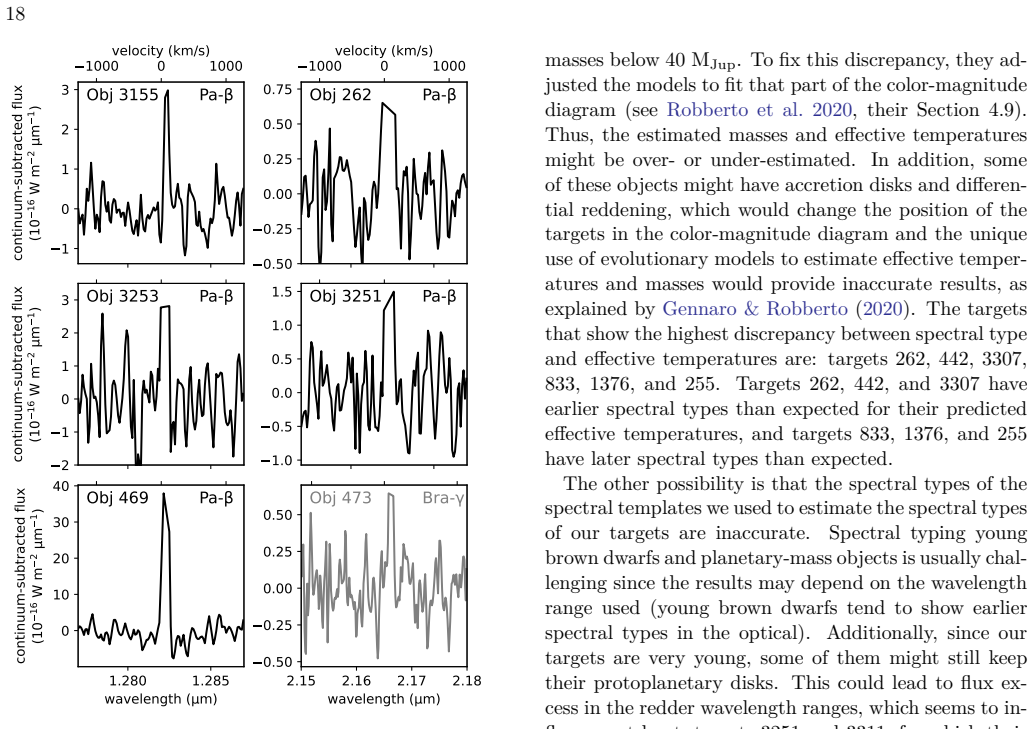
- [Section 5.1 vs Section 6.2/Table 5/Fig. 15] There is a direct contradiction about which objects show Br-gamma. Section 5.1 (K-band bullet) states that the Br-gamma line is seen 'only in object 1549', while Section 6.2, Table 5, and Fig. 15 identify object 473 as the Br-gamma source and object 469 as a Pa-beta source; the Conclusion (item 2) repeats the Table 5 assignment. This matters because the accretion luminosity for object 473 is computed from Br-gamma using different scaling coefficients than Pa-beta (Eq. 1 and Table 5). The identification must be corrected and the consequent accretion-rate values re-derived for 473 and 469.
- [Section 6.2, Eqs. (1)-(2), and Fig. 16] The conclusion that ONC planetary-mass objects 'deplete their disks quickly' rests on Mdot values obtained by applying L_acc-L_line scalings from Alcala et al. (2017) and Aoyama et al. (2021) with an assumed Rin=5R*. The CASPAR comparison in Fig. 16 is not an independent validation, because CASPAR is built from the same family of calibrations and the same inner-radius assumption. The paper itself notes (Section 6.2) that Betti et al. (2023) found the stellar relations may not hold for brown dwarfs. To keep the claim, the authors should either (i) provide a calibration-independent comparison (e.g., line luminosity versus mass directly), or (ii) explicitly restrict the conclusion to line-flux-based evidence and reframe the Fig. 16 agreement as a consistency check rather than confirmation.
- [Section 2 and Section 8; Table 1/Fig. 16 mass axis] The masses and effective temperatures used for the x-axis of Fig. 16 and for the planetary-mass classification come from Robberto et al. (2020) empirically adjusted isochrones, in a regime where the authors acknowledge BT-Settl models fail for objects below ~45 M_Jup. The paper notes the resulting 'significant uncertainties' (Section 2) and that masses may be over- or underestimated (Section 8), but the accretion-rate versus mass comparison in Fig. 16 is plotted without propagating these uncertainties. At minimum, the paper should state how the mass uncertainty affects the placement of the four planetary-mass points relative to the 1 Myr CASPAR track, and whether the 'quick depletion' conclusion would survive a factor-of-two mass shift.
- [Table 4] Table 4 includes object 365, which Section 2 explicitly removes from the final sample ('objects 3382, 363, 367, 365, ...'), and the table contains 26 entries while the final sample has 25 objects. This is an internal inconsistency that complicates the gravity-score summary; it should be corrected so that Table 4 matches the final sample.
minor comments (5)
- [Throughout] The notation 'Bra-gamma' in the abstract and elsewhere should be standardized to 'Br-gamma' (e.g., 'Pa-beta' is used consistently but 'Bra' is not).
- [Fig. 4 caption] Typo: 'thrid field' should be 'third field'.
- [Section 8] Typo: 'circusmstellar disks' should be 'circumstellar disks'.
- [Section 5.1] The K-band bullet says Br-gamma appears only in object 1549; this is part of the contradiction listed in the major comments, but even if corrected, the sentence should be re-checked for consistency with Table 2.
- [Section 5.2] The phrase 'we aimed at spectral typing' is awkward; consider 'we determined spectral types by comparing'.
Circularity Check
No significant circularity: the spectral library and gravity-index analysis are independent; the accretion comparison has a shared-calibration caveat but does not reduce to its own inputs.
full rationale
The core deliverables of this paper are new MOSFIRE JHK spectra, line identifications, spectral types obtained by matching external literature templates, and gravity indices computed with the Allers & Liu (2013) methodology. These are all measured quantities benchmarked against outside data, and no equation in the paper is defined in terms of the quantity it purports to establish. The accretion-rate derivation uses Eq. (1) (Alcalá+2017 stellar and Aoyama+2021 planetary L_acc–L_line calibrations) and Eq. (2) (with R_in=5R*), and the resulting Mdot values are compared to the CASPAR 1 Myr relations from Betti+2023. This is not circular in the strict sense: the ONC line fluxes are new data, the CASPAR relations are an external empirical archive, and the paper does not fit any parameter to its own targets and then rename that fit a prediction. The manuscript itself flags the main weakness: “Betti et al. (2023) has shown empirically that these [stellar relations] might not hold for brown dwarfs,” and because CASPAR is co-authored by Betti and likely draws on the same L_acc–L_line calibration family, the Fig. 16 agreement is weaker than an independent test of the disk-depletion conclusion. That is a correctness/limitation concern, not a circular reduction. The heavy reliance on Robberto+2020 masses and effective temperatures (co-authored by the present team) is an inherited systematic uncertainty, explicitly acknowledged in the text, rather than a self-definitional step. The same-author citations to Manjavacas+ template spectra and Betti+2022/2023 are used as data or benchmarks, not as unverified uniqueness theorems or smuggled ansätze. An internal inconsistency exists between Section 5.1 (Br-gamma only in object 1549) and Section 6.2/Table 5 (Br-gamma for object 473), but that is an error affecting one of the four planetary-mass points, not circularity. Overall, the library and its youth/membership confirmation are self-contained; the accretion-rate comparison carries a shared-calibration caveat but does not reduce by construction.
Assumptions & free parameters
free parameters (3)
- Disk blackbody temperature for object 3251 =
250 K
- Disk blackbody temperature for object 3311 =
1800 K
- Inner disk radius R_in/R* =
5
assumptions (6)
- domain assumption Distance to the ONC is d=414±7 pc (Menten et al. 2007)
- domain assumption Extinction law of Cardelli et al. (1989) with R_V=3.1 applies to the ONC lines of sight
- domain assumption The cluster is 1-3 Myr old (Jeffries et al. 2011) and gravity indices calibrated by Allers & Liu (2013) correctly distinguish very-low-gravity young objects
- domain assumption Mass and effective temperature estimates from Robberto et al. (2020), based on BT-Settl evolutionary models with an empirical isochrone adjustment, are accurate enough for the claims
- domain assumption L_acc-L_line scaling relations from Alcala et al. (2017) and Aoyama et al. (2021) apply to substellar and planetary-mass accretors
- domain assumption The spectral type templates from the cited literature are correct and can be applied to ONC objects after dereddening
Cite this review
Pith. "Pith review of A Near-Infrared Spectral Library of Very Young Brown Dwarfs and Planetary-Mass Objects in the Orion Nebula Cluster." pith.science (2026). https://pith.science/paper/PTGEWPAL
@misc{pith2026250814035,
  author       = {Pith},
  title        = {Pith review of: A Near-Infrared Spectral Library of Very Young Brown Dwarfs and Planetary-Mass Objects in the Orion Nebula Cluster},
  year         = {2026},
  howpublished = {\url{https://pith.science/paper/PTGEWPAL}},
  note         = {Machine review of arXiv:2508.14035}
}
read the original abstract
Age-benchmark brown dwarfs' and planetary-mass objects' spectroscopy is key to characterize substellar evolution. In this paper we present the JHK medium resolution (R~3000) spectra of 25 7-75 M_Jup (spectral types L3.0-M6.0) brown dwarfs and planetary-mass objects in the Orion Nebula Cluster obtained with MOSFIRE installed at the W. M. Keck I telescope. We obtained the spectral types of the targets in our sample using template brown dwarf and planetary-mass objects' spectra. We confirmed their extreme youth (<5 Myr) and membership to the cluster using spectral indices, and the diversity of their spectra even for targets with similar spectral types. Six of our targets presented Pa-beta and Bra-gamma emission lines, suggesting the existence of accreting protoplanetary disks to objects with masses as low as 7 M_Jup. After analyzing the emission lines of those objects, and measuring their accretion rates, we compared them to those of stars, brown dwarfs and planetary-mass objects, confirming that planetary-mass young objects deplete their disks quickly at young ages. Finally, we illustrate the spectral evolution of a 7-10 M_Jup planetary-mass object through its life from 1-3 Myr to 200 Myr old using one of our latest spectra type targets, and other targets from the literature with older age, but similar estimated masses. The spectra are publicly available for the community's use as data behind the figures.
Figures


Figures from the paper (20 more)




Reference graph
Works this paper leans on
-
[1]
Alcal´ a, J. M., Natta, A., Manara, C. F., et al. 2014, A&A, 561, A2, doi: 10.1051/0004-6361/201322254 Alcal´ a, J. M., Manara, C. F., Natta, A., et al. 2017, A&A, 600, A20, doi: 10.1051/0004-6361/201629929
-
[2]
Allard, F., Homeier, D., & Freytag, B. 2012, Royal Society of London Philosophical Transactions Series A, 370, 2765, doi: 10.1098/rsta.2011.0269
arXiv 2012
-
[3]
Allers, K. N., & Liu, M. C. 2007, in Bulletin of the American Astronomical Society, Vol. 39, American Astronomical Society Meeting Abstracts, 103.15
work page 2007
-
[4]
Allers, K. N., & Liu, M. C. 2013, ApJ, 772, 79, doi: 10.1088/0004-637X/772/2/79
-
[5]
Allers, K. N., Jaffe, D. T., Luhman, K. L., et al. 2007, ApJ, 657, 511, doi: 10.1086/510845
doi:10.1086/510845 2007
-
[6]
2021, ApJL, 917, L30, doi: 10.3847/2041-8213/ac19bd
Aoyama, Y., Marleau, G.-D., Ikoma, M., & Mordasini, C. 2021, ApJL, 917, L30, doi: 10.3847/2041-8213/ac19bd
-
[7]
Aoyama, Y., Marleau, G.-D., Mordasini, C., & Ikoma, M. 2020, arXiv e-prints, arXiv:2011.06608, doi: 10.48550/arxiv.2011.06608 Astropy Collaboration, Robitaille, T. P., Tollerud, E. J., et al. 2013, A&A, 558, A33, doi: 10.1051/0004-6361/201322068 Astropy Collaboration, Price-Whelan, A. M., Sip˝ ocz, B. M., et al. 2018, AJ, 156, 123, doi: 10.3847/1538-3881/...
-
[8]
Baraffe, I., Chabrier, G., Allard, F., & Hauschildt, P. H. 2002, A&A, 382, 563, doi: 10.1051/0004-6361:20011638
Show all 63 references
-
[9]
2016, extinction v0.3.0, Zenodo, doi: 10.5281/zenodo.804967
Barbary, K. 2016, extinction v0.3.0, Zenodo, doi: 10.5281/zenodo.804967
2016 doi
-
[10]
K., Follette, K
Betti, S. K., Follette, K. B., Ward-Duong, K., et al. 2022, ApJL, 935, L18, doi: 10.3847/2041-8213/ac85ef —. 2023, AJ, 166, 262, doi: 10.3847/1538-3881/ad06b8
2022 doi
-
[11]
2014, A&A, 562, A127, doi: 10.1051/0004-6361/201118270
Bonnefoy, M., Chauvin, G., Lagrange, A.-M., et al. 2014, A&A, 562, A127, doi: 10.1051/0004-6361/201118270
2014 doi
-
[12]
2010, A&A, 512, A52, doi: 10.1051/0004-6361/200912688
Bonnefoy, M., Chauvin, G., Rojo, P., et al. 2010, A&A, 512, A52, doi: 10.1051/0004-6361/200912688
2010 doi
-
[13]
2013, A&A, 555, A107, doi: 10.1051/0004-6361/201220838
Bonnefoy, M., Boccaletti, A., Lagrange, A.-M., et al. 2013, A&A, 555, A107, doi: 10.1051/0004-6361/201220838
2013 doi
-
[14]
B., Lunine, J
Burrows, A., Hubbard, W. B., Lunine, J. I., & Liebert, J. 2001, Reviews of Modern Physics, 73, 719, doi: 10.1103/RevModPhys.73.719
2001 doi
-
[15]
A., de Burgos, A., Alonso-Floriano, F
Caballero, J. A., de Burgos, A., Alonso-Floriano, F. J., et al. 2019, A&A, 629, A114, doi: 10.1051/0004-6361/201935987
2019 doi
-
[16]
A., Clayton, G
Cardelli, J. A., Clayton, G. C., & Mathis, J. S. 1989, ApJ, 345, 245, doi: 10.1086/167900
1989 doi
-
[17]
M., Dumas, C., et al
Chauvin, G., Lagrange, A. M., Dumas, C., et al. 2005, A&A, 438, L25, doi: 10.1051/0004-6361:200500116
2005 doi
-
[18]
L., Faherty, J., Kirkpatrick, D., & Burgasser, A
Cruz, K. L., Faherty, J., Kirkpatrick, D., & Burgasser, A. J. 2007, in Bulletin of the American Astronomical
2007
-
[19]
C., Rayner, J
Cushing, M. C., Rayner, J. T., & Vacca, W. D. 2005, ApJ, 623, 1115, doi: 10.1086/428040
2005 doi
-
[20]
C., Marley, M
Cushing, M. C., Marley, M. S., Saumon, D., et al. 2008, ApJ, 678, 1372, doi: 10.1086/526489
2008 doi
-
[21]
2012, A&A, 548, A26, doi: 10.1051/0004-6361/201219984
Delorme, P., Gagn´ e, J., Malo, L., et al. 2012, A&A, 548, A26, doi: 10.1051/0004-6361/201219984
2012 doi
-
[22]
K., Rice, E
Faherty, J. K., Rice, E. L., Cruz, K. L., Mamajek, E. E., & N´ u˜ nez, A. 2013, AJ, 145, 2, doi: 10.1088/0004-6256/145/1/2
2013 doi
-
[23]
K., Riedel, A
Faherty, J. K., Riedel, A. R., Cruz, K. L., et al. 2016, ApJS, 225, 10, doi: 10.3847/0067-0049/225/1/10
2016 doi
-
[24]
2020, ApJ, 896, 80, doi: 10.3847/1538-4357/ab911a
Gennaro, M., & Robberto, M. 2020, ApJ, 896, 80, doi: 10.3847/1538-4357/ab911a
2020 doi
-
[25]
2010, MNRAS, 405, 1140, doi: 10.1111/j.1365-2966.2010.16524.x
Greiner, J. 2010, MNRAS, 405, 1140, doi: 10.1111/j.1365-2966.2010.16524.x
2010
-
[26]
I., Meyer, M
Gorlova, N. I., Meyer, M. R., Rieke, G. H., & Liebert, J. 2003, ApJ, 593, 1074, doi: 10.1086/376730
2003 doi
-
[27]
1998, ApJ, 492, 323, doi: 10.1086/305032
Gullbring, E., Hartmann, L., Brice˜ no, C., & Calvet, N. 1998, ApJ, 492, 323, doi: 10.1086/305032
1998 doi
-
[28]
J., & Hillenbrand, L
Herczeg, G. J., & Hillenbrand, L. A. 2008, ApJ, 681, 594, doi: 10.1086/586728
2008 doi
-
[29]
D., Littlefair, S
Jeffries, R. D., Littlefair, S. P., Naylor, T., & Mayne, N. J. 2011, MNRAS, 418, 1948, doi: 10.1111/j.1365-2966.2011.19613.x
2011
-
[30]
2021, A&A, 650, A48, doi: 10.1051/0004-6361/202039899
Kubiak, K., Muˇ zi´ c, K., Sousa, I., et al. 2021, A&A, 650, A48, doi: 10.1051/0004-6361/202039899
2021 doi
-
[31]
C., Dupuy, T
Liu, M. C., Dupuy, T. J., & Allers, K. N. 2016, ApJ, 833, 96, doi: 10.3847/1538-4357/833/1/96
2016 doi
-
[32]
C., Magnier, E
Liu, M. C., Magnier, E. A., Deacon, N. R., et al. 2013, ApJL, 777, L20, doi: 10.1088/2041-8205/777/2/L20
2013 doi
-
[33]
2008, in Star Formation Across the Milky Way Galaxy
Lodieu, N. 2008, in Star Formation Across the Milky Way Galaxy
2008
-
[34]
C., Jameson, R
Lodieu, N., Hambly, N. C., Jameson, R. F., & Hodgkin, S. T. 2008, MNRAS, 383, 1385, doi: 10.1111/j.1365-2966.2007.12676.x
2008
-
[35]
R., B´ ejar, V
Lodieu, N., Zapatero Osorio, M. R., B´ ejar, V. J. S., & Pe˜ na Ram´ ırez, K. 2018, MNRAS, 473, 2020, doi: 10.1093/mnras/stx2279
2018 doi
-
[36]
J., Pascucci, I., et al
Long, F., Herczeg, G. J., Pascucci, I., et al. 2017, ApJ, 844, 99, doi: 10.3847/1538-4357/aa78fc
2017 doi
-
[37]
Luhman, K. L. 2007, ApJS, 173, 104, doi: 10.1086/520114
2007 doi
-
[38]
L., Alves de Oliveira, C., Baraffe, I., et al
Luhman, K. L., Alves de Oliveira, C., Baraffe, I., et al. 2024, ApJ, 975, 162, doi: 10.3847/1538-4357/ad7b19 23
2024 doi
-
[39]
L., Hern´ andez, J., Downes, J
Luhman, K. L., Hern´ andez, J., Downes, J. J., Hartmann, L., & Brice˜ no, C. 2008, ApJ, 688, 362, doi: 10.1086/592264
2008 doi
-
[40]
L., Herrmann, K
Luhman, K. L., Herrmann, K. A., Mamajek, E. E., Esplin, T. L., & Pecaut, M. J. 2018, AJ, 156, 76, doi: 10.3847/1538-3881/aacc6d
2018 doi
-
[41]
L., & Mamajek, E
Luhman, K. L., & Mamajek, E. E. 2012, ApJ, 758, 31, doi: 10.1088/0004-637X/758/1/31
2012 doi
-
[42]
L., Tremblin, P., Birkmann, S
Luhman, K. L., Tremblin, P., Birkmann, S. M., et al. 2023, ApJL, 949, L36, doi: 10.3847/2041-8213/acd635
2023 doi
-
[43]
Mamajek, E. E. 2005, ApJ, 634, 1385, doi: 10.1086/468181
2005 doi
-
[44]
E., & Bell, C
Mamajek, E. E., & Bell, C. P. M. 2014, MNRAS, 445, 2169, doi: 10.1093/mnras/stu1894
2014 doi
-
[45]
F., Testi, L., Herczeg, G
Manara, C. F., Testi, L., Herczeg, G. J., et al. 2017, A&A, 604, A127, doi: 10.1051/0004-6361/201630147
2017 doi
-
[46]
Manjavacas, E., Lodieu, N., B´ ejar, V. J. S., et al. 2020, MNRAS, 491, 5925, doi: 10.1093/mnras/stz3441
2020 doi
-
[47]
E., et al
Manjavacas, E., Bonnefoy, M., Schlieder, J. E., et al. 2014, A&A, 564, A55, doi: 10.1051/0004-6361/201323016
2014 doi
-
[48]
M., et al
Manjavacas, E., Goldman, B., Alcal´ a, J. M., et al. 2016, MNRAS, 455, 1341, doi: 10.1093/mnras/stv2048
2016 doi
-
[49]
2024, AJ, 167, 168, doi: 10.3847/1538-3881/ad2938
Manjavacas, E., Tremblin, P., Birkmann, S., et al. 2024, AJ, 167, 168, doi: 10.3847/1538-3881/ad2938
2024 doi
-
[50]
C., Lucas, P
Marocco, F., Day-Jones, A. C., Lucas, P. W., et al. 2014, MNRAS, 439, 372, doi: 10.1093/mnras/stt2463 Mart´ ın, E. C., Mace, G. N., McLean, I. S., et al. 2017, ApJ, 838, 73, doi: 10.3847/1538-4357/aa6338
2014 doi
-
[51]
R., Kirkpatrick, J
McGovern, M. R., Kirkpatrick, J. D., McLean, I. S., et al. 2004, ApJ, 600, 1020, doi: 10.1086/379849
2004 doi
-
[52]
S., McGovern, M
McLean, I. S., McGovern, M. R., Burgasser, A. J., et al. 2003, ApJ, 596, 561, doi: 10.1086/377636
2003 doi
-
[53]
M., Reid, M
Menten, K. M., Reid, M. J., Forbrich, J., & Brunthaler, A. 2007, A&A, 474, 515, doi: 10.1051/0004-6361:20078247
2007 doi
-
[54]
A., Lada, C
Muench, A. A., Lada, C. J., Luhman, K. L., Muzerolle, J., & Young, E. 2007, AJ, 134, 411, doi: 10.1086/518560
2007 doi
-
[55]
2014, ApJ, 787, 5, doi: 10.1088/0004-637X/787/1/5
Naud, M.-E., Artigau, ´E., Malo, L., et al. 2014, ApJ, 787, 5, doi: 10.1088/0004-637X/787/1/5
2014 doi
-
[56]
2024, A&A, 686, A37, doi: 10.1051/0004-6361/202347327
Piscarreta, L., Muˇ zi´ c, K., Almendros-Abad, V., & Scholz, A. 2024, A&A, 686, A37, doi: 10.1051/0004-6361/202347327
2024 doi
-
[57]
X., Hennawi, J., Cooke, R., et al
Prochaska, J. X., Hennawi, J., Cooke, R., et al. 2019, pypeit/PypeIt: Releasing for DOI, 0.11.0.1, Zenodo, doi: 10.5281/zenodo.3506873 —. 2020, pypeit/PypeIt: Release 1.0.0, v1.0.0, Zenodo, doi: 10.5281/zenodo.3743493
2019 doi
-
[58]
2012, A&A, 548, A56, doi: 10.1051/0004-6361/201219832
Rigliaco, E., Natta, A., Testi, L., et al. 2012, A&A, 548, A56, doi: 10.1051/0004-6361/201219832
2012 doi
-
[59]
M., & Espaillat, C
Rilinger, A. M., & Espaillat, C. C. 2021, ApJ, 921, 182, doi: 10.3847/1538-4357/ac09e5
2021 doi
-
[60]
G., et al
Robberto, M., Gennaro, M., Ubeira Gabellini, M. G., et al. 2020, ApJ, 896, 79, doi: 10.3847/1538-4357/ab911e
2020 doi
-
[61]
P., Todorov, K
Stolker, T., Quanz, S. P., Todorov, K. O., et al. 2020, A&A, 635, A182, doi: 10.1051/0004-6361/201937159 Su´ arez, G., Vos, J. M., Metchev, S., Faherty, J. K., & Cruz, K. 2023, ApJL, 954, L6, doi: 10.3847/2041-8213/acec4b
2020 doi
-
[62]
M., Allers, K
Vos, J. M., Allers, K. N., & Biller, B. A. 2017, ApJ, 842, 78, doi: 10.3847/1538-4357/aa73cf
2017 doi
-
[63]
J., Lucas, P
Weights, D. J., Lucas, P. W., Roche, P. F., Pinfield, D. J., & Riddick, F. 2009, MNRAS, 392, 817, doi: 10.1111/j.1365-2966.2008.14096.x 24 APPENDIX A.ALL MOSFIRE SPECTRA OF OUR SAMPLE Here we show all the MOSFIRE spectra that we obtained in our sample. Some of the spectra were...
2009
Reviewed August 5, 2026 · model on record in the stance chip above.
Discussion (0). Continue with ORCID to comment.