REVIEW 3 major objections 6 minor 40 references
Semi-Supervised Semantic Segmentation with High- and Low-level Consistency
T0 review · 3 major / 6 minor · reviewed 2026-08-14 · deepseek-v4-flash
Pith's one-line read The paper claims that a two-branch semi-supervised model, pairing a GAN-based segmentation branch with a Mean-Teacher classification branch, is the new state of the art in semi-supervised semantic segmentation and gains 5–12 mIoU points…
desk verdict A solid, well-ablated semi-supervised segmentation paper that likely works, but the state-of-the-art claim is under-supported because the only other prior true SSL method (Souly et al.) is never compared quantitatively. read the letter →
The pith
A machine-rendered reading of the paper's core claim, the machinery that carries it, and where it could break.
The reading
What carries the argument
The machinery is a two-branch architecture with late fusion. The s4GAN branch consists of a DeepLabv2 segmentation network acting as generator and a convolutional image-wise discriminator; its losses are cross-entropy on labeled pixels, feature matching on unlabeled predictions, and a self-training loss that converts discriminator-confident predictions into pseudo ground truth. The MLMT branch is a Mean Teacher classifier whose student and teacher networks see differently perturbed images, trained by classification loss plus a consistency loss; at inference a threshold $\tau=0.2$ on the teacher's soft class scores switches off segmentation channels. The key identity the argument relies on is that the discriminator score is a usable confidence measure for pseudo-labeling, which lets unlabeled data enter supervised training without manual labels.
What would settle it
Take a trained s4GAN model and extract the predictions that pass the confidence threshold $\gamma$; compare them against ground truth on a held-out subset of the unlabeled pool. If the pseudo-labels have high error on some classes or the mIoU gain disappears when those confident-but-wrong classes are removed, the self-training mechanism is not doing what the paper assumes.
Extended reading notes
Core claim
The central claim is that low-level and high-level segmentation artifacts fail in different ways and should be fixed by different branches. The low-level branch (s4GAN) trains the segmentation network as a generator against an image-wise discriminator, replacing the standard GAN loss with a feature-matching loss and adding a self-training term that reuses confident discriminator-approved predictions as pseudo-labels. The high-level branch (MLMT) adapts Mean Teacher to multi-label image classification and uses its class-presence scores to zero out segmentation channels for classes the image does not contain. The paper reports that this combination raises mIoU by roughly 5–12 points over the supervised baseline at 1/50 to 1/4 labeled data on PASCAL VOC, and consistently improves over the prior GAN-based method [15], with ablations attributing the gain to all three loss terms.
Load-bearing premise
The load-bearing premise is that the discriminator's confidence score reliably indicates which unlabeled predictions are correct enough to serve as pseudo ground truth; if the discriminator is confidently wrong about certain structures, self-training will reinforce exactly those errors.
Editorial extensions
If this is right
- With only 1/50 of PASCAL VOC labeled, the combined model reaches 60.4 mIoU without COCO pre-training, 12.1 points above the supervised baseline and 11.2 above the prior GAN method.
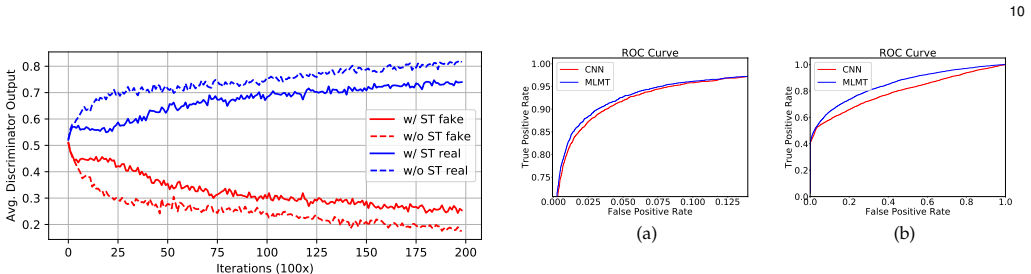
- The s4GAN branch alone provides most of the gain; the MLMT branch adds a complementary 2 points by removing false positives, but brings no gain on Cityscapes because nearly all classes appear in nearly every image.
- The method also benefits from extra image-level weak labels: adding 9K weak annotations to 1.4K strong ones yields 69.6 mIoU, beating weakly supervised methods that rely on CRF post-processing.
- All three generator losses matter: feature matching outperforms the standard GAN loss, and adding self-training gives a further gain, with the discriminator output staying closer to 0.5.
Reading between the lines
- Inference: The self-training step would benefit from direct measurement of pseudo-label accuracy; the paper reports end-task mIoU but never measures how often discriminator-approved predictions are actually correct, so the mechanism supporting the gain remains partly inferred.
- Inference: Because the MLMT branch is only useful when class presence varies across images, a class-conditional or class-balanced variant could extend the same idea to datasets like Cityscapes where the branch is currently inactive.
- Inference: The reported stability of feature matching over the standard GAN loss suggests the method could transfer to domains such as medical imaging, where ImageNet pre-training is less helpful and the MLMT branch already shows a larger ROC improvement from scratch.
- Inference: The approach does not require generated images, only predictions from one network, so it could be combined with consistency regularization at the pixel level (e.g., perturbation-based losses) instead of only at the image level.
Signed reviews
Editorial analysis
A structured set of objections, weighed in public.
Referee Report
Summary. The paper proposes a dual-branch method for semi-supervised semantic segmentation. The first branch (s4GAN) trains a DeepLabv2 segmentation network as a generator in a GAN, using a feature-matching loss and a self-training loss that reuses high-confidence discriminator outputs as pseudo-labels. The second branch (MLMT) is a Mean Teacher multi-label classifier that suppresses false-positive class channels at evaluation time. Experiments on PASCAL VOC 2012, PASCAL-Context, and Cityscapes report consistent mIoU improvements over a supervised DeepLabv2 baseline and over Hung et al., especially at low labeled-data fractions, along with ablations of the loss terms and branch contributions.
Significance. If the empirical results hold, the paper offers a practically useful recipe for semantic segmentation with very few pixel labels, combining adversarial training, feature matching, self-training, and a semi-supervised image-level classifier. The ablations in Tables 5 and 6 support the individual design choices, and the release of source code is a plus for reproducibility. The multi-dataset evaluation and the honest reporting of failure cases are also strengths. The significance is tempered, however, by the absence of a quantitative comparison with Souly et al., one of only two prior true semi-supervised methods named by the paper, and by the lack of variance estimates over random splits.
major comments (3)
- [Abstract; Section 2; Tables 1-4] The abstract and Section 4.2.1 claim "new state-of-the-art" in semi-supervised semantic segmentation, but the quantitative comparisons in Tables 1-4 and Figure 2 include only Hung et al. [15] and supervised DeepLabv2 baselines. Section 2 explicitly names Souly et al. [34] as one of only two prior true semi-supervised methods for this task, yet no mIoU value for Souly et al. appears anywhere in the experiments. Because the central claim is competitive superiority, the omission of a direct comparison with a named prior method leaves the claim unsupported. Please add the Souly et al. numbers on the same splits and backbone, or restrict the claim to showing improvement over Hung et al.
- [Section 4.1.3; Section 4.2.2; Tables 1-4] All reported mIoU numbers are single runs on a single randomly sampled labeled/unlabeled split, and the hyperparameters λ_fm, λ_st, λ_cons, τ, and γ are selected through cross-validation on the same validation set that is used for the reported final numbers. The threshold experiments in Section 4.2.2 explicitly search over thresholds on the validation set and report the best value. With only one split and no variance estimates, the claimed 5-12 mIoU point gains cannot be distinguished from split luck, and the validation-set tuning may introduce optimism. Please report results over at least three random splits or seeds (mean ± std), and either use a separate held-out set for hyperparameter selection or provide a sensitivity analysis for τ and γ.
- [Table 4; Section 4.2.1 (Cityscapes)] On Cityscapes, Table 4 reports only "Ours (s4GAN only)" and no s4GAN+MLMT result, and the text states that the MLMT branch was ineffective for this dataset because most classes appear in almost every image. The abstract nevertheless claims that the dual-branch approach achieves new state-of-the-art on "several standard benchmarks," which implicitly includes Cityscapes. The claim should be qualified, and the full dual-branch model should either be evaluated and reported on Cityscapes or the Cityscapes claim limited to the s4GAN branch. As written, the dual-branch contribution is not demonstrated on that benchmark.
minor comments (6)
- [Section 2] In Section 2, the phrase "the two-stage training process of [23]" is a reference error: the two-stage GAN training belongs to Hung et al. [15], not Long et al. [23].
- [Equation (3)] In Eq. (3), the condition should be written as D(S(x_u)) ≥ γ, and the definition of the pseudo-label y* (presumably the argmax of S(x_u) per pixel) should be stated explicitly.
- [Section 4.2.1] The text says the method gives a "performance increase of 5% to 12%" over the baseline; this is more accurately stated as 5 to 12 mIoU points, to avoid confusion with relative percentage improvements.
- [Section 4.1.3] The paper says "Through cross-validation, we find the optimal loss weights" but never describes the procedure: which data splits were used, how many folds, and whether the validation set used for reporting was excluded from that search. Please clarify the protocol.
- [Tables 1-5] The label fractions are expressed inconsistently: Table 1 uses 1/50, 1/20, 1/8, 1/4 while Table 5 uses 5:95 and the text sometimes refers to percents. Please standardize the notation.
- [Abstract] The abstract's claim of "new state-of-the-art in semi-supervised learning" is broader than the actual task; please qualify it to "semi-supervised semantic segmentation."
Circularity Check
No significant circularity: the central claim is an empirical benchmark result, not a derivation reduced to its own inputs.
full rationale
The paper's central claim is a set of empirical mIoU numbers on standard benchmarks. The dual-branch model is defined through explicit losses (cross-entropy, feature matching, self-training, and mean-teacher consistency), and its performance is measured against held-out validation data. The self-training loss in Eq. 3 does use pseudo-labels y* generated from the segmentation network's own predictions, but this is self-training by design, a standard semi-supervised learning procedure, not a claim that the model derives a result from itself; the reported improvement is an externally measured quantity on data not used to fit the loss. The paper includes an ablation (Table 6) showing that adding the self-training loss improves mIoU (55.4 to 58.1 at 1/50), providing empirical support for the component. Hyperparameters were tuned on the validation set, which is a possible leakage concern but not a circularity of the derivation. The absence of a quantitative comparison to Souly et al. [34] weakens the 'new state-of-the-art' claim as an evidential matter, but an omitted comparator is not a circular step. There is no load-bearing self-citation, no imported uniqueness theorem, and no ansatz smuggled in via citation; citations to Salimans et al. and Tarvainen and Valpola reference external, independently established methods. The paper is self-contained against external benchmarks, so no significant circularity is present.
Assumptions & free parameters
free parameters (5)
- lambda_fm =
0.1
- lambda_st =
1.0
- lambda_cons =
1.0
- tau =
0.2
- gamma =
0.6 for PASCAL datasets, 0.7 for Cityscapes
assumptions (3)
- domain assumption Discriminator score is a valid confidence measure for selecting pseudo-labels.
- domain assumption Mean Teacher consistency regularization transfers from single-label classification to multi-label image classification.
- domain assumption A single class-presence threshold applied to all classes removes false positives more often than it removes true positives.
Cite this review
Pith. "Pith review of Semi-Supervised Semantic Segmentation with High- and Low-level Consistency." pith.science (2026). https://pith.science/paper/PTL6D4MO
@misc{pith2026190805724,
  author       = {Pith},
  title        = {Pith review of: Semi-Supervised Semantic Segmentation with High- and Low-level Consistency},
  year         = {2026},
  howpublished = {\url{https://pith.science/paper/PTL6D4MO}},
  note         = {Machine review of arXiv:1908.05724}
}
read the original abstract
The ability to understand visual information from limited labeled data is an important aspect of machine learning. While image-level classification has been extensively studied in a semi-supervised setting, dense pixel-level classification with limited data has only drawn attention recently. In this work, we propose an approach for semi-supervised semantic segmentation that learns from limited pixel-wise annotated samples while exploiting additional annotation-free images. It uses two network branches that link semi-supervised classification with semi-supervised segmentation including self-training. The dual-branch approach reduces both the low-level and the high-level artifacts typical when training with few labels. The approach attains significant improvement over existing methods, especially when trained with very few labeled samples. On several standard benchmarks - PASCAL VOC 2012, PASCAL-Context, and Cityscapes - the approach achieves new state-of-the-art in semi-supervised learning.
Figures


Figures from the paper (8 more)


Reference graph
Works this paper leans on
-
[15]
W. Hung, Y. Tsai, Y. Liou, Y. Lin, and M. Yang. Adversarial learning for semi-supervised semantic segmentation. In BMVC, 2018
work page 2018
- [34]
- [1]
-
[2]
B. Athiwaratkun, M. Finzi, P . Izmailov, and A. G. Wilson. Im- proving consistency-based semi-supervised learning with weight averaging. arXiv preprint arXiv:1806.05594 , 2018
arXiv 2018
-
[3]
L. Chen, G. Papandreou, I. Kokkinos, K. Murphy, and A. L. Yuille. Semantic image segmentation with deep convolutional nets and fully connected crfs. CoRR, abs/1412.7062, 2014
arXiv 2014
-
[4]
L. Chen, G. Papandreou, I. Kokkinos, K. Murphy, and A. L. Yuille. Deeplab: Semantic image segmentation with deep convo- lutional nets, atrous convolution, and fully connected crfs. TP AMI, 40(4):834–848, 2018
work page 2018
-
[5]
L. Chen, Y. Zhu, G. Papandreou, F. Schroff, and H. Adam. Encoder-decoder with atrous separable convolution for semantic image segmentation. In ECCV, 2018
work page 2018
- [6]
Show all 40 references
-
[7]
J. Dai, K. He, and J. Sun. Boxsup: Exploiting bounding boxes to supervise convolutional networks for semantic segmentation. In ICCV, 2015
2015
-
[8]
J. Deng, W. Dong, R. Socher, L. jia Li, K. Li, and L. Fei-fei. Imagenet: A large-scale hierarchical image database. In CVPR, 2009
2009
-
[9]
Everingham, L
M. Everingham, L. Gool, C. K. Williams, J. Winn, and A. Zis- serman. The pascal visual object classes (voc) challenge. IJCV, 88(2):303–338, 2010
2010
-
[10]
Goodfellow, J
I. Goodfellow, J. Pouget-Abadie, M. Mirza, B. Xu, D. Warde-Farley, S. Ozair, A. Courville, and Y. Bengio. Generative adversarial nets. In NIPS. 2014. 11
2014
-
[11]
Hariharan, P
B. Hariharan, P . Arbelaez, L. Bourdev, S. Maji, and J. Malik. Semantic contours from inverse detectors. In ICCV, 2011
2011
-
[12]
K. He, X. Zhang, S. Ren, and J. Sun. Deep residual learning for image recognition. In CVPR, 2016
2016
-
[13]
S. Hong, H. Noh, and B. Han. Decoupled deep neural network for semi-supervised semantic segmentation. In NIPS. 2015
2015
-
[14]
J. Hu, L. Shen, and G. Sun. Squeeze-and-excitation networks. In CVPR, 2018
2018
-
[16]
Khoreva, R
A. Khoreva, R. Benenson, J. Hosang, M. Hein, and B. Schiele. Simple does it: Weakly supervised instance and semantic segmen- tation. In CVPR, 2017
2017
-
[17]
D. P . Kingma and J. Ba. Adam: A method for stochastic optimiza- tion. In ICLR, 2015
2015
-
[18]
Laine and T
S. Laine and T. Aila. Temporal ensembling for semi-supervised learning. In ICLR, 2017
2017
-
[19]
Lecun, L
Y. Lecun, L. Bottou, Y. Bengio, and P . Haffner. Gradient-based learning applied to document recognition. In Proceedings of the IEEE, pages 2278–2324, 1998
1998
-
[20]
D. Lin, J. Dai, J. Jia, K. He, and J. Sun. Scribblesup: Scribble- supervised convolutional networks for semantic segmentation. In CVPR, 2016
2016
-
[21]
G. Lin, A. Milan, C. Shen, and I. Reid. Refinenet: Multi-path refinement networks for high-resolution semantic segmentation. In CVPR, 2017
2017
-
[22]
T.-Y. Lin, M. Maire, S. Belongie, J. Hays, P . Perona, D. Ramanan, P . Dollr, and C. L. Zitnick. Microsoft COCO: Common objects in context. In ECCV, 2014
2014
-
[23]
J. Long, E. Shelhamer, and T. Darrell. Fully convolutional networks for semantic segmentation. In CVPR, 2015
2015
-
[24]
P . Luc, C. Couprie, S. Chintala, and J. Verbeek. Semantic segmen- tation using adversarial networks. In NIPS Workshops. 2016
2016
-
[25]
A. L. Maas, A. Y. Hannun, and A. Y. Ng. Rectifier nonlinearities improve neural network acoustic models. In ICML Workshop on Deep Learning for Audio, Speech and Language Processing , 2013
2013
-
[26]
Miyato, S
T. Miyato, S. ichi Maeda, M. Koyama, and S. Ishii. Virtual adversarial training: a regularization method for supervised and semi-supervised learning. TP AMI, 2018
2018
-
[27]
Mottaghi, X
R. Mottaghi, X. Chen, X. Liu, N.-G. Cho, S.-W. Lee, S. Fidler, R. Urtasun, and A. Yuille. The role of context for object detection and semantic segmentation in the wild. In CVPR, 2014
2014
-
[28]
Oliver, A
A. Oliver, A. Odena, C. Raffel, E. D. Cubuk, and I. J. Goodfellow. Realistic evaluation of semi-supervised learning algorithms. In ICLR Workshop. 2018
2018
-
[29]
Papandreou, L.-C
G. Papandreou, L.-C. Chen, K. P . Murphy, and A. L. Yuille. Weakly- and semi-supervised learning of a deep convolutional network for semantic image segmentation. In ICCV, 2015
2015
-
[30]
Paszke, S
A. Paszke, S. Gross, S. Chintala, G. Chanan, E. Yang, Z. DeVito, Z. Lin, A. Desmaison, L. Antiga, and A. Lerer. Automatic differ- entiation in pytorch. 2017
2017
-
[31]
C. Peng, X. Zhang, G. Yu, G. Luo, and J. Sun. Large kernel matters – improve semantic segmentation by global convolutional network. In CVPR, 2017
2017
-
[32]
P . O. Pinheiro and R. Collobert. From image-level to pixel-level labeling with convolutional networks. In CVPR, 2015
2015
-
[33]
Salimans, I
T. Salimans, I. Goodfellow, W. Zaremba, V . Cheung, A. Radford, X. Chen, and X. Chen. Improved techniques for training gans. In NIPS. 2016
2016
-
[35]
Srivastava, G
N. Srivastava, G. Hinton, A. Krizhevsky, I. Sutskever, and R. Salakhutdinov. Dropout: A simple way to prevent neural networks from overfitting. JMLR, 15(1):1929–1958, 2014
1929
-
[36]
M. Tang, F. Perazzi, A. Djelouah, I. B. Ayed, C. Schroers, and Y. Boykov. On regularized losses for weakly-supervised cnn segmentation. In ECCV, 2018
2018
-
[37]
Tarvainen and H
A. Tarvainen and H. Valpola. Mean teachers are better role mod- els: Weight-averaged consistency targets improve semi-supervised deep learning results. In NIPS. 2017
2017
-
[38]
Y. Wei, J. Feng, X. Liang, M.-M. Cheng, Y. Zhao, and S. Yan. Object region mining with adversarial erasing: A simple classification to semantic segmentation approach. In CVPR, 2017
2017
-
[39]
Y. Wei, H. Xiao, H. Shi, Z. Jie, J. Feng, and T. S. Huang. Revisiting dilated convolution: A simple approach for weakly- and semi- supervised semantic segmentation. In CVPR, 2018
2018
-
[40]
Zhang, K
H. Zhang, K. Dana, J. Shi, Z. Zhang, X. Wang, A. Tyagi, and A. Agrawal. Context encoding for semantic segmentation. In CVPR, 2018
2018
Reviewed August 14, 2026 · model on record in the stance chip above.
Discussion (0). Continue with ORCID to comment.