REVIEW 4 major objections 5 minor 38 references
A two-level pattern-mining workflow compresses 900GB of HPC logs into roughly 20MB of automaton-stored patterns and sequences, retrieves them in milliseconds, and captures near-100% of high-priority error messages.
Reviewed by Pith at T0; open to challenge. T0 means a machine referee read the full paper against a public rubric. the ladder, T0–T4 →
T0 review · deepseek-v4-flash
2026-08-01 13:17 UTC pith:PTM2IGAM
load-bearing objection A credible workflow integration with a circular accuracy metric; the compression numbers are real, the anomaly detection claim is not. the 4 major comments →
A Scalable Pattern Mining Workflow for Interpretable Machine Log Analysis in High-Performance Computing Environments
The pith
A machine-rendered reading of the paper's core claim, the machinery that carries it, and where it could break.
Core claim
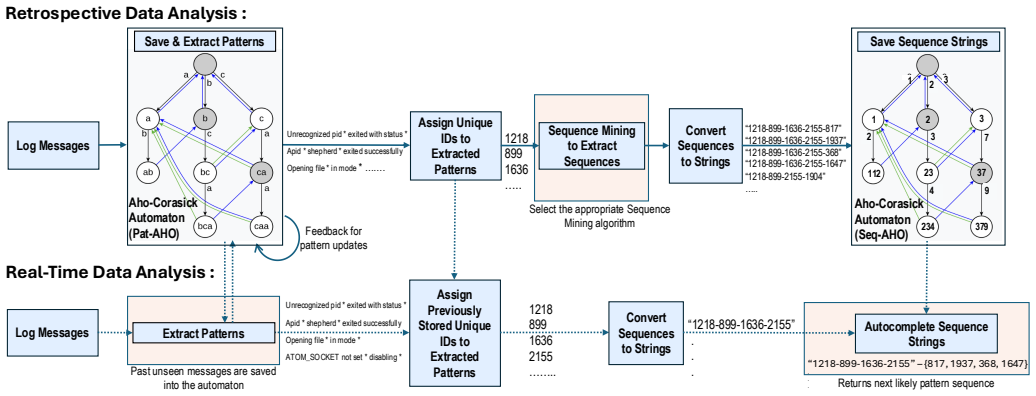
The paper's central claim is that combining pattern mining with priority-weighted, two-level sequence mining and storing the results in Aho-Corasick finite-state automata yields a scalable workflow for exascale HPC log analysis. At Level 1, the TUP algorithm extracts top-k high-importance pattern sequences for each process within a node; at Level 2, the CLH-Miner algorithm extracts cross-level sequences across jobs and nodes. These sequences are stored in a second automaton (seq-AHO) that supports prefix lookup and autocompletion of likely next pattern IDs. The authors report that this pipeline compresses 900GB of syslogs to roughly 20MB, retrieves patterns in 0.3–3 milliseconds, and recover
What carries the argument
The workflow uses two Aho-Corasick automata—pat-AHO, which stores the static parts of log messages as patterns with unique IDs, and seq-AHO, which stores sequences of pattern IDs as strings and includes a trie for autocomplete. Two sequence-mining algorithms do the heavy lifting: TUP (top-k high-utility episode mining) extracts process-level sequences at Level 1, and CLH-Miner (cross-level high-utility itemset mining) extracts job- and node-level sequences at Level 2. Syslog priority fields are converted to importance scores (e.g., EMERGENCY=100,000, DEBUG=1) so that rare critical messages are weighted far above frequent informational ones. The automata make both retrospective and real-time
Load-bearing premise
The near-100% accuracy figures rest on the assumption that high-priority syslog lines (priority below 5) are exactly the messages that matter for failure detection, and since the algorithms are deliberately designed to retrieve those lines, the metric measures internal consistency rather than independent detection of real failures.
What would settle it
Run the workflow on logs from a period with known, labeled node or job failures, and check whether the high-priority sequences it flags align with the actual failure events; if retrieval of priority<5 lines stays near 100% but the flagged sequences do not correspond to real failures, the central claim of predictive failure analysis collapses.
If this is right
- Compression from 900GB of raw logs to roughly 20MB of patterns and sequences makes the full corpus searchable in memory, enabling retrospective analysis on a single node.
- Millisecond-level pattern retrieval and per-process sequence mining around 0.3 seconds make the workflow plausible for real-time or near-real-time monitoring on production systems.
- The two-level hierarchy (process → node → job) yields job-level error signatures, allowing jobs to be grouped by shared failure modes and distinguishing user-specific behavior.
- The compressed pattern-ID format can feed downstream LLM-based pipelines, including retrieval-augmented generation, which cannot ingest terabyte-scale raw text logs directly.
- If the near-100% retrieval of high-priority messages holds more broadly, it provides a fast filter that reduces the search space for root-cause analysis and failure diagnosis.
Where Pith is reading between the lines
- Editorial inference: The reported 'accuracy' only verifies that the algorithms retrieve the high-priority log lines they were explicitly designed to prioritize; it does not independently validate that those lines correspond to actual failures, so a separate ground-truth evaluation would be needed to support the stronger predictive-failure claim.
- Editorial inference: The automaton autocomplete suggests a natural extension—using stored sequences to predict the next error pattern in an online stream—but the paper does not measure whether autocompleted sequences actually precede failures in time, leaving lead-time prediction untested.
- Editorial inference: The pattern-ID compression scheme could generalize to other multi-source telemetry (sensor, network, power) if the same extraction step were applied, but the authors explicitly note that root-cause analysis would require combining text data with numeric and event data, which is outside this workflow's scope.
- Editorial inference: Because minimum-importance thresholds and priority scores are set by the user, the workflow's effectiveness depends on domain expertise; automating importance detection, which the paper lists as future work, would make it more turnkey and less subjective.
Editorial analysis
A structured set of objections, weighed in public.
Referee Report
Summary. The paper proposes an end-to-end workflow for mining interpretable patterns and pattern sequences from raw text-based HPC logs. Retrospective analysis extracts message templates with Aho-Corasick automata (pat-AHO), assigns importance scores based on syslog priorities, mines co-occurring patterns using TUP (level 1) and CLH-Miner (level 2), and stores the resulting sequences in a second automaton (seq-AHO) for fast lookup and autocomplete. The authors report compressed storage of 900 GB of logs into ~20 MB, millisecond retrieval times, and 96–100% "accuracy" for retrieving high-priority log lines, and conclude that the workflow enables online anomaly detection and predictive failure analysis.
Significance. If properly validated, the proposed workflow could be a useful engineering contribution: it offers a compact, interpretable representation of HPC logs, embarrassingly parallel level-1 mining, and an automaton-based structure for sequence lookup and autocompletion. The storage compression and retrieval timings are interesting. However, the central quantitative claim is not supported by the evaluation as written. The accuracy metric is defined relative to the algorithm's own priority labels rather than any ground truth about failures or anomalies, and the case study is anecdotal. The paper's advertised predictive and online capabilities go beyond what the experiments demonstrate. The strengths are the workflow design and the reported scale, but the evaluation would need substantial revision before the main claims can be accepted.
major comments (4)
- [Section V, Tables III and IV] The accuracy metric is circular. The text states: "Accuracy is measured by whether the algorithm retrieves all high-priority sequences." Since TUP and CLH-Miner are explicitly designed to mine high-importance patterns (Section III-B), the 96–100% figures measure recall relative to the input priority labels, not detection or prediction quality. Table IV's own note admits the metric only checks retrieval of sequences identified by level 1. This does not support the conclusion in Section VI of "near 100% accuracy for rare, high-priority messages" enabling "online anomaly detection and predictive failure analysis." Moreover, the "rare" characterization is contradicted by the data: Table III rows show high-priority lines constitute 96–99.8% of log lines in several files. A valid evaluation must use a ground-truth failure or anomaly set (e.g., jobs with non-zero exit codes) and report precisio
- [Section V, overall evaluation] No baselines are provided. The paper dismisses Drain and Spell in Section II as "fragile" and "heuristic," but no empirical comparison on the same dataset is reported. Without comparison to standard log parsers, sequence-mining baselines, or simple counting/priority-threshold methods, the claimed advantages of the workflow cannot be assessed. The paper should report at least a runtime, compression, and detection-quality comparison on a common benchmark or on the same exascale logs.
- [Section IV-B, case study] The case study is qualitative: 8 jobs from 2 users, with visual inspection of scatter plots and descriptions of "unique signatures." No quantitative analysis connects the mined sequences to the job outcomes (the underlined jobs with non-zero exit status are not enumerated, and no sequence-level statistics are given for failed vs. successful jobs). The paper states that root-cause analysis is out of scope, but without linking sequences to actual failures, the claim of "predictive failure analysis" is unsupported. At minimum, the authors should report whether specific sequences are statistically more frequent in or predictive of failed jobs.
- [Section V-A, performance evaluation] The real-time claim is not tested. Table II reports retrieval times for individual strings of 65–1094 characters, which is only a microbenchmark of the automaton lookup. The full real-time pipeline—raw log ingestion, variable-part removal, pattern ID assignment, sequence lookup, and autocomplete—is never evaluated as an online stream. Tables III and IV report offline per-file processing times, not end-to-end online latency. The paper should either add a streaming benchmark or temper the "online" language in Section VI.
minor comments (5)
- [Section III-B] "the sequence mining (pat-AHO)" appears to be a typo; the intended reference is likely seq-AHO.
- [Section V-A, Table II] The text says "The ID column is a unique file ID," but Table II has no ID column. Either add the column or remove the sentence.
- [Section IV-A4, Figure 5] The PCA cluster analysis is described qualitatively. Please report preprocessing, number of components, explained variance, and any cluster validation metric. Without these, the visual separation into "head node," "error-prone nodes," and "server node" is not substantiated.
- [Section III-B and Table I] The importance scores in Table I are free parameters, and the text claims that "setting a larger difference ... yields more accurate results" without showing any sensitivity analysis. A short ablation over importance-score scalings would make the method more reproducible.
- [References] Reference [28] is incomplete (no authors, title, or venue beyond a URL). Please cite the canonical TUP paper. Also, reference [19] is a Wikipedia URL; a more durable citation is preferable.
Circularity Check
Accuracy metric is circular: near-100% accuracy is defined as retrieval of the high-priority messages the mining algorithms are explicitly designed to find.
specific steps
-
self definitional
[Section V-A, Tables III-IV; Section III-B]
"Accuracy is measured by whether the algorithm retrieves all high-priority sequences. We are only looking for high-priority sequences, as they are fewer in number and more critical than warning, alert, and informational messages... Note that if level 1 missed a high-importance pattern, then that would be missed by level 2 as well, since the input to level 2 is the output of level 1. The accuracy only indicates whether level 2 sequence mining retrieves all the high-importance sequences identified by level 1."
The target set is defined by the same importance scores that drive the algorithms: Section III-B states TUP identifies 'top K patterns with high importance' and that 'Assigning the importance scores forces the algorithm to focus more on the rare critical messages.' High Priority Lines are priority<5. Thus 'accuracy' is a recall check that a high-importance-focused miner found high-importance lines in the same logs from which the sequences were mined. The 96-100% figures restate the algorithm's objective; they do not validate anomaly detection or failure prediction, despite the conclusion's claim of 'near 100% accuracy for rare, high-priority messages.'
-
other
[Section III-A real-time analysis and Section VI conclusion]
"If the sequence is present, we can perform a lookup in the seq-AHO (trie data structure) to identify the next likely pattern IDs and their past occurrences count."
The real-time 'prediction' is a trie lookup over sequences previously mined and stored from the same historical logs; the 'next likely' IDs are exactly the stored suffixes. No held-out or future data is used, and no predictive accuracy is measured. The conclusion's 'online anomaly detection and predictive failure analysis' therefore reduces to replaying stored continuations rather than an independent predictive result.
full rationale
The paper's central quantitative claim rests on an evaluation definition that is circular. In Section V, accuracy is defined as whether the sequence miners retrieve all high-priority sequences, where the miners' objective is precisely to find high-importance patterns (Section III-B). The high-priority lines in Tables III and IV are the same lines the importance scores direct TUP and CLH-Miner to recover, measured on the same data used to build the sequences. The 96-100% figures are therefore a recall check on the input, not an independent validation of anomaly detection or failure prediction. The Level 2 caveat explicitly concedes that accuracy only reflects Level 1's identified sequences. The real-time autocomplete channel similarly returns previously stored suffixes from seq-AHO, so the conclusion's 'predictive failure analysis' is not supported by any held-out predictive experiment. No baseline comparison or ground-truth failure labels are provided; the case study is anecdotal. I find no separate self-citation circularity; the circularity is in the evaluation metric itself, warranting a score of 8.
Axiom & Free-Parameter Ledger
free parameters (5)
- Importance scores for syslog priorities =
EMERGENCY=100000, ALERT=90000, CRITICAL=70000, ERROR=60000, WARNING=8000, NOTICE=2000, INFO=1, DEBUG=1
- Top-k parameter for TUP =
10 (stated in Section IV-B-1)
- Minimum importance threshold =
10, 100, 1000, 5000 (Table IV)
- Time window length for sequence extraction =
Not specified numerically
- Deduplication interval =
10 seconds
axioms (3)
- domain assumption Log messages have a stable non-variable part that can be extracted as a pattern by removing variable fields.
- domain assumption The syslog priority field (or user-assigned importance) correctly reflects the operational importance of a message.
- ad hoc to paper Co-occurrence of patterns within a process and within a short time window constitutes a meaningful sequence that can characterize job failures.
read the original abstract
Modern supercomputers housed in High Performance Computing (HPC) environments generate massive volumes of log data daily, revealing intricate information and performance metrics about these complex systems. The sheer size and heterogeneous nature of HPC logs, especially text data, pose significant challenges for traditional analytical techniques. Consequently, more complex workflows are necessary for pattern extraction when analyzing these logs, enabling the discovery of underlying patterns and anomalies that may indicate system faults and help predict future failures and inefficiencies. Our log analysis workflow investigates a combination of advanced pattern-matching and mining techniques applied to HPC log analysis. By systematically identifying frequent log patterns and pattern sequences in log messages and storing them in a finite-state automaton, such as the Aho-Corasick automaton, our workflow enables automated detection of frequent errors and fault events. To extract these patterns and sequences, we leverage information about system hierarchy and message priority. We then correlate and cluster the identified error sequences with job logs, revealing groups of applications with similar or dissimilar error signatures. This approach yields insights that inform improvements and guide real-time monitoring efforts. Our research establishes that pattern mining is vital for unlocking the full potential of log data by enabling real-time analysis and contributing to more resilient, scalable HPC systems. We demonstrate the effectiveness of our approach through summary statistics and a case study on an exascale-class system supercomputer.
Figures


Reference graph
Works this paper leans on
-
[1]
Big data meets hpc log analytics: Scalable approach to understanding systems at extreme scale,
B. H. Park, S. Hukerikar, R. Adamson, and C. Engelmann, “Big data meets hpc log analytics: Scalable approach to understanding systems at extreme scale,” in2017 IEEE International Conference on Cluster Computing (CLUSTER), 2017, pp. 758–765
2017
-
[2]
Instruction-tuned llms for parsing and mining unstructured logs on leadership hpc systems,
A. M. Karimi, J. Y . Choi, C. Q. Cao, and A. Khan, “Instruction-tuned llms for parsing and mining unstructured logs on leadership hpc systems,” 2026. [Online]. Available: https://arxiv.org/abs/2604.05168
Pith/arXiv arXiv 2026
-
[3]
Logmaster: Mining event correlations in logs of large-scale cluster systems,
X. Fu, R. Ren, J. Zhan, W. Zhou, Z. Jia, and G. Lu, “Logmaster: Mining event correlations in logs of large-scale cluster systems,” in2012 IEEE 31st Symposium on Reliable Distributed Systems, 2012, pp. 71–80
2012
-
[4]
Clusterlog: Clustering logs for effective log-based anomaly detection,
C. Egersdoerfer, D. Dai, and D. Zhang, “Clusterlog: Clustering logs for effective log-based anomaly detection,” 2023. [Online]. Available: https://arxiv.org/abs/2301.07846
Pith/arXiv arXiv 2023
-
[5]
Assessing data usefulness for fail- ure analysis in anonymized system logs,
S. Ghiasvand and F. M. Ciorba, “Assessing data usefulness for fail- ure analysis in anonymized system logs,” in2018 17th International Symposium on Parallel and Distributed Computing (ISPDC), 2018, pp. 164–171
2018
-
[6]
Epic: Generative ai platform for accelerating hpc operational data analytics,
A. M. Karimi, W. Shin, J. Hines, T. Ghosal, N. S. Sattar, and F. Wang, “Epic: Generative ai platform for accelerating hpc operational data analytics,” 2025. [Online]. Available: https://arxiv.org/abs/2509.16212
arXiv 2025
-
[7]
Clairvoyant: a log-based transformer-decoder for failure prediction in large- scale systems,
K. A. Alharthi, A. Jhumka, S. Di, and F. Cappello, “Clairvoyant: a log-based transformer-decoder for failure prediction in large- scale systems,” inProceedings of the 36th ACM International Conference on Supercomputing, ser. ICS ’22. New York, NY , USA: Association for Computing Machinery, 2022. [Online]. Available: https://doi.org/10.1145/3524059.3532374
arXiv 2022
-
[8]
Time machine: Generative real-time model for failure (and lead time) prediction in HPC systems,
K. A. Alharthi, A. Jhumka, S. Di, L. Gui, F. Cappello, and S. McIntosh-Smith, “Time machine: Generative real-time model for failure (and lead time) prediction in HPC systems,” in2023 53rd Annual IEEE/IFIP International Conference on Dependable Systems and Networks (DSN), 2023, pp. 508–521. [Online]. Available: https://doi.org/10.1109/DSN58367.2023.00054
arXiv 2023
-
[9]
Analyzing and predicting job failures from HPC system log,
J.-W. Park, X. Huang, and C.-H. Lee, “Analyzing and predicting job failures from HPC system log,”The Journal of Supercomputing, vol. 80, pp. 435–462, 2024. [Online]. Available: https://doi.org/10.1007/ s11227-023-05482-y
2024
-
[10]
Analyzing a lifetime of failures on a cray xc40 supercomputer,
K. A. Brown, T. Mallick, Z. Lan, R. B. Ross, and C. D. Carothers, “Analyzing a lifetime of failures on a cray xc40 supercomputer,” in Proceedings of the Cray User Group, ser. CUG ’25. New York, NY , USA: Association for Computing Machinery, 2025, p. 103–114. [Online]. Available: https://doi.org/10.1145/3757348.3757360
arXiv 2025
-
[11]
Sentilog: Anomaly detecting on parallel file systems via log-based sentiment analysis,
D. Zhang, D. Dai, R. Han, and M. Zheng, “Sentilog: Anomaly detecting on parallel file systems via log-based sentiment analysis,” inProceedings of the 13th ACM Workshop on Hot Topics in Storage and File Systems, ser. HotStorage ’21. New York, NY , USA: Association for Computing Machinery, 2021, p. 86–93. [Online]. Available: https://doi.org/10.1145/3465332.3470873
arXiv 2021
-
[12]
ModuleLog: Module based approach to anomaly detection in parallel file system logs,
C. Egersdoerfer, D. Dai, and D. Zhang, “ModuleLog: Module based approach to anomaly detection in parallel file system logs,” https: //ninercommons.charlotte.edu/record/4157?ln=en&v=pdf, 2022, [Ac- cessed 07-05-2026]
2022
-
[13]
Mela: A visual analytics tool for studying multifidelity hpc system logs,
F. Shilpika, B. Lusch, M. Emani, V . Vishwanath, M. E. Papka, and K.-L. Ma, “Mela: A visual analytics tool for studying multifidelity hpc system logs,” in2019 IEEE/ACM Industry/University Joint International Workshop on Data-center Automation, Analytics, and Control (DAAC), 2019, pp. 13–18
2019
-
[14]
A multi-level, multi-scale visual analytics approach to assessment of multifidelity hpc systems,
S. Shilpika, B. Lusch, M. Emani, F. Simini, V . Vishwanath, M. E. Papka, and K.-L. Ma, “A multi-level, multi-scale visual analytics approach to assessment of multifidelity hpc systems,” in2024 IEEE 24th Interna- tional Symposium on Cluster, Cloud and Internet Computing (CCGrid), 2024, pp. 478–488
2024
-
[15]
An incremental multi-level, multi-scale approach to assessment of multifidelity hpc systems,
Shilpika, B. Lusch, V . Vishwanath, and M. E. Papka, “An incremental multi-level, multi-scale approach to assessment of multifidelity hpc systems,” inProceedings of the SC ’24 Workshops of the International Conference on High Performance Computing, Network, Storage, and Analysis, ser. SC-W ’24. IEEE Press, 2025, p. 1576–1587. [Online]. Available: https://...
arXiv 2025
-
[16]
Spell: Streaming parsing of system event logs,
M. Du and F. Li, “Spell: Streaming parsing of system event logs,” in 2016 IEEE 16th International Conference on Data Mining (ICDM), 2016, pp. 859–864
2016
-
[17]
Drain: An online log parsing approach with fixed depth tree,
P. He, J. Zhu, Z. Zheng, and M. R. Lyu, “Drain: An online log parsing approach with fixed depth tree,” in2017 IEEE International Conference on Web Services (ICWS), 2017, pp. 33–40
2017
-
[18]
Efficient string matching: an aid to bibliographic search,
A. V . Aho and M. J. Corasick, “Efficient string matching: an aid to bibliographic search,”Commun. ACM, vol. 18, no. 6, p. 333–340, Jun
-
[19]
https://en.wikipedia.org/wiki/AhoCorasick algorithm, [Accessed 06-05- 2026]
2026
-
[20]
Efficient multi-pattern log matching in go language,
F. Halas, “Efficient multi-pattern log matching in go language,” 2014. [Online]. Available: https://is.muni.cz/th/xbva1/thesis.pdf
2014
-
[21]
Glop: Enabling massively parallel incident response through gpu log processing,
X. J. A. Bellekens, C. Tachtatzis, R. C. Atkinson, C. Renfrew, and T. Kirkham, “Glop: Enabling massively parallel incident response through gpu log processing,” inProceedings of the 7th International Conference on Security of Information and Networks, ser. SIN ’14. New York, NY , USA: Association for Computing Machinery, 2014, p. 295–301. [Online]. Availa...
arXiv 2014
-
[22]
Juggling the jigsaw: towards automated problem inference from network trouble tickets,
R. Potharaju, N. Jain, and C. Nita-Rotaru, “Juggling the jigsaw: towards automated problem inference from network trouble tickets,” inProceed- ings of the 10th USENIX Conference on Networked Systems Design and Implementation, ser. nsdi’13. USA: USENIX Association, 2013, p. 127–142
2013
-
[23]
On the efficient application of aho-corasick algorithm in process mining,
A. M. Konchagin and A. A. Kalenkova, “On the efficient application of aho-corasick algorithm in process mining,” inAnalysis of Images, Social Networks and Texts. Cham: Springer International Publishing, 2018, pp. 371–377
2018
-
[24]
Constructing the knowledge base for cognitive it service management,
Q. Wang, W. Zhou, C. Zeng, T. Li, L. Shwartz, and G. Y . Grabarnik, “Constructing the knowledge base for cognitive it service management,” in2017 IEEE International Conference on Services Computing (SCC), 2017, pp. 410–417
2017
-
[25]
Deterministic memory-efficient string matching algorithms for intrusion detection,
N. Tuck, T. Sherwood, B. Calder, and G. Varghese, “Deterministic memory-efficient string matching algorithms for intrusion detection,” in IEEE INFOCOM 2004, vol. 4, 2004, pp. 2628–2639 vol.4
2004
-
[26]
A high throughput string matching architecture for intrusion detection and prevention,
L. Tan and T. Sherwood, “A high throughput string matching architecture for intrusion detection and prevention,” inProceedings of the 32nd Annual International Symposium on Computer Architecture (ISCA), 2005, pp. 112–122
2005
-
[27]
A memory- efficient reconfigurable aho-corasick fsm implementation for intrusion detection systems,
V . Dimopoulos, I. Papaefstathiou, and D. N. Pnevmatikatos, “A memory- efficient reconfigurable aho-corasick fsm implementation for intrusion detection systems,” inInternational Conference on Embedded Computer Systems: Architectures, Modeling and Simulation (IC-SAMOS), 2007, pp. 186–193
2007
-
[28]
philippe-fournier- viger.com,
S. Rathore, S. Dawar, V . Goyal, and D. Patel, “philippe-fournier- viger.com,” https://www.philippe-fournier-viger.com/spmf/TUP.pdf, [Accessed 07-05-2026]
2026
-
[29]
THUE: discovering top-k high utility episodes,
S. Wan, J. Chen, W. Gan, G. Chen, and V . Goyal, “THUE: discovering top-k high utility episodes,”CoRR, vol. abs/2106.14830, 2021. [Online]. Available: https://arxiv.org/abs/2106.14830
Pith/arXiv arXiv 2021
-
[30]
Mining cross-level high utility itemsets,
P. Fournier-Viger, Y . Wang, J. C.-W. Lin, J. M. Luna, and S. Ventura, “Mining cross-level high utility itemsets,” inTrends in Artificial Intelligence Theory and Applications. Artificial Intelligence Practices: 33rd International Conference on Industrial, Engineering and Other Applications of Applied Intelligent Systems, IEA/AIE 2020, Kitakyushu, Japan, S...
doi:10.1007/978-3-03 2020
-
[31]
Mining cost-effective patterns in event logs,
P. Fournier-Viger, J. Li, J. C.-W. Lin, T. T. Chi, and R. Uday Kiran, “Mining cost-effective patterns in event logs,”Know.-Based Syst., vol. 191, no. C, Mar. 2020. [Online]. Available: https://doi.org/10.1016/j. knosys.2019.105241
arXiv 2020
-
[32]
Sequence detection in event log files,
I. Mavroudopoulos, T. Toliopoulos, C. Bellas, A. Kosmatopoulos, and A. Gounaris, “Sequence detection in event log files,” inInternational Conference on Extending Database Technology, 2021. [Online]. Available: https://api.semanticscholar.org/CorpusID:232283442
2021
-
[33]
Log pattern mining for distributed system maintenance,
J. Chen, P. Wang, S. Du, and W. Wang, “Log pattern mining for distributed system maintenance,”Complexity, vol. 2020, no. 1, p. 6628165, 2020. [Online]. Available: https://onlinelibrary.wiley.com/doi/ abs/10.1155/2020/6628165
-
[34]
Discovery of frequent episodes in event logs,
M. Leemans and W. M. P. van der Aalst, “Discovery of frequent episodes in event logs,” inData-Driven Process Discovery and Analysis, P. Cer- avolo, B. Russo, and R. Accorsi, Eds. Cham: Springer International Publishing, 2015, pp. 1–31
2015
-
[35]
Online system problem detection by mining patterns of console logs,
W. Xu, L. Huang, A. Fox, D. Patterson, and M. Jordan, “Online system problem detection by mining patterns of console logs,” in2009 Ninth IEEE International Conference on Data Mining, 2009, pp. 588–597
2009
-
[36]
pyahocorasick — ahocorasick documentation — pyaho- corasick.readthedocs.io,
“pyahocorasick — ahocorasick documentation — pyaho- corasick.readthedocs.io,” https://pyahocorasick.readthedocs.io/en/latest/ #testimonials, [Accessed 06-05-2026]
2026
-
[37]
Redis reference — redis.io,
“Redis reference — redis.io,” https://redis.io/docs/latest/develop/ reference/, [Accessed 06-05-2026]
2026
-
[1975]
Available: https://doi.org/10.1145/360825.360855
[Online]. Available: https://doi.org/10.1145/360825.360855
discussion (0)
Sign in with ORCID, Apple, or X to comment. Anyone can read and Pith papers without signing in.