REVIEW 4 major objections 6 minor 54 references
DuoCLR: Dual-Surrogate Contrastive Learning for Skeleton-based Human Action Segmentation
T0 review · 4 major / 6 minor · reviewed 2026-08-15 · deepseek-v4-flash
Pith's one-line read Pretraining on trimmed skeleton clips with shuffle-and-warp augmentations transfers to action segmentation and beats fully supervised baselines.
desk verdict Genuinely new pretraining idea for skeleton action segmentation, but the reported margins are likely inflated by test-set access and an unfair data split. read the letter →
The pith
A machine-rendered reading of the paper's core claim, the machinery that carries it, and where it could break.
The reading
What carries the argument
Shuffle and Warp is the load-bearing augmentation: trimmed single-action skeleton sequences are sampled, permuted, and concatenated into multi-action sequences, with each incoming sequence warped by an estimated rotation, translation, and scale so that the concatenation looks like a physically coherent video rather than a splice of inconsistent camera views. The two surrogate tasks then operate on these permutations. CPC treats local action encodings from different permutations as positive pairs and pushes them together through an InfoNCE loss with memory banks, so the same action becomes context-invariant. ROR builds pairwise difference features between the local projections of two permutations and classifies which of the $|P_j|!$ relative orders connects them, forcing the network to encode action order and long-range context. A temporal encoder built from dilated temporal convolutions over the graph convolutional features gives the feature extractor a large receptive field, so downstream segmentation needs no sliding windows.
What would settle it
On a transfer pair with a large viewpoint gap, e.g. pretraining on NTU RGB+D and evaluating on an untrimmed dataset recorded from an overhead camera, compare DuoCLR with and without Warp using the same linear-evaluation protocol; if mAP@0.1 drops toward the Shuffle-only value of 73.8 or below as viewpoint mismatch grows, then the single rigid alignment used by Warp is the weak link.
Extended reading notes
Core claim
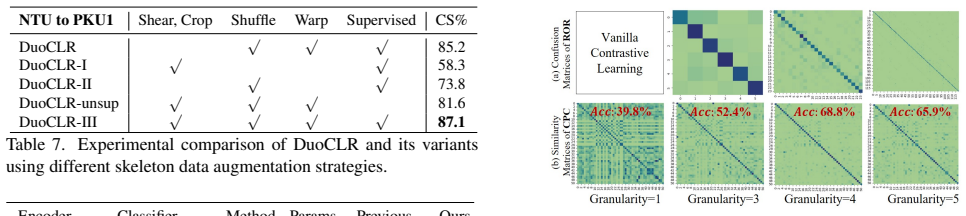
The central claim is that self-supervised learning for skeleton action segmentation should operate on multi-action permutations of trimmed sequences rather than on isolated sequences, and that two complementary surrogate tasks make this work. CPC enforces permutation-invariant intra-class similarity: the same action appearing in different multi-action contexts should produce the same local feature. ROR enforces permutation-aware inter-class structure: from the features of two permutations that share the same action set, the model must recover the relative ordering of the actions. Together, the two tasks regularize the feature space at both local and global scales. The paper reports that this pretraining, with a graph convolutional visual encoder and a dilated temporal encoder, transfers to untrimmed multi-class and multi-label segmentation datasets and outperforms earlier self-supervised and end-to-end supervised methods on most benchmarks, e.g. mAP@0.1 of 85.2 versus 56.0 for the linear-evaluation baseline on NTU to PKU1.
Load-bearing premise
The load-bearing premise is that the Warp step can bring any two trimmed skeleton sequences into one consistent camera configuration using a single rotation, translation, and scale, so that the concatenated sequences are physically coherent; the ablation attributes much of the gain to this alignment, yet the parameter estimation is described only in the supplementary material.
Editorial extensions
If this is right
- With linear evaluation only, pretrained features push NTU-to-PKU1 mAP@0.1 from 56.0 to 85.2, so the extractor is useful without fine-tuning.
- Fine-tuning the pretrained extractor reaches 94.4 CS / 96.8 CV on PKU1, above the end-to-end supervised segmentation baseline, so the pretraining transfers beyond a fixed feature.
- The same recipe improves composite multi-label segmentation on Toyota Smarthome Untrimmed and Charades, where frames carry multiple labels.
- DuoCLR reduces frame-level label requirements by 42-63% while matching fully supervised performance on the tested datasets.
- The augmentation and surrogate tasks compose with classical augmentations like Shear and Crop, raising PKU1 accuracy from 85.2 to 87.1, so the gains are not tied to one augmentation family.
Reading between the lines
- If the Warp alignment generalizes beyond the tested camera settings, the same trimmed-to-untrimmed pretraining could transfer across skeleton datasets with different coordinate conventions, a setting the paper does not evaluate.
- The pairing of an invariance task (CPC) with an order-reasoning task (ROR) is a general recipe; a similar dual-surrogate design could apply to other frame-level tasks such as temporal action localization or motion forecasting.
- A direct testable extension is to replace the single rigid Warp with a learned or sequence-specific alignment and measure whether the remaining gap between DuoCLR and its Shuffle-only variant shrinks.
- Because the unsupervised variant still reaches 81.6 mAP@0.1, the framework may run on unlabeled trimmed video at a modest cost, which the paper notes but does not exploit beyond one experiment.
Signed reviews
Editorial analysis
A structured set of objections, weighed in public.
Referee Report
Summary. The paper proposes DuoCLR, a contrastive pretraining method for skeleton-based action segmentation. DuoCLR samples trimmed single-action skeleton sequences, shuffles and warps them into multi-action permutations, and trains a GCN+TCN encoder with two surrogate losses: CPC (InfoNCE on same-class action segments across permutations) and ROR (classification of the relative permutation mapping). The pretrained encoder is transferred to untrimmed segmentation datasets (PKU1, PKU2, TSU, Charades) under linear and fine-tuned protocols. The paper reports large gains over baselines and ablates the surrogate tasks, augmentation components, action granularity, and encoder structure.
Significance. If the reported results are reproducible, DuoCLR would be a meaningful step: it produces a sliding-window-free, transferable skeleton feature extractor for frame-level action segmentation, and it explicitly targets the trimmed-to-untrimmed gap that most prior contrastive skeleton work ignores. The paper ships a project page with code, uses multiple external benchmarks, and provides component-wise ablations (Tables 5, 7, 8). These strengths make the central idea worth pursuing. However, the headline comparisons are currently compromised by two evaluation-protocol choices—pretraining on the full source splits (Sec. 4.1) and selecting action granularity G on the target evaluation set (Sec. 4.3)—so the significance claim is not yet established at the level stated in Sec. 4.2.
major comments (4)
- [Sec. 4.1 (Pretraining), Tables 1-2] Pretraining uses "the entire (both training and testing) set" of each trimmed source dataset. Standard self-supervised skeleton pretraining uses only the training split (e.g., AimCLR, ActCLR, Hi-TRS in Table 1); if those comparatives used only the training split, DuoCLR is trained on roughly twice the source data and additionally uses the source test split's action labels to form CPC positive pairs and ROR classes. This protocol difference alone can explain part of the large margins in Tables 1 and 2 and prevents the comparison from isolating the proposed surrogate tasks and augmentation. Please re-run the main comparisons with the same source split convention as the baselines (train-only), or report baseline numbers trained under the same full-source protocol.
- [Sec. 4.3 (Effectiveness of Action Granularity), Fig. 6] The action granularity G is tuned by measuring "Acc values" of the CPC+ROR network on PKU2, and G≈4 is then used for the reported PKU2 and PKU1 results. This is model selection on the evaluation set: the headline numbers in Tables 1 and 2 for PKU2/PKU1 are not independent of the test labels. Please replace this with a validation-split or cross-validation-based selection rule, or clearly report the G values used per dataset and show that the conclusions are stable across a range of G.
- [Related work, Tables 1-2] SCS [39]—the authors' own prior work—is the closest published method: it also builds multi-action sequences from trimmed skeletons and uses contrastive learning for segmentation, and it is discussed in Sec. 2. SCS does not appear in Tables 1 or 2, and the text does not explain its absence. Without a direct comparison to SCS, the claim of outperforming "most state-of-the-art comparatives" is incomplete, and the incremental contribution of Shuffle-and-Warp plus CPC/ROR over SCS's offline stitching is not quantified. Please add SCS to the benchmark tables under matched protocols.
- [Sec. 3.2, Eq. (3), Table 7] The Warp operation is a load-bearing component: Table 7 shows that removing Warp drops CS mAP0.1 from 85.2 to 73.8. However, the rotation/translation/scale estimation is deferred to the supplementary material with only a one-line reference, and Eq. (3) assumes a single global similarity transform can align any two heterogenous skeleton sequences into one camera configuration. Since the generality of this assumption is central to the transfer claims, the estimation procedure, its failure modes, and the sequence-level concatenation details need to be specified in the main text or in a directly accessible appendix, with at least one qualitative example of alignment success and failure.
minor comments (6)
- [Sec. 4.3] There are copyediting issues in this section: "and and the best model" should be "and the best model", "Siding-window-free" should be "Sliding-window-free", and "suppassing" should be "surpassing".
- [Tables 1-5] No error bars or multiple-seed statistics are reported; given the large claimed margins, reporting mean and standard deviation over at least three seeds for the main tables would strengthen the empirical claims.
- [Table 3] The semi-supervised protocol should define what the 5% and 10% refer to (labeled videos? labeled frames? random subsets?) and how the remaining target-domain data is used during evaluation.
- [Table 4] The data-savings numbers are presented without specifying the baseline model and protocol used to define "compatible performance with the vanilla model trained on 100% data"; please clarify the comparison protocol.
- [Eq. (1), Eqs. (7)-(8)] In Eq. (1), τ is called a temperature parameter but the formula as written is just a normalized cosine similarity; please show where τ enters (e.g., inside the exponent) so that Eq. (1) matches the InfoNCE convention used in Eqs. (7)-(8).
- [Fig. 6] The confusion matrices and similarity matrices are difficult to read at the current figure resolution; please enlarge the panels or separate them into two figures.
Circularity Check
Action granularity G is selected using the target test set, so the reported PKU2 numbers are a selected maximum rather than an independent transfer prediction; the DuoCLR derivation itself is otherwise self-contained.
-
fitted input called prediction
[Sec. 4.3, 'Effectiveness of Action Granularity' (Fig. 6), feeding Table 1 'NTU→PKU2' row]
"where Acc values evaluate the transferability of the resultant (CPC+ROR) network on PKU 2. While G=1, it degrades to a vanilla contrastive learning model [18]. While G increases, each model is capable of learning at different action granularity and and the best model is achieved when G is around 4."
The PKU2 mIoU/Acc numbers reported in Table 1 are produced by the configuration selected using the same PKU2 test-set accuracy ('Acc values evaluate the transferability ... on PKU 2'). Thus the headline PKU2 result is the maximum of an evaluation-set scan over G, not an independent prediction of an unseen configuration. The selection loop makes the reported 'best' value partly forced by the evaluation labels; other benchmarks (PKU1, TSU, Charades) are not selected on their own test labels, so the circularity is partial.
full rationale
The core derivation chain — Shuffle-and-Warp (Eqs. 2-4), CPC (Eqs. 7-9), ROR (Eqs. 10-11), and the DuoCLR loss (Eq. 12) — is self-contained: no loss or network component is defined in terms of the downstream segmentation targets, and the evaluation is against external untrimmed benchmarks. The only self-citation, [39] (Tian and Payeur), is used to position prior SCS as offline stitching and is not load-bearing for the DuoCLR claim. The one genuine circularity signal is the Sec. 4.3 granularity study: G is chosen by inspecting transferability Acc on PKU2, and the same PKU2 Acc/mIoU is then presented in Table 1 as the method's result; that particular reported outcome is a test-set-selected maximum. Separately, Sec. 4.1's pretraining on 'the entire (both training and testing) set' of the source datasets is a data-leakage/correctness risk for comparisons with methods pretrained on train splits only, but it is not a reduction of the target prediction to the target input and is not counted as circularity. The Warp parameter-estimation details are deferred to supplementary material, which is a reproducibility gap rather than a circular step.
Assumptions & free parameters
free parameters (3)
- action granularity G =
around 4
- ROR loss weight alpha =
not reported
- memory bank sizes N and M =
684 and 32,768
assumptions (4)
- domain assumption Concatenating warped trimmed sequences yields pseudo-untrimmed sequences whose temporal structure is useful for learning action segmentation.
- domain assumption A single global rotation, translation, and scale can align any two skeleton sequences into a common camera configuration.
- domain assumption Action-class labels are available for the trimmed pretraining sequences to define CPC positive pairs.
- ad hoc to paper The optimal action granularity found on PKU2 transfers to the other downstream datasets.
Cite this review
Pith. "Pith review of DuoCLR: Dual-Surrogate Contrastive Learning for Skeleton-based Human Action Segmentation." pith.science (2026). https://pith.science/paper/PTS2WFR7
@misc{pith2026250905543,
  author       = {Pith},
  title        = {Pith review of: DuoCLR: Dual-Surrogate Contrastive Learning for Skeleton-based Human Action Segmentation},
  year         = {2026},
  howpublished = {\url{https://pith.science/paper/PTS2WFR7}},
  note         = {Machine review of arXiv:2509.05543}
}
read the original abstract
In this paper, a contrastive representation learning framework is proposed to enhance human action segmentation via pre-training using trimmed (single action) skeleton sequences. Unlike previous representation learning works that are tailored for action recognition and that build upon isolated sequence-wise representations, the proposed framework focuses on exploiting multi-scale representations in conjunction with cross-sequence variations. More specifically, it proposes a novel data augmentation strategy, 'Shuffle and Warp', which exploits diverse multi-action permutations. The latter effectively assists two surrogate tasks that are introduced in contrastive learning: Cross Permutation Contrasting (CPC) and Relative Order Reasoning (ROR). In optimization, CPC learns intra-class similarities by contrasting representations of the same action class across different permutations, while ROR reasons about inter-class contexts by predicting relative mapping between two permutations. Together, these tasks enable a Dual-Surrogate Contrastive Learning (DuoCLR) network to learn multi-scale feature representations optimized for action segmentation. In experiments, DuoCLR is pre-trained on a trimmed skeleton dataset and evaluated on an untrimmed dataset where it demonstrates a significant boost over state-the-art comparatives in both multi-class and multi-label action segmentation tasks. Lastly, ablation studies are conducted to evaluate the effectiveness of each component of the proposed approach.
Figures


Figures from the paper (3 more)


Reference graph
Works this paper leans on
-
[39]
Haitao Tian and Pierre Payeur. Stitch, contrast, and segment: Learning a human action segmentation model using trimmed skeleton videos. InProceedings of the AAAI Conference on Artificial Intelligence, pages 7365–7373, 2025. 3
work page 2025
-
[1]
Maskclr: Attention-guided contrastive learning for robust action representation learning
Mohamed Abdelfattah, Mariam Hassan, and Alexandre Alahi. Maskclr: Attention-guided contrastive learning for robust action representation learning. InProceedings of the IEEE/CVF Conference on Computer Vision and Pattern Recognition, pages 18678–18687, 2024. 1, 3
work page 2024
-
[2]
Shurong Chai, Rahul Kumar Jain, Jiaqing Liu, Shiyu Teng, Tomoko Tateyama, Yinhao Li, and Yen-Wei Chen. A motion-aware and temporal-enhanced spatial–temporal graph convolutional network for skeleton-based human ac- tion segmentation.Neurocomputing, 580:127482, 2024. 2
work page 2024
-
[3]
Action segmentation with joint self- supervised temporal domain adaptation
Min-Hung Chen, Baopu Li, Yingze Bao, Ghassan Al- Regib, and Zsolt Kira. Action segmentation with joint self- supervised temporal domain adaptation. InProceedings of the IEEE/CVF Conference on Computer Vision and Pattern Recognition, pages 9454–9463, 2020. 2
work page 2020
-
[4]
A simple framework for contrastive learning of visual representations
Ting Chen, Simon Kornblith, Mohammad Norouzi, and Ge- offrey Hinton. A simple framework for contrastive learning of visual representations. InInternational conference on ma- chine learning, pages 1597–1607. PMLR, 2020. 1, 3
work page 2020
-
[5]
Improved baselines with momentum contrastive learning
Xinlei Chen, Haoqi Fan, Ross Girshick, and Kaiming He. Improved baselines with momentum contrastive learning. arXiv preprint arXiv:2003.04297, 2020. 1, 3, 5
arXiv 2003
-
[6]
Channel-wise topology refinement graph convolution for skeleton-based action recognition
Yuxin Chen, Ziqi Zhang, Chunfeng Yuan, Bing Li, Ying Deng, and Weiming Hu. Channel-wise topology refinement graph convolution for skeleton-based action recognition. In Proceedings of the IEEE/CVF international conference on computer vision, pages 13359–13368, 2021. 1, 2
work page 2021
-
[7]
Hi- erarchically self-supervised transformer for human skeleton representation learning
Yuxiao Chen, Long Zhao, Jianbo Yuan, Yu Tian, Zhaoyang Xia, Shijie Geng, Ligong Han, and Dimitris N Metaxas. Hi- erarchically self-supervised transformer for human skeleton representation learning. InEuropean Conference on Com- puter Vision, pages 185–202. Springer, 2022. 2, 3, 6, 8
work page 2022
Show all 54 references
-
[8]
Contrastive learning from spatio-temporal mixed skeleton sequences for self- supervised skeleton-based action recognition.arXiv preprint arXiv:2207.03065, 2022
Zhan Chen, Hong Liu, Tianyu Guo, Zhengyan Chen, Pinhao Song, and Hao Tang. Contrastive learning from spatio-temporal mixed skeleton sequences for self- supervised skeleton-based action recognition.arXiv preprint arXiv:2207.03065, 2022. 3
2022 arXiv
-
[9]
Infogcn++: Learning representation by predicting the future for online skeleton-based action recognition.IEEE Transactions on Pattern Analysis and Machine Intelligence,
Seunggeun Chi, Hyung-gun Chi, Qixing Huang, and Karthik Ramani. Infogcn++: Learning representation by predicting the future for online skeleton-based action recognition.IEEE Transactions on Pattern Analysis and Machine Intelligence,
-
[10]
Ms-tct: Multi-scale temporal con- vtransformer for action detection
Rui Dai, Srijan Das, Kumara Kahatapitiya, Michael S Ryoo, and Franc ¸ois Br´emond. Ms-tct: Multi-scale temporal con- vtransformer for action detection. InProceedings of the IEEE/CVF Conference on Computer Vision and Pattern Recognition, pages 20041–20051, 2022. 6
2022
-
[11]
Toyota smarthome untrimmed: Real-world untrimmed videos for activity detection.IEEE Transactions on Pattern Analysis and Machine Intelligence, 45(2):2533– 2550, 2022
Rui Dai, Srijan Das, Saurav Sharma, Luca Minciullo, Lorenzo Garattoni, Francois Bremond, and Gianpiero Francesca. Toyota smarthome untrimmed: Real-world untrimmed videos for activity detection.IEEE Transactions on Pattern Analysis and Machine Intelligence, 45(2):2533– 2550, 20...
2022
-
[12]
Toyota smarthome: Real-world activities of daily living
Srijan Das, Rui Dai, Michal Koperski, Luca Minci- ullo, Lorenzo Garattoni, Francois Bremond, and Gianpiero Francesca. Toyota smarthome: Real-world activities of daily living. InProceedings of the IEEE/CVF international con- ference on computer vision, pages 833–842, 2019. 1, 3, 6
2019
-
[13]
Hierarchical contrast for unsu- pervised skeleton-based action representation learning
Jianfeng Dong, Shengkai Sun, Zhonglin Liu, Shujie Chen, Baolong Liu, and Xun Wang. Hierarchical contrast for unsu- pervised skeleton-based action representation learning. In Proceedings of the AAAI Conference on Artificial Intelli- gence, pages 525–533, 2023. 1, 3, 4, 7
2023
-
[14]
Skeletr: Towards skeleton-based action recognition in the wild
Haodong Duan, Mingze Xu, Bing Shuai, Davide Mod- olo, Zhuowen Tu, Joseph Tighe, and Alessandro Bergamo. Skeletr: Towards skeleton-based action recognition in the wild. InProceedings of the IEEE/CVF International Con- ference on Computer Vision, pages 13634–13644, 2023. 2, 7
2023
-
[15]
Ms-tcn: Multi-stage tem- poral convolutional network for action segmentation
Yazan Abu Farha and Jurgen Gall. Ms-tcn: Multi-stage tem- poral convolutional network for action segmentation. InPro- ceedings of the IEEE/CVF conference on computer vision and pattern recognition, pages 3575–3584, 2019. 4, 6
2019
-
[16]
Skeleton-based action segmentation with multi-stage spatial- temporal graph convolutional neural networks.IEEE Trans- actions on Emerging Topics in Computing, 12(1):202–212,
Benjamin Filtjens, Bart Vanrumste, and Peter Slaets. Skeleton-based action segmentation with multi-stage spatial- temporal graph convolutional neural networks.IEEE Trans- actions on Emerging Topics in Computing, 12(1):202–212,
-
[17]
Hyperbolic self-paced learning for self-supervised skeleton-based action representations.arXiv preprint arXiv:2303.06242, 2023
Luca Franco, Paolo Mandica, Bharti Munjal, and Fabio Galasso. Hyperbolic self-paced learning for self-supervised skeleton-based action representations.arXiv preprint arXiv:2303.06242, 2023. 1, 3, 4
2023 arXiv
-
[18]
Contrastive learning from ex- tremely augmented skeleton sequences for self-supervised action recognition
Tianyu Guo, Hong Liu, Zhan Chen, Mengyuan Liu, Tao Wang, and Runwei Ding. Contrastive learning from ex- tremely augmented skeleton sequences for self-supervised action recognition. InProceedings of the AAAI Conference on Artificial Intelligence, pages 762–770, 2022. 1, 2, 3, 4...
2022
-
[19]
Global and local contrastive learning for self-supervised skeleton-based action recognition.IEEE Transactions on Circuits and Systems for Video Technology, 2024
Jinhua Hu, Yonghong Hou, Zihui Guo, and Jiajun Gao. Global and local contrastive learning for self-supervised skeleton-based action recognition.IEEE Transactions on Circuits and Systems for Video Technology, 2024. 3
2024
-
[20]
Graph contrastive learn- ing for skeleton-based action recognition.arXiv preprint arXiv:2301.10900, 2023
Xiaohu Huang, Hao Zhou, Jian Wang, Haocheng Feng, Junyu Han, Errui Ding, Jingdong Wang, Xinggang Wang, Wenyu Liu, and Bin Feng. Graph contrastive learn- ing for skeleton-based action recognition.arXiv preprint arXiv:2301.10900, 2023. 1, 3, 4, 6
2023 arXiv
-
[21]
Language-assisted skeleton action understanding for skeleton-based temporal action seg- mentation
Haoyu Ji, Bowen Chen, Xinglong Xu, Weihong Ren, Zhiy- ong Wang, and Honghai Liu. Language-assisted skeleton action understanding for skeleton-based temporal action seg- mentation. InEuropean Conference on Computer Vision, pages 400–417. Springer, 2025. 2, 3, 6
2025
-
[22]
The kinetics hu- man action video dataset.arXiv preprint arXiv:1705.06950,
Will Kay, Joao Carreira, Karen Simonyan, Brian Zhang, Chloe Hillier, Sudheendra Vijayanarasimhan, Fabio Viola, Tim Green, Trevor Back, Paul Natsev, et al. The kinetics hu- man action video dataset.arXiv preprint arXiv:1705.06950,
-
[23]
Unsupervised representation learning by sort- ing sequences
Hsin-Ying Lee, Jia-Bin Huang, Maneesh Singh, and Ming- Hsuan Yang. Unsupervised representation learning by sort- ing sequences. InProceedings of the IEEE international con- ference on computer vision, pages 667–676, 2017. 5
2017
-
[24]
3d human action rep- resentation learning via cross-view consistency pursuit
Linguo Li, Minsi Wang, Bingbing Ni, Hang Wang, Jiancheng Yang, and Wenjun Zhang. 3d human action rep- resentation learning via cross-view consistency pursuit. In Proceedings of the IEEE/CVF conference on computer vi- sion and pattern recognition, pages 4741–4750, 2021. 1, 3, 6, 8
2021
-
[25]
Actional-structural graph convolutional networks for skeleton-based action recognition
Maosen Li, Siheng Chen, Xu Chen, Ya Zhang, Yanfeng Wang, and Qi Tian. Actional-structural graph convolutional networks for skeleton-based action recognition. InProceed- ings of the IEEE/CVF conference on computer vision and pattern recognition, pages 3595–3603, 2019. 2, 4, 5
2019
-
[26]
A decoupled spatio- temporal framework for skeleton-based action segmentation
Yunheng Li, Zhongyu Li, Shanghua Gao, Qilong Wang, Qibin Hou, and Ming-Ming Cheng. A decoupled spatio- temporal framework for skeleton-based action segmentation. arXiv preprint arXiv:2312.05830, 2023. 2
2023 arXiv
-
[27]
Ms2l: Multi-task self-supervised learning for skeleton based action recognition
Lilang Lin, Sijie Song, Wenhan Yang, and Jiaying Liu. Ms2l: Multi-task self-supervised learning for skeleton based action recognition. InProceedings of the 28th ACM international conference on multimedia, pages 2490–2498, 2020. 3, 5, 6, 7
2020
-
[28]
Actionlet- dependent contrastive learning for unsupervised skeleton- based action recognition
Lilang Lin, Jiahang Zhang, and Jiaying Liu. Actionlet- dependent contrastive learning for unsupervised skeleton- based action recognition. InProceedings of the IEEE/CVF Conference on Computer Vision and Pattern Recognition, pages 2363–2372, 2023. 1, 2, 3, 4, 5, 6
2023
-
[29]
Pku-mmd: A large scale benchmark for continu- ous multi-modal human action understanding.arXiv preprint arXiv:1703.07475, 2017
Chunhui Liu, Yueyu Hu, Yanghao Li, Sijie Song, and Jiay- ing Liu. Pku-mmd: A large scale benchmark for continu- ous multi-modal human action understanding.arXiv preprint arXiv:1703.07475, 2017. 1, 3, 6
2017 arXiv
-
[30]
Skeleton-cutmix: Mixing up skeleton with probabilistic bone exchange for supervised domain adapta- tion.IEEE Transactions on Image Processing, 2023
Hanchao Liu, Yuhe Liu, Tai-Jiang Mu, Xiaolei Huang, and Shi-Min Hu. Skeleton-cutmix: Mixing up skeleton with probabilistic bone exchange for supervised domain adapta- tion.IEEE Transactions on Image Processing, 2023. 3
2023
-
[31]
Hao Ma, Zaiyue Yang, and Haoyang Liu. Fine-grained unsu- pervised temporal action segmentation and distributed repre- sentation for skeleton-based human motion analysis.IEEE Transactions on Cybernetics, 52(12):13411–13424, 2021. 2
2021
-
[32]
Cmd: Self-supervised 3d action representation learning with cross-modal mutual distillation
Yunyao Mao, Wengang Zhou, Zhenbo Lu, Jiajun Deng, and Houqiang Li. Cmd: Self-supervised 3d action representation learning with cross-modal mutual distillation. InEuropean Conference on Computer Vision, pages 734–752. Springer,
-
[33]
Shuf- fle and learn: unsupervised learning using temporal order verification
Ishan Misra, C Lawrence Zitnick, and Martial Hebert. Shuf- fle and learn: unsupervised learning using temporal order verification. InComputer Vision–ECCV 2016: 14th Euro- pean Conference, Amsterdam, The Netherlands, October 11– 14, 2016, Proceedings, Part I 14, pages 527–544. ...
2016
-
[34]
Halp: Hal- lucinating latent positives for skeleton-based self-supervised learning of actions
Anshul Shah, Aniket Roy, Ketul Shah, Shlok Mishra, David Jacobs, Anoop Cherian, and Rama Chellappa. Halp: Hal- lucinating latent positives for skeleton-based self-supervised learning of actions. InProceedings of the IEEE/CVF Con- ference on Computer Vision and Pattern Recognit...
2023
-
[35]
Ntu rgb+ d: A large scale dataset for 3d human activity anal- ysis
Amir Shahroudy, Jun Liu, Tian-Tsong Ng, and Gang Wang. Ntu rgb+ d: A large scale dataset for 3d human activity anal- ysis. InProceedings of the IEEE conference on computer vision and pattern recognition, pages 1010–1019, 2016. 1, 3, 6
2016
-
[36]
Hollywood in homes: Crowdsourcing data collection for activity under- standing
Gunnar A Sigurdsson, G ¨ul Varol, Xiaolong Wang, Ali Farhadi, Ivan Laptev, and Abhinav Gupta. Hollywood in homes: Crowdsourcing data collection for activity under- standing. InComputer Vision–ECCV 2016: 14th Euro- pean Conference, Amsterdam, The Netherlands, October 11– 14, 20...
2016
-
[37]
Self-supervised 3d skeleton action representation learning with motion con- sistency and continuity
Yukun Su, Guosheng Lin, and Qingyao Wu. Self-supervised 3d skeleton action representation learning with motion con- sistency and continuity. InProceedings of the IEEE/CVF international conference on computer vision, pages 13328– 13338, 2021. 3
2021
-
[38]
Skeleton-contrastive 3d action representation learn- ing
Fida Mohammad Thoker, Hazel Doughty, and Cees GM Snoek. Skeleton-contrastive 3d action representation learn- ing. InProceedings of the 29th ACM international confer- ence on multimedia, pages 1655–1663, 2021. 1, 3, 4, 6
2021
-
[40]
Visualizing data using t-sne.Journal of machine learning research, 9 (11), 2008
Laurens Van der Maaten and Geoffrey Hinton. Visualizing data using t-sne.Journal of machine learning research, 9 (11), 2008. 7
2008
-
[41]
Usdrl: Unified skeleton-based dense repre- sentation learning with multi-grained feature decorrelation
Wanjiang Weng, Hongsong Wang, Junbo He, Lei He, and Guosen Xie. Usdrl: Unified skeleton-based dense repre- sentation learning with multi-grained feature decorrelation. arXiv preprint arXiv:2412.09220, 2024. 6
2024 arXiv
-
[42]
Scd- net: Spatiotemporal clues disentanglement network for self- supervised skeleton-based action recognition
Cong Wu, Xiao-Jun Wu, Josef Kittler, Tianyang Xu, Sara Ahmed, Muhammad Awais, and Zhenhua Feng. Scd- net: Spatiotemporal clues disentanglement network for self- supervised skeleton-based action recognition. InProceed- ings of the AAAI Conference on Artificial Intelligence, pag...
2024
-
[43]
Joint mixing data augmen- tation for skeleton-based action recognition.ACM Transac- tions on Multimedia Computing, Communications and Ap- plications, 2024
Linhua Xiang and Zengfu Wang. Joint mixing data augmen- tation for skeleton-based action recognition.ACM Transac- tions on Multimedia Computing, Communications and Ap- plications, 2024. 3
2024
-
[44]
Generative action description prompts for skeleton-based action recognition
Wangmeng Xiang, Chao Li, Yuxuan Zhou, Biao Wang, and Lei Zhang. Generative action description prompts for skeleton-based action recognition. InProceedings of the IEEE/CVF International Conference on Computer Vision, pages 10276–10285, 2023. 2
2023
-
[45]
Self-supervised spatiotemporal learning via video clip order prediction
Dejing Xu, Jun Xiao, Zhou Zhao, Jian Shao, Di Xie, and Yueting Zhuang. Self-supervised spatiotemporal learning via video clip order prediction. InProceedings of the IEEE/CVF conference on computer vision and pattern recognition, pages 10334–10343, 2019. 5
2019
-
[46]
Spatial tempo- ral graph convolutional networks for skeleton-based action recognition
Sijie Yan, Yuanjun Xiong, and Dahua Lin. Spatial tempo- ral graph convolutional networks for skeleton-based action recognition. InProceedings of the AAAI conference on arti- ficial intelligence, 2018. 1, 2, 4, 6, 7
2018
-
[47]
Unik: A unified framework for real-world skeleton-based action recognition.arXiv preprint arXiv:2107.08580, 2021
Di Yang, Yaohui Wang, Antitza Dantcheva, Lorenzo Garat- toni, Gianpiero Francesca, and Franc ¸ois Br ´emond. Unik: A unified framework for real-world skeleton-based action recognition.arXiv preprint arXiv:2107.08580, 2021. 1, 2, 7
2021 arXiv
-
[48]
Lac-latent action composition for skeleton-based ac- tion segmentation
Di Yang, Yaohui Wang, Antitza Dantcheva, Quan Kong, Lorenzo Garattoni, Gianpiero Francesca, and Francois Bre- mond. Lac-latent action composition for skeleton-based ac- tion segmentation. InProceedings of the IEEE/CVF Interna- tional Conference on Computer Vision, pages 13679–13690,
-
[49]
Hierarchi- cal consistent contrastive learning for skeleton-based action recognition with growing augmentations
Jiahang Zhang, Lilang Lin, and Jiaying Liu. Hierarchi- cal consistent contrastive learning for skeleton-based action recognition with growing augmentations. InProceedings of the AAAI Conference on Artificial Intelligence, pages 3427– 3435, 2023. 1, 2, 3
2023
-
[50]
Prompted con- trast with masked motion modeling: Towards versatile 3d ac- tion representation learning
Jiahang Zhang, Lilang Lin, and Jiaying Liu. Prompted con- trast with masked motion modeling: Towards versatile 3d ac- tion representation learning. InProceedings of the 31st ACM International Conference on Multimedia, pages 7175–7183,
-
[51]
Shap-mix: shap- ley value guided mixing for long-tailed skeleton based ac- tion recognition
Jiahang Zhang, Lilang Lin, and Jiaying Liu. Shap-mix: shap- ley value guided mixing for long-tailed skeleton based ac- tion recognition. InProceedings of the Thirty-Third Inter- national Joint Conference on Artificial Intelligence, pages 1688–1696, 2024. 3
2024
-
[52]
Unsupervised representation learning with long-term dynamics for skeleton based action recognition
Nenggan Zheng, Jun Wen, Risheng Liu, Liangqu Long, Jian- hua Dai, and Zhefeng Gong. Unsupervised representation learning with long-term dynamics for skeleton based action recognition. InProceedings of the AAAI Conference on Ar- tificial Intelligence, 2018. 3
2018
-
[53]
Self-supervised action representation learning from partial spatio-temporal skeleton sequences
Yujie Zhou, Haodong Duan, Anyi Rao, Bing Su, and Ji- aqi Wang. Self-supervised action representation learning from partial spatio-temporal skeleton sequences. InProceed- ings of the AAAI Conference on Artificial Intelligence, pages 3825–3833, 2023. 3
2023
-
[54]
Modeling the relative visual tempo for self-supervised skeleton-based action recognition
Yisheng Zhu, Hu Han, Zhengtao Yu, and Guangcan Liu. Modeling the relative visual tempo for self-supervised skeleton-based action recognition. InProceedings of the IEEE/CVF International Conference on Computer Vision, pages 13913–13922, 2023. 1, 3
2023
Reviewed August 15, 2026 · model on record in the stance chip above.
Discussion (0). Continue with ORCID to comment.