REVIEW 2 major objections 5 minor 1 cited by
Is high-dimensional photonic entanglement robust to noise?
T0 review · 2 major / 5 minor · reviewed 2026-08-14 · deepseek-v4-flash
Pith's one-line read Photonic entanglement survives far more noise when the measurement space is enlarged beyond the entanglement dimension.
desk verdict Clean operational result separating entanglement dimension from measurement dimension, with the headline d=300 gain honestly labeled as an idealization in the body. read the letter →
The pith
A machine-rendered reading of the paper's core claim, the machinery that carries it, and where it could break.
The reading
What carries the argument
The central object is the quantum contrast, defined as $Q = 1 + \frac{\mu(1+\mu)}{(n/\eta + \mu)^2}$, where $\mu$ is the photon-pair generation probability, $n$ the combined dark-plus-background count probability, and $\eta$ the collection efficiency; it is exactly the ratio of two-photon coincidence counts to accidental counts. This single number is tied to the standard isotropic-state model through $p = (Q-1)/(Q-1+d)$, turning a whole noise budget into one measurable parameter. The second load-bearing piece is the fidelity-witness formalism built on mutually unbiased bases (bases in which any state from one basis has overlap $1/d$ with any state of another): measurements in two such bases give the lower bound $\tilde{F} \ge \frac{Q-d+1}{Q+d-1}$ and hence the threshold in Eq. (6), while measurements in all $d+1$ bases give the exact-fidelity bound in Eq. (8), $k < \frac{(d+1)Q}{d+Q-1}$. The mechanism carrying the argument is the deliberate mismatch between the operational dimension $d$ and the entanglement dimension $k$: enlarging the measurement space dilutes the noise relative to the target state, so the same amount of noise permits certification of larger $k$.
What would settle it
Measure the minimum quantum contrast required to certify a fixed $k=5$ dimensional entanglement using two-MUB witnesses at $d=5, 7, 9,$ and $12$ on the same source, adding spatial modes without changing per-mode loss or noise. The claim predicts the threshold falls to a minimum near $d_{\mathrm{opt}}\approx 9$; if the measured threshold rises with d instead, or if the reduction is far smaller than Eq. (6), the central claim is falsified. A complementary check is to repeat with a deliberately bandwidth-limited source, where the theory predicts the advantage saturates: locating the d at which the advantage vanishes tests the bound the paper identifies.
Extended reading notes
Core claim
The paper establishes a separation between the operational Hilbert-space dimension d and the entanglement dimension k being certified. For certification with measurements in two mutually unbiased bases, the quantum contrast must satisfy $Q > \frac{(d-1)(d+k-1)}{d-k+1}$; for fixed k, this is minimized at $d_{\mathrm{opt}} = \sqrt{2}\sqrt{k^2 - 3k + 2} + k - 1$, giving $Q_{\mathrm{opt}} = 3k + 2\sqrt{2}\sqrt{(k-2)(k-1)} - 4$. For large k the optimal dimension is about $2.41k$ and the required contrast about $5.83k$, in contrast to roughly $2k^2$ when $d=k$; therefore, for example, certifying $k=1000$ entanglement with two MUBs needs $Q\approx 2\times 10^6$ at $d=1000$ but only $Q\approx 5.8\times 10^3$ at $d\approx 2410$. When all $d+1$ mutually unbiased bases are used, the certifiable dimension is bounded by $k < \frac{(d+1)Q}{d+Q-1}$, and in the infinite-dimensional limit $k$ approaches $Q$, so the minimal contrast for $k$-dimensional entanglement is $k$. The paper defines $Q$ as the coincidence-to-accidental ratio and connects it to the isotropic-state noise parameter through $p = (Q-1)/(Q-1+d)$, then verifies the thresholds experimentally.
Load-bearing premise
The analytical result assumes that adding Hilbert-space modes costs nothing—no extra noise, no extra loss, and no change in mode amplitudes—and that the state remains maximally entangled, with equal amplitudes across all d modes. If a physical source's noise or per-mode efficiency degrades as d grows, the predicted threshold reductions shrink, as the paper's own finite-bandwidth simulations show.
Editorial extensions
If this is right
- Certifying a fixed k-dimensional entanglement becomes cheaper in noise terms as d grows to $d_{\mathrm{opt}}$: the required quantum contrast falls by a factor of about $0.343k$, so for $k=1000$ it drops from about $2\times10^6$ to about $5.8\times10^3$.
- When all $d+1$ mutually unbiased bases are measured, the certifiable dimension k is bounded by $k < \frac{(d+1)Q}{d+Q-1}$, and in an infinite-dimensional space the maximum certifiable k equals Q, so the minimum quantum contrast for k-dimensional entanglement is k.
- A single measured quantum contrast Q predicts not only the certifiable dimension but also the violation of EPR-steering and CGLMP nonlocality inequalities, giving experimenters a fast diagnostic of system performance.
- The practical benefit is large for multi-outcome detectors: certifying $k=1000$ with two MUBs tolerates two orders of magnitude higher detector noise and an efficiency drop from 80% to 23% when d is enlarged from 1000 to about 2410.
- Finite source bandwidth bounds the advantage: numerical simulations show that d can be increased only up to a point set by the state's mode width, so the analytical thresholds are upper bounds rather than universal guarantees.
Reading between the lines
- Because Q is an online-measurable parameter, an entanglement distribution system could in principle dynamically adjust the operational dimension d to keep certification possible as channel noise fluctuates; the paper does not discuss this adaptive strategy.
- The same k-versus-d separation should carry over to time-bin and frequency entanglement, but the quantitative detector-efficiency gains would need to be re-derived for those mode structures, since their noise coefficients n and η are dimension-dependent in practice.
- The optimal overhead $d_{\mathrm{opt}}/k \approx 2.41$ suggests a design rule: modest alphabet expansion can substitute for costly detector and source upgrades; that is an economic consequence of the physics, not a physics claim the paper makes.
- For non-maximally entangled states, the relation between Q and p changes, so an analogous single-parameter theory would be needed to know whether the $5.83k$ scaling survives when the flat-spectrum assumption is dropped.
Signed reviews
Editorial analysis
A structured set of objections, weighed in public.
Referee Report
Summary. The manuscript develops an operational noise model for high-dimensional photonic entanglement. It defines the quantum contrast Q as the ratio of coincidence to accidental counts (Eq. 4), relates Q to the isotropic-state noise parameter p (Eq. 2), and derives the minimum Q required to certify k-dimensional entanglement using two-MUB witnesses (Eq. 6) and all-MUB witnesses (Eq. 8). The central observation is that separating the operational Hilbert-space dimension d from the certified entanglement dimension k lowers the required Q; for two-MUB witnesses the optimal d is approximately 2.41k, reducing the required Q from O(k^2) to O(k). The authors verify the Q-based predictions against experimental data in d = 3, 5, and 7 and against numerical simulations of finite-bandwidth states (Fig. 7). They conclude that high-dimensional entanglement is neither universally robust nor universally fragile; the benefit depends on the relationship between Q, d, and k.
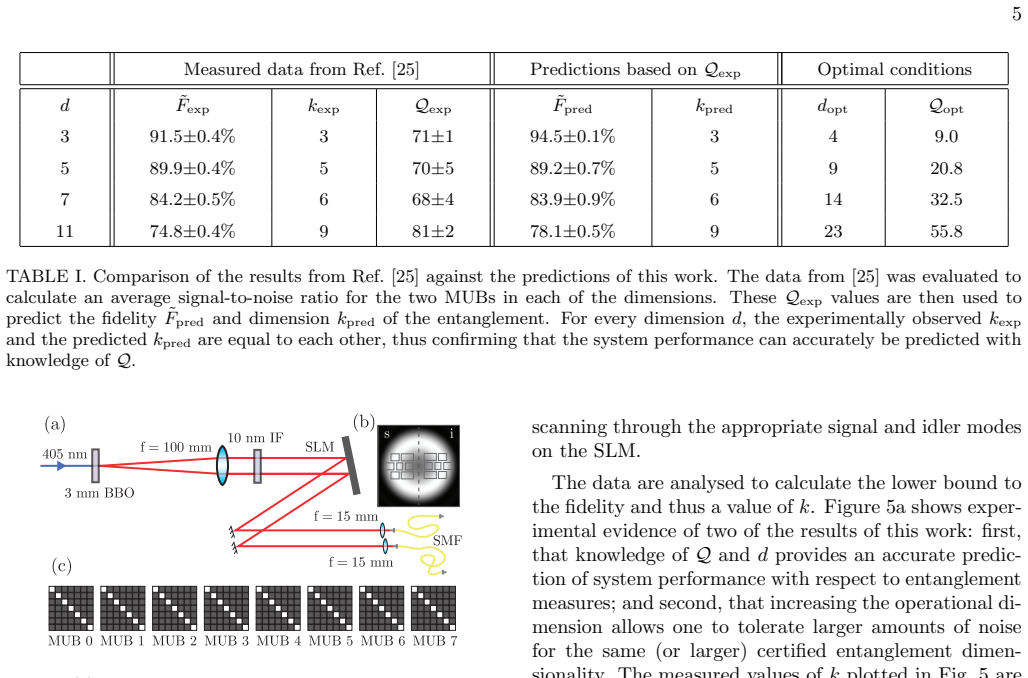
Significance. If the results hold, the paper provides a useful, experimentally accessible single-parameter framework for predicting noise tolerance and for choosing measurement strategies. The analytical formulas are simple, and the model assumptions are stated explicitly. The experimental data at d = 3, 5, and 7 agree with the predicted trends, and the finite-bandwidth numerical simulations honestly show where the ideal model breaks down. The main caveat is that the headline d = 300, two-orders-of-magnitude improvement is an extrapolation of the penalty-free, maximally-entangled model and is not demonstrated for realistic sources; the paper's own simulations show the advantage saturates with finite bandwidth. This is a significant qualification, but not a fatal one, because the manuscript is transparent about the model assumptions and the core Q-based predictive framework remains useful.
major comments (2)
- [Abstract; 'Assumptions of the model'; 'Example for an EMCCD camera'; Fig. 7] The two-orders-of-magnitude reduction at d = 300 is derived under the two assumptions stated in the model: the dimension of the state can be increased without any penalty, and the mode coefficients are equal, i.e., the state is maximally entangled. The paper's own finite-bandwidth simulations (Fig. 7, sigma = 2, 4, 10) show that the advantage of increasing d saturates when the state has finite bandwidth, and only the sigma = 100000 curve recovers the analytic upper bound. As written, the abstract and the EMCCD example present an idealized upper bound as a general capability claim. Please qualify the headline claim in the abstract and, ideally, provide a quantitative estimate of the achievable advantage for a finite-bandwidth source, since the current d = 300 statement is not a prediction for SPDC-like sources.
- [Section 'Entanglement verification via all mutually unbiased bases', Eqs. (7) and (8)] The step from Eq. (7) to Eq. (8) is not spelled out and does not follow from the fidelity criterion F > (k-1)/d used for the two-MUB witness. Combining Eq. (7) with that criterion gives k < [(d+1)Q + (d-1) + d/(d-1)]/(Q+d-1), which differs from Eq. (8) by a term of order d in the numerator; the difference is negligible only for Q >> d. Since Eq. (8) is used to state the d -> infinity limit k -> Q and to define the upper bounds in Fig. 5, please state the entanglement-dimensionality criterion used in this section and either correct Eq. (8) or explicitly label it as a conservative approximation.
minor comments (5)
- [Abstract] The abstract contains a typo: 'entaglement' should be 'entanglement'. Also, the phrase 'doubling the size of a Hilbert space with local dimension d=300' is ambiguous; please specify the starting and final dimensions (e.g., from d = 300 to d = 600, or from k = 124 to d_opt ~ 300).
- [Section 'Experimental verification'] The sentence 'the computational basis uses the standard anti-correlations in photon momenta that are are observed in the far-field of SPDC' contains a duplicated 'are'.
- [Fig. 7 caption] The caption says 'the dotted lines are the analytical thoery' and the text claims 'Increasing the size of the space d continues to provide noise resistance'; for finite sigma the caption should make clear that the advantage saturates rather than continuing indefinitely, and the typo 'thoery' should be corrected.
- [Section 'Entanglement verification via all mutually unbiased bases'] The notation ilde F is used for both the two-MUB lower bound (Eq. 5) and the all-MUB expression (Eq. 7); please define both and clarify whether Eq. (7) is an exact fidelity or an achievable lower bound.
- [References] Reference [37] is cited as an arXiv preprint; if it has been published by the time of submission, please update the reference to the journal version.
Circularity Check
No significant circularity: the central Q-to-k relations are derived analytically from an external MUB-fidelity witness, and the experimental re-analysis is in-sample but not tautological.
full rationale
The paper's main quantitative claims are the thresholds in Eq. (6) (two MUBs) and Eq. (8) (all MUBs), which follow algebraically from the two-MUB and all-MUB fidelity witnesses of Ref. [25] together with the isotropic-state model. Quantum contrast Q is operationally defined in Eq. (4) as a ratio of coincidence to accidental counts and is not defined in terms of k; the entanglement dimension k is a separate quantity obtained from fidelity thresholds. The analytical derivation is therefore self-contained and does not fit k to Q. The experimental verification in Table I and Fig. 5 computes Q from the same coincidence matrices that are used to infer k, so the validation is in-sample; however, the predicted fidelity is a lower bound and is not identical to the measured fidelity (e.g. d=11: 78.1% vs 74.8%), so k_pred is not forced by construction. The d=300 two-orders-of-magnitude example is explicitly presented as an upper bound under stated assumptions (penalty-free dimension increase and equal mode amplitudes), and the finite-bandwidth simulations in Fig. 7 acknowledge the resulting limitation; this is a modeling caveat, not a circular step. Self-citations to Ref. [25] cite a published, parameter-free witness result rather than an unverified uniqueness claim, so they are not load-bearing in a circular sense. No step in the derivation reduces by definition or by fit to its own inputs.
Assumptions & free parameters
assumptions (5)
- standard math SPDC with undepleted pump produces the multi-mode squeezed state of Eq. (14), leading to the explicit form of Eq. (3).
- domain assumption Noise is modeled by the isotropic state (white noise) with parameter p, as in Eq. (1).
- domain assumption Equal mode amplitudes, i.e., the state is maximally entangled.
- ad hoc to paper Noise n and efficiency eta are dimension-independent, and increasing d has no penalty.
- standard math Fidelity witnesses from Bavaresco et al. [25] correctly certify entanglement dimensionality.
Cite this review
Pith. "Pith review of Is high-dimensional photonic entanglement robust to noise?." pith.science (2026). https://pith.science/paper/PU3NOGUQ
@misc{pith2026190808943,
  author       = {Pith},
  title        = {Pith review of: Is high-dimensional photonic entanglement robust to noise?},
  year         = {2026},
  howpublished = {\url{https://pith.science/paper/PU3NOGUQ}},
  note         = {Machine review of arXiv:1908.08943}
}
read the original abstract
High-dimensional entangled states are of significant interest in quantum science as they increase the information content per photon and can remain entangled in the presence of significant noise. We develop the analytical theory and show experimentally that the noise tolerance of high-dimensional entanglement can be significantly increased by modest increases to the size of the Hilbert space. For example, doubling the size of a Hilbert space with local dimension d=300 leads to a reduction of the threshold detector efficiencies required for entanglement certification by two orders of magnitude. This work is developed in the context of spatial entanglement, but it can easily be translated to photonic states entangled in different degrees of freedom. We also demonstrate that knowledge of a single parameter, the signal-to-noise ratio, precisely links measures of entanglement to a range of experimental parameters quantifying noise in a quantum communication system, enabling accurate predictions of its performance. This work serves to answer a simple question: "Is high-dimensional photonic entaglement robust to noise?". Here we show that the answer is more nuanced than a simple "yes" or "no" and involves a complex interplay between the noise characteristics of the state, channel, and detection system
Figures


Figures from the paper (4 more)


Forward citations
Cited by 1 Pith paper
-
Bright Source of High-Dimensional Temporal Entanglement
A compact ppKTP source generates high-dimensional time-bin entanglement, with a new witness certifying Schmidt numbers up to 8 and peak key/entanglement rates at dimension 4.
Reference graph
Works this paper leans on
-
[25]
J. Bavaresco, N. H. Valencia, C. Kl¨ ockl, M. Pivoluska, P. Erker, N. Friis, M. Malik, and M. Huber, Nature Physics 14, 1032 (2018)
work page 2018
-
[1]
Einstein, B
A. Einstein, B. Podolsky, and N. Rosen, Physical Review 47, 777 (1935)
1935
-
[2]
Horodecki, P
R. Horodecki, P. Horodecki, M. Horodecki, and K. Horodecki, Rev. Mod. Phys. 81, 865 (2009)
2009
-
[3]
M. D. Reid, P. D. Drummond, W. P. Bowen, E. G. Cav- alcanti, P. K. Lam, H. A. Bachor, U. L. Andersen, and G. Leuchs, Rev. Mod. Phys. 81, 1727 (2009)
2009
-
[4]
Ac´ ın, N
A. Ac´ ın, N. Brunner, N. Gisin, S. Massar, S. Pironio, and V. Scarani, Phys. Rev. Lett. 98, 230501 (2007)
2007
-
[5]
A. C. Dada, J. Leach, G. S. Buller, M. J. Padgett, and E. Andersson, Nature Physics 7, 677 (2011)
2011
-
[6]
Giovannetti, S
V. Giovannetti, S. Lloyd, and L. Maccone, Nature Pho- tonics 5, 222 (2011)
2011
-
[7]
R. Fickler, M. Krenn, R. Lapkiewicz, S. Ramelow, and A. Zeilinger, Scientific Reports 3, 1914 (2013)
work page 2013
Show all 40 references
-
[8]
Bornman, M
N. Bornman, M. Agnew, F. Zhu, A. Vall´ es, A. Forbes, and J. Leach, npj Quantum Information 5, 63 (2019)
2019
-
[9]
Ringbauer, B
M. Ringbauer, B. Duffus, C. Branciard, E. G. Cavalcanti, A. G. White, and A. Fedrizzi, Nature Physics 11, 249 (2015)
2015
-
[10]
Proietti, J
M. Proietti, J. Ho, F. Grasselli, P. Barrow, M. Malik, and A. Fedrizzi, arXiv , 2002.01491 (2020), 2002.01491
2020 arXiv
-
[11]
Collins, N
D. Collins, N. Gisin, N. Linden, S. Massar, and S. Popescu, Phys. Rev. Lett. 88, 040404 (2002)
2002
-
[12]
N. J. Cerf, M. Bourennane, A. Karlsson, and N. Gisin, Phys. Rev. Lett. 88, 127902 (2002)
2002
-
[13]
R. T. Thew, A. Ac´ ın, H. Zbinden, and N. Gisin, Phys. Rev. Lett. 93, 010503 (2004)
2004
-
[14]
H. M. Wiseman, S. J. Jones, and A. C. Doherty, Phys. Rev. Lett. 98, 140402 (2007)
2007
-
[15]
V´ ertesi, S
T. V´ ertesi, S. Pironio, and N. Brunner, Phys. Rev. Lett. 104, 060401 (2010)
2010
-
[16]
Krenn, M
M. Krenn, M. Malik, M. Erhard, and A. Zeilinger, Phil. Trans. R. Soc. A 375, 20150442 (2017)
2017
-
[17]
Erhard, R
M. Erhard, R. Fickler, M. Krenn, and A. Zeilinger, Light: Science & Applications 7, 17146 (2018)
2018
-
[18]
Kaszlikowski, P
D. Kaszlikowski, P. Gnaci´ nski, M. ˙Zukowski, W. Mik- laszewski, and A. Zeilinger, Phys. Rev. Lett. 85, 4418 (2000)
2000
-
[19]
A. K. Jha, M. Malik, and R. W. Boyd, Phys. Rev. Lett. 101, 180405 (2008)
2008
-
[21]
J. Wang, S. Paesani, Y. Ding, R. Santagati, P. Skrzypczyk, A. Salavrakos, J. Tura, R. Augusiak, L. Manˇ cinska, D. Bacco,et al., Science 360, 285 (2018)
2018
-
[22]
Bouchard, K
F. Bouchard, K. Heshami, D. England, R. Fickler, R. W. Boyd, B.-G. Englert, L. L. S´ anchez-Soto, and E. Karimi, Quantum 2, 111 (2018)
2018
-
[23]
N. H. Valencia, S. Goel, W. McCutcheon, H. Defienne, and M. Malik, arXiv , 1910.04490 (2019), 1910.04490
2019 arXiv
-
[24]
Ecker, F
S. Ecker, F. Bouchard, L. Bulla, F. Brandt, O. Kohout, F. Steinlechner, R. Fickler, M. Malik, Y. Guryanova, R. Ursin, and M. Huber, Phys. Rev. X 9, 041042 (2019)
2019
-
[26]
R. F. Werner, Physical Review A 40, 4277 (1989)
1989
-
[27]
Christ, K
A. Christ, K. Laiho, A. Eckstein, K. N. Cassemiro, and C. Silberhorn, New Journal of Physics 13, 033027 (2011)
2011
-
[28]
H. P. Yuen, Physical Review A 13, 2226 (1976)
1976
-
[29]
Takeoka, R.-B
M. Takeoka, R.-B. Jin, and M. Sasaki, New Journal of Physics 17, 043030 (2015)
2015
-
[30]
Alibart, J
O. Alibart, J. Fulconis, G. Wong, S. Murdoch, W. Wadsworth, and J. Rarity, New Journal of Physics 8, 67 (2006)
2006
-
[31]
Wasilewski, C
W. Wasilewski, C. Radzewicz, R. Frankowski, and K. Banaszek, Phys. Rev. A 78, 033831 (2008)
2008
-
[32]
R. H. Hadfield, Nature Photonics 3, 696 (2009)
2009
-
[33]
P. P. Rohde and T. C. Ralph, Journal of Modern Optics 53, 1589 (2006)
2006
-
[34]
Takesue, S
H. Takesue, S. W. Nam, Q. Zhang, R. H. Hadfield, T. Honjo, K. Tamaki, and Y. Yamamoto, Nature Pho- tonics 1, 343 (2007)
2007
-
[35]
M. P. Edgar, D. S. Tasca, F. Izdebski, R. E. Warburton, J. Leach, M. Agnew, G. S. Buller, R. W. Boyd, and M. J. Padgett, Nature Communications 3, 984 (2012)
2012
-
[36]
Defienne, M
H. Defienne, M. Reichert, and J. W. Fleischer, Physical review letters 121, 233601 (2018)
2018
-
[37]
Valencia, V
N. Valencia, V. Srivastav, M. Pivoluska, M. Hu- ber, N. Friis,, W. McCutcheon, and M Malik, https://arxiv.org/abs/2004.04994 (2020)
2020 arXiv
-
[38]
Leach, B
J. Leach, B. Jack, J. Romero, A. K. Jha, A. M. Yao, S. Franke-Arnold, D. G. Ireland, R. W. Boyd, S. M. Bar- nett, and M. J. Padgett, Science 329, 662 (2010)
2010
-
[39]
Schneeloch, C
J. Schneeloch, C. J. Broadbent, S. P. Walborn, E. G. Cavalcanti, and J. C. Howell, Phys. Rev. A 87, 062103 (2013)
2013
-
[40]
Leach, E
J. Leach, E. Bolduc, D. J. Gauthier, and R. W. Boyd, Phys. Rev. A 85, 060304 (2012)
2012
-
[41]
Salavrakos, R
A. Salavrakos, R. Augusiak, J. Tura, P. Wittek, A. Ac´ ın, and S. Pironio, Phys. Rev. Lett. 119, 040402 (2017). Generation of high-dimensional entanglement through nonlinear optical processing The Hamiltonian of the electromagnetic field in the interaction picture in nonlinear ...
2017
Reviewed August 14, 2026 · model on record in the stance chip above.
Discussion (0). Continue with ORCID to comment.