REVIEW 3 major objections 5 minor 53 references
Multi-tracklet Tracking for Generic Targets with Adaptive Detection Clustering
T0 review · 3 major / 5 minor · reviewed 2026-08-05 · deepseek-v4-flash
Pith's one-line read Grouping noisy detections into short tracklets makes generic-object tracking more accurate and faster, the paper argues.
desk verdict A novel adaptive tracklet-generation scheme that shows real promise on GMOT-40, but the headline claim of improving MHT is not directly supported by the experiments as reported. read the letter →
The pith
A machine-rendered reading of the paper's core claim, the machinery that carries it, and where it could break.
The reading
What carries the argument
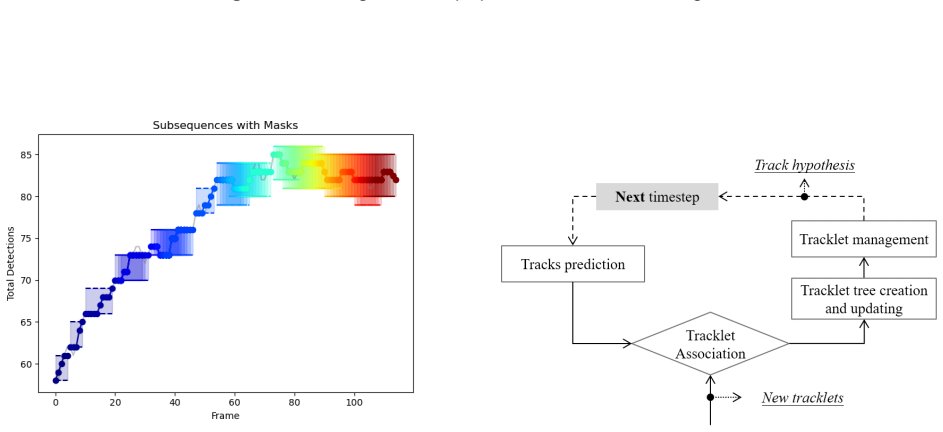
The load-bearing object is the tracklet, a short, identity-labeled set of detections, produced by three steps: sequence partitioning by the gradient of the detection-count curve; density-based clustering of detection centers with DBSCAN at epsilon=80 px and min points=2; and an integer linear program (Eq. 13) with a transitive-clique constraint that assigns detections within each cluster to tracklets. These tracklets enter an MHT-style tree as leaf nodes; branch scores combine motion log-likelihood (Eq. 17), appearance log-ratio (Eq. 18), and average confidence (Eq. 19), and global selection is a maximum-weight independent set. The clique constraint is the step that keeps a cluster's nodes c
What would settle it
On a densely packed small-target sequence such as 'insect-3', look for pairs of ground-truth targets whose detection centers fall within 80 pixels in the same subsequence. If any such pair is assigned to one DBSCAN cluster and the resulting tracklet contains detections of both identities, the generation stage's separation premise fails and the method's advantage should shrink on that sequence.
Extended reading notes
Core claim
The central discovery claimed is that tracklets generated by adaptive detection clustering outperform raw detections as the basic unit of multi-hypothesis tracking for generic targets. The method reads detection confidence and count changes to find cut points, clusters detections in each subsequence via DBSCAN, and solves a small integer program (with a transitive-clique constraint) to form tracklets. It then treats each tracklet as a leaf in MHT trees, scores branches with a weighted sum of motion log-likelihood, appearance log-likelihood, and average confidence, and resolves conflicts by maximum-weight independent set selection. The authors report this yields the best or second-best MOTA a
Load-bearing premise
A single fixed 80-pixel radius with min points of 2 must separate distinct targets into different clusters across all ten GMOT-40 categories, despite object scales that range from insects to vehicles; otherwise the ILP is asked to split mixed clusters, and its clique constraint tends to merge them.
Editorial extensions
If this is right
- Variable-length sequence partitioning keeps tracklet generation tractable: compared with fixed windows, it maintains a 100% pass rate across all window sizes while reducing generation time and the number of tracklets and identity switches.
- Tracklet-level features are more separable than single-detection features: t-SNE visualization and similarity histograms on the 'airplane-0' sequence show more distinct feature boundaries, which supports the lower ID-switch counts in the main experiments.
- Ablation results attribute the gain to all three mechanisms: removing adaptive clustering costs about 3.1 MOTA, and removing the tracklet module and appearance module causes further drops in MOTA and increases FP+FN.
- Under ground-truth detections, MTT reaches MOTA 95.60 and IDF1 88.29, close to but below a reproduced plain MHT (96.37 and 90.31), indicating that tracklet segmentation slightly reduces information completeness when detections are perfect while helping most when detections are noisy.
- On GMOT-40, MTT holds across protocols: one-shot MOTA is the best at 24.20, zero-shot MOTA is the best at 28.11, and normal-detection IDF1 is the best at 48.36 with MOTA close to the leader.
Reading between the lines
- Editorial inference: the density-based tracklet generator could likely be attached to association trackers other than MHT, since any tracker that links detections should benefit from the variance reduction of tracklet-level features; the paper's reported gains may not be tied to the specific MHT machinery.
- Editorial inference: because the 80-pixel radius is fixed globally, an adaptive version that scales epsilon with median box size or local target density could push the method further on insect-scale and vehicle-scale sequences—an experiment the paper does not run but its own limitation discussion implies.
- Editorial inference: the reported ceiling (MOTA below 40, IDF1 below 50 on one-shot GMOT) suggests the next performance jump will come from using tracklet consistency to refine low-confidence detections, not from association alone, since the authors themselves state that detector robustness is the remaining bottleneck.
Editorial analysis
A structured set of objections, weighed in public.
Referee Report
Summary. The paper proposes Multi-Tracklet Tracking (MTT), a tracklet-based variant of multi-hypothesis tracking for the GMOT task. Tracklets are generated by first partitioning the video into variable-length subsequences based on a detection-count gradient, then clustering detections within each subsequence using DBSCAN with a fixed pixel radius, and finally solving an ILP with a clique/transitivity constraint to form tracklets. These tracklets replace individual detections as leaf nodes in the MHT tree, with motion, appearance, and confidence scoring, followed by global maximum-weight-independent-set association. The method is evaluated on GMOT-40 under normal, one-shot, and zero-shot detection protocols, with additional ablation and ground-truth-detection comparisons. The paper reports competitive results, particularly on the one-shot protocol, and honestly acknowledges that MTT is below the reproduced MHT baseline under ground-truth detections.
Significance. If the central claim is validated, the contribution is practically useful: a tracklet pre-processing and association strategy that makes MHT more efficient and robust when detections are low-confidence and categories are unseen. The paper has several strengths: it evaluates on all 40 GMOT-40 sequences under three protocols, provides an ablation study, and explicitly discusses limitations. However, the load-bearing claim that MTT improves the multi-hypothesis tracker in low-confidence scenarios is not directly tested, because the only MTT-versus-MHT comparison is under ground-truth detections, where MTT is worse, and MHT is absent from the one-shot and zero-shot tables. The efficiency analysis also relies on a self-selected subset of sequences. These issues are fixable and central, so major revision is warranted.
major comments (3)
- [Section 5.4, Tables III and V] The paper's central claim, stated in the introduction and repeated in Section 5.4, is that MTT improves multi-hypothesis tracking in low-confidence detection scenarios. This is not demonstrated. Table III is the only direct MTT-vs-MHT comparison, but it uses ground-truth detections, where MTT has lower MOTA (95.60 vs 96.37) and lower IDF1 (88.29 vs 90.31). Table V, which contains the one-shot GlobalTrack and zero-shot GLIP protocols that constitute the low-confidence setting, omits MHT entirely. The observed gains over the other baselines could therefore come from the DBSCAN prefiltering or from the appearance/confidence scoring rather than from an improved tracklet-based MHT association. Please add MHT as a baseline in the one-shot and zero-shot protocols and, ideally, an ablation that adds MTT components one by one on top of the reproduced MHT to localize the source of improvement.
- [Section 5.2.1, Table II] The time-cost comparison is not sufficient to support the efficiency claims. The starred columns are computed on only 12 of the 40 sequences, and the text states that time spent on failed sequences is not included. For the fixed-length window method, pass rates drop to as low as 30% for window size 10, so excluding failures selects the easy subset for the method being compared. The claim that the variable-length window method has a time advantage over the non-tracklet method is therefore not established on the full benchmark. Please report runtime for all 40 sequences or give a per-sequence breakdown that accounts for failed runs, and use a uniform protocol for all methods.
- [Section 4.2.2 and Table I] The density-based tracklet generator uses a single fixed (epsilon, delta) = (80, 2) in pixels across all ten GMOT-40 categories, whose object scales range from insects to vehicles. A fixed Euclidean radius can merge nearby targets in dense insect scenes and split large vehicles in sparse scenes. Because errors in tracklet generation propagate into the ILP of Eq. (13) and then into the track trees, this parameter choice is load-bearing. No sensitivity analysis of epsilon/delta, or of the confidence threshold, is reported. Please add a robustness study over these parameters or a category-wise analysis to justify the fixed setting.
minor comments (5)
- [Section 5.4] The text says 'significant improvements of 3.8% in MOTA and 2.14% in IDF1.' Since no error bars or significance tests are provided, 'significant' should be replaced by 'substantial' or supported with per-sequence variance and a statistical test.
- [Section 4.3] The text 'Unlike the traditional HMT framework' should be 'MHT framework.' There are also typos elsewhere, e.g., 'hight confidence,' 'detetion,' 'sloving,' and 'subsequnences,' which should be corrected.
- [Section 4.2.2] Eq. (9) defines the epsilon-neighborhood for detection center points, but Eq. (10) writes the distance matrix for detections z_i. Please clarify exactly what input dist() receives and whether bounding-box size is used anywhere in the clustering.
- [Section 4.3.2, Eq. (17)] The term V_space in the motion score is not defined. Please specify the dimension and units of the observation space so that the log-likelihood constant is interpretable.
- [Table IV] The components A, B, and C should be defined in the table caption or immediately before the table. Currently the definitions appear only in the text, and each ablation row should state exactly which modules are removed.
Circularity Check
No significant circularity: the tracklet-generation and association steps are self-contained optimizations, and the headline result is benchmarked on an external dataset.
full rationale
I walked the paper's derivation chain. The claimed contribution is a tracklet-enhanced multi-hypothesis tracker: adaptive sequence partitioning (Eqs. 6-8), density-based tracklet generation via DBSCAN and the ILP tracklet-extraction problem (Eqs. 9-13), tracklet tree creation/updating and scoring (Eqs. 14-20), and global tracklet association via MWIS (Eq. 21). Each of these is presented as an optimization or scoring construction whose inputs are detections, features, and threshold parameters; none defines its output in terms of the headline performance metric. The central empirical claim is evaluated on the external GMOT-40 benchmark with fixed one-shot, zero-shot, and normal detection protocols (Table V), so the reported MOTA/IDF1 improvements do not reduce by construction to a fitted quantity. The self-citations to the authors' prior tracklet/MHT works ([20], [21]) appear only as background descriptions of existing tracklet-based strategies; the paper does not rely on a self-cited uniqueness theorem, nor does it smuggle in an ansatz solely by citation. The absence of an MHT row in the one-shot/zero-shot tables (Table V) is a missing control for the claim of improving MHT under low-confidence detections, and the undisclosed choice of hyperparameters could be an overfitting concern, but neither is a circularity. No circular step can be exhibited from the paper's equations or citations.
Assumptions & free parameters
free parameters (16)
- DBSCAN epsilon =
80 pixels
- DBSCAN min samples (delta) =
2
- Gradient threshold d =
5
- Median filter window w_median =
5
- Confidence threshold theta_s =
0.1
- NMS threshold =
0.5
- Max subwindow length l_max =
5
- Max detection count in subsequence u =
70
- Motion distance threshold theta_mot =
15
- Appearance distance threshold theta_app =
0.85
- Pruning depth k =
2
- Null appearance likelihood theta_null =
0.3
- Max patience window =
10
- Max leaves per track tree =
8
- Scoring weights (w_mot, w_app, w_conf) =
(0.1, 0.9, 3.0)
- Sliding window step S =
1
assumptions (7)
- domain assumption Detection confidence scores are informative of true target presence.
- domain assumption Spatial proximity in a short subsequence implies same identity.
- domain assumption ImageNet-pretrained ResNet-18 features are discriminative for generic unseen categories.
- domain assumption The detection count curve and its gradient reflect scene events such as occlusion and target entry/exit.
- ad hoc to paper All detections in a generated tracklet must be pairwise linked (clique constraint).
- standard math MHT and MWIS formulations adequately approximate the NP-hard data association problem.
- domain assumption The null hypothesis models for motion and appearance scoring are appropriate.
Cite this review
Pith. "Pith review of Multi-tracklet Tracking for Generic Targets with Adaptive Detection Clustering." pith.science (2026). https://pith.science/paper/PU3TJWM4
@misc{pith2026250805172,
  author       = {Pith},
  title        = {Pith review of: Multi-tracklet Tracking for Generic Targets with Adaptive Detection Clustering},
  year         = {2026},
  howpublished = {\url{https://pith.science/paper/PU3TJWM4}},
  note         = {Machine review of arXiv:2508.05172}
}
read the original abstract
Tracking specific targets, such as pedestrians and vehicles, has been the focus of recent vision-based multitarget tracking studies. However, in some real-world scenarios, unseen categories often challenge existing methods due to low-confidence detections, weak motion and appearance constraints, and long-term occlusions. To address these issues, this article proposes a tracklet-enhanced tracker called Multi-Tracklet Tracking (MTT) that integrates flexible tracklet generation into a multi-tracklet association framework. This framework first adaptively clusters the detection results according to their short-term spatio-temporal correlation into robust tracklets and then estimates the best tracklet partitions using multiple clues, such as location and appearance over time to mitigate error propagation in long-term association. Finally, extensive experiments on the benchmark for generic multiple object tracking demonstrate the competitiveness of the proposed framework.
Figures


Figures from the paper (7 more)




Reference graph
Works this paper leans on
-
[1]
Y.Wu,H.Sheng,Y.Zhang,S.Wang,Z.Xiong,W.Ke,Hybridmotion model for multiple object tracking in mobile devices, IEEE Internet of Things Journal (2022)
work page 2022
-
[2]
S.Wang,H.Sheng,Y.Zhang,D.Yang,J.Shen,R.Chen,Blockchain- empowered distributed multi-camera multi-target tracking in edge computing, IEEE Transactions on Industrial Informatics (2023)
work page 2023
-
[3]
S. Wang, H. Sheng, D. Yang, Y. Zhang, Y. Wu, S. Wang, Extend- able multiple nodes recurrent tracking framework with rtu++, IEEE Transactions on Image Processing 31 (2022) 5257–5271
2022
- [4]
-
[5]
Z. Wu, W. Ke, C. Wang, W. Zhang, Z. Xiong, Online 3d recon- structionofzebrafishbehavioraltrajectorieswithinaholisticperspec- tive, in: 2022 IEEE International Conference on Bioinformatics and Biomedicine (BIBM), IEEE, 2022, pp. 854–859
work page 2022
-
[6]
Z. Wu, C. Wang, W. Zhang, G. Sun, W. Ke, Z. Xiong, Online 3d behavioral tracking of aquatic model organism with a dual-camera system, Advanced Engineering Informatics 61 (2024) 102481
work page 2024
-
[7]
L. Hu, J. Zhang, W. Lv, Y. Gong, J. Wang, J. Zhang, D. Zeng, Dctracker: Rethinking mot in soccer events under dual views via cascade association, Knowledge-Based Systems (2024) 112528
work page 2024
-
[8]
W. Kim, Y. B. Cho, S. Lee, Thermal sensor-based multiple object tracking for intelligent livestock breeding, IEEE Access 5 (2017) 27453–27463
work page 2017
Show all 53 references
-
[9]
C.Zhang,W.Xie,Y.Li,Z.Liu,Multi-sourcetstargetrecognitionvia an intuitionistic fuzzy method, Remote Sensing 15 (24) (2023) 5773
2023
-
[10]
Zhang, L.-Q
C.-Y. Zhang, L.-Q. Li, S. Huang, Multiple target data-association algorithm based on takagi–sugeno intuitionistic fuzzy model, Neu- rocomputing 536 (2023) 114–124. First Author et al.:Preprint submitted to ElsevierPage 10 of 12 Short Title of the Article Method MOTA↑IDF1↑MT↑PT...
2023
-
[11]
Luo, T.-K
W. Luo, T.-K. Kim, Generic object crowd tracking by multi-task learning., in: BMVC, Vol. 1, 2013, p. 3
2013
-
[12]
1290–1297
W.Luo,T.-K.Kim,B.Stenger,X.Zhao,R.Cipolla,Bi-labelpropaga- tion for generic multiple object tracking, in: Proceedings of the IEEE Conference on Computer Vision and Pattern Recognition, 2014, pp. 1290–1297
2014
-
[13]
H. Bai, W. Cheng, P. Chu, J. Liu, K. Zhang, H. Ling, Gmot-40: A benchmarkforgenericmultipleobjecttracking,in:Proceedingsofthe IEEE/CVFConferenceonComputerVisionandPatternRecognition, 2021, pp. 6719–6728
2021
-
[14]
L. H. Li, P. Zhang, H. Zhang, J. Yang, C. Li, Y. Zhong, L. Wang, L.Yuan,L.Zhang,J.-N.Hwang,etal.,Groundedlanguage-imagepre- training, in: Proceedings of the IEEE/CVF Conference on Computer Vision and Pattern Recognition, 2022, pp. 10965–10975
2022
-
[15]
S. Liu, Z. Zeng, T. Ren, F. Li, H. Zhang, J. Yang, C. Li, J. Yang, H. Su, J. Zhu, et al., Grounding dino: Marrying dino with grounded pre-training for open-set object detection, arXiv preprint arXiv:2303.05499 (2023)
2023 arXiv
-
[16]
Q. Liu, Y. Li, Y. Jiang, Y. Fu, Siamese-detr for generic multi-object tracking, IEEE Transactions on Image Processing (2024)
2024
-
[17]
S. H. Rezatofighi, A. Milan, Z. Zhang, Q. Shi, A. Dick, I. Reid, Joint probabilistic data association revisited, in: Proceedings of the IEEE international conference on computer vision, 2015, pp. 3047–3055
2015
-
[18]
S. Oh, S. Russell, S. Sastry, Markov chain monte carlo data asso- ciation for multi-target tracking, IEEE Transactions on Automatic Control 54 (3) (2009) 481–497
2009
-
[19]
1234–1241
B.Wang,G.Wang,K.LukChan,L.Wang,Trackletassociationwith online target-specific metric learning, in: Proceedings of the IEEE conference on computer vision and pattern recognition, 2014, pp. 1234–1241
2014
-
[20]
H.Sheng,J.Chen,Y.Zhang,W.Ke,Z.Xiong,J.Yu,Iterativemultiple hypothesistrackingwithtracklet-levelassociation,IEEETransactions on Circuits and Systems for Video Technology 29 (12) (2018) 3660– 3672
2018
-
[21]
Y.Zhang,H.Sheng,Y.Wu,S.Wang,W.Lyu,W.Ke,Z.Xiong,Long- term tracking with deep tracklet association, IEEE Transactions on Image Processing 29 (2020) 6694–6706
2020
-
[22]
S. S. Blackman, Multiple hypothesis tracking for multiple target tracking, IEEE Aerospace and Electronic Systems Magazine 19 (1) (2004) 5–18
2004
-
[23]
C. Kim, F. Li, A. Ciptadi, J. M. Rehg, Multiple hypothesis tracking revisited, in: Proceedings of the IEEE international conference on computer vision, 2015, pp. 4696–4704
2015
-
[24]
3645–3649
N.Wojke,A.Bewley,D.Paulus, Simpleonlineandrealtimetracking with a deep association metric, in: 2017 IEEE international confer- ence on image processing (ICIP), IEEE, 2017, pp. 3645–3649
2017
-
[25]
Bewley, Z
A. Bewley, Z. Ge, L. Ott, F. Ramos, B. Upcroft, Simple online and realtime tracking, in: 2016 IEEE international conference on image processing (ICIP), IEEE, 2016, pp. 3464–3468
2016
-
[26]
Ciaparrone, F
G. Ciaparrone, F. L. Sánchez, S. Tabik, L. Troiano, R. Tagliaferri, F. Herrera, Deep learning in video multi-object tracking: A survey, Neurocomputing 381 (2020) 61–88
2020
-
[27]
5567–5577
S.Li,T.Fischer,L.Ke,H.Ding,M.Danelljan,F.Yu,Ovtrack:Open- vocabularymultipleobjecttracking,in:ProceedingsoftheIEEE/CVF conference on computer vision and pattern recognition, 2023, pp. 5567–5577
2023
-
[28]
Radford, J
A. Radford, J. W. Kim, C. Hallacy, A. Ramesh, G. Goh, S. Agarwal, G.Sastry,A.Askell,P.Mishkin,J.Clark,etal.,Learningtransferable visual models from natural language supervision, in: International conference on machine learning, PMLR, 2021, pp. 8748–8763
2021
-
[29]
Neubeck, L
A. Neubeck, L. Van Gool, Efficient non-maximum suppression, in: 18th international conference on pattern recognition (ICPR’06), Vol. 3, IEEE, 2006, pp. 850–855
2006
-
[30]
Huang, B
C. Huang, B. Wu, R. Nevatia, Robust object tracking by hierarchical associationofdetectionresponses,in:ComputerVision–ECCV2008: 10th European Conference on Computer Vision, Marseille, France, October 12-18, 2008, Proceedings, Part II 10, Springer, 2008, pp. 788–801
2008
-
[31]
A.RoshanZamir,A.Dehghan,M.Shah,Gmcp-tracker:Globalmulti- object tracking using generalized minimum clique graphs, in: Com- puter Vision–ECCV 2012: 12th European Conference on Computer Vision, Florence, Italy, October 7-13, 2012, Proceedings, Part II 12, Springer, 2012, pp. 343...
2012
-
[32]
B.Wang,G.Wang,K.L.Chan,L.Wang,Trackletassociationbyon- linetarget-specificmetriclearningandcoherentdynamicsestimation, IEEEtransactionsonpatternanalysisandmachineintelligence39(3) (2016) 589–602
2016
-
[33]
H. Shen, L. Huang, C. Huang, W. Xu, Tracklet association tracker: An end-to-end learning-based association approach for multi-object tracking, arXiv preprint arXiv:1808.01562 (2018)
2018 arXiv
-
[34]
G. Wang, Y. Wang, H. Zhang, R. Gu, J.-N. Hwang, Exploit the connectivity: Multi-object tracking with trackletnet, in: Proceedings of the 27th ACM international conference on multimedia, 2019, pp. 482–490
2019
-
[35]
L. Chen, H. Ai, R. Chen, Z. Zhuang, Aggregate tracklet appearance features for multi-object tracking, IEEE Signal Processing Letters 26 (11) (2019) 1613–1617
2019
-
[36]
A. B. Poore, S. Gadaleta, Some assignment problems arising from multipletargettracking,Mathematicalandcomputermodelling43(9-
-
[37]
Zhang, P
Y. Zhang, P. Sun, Y. Jiang, D. Yu, F. Weng, Z. Yuan, P. Luo, W. Liu, X. Wang, Bytetrack: Multi-object tracking by associating every detection box, in: European conference on computer vision, Springer, 2022, pp. 1–21
2022
-
[38]
D. J. Papageorgiou, M. R. Salpukas, The maximum weight indepen- dent set problem for data association in multiple hypothesis tracking, in: Optimization and Cooperative Control Strategies: Proceedings of the 8th International Conference on Cooperative Control and Opti- mization...
2009
-
[39]
K. He, X. Zhang, S. Ren, J. Sun, Deep residual learning for image recognition, in: Proceedings of the IEEE conference on computer vision and pattern recognition, 2016, pp. 770–778
2016
-
[40]
J. Deng, W. Dong, R. Socher, L.-J. Li, K. Li, L. Fei-Fei, Imagenet: A large-scalehierarchicalimagedatabase,in:2009IEEEconferenceon computer vision and pattern recognition, Ieee, 2009, pp. 248–255
2009
-
[41]
Paszke, S
A. Paszke, S. Gross, F. Massa, A. Lerer, J. Bradbury, G. Chanan, T. Killeen, Z. Lin, N. Gimelshein, L. Antiga, et al., Pytorch: An imperative style, high-performance deep learning library, Advances in neural information processing systems 32 (2019)
2019
-
[42]
Bernardin, R
K. Bernardin, R. Stiefelhagen, Evaluating multiple object tracking performance: the clear mot metrics, EURASIP Journal on Image and Video Processing 2008 (2008) 1–10
2008
-
[43]
Ristani, F
E. Ristani, F. Solera, R. Zou, R. Cucchiara, C. Tomasi, Performance measures and a data set for multi-target, multi-camera tracking, in: European conference on computer vision, Springer, 2016, pp. 17–35
2016
-
[44]
G. J. et. al., ultralytics/yolov5: v6.0 - YOLOv5n ’Nano’ models, Roboflow integration, TensorFlow export, OpenCV DNN support (Oct. 2021).doi:10.5281/zenodo.5563715. URLhttps://doi.org/10.5281/zenodo.5563715
2021 doi
-
[45]
10012–10022
Z.Liu,Y.Lin,Y.Cao,H.Hu,Y.Wei,Z.Zhang,S.Lin,B.Guo,Swin transformer: Hierarchical vision transformer using shifted windows, in: Proceedings of the IEEE/CVF international conference on com- puter vision, 2021, pp. 10012–10022
2021
-
[46]
T.-Y. Lin, M. Maire, S. Belongie, J. Hays, P. Perona, D. Ramanan, P. Dollár, C. L. Zitnick, Microsoft coco: Common objects in con- text, in: Computer Vision–ECCV 2014: 13th European Conference, Zurich, Switzerland, September 6-12, 2014, Proceedings, Part V 13, Springer, 2014, ...
2014
-
[47]
Van der Maaten, G
L. Van der Maaten, G. Hinton, Visualizing data using t-sne., Journal of machine learning research 9 (11) (2008)
2008
-
[48]
Xiang, A
Y. Xiang, A. Alahi, S. Savarese, Learning to track: Online multi- object tracking by decision making, in: International Conference on Computer Vision (ICCV), 2015
2015
-
[49]
E.Bochinski,V.Eiselein,T.Sikora,High-speedtracking-by-detection without using image information, in: 2017 14th IEEE international conferenceonadvancedvideoandsignalbasedsurveillance(AVSS), IEEE, 2017, pp. 1–6
2017
-
[50]
P. Chu, H. Ling, Famnet: Joint learning of feature, affinity and multi-dimensional assignment for online multiple object tracking, in: ProceedingsoftheIEEE/CVFInternationalConferenceonComputer Vision, 2019, pp. 6172–6181
2019
-
[51]
N.Aharon,R.Orfaig,B.-Z.Bobrovsky,Bot-sort:Robustassociations multi-pedestrian tracking, arXiv preprint arXiv:2206.14651 (2022). First Author et al.:Preprint submitted to ElsevierPage 12 of 12 Short Title of the Article Misclassification Low confidence Correct classification Lo...
2022 arXiv
-
[52]
tracklet generation subsequnences
-
[53]
tracklet association Figure 4:Illustration of tracklet-based tracking. First Author et al.:Preprint submitted to ElsevierPage 13 of 12 Short Title of the Article Object Detection Tracklet Tracking Detector Sequence partitioning Subsequence clustering Hypothesis updating Hypoth...
Reviewed August 5, 2026 · model on record in the stance chip above.
Discussion (0). Continue with ORCID to comment.