REVIEW 3 major objections 6 minor 56 references
Recovering link-weight structure in complex networks with weight-aware random walks
T0 review · 3 major / 6 minor · reviewed 2026-08-05 · deepseek-v4-flash
Pith's one-line read A weight-biased random walk preserves edge-weight relationships in node embeddings far better than unweighted or strength-based walks, with synthetic correlations above 0.9.
desk verdict A useful, well-executed empirical comparison with a predictable headline result, undermined by an unvalidated similarity metric and no error bars; worth citing and refereeing but not a landmark. read the letter →
The pith
A machine-rendered reading of the paper's core claim, the machinery that carries it, and where it could break.
The reading
What carries the argument
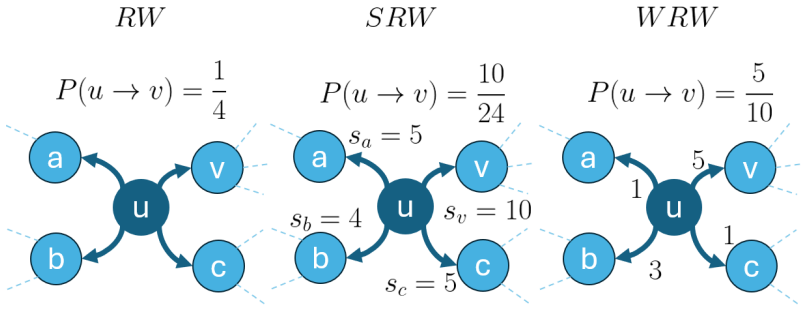
The load-bearing object is the weight-aware random walk (WRW): a walk that steps from $u$ to neighbor $v$ with probability $P(u \to v) = w_{uv} / \sum_{w \in N(u)} w_{uw}$, so high-weight edges are traversed more often and therefore appear more frequently in the skip-gram training contexts. The evaluation machinery is equally central: the Pearson correlation between each original edge weight and the cosine similarity of the embeddings of its two endpoints, applied across synthetic models, eleven real networks, and complete graphs pruned by weight percentiles. This metric is what turns walk behavior into a measurable claim about weight preservation.
What would settle it
On a synthetic Erdős–Rényi graph with exponential edge weights and roughly 2,000 nodes, compute WRW embeddings and compare the Pearson correlation between original weights and embedding cosine similarity with Spearman's rank correlation. If the rank correlation is much lower than the reported ~0.9 Pearson value, the apparent preservation is an artifact of the correlation measure rather than genuine recovery of weight order.
Extended reading notes
Core claim
The paper's discovery is that the random-walk rule determines whether edge weights reappear in node embeddings. Using transition probability $P(u \to v)=w_{uv}/\sum_w w_{uw}$, the cosine similarity of connected nodes' embedding vectors tracks the original edge weight — above 0.9 Pearson correlation on Erdős–Rényi, stochastic-block, and Waxman models — while unweighted walks stay near zero unless topology already encodes weight. Strength-based walks help on degree-correlated scale-free networks. In real graphs the best WRW correlation is 0.446, and shuffled-weight controls show part of the signal is structural. Low-weight-edge pruning first improves correlation, then past roughly the 30–60th
Load-bearing premise
Every conclusion rests on the assumption that the correlation between original edge weights and the similarity of embedding vectors is a fair, topology-independent measure of how well weights are preserved.
Editorial extensions
If this is right
- For any downstream task that needs edge weights, the cheapest fix is to replace the walk's transition rule with WRW's $P(u \to v)\propto w_{uv}$; no other part of the embedding pipeline needs to change.
- On random and community-structured synthetic graphs, the reported correlations above 0.9 mean embedding cosine similarity can stand in for original edge weights almost linearly.
- On scale-free networks, the hub distortion warns that a single weighted-walk recipe will not work; strength-based walks can be a better fallback when degree and weight are tightly coupled.
- Pruning experiments give a practical rule of thumb: removing low-weight edges up to about the 30–60th percentile can clean the weight signal, but heavier pruning should be avoided.
- Because real-world results are heterogeneous, practitioners should validate the chosen walk on a shuffled-weight null model before trusting that recovered similarity is weight-driven.
Reading between the lines
- A direct extension the authors do not state: if embedding cosine similarity tracks edge weights, the learned vectors can be used as an unsupervised edge-weight predictor — the dot product of two endpoint vectors estimates the strength of their link without any labeled training.
- The consistent rise-plateau-drop curve suggests an automatic denoising heuristic: sweep the pruning percentile, measure weight-correlation on a held-out edge set, and keep the threshold at the start of the plateau; this could become a cheap preprocessing step for weighted graph learning.
- Because the evaluation metric is a single global correlation, it cannot distinguish weights recovered in rank order from weights recovered linearly; a rank-based metric or a direct weight-regression test would tell whether WRW preserves exact values or just ordering.
- The heterogeneity across real networks invites a topology-adaptive rule — select the walk strategy from measurable graph features such as degree heterogeneity, weight skewness, or modularity rather than assuming WRW is always best; some networks in the paper even benefit from shuffled weights.
Editorial analysis
A structured set of objections, weighed in public.
Referee Report
Summary. The paper asks whether, and under what conditions, random-walk-based node embeddings preserve edge-weight information. It compares three transition strategies—unweighted random walk (RW), strength-biased random walk (SRW), and weight-proportional random walk (WRW)—on weighted Erdős–Rényi, stochastic block, Waxman, and Barabási–Albert models, on 11 real-world networks, and on complete graphs subjected to progressive low-weight edge removal. The evaluation metric is the Pearson correlation between original edge weights and the cosine similarity of connected node-pair embeddings produced by skip-gram/negative sampling. The main reported findings are that WRW achieves the highest correlations in most synthetic and real-world settings, with synthetic correlations above 0.9 in some models, real-world correlations peaking at 0.446, and a three-phase threshold response where moderate pruning improves correlation but excessive pruning degrades it. The paper concludes that weight-aware walks are generally the best strategy for preserving edge-weight relationships, while acknowledging that the result is not universal.
Significance. If the central result is accepted, the paper provides a useful systematic benchmark: it is a straightforward, parameter-free comparison of three walk strategies across diverse network structures, with a shuffled-weight null model and a robustness analysis that are both methodologically valuable. The connection between walk design and interpretable weight preservation in embeddings is of practical interest for transportation, finance, and recommendation applications. The paper does not introduce a new model or fit any free parameters, which makes the qualitative comparison easy to reproduce. However, the entire conclusion rests on a single unvalidated similarity metric, and the reported comparisons lack uncertainty quantification; these issues currently limit the strength of the claims.
major comments (3)
- [Section IV.D, Eq. (3), Table II] The Pearson correlation between original edge weights and cosine similarity of connected-pair embeddings is the sole evaluation metric, and it is never validated. For skip-gram with negative sampling, the embedding dot product approximates the PMI of co-occurrence; under the WRW transition P(u→v)=w_uv/Σ_w w_uw, this PMI is approximately log(w_uv) − log(s_u) − log(s_v) plus constants, so dot-product similarity confounds edge weight with node strength. Cosine similarity adds a norm normalization that depends on strength and degree. Thus a walk can encode weights well in the dot product while showing modest cosine correlation, and vice versa. This concern is visible in Table II: for Sp High School Diaries and Faculty Hiring US Academia, RW/SRW correlations on shuffled weights are nearly identical to or higher than on original weights (e.g., Faculty Hiring SRW 0.311 shuffled vs 0.245 origina
- [Section V.A, Figures 4–7, Table II] The text states that 10 random instances of each synthetic configuration were generated, but no error bars, standard deviations, confidence intervals, or significance tests are reported; the word 'significantly' is used qualitatively. Point estimates alone are insufficient to support the claim that WRW 'consistently' outperforms the alternatives, especially for real-world networks where differences are modest (e.g., Budapest Connectome: WRW 0.129 vs SRW 0.067) and for the null-model comparisons. Please report variability across instances and embedding initializations and, where appropriate, paired tests or bootstrap confidence intervals for the walk-strategy contrasts.
- [Section VI and Table II] The concluding claim that 'weight-aware random walks are essential' is stronger than the evidence. In Table II, Faculty Hiring US Academia has its highest observed correlation with SRW on shuffled weights (0.311), exceeding WRW on original weights (0.267); New Zealand Collab has a higher original-weight correlation with SRW (0.023) than WRW (0.003); and three networks have negative WRW correlations. The abstract's 'not a universal solution' qualifier is appropriate, but Section VI should state the recommendation in a more conditional form or specify the network characteristics for which WRW is expected to help.
minor comments (6)
- [Section IV, step 3 vs. Section IV.C] The methodology says 'we employ both Skip-Gram and Continuous Bag-of-Words (CBOW) architectures,' but Section IV.C and all reported results describe only skip-gram; no CBOW results appear. Please clarify or provide CBOW results.
- [Section IV.B vs. Section V.A.1] The graph-size parameter range is inconsistent: Section IV.B says 'the number of nodes from 16 to 1024,' while Section V.A.1 and Figure 4 say 128 to 4096 nodes.
- [After Section III] The manuscript contains a stray block of 'gid' tokens between Section III and Figure 1. This appears to be a corruption artifact and should be removed before publication.
- [Table I] The graph-selection criterion 'bidirectional' is unclear; please specify whether all networks are undirected/symmetric and how the adjacency matrix is symmetrized if needed.
- [Section V.B] The null model is described only as 'randomly shuffling the weights while preserving the overall distribution.' Please state the exact shuffling procedure (e.g., permutation of weights over edges) and the number of shuffles used.
- [Abstract and Section V.A.2] Minor language issues: 'Using edges weights,' 'random walk strategies ... keeps,' and 'a plato' in Section V.A.2 should be corrected.
Circularity Check
No significant circularity: the paper reports direct empirical correlations with external null-model controls; self-citations are contextual, not load-bearing.
full rationale
This paper does not derive a prediction from an input in a way that reduces to its own assumptions. It reports direct measurements of the Pearson correlation between original edge weights and the cosine similarity of node-pair embeddings produced by three random-walk strategies. The weighted random walk (Eq. 3) is defined using edge weights, so its better weight-correlation is an expected empirical consequence of sampling bias, not a fitted parameter renamed as a prediction. No parameters are fitted to the target correlations, no uniqueness theorem is imported, and no central claim is justified solely by self-citation. The shuffled-weight null model provides an external benchmark against the same topology, and the across-model synthetic experiments provide independent control conditions. Author self-citations (e.g., [17,18,41]) appear only in background and motivation, not as the evidential basis for the measured correlations. The complete-graph threshold experiment uses cosine-similarity-derived weights as ground truth and then evaluates cosine similarity of embeddings; although the metric is aligned, the embeddings come from random walks on the weighted graph only, so the result is not equivalent to its input by construction. A skeptical concern about whether cosine similarity is a faithful, topology-independent measure of weight preservation is a validity question, not a circularity, and does not raise the circularity score.
Assumptions & free parameters
assumptions (4)
- domain assumption Skip-gram/Word2Vec training converts random walk co-occurrences into embeddings that capture structural and relational information.
- domain assumption Pearson correlation between cosine similarity of connected node pairs and original edge weights is an appropriate measure of weight preservation.
- domain assumption The shuffled-weight null model isolates the contribution of actual weights from topology when comparing original versus shuffled correlations.
- domain assumption The synthetic graph models and their weight assignment functions represent common characteristics of real-world weighted networks.
Cite this review
Pith. "Pith review of Recovering link-weight structure in complex networks with weight-aware random walks." pith.science (2026). https://pith.science/paper/PUGG6RDX
@misc{pith2026250807489,
  author       = {Pith},
  title        = {Pith review of: Recovering link-weight structure in complex networks with weight-aware random walks},
  year         = {2026},
  howpublished = {\url{https://pith.science/paper/PUGG6RDX}},
  note         = {Machine review of arXiv:2508.07489}
}
read the original abstract
Using edge weights is essential for modeling real-world systems where links possess relevant information, and preserving this information in low-dimensional representations is relevant for classification and prediction tasks. This paper systematically investigates how different random walk strategies - traditional unweighted, strength-based, and fully weight-aware - keeps edge weight information when generating node embeddings. Using network models, real-world graphs, and networks subjected to low-weight edge removal, we measured the correlation between original edge weights and the similarity of node pairs in the embedding space generated by random walk strategies. Our results consistently showed that weight-aware random walks significantly outperform other strategies, achieving correlations above 0.90 in network models. However, performance in real-world networks was more heterogeneous, influenced by factors like topology and weight distribution. Our analysis also revealed that removing weak edges via thresholding can initially improve correlation by reducing noise, but excessive pruning degrades representation quality. Our findings suggest that simply using a weight-aware random walk is generally the best approach for preserving node weight information in embeddings, but it is not a universal solution.
Figures


Figures from the paper (5 more)


Reference graph
Works this paper leans on
-
[1]
Graph Selection: our study on biased random walks in networks is conducted on a diverse set of networks with varying structures, sources, and weight distributions. These networks primarily come from three categories: synthetic graph models, real- world networks, and complete graphs. For graph models, we opted for those that different represent common char...
-
[2]
Random Walk: we employed three distinct random walk strategies on each graph. Two of these strategies incorporated edge weights as a bias for transition probabilities, thereby increasing the likelihood of traversing higher-weight connections. The third strategy, a pure random walk, disregarded edge weights entirely, functioning as a control to evaluate th...
-
[3]
Embedding: by performing several realizations of the random walks, we obtain a collec- tion of sequences of nodes. Then we apply the same logic behind Node2Vec, in which such sequences are fed into the Word2Vec, traditionally used in language processing. To convert thenode sequences into embedding vectors, we employboth Skip-Gramand Continuous Bag-of-Word...
-
[4]
Node Similarity: the primary objective of this study is to evaluate whether random walks can effectively encode edge weight information into node embeddings. To assess this, we compute the cosine similarity between all connected node pairs in the em- beddings generated for each combination of graph and random walk technique. We then measure the Pearson co...
-
[5]
Weighted Graph Models We used four well-known graph models, modified to include weighted edges: the Erdős–Rényi model, the stochastic block model (SBM), the Waxman model, and the Barabási–Albert model. Each graph varied in size, following powers of 2, ranging from 128 to 4096 nodes, and the average node degree between 2 and 32, using the same logic. To en...
-
[6]
We also restricted the selection to networks with fewer than 5,000 nodes
Real Graphs For the real-world networks, we used the Netzschleuder network catalog [34], selecting 11 weighted graphs that are bidirectional – meaning the origin and destination nodes are interchangeable – and unipartite, indicating that all nodes are of the same type. We also restricted the selection to networks with fewer than 5,000 nodes. Additionally,...
work page 2019
-
[7]
Complete Graphs To evaluate how the removal of low-weight edges impacts the ability of random walks to capture weight information, we conducted a controlled experiment using completed graphs – i.e., fully connected networks where every node is linked to every other node. We began by generating a random feature matrix, where each row represents a node and ...
-
[8]
Graph Size The first parameter analyzed in our study is the graph size. Figure 4 presents the results of fixing the average node degree to 16, and doing 16 walks per node of length 128, while increasing the graph size in powers of two, ranging from 128 to 4096 nodes, with the rows representing the walk types, and the columns the graph models. The first ro...
Show all 56 references
-
[9]
This analysis was conducted on networks composed of 2048 nodes
Average Node Degree We now analyze the correlation’s behavior as a function of the networks’ average degree. This analysis was conducted on networks composed of 2048 nodes. In Figure 5, we have similar results as in Figure 4, with ER and SBM having correlations close to zero f...
-
[10]
For this analysis, we used a fixed graph size of 2048 nodes with an average node degree of 16
Walks per Node and Walk Length Figures 6 and 7 show the influence of the number of walks per node and the walk length on the observed correlation, respectively. For this analysis, we used a fixed graph size of 2048 nodes with an average node degree of 16. First, we kept the wa...
-
[11]
Al-Saqqa and A
S. Al-Saqqa and A. Awajan. The use of word2vec model in sentiment analysis: A survey. In Proceedings of the 2019 international conference on artificial intelligence, robotics and control, pages 39–43, 2019
2019
-
[12]
D. R. Amancio. Network analysis of named entity co-occurrences in written texts.Europhysics Letters, 114(5):58005, 2016
2016
-
[13]
D. R. Amancio, O. N. Oliveira, and L. da F Costa. Robustness of community structure to node removal. Journal of Statistical Mechanics: Theory and Experiment, 2015(3):P03003, 2015
2015
-
[14]
Barabaasi and R
A.-L. Barabaasi and R. Albert. Emergence of scaling in random networks.Science, 286(5439): 509–512, Oct. 1999
1999
-
[15]
Barbour, S
J. Barbour, S. Rajeh, S. Najem, and H. Cherifi. Evaluating community structure preservation of network embedding algorithms. InFrench Regional Conference on Complex Systems, 2024
2024
-
[16]
Belkin and P
M. Belkin and P. Niyogi. Laplacian eigenmaps and spectral techniques for embedding and clustering. Advances in neural information processing systems, 14, 2001
2001
-
[17]
Bengio, R
Y. Bengio, R. Ducharme, P. Vincent, and C. Jauvin. A neural probabilistic language model. Journal of machine learning research, 3(Feb):1137–1155, 2003
2003
-
[18]
A. C. M. Brito, F. N. Silva, and D. R. Amancio. A complex network approach to political analysis: Application to the brazilian chamber of deputies.Plos one, 15(3):e0229928, 2020
2020
-
[19]
S. Cao, W. Lu, and Q. Xu. Grarep: Learning graph representations with global structural information. In Proceedings of the 24th ACM international on conference on information and knowledge management, pages 891–900, 2015
2015
-
[20]
T. F. Cox and M. A. Cox.Multidimensional scaling. CRC press, 2000
2000
-
[21]
De Winter, T
S. De Winter, T. Decuypere, S. Mitrović, B. Baesens, and J. De Weerdt. Combining temporal aspects of dynamic networks with node2vec for a more efficient dynamic link prediction. In 2018 IEEE/ACM international conference on advances in social networks analysis and mining (ASONA...
2018
-
[22]
Dehghan-Kooshkghazi, B
A. Dehghan-Kooshkghazi, B. Kamiński, Ł. Kraiński, P. Prałat, and F. Théberge. Evaluating node embeddings of complex networks.Journal of Complex Networks, 10(4):cnac030, 2022. 30
2022
-
[23]
Erdös and A
P. Erdös and A. Rényi. On random graphs i.Publicationes Mathematicae Debrecen, 6:290, 1959
1959
-
[24]
Fardet and A
T. Fardet and A. Levina. Weighted directed clustering: Interpretations and requirements for heterogeneous, inferred, and measured networks.Physical Review Research, 3(4):043124, 2021
2021
-
[25]
Goldberg and O
Y. Goldberg and O. Levy. word2vec explained: deriving mikolov et al.’s negative-sampling word-embedding method. arXiv preprint arXiv:1402.3722, 2014
2014 arXiv
-
[26]
Grover and J
A. Grover and J. Leskovec. node2vec: Scalable feature learning for networks. InProceedings of the 22nd ACM SIGKDD international conference on Knowledge discovery and data mining, pages 855–864, 2016
2016
-
[27]
Guerreiro, F
L. Guerreiro, F. N. Silva, and D. R. Amancio. Identifying the perceived local properties of networks reconstructed from biased random walks.Plos one, 19(1):e0296088, 2024
2024
-
[28]
Guerreiro, F
L. Guerreiro, F. N. Silva, and D. R. Amancio. Recovering network topology and dynamics from sequences: Amachinelearningapproach. Physica A: Statistical Mechanics and its Applications, 638:129618, 2024
2024
-
[29]
M. U. Gutmann and A. Hyvärinen. Noise-contrastive estimation of unnormalized statistical models, with applications to natural image statistics.The journal of machine learning research, 13(1):307–361, 2012
2012
-
[30]
M. A. Hasan and M. J. Zaki. A survey of link prediction in social networks.Social network data analytics, pages 243–275, 2011
2011
-
[31]
P. W. Holland, K. B. Laskey, and S. Leinhardt. Stochastic blockmodels: First steps.Social Networks, 5(2):109–137, 1983. ISSN 0378-8733
1983
-
[32]
Jatnika, M
D. Jatnika, M. A. Bijaksana, and A. A. Suryani. Word2vec model analysis for semantic similarities in english words.Procedia Computer Science, 157:160–167, 2019
2019
-
[33]
J. H. Kim, J. Son, H. Kim, and E. Lee. Node embedding for homophilous graphs with argew: Augmentation of random walks by graph edge weights.arXiv preprint arXiv:2308.05957, 2023
2023 arXiv
-
[34]
Kosmatopoulos, K
A. Kosmatopoulos, K. Loumponias, D. Chatzakou, T. Tsikrika, S. Vrochidis, and I. Kom- patsiaris. Random-walk graph embeddings and the influence of edge weighting strategies in community detection tasks. InProceedings of the 2021 Workshop on Open Challenges in Online Social Net...
2021
-
[35]
Kovács, S
B. Kovács, S. Kojaku, G. Palla, and S. Fortunato. Iterative embedding and reweighting of complex networks reveals community structure.Scientific Reports, 14(1):17184, 2024. 31
2024
-
[36]
R. I. Kurnia and A. S. Girsang. Classification of user comment using word2vec and deep learning. Int J Emerg Technol Adv Eng, 11(5):1–8, 2021
2021
-
[37]
R. Liu, M. Hirn, and A. Krishnan. Accurately modeling biased random walks on weighted networks using node2vec+.Bioinformatics, 39(1):btad047, 2023
2023
-
[38]
Ma and Y
L. Ma and Y. Zhang. Using word2vec to process big text data. In2015 IEEE International Conference on Big Data (Big Data), pages 2895–2897. IEEE, 2015
2015
-
[39]
Linkpredictionregressionforweightedco-authorshipnetworks
I.MakarovandO.Gerasimova. Linkpredictionregressionforweightedco-authorshipnetworks. In International work-conference on artificial neural networks, pages 667–677. Springer, 2019
2019
-
[40]
Mikolov, K
T. Mikolov, K. Chen, G. Corrado, and J. Dean. Efficient estimation of word representations in vector space.arXiv preprint arXiv:1301.3781, 2013
2013 arXiv
-
[41]
Mikolov, I
T. Mikolov, I. Sutskever, K. Chen, G. S. Corrado, and J. Dean. Distributed representations of words and phrases and their compositionality.Advances in neural information processing systems, 26, 2013
2013
-
[42]
Mnih and Y
A. Mnih and Y. W. Teh. A fast and simple algorithm for training neural probabilistic language models. arXiv preprint arXiv:1206.6426, 2012
2012 arXiv
-
[43]
Morin and Y
F. Morin and Y. Bengio. Hierarchical probabilistic neural network language model. InInter- national workshop on artificial intelligence and statistics, pages 246–252. PMLR, 2005
2005
-
[44]
T. P. Peixoto. The netzschleuder network catalogue and repository, Aug. 2020. URLhttps: //doi.org/10.5281/zenodo.7839981
2020 doi
-
[45]
Perozzi, R
B. Perozzi, R. Al-Rfou, and S. Skiena. Deepwalk: Online learning of social representations. In Proceedings of the 20th ACM SIGKDD international conference on Knowledge discovery and data mining, pages 701–710, 2014
2014
-
[46]
A. P. Riascos and J. L. Mateos. Random walks on weighted networks: a survey of local and non-local dynamics. Journal of Complex Networks, 9(5):cnab032, 2021
2021
-
[47]
H. Schwenk. Continuous space language models.Computer Speech & Language, 21(3):492–518, 2007
2007
-
[48]
J. Tang, M. Qu, M. Wang, M. Zhang, J. Yan, and Q. Mei. Line: Large-scale information network embedding. In Proceedings of the 24th international conference on world wide web, pages 1067–1077, 2015
2015
-
[49]
J. B. Tenenbaum, V. d. Silva, and J. C. Langford. A global geometric framework for nonlinear dimensionality reduction. science, 290(5500):2319–2323, 2000. 32
2000
-
[50]
Vital and D
A. Vital and D. R. Amancio. A comparative analysis of local similarity metrics and machine learning approaches: application to link prediction in author citation networks.Scientometrics, 127(10):6011–6028, 2022
2022
-
[51]
Vital Jr, F
A. Vital Jr, F. N. Silva, and D. R. Amancio. Comparing random walks in graph embedding and link prediction.PloS one, 19(11):e0312863, 2024
2024
-
[52]
Vital Jr, F
A. Vital Jr, F. N. Silva, O. N. Oliveira Jr, and D. R. Amancio. Predicting citation impact of research papers using gpt and other text embeddings.Physica A: Statistical Mechanics and its Applications, page 130789, 2025
2025
-
[53]
B. Waxman. Routing of multipoint connections.IEEE Journal on Selected Areas in Commu- nications, 6(9):1617–1622, 1988
1988
-
[54]
X. Wu, H. Pang, Y. Fan, Y. Linghu, and Y. Luo. Probwalk: A random walk approach in weighted graph embedding.Procedia Computer Science, 183:683–689, 2021
2021
-
[55]
Yassin, A
A. Yassin, A. Haidar, H. Cherifi, H. Seba, and O. Togni. An evaluation tool for backbone extraction techniques in weighted complex networks.Scientific Reports, 13(1):17000, 2023
2023
-
[56]
S. H. Yook, H. Jeong, A.-L. Barabási, and Y. Tu. Weighted evolving networks.Phys. Rev. Lett., 86:5835–5838, Jun 2001. 33
2001
Reviewed August 5, 2026 · model on record in the stance chip above.
Discussion (0). Continue with ORCID to comment.