REVIEW 2 major objections 5 minor 12 references
Anonymous shared resources produce no pairwise phase coupling between identical checkpointing jobs, so self-reinforcing checkpoint storms fail inside the model.
Reviewed by Pith at T0; open to challenge. T0 means a machine referee read the full paper against a public rubric. the ladder, T0–T4 →
T0 review · grok-4.5
2026-07-31 09:18 UTC pith:PUGPFRCM
load-bearing objection Clean negative result: under anonymity and exclusive phases, identical jobs have identically zero pairwise coupling, so checkpoint storms are not self-reinforcing inside this model. the 2 major comments →
Anonymous sharing is pairwise phase-blind
The pith
A machine-rendered reading of the paper's core claim, the machinery that carries it, and where it could break.
Core claim
For identical jobs with write shorter than compute, an anonymous resource yields a pairwise return map that is the identity: the phase gap is conserved under storage contention, a shared power cap, or both, at any cap severity. The two-body interaction underlying Kuramoto and Mirollo–Strogatz theory is identically zero. Anonymity further freezes firing order for any N, so no trajectory reaches synchrony from outside it; the surviving fully-overlapping N-writer map is diagonal with reciprocal spectrum and unit determinant, making synchrony a fixed point with expanding directions rather than an attractor.
What carries the argument
The equal-occupancy identity (Lemma 3): exclusive phases partition time and anonymity equalizes rates among active users, so two identical jobs that have finished the same number of writes differ in solo compute work only by a constant fixed by their write offset. That conserved work difference maps, via the firing-gap function, to a conserved phase gap (Theorem 4), which is pairwise phase-blindness.
Load-bearing premise
Jobs must stop computing while they write, so write and compute intervals partition time and equal writing time becomes equal solo compute work.
What would settle it
Run two identical jobs under pure anonymous storage contention with write shorter than compute and measure the phase-gap return map over many cycles: if the gap systematically shrinks or grows rather than staying flat at floating-point noise, the central claim is false. Separately, derive or measure a nonzero pairwise coupling once checkpoints become non-blocking (compute continues during flush).
If this is right
- A collision-free stagger is invariant and permanent in the deterministic uncapped model whenever total write demand stays at or below the geometric threshold N/(N−1).
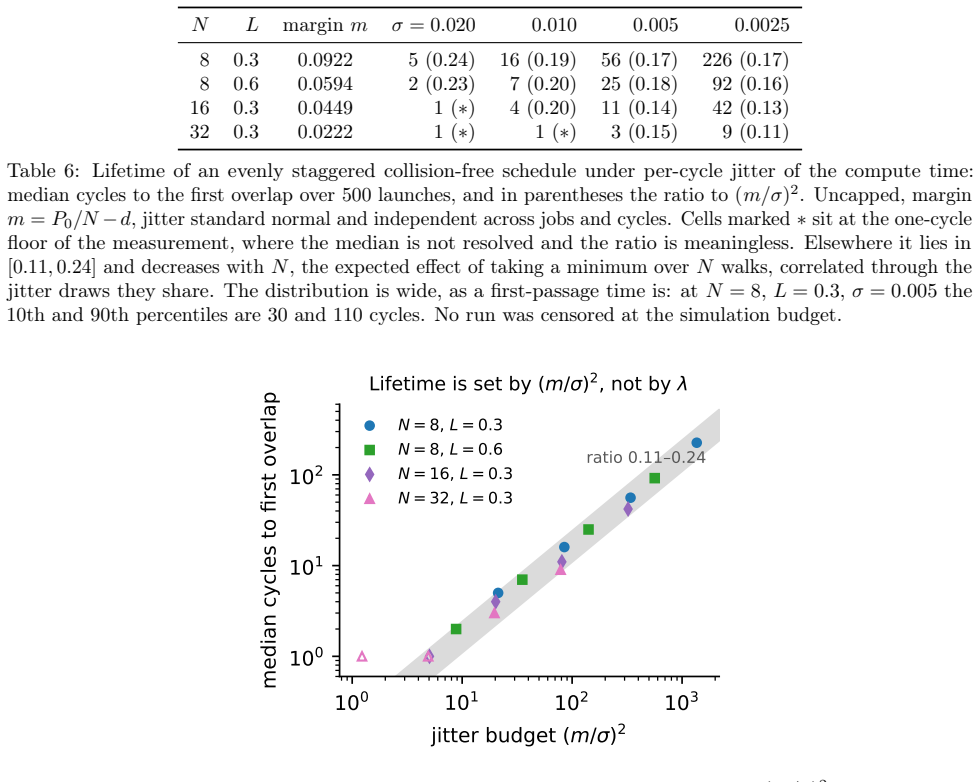
- Under per-cycle compute jitter, stagger lifetime is a first-passage time that scales as (margin/σ)², not with the free-dynamics separation rate.
- Storm incidence should track launch-time and interval-setting statistics rather than the fleet’s history of past collisions.
- Heterogeneous jobs behind a binding cap do acquire a genuine pairwise coupling, which is the sharp boundary of the neutrality result.
- Absence of locking does not license independent-phase sizing: measured upper tails of concurrent writers stay heavier than the binomial baseline in every cell.
Where Pith is reading between the lines
- If the paper’s anonymity conjecture holds, a memoryless anonymous resource cannot steer relative phase between identical users; phase control then requires breaking anonymity, adding controller memory, or exploiting heterogeneity already present.
- Asynchronous checkpointing is the first place a restored pairwise storm mechanism should appear, because the partition identity that closes the proof fails as soon as compute continues during flush.
- Volume preservation on the three-body branch suggests design effort is better spent on launch staggering and jitter budgets than on mid-run desynchronization of already-running identical jobs.
Editorial analysis
A structured set of objections, weighed in public.
Referee Report
Summary. The paper models independent checkpointing jobs as integrate-and-fire oscillators coupled through anonymous shared resources (storage bandwidth and/or a power cap). It proves that for two identical jobs with d<T under Assumptions 1–3 the phase-gap return map is the identity for any combination of those resources and any cap severity (Theorem 4), so pairwise coupling vanishes rather than being weak. Anonymity freezes the cyclic firing order for any N (Proposition 14), making synchrony unreachable from outside itself. On the fully-overlapping uncapped branch the N-writer return map is diagonal in consecutive-start intervals with eigenvalues (N−j)/j, reciprocal spectrum and unit determinant (Theorem 8); the determinant is shown to follow from anonymity alone for any admissible throughput f (Proposition 12). Numerics with an exact event-driven integrator confirm pair neutrality to floating-point noise, the predicted spectrum, absence of locking/clustering over hundreds of cycles, a heavier upper tail of concurrent writers than independent phases, and diffusive stagger lifetime ~ (m/σ)² under jitter. Heterogeneous jobs behind a binding cap restore a genuine pairwise coupling, which bounds the claim.
Significance. If the result holds inside the stated model, it cleanly falsifies the self-reinforcing ‘checkpoint storm’ narrative for identical jobs under anonymous contention: the two-body interaction underlying Kuramoto and Mirollo–Strogatz is absent, not merely weak, and synchrony is not an attractor. The contribution is mathematical rather than empirical—occupancy bookkeeping, proved theorems, an exact integrator cross-check (Table 1 drifts ~10⁻¹⁴–10⁻¹⁵; spectrum residuals ~10⁻⁹), explicit counter-examples where coupling returns, a written protocol, and a full replication package. That package and the sharp limitation map (§8) are genuine strengths. The operational redirection (storm incidence should track launch/interval statistics; stagger lifetime is set by jitter budget, not λ) is falsifiable and useful to systems and facility-power audiences even though the model is deliberately minimal.
major comments (2)
- [§4 Theorem 8; §6; §7; §8.2] Theorem 8 and all of §6 require C≥N (uncapped). Production fleets are power-capped; the paper itself calls the binding-cap homogeneous case ‘the most consequential gap’ (§8.2) and reports det J ≫ 1 once the cap binds. The abstract and §7 operational claims (‘sharing one storage fabric therefore gives such a fleet no mechanism… that would drive it into phase locking’; ‘a stagger is permanent while the cap does not bind’) should be fenced more tightly to the uncapped regime, or the authors should supply at least exploratory N-body numerics under binding C for identical jobs so the reader can judge whether the no-locking conclusion survives the regime operators actually run.
- [§6.4; Corollary 10; Abstract] Absence of clustering is established by measurement (no resolved decay of the smallest gap over 800 cycles; Daido moments within a change of null of the floor; §6.4), not by proof. Corollary 10 explicitly leaves open an asymptotic approach a₁^{(k)}→0 along other branches of the global map. For a journal claim that the fleet ‘neither locks nor clusters’, the abstract and conclusion should state the finite-time/numerical character of the clustering exclusion, or the authors should add a longer-horizon bound / argument that closes the gap left by Corollary 10.
minor comments (5)
- [§2 Definition 2] Definition 2 introduces ‘phase-blind at order k’ and the section construction somewhat densely; a short forward pointer from the abstract’s ‘pairwise phase-blind’ to Definition 2 would help non-dynamical-systems readers.
- [Figure 1; §4] Figure 1 caption and the surrounding text use a′ and a0 interchangeably for the image intervals; unify notation with Eq. (7).
- [Table 3] Table 3’s parenthetical (rejected | null-rate) is easy to misread; a two-column split or explicit legend would clarify.
- [§1; §9] The companion paper [5] is cited for reconciliation (§9); a one-sentence statement of its arXiv id and the precise τ→0 limit already in the introduction would spare the reader a late surprise.
- [§1–§2] Minor typographical inconsistencies: ‘acheckpoint storm’, ‘equivalentlyL≤L ⋆’, and occasional missing spaces before inline math in the introduction and §2.
Circularity Check
No significant circularity: pairwise identity map and N-body diagonal spectrum are proved from occupancy bookkeeping under stated assumptions, not fitted or self-defined.
full rationale
The load-bearing claims (Theorem 4: two-job return map is the identity; Theorem 8 / Proposition 12: fully-overlapping N-writer map is diagonal with reciprocal spectrum and unit determinant from anonymity) are derived by direct accounting: exclusive phases give the partition |K_i|=t-|W_i|, anonymity equates rates for co-active users, and the conserved work difference (Lemma 3) forces g(δ)≡0 for identical jobs. The N-body leads Λ_j=a_j/j banked at concurrency j and cashed at N-j yield a'_j=((N-j)/j)a_j without free parameters. Numerical tables verify these identities to floating-point noise on an exact event-driven integrator; they do not define the maps. The same-author companion [5] is cited only to reconcile the τ o0 limit of a lagged controller and is not an input to any proof here. No uniqueness theorem is imported, no ansatz is smuggled, and no fitted quantity is relabelled a prediction. The derivation is self-contained against its stated assumptions.
Axiom & Free-Parameter Ledger
axioms (6)
- domain assumption Blocking checkpoint: write and compute phases are exclusive and partition time (Assumption 1).
- domain assumption Anonymous equal sharing: each active user gets a rate depending only on the count of active users, with f(1)=1 and f(n)≤n; compute rate min{1,C/n_c} (Assumption 2).
- domain assumption Deterministic per-cycle work: T_i and V_i constant within a job except where jitter is introduced explicitly (Assumption 3).
- domain assumption d < T (write shorter than compute) so the two-job section is nonempty and recurrent with constant write offset.
- domain assumption For the N-writer diagonal map, C≥N so compute durations stay equal after staggered write finishes (Theorem 8).
- standard math Standard hybrid/event-driven ODE reasoning and piecewise-affine return maps on firing sections.
invented entities (2)
-
Anonymous resource / phase-blind coupling at order k
independent evidence
-
Stagger-feasibility threshold L⋆ = N/(N−1)
independent evidence
read the original abstract
Independent training jobs sharing a storage system write their checkpoints through the same finite bandwidth, and the resulting bursts of correlated I/O are commonly described as a self-reinforcing "checkpoint storm". We formalise the self-reinforcement as phase locking in a population of integrate-and-fire oscillators coupled through a shared resource, and show that within that model it fails. Call a resource anonymous if the rate it delivers to an active user depends on how many users are active and not on which. For identical jobs whose write is shorter than their compute interval, an anonymous resource produces no pairwise coupling at all: the two-job return map of the phase gap is the identity, under storage contention, under a shared power cap and under both, so the two-body interaction on which the Kuramoto and Mirollo-Strogatz frameworks are built is not weak here but absent. Anonymity also freezes the firing order, for any fleet size and any cap, so no trajectory reaches the synchronous state from outside it. What survives is a third-order effect: where all $N$ write windows overlap and the cap does not bind, the map is diagonal in the intervals between consecutive write starts, $a_j \mapsto ((N-j)/j)a_j$, with reciprocal spectrum and unit determinant, making synchrony a fixed point with $\lceil N/2\rceil-1$ expanding directions rather than an attractor. That determinant follows from anonymity and not from fairness: for any anonymous throughput $f$ with $f(n)\le n$ the spectrum becomes $(N-j)f(j)/(j f(N-j))$, whose product is still one. Numerically, a fleet launched at random neither locks nor clusters, and absence of locking is not absence of bursts: the upper tail of the number of concurrent writers stays above its independent-phase value. Heterogeneous jobs behind a binding cap do acquire a genuine pairwise coupling, which is where the statement stops generalising.
Figures


Reference graph
Works this paper leans on
-
[1]
Carmen C. Canavier and Ruben A. Tikidji-Hamburyan. Globally attracting synchrony in a network of oscillators with all-to-all inhibitory pulse coupling.Physical Review E, 95(3):032215, 2017. doi: 10.1103/PhysRevE.95.032215
-
[2]
Hiroaki Daido. Onset of cooperative entrainment in limit-cycle oscillators with uniform all-to-all interactions: bifurcation of the order function.Physica D: Nonlinear Phenomena, 91(1–2):24–66, 1996. doi: 10.1016/0167-2789(95) 00260-X
-
[3]
The Llama 3 herd of models, 2024
Aaron Grattafiori et al. The Llama 3 herd of models, 2024. arXiv:2407.21783
Pith/arXiv arXiv 2024
-
[4]
EasyRider: Mitigating power transients in datacenter-scale training workloads, 2026
Dillon Jensen, Obi Nnorom Jr., Grant Wilkins, Hugo Budd, Ram Rajagopal, Juan Rivas-Davila, and Phil Levis. EasyRider: Mitigating power transients in datacenter-scale training workloads, 2026. arXiv:2604.15522
Pith/arXiv arXiv 2026
-
[5]
Brieuc Le Roux Tardif. Do co-located AI training jobs synchronize? load-dependent throttling as a coupling mechanism for phase-locking behind a shared power cap, 2026. arXiv:2607.19638, submitted 22 July 2026
Pith/arXiv arXiv 2026
-
[6]
Renato E. Mirollo and Steven H. Strogatz. Synchronization of pulse-coupled biological oscillators.SIAM Journal on Applied Mathematics, 50(6):1645–1662, 1990. doi: 10.1137/0150098
doi:10.1137/0150098 1990
-
[7]
Distributed checkpoint: Efficient checkpointing in large-scale jobs
Saurabh Mishra, Meet Vadakkanchery, Pradeep Fernando, Saiteja Samudrala, Gerson Kroiz, Jingxin Ye, and Viacheslav Kovalevskyi. Distributed checkpoint: Efficient checkpointing in large-scale jobs. https://pytorch. org/blog/distributed-checkpoint-efficient-checkpointing-in-large-scale-jobs/ , 2025. PyTorch blog, 11 September 2025; consulted 2026-07-28
2025
-
[8]
AI workload variability and its impact on data center power stability.https://www.opal-rt.com/blog/ ai-workload-variability-and-its-impact-on-data-center-power-stability/ , 2026
OPAL-RT. AI workload variability and its impact on data center power stability.https://www.opal-rt.com/blog/ ai-workload-variability-and-its-impact-on-data-center-power-stability/ , 2026. Vendor technical blog, 22 March 2026. Cited for the sub-second timescale, not for magnitudes
2026
-
[9]
AI training load fluctuations at gigawatt-scale: Risk of power grid blackout?https://newsletter
SemiAnalysis. AI training load fluctuations at gigawatt-scale: Risk of power grid blackout?https://newsletter. semianalysis.com/p/ai-training-load-fluctuations-at-gigawatt-scale-risk-of-power-grid-blackout ,
-
[10]
Not every sync is safe: Calibrated DiLoCo scheduling for shared AI infrastructure, 2026
Maxwell Twelftree, David Lemphers, An-chi He, and Yue Yang. Not every sync is safe: Calibrated DiLoCo scheduling for shared AI infrastructure, 2026. arXiv:2607.02544
Pith/arXiv arXiv 2026
-
[11]
Firefly-inspired sensor network synchronicity with realistic radio effects
Geoff Werner-Allen, Geetika Tewari, Ankit Patel, Matt Welsh, and Radhika Nagpal. Firefly-inspired sensor network synchronicity with realistic radio effects. InProceedings of the 3rd ACM International Conference on Embedded Networked Sensor Systems (SenSys ’05), pages 142–153, San Diego, CA, 2005. doi: 10.1145/1098918.1098934. 22
arXiv 2005
-
[2025]
Industry analysis, 25 June 2025
2025
discussion (0)
Sign in with ORCID, Apple, or X to comment. Anyone can read and Pith papers without signing in.