REVIEW 4 major objections 6 minor 34 references
Deterministic Epidemic Models For Ebola Infection With Time-dependent Controls
T0 review · 4 major / 6 minor · reviewed 2026-08-14 · deepseek-v4-flash
Pith's one-line read The paper claims that time-dependent vaccination, treatment, and educational campaigns reduce Ebola transmission in SIR and SEIR models, and it derives the optimal control schedules that do so.
desk verdict A competent but routine re-derivation of Rachah–Torres SIR/SEIR optimal control models via Pontryagin, with one new SIR strategy; the math checks out, but the main numerical claim is under-specified (missing B) and the conclusion is built into the model. read the letter →
The pith
A machine-rendered reading of the paper's core claim, the machinery that carries it, and where it could break.
The reading
What carries the argument
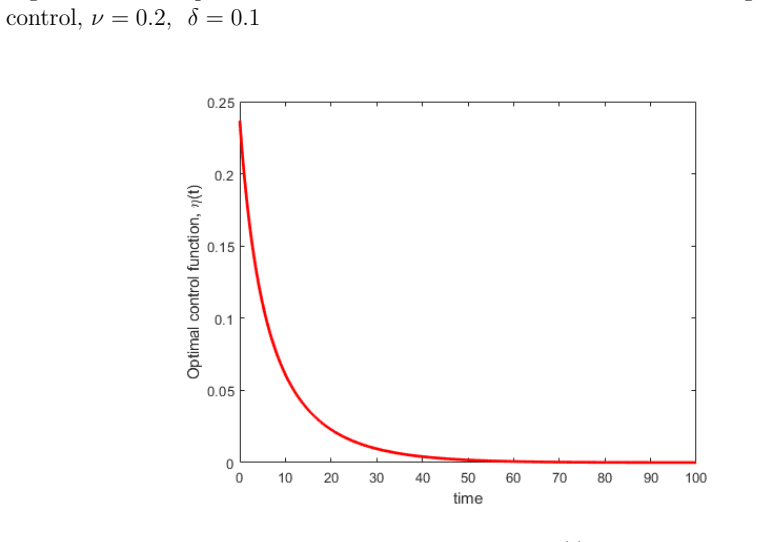
The load-bearing machinery is the controlled compartmental SIR and SEIR systems together with the maximum principle of optimal control. Each model is scaled by total population so states are proportions, and the controls enter as transfer rates: vaccination and education move susceptibles into the recovered class, and treatment moves infected individuals into the recovered class. For each strategy the paper constructs a Hamiltonian, derives the adjoint differential equations with zero terminal conditions, and obtains the optimal controls as clamped expressions of the adjoint differences, e.g., $\eta^*(t)=\min\{1,\max\{0, s^*(t)(\phi_1-\phi_4)/D\}\}$ for the SEIR vaccination strategy. The forward-backward sweep scheme with fourth-order Runge-Kutta then solves the state and adjoint systems alternately until convergence, and it is this combined derivation-and-sweep procedure that produces the numerical comparisons.
What would settle it
Run the uncontrolled SIR system with the paper's values ($\nu=0.2$, $\delta=0.1$) and compare its predicted epidemic curve with confirmed Ebola case counts from a real outbreak; if the model cannot reproduce the observed timing, peak, or final size, then the control comparisons built on the same equations are not quantitatively reliable for Ebola.
Extended reading notes
Core claim
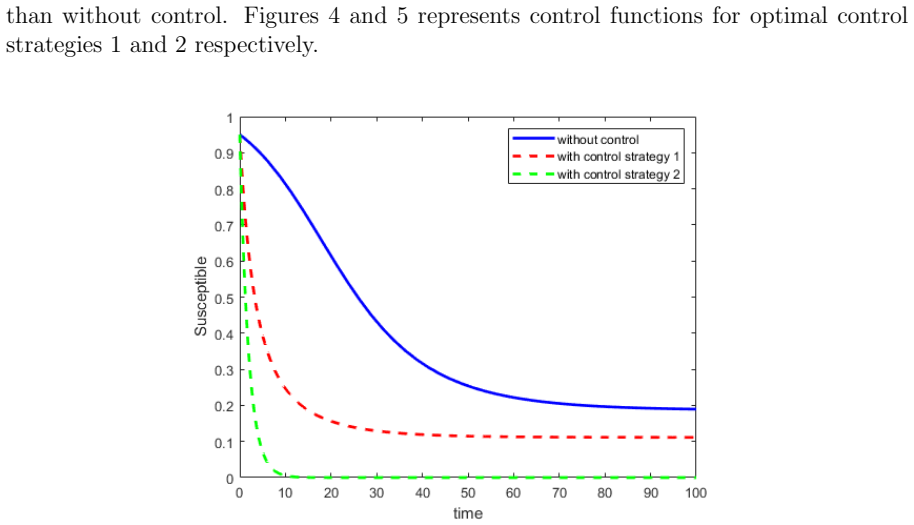
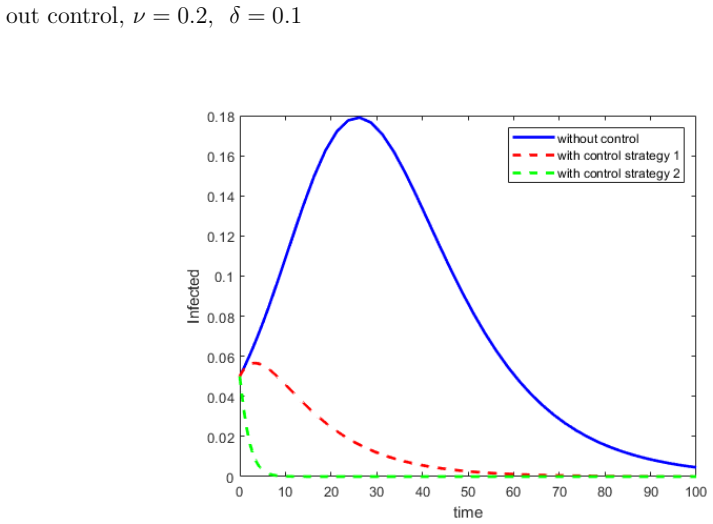
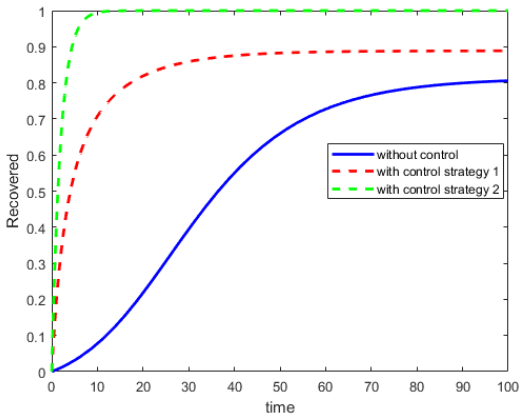
The central claim is that optimal time-dependent controls, applied to standard SIR and SEIR Ebola models, produce a clear reduction in disease burden relative to the uncontrolled systems. The paper establishes this by writing each model as a controlled dynamical system, minimizing an objective functional that balances infected counts against quadratic costs of vaccination, treatment, and education, and applying necessary optimality conditions to obtain adjoint equations and explicit formulas for the optimal controls. It adds one strategy to the SIR model on top of the earlier SIR and SEIR formulations, namely treatment combined with education, and it solves the resulting optimality systems numerically with a forward-backward sweep using fourth-order Runge-Kutta. The reported simulations show lower susceptible and infected proportions and higher recovered proportions under every controlled strategy, leading to the paper's stated conclusion that educational campaigns, vaccination, and treatment can reduce Ebola transmission.
Load-bearing premise
The load-bearing premise is that the population is closed and constant in size and that vaccination, education, and treatment act by transferring people directly into the recovered class; if births, deaths, waning immunity, or delayed protection are substantial, the numerical trajectories no longer describe an Ebola outbreak.
Editorial extensions
If this is right
- The modeled epidemics peak with fewer infected individuals when the optimal schedules are applied, so the same conclusion holds for any Ebola-like disease with a similar transmission structure.
- The additional SIR strategy of combining treatment with education expands the SIR intervention options from vaccination-only to also include a treatment-plus-education design.
- The numerical agreement with direct-method results in prior work suggests the indirect optimal-control route is interchangeable with direct solvers for these models.
- Because the objective functionals carry cost weights, the framework also yields information about intervention cost: cheaper controls are used at higher intensity, all else equal.
Reading between the lines
- The same machinery could be applied to Ebola models with quarantine, hospitalization, safe burial, or post-death transmission; those compartments would change the adjoint equations and likely change the optimal balance between education and treatment.
- A natural testable extension is to fit the parameters to a real outbreak curve and compare the predicted optimal schedules with the interventions actually deployed, which would indicate whether the modeled savings are realistic.
- The instant-transfer assumption for vaccination and education is an idealization; adding a delay between vaccination and protection, or between education and behavior change, would likely soften the reported reductions.
- One could rank strategies by computing the total cost needed to achieve a fixed reduction in the final epidemic size, rather than only comparing trajectories.
Signed reviews
Editorial analysis
A structured set of objections, weighed in public.
Referee Report
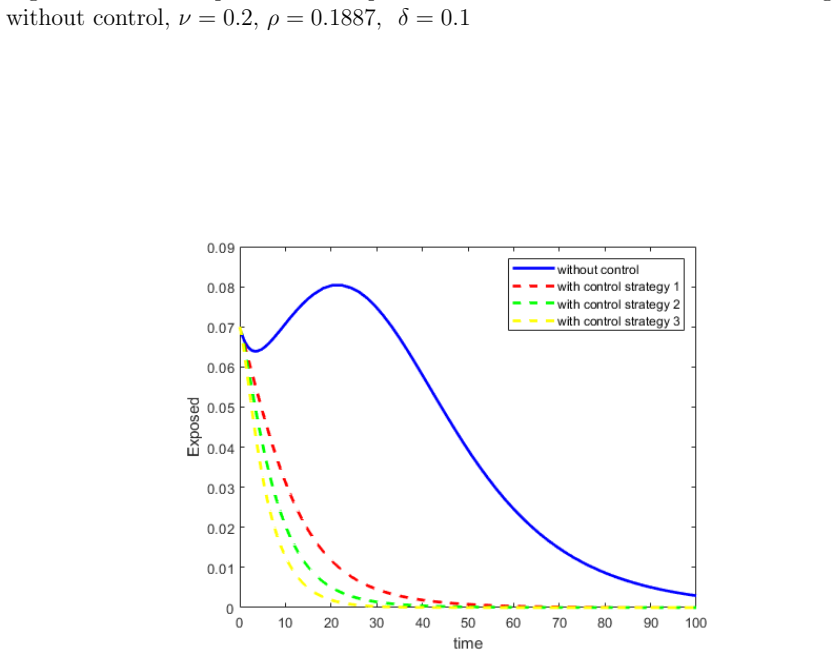
Summary. This paper applies Pontryagin's maximum principle to deterministic SIR and SEIR compartmental models of Ebola with time-dependent controls (vaccination, treatment, and educational campaign). The authors derive Hamiltonian functions, adjoint systems, and optimal control characterizations for several control strategies, including what they present as an additional SIR strategy with treatment and education controls, and they solve the optimality systems numerically using a forward-backward sweep with fourth-order Runge-Kutta. The central claim, based on numerical illustrations, is that all control strategies reduce the infected, exposed, and susceptible proportions relative to the uncontrolled model.
Significance. The algebraic derivation of the adjoint equations and optimality conditions is, for the stated Hamiltonians, standard and correct in the main cases checked, and the forward-backward sweep scheme is the recognized method for such problems. The paper, however, offers no existence or uniqueness theorems for the optimal controls, omits proofs for Theorems 2-5, and provides no code or complete parameter specification for the simulations, so the numerical evidence for the headline conclusion cannot be independently verified. The conclusion that controls reduce infection is also largely built into the model structure because vaccination/education remove susceptibles and treatment removes infecteds. As a purely methodological exercise applied to existing models, the work is incremental; its value depends on the completeness and reproducibility of the numerics.
major comments (4)
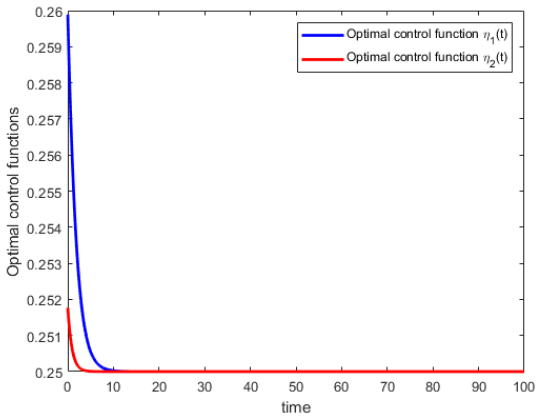
- [§2.3, Eq. (4), Fig. 4] The value of the weight B in the SIR Strategy 1 objective functional (4) is never assigned. Section 2.3 lists D=1, C1=1, C2=5, and C3=5, but D is the SEIR vaccination weight from Section 3.1, not B. Consequently the infected-proportion trajectory in Figure 2 and the control in Figure 4 for Strategy 1 depend on an unreported parameter, and the central numerical conclusion for the SIR model is not reproducible. A one-line statement of B's value (if B=1 was intended) would close this gap, but as written the evidence base is under-specified.
- [§2.1, Eq. (5)] The second equation of the controlled SIR system reads di/dt = ν s(t) s(t) − δ i(t); the correct term is ν s(t) i(t). If the numerical simulations were run with this erroneous state equation, the trajectories shown in Figures 1-4 would not correspond to the Hamiltonian in Eq. (6) or the adjoint system in Eq. (8). The equation must be corrected and the numerical implementation checked against the corrected system.
- [Remark 1 (after Theorem 2)] Proofs of Theorems 2-5 are omitted, with only the statement that they are similar to Theorem 1. Since these theorems are the central analytical results of the paper, and the proof of Theorem 1 is itself only a sketch (it refers to solving ∂H/∂η=0 without showing the projection onto the box constraints), the paper should provide full proofs or at least a detailed derivation for one representative SEIR case, with the remaining cases relegated to an appendix.
- [§2.3 and §3.4, no-control baseline] The comparison of controlled trajectories against the uncontrolled model is not informative about the worth of the controls, because by construction the controls transfer susceptibles (vaccination/education) and infecteds (treatment) directly into the recovered class; any positive control therefore reduces the infected proportion. The conclusion would be strengthened by comparing strategies against one another (e.g., total cost, peak infection, or final size per unit cost) and explicitly stating that the paper only demonstrates that the modeled mechanisms do what they are built to do. This does not invalidate the mathematics but should be acknowledged in the interpretation.
minor comments (6)
- [§2.1, after Eq. (5)] The text states that 'the positive parameter A is the weight on cost of vaccination,' but the objective functional uses B; no parameter A is defined.
- [§3, Eq. (19)] In the model description, the compartments are listed as 'S(t), E(t), E(t) and R(t)', which should be 'S(t), E(t), I(t) and R(t)'.
- [§3, Eq. (21)] The fourth state equation is written as dr(r)/dt and should be dr(t)/dt.
- [§3.3, Eqs. (34) and (36)] The objective functional and Hamiltonian contain mismatched brackets: J(η1,η2)=∫[D1 i(t)] + ... and H = D1 i(t)] + ...; the stray bracket after i(t) should be removed.
- [§3.2, Theorem 4] Theorem 4 states that the control minimizes 'over G3', but the control set defined for this strategy is G4; the reference should be updated.
- [§3.2, Eq. (30)] In the Hamiltonian, the term 'δi + η(t)s(t)' should read 'δ i(t) + η(t) s(t)'.
Circularity Check
No circularity: the PMP derivations are self-contained, parameters are borrowed rather than fitted, and the numerical conclusion is a model implication rather than an empirical prediction.
full rationale
The paper re-derives optimal control problems for SIR and SEIR Ebola models using Pontryagin's maximum principle. Theorems 1–5 construct adjoint equations and control characterizations directly from the stated Hamiltonians (Eqs. (6), (15), (24), (30), (36)), so the mathematical derivation chain is self-contained and does not import its conclusion from a fitted parameter or a self-citation. Parameter values ν=0.2, δ=0.1, ρ=0.1887 are explicitly taken from Rachah and Torres (2015, 2016), not fitted in this paper, and the objective weights are stated assumptions; therefore no fitted-input-called-prediction step occurs. The authors cite external works (Rachah and Torres, Pontryagin, Lenhart and Workman) but not their own prior results, so there is no self-citation load-bearing argument. The concluding statement that vaccination, education, and treatment can reduce transmission does follow from the control terms in Eqs. (5), (14), (23), and (35), where controls deplete S or I into R; however, the optimal controls themselves are computed from the optimality systems rather than assumed, and the paper does not present this statement as an empirically validated prediction about actual Ebola data. The omission of the SIR strategy-1 cost weight B in Section 2.3 is a reproducibility/correctness gap for Figures 2 and 4, but it is not a circularity: the adjoint and control equations (8)–(9) are algebraically correct conditional on B. For these reasons, no circular step meeting the quote-and-reduce standard can be identified.
Assumptions & free parameters
free parameters (5)
- Infection rate nu =
0.2
- Recovery rate delta =
0.1
- Progression rate rho (SEIR) =
0.1887
- Initial fractions =
SIR: s0=0.95, i0=0.05, r0=0; SEIR: s0=0.88, e0=0.07, i0=0.05, r0=0
- Objective weights B, C1-C3, D, D1-D3, K1-K3 =
B not clearly fixed; C1=1, C2=5, C3=5; D=5 (SEIR), K1=1, K2=5, K3=5; D1=1, D2=5, D3=5.
assumptions (5)
- domain assumption Constant total population with no vital dynamics (no births, no natural or disease-induced deaths); total population N is fixed.
- domain assumption Incidence is mass action: new infections are proportional to the product of susceptible and infected fractions, nu S I / N.
- domain assumption Controls are Lebesgue measurable, take values in [0,1], and enter the state equations linearly.
- standard math Pontryagin's maximum principle applies and an optimal control exists, without verifying standard convexity or compactness sufficient conditions.
- domain assumption The forward-backward sweep numerical scheme converges to the solution of the optimality system.
Cite this review
Pith. "Pith review of Deterministic Epidemic Models For Ebola Infection With Time-dependent Controls." pith.science (2026). https://pith.science/paper/PUIEWPMU
@misc{pith2026190807974,
  author       = {Pith},
  title        = {Pith review of: Deterministic Epidemic Models For Ebola Infection With Time-dependent Controls},
  year         = {2026},
  howpublished = {\url{https://pith.science/paper/PUIEWPMU}},
  note         = {Machine review of arXiv:1908.07974}
}
read the original abstract
In this paper, we have studied epidemiological models for Ebola infection using nonlinear ordinary differential equations and optimal control theory. We considered optimal control analysis of SIR and SEIR models for the deadly Ebola infection using vaccination, treatment and educational campaign as time-dependent controls functions. We have applied indirect methods to study existing deterministic optimal control epidemic models for Ebola virus disease. These methods in optimal control are based on Hamiltonian function and the Pontryagin's maximum principle to construct adjoint equations and optimality systems. The forward-backward sweep numerical scheme with fourth-order Runge-Kutta method is used to solve the optimality system for the various control strategies. From our numerical illustrations, we can conclude that, effective educational campaigns and vaccination of susceptible individuals as were as effective treatments of infected individuals can help reduce the disease transmission.
Figures
Figures from the paper (9 more)



Reference graph
Works this paper leans on
-
[1]
F. B . Agusto, M. I. Teboh-Ewungkem, and A. B Gumel. Mathematical assessment of the effect of traditional beliefs and customs on the transmission dynamics of the 2014 ebola outbreaks. BMC medicine, 13 0 (1): 0 96, 2015
work page 2014
-
[2]
M. D. Ahmad, M. Usman, A. Khan, and M. Imran. Optimal control analysis of ebola disease with control strategies of quarantine and vaccination. Infectious diseases of poverty, 5 0 (1): 0 72, 2016
work page 2016
-
[3]
C. L. Althaus. Estimating the reproduction number of ebola virus (ebov) during the 2014 outbreak in west africa. PLoS currents, 6, 2014
work page 2014
-
[4]
I. Area, F. Nda \"i rou, J. J Nieto, C. J. Silva, and D. F. M. Torres. Ebola model and optimal control with vaccination constraints. Journal of Industrial and Management Optimization, 14 0 (2): 0 427--466, 2018
work page 2018
-
[5]
A. Atangana and E. F. D. Goufo. On the mathematical analysis of ebola hemorrhagic fever: deathly infection disease in west african countries. BioMed research international, 2014, Article ID 261383: 0 7 pages, 2014
work page 2014
- [6]
- [7]
- [8]
Show all 34 references
-
[9]
Bonyah, M
E. Bonyah, M. A. Khan, K. O. Okosun, and J. F. G \'o mez-Aguilar. On the co‐infection of dengue fever and zika virus. Optim Control Appl Meth, pages 1--28, 2019
2019
-
[10]
Chowell and H
G. Chowell and H. Nishiura. Transmission dynamics and control of ebola virus disease (evd): a review. BMC medicine, 12 0 (1): 0 196, 2014
2014
-
[11]
Chowell, N
G. Chowell, N. W. Hengartner, C. Castillo-Chavez, P. W. Fenimore, and J. M. Hyman. The basic reproductive number of ebola and the effects of public health measures: the cases of congo and uganda. Journal of theoretical biology, 229 0 (1): 0 119--126, 2004
2004
-
[12]
D\' e nes and A
A. D\' e nes and A. B. Gumel. Modeling the impact of quarantine during an outbreak of ebola virus disease. Infectious Disease Modelling, 4: 0 12--27, 2019
2019
-
[13]
P. Diaz, P. Constantine, K. Kalmbach, E. Jones, and S. Pankavich. A modified seir model for the spread of ebola in western africa and metrics for resource allocation. Applied Mathematics and Computation, 324: 0 141--155, 2018
2018
-
[14]
F. Dong, D. Xu, Z. Wang, and M. Dong. Evaluation of ebola spreading in west africa and decision of optimal medicine delivery strategies based on mathematical models. Infection, Genetics and Evolution, 36: 0 35--40, 2015
2015
-
[15]
E. F. D. Goufo, M. K. Pene, and S. Mugisha. Stability analysis of epidemic models of ebola hemorrhagic fever with non-linear transmission. Journal of Nonlinear Sciences & Applications (JNSA), 9 0 (6), 2016
2016
-
[16]
E. V. Grigorieva, P. B. Deignan, and E. N Khailov. Optimal control problem for a seir type model of ebola epidemics. Revista de Matem \'a tica: Teor \' a y Aplicaciones , 24 0 (1): 0 79--96, 2017
2017
-
[17]
H. W. Hethcote. The mathematics of infectious diseases. SIAM review, 42 0 (4): 0 599--653, 2000
2000
-
[18]
Jiang, K
S. Jiang, K. Wang, C. Li, G. Hong, X. Zhang, M. Shan, H. Li, and J. Wang. Mathematical models for devising the optimal ebola virus disease eradication. Journal of translational medicine, 15 0 (1): 0 124, 2017
2017
-
[19]
A. Khan, M. Naveed, M. Du r- e-Ahmad, and M. Imran. Estimating the basic reproductive ratio for the ebola outbreak in liberia and sierra leone. Infectious diseases of poverty, 4 0 (1): 0 13, 2015
2015
-
[20]
M. A. Khan, S. W. Shah, S. Ullah, and J. F. G \'o mez-Aguilar. A dynamical model of asymptomatic carrier zika virus with optimal control strategies. Nonlinear Analysis: Real World Applications, 50: 0 144--170, 2019
2019
-
[21]
Lenhart and J
S. Lenhart and J. T. Workman. Optimal control applied to biological models. Chapman and Hall/CRC, 2007
2007
-
[22]
D. Luo, R. Zheng, D. Wang, X. Zhang, Y. Yin, K. Wang, and W. Wang. Effect of sexual transmission on the west africa ebola outbreak in 2014: a mathematical modelling study. Scientific reports, 9, 2019
2014
-
[23]
T. Y. Miyaoka, S. Lenhart, and J. C. A. Meyer. Optimal control of vaccination ina vector-borne reaction-diffusion model applied to zika virus. Journal of Mathematical Biology, pages 1--28, 2019
2019
-
[24]
Ndanguza, I
D. Ndanguza, I. S. Mbalawata, H. Haario, and J. M. Tchuenche. Analysis of bias in an ebola epidemic model by extended kalman filter approach. Mathematics and Computers in Simulation, 142: 0 113--129, 2017
2017
-
[25]
G. A. Ngwa and M. I. Teboh-Ewungkem. A mathematical model with quarantine states for the dynamics of ebola virus disease in human populations. Computational and mathematical methods in medicine, vol. 2016, Article ID 9352725: 0 29 pages, 2016
2016
-
[26]
L. S. Pontryagin, V.G. Boltyanskii, R. V. Gamkrelidze, and E. F. Mishchenko. The mathematical theory of optimal processes. New York, John Wiley & Sons, 1962
1962
-
[27]
Rachah and D
A. Rachah and D. F. M. Torres. Mathematical modelling, simulation, and optimal control of the 2014 ebola outbreak in west africa. Discrete Dynamics in Nature and Society, vol. 2015, Article ID 842792: 0 9 pages, 2015
2014
-
[28]
Rachah and D
A. Rachah and D. F. M. Torres. Dynamics and optimal control of ebola transmission. Mathematics in Computer Science, 10 0 (3): 0 331--342, 2016
2016
-
[29]
Sharomi and T
O. Sharomi and T. Malik. Optimal control in epidemiology. Annals of Operations Research, 251 0 (1-2): 0 55--71, 2017
2017
-
[30]
T. W. Tulu, B. Tian, and Z. Wu. Mathematical modeling, analysis and markov chain monte carlo simulation of ebola epidemics. Results in physics, 7: 0 962--968, 2017
2017
-
[31]
J. S. Weitz and J. Dushoff. Modeling post-death transmission of ebola: challenges for inference and opportunities for control. Scientific reports, 5: 0 8751, 2015
2015
-
[32]
Ebola virus disease, https://www.who.int/news-room/fact-sheets/detail/ebola-virus-disease, 2019
WHO. Ebola virus disease, https://www.who.int/news-room/fact-sheets/detail/ebola-virus-disease, 2019
2019
-
[33]
Modeling the transmission dynamics of ebola virus disease in liberia
Zhi-Qiang Xia, Shi-Fu Wang, Shen-Long Li, Liu-Yu Huang, Wen-Yi Zhang, Gui-Quan Sun, Zhong-Tao Gai, and Zhen Jin. Modeling the transmission dynamics of ebola virus disease in liberia. Scientific reports, 5: 0 13857, 2015
2015
-
[34]
Zakary, M
O. Zakary, M. Rachik, and I. Elmouki. A multi-regional epidemic model for controlling the spread of ebola: awareness, treatment, and travel-blocking optimal control approaches. Mathematical Methods in the Applied Sciences, 40 0 (4): 0 1265--1279, 2017
2017
Reviewed August 14, 2026 · model on record in the stance chip above.
Discussion (0). Continue with ORCID to comment.