REVIEW 2 major objections 4 minor 21 references
$(\ell,\delta)$-Diversity: Linkage-Robustness via a Composition Theorem
T0 review · 2 major / 4 minor · reviewed 2026-08-15 · deepseek-v4-flash
Pith's one-line read Standard $\ell$-diversity can collapse to $1$-diversity under linkage, while the paper's approximate variant $(\ell,\delta)$-diversity degrades only in failure probability.
desk verdict A correct and honestly-scoped theory paper: (ℓ,δ)-diversity gives a composition theorem for linkage-robustness, with the exact-distribution assumption as the main gap. read the letter →
The pith
A machine-rendered reading of the paper's core claim, the machinery that carries it, and where it could break.
The reading
What carries the argument
The argument is carried by Algorithm 1 (Mech-$(\ell,\delta)$-Diversity), which turns a distributional threshold into a dataset-size formula. A central agency picks $p \le p_\ell$ and partitions the quasi-identifier space into equivalence classes $\mathcal{Q}$ such that each class $\mathbf{q}$ has at least $\ell$ sensitive attributes $s$ with $P(\mathbf{q},s) \ge p$; the number of classes is bounded by $m$, and Lemma 4.3 gives $|\mathcal{Q}| \le m$. Each data owner collects $N = \ln(m\ell/\delta)/\ln(1/(1-p))$ i.i.d. samples, and Theorem 4.4 uses two union bounds to show every class sees at least $\ell$ distinct sensitive attributes with probability at least $1-\delta$. Theorem 4.5 then observes that a failure in the linked dataset implies a failure in one of the $t$ constituent datasets, so the union bound over datasets yields $(\ell,t\delta)$-diversity. For utility, Greedy-Generalize (Algorithm 2) sweeps the quasi-identifiers in a fixed total order and is proved optimal among contiguous admissible generalization algorithms.
What would settle it
A direct simulation can settle the composition bound: fix $\ell$, $\delta$, $p$, and a known distribution $P_{Q,S}$, run Algorithm 1 many times, link $t$ datasets, and count how often the linked dataset has fewer than $\ell$ distinct sensitive attributes in some equivalence class; if the empirical failure rate exceeds $t\delta$, Theorem 4.5 is wrong. For the worst-case claim, take $|\mathcal{S}|=5$ and $t=2$ with $\ell=3$: Proposition 3.1 says the worst-case post-linkage diversity is $1$, so an explicit pair of $3$-diverse datasets whose linkage leaves only one sensitive attribute would confirm the collapse.
Extended reading notes
Core claim
The central discovery is that replacing pure $\ell$-diversity with an approximate version changes the worst-case behavior under linkage. The paper first proves (Proposition 3.1) that for $t\ge 2$ datasets each satisfying $\ell$-diversity, the worst-case post-linkage dataset satisfies only $1$-diversity whenever $\ell \le L(t-1)/t + 1$, and in general degrades to $L+1-(L-\ell+1)^t$, where $L=|\mathcal{S}|-1$; with $t=2$ this is $2\ell - L - 1$, so every $\ell \le L/2+1$ collapses to $1$-diversity. It then defines $(\ell,\delta)$-diversity and proves (Theorem 4.4) that Algorithm 1 yields $(\ell,\delta)$-diversity when $N = \ln(m\ell/\delta)/\ln(1/(1-p))$ i.i.d. samples are used. The composition theorem (Theorem 4.5) states that the linked post-linkage dataset $D_{[t]}$ satisfies $(\ell,t\delta)$-diversity, meaning linkage preserves the diversity parameter $\ell$ and only multiplies the failure probability by $t$.
Load-bearing premise
The guarantee relies on the central agency knowing the exact joint distribution of quasi-identifiers and sensitive attributes; if the agency only estimates it, the mechanism's equivalence classes and sample size are computed from wrong probabilities and the promised failure bound may not hold.
Editorial extensions
If this is right
- A data owner who uses Mech-$(\ell,\delta)$-Diversity can release $t$ linked datasets and still promise $\ell$-diversity: setting the per-dataset failure probability to $\delta/t$ keeps the post-linkage failure at most $\delta$.
- With pure $\ell$-diversity, the paper's threshold $L(t-1)/t+1$ lets a data owner compute exactly when linkage will collapse diversity to $1$, so the risk is quantifiable before release.
- Because Algorithm 1 fixes the equivalence classes before sampling and broadcasts them to all data owners, every dataset is anonymized in a coordinated way, preventing per-owner generalization choices from creating hidden intersections at linkage time.
- For independent quasi-identifiers and sensitive attributes, the paper guarantees at least $\lfloor \theta p_\ell / p \rfloor$ equivalence classes, and exactly $\lfloor p_\ell / p \rfloor$ for uniform quasi-identifiers, giving an explicit utility-versus-sample-size tradeoff.
Reading between the lines
- The paper leaves implicit that the composition argument is not specific to $\ell$-diversity: any anonymity property of the form 'holds with probability $1-\delta$ over i.i.d. samples' should degrade only in failure probability under linkage if the anonymization map is fixed before sampling; testing this on entropy $\ell$-diversity or $k$-anonymity would delimit the principle.
- The exact-distribution assumption is where the guarantee would break first: a mechanism that uses only conservative lower bounds on cell probabilities, or a finite-sample confidence correction, would make the result robust to the central agency's estimation error without changing the composition bound.
- A testable extension would evaluate whether maximizing the number of equivalence classes, the paper's utility measure, coincides with preserving downstream statistical utility, for example by comparing Greedy-Generalize to other generalizations in estimating $P(S\mid \mathbf{q})$ at a fixed sample size.
Signed reviews
Editorial analysis
A structured set of objections, weighed in public.
Referee Report
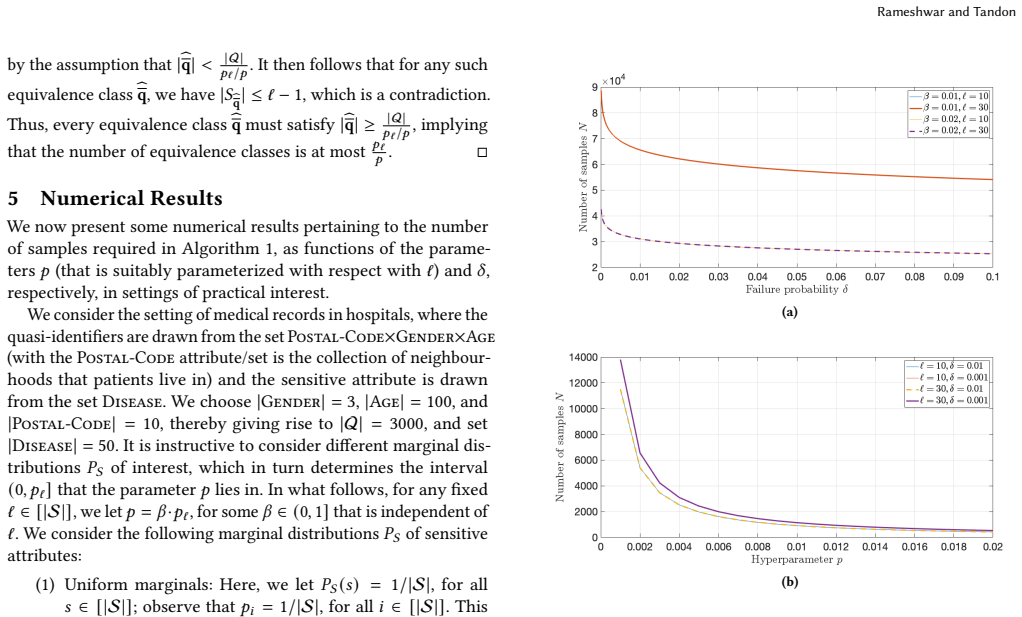
Summary. The paper studies the degradation of ℓ-diversity when an adversary links t anonymized datasets on the basis of common quasi-identifiers. It first proves a worst-case result (Proposition 3.1) showing that pure ℓ-diversity can collapse to 1-diversity upon linkage, even for moderately large ℓ. It then introduces (ℓ,δ)-diversity, a probabilistic relaxation of ℓ-diversity, and proposes Algorithm 1 (Mech-(ℓ,δ)-Diversity), which is executed by a central agency that knows the joint distribution P_Q,S exactly. Theorem 4.4 shows that a dataset produced by Algorithm 1 satisfies (ℓ,δ)-diversity, and Theorem 4.5 claims a composition theorem: linking t such datasets preserves ℓ-diversity with failure probability at most tδ. Section 4.3 gives contiguous generalization algorithms (Greedy-Generalize, Generalize-Ind) and lower bounds on the number of equivalence classes, and Section 5 reports numerical experiments on the required sample size.
Significance. If the results hold under their assumptions, the paper makes a useful conceptual contribution: (ℓ,δ)-diversity is a natural approximate analogue of ℓ-diversity with a simple composition property, in the same spirit as approximate differential privacy. The paper contains elementary but mostly correct proofs, explicit and implementable algorithms, and concrete numerical experiments. The highlighted contrast with pure ℓ-diversity is compelling. The main caveat is that the mechanism assumes exact knowledge of the joint distribution, and the paper's assertion that estimation error can be 'carried forward' is not backed by any formal argument, which limits the practical reach of the main theorems.
major comments (2)
- [Section 4.1, Algorithm 1, Theorems 4.4-4.5] The exact-knowledge assumption on P_Q,S is load-bearing, and the claim in Section 4.1 that estimation error in total variation 'can be carried forward in every step' is unsupported. Concretely, if the central agency uses an estimate P_hat with ||P_hat - P||_TV <= epsilon, a class q constructed via Step 3 may satisfy |{s : P_hat(q,s) >= p}| >= ell while the true set {s : P(q,s) >= p} has fewer than ell elements; moreover, for an attribute with true probability p' < p, the per-attribute absence probability is (1-p')^N > (1-p)^N, so the union bound in Theorem 4.4 can exceed delta for the same N. For epsilon >= p, a sensitive symbol with true probability below p can nevertheless be included in S_q based on its estimated probability, completely invalidating the (ell,delta) guarantee. Since Theorem 4.5 is a t-fold union over per-dataset guarantees, it inherits this issue. The paper should either remove the 'carry forward' assertion and state all results under exact P, or provide a formal robustness analysis with modified parameters p' = p - epsilon and an adjusted N, including conditions under which the constructed classes still satisfy the required constraints.
- [Theorem 4.5, proof] The proof is missing the key step needed to turn the per-dataset guarantee into a guarantee on the linked dataset. From the statement of Theorem 4.4 alone, each dataset independently satisfies (ell,delta)-diversity, but the ell distinct sensitive attributes realized in equivalence class q in different datasets need not coincide; the intersection of the supports could be far smaller than ell. The argument works only if one uses the stronger event established in the proof of Theorem 4.4, namely that all attributes in the fixed set S_q|ell (which is common to all datasets because Algorithm 1 fixes the same equivalence classes and the same P) appear in every dataset. The union bound should be over t*ell*|Q| events and should use the fact that m <= |Q| to obtain the stated t*delta. As written, the sentence 'It then follows from the proof of Theorem 4.4 and a union bound' does not justify the claim and should be expanded.
minor comments (4)
- [Section 3, Proposition 3.1] The statement 'for any ℓ≤[|S|]' should read 'for any ℓ∈[|S|]', since ℓ is an integer parameter, not a subset of [|S|].
- [Algorithm 3 and Lemma 4.7] The quantity T := |Q| / floor(theta p_ell / p) may fail to be an integer, and the denominator can be zero when theta p_ell / p < 1; the construction should either explicitly assume that |Q| is divisible by the chosen class size and that the floor is positive, or define equivalence classes of sizes floor and ceil so that all quasi-identifiers are covered.
- [Section 4.2] The notion that a collection of datasets obeys (ell,delta)-diversity is introduced informally in the text before Theorem 4.5; it should be defined as a probability over the joint randomness of all t sampled datasets to avoid ambiguity.
- [Proof of Theorem 4.4] The set S_q|ell is defined as 'the ell sensitive attributes in S_q with the largest value of P(q,s)', but this is ambiguous under ties; a fixed tie-breaking rule should be specified, since the proof unions over exactly this set.
Circularity Check
No significant circularity: the mechanism's guarantees are derived by direct union-bound calculations from the stated i.i.d. and exact-distribution assumptions.
full rationale
The paper's central derivation chain is self-contained. Definition 4.1 fixes (ℓ,δ)-diversity as a probabilistic relaxation of ℓ-diversity; Algorithm 1 fixes a threshold p ≤ p_ℓ and sample size N = ln(mℓ/δ)/ln(1/(1-p)); Theorem 4.4 proves the guarantee by bounding, for each equivalence class, the probability that any of the ℓ heaviest sensitive attributes is absent as at most ℓ(1-p)^N, then union-bounding over the at most m classes; Theorem 4.5 then unions the per-dataset failure events over t datasets to obtain (ℓ,tδ)-diversity after linkage. Each step is a direct probabilistic calculation from the model assumptions, not an equation defined in terms of its own conclusion. The construction does rely on the CA knowing P_{Q,S} exactly and on the same deterministic sets S_q being used for every dataset, which makes the composition theorem a one-line union bound rather than a deep result; but reliance on an assumption is not circularity. There are no fitted parameters presented as predictions, no load-bearing self-citations, and no uniqueness or ansatz results imported from the authors' prior work. The unproven claim that total-variation estimation error 'can be carried forward in every step' is a robustness gap, not a circular-input issue, so it does not affect the circularity score.
Assumptions & free parameters
free parameters (1)
- p (probability-mass threshold) =
chosen by CA in (0,p_ℓ]; experiments use p=β·p_ℓ with β in {0.01, 0.02}
assumptions (7)
- domain assumption The central agency knows the exact joint distribution P_{Q,S}.
- domain assumption Records in each released dataset are i.i.d. draws from P_{Q,S}.
- domain assumption At least one user is common to all t datasets, and linkage matches exact quasi-identifier equivalence classes.
- domain assumption Quasi-identifier and sensitive-attribute alphabets Q and S are finite and independent of N.
- domain assumption The adversary's linkage is the pointwise minimum of sensitive-attribute counts across the t matched equivalence classes.
- domain assumption For the utility lower bounds, the quasi-identifier and sensitive attributes are independent, so P_{Q,S}=P_Q·P_S; Corollary 4.8 additionally assumes P_Q uniform.
- standard math Standard union bound for probabilities.
invented entities (1)
-
(ℓ,δ)-diversity
Cite this review
Pith. "Pith review of $(\ell,\delta)$-Diversity: Linkage-Robustness via a Composition Theorem." pith.science (2026). https://pith.science/paper/PUKC7URY
@misc{pith2026250618405,
  author       = {Pith},
  title        = {Pith review of: $(\ell,\delta)$-Diversity: Linkage-Robustness via a Composition Theorem},
  year         = {2026},
  howpublished = {\url{https://pith.science/paper/PUKC7URY}},
  note         = {Machine review of arXiv:2506.18405}
}
abstract
In this paper, we consider the problem of degradation of anonymity upon linkages of anonymized datasets. We work in the setting where an adversary links together $t\geq 2$ anonymized datasets in which a user of interest participates, based on the user's known quasi-identifiers, which motivates the use of $\ell$-diversity as the notion of dataset anonymity. We first argue that in the worst case, such linkage attacks can reveal the exact sensitive attribute of the user, even when each dataset respects $\ell$-diversity, for moderately large values of $\ell$. This issue motivates our definition of (approximate) $(\ell,\delta)$-diversity -- a parallel of (approximate) $(\epsilon,\delta)$-differential privacy (DP) -- which simply requires that a dataset respect $\ell$-diversity, with high probability. We then present a mechanism for achieving $(\ell,\delta)$-diversity, in the setting of independent and identically distributed samples. Next, we establish bounds on the degradation of $(\ell,\delta)$-diversity, via a simple ``composition theorem,'' similar in spirit to those in the DP literature, thereby showing that approximate diversity, unlike standard diversity, is roughly preserved upon linkage. Finally, we describe simple algorithms for maximizing utility, measured in terms of the number of anonymized ``equivalence classes,'' and derive explicit lower bounds on the utility, for special sample distributions.
Figures

Reference graph
Works this paper leans on
-
[9]
Sachin Lodha and Dilys Thomas. 2008. Probabilistic Anonymity. InPrivacy, Security, and Trust in KDD, Francesco Bonchi, Elena Ferrari, Bradley Malin, and Yücel Saygin (Eds.). Springer Berlin Heidelberg, Berlin, Heidelberg, 56–79
work page 2008
-
[1]
Gagan Aggarwal, Tomás Feder, Krishnaram Kenthapadi, Rajeev Motwani, Rina Panigrahy, Dilys Thomas, and An Zhu. 2005. Anonymizing Tables. InDatabase Theory - ICDT 2005, Thomas Eiter and Leonid Libkin (Eds.). Springer Berlin Heidelberg, Berlin, Heidelberg, 246–258
work page 2005
-
[2]
R.J. Bayardo and Rakesh Agrawal. 2005. Data privacy through optimal k- anonymization. In21st International Conference on Data Engineering (ICDE’05). 217–228. doi:10.1109/ICDE.2005.42
-
[3]
Irit Dinur and Kobbi Nissim. 2003. Revealing information while preserving privacy. InProceedings of the Twenty-Second ACM SIGMOD-SIGACT-SIGART Symposium on Principles of Database Systems(San Diego, California)(PODS ’03). Association for Computing Machinery, New York, NY, USA, 202–210. doi:10. 1145/773153.773173
arXiv 2003
-
[4]
Cynthia Dwork and Aaron Roth. 2014. The Algorithmic Foundations of Differ- ential Privacy.Foundations and Trends®in Theoretical Computer Science9, 3–4 (2014), 211–407. doi:10.1561/0400000042
-
[5]
Nils Homer, Szabolcs Szelinger, David Duggan Margot Redman, Waibhav Tembe, Jill Muehling, John V. Pearson, Dietrich A. Stephan, Stanley F. Nelson, and David W. Craig. 2008. Resolving Individuals Contributing Trace Amounts of DNA to Highly Complex Mixtures Using High-Density SNP Genotyping Microarrays. PLoS Genetics 4(8)25 (2008). doi:10.1371/journal.pgen.1000167
-
[6]
K. LeFevre, D.J. DeWitt, and R. Ramakrishnan. 2006. Mondrian Multidimensional K-Anonymity. In22nd International Conference on Data Engineering (ICDE’06). 25–25. doi:10.1109/ICDE.2006.101
-
[7]
Ninghui Li, Tiancheng Li, and Suresh Venkatasubramanian. 2007. t-Closeness: Privacy Beyond k-Anonymity and l-Diversity. In2007 IEEE 23rd International Conference on Data Engineering. 106–115. doi:10.1109/ICDE.2007.367856
arXiv 2007
Show all 21 references
-
[8]
Ninghui Li, Wahbeh Qardaji, and Dong Su. 2012. On sampling, anonymiza- tion, and differential privacy or, k-anonymization meets differential privacy. InProceedings of the 7th ACM Symposium on Information, Computer and Com- munications Security(Seoul, Korea)(ASIACCS ’12). Assoc...
2012
-
[10]
Ashwin Machanavajjhala, Daniel Kifer, Johannes Gehrke, and Muthuramakrish- nan Venkitasubramaniam. 2007. L-diversity: Privacy beyond k-anonymity.ACM Trans. Knowl. Discov. Data1, 1 (March 2007), 3–es. doi:10.1145/1217299.1217302
2007
-
[11]
Adam Meyerson and Ryan Williams. 2004. On the complexity of optimal K- anonymity. InProceedings of the Twenty-Third ACM SIGMOD-SIGACT-SIGART Symposium on Principles of Database Systems(Paris, France)(PODS ’04). Asso- ciation for Computing Machinery, New York, NY, USA, 223–228....
2004
-
[12]
Rajeev Motwani and Shubha U. Nabar. 2008. Anonymizing Unstructured Data. arXiv:0810.5582 [cs.DB] https://arxiv.org/abs/0810.5582
2008 arXiv
-
[13]
Arvind Narayanan and Vitaly Shmatikov. 2008. Robust De-anonymization of Large Sparse Datasets. In2008 IEEE Symposium on Security and Privacy (sp 2008). 111–125. doi:10.1109/SP.2008.33
2008 doi
-
[14]
2025.General Election to Loksabha 2024 - Statistical Reports
Election Commission of India. 2025.General Election to Loksabha 2024 - Statistical Reports. https://www.eci.gov.in/general-election-to-loksabha-2024-statistical- reports
2025
-
[15]
Hyoungmin Park and Kyuseok Shim. 2007. Approximate algorithms for K- anonymity. InProceedings of the 2007 ACM SIGMOD International Conference on Management of Data(Beijing, China)(SIGMOD ’07). Association for Computing Machinery, New York, NY, USA, 67–78. doi:10.1145/1247480.1247490
2007
-
[16]
Samarati
P. Samarati. 2001. Protecting respondents identities in microdata release.IEEE Transactions on Knowledge and Data Engineering13, 6 (2001), 1010–1027. doi:10. 1109/69.971193
2001
-
[17]
Samarati and L
P. Samarati and L. Sweeney. 1998.Protecting Privacy when Disclosing Informa- tion: k-Anonymity and its Enforcement through Generalization and Suppression. Technical Report. http://www.csl.sri.com/papers/sritr-98-04/
1998
-
[18]
Latanya Sweeney. 1997. Weaving technology and policy together to maintain confidentiality.Journal of Law, Medicine & Ethics25, 2–3 (1997), 98–110. doi:10. 1111/j.1748-720x.1997.tb01885.x
1997
-
[19]
L. Sweeney. 2002. k-anonymity: A model for protecting privacy.In- ternational Journal of Uncertainty, Fuzziness and Knowledge-Based Systems10, 05 (2002), 557–570. doi:10.1142/S0218488502001648 arXiv:https://doi.org/10.1142/S0218488502001648
2002 doi
-
[20]
2017.The Complexity of Differential Privacy
Salil Vadhan. 2017.The Complexity of Differential Privacy. Springer International Publishing, Cham, 347–450. doi:10.1007/978-3-319-57048-8_7
2017 doi
-
[21]
C. Whong. 2014.FOILing NYC’s Taxi Trip Data. https://chriswhong.com/open- data/foil_nyc_taxi/
2014
Reviewed August 15, 2026 · model on record in the stance chip above.
Discussion (0). Continue with ORCID to comment.