REVIEW 4 major objections 7 minor 48 references
General Properties of the Thermo-Metric for CV event manifolds and the magnetization combinatorial scheme
T0 review · 4 major / 7 minor · reviewed 2026-07-31 · grok-4.5
Pith's one-line read Freezing contiguous magnetic fields on CV thermo-space forces the system onto universal curved factors whose geodesics end only at hypercube vertices and face midpoints fixed by initial angle.
desk verdict Solid explicit thermo-metric geometry and embeddings; the geodesic “angle-only endpoint” claim does not survive the paper’s own asymptotic analysis. read the letter →
The pith
A machine-rendered reading of the paper's core claim, the machinery that carries it, and where it could break.
The reading
What carries the argument
The magnetization combinatorial scheme and the universal factors M_n|reg: freezing contiguous magnetic fields defines an immersion of B_{n+1}|reg into flat E^{2n} whose pull-back metric splits as R times M_n|reg with the explicit diagonal-plus-off-diagonal form (6.14); the same immersion realises the embedding into R^{2n−1} with Cartan-matrix flat metric.
What would settle it
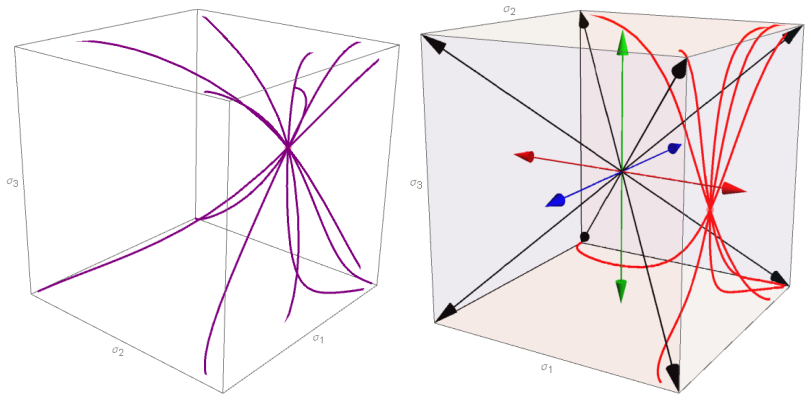
Integrate the geodesic equations of M_4|reg (or higher) from many interior starts and many initial directions; check whether terminals still land only on hypercube vertices, face centres and edge midpoints and whether the terminal is independent of the start point for fixed initial angle.
Extended reading notes
Core claim
The thermo-metric of extended Souriau Gibbs distributions on CV manifolds is flat when unconstrained. Freezing any uninterrupted chain of n−1 contiguous magnetic fields forces the dynamics onto a universal curved submanifold M_n|reg whose metric is given explicitly by the Hessian pull-back (6.14), whose holonomic Riemann tensor is diagonal in antisymmetric pairs, and which embeds isometrically into R^{2n−1} either with the a_{2n−1} Cartan matrix or as a generalized translation hypersurface; the boundary at infinity is a hypercube whose distinguished points are the observed terminals of all geodesics, fixed solely by initial angular slope.
Load-bearing premise
That the rule that geodesic end-points on the hypercube boundary depend only on starting angle, not on starting point, holds for every dimension n and is structural rather than a low-n numerical accident.
Editorial extensions
If this is right
- Each isolated vanishing magnetic field contributes an independent copy of the regular 2-factor M_2|reg; each contiguous (n−1)-chain contributes one M_n|reg, so large-q thermo-space factors into a flat piece times a tensor product of these universal curved tiles.
- In the even-q case an extra universal singular 2-factor M_2|sing appears with curvature walls that already partition the plane into non-communicating geodesic regions.
- The hypercube boundary and angle-determined terminals supply a discrete combinatorial skeleton that can label phases or categories without continuous isometries.
- Embedding M_n|reg as a generalized translation hypersurface with hyperoctahedral discrete isometries gives an explicit geometric model for the discrete symmetry of each magnetization tile.
- The same combinatorial freezing scheme is proposed as the geometric realisation of agents that reinforce or inhibit spontaneous geodesic evolution in unsupervised learning with reinforcement.
Reading between the lines
- If the angle-only terminal rule is proved for all n, the thermo-space boundary becomes a discrete decision surface that could replace soft clustering by hard combinatorial labels in layer-wise analysis of Cartan networks.
- Curvature walls generated by the diagonal Riemann structure may act as natural phase separators; controlling which magnetic fields are frozen would then amount to choosing which category walls are present.
- The appearance of the a_{2n−1} Cartan matrix as the ambient flat metric hints that root-system combinatorics may organise admissible freezing patterns beyond the contiguous-chain rule already derived.
- Extending the same immersion analysis to other abelian structures on CV manifolds (promised in the outlook) would test whether flatness-plus-universal-tiles is special to the principal subalgebra sequence or generic for all exact Souriau extensions.
Editorial analysis
A structured set of objections, weighed in public.
Referee Report
Summary. The paper studies the information-geometry ("thermo-metric") on the thermodynamic parameter space of extended Souriau Gibbs distributions on Calabi-Vesentini manifolds, built as minus the Hessian of log Z, where Z is the exact partition function from the authors' predecessor paper [7]. Main claims: (i) with all generalized "magnetic fields" h_i present (q odd), the full thermo-metric is flat, with an explicit Euclideanizing coordinate change (4.3); (ii) freezing an uninterrupted chain of n−1 contiguous magnetic fields splits off a universal curved n-manifold M_n|reg with explicit metric (6.14), whose Riemann tensor is diagonal in antisymmetric index pairs (6.18); (iii) M_n|reg embeds in flat R^{2n−1} either with the a_{2n−1} Cartan matrix as flat metric or, equivalently, as a generalized translation hypersurface (6.51); (iv) for q even an additional universal 2D factor M_2|sing with curvature singularities along four curves appears; (v) numerically, geodesics of M_n|reg terminate at hypercube vertices, face centers, or edge midpoints, with the endpoint "decided by the initial orientation angle independently of the starting point" — a feature the authors compare to Penrose boundaries. Claims (i)-(iv) rest on explicit, checkable computations; claim (v) is numerical (MATHEMATICA, n=2,3) and stated as a conjecture for general n.
Significance. If the computational results hold, the paper provides a complete, explicit, and parameter-free description of an interesting family of information geometries: exact Hessian metrics, their flat factors, universal curved factors, curvature formulas, and two concrete flat embeddings. The a_{2n-1} Cartan-matrix embedding and the generalized-translation-hypersurface picture are elegant and likely of independent interest in information geometry. The derivation is a genuine downstream calculation from the partition functions of [7], not a restatement of inputs, and all formulas are explicit enough to be checked by the reader. However, the result advertised most prominently (the Penrose-like endpoint law) is, as argued in Major Comment 1, very likely false as stated even for n=2: it contradicts the asymptotic constancy of the metric in x-coordinates. The durable contribution is the metric/curvature/embedding structure, not the endpoint law.
major comments (4)
- [§5.2.3, §7, Abstract] Abstract, §5.2.3, §7, Conclusion (F): the endpoint law ('end-points of all geodesics depending only on their angular slope at the start', independent of the starting point) is contradicted by the metric's own asymptotics. Via (5.35)/(6.51), in x-coordinates the metric of M_n|reg is g_ij = δ_ij + (δ_ij − 1/n) tanh(x_i/√2) tanh(x_j/√2), which approaches a CONSTANT metric exponentially fast as any |x_i|→∞. Geodesics therefore acquire asymptotic straight lines in x-space, and the terminal point on the hypercube boundary depends on the full asymptotic line (slope AND intercept), not on slope alone. Concretely for n=2: Γ^y_xx = g^{yy} ∂_x g_xy with g_xy = −(1/2)tanh(x/√2)tanh(y/√2) is nonzero for y≠0, with sign such that a geodesic fired axis-parallel from an off-axis point is repelled from the axis, acquires transverse velocity, and ends at a vertex, while the same initial angle from the orig
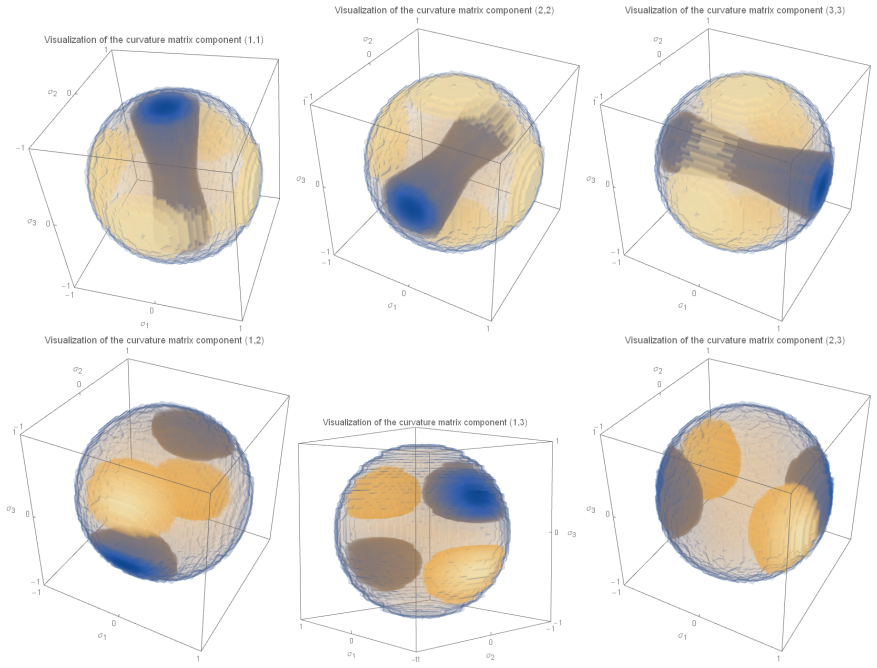
- [§6.2, Eq. (6.18), §7] Eq. (6.18) and §6.2: the diagonality of R_{µν|στ} in antisymmetric index pairs is described as an 'experimental result' obtained 'for an extended number of instances' of n. The abstract and Conclusion (E) present it as an established general property. Similarly, the boundary degeneration of the curvature 2-form (origin ~ SO(1,n)/SO(n), face centers ~ R × SO(1,n−1)/SO(n−1), vanishing at vertices; §7, App. A (A.11)-(A.15)) is verified only for n=3 and conjectured in general. Since the metric has the simple closed form g_ij = δ_ij + (δ_ij − 1/n) t_i t_j, t_i = tanh(x_i/√2), and an explicit hypersurface embedding (6.51), a general-n proof (e.g. via the Gauss equation for the graph embedding) looks feasible and would substantially strengthen the paper. Either supply such a proof or label (6.18) and the §7 statements as conjectures everywhere, including the abstract and conclusions.
- [§8.1, Eqs. (8.14)-(8.16)] Eqs. (8.14)-(8.16), Figs. 12-13: the paper does not state whether the curvature singularities of M_2|sing intersect the physical convergence domain D_d (|σ|,|τ|<1). From (8.14), the denominator vanishes only when σ²(1−τ²) = −(τ²+3), which has no solution with both |σ|,|τ|<1, so the singular locus appears to lie entirely outside the physical square — but this should be argued explicitly, since a singularity of a Hessian metric inside the convergence domain would contradict finiteness of the covariance. The same question (whether 'curvature walls' can ever enter the physical polytope) should be addressed for the general combinatorial scheme, as it bears directly on the claimed thermodynamic interpretation.
- [Abstract, §5.2.3, §9] Abstract, §5.2.3, §9: the analogy with Penrose diagrams and 'causal structure at infinity' is asserted but no conformal compactification is constructed; what the numerics actually probe is the visual/geodesic boundary of a complete simply connected manifold of (mostly) non-positive curvature. In view of Major Comment 1 (the visual boundary is the full hypercube perimeter, not 8 distinguished points), the Penrose language is misleading and should be removed or replaced by the standard Cartan-Hadamard visual-boundary framework, which is the correct setting for the questions being asked.
minor comments (7)
- [§5.2.3] The geodesic equations are called 'highly non-linear PDE.s' in §5.2.3 and §7; they are ODEs.
- [§6.3, Eq. (6.48)] Eq. (6.48) is labelled Π[3] but is the n=2 matrix; it should be Π[2] (Eq. (6.47) already uses Π[3]).
- [Fig. 1] Fig. 1 caption lists the frozen fields as 'h_3, h_5, h_5'; presumably the third index is a typo. Please also make explicit in the figure which ρ-coordinates pair into each E^4.
- [§3.2.1, before Eq. (3.21)] Duplicated sentence: 'Integrating on the appropriate polytopes one obtainsIntegrating on the appropriate polytopes one obtains'.
- [throughout] Numerous typos: 'Riemanian' (§5.1), 'evenience' (§6.2), 'lenght' (§7), 'reminescent' and 'It superfluous' (Conclusion F), 'sponatenous' (Conclusion c), 'negattive' (footnote 6), 'altrough' (footnote 8), 'concetually' (§6.4), 'syntetic' (footnote 7). A careful proofreading pass is needed.
- [§2.1, footnote 6] The retroactive sign correction to [7] (overall sign of the Kähler metric in (2.10)/(2.16), footnote 6) is important for readers of the predecessor paper; please state it prominently (ideally as a formal erratum to [7]) and confirm that no other formulas in [7] are affected.
- [References] References [8] and [47] are cited for load-bearing motivation but are unpublished/in preparation; please either provide accessible preprints or soften the dependence on them.
Circularity Check
No significant circularity: thermo-metric geometry is a genuine downstream calculation from prior exact partition functions, not a restatement of inputs by construction.
full rationale
The paper takes as input the explicit partition functions Z^b_ν(λ) and Z^d_s(λ) derived in the authors’ prior work [7], forms the stochastic Hamiltonian H_sto = −log Z, and computes the Hessian thermo-metric (eqs. 4.1–4.2, 8.1–8.4). Flatness of the unconstrained metric is established by an explicit coordinate change (4.3) to Euclidean form; curved factors M_n|reg arise by pull-back under the immersion that enforces vanishing of contiguous magnetic fields (6.7–6.14); the Cartan-matrix embedding and translation-hypersurface realization follow from that same immersion (6.22–6.44, 6.49–6.51). These are ordinary differential-geometric calculations on a fixed input metric; no free parameters are fitted to data and then re-presented as predictions, and no uniqueness theorem is imported to forbid alternatives. Heavy citation of [1–7] is sequential programme building, not load-bearing circular justification of the curvature or embedding formulae. The geodesic terminal-point rule is explicitly labelled numerical/conjectural (Secs. 5.2.3, 7) and is therefore not a claimed first-principles derivation that could be circular. Correctness concerns about that rule (asymptotics of the log-cosh embedding) are outside the circularity criterion. Score 1 only for routine self-citation density that does not reduce any central geometric claim to its own definition.
Assumptions & free parameters
assumptions (5)
- domain assumption Thermo-metric on the contact manifold is ds²_℧ = dI² − (1/2)(H_ij dλ^i dλ^j + H^{-1|ij} dx_i dx_j) with H the Hessian of the stochastic Hamiltonian −log Z.
- domain assumption Partition functions Z^b_ν and Z^d_s for extended Souriau distributions on CV manifolds are those computed in the predecessor paper [7], eqs. (3.19)–(3.23).
- ad hoc to paper Extra temperatures conjugate to square roots of principal-subalgebra Casimirs may be interpreted as generalized magnetic fields whose vanishing implements spontaneous-symmetry-breaking-like reductions.
- standard math Standard Riemannian geometry: pull-backs of flat metrics under immersions, Christoffel/Riemann definitions, Cartan–Hadamard notions, a_ℓ root/weight constructions.
- ad hoc to paper Geodesic endpoint structure observed for n=2,3 extends to all M_n|reg and encodes a Penrose-like causal organization of ∂_∞.
invented entities (2)
-
Universal manifolds M_n|reg (and B_{n+1|reg}, M_2|sing)
-
Magnetization combinatorial scheme as categorical partition / RL agent mechanism
Cite this review
Pith. "Pith review of General Properties of the Thermo-Metric for CV event manifolds and the magnetization combinatorial scheme." pith.science (2026). https://pith.science/paper/PUTLSS7I
@misc{pith2026260724342,
  author       = {Pith},
  title        = {Pith review of: General Properties of the Thermo-Metric for CV event manifolds and the magnetization combinatorial scheme},
  year         = {2026},
  howpublished = {\url{https://pith.science/paper/PUTLSS7I}},
  note         = {Machine review of arXiv:2607.24342}
}
abstract
Following previous results recently obtained by us, on Information Geometry versus Geometrical Thermodynamics and on the exact calculation of partition functions for extended Souriau Gibbs distributions on Calabi Vesentini manifolds, we study the differential geometry of the corresponding thermo-metrics. A general intriguing scheme is discovered and put into evidence. A small yet significant difference, distinguishes the even from the odd dimensional instance of the microscopic CV manifolds. Apart from that the complete thermo-space is flat when no constraint is introduced. Freezing the magnetic fields, which can be done according to complicated combinatorials, forces the thermo-system to evolve on curved submanifolds of the thermo--space that have a structure depending only on the length of the $n-1$ chain of frozen contiguous magnetic fields. The behavior of Riemann tensor components for such spaces is codified by a symmetric matrix with peculiar behavior along special symmetrically arranged submanifolds that, might be responsible for the generation of curvature walls and for the categorical partitioning of the thermo space. The embedding of this curved submanifold into $\mathbb{R}^{2n-1}$ can be traced back to the vanishing of magnetic fields and, in this case, the flat metric on $\mathbb{R}^{2n-1}$ is the $\mathfrak{a}_{2n-1}$ simple Lie algebra Cartan matrix. In another version the flat embedding reveals the geometric interpretation of the $n$-manifold as a generalized translation hypersurface. The boundary at infinity has a hypercube structure whose face central points and vertices appear, numerically, to be the end-points of all geodesics depending only on their angular slope at the start. This general feature is reminiscent of the causal structure at infinity of Lorentzian space-times and of Penrose diagrams.
Figures


Figures from the paper (12 more)




Reference graph
Works this paper leans on
-
[7]
P. Fr´ e, A. S. Sorin, and M. Trigiante, “The macroscopic Kaehler metric of Geometric Thermodynamics versus the microscopic one on the Event Manifold: Exact Partition Functions on CV manifolds. Extended Souriau temperatures and spontaneous magnetizations,”arXiv, 2026.https://arxiv.org/abs/2606.09438
arXiv 2026
-
[1]
U. Bruzzo, P. G. Fr´ e, and M. Trigiante, “The Paint Group Tits Satake Theory of Hyperbolic Symmetric Spaces: the distance function, paint invariants and discrete subgroups,”ArXiv, 2025. arxiv:2503.07626
arXiv 2025
-
[2]
Navigation through Non Compact Symmetric Spaces: a mathematical perspective on Cartan Neural Networks,
P. G. Fr´ e, F. Milanesio, M. Santoro, and G. Sanguinetti, “Navigation through Non Compact Symmetric Spaces: a mathematical perspective on Cartan Neural Networks,”Journal of Geometry and Physics, vol. 224, p. 105804,
-
[3]
Cartan Networks: Group theoretical Hyperbolic Deep Learning,
P. G. Fr´ e, F. Milanesio, M. Santoro, and G. Sanguinetti, “Cartan Networks: Group theoretical Hyperbolic Deep Learning,”ArXiv, 2025. arxiv:2505.24353v1
arXiv 2025
-
[4]
P. Fr´ e, M. Milanesio, F. Oyarzo, M. Santoro, and M. Trigiante, “Tessellation Groups, Harmonic Analysis on Non Compact Symmetric Spaces and the Heat kernel in view of Cartan Convolutional Neural Networks,”Forscritte der Physik, 2025. published:https://doi.org/10.1002/prop.70099, on ArXivhttps://arxiv.org/abs/2508. 16015v1
-
[5]
P. Fr´ e, “Axial symmetric Navier Stokes equations and the Beltrami/antiBeltrami spectrum in view of Physics Informed Neural Networks,”Transport Phenomena, vol. 1, Jan. 2026.http://dx.doi.org/10.1515/ tp-2026-0011,https://arxiv.org/abs/2512.08846v2
arXiv 2026
-
[6]
Thermodynamics ` a la Souriau on K¨ ahler Non Compact Symmetric Spaces for Cartan Neural Networks,
P. G. Fr´ e, A. S. Sorin, and M. Trigiante, “Thermodynamics ` a la Souriau on K¨ ahler Non Compact Symmetric Spaces for Cartan Neural Networks,”Entropy, vol. 28, pp. 365–468, 2026.https://doi.org/10.3390/e28040365, preprint on ArXivhttps://arxiv.org/abs/2512.16772
arXiv 2026
-
[8]
Homogeneous Non Symmetric Special K¨ ahler Geometries as Broken Isometry Metrics on Symmetric Special K¨ ahler Manifolds,
P. Fr´ e, M. Trigiante, and A. Van Proyen, “Homogeneous Non Symmetric Special K¨ ahler Geometries as Broken Isometry Metrics on Symmetric Special K¨ ahler Manifolds,” Research Project under development
Show all 48 references
-
[9]
Information and Accuracy attainable in the estimation of statistical parameters,
C. Rao, “Information and Accuracy attainable in the estimation of statistical parameters,”Bull. Calcutta Math. Soc., vol. 37, pp. 81–91, 1945
1945
-
[10]
Statistical Decision Rules and Optimal Inferences,
N. Chentsov, “Statistical Decision Rules and Optimal Inferences,”Trans. of Math. Monog. , Amer. Math. Society, Providence, vol. 53, 1982
1982
-
[11]
Amari,Information Geometry and Its Applications
S. Amari,Information Geometry and Its Applications. Springer: Applied Mathematical Sciences, Tokyo, Japan, 2016
2016
-
[12]
Information Theory and Statistical Mechanics,
E. Jaynes, “Information Theory and Statistical Mechanics,”Physical Review, vol. 106 (4), pp. 620–630, 1957
1957
-
[13]
Information Theory and Statistical Mechanics ii,
E. Jaynes, “Information Theory and Statistical Mechanics ii,”Physical Review, vol. 108 (2), pp. 171–190, 1957
1957
-
[14]
Contact Geometry, Measurement and Thermodynamics,
V. Lychagin, “Contact Geometry, Measurement and Thermodynamics,” inNonlinear PDEs, Their Geometry, and Applications. Proceedings of the Wisla 18 Summer School, pp. 3–54, Springer Nature, 2019. doi:10.1007/978- 3-030-17031-8 1
2019 doi
-
[15]
Optimal thermodynamic processes for gases,
A. Kushner, V. Lychagin, and M. Roop, “Optimal thermodynamic processes for gases,”Entropy, vol. 22, p. 448, Apr. 2020. arxiv:2003.01984
2020 arXiv
-
[16]
On higher order structures in thermodynamics,
V. Lychagin and M. Roop, “On higher order structures in thermodynamics,”Entropy, vol. 22, p. 1147, Oct. 2020. arxiv:2009.02077. 53
2020 arXiv
-
[18]
Steady filtration of Peng-Robinson gas in a porous medium,
V. Lychagin and M. Roop, “Steady filtration of Peng-Robinson gas in a porous medium,”ArXiv/1903.00276,
1903 arXiv
-
[20]
Thermodynamic curvature measures interactions,
G. Ruppeiner, “Thermodynamic curvature measures interactions,”American Journal of Physics, vol. 78, no. 11, pp. 1170–1180, 2010. doi:10.1119/1.3459936
2010 doi
-
[21]
Thermodynamic curvature from the critical point to the triple point,
G. Ruppeiner, “Thermodynamic curvature from the critical point to the triple point,”Physical Review E, vol. 86, no. 2, 2012. doi:10.1103/PhysRevE.86.021130
2012 doi
-
[22]
Thermodynamic curvature: pure fluids to black holes,
G. Ruppeiner, “Thermodynamic curvature: pure fluids to black holes,”Journal of Physics: Conference Series, vol. 410, p. 012138, 2013. doi:10.1103/PhysRevE.86.052103
2013 doi
-
[23]
Thermodynamic R-diagrams reveal solid-like fluid states,
G. Ruppeiner, P. Mausbach, and H.-O. May, “Thermodynamic R-diagrams reveal solid-like fluid states,”Physics Letters A, vol. 379, no. 7, pp. 646–649, 2015. doi:10.1016/j.physleta.2014.12.021
2015 doi
-
[24]
Souriau,Structure des Syst` emes Dynamiques
J. Souriau,Structure des Syst` emes Dynamiques. Dunod: Paris, France, 1969
1969
-
[25]
M´ ecanique statistique, groupes de Lie et cosmologie,
J. Souriau, “M´ ecanique statistique, groupes de Lie et cosmologie,” inColloque International du CNRS G´ eom´ etrie Symplectique et Physique Math´ ematique, 1974. Souriau, J.M., Ed.; CNRS: Marseille, France
1974
-
[26]
Barbaresco,Jean-Marie Souriau’s Symplectic Model of Statistical Physics: Papers on Lie Groups Thermo- dynamics - Quod Erat Demonstrandum., vol
F. Barbaresco,Jean-Marie Souriau’s Symplectic Model of Statistical Physics: Papers on Lie Groups Thermo- dynamics - Quod Erat Demonstrandum., vol. 361. Springer Proceedings in Mathematics & Statistics, 2021. In: Barbaresco, F., Nielsen, F. (eds) Geometric Structures of Statist...
2021 doi
-
[27]
From Tools in Symplectic and Poisson Geometry to Souriau’s Theories of Statistical Mechanics and Thermodynamics,
C. M. Marle, “From Tools in Symplectic and Poisson Geometry to Souriau’s Theories of Statistical Mechanics and Thermodynamics,”Entropy, vol. 18, no. 10, p. 370, 2016.https://www.mdpi.com/1099-4300/18/10/370
2016
-
[28]
Geometric Theory of Heat from Souriau Lie Groups Thermodynamics and Koszul Hessian Geometry: Applications in Information Geometry for Exponential Families,
F. Barbaresco, “Geometric Theory of Heat from Souriau Lie Groups Thermodynamics and Koszul Hessian Geometry: Applications in Information Geometry for Exponential Families,”Entropy, vol. 18, no. 11, 2016. https://www.mdpi.com/1099-4300/18/11/386
2016
-
[29]
Lie Group Machine Learning and Gibbs Density on Poincar´ e Unit Disk from Souriau Lie Group Thermodynamics and SU(1,1) Coadjoint Orbits,
F. Barbaresco, “Lie Group Machine Learning and Gibbs Density on Poincar´ e Unit Disk from Souriau Lie Group Thermodynamics and SU(1,1) Coadjoint Orbits,” inGeometric Science of Information(F. Nielsen and F. Bar- baresco, eds.), (Cham), pp. 157–170, Springer International Publi...
2019
-
[30]
Gaussian Distributions on the Space of Symmetric Positive Definite Matrices from Souriau’s Gibbs State for Siegel Domains by Coadjoint Orbit and Moment Map,
F. Barbaresco, “Gaussian Distributions on the Space of Symmetric Positive Definite Matrices from Souriau’s Gibbs State for Siegel Domains by Coadjoint Orbit and Moment Map,” inGeometric Science of Information (F. Nielsen and F. Barbaresco, eds.), pp. 245–255, Springer Internat...
2021 doi
-
[31]
On Gibbs states of mechanical systems with symmetries,
C.-M. Marle, “On Gibbs states of mechanical systems with symmetries,”ArXiv, 2021.https://arxiv.org/abs/ 2012.00582
2021 arXiv
-
[32]
Jean-Marie Souriau’s Symplectic Foliation Model of Sadi Carnot’s Thermodynamics,
F. Barbaresco, “Jean-Marie Souriau’s Symplectic Foliation Model of Sadi Carnot’s Thermodynamics,”Entropy, vol. 27, p. 509, 2025.https://doi.org/10.3390/e27050509, PDF:https://www.mdpi.com/1099-4300/27/5/ 509/pdf?version=1747042071. 54
2025 doi
-
[33]
Debreu’s 3-Webs and Affinely Flat Bi-Lagrangian Manifolds Links with Transverse Symplectic Foliation of Souriau’s Dissipative Lie Group Thermodynamics,
F. Barbaresco, “Debreu’s 3-Webs and Affinely Flat Bi-Lagrangian Manifolds Links with Transverse Symplectic Foliation of Souriau’s Dissipative Lie Group Thermodynamics,” inLecture Notes in Computer Science, vol 16034. Springer, Cham., 2026. In: Nielsen, F., Barbaresco, F. (eds)...
2026 doi
-
[34]
Symplectic Foliation Transverse Structure and Libermann Foliation of Heat Theory and Infor- mation Geometry,
F. Barbaresco, “Symplectic Foliation Transverse Structure and Libermann Foliation of Heat Theory and Infor- mation Geometry,” inLecture Notes in Computer Science 14072, p. 152–164, 2023. In Geometric Science of Information GSI’23, Proceedings of the 6th International Conferenc...
2023
-
[35]
A classification of coadjoint orbits carrying Gibbs ensembles,
K.-H. NEEB, “A classification of coadjoint orbits carrying Gibbs ensembles,”ArXiv, 2026.https://arxiv.org/ pdf/2601.04934
2026
-
[36]
Deep Learning and Geometric Deep Learning: an introduction for mathematicians and physicists,
R. Fioresi and F. Zanchetta, “Deep Learning and Geometric Deep Learning: an introduction for mathematicians and physicists,”arXiv, 2023.https://arxiv.org/abs/2305.05601
2023 arXiv
-
[37]
Thermodynamic Curvature of the Binary van der Waals Fluid,
G. Ruppeiner and A. Seftas, “Thermodynamic Curvature of the Binary van der Waals Fluid,”Entropy, vol. 22, no. 11, p. 1208, 2020. doi:10.3390/e22111208
2020 doi
-
[38]
Isometries of special manifolds,
B. de Wit and A. Van Proeyen, “Isometries of special manifolds,”ArXiv, 1997.https://arxiv.org/abs/hep-th/ 9505097
1997
-
[39]
Classification of Kahler Manifolds inN= 2 Vector Multiplet Supergravity Couplings,
E. Cremmer and A. Van Proeyen, “Classification of Kahler Manifolds inN= 2 Vector Multiplet Supergravity Couplings,”Class. Quant. Grav., vol. 2, p. 445, 1985
1985
-
[40]
Vector Multiplets Coupled to N=2 Supergravity: SuperHiggs Effect, Flat Potentials and Geometric Structure,
E. Cremmer, C. Kounnas, A. Van Proeyen, J. P. Derendinger, S. Ferrara, B. de Wit, and L. Girardello, “Vector Multiplets Coupled to N=2 Supergravity: SuperHiggs Effect, Flat Potentials and Geometric Structure,”Nucl. Phys., vol. B250, pp. 385–426, 1985
1985
-
[41]
Potentials and Symmetries of General Gauged N=2 Supergravity: Yang-Mills Models,
B. de Wit and A. Van Proeyen, “Potentials and Symmetries of General Gauged N=2 Supergravity: Yang-Mills Models,”Nucl. Phys., vol. B245, pp. 89–117, 1984
1984
-
[42]
Gauge and Matter Fields Coupled to N=2 Supergravity,
B. de Wit, P. G. Lauwers, R. Philippe, S. Q. Su, and A. Van Proeyen, “Gauge and Matter Fields Coupled to N=2 Supergravity,”Phys. Lett., vol. 134B, pp. 37–43, 1984
1984
-
[43]
Broken sigma model isometries in very special geometry,
B. de Wit and A. Van Proeyen, “Broken sigma model isometries in very special geometry,”Phys. Lett., vol. B293, pp. 94–99, 1992
1992
-
[44]
Special geometry, cubic polynomials and homogeneous quaternionic spaces,
B. de Wit and A. Van Proeyen, “Special geometry, cubic polynomials and homogeneous quaternionic spaces,” Commun. Math. Phys., vol. 149, pp. 307–334, 1992
1992
-
[45]
P. G. Fr´ e,Gravity, a Geometrical Course, vol. 1,2. Dordrecht: Springer Science & Business Media, 2012
2012
-
[46]
P. G. Fr´ e,Discrete, Finite and Lie Groups. Berlin, Boston: De Gruyter, 2023. doi:10.1515/9783111201535
2023 doi
-
[47]
Explicit Construction of Cartan Neural Networks with layers in the Calabi-Vesentini Tits-Satake tower, note=paper in preparation,
P. Fr´ e, R. Noris, M. Oyarzo, and M. Trigiante, “Explicit Construction of Cartan Neural Networks with layers in the Calabi-Vesentini Tits-Satake tower, note=paper in preparation,”
-
[48]
Categorical Perception: A Groundwork for Deep Learning,
L. Bonnasse Gahot and J. Nadal, “Categorical Perception: A Groundwork for Deep Learning,”ArXiv.https: //arxiv.org/abs/2012.05549
2012 arXiv
-
[49]
Neural Coding of Categories: information efficiency and optimal population codes,
L. Bonnasse Gahot and J. Nadal, “Neural Coding of Categories: information efficiency and optimal population codes,”Journal of Computational Neuroscience, vol. 25, pp. 169–187, 2008. 55
2008
-
[2026]
On ArXivhttps://arxiv.org/abs/2507.16871
Reviewed July 31, 2026 · model on record in the stance chip above.
Discussion (0). Sign in to comment.