REVIEW 4 major objections 6 minor 52 references
SemFaceEdit: Semantic Face Editing on Generative Radiance Manifolds
T0 review · 4 major / 6 minor · reviewed 2026-08-06 · deepseek-v4-flash
Pith's one-line read SemFaceEdit claims that a 3D generative face model can be made locally editable by giving each facial semantic its own appearance latent code and a shared geometry latent code, with a Semantic Volume Masking layer that sorts every sampled…
desk verdict SemFaceEdit adds a real capability to 3D GAN editing but leaves the load-bearing semantic-assignment assumption untested and skips the closest baseline. read the letter →
The pith
A machine-rendered reading of the paper's core claim, the machinery that carries it, and where it could break.
The reading
What carries the argument
The central mechanism is the Semantic Volume Masking layer, defined by the assignment $S_k(r) = \arg\max_k \sum_{j=k}^K T(x_j)\alpha(x_j)s(x_j,d)$ for points on the $k$-th of $K$ radiance manifolds along a ray, which partitions all sampled points and their appearance descriptors into $n$ semantic collections. Each collection is then processed by a separate mapping network inside the Appearance Module, so that the $i$-th appearance latent $z_i$ conditions only the $i$-th semantic's descriptors; the shared Geometry Module's latent $z$ controls occupancy and semantic layout. This segregation is what turns a global radiance field into locally editable regions.
What would settle it
Render a view of a real image inverted with SemFaceEdit, then compare the semantic label assigned to each point by Eq. 2 against a ground-truth 3D semantic volume obtained from a fitted morphable face model or a synthetic rig; if masking mislabels points at region boundaries under view changes, the per-semantic latent code will also alter neighbouring regions, which can be measured as a per-region SSIM drop when only one $z_i$ is changed.
Extended reading notes
Core claim
On the paper's own terms, the discovery is that semantic control over a radiance field can be obtained without retraining and without global appearance changes. SemFaceEdit trains a Geometry Module to produce, for each point on a radiance manifold, an occupancy value, a semantic radiance vector, and a high-dimensional appearance descriptor, and an Appearance Module that predicts RGB colour after the Semantic Volume Masking layer has partitioned points by Eq. 2's $\arg\max$ over accumulated transmittance-weighted semantic radiance. Because each semantic class is conditioned by its own mapping network, the $i$-th appearance latent $z_i$ controls only the colour of the $i$-th region, and the geometry latent $z$ controls occupancy and semantic layout. The paper demonstrates that this allows transferring the appearance or geometry of one semantic from a source to a target image by swapping the corresponding latent code and solving a mask-and-image inversion objective, while other regions are preserved.
Load-bearing premise
The method assumes that the per-point assignment of 3D locations to facial regions is correct everywhere, even though it is learned only from flat 2D masks with no depth information, so that swapping one region's latent code never alters another region.
Editorial extensions
If this is right
- Portrait attribute transfer becomes a latent-code swap: to give image A the hair of image B, exchange the hair appearance latent code and run a short inversion, leaving face and background latent codes fixed.
- Semantic mask editing (e.g., expanding hair or shrinking mouth) changes geometry only in the edited region, with other regions preserved.
- Each appearance latent $z_i$ controls only colour and texture of its semantic region, so hair colour, face tone, and garment colour can be varied independently and composed freely.
- Because both semantic and RGB radiance fields live in the same volume, every edit remains multi-view consistent.
- Inversion to $W$ space takes on the order of $10^2$ iterations in the paper's experiments, compared with $5\times10^3$ for FENeRF, making these edits practical on a single image.
Reading between the lines
- If the masking is as clean as claimed, the same per-semantic latent architecture could carry over to full-body avatars or object categories, where the semantic classes are swapped for body parts or object components.
- The hard $\arg\max$ in Eq. 2 is a natural place to expect boundary artifacts; a soft or probabilistic assignment could improve hair fidelity, which the paper itself lists as a limitation.
- One could quantify disentanglement by measuring per-region SSIM and LPIPS before and after changing a single $z_i$; the paper shows qualitative results but does not report such a per-region fidelity metric.
- The approach suggests that text-conditioned editing could be attached to each semantic latent manifold, since each region already has an isolated low-dimensional code.
Editorial analysis
A structured set of objections, weighed in public.
Referee Report
Summary. The paper introduces SemFaceEdit, a 3D-aware GAN for semantic face editing built on generative radiance manifolds. The generator is decomposed into a Geometry Module that predicts occupancy, semantic radiance, and appearance descriptors, and an Appearance Module that takes appearance descriptors segregated by a Semantic Volume Masking layer and conditions them on per-semantic latent codes before predicting RGB radiance. Training is two-stage and adversarial on CelebAMask-HQ. The paper claims precise localized editing of particular facial semantics while preserving other regions, and reports qualitative results for appearance transfer, geometry transfer, and semantic-mask editing, along with FID/KID for generated images and an mIoU for inversion. The central promise is per-semantic latent control over both appearance and geometry.
Significance. If the claims hold, SemFaceEdit would offer a practical capability: semantic-specific appearance and geometry control in a 3D-aware radiance-field GAN without retraining, built on the efficient manifold sampling of GRAM. The architecture is modular and internally plausible, the two-stage training recipe is concrete, and the qualitative results, especially the inversion convergence compared with FE-NeRF, are promising. The paper also avoids the need for 3D scans during training. However, the central claim of precise locality is not yet supported by quantitative evidence: generation quality is measured, but editing quality and disentanglement are not. Moreover, one of the core equations appears to define semantic labeling in a way that is inconsistent with the stated preservation guarantee. The contribution is therefore significant in scope but currently under-validated.
major comments (4)
- [§3.1, Eq. (2)] Equation (2) computes the semantic label S_k(r) as the argmax of the accumulated semantic radiance from the k-th manifold point to the end of the ray, rather than of the local semantic radiance s(x_k) at that point. Because a later surface with a high semantic response can dominate the suffix sum, an earlier point can be relabeled as belonging to a different semantic class. The Semantic Volume Masking layer would then place that earlier point and its appearance descriptor F into the wrong semantic collection, so editing the latent code of the dominant class could change radiance at points that actually belong to another class. This directly threatens the advertised preservation of non-edited regions. In addition, the hard argmax in Eq. (2) has zero gradient, while Contribution 2 calls this layer "differentiable"; the text does not describe a straight-through estimator or a soft relaxation. Please correct the labeling rule or justify the suffix-sum rule explicitly, and verify per-point label fidelity.
- [Contributions and §4.2] The contributions claim semantic-specific control over geometry by manipulating latent spaces specific to each semantic attribute, but the Geometry Module in Eq. (1) takes a single global geometric latent z and outputs a global occupancy field σ; there is no per-semantic geometry latent code. Geometry editing in §4.2 is performed by optimizing a global offset δw+ against a composite semantic mask, not by swapping a semantic-specific geometry code. Consequently, the claim of per-semantic geometry latent control is not supported by the architecture as described, and the preservation of non-edited geometry relies entirely on the optimization not disturbing other regions. Please either introduce per-semantic geometry latents or reframe the claim, and provide a quantitative test of preservation of non-edited geometry during geometry transfer.
- [§4.3, Table 1] All reported quantitative metrics, FID and KID, evaluate unconditional generation quality, not editing. The paper's central claim is precise local editing with preservation of other semantic regions, and the evidence for this is exclusively qualitative in Figures 4-8. I request a quantitative editing protocol: for each semantic latent swap, measure semantic mIoU and image-similarity or identity preservation over the regions that should remain unchanged, and measure attribute classification accuracy or mask agreement over the edited region. A comparison with FE-NeRF and IDE-3D under the same protocol would be particularly valuable. Without such measurements, the claimed superiority in "radiance field disentanglement" is not established.
- [§4.3, Fig. 9 and Appendix 2.1] The reported 0.85 mIoU for inversion measures agreement between the generator's rendered semantic mask and the target mask that is itself the objective of the inversion optimization in Eq. (10). This is an optimization-fit metric, not a measure of the correctness of the per-point semantic assignments that the Semantic Volume Masking layer relies on. Since the paper's own Limitations section concedes that "any discrepancies in the semantic geometry propagates to final facial appearance," a direct check is needed: compare the Eq. (2) classification of each sampled point with the local semantic radiance s(x_k), or with a denser reference labeling, and report agreement as a function of depth and semantic class. Without this, the locality premise of the entire editing pipeline remains untested.
minor comments (6)
- [§3.1, Eq. (2)] The transmittance product writes T(x_j)=∏_{i<j;i≥k}(1−σ(x_j)), but the factor should be σ(x_i); as written the product does not depend correctly on the intermediate points.
- [§4.1] Training for 120K iterations on 30K images is 4 epochs, not 3; the second stage of 30K iterations is 1 epoch. Please correct the epoch count or the iteration count.
- [§4.2 and Fig. 7 caption] The text states the method converges to 0.85 mIoU within 50 iterations, while the Fig. 7 caption says "rapid convergence within 500 iterations"; these numbers should be reconciled.
- [Appendix, Eq. (3)] Under the stated softplus convention f(x)=log(1+exp(x)), the generator terms use f(D_s(...)) while the discriminator terms use f(−D(...)); this is not the standard non-saturating GAN formulation. Please clarify the sign convention or the intended loss direction.
- [§3.1] The assertion that learning semantic radiance from masks alone "is bound to fail" without the appearance-descriptor pathway is not supported by an ablation. Either provide the isolating ablation or soften the claim.
- [§4.3 and Related Work] IDE-3D [38] is discussed in Related Work as an editing method for tri-planes but is not compared in the experiments; a comparison or a brief explanation of its omission would strengthen the evaluation.
Circularity Check
No significant circularity: the central editing mechanism is an empirical architecture, and the only self-referential element is the reported inversion mIoU, which measures fit to the optimization target rather than external semantic accuracy.
-
fitted input called prediction
[Section 4.3 (Quantitative comparison) and Appendix Eq. (10)]
"To assess the 3D inversion capability of SemFaceEdit, we perform inversions on 1K images from the CelebAMask-HQ Dataset, calculating the mean Intersection over Union (mIoU) for all n semantics. Across all inverted images, our approach converges to 0.85 mIoU within 50 iterations. ... L(δw+, δw+ i ) = λsLs(S′, Sed) + λimLim(I ′ ⊙ (1 − r), I ⊙ (1 − r)) + λvgg Lvgg (I ′ ⊙ (1 − r), I ⊙ (1 − r)) (10)"
The 0.85 mIoU is computed between the generator's rendered semantic mask and the same mask used as the target in the inversion loss (Ls in Eq. 9/10). It therefore certifies that the optimization matched its own objective, not that the per-point semantic labels in Eq. 2 are correct. This is a self-referential performance number, but it is not load-bearing for the central editing claim.
full rationale
The paper's core pipeline is an empirical architecture: Geometry and Appearance modules are trained adversarially, semantic masking is defined by Eq. 2, and editing is performed by swapping latent codes and optimizing an inversion offset. No equation reduces to its own input, and no fitted parameter is later presented as an external prediction. The only self-referential element is the headline inversion mIoU, which measures agreement with the mask used as the inversion objective; that is a standard reconstruction metric rather than a circular derivation. The Limitations section openly concedes semantic-geometry discrepancies, which is a correctness risk, not circularity. No load-bearing self-citations appear: references to GRAM, FENeRF, and NeRFFaceEditing are external works. Score 2 reflects the minor self-referential metric.
Assumptions & free parameters
free parameters (3)
- Semantic clubbing (19 to 4 classes) =
n = 4: hair, face, garment, background
- Loss weights (stage 1, stage 2, inversion) =
lam_im=5, lam_s=1, lam_p=10, lam_l=1; then lam_im=1, lam_p=10; inversion lam_s=10, lam_im=1, lam_vgg=1
- Network depth (FiLM layers) =
8 layers in both modules
assumptions (5)
- standard math Volumetric rendering equations (transmittance, opacity accumulation) apply to points sampled on 2D manifolds
- domain assumption Adversarial training on 2D images yields a multi-view-consistent 3D radiance field
- domain assumption The GRAM manifold predictor supplies sufficient iso-surfaces (K=24) for semantic and RGB radiance learning
- ad hoc to paper Semantic radiance can be learned from 2D masks if appearance descriptors F provide gradient flow into the geometry module
- ad hoc to paper The hard arg-max assignment in Eq. 2 labels points correctly; semantic-geometry errors are small enough not to corrupt appearance
Cite this review
Pith. "Pith review of SemFaceEdit: Semantic Face Editing on Generative Radiance Manifolds." pith.science (2026). https://pith.science/paper/PVRIENQN
@misc{pith2026250622833,
  author       = {Pith},
  title        = {Pith review of: SemFaceEdit: Semantic Face Editing on Generative Radiance Manifolds},
  year         = {2026},
  howpublished = {\url{https://pith.science/paper/PVRIENQN}},
  note         = {Machine review of arXiv:2506.22833}
}
read the original abstract
Despite multiple view consistency offered by 3D-aware GAN techniques, the resulting images often lack the capacity for localized editing. In response, generative radiance manifolds emerge as an efficient approach for constrained point sampling within volumes, effectively reducing computational demands and enabling the learning of fine details. This work introduces SemFaceEdit, a novel method that streamlines the appearance and geometric editing process by generating semantic fields on generative radiance manifolds. Utilizing latent codes, our method effectively disentangles the geometry and appearance associated with different facial semantics within the generated image. In contrast to existing methods that can change the appearance of the entire radiance field, our method enables the precise editing of particular facial semantics while preserving the integrity of other regions. Our network comprises two key modules: the Geometry module, which generates semantic radiance and occupancy fields, and the Appearance module, which is responsible for predicting RGB radiance. We jointly train both modules in adversarial settings to learn semantic-aware geometry and appearance descriptors. The appearance descriptors are then conditioned on their respective semantic latent codes by the Appearance Module, facilitating disentanglement and enhanced control. Our experiments highlight SemFaceEdit's superior performance in semantic field-based editing, particularly in achieving improved radiance field disentanglement.
Figures


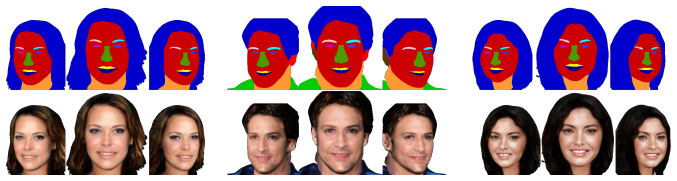
Figures from the paper (9 more)


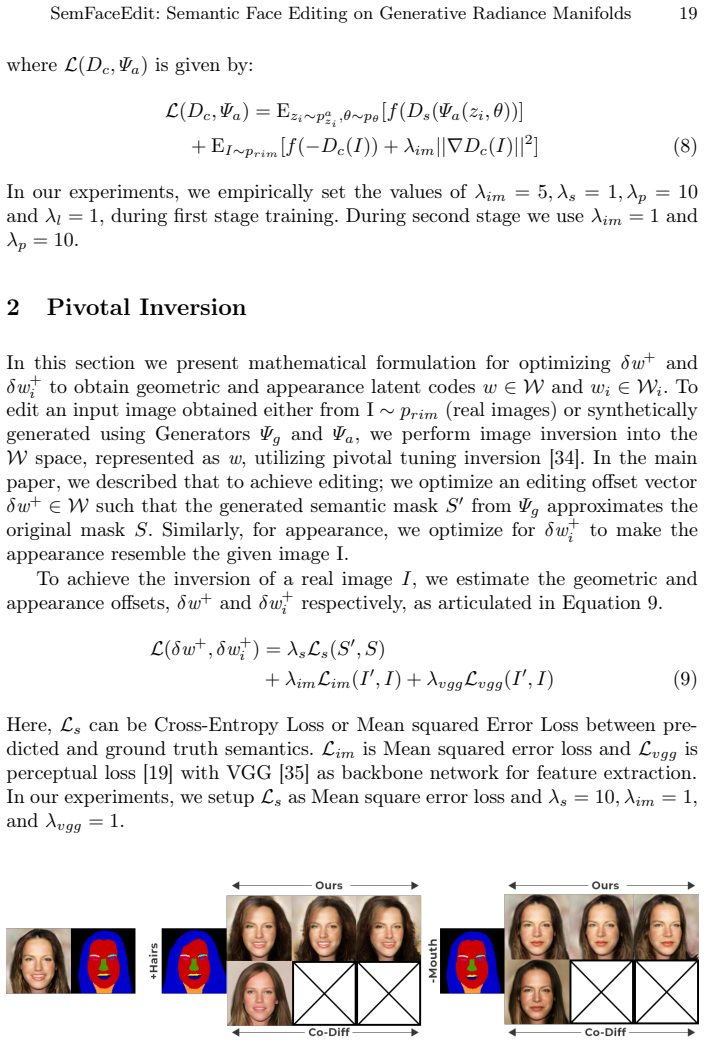


Reference graph
Works this paper leans on
-
[1]
ACM Transactions on Graphics (ToG)40(3), 1–21 (2021)
Abdal, R., Zhu, P., Mitra, N.J., Wonka, P.: Styleflow: Attribute-conditioned ex- ploration of stylegan-generated images using conditional continuous normalizing flows. ACM Transactions on Graphics (ToG)40(3), 1–21 (2021)
2021
-
[2]
arXiv preprint arXiv:2303.13071 (2023)
An, S., Xu, H., Shi, Y., Song, G., Ogras, U., Luo, L.: Panohead: Geometry-aware 3d full-head synthesis in 360. arXiv preprint arXiv:2303.13071 (2023)
arXiv 2023
-
[3]
In: 2023 IEEE 17th International Conference on Auto- matic Face and Gesture Recognition (FG)
Athar, S., Shu, Z., Samaras, D.: Flame-in-nerf: Neural control of radiance fields for free view face animation. In: 2023 IEEE 17th International Conference on Auto- matic Face and Gesture Recognition (FG). pp. 1–8. IEEE (2023)
work page 2023
-
[4]
arXiv preprint arXiv:1801.01401 (2018)
Bińkowski, M., Sutherland, D.J., Arbel, M., Gretton, A.: Demystifying mmd gans. arXiv preprint arXiv:1801.01401 (2018)
arXiv 2018
-
[5]
In: Proceedings of the IEEE international conference on computer vision
Bulat, A., Tzimiropoulos, G.: How far are we from solving the 2d & 3d face align- ment problem?(and a dataset of 230,000 3d facial landmarks). In: Proceedings of the IEEE international conference on computer vision. pp. 1021–1030 (2017)
work page 2017
-
[6]
In: Proceedings of the IEEE/CVF Conference on Computer Vision and Pattern Recognition
Chan, E.R., Lin, C.Z., Chan, M.A., Nagano, K., Pan, B., De Mello, S., Gallo, O., Guibas, L.J., Tremblay, J., Khamis, S., et al.: Efficient geometry-aware 3d generative adversarial networks. In: Proceedings of the IEEE/CVF Conference on Computer Vision and Pattern Recognition. pp. 16123–16133 (2022)
work page 2022
-
[7]
In: Proceed- ings of the IEEE/CVF conference on computer vision and pattern recognition
Chan, E.R., Monteiro, M., Kellnhofer, P., Wu, J., Wetzstein, G.: pi-gan: Periodic implicit generative adversarial networks for 3d-aware image synthesis. In: Proceed- ings of the IEEE/CVF conference on computer vision and pattern recognition. pp. 5799–5809 (2021)
2021
-
[8]
Chen, A., Liu, R., Xie, L., Chen, Z., Su, H., Yu, J.: Sofgan: A portrait image generator with dynamic styling. ACM Transactions on Graphics41(1) (2022) SemFaceEdit: Semantic Face Editing on Generative Radiance Manifolds 15
work page 2022
Show all 52 references
-
[9]
In: Proceedings of the IEEE/CVF Conference on Computer Vision and Pattern Recognition
Deng, Y., Yang, J., Xiang, J., Tong, X.: Gram: Generative radiance manifolds for 3d-aware image generation. In: Proceedings of the IEEE/CVF Conference on Computer Vision and Pattern Recognition. pp. 10673–10683 (2022)
2022
-
[10]
In: IEEE Computer Vision and Pattern Recognition Workshops (2019)
Deng, Y., Yang, J., Xu, S., Chen, D., Jia, Y., Tong, X.: Accurate 3d face reconstruc- tion with weakly-supervised learning: From single image to image set. In: IEEE Computer Vision and Pattern Recognition Workshops (2019)
2019
-
[11]
In: Proceedings of the IEEE/CVF Conference on Computer Vision and Pattern Recognition
Ding, Z., Zhang, X., Xia, Z., Jebe, L., Tu, Z., Zhang, X.: Diffusionrig: Learning personalized priors for facial appearance editing. In: Proceedings of the IEEE/CVF Conference on Computer Vision and Pattern Recognition. pp. 12736–12746 (2023)
2023
-
[12]
ACM Transactions on Graphics (ToG)40(4), 1–13 (2021)
Feng, Y., Feng, H., Black, M.J., Bolkart, T.: Learning an animatable detailed 3d face model from in-the-wild images. ACM Transactions on Graphics (ToG)40(4), 1–13 (2021)
2021
-
[13]
Advances in neural infor- mation processing systems27 (2014)
Goodfellow, I., Pouget-Abadie, J., Mirza, M., Xu, B., Warde-Farley, D., Ozair, S., Courville, A., Bengio, Y.: Generative adversarial nets. Advances in neural infor- mation processing systems27 (2014)
2014
-
[14]
arXiv preprint arXiv:2110.08985 (2021)
Gu, J., Liu, L., Wang, P., Theobalt, C.: Stylenerf: A style-based 3d-aware generator for high-resolution image synthesis. arXiv preprint arXiv:2110.08985 (2021)
2021 arXiv
-
[15]
Advances in neural information processing systems30 (2017)
Heusel,M.,Ramsauer,H.,Unterthiner,T.,Nessler,B.,Hochreiter,S.:Ganstrained by a two time-scale update rule converge to a local nash equilibrium. Advances in neural information processing systems30 (2017)
2017
-
[16]
In: Proceedings of the IEEE/CVF Conference on Com- puter Vision and Pattern Recognition
Huang, Z., Chan, K.C., Jiang, Y., Liu, Z.: Collaborative diffusion for multi-modal face generation and editing. In: Proceedings of the IEEE/CVF Conference on Com- puter Vision and Pattern Recognition. pp. 6080–6090 (2023)
2023
-
[17]
In: SIGGRAPH Asia 2022 Conference Papers
Jiang, K., Chen, S.Y., Liu, F.L., Fu, H., Gao, L.: Nerffaceediting: Disentangled face editing in neural radiance fields. In: SIGGRAPH Asia 2022 Conference Papers. pp. 1–9 (2022)
2022
-
[18]
arXiv preprint arXiv:2112.03517 (2021)
Jo, K., Shim, G., Jung, S., Yang, S., Choo, J.: Cg-nerf: Conditional generative neural radiance fields. arXiv preprint arXiv:2112.03517 (2021)
2021 arXiv
-
[19]
In: Computer Vision–ECCV 2016: 14th European Conference, Amsterdam, The Netherlands, October 11-14, 2016, Proceedings, Part II 14
Johnson, J., Alahi, A., Fei-Fei, L.: Perceptual losses for real-time style transfer and super-resolution. In: Computer Vision–ECCV 2016: 14th European Conference, Amsterdam, The Netherlands, October 11-14, 2016, Proceedings, Part II 14. pp. 694–711. Springer (2016)
2016
-
[20]
In: Proceedings of the IEEE/CVF conference on computer vision and pattern recognition
Kim, G., Kwon, T., Ye, J.C.: Diffusionclip: Text-guided diffusion models for robust image manipulation. In: Proceedings of the IEEE/CVF conference on computer vision and pattern recognition. pp. 2426–2435 (2022)
2022
-
[21]
arXiv preprint arXiv:1412.6980 (2014)
Kingma, D.P., Ba, J.: Adam: A method for stochastic optimization. arXiv preprint arXiv:1412.6980 (2014)
2014 arXiv
-
[22]
In: IEEE Conference on Computer Vision and Pattern Recognition (CVPR) (2020)
Lee, C.H., Liu, Z., Wu, L., Luo, P.: Maskgan: Towards diverse and interactive facial image manipulation. In: IEEE Conference on Computer Vision and Pattern Recognition (CVPR) (2020)
2020
-
[23]
arXiv preprint arXiv:2109.09378 (2021)
Leimkühler, T., Drettakis, G.: Freestylegan: Free-view editable portrait rendering with the camera manifold. arXiv preprint arXiv:2109.09378 (2021)
2021 arXiv
-
[24]
ACM Trans
Li, T., Bolkart, T., Black, M.J., Li, H., Romero, J.: Learning a model of facial shape and expression from 4d scans. ACM Trans. Graph.36(6), 194–1 (2017)
2017
-
[25]
In: Proceedings of the IEEE/CVF conference on computer vision and pattern recognition (2020)
Liao, Y., Schwarz, K., Mescheder, L., Geiger, A.: Towards unsupervised learning of generative models for 3d controllable image synthesis. In: Proceedings of the IEEE/CVF conference on computer vision and pattern recognition (2020)
2020
-
[26]
Mescheder, L., Geiger, A., Nowozin, S.: Which training methods for gans do ac- tually converge? In: International conference on machine learning. pp. 3481–3490. PMLR (2018) 16 S. Verma et al
2018
-
[27]
In: Proceedings of the IEEE/CVF International Conference on Computer Vision
Michalkiewicz, M., Pontes, J.K., Jack, D., Baktashmotlagh, M., Eriksson, A.: Im- plicit surface representations as layers in neural networks. In: Proceedings of the IEEE/CVF International Conference on Computer Vision. pp. 4743–4752 (2019)
2019
-
[28]
Commu- nications of the ACM65(1), 99–106 (2021)
Mildenhall, B., Srinivasan, P.P., Tancik, M., Barron, J.T., Ramamoorthi, R., Ng, R.: Nerf: Representing scenes as neural radiance fields for view synthesis. Commu- nications of the ACM65(1), 99–106 (2021)
2021
-
[29]
In: Proceedings of the IEEE/CVF Conference on Computer Vision and Pattern Recognition
Niemeyer, M., Geiger, A.: Giraffe: Representing scenes as compositional generative neural feature fields. In: Proceedings of the IEEE/CVF Conference on Computer Vision and Pattern Recognition. pp. 11453–11464 (2021)
2021
-
[30]
In: Proceedings of the IEEE/CVF International Conference on Computer Vision
Oechsle, M., Peng, S., Geiger, A.: Unisurf: Unifying neural implicit surfaces and radiance fields for multi-view reconstruction. In: Proceedings of the IEEE/CVF International Conference on Computer Vision. pp. 5589–5599 (2021)
2021
-
[31]
In: Pro- ceedings of the IEEE/CVF Conference on Computer Vision and Pattern Recogni- tion
Or-El, R., Luo, X., Shan, M., Shechtman, E., Park, J.J., Kemelmacher-Shlizerman, I.: Stylesdf: High-resolution 3d-consistent image and geometry generation. In: Pro- ceedings of the IEEE/CVF Conference on Computer Vision and Pattern Recogni- tion. pp. 13503–13513 (2022)
2022
-
[32]
In: Proceedings of the IEEE/CVF conference on computer vision and pattern recognition
Park, T., Liu, M.Y., Wang, T.C., Zhu, J.Y.: Semantic image synthesis with spatially-adaptive normalization. In: Proceedings of the IEEE/CVF conference on computer vision and pattern recognition. pp. 2337–2346 (2019)
2019
-
[33]
In: 2009 sixth IEEE interna- tional conference on advanced video and signal based surveillance
Paysan, P., Knothe, R., Amberg, B., Romdhani, S., Vetter, T.: A 3d face model for pose and illumination invariant face recognition. In: 2009 sixth IEEE interna- tional conference on advanced video and signal based surveillance. pp. 296–301. Ieee (2009)
2009
-
[34]
ACM Transactions on graphics42(1), 1–13 (2022)
Roich, D., Mokady, R., Bermano, A.H., Cohen-Or, D.: Pivotal tuning for latent- based editing of real images. ACM Transactions on graphics42(1), 1–13 (2022)
2022
-
[35]
arXiv preprint arXiv:1409.1556 (2014)
Simonyan, K., Zisserman, A.: Very deep convolutional networks for large-scale image recognition. arXiv preprint arXiv:1409.1556 (2014)
2014 arXiv
-
[36]
In: Proceedings of the IEEE/CVF Conference on Computer Vision and Pattern Recognition
Sitzmann, V., Thies, J., Heide, F., Nießner, M., Wetzstein, G., Zollhofer, M.: Deepvoxels: Learning persistent 3d feature embeddings. In: Proceedings of the IEEE/CVF Conference on Computer Vision and Pattern Recognition. pp. 2437– 2446 (2019)
2019
-
[37]
In: Proceedings of the ieee/cvf conference on computer vision and pattern recognition
Sun, J., Deng, Q., Li, Q., Sun, M., Ren, M., Sun, Z.: Anyface: Free-style text- to-face synthesis and manipulation. In: Proceedings of the ieee/cvf conference on computer vision and pattern recognition. pp. 18687–18696 (2022)
2022
-
[38]
ACM Transactions on Graphics (ToG)41(6), 1–10 (2022)
Sun, J., Wang, X., Shi, Y., Wang, L., Wang, J., Liu, Y.: Ide-3d: Interactive disen- tangled editing for high-resolution 3d-aware portrait synthesis. ACM Transactions on Graphics (ToG)41(6), 1–10 (2022)
2022
-
[39]
In: Proceedings of the IEEE/CVF Conference on Computer Vision and Pattern Recognition
Sun, J., Wang, X., Zhang, Y., Li, X., Zhang, Q., Liu, Y., Wang, J.: Fenerf: Face editing in neural radiance fields. In: Proceedings of the IEEE/CVF Conference on Computer Vision and Pattern Recognition. pp. 7672–7682 (2022)
2022
-
[40]
In: Pro- ceedings of the IEEE/CVF Conference on Computer Vision and Pattern Recogni- tion
Tucker, R., Snavely, N.: Single-view view synthesis with multiplane images. In: Pro- ceedings of the IEEE/CVF Conference on Computer Vision and Pattern Recogni- tion. pp. 551–560 (2020)
2020
-
[41]
In: Proceedings of the IEEE/CVF International Conference on Computer Vision
Yu, A., Li, R., Tancik, M., Li, H., Ng, R., Kanazawa, A.: Plenoctrees for real-time rendering of neural radiance fields. In: Proceedings of the IEEE/CVF International Conference on Computer Vision. pp. 5752–5761 (2021)
2021
-
[42]
International journal of computer vision129, 3051–3068 (2021) SemFaceEdit: Semantic Face Editing on Generative Radiance Manifolds 17
Yu, C., Gao, C., Wang, J., Yu, G., Shen, C., Sang, N.: Bisenet v2: Bilateral network with guided aggregation for real-time semantic segmentation. International journal of computer vision129, 3051–3068 (2021) SemFaceEdit: Semantic Face Editing on Generative Radiance Manifolds 17
2021
-
[43]
In: Proceedings of the European conference on computer vision (ECCV)
Yu, C., Wang, J., Peng, C., Gao, C., Yu, G., Sang, N.: Bisenet: Bilateral segmenta- tion network for real-time semantic segmentation. In: Proceedings of the European conference on computer vision (ECCV). pp. 325–341 (2018)
2018
-
[44]
In: Proceedings of the IEEE/CVF conference on computer vision and pattern recognition
Zheng, Y., Yang, H., Zhang, T., Bao, J., Chen, D., Huang, Y., Yuan, L., Chen, D., Zeng, M., Wen, F.: General facial representation learning in a visual-linguistic manner. In: Proceedings of the IEEE/CVF conference on computer vision and pattern recognition. pp. 18697–18709 (2022)
2022
-
[45]
In: Proceedings of the IEEE/CVF Conference on Computer Vision and Pattern Recognition
Zheng, Y., Abrevaya, V.F., Bühler, M.C., Chen, X., Black, M.J., Hilliges, O.: Im avatar: Implicit morphable head avatars from videos. In: Proceedings of the IEEE/CVF Conference on Computer Vision and Pattern Recognition. pp. 13545– 13555 (2022)
2022
-
[46]
arXiv preprint arXiv:2110.09788 (2021)
Zhou, P., Xie, L., Ni, B., Tian, Q.: Cips-3d: A 3d-aware generator of gans based on conditionally-independent pixel synthesis. arXiv preprint arXiv:2110.09788 (2021)
2021 arXiv
-
[47]
Zhou, T., Tucker, R., Flynn, J., Fyffe, G., Snavely, N.: Stereo magnification: Learn- ingviewsynthesisusingmultiplaneimages.arXivpreprintarXiv:1805.09817(2018)
2018 arXiv
-
[48]
In: Proceedings of the IEEE/CVF Conference on Com- puter Vision and Pattern Recognition
Zhu, P., Abdal, R., Qin, Y., Wonka, P.: Sean: Image synthesis with semantic region- adaptive normalization. In: Proceedings of the IEEE/CVF Conference on Com- puter Vision and Pattern Recognition. pp. 5104–5113 (2020)
2020
-
[49]
In: European Conference on Computer Vision
Zhuang, Y., Zhu, H., Sun, X., Cao, X.: Mofanerf: Morphable facial neural radiance field. In: European Conference on Computer Vision. pp. 268–285. Springer (2022) 18 S. Verma et al. Appendix 1 Loss Functions As discussed in the main paper, we train our network in two stages in ...
2022
-
[50]
Note that since our approach generates semantic and rgb-radiances in a vol- ume, by design it supports generation of multi-view images by changing camera SemFaceEdit: Semantic Face Editing on Generative Radiance Manifolds 21 Fig. 11. Artifacts due to discrepancy in semantic ra...
-
[51]
Each variant is trained for 60K iterations (2 epoch) jointly learning weights for both Geometry Module and Appearance Module (First stage)
Dataset images with different weight sharing in Appearance Module. Each variant is trained for 60K iterations (2 epoch) jointly learning weights for both Geometry Module and Appearance Module (First stage). Method FID ↓ KID (×103) ↓ No shared weights 30.36 41.62 Fully Shared A...
-
[52]
Each variant is trained for 60K iterations (2 epochs), jointly learning weights for both Geometry Module and Appearance Module (First stage)
Dataset images with different architecture depth of Geometry Module and Appear- ance Module. Each variant is trained for 60K iterations (2 epochs), jointly learning weights for both Geometry Module and Appearance Module (First stage). Depth Geometric Module Appearance Module F...
Reviewed August 6, 2026 · model on record in the stance chip above.
Discussion (0). Sign in to comment.