REVIEW 4 major objections 4 minor 35 references
Hint-Guided Diversified Policy Optimization for LLM Reasoning
T0 review · 4 major / 4 minor · reviewed 2026-08-02 · deepseek-v4-flash
Pith's one-line read HDPO claims that LLM reasoning improves when a model is explicitly trained to propose multiple candidate outlines, select the most reliable one, and then reason, with diversity and confidence rewards, so exploration happens inside a single
desk verdict A genuinely useful RLVR training recipe with consistent ablations, but the entropy-based reliability reward is only weakly validated and the headline 'reliable selection' claim overstates what the evidence shows. read the letter →
The pith
A machine-rendered reading of the paper's core claim, the machinery that carries it, and where it could break.
The reading
What carries the argument
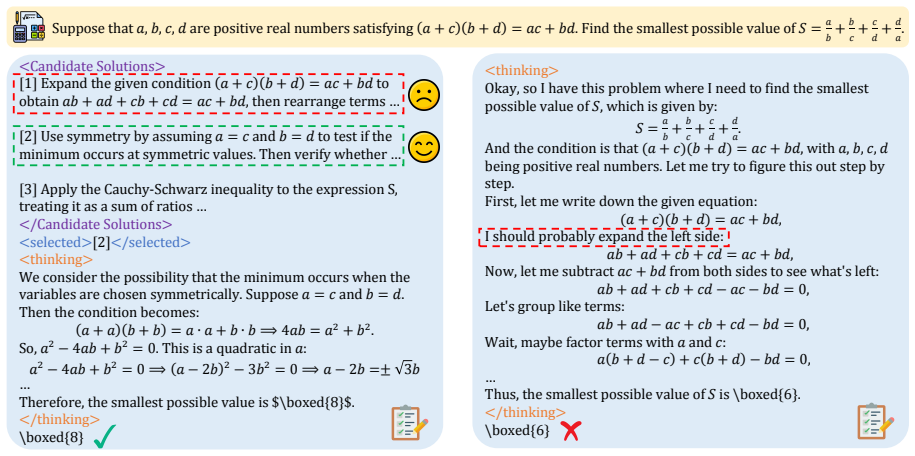
The load-bearing object is the propose-select-think trajectory, which splits reasoning into three identifiable parts: a candidate-solutions block listing 1–5 high-level outlines, a selected tag naming one outline, and a thinking block with the final derivation. This structure lets RL assign separate rewards to distinct behaviors. The diversity reward measures pairwise cosine similarity between embedded candidate outlines and is applied through a sine schedule that rises from zero after a warm-up; the reliability reward ranks outlines by mean token entropy and pays 1/rank for selecting the lowest-entropy outline, scaled by group-level accuracy. Together these convert a costly inference-time s
What would settle it
On a fixed benchmark set, take every candidate outline the trained model generates, compute its token entropy and (by sampling many continuations) the probability that it reaches the ground-truth answer, then rank the candidates both ways. If the rank correlation is near zero, or if low-entropy outlines repeatedly lead to wrong answers on problems where other outlines succeed, the reliability reward is rewarding confidence rather than correctness. The paper reports Spearman correlations of 0.57–0.67, so the decisive check is whether those correlations hold on held-out problems and in the tails
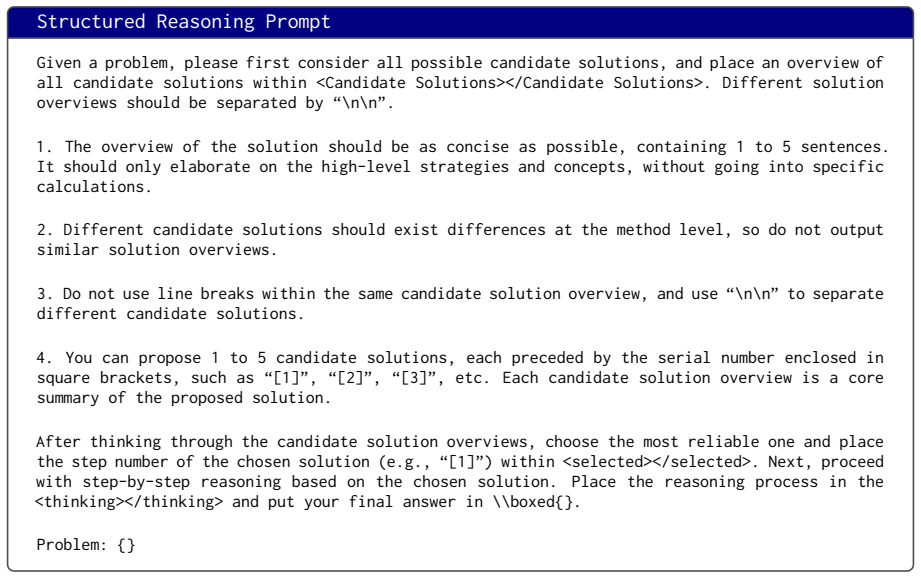
Extended reading notes
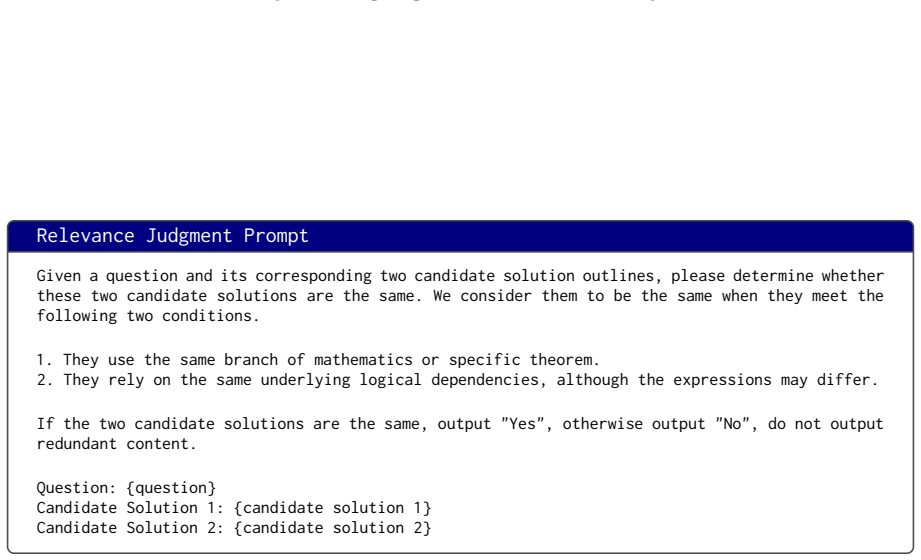
Core claim
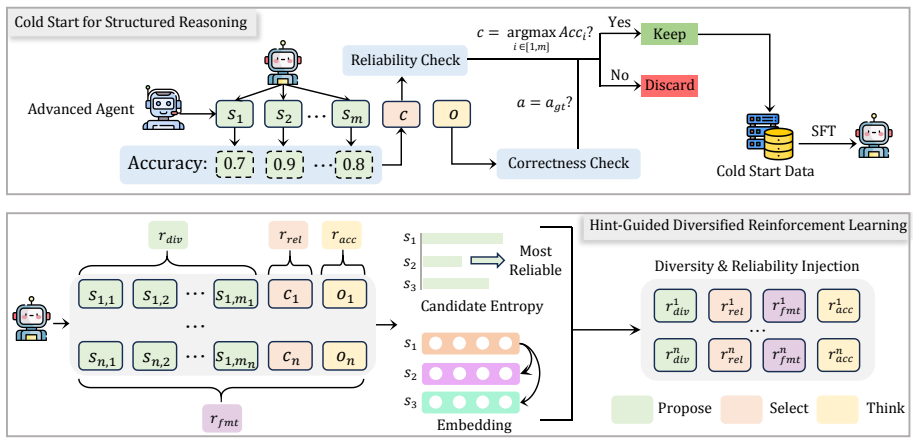
The paper argues that accuracy-only RLVR fails to incentivize the explore-then-commit behavior that human problem solving uses, and that this behavior can be taught directly into policy weights. Its central proposal is HDPO, a two-stage training scheme: first, cold-start supervised fine-tuning makes the model emit a set of candidate solution outlines, select one outline, and only then produce full reasoning; second, reinforcement learning shapes this behavior with format, accuracy, diversity, and reliability rewards. The paper reports that 4B–8B models trained this way outperform standard outcome-reward RL baselines on nine benchmarks—for one 7B backbone, average accuracy rises from 53.71 to
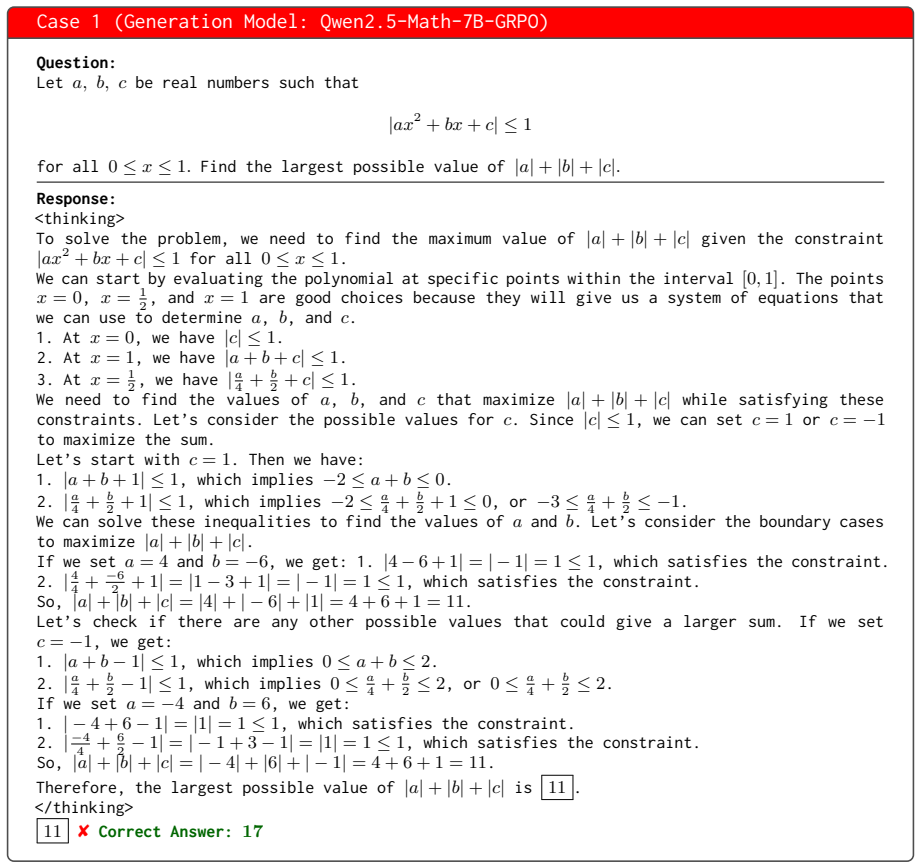
Load-bearing premise
That token-level confidence (low entropy) of a candidate outline is a faithful proxy for the probability that the outline leads to the correct answer, and that the lightweight model used in cold-start filtering measures that probability accurately; if low-entropy outlines are merely confident-but-wrong, the reliability reward teaches the model to commit to plausible errors.
Editorial extensions
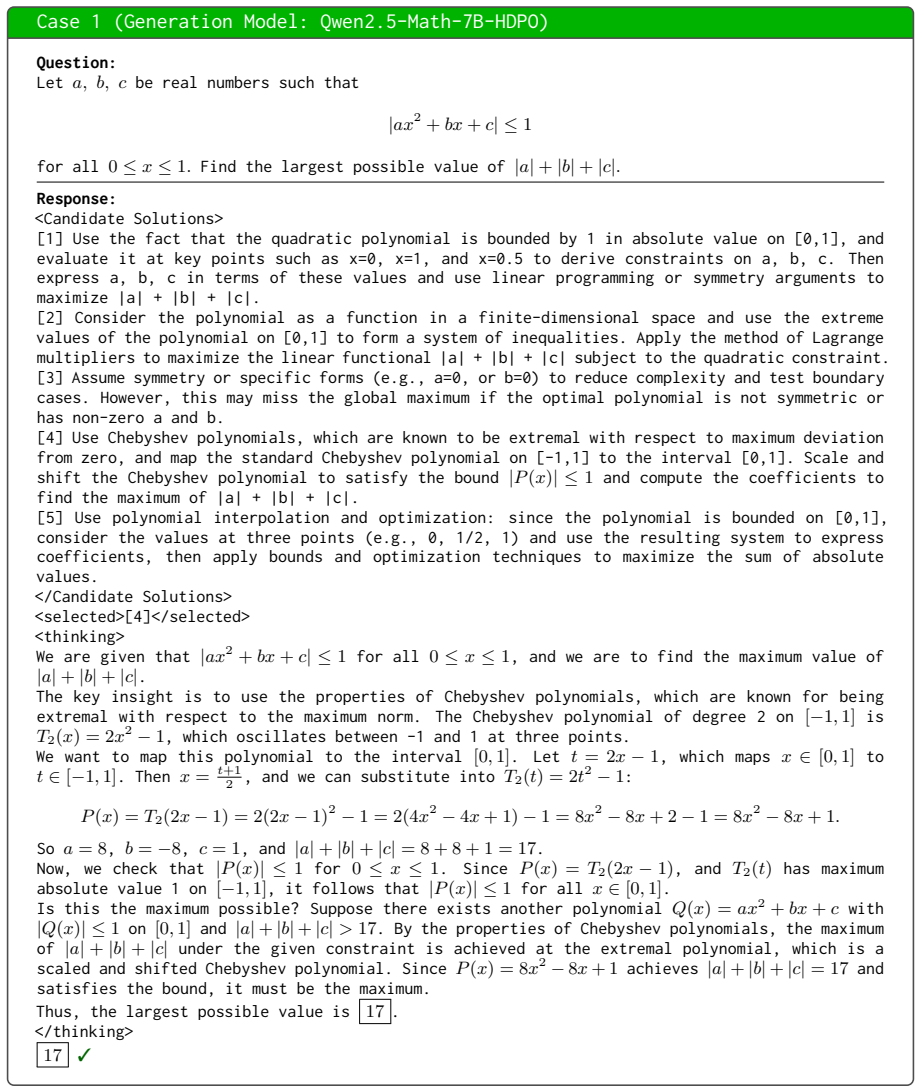
If this is right
- If HDPO is right, RLVR does not have to be limited to outcome-level correctness; process-level rewards for exploration and selection can be folded into policy weights without extra inference-time sampling.
- The gains appear to transfer across model families and sizes (4B, 7B, 8B) and across math and general reasoning benchmarks, suggesting the mechanism is not tied to one dataset or architecture.
- The self-evolution result implies that dependence on a large teacher can be reduced over iterations, making the overall pipeline cheaper to scale.
- Because the method wraps a group-relative policy optimizer, its reward design could be added to existing RLVR pipelines rather than requiring new optimization machinery.
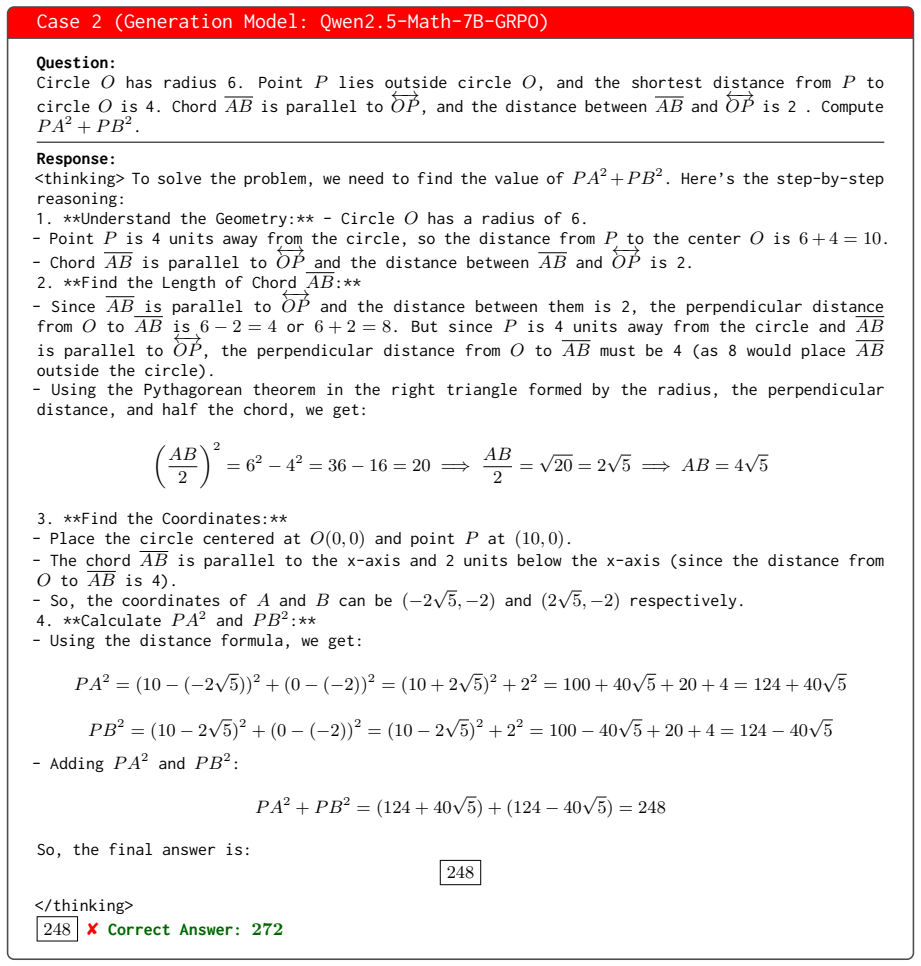
Reading between the lines
- Extension: If the entropy proxy is the true bottleneck, blending it with a cheap external verifier or a learned reliability classifier should push selection accuracy beyond the numbers reported in the paper; a test like that would separate the reliability-reward design from the propose-select-think structure itself.
- Extension: The paper evaluates on fixed math and general-knowledge benchmarks; applying HDPO to code generation or multi-step planning, where verifiable rewards exist but solution spaces are larger and answers are not a single number, would test whether the diversity-and-selection mechanism transfers beyond closed-form math.
- Extension: The diversity reward is gated by final-answer correctness, so the model is only rewarded for diversity when it already gets the answer right; an un-gated variant would reveal whether diversity is learned as a reasoning strategy or merely as a side effect of fitting the training distribution.
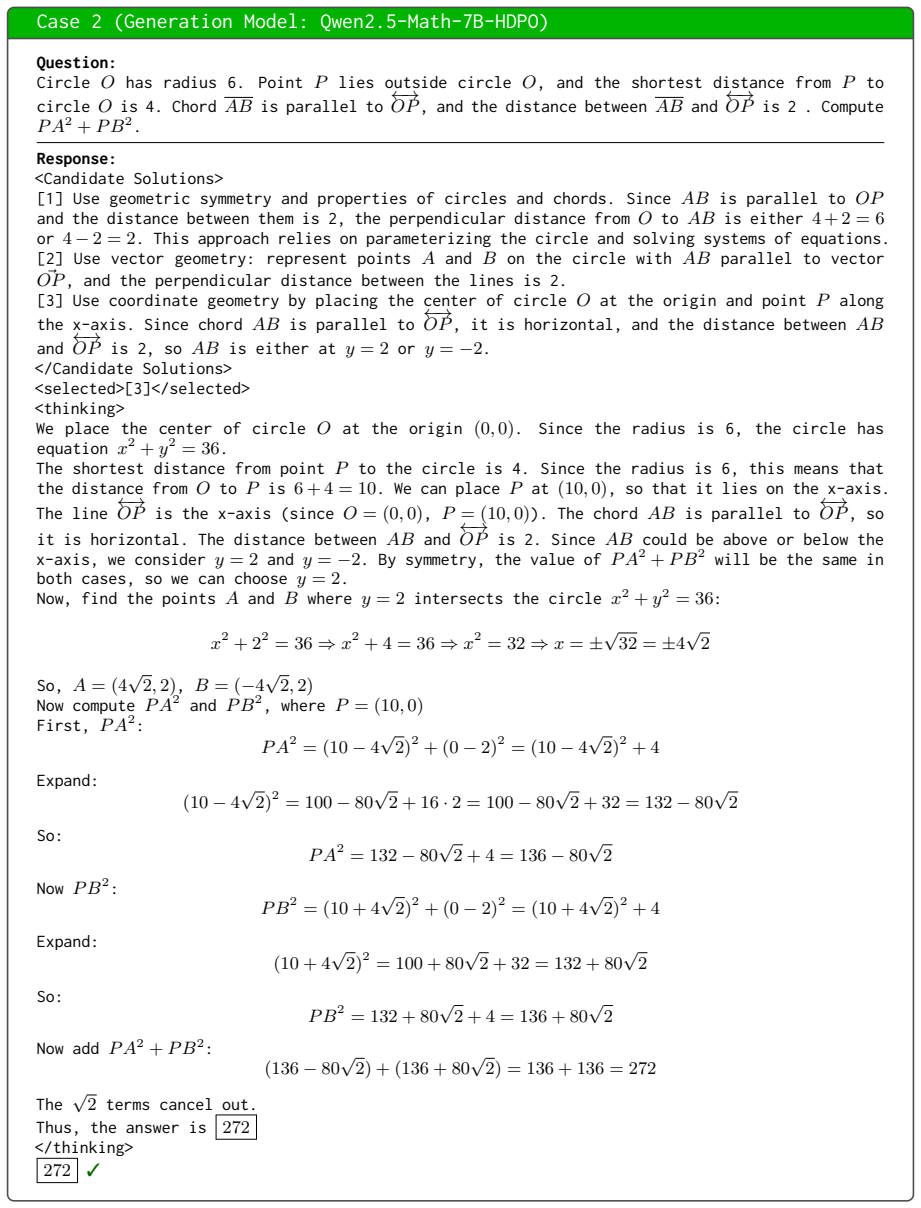
Signed reviews
Editorial analysis
A structured set of objections, weighed in public.
Referee Report
Summary. The paper proposes HDPO, a two-stage RLVR pipeline for LLM reasoning. In the first stage, the model is SFT on teacher-distilled ``propose-select-think'' trajectories: it generates multiple candidate solution outlines, selects one as a hint, and then produces a full solution. The distilled data is filtered by final-answer correctness and by a lightweight-model-based reliability check of the selected candidate. In the second stage, the model is fine-tuned with GRPO using a composite reward that adds a scheduled diversity reward (based on embedding similarity of candidate outlines) and a reliability reward (based on inverse entropy rank of the selected outline) to the usual format and accuracy rewards. Experiments on three backbones (Qwen3-4B, Qwen2.5-Math-7B, DeepSeek-R1-Distill-Llama-8B) and nine benchmarks report consistent improvements over GRPO and several prior RLVR baselines. Ablations cover the cold start, the RL phase, the diversity and reliability rewards, the scheduling, and several design variants.
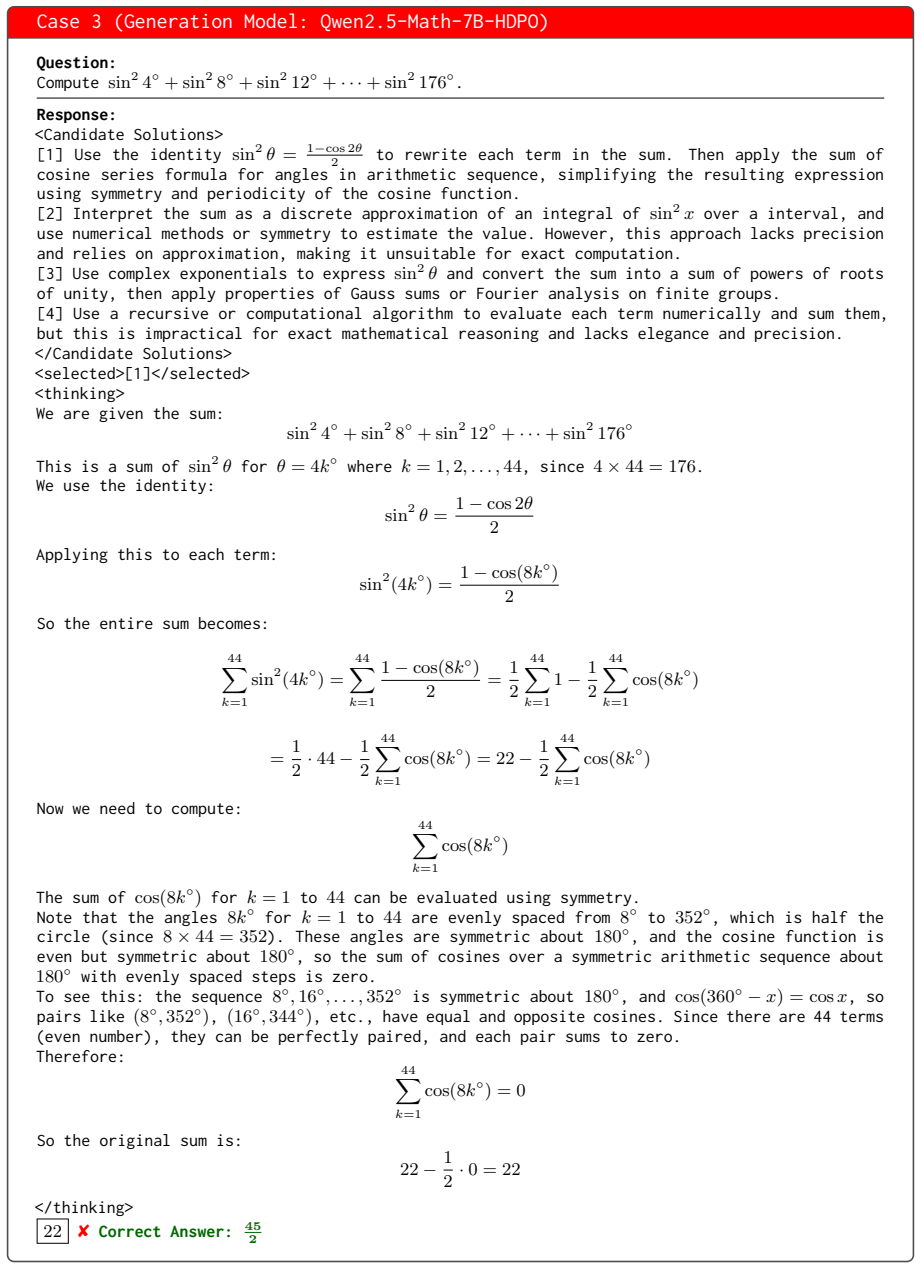
Significance. If the results are confirmed, the paper makes a useful empirical contribution: it shows that a reasoning policy can internalize a explore-then-select cycle at zero inference-time overhead, and that a diversity incentive plus an entropy-based reliability incentive can improve both final-answer accuracy and the quality of the selected candidate. The method is described in enough detail to reimplement, and the ablation coverage is broad (cold start, RL, diversity, scheduling, reliability, candidate count, embedding model, and alternative policy-optimization algorithms). A self-evolution variant that removes the external teacher is also explored. However, the strength of the central claim is currently limited by the absence of statistical uncertainty estimates, by the lack of a clear validation protocol for hyperparameters, and by the reliance on a moderate, proxy-based correlation to justify the reliability reward. The paper is a solid candidate in an active line of work, but these load-bearing issues need to be addressed before the reported gains can be taken at face value.
major comments (4)
- [§3.4, Eqs. (9)–(11); Table 4] The reliability reward is not gated by correctness. In Eq. (11), the term \bar{r_acc}·r_rel is nonzero for every trajectory in a group whenever at least one answer in the group is correct, regardless of that trajectory's own r_acc. Thus an incorrect trajectory that selects a low-entropy candidate still receives positive reliability reward. The paper's defense in Appendix J is informal; it argues that RLVR eventually corrects this, but no experiment demonstrates that the entropy ranking of the selected candidate correlates with the final answer's correctness after training. Table 3 reports only moderate Spearman correlations (0.57–0.67) between the entropy ranking and the Qwen3-1.7B-sampled accuracy, and that criterion is itself a proxy, not ground truth. Table 4's selection-accuracy metric uses the same lightweight sampler as the cold-start filter, so the observed improvement may reflect
- [§4.2, Table 1] No error bars, confidence intervals, or multiple seeds are reported for any result. For example, on AIME 25 the Qwen3-4B HDPO score is 27.92 against GRPO's 25.78; with 30 problems and a pass@3 estimate from 16 samples, this 2.14-point gap is very plausibly within sampling noise. Several other per-benchmark gaps are similarly small. The abstract and conclusion claim that HDPO "greatly boosts" reasoning ability, but single-run results cannot support that strength of claim. Please run at least three independent training runs per configuration and report means and standard deviations (or bootstrap confidence intervals), including for the baselines; state the number of seeds used throughout.
- [§3.3 and §4.3] The two-stage design is not isolated from the additional SFT data. HDPO adds 83,279 teacher-distilled trajectories during cold start, while the GRPO baseline receives only RL. The ablation "w/o Cold Start" shows that the RL rewards alone already outperform GRPO (e.g., AIME 25: 28.63 vs. 24.55), and "w/o RL" shows that cold-start SFT alone performs worse than GRPO. This leaves open the possibility that the gains of HDPO over GRPO come mainly from the reward design and not from the specific "propose-select-think" cold start. To attribute the gain to the structured trajectory, include a control that performs SFT on the same 83k trajectories in a standard chain-of-thought format (or with randomly selected candidates) before the same RL stage. Additionally, ablate the reliability filter in the cold-start data construction (e.g., keep all correct trajectories regardless of whether the selected
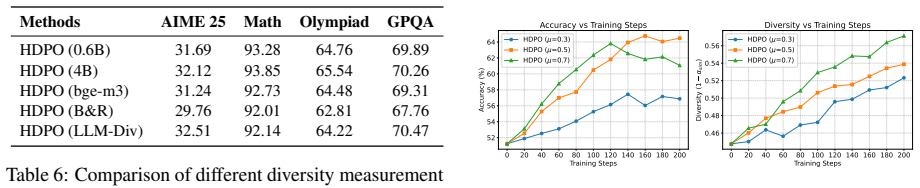
- [§4.2, Appendix D/G; Table 9; Figure 5] Hyperparameters appear to be selected directly on the evaluation benchmarks. Table 9 chooses the maximum number of candidates M=5 using AIME 25, Math-500, Olympiad-Bench, and GPQA; Figure 5 selects the diversity strength µ=0.5 using Olympiad-Bench; Table 6 selects the embedding model using the same benchmarks. If these test sets were used for model selection, the reported numbers are optimistically biased and the ablations in Table 2 are not independent. Please specify a held-out validation set (e.g., a split of the training data or a separate set such as MATH or Minerva) that was used for all hyperparameter and design choices, and report final test-benchmark results only after those choices were fixed. If a validation split was already used, state it explicitly in Section 4.1 or Appendix B.
minor comments (4)
- [Table 4] The metric is called "selection accuracy" but is not defined in the text. Please define it precisely, e.g., the fraction of problems for which the model's selected candidate has the highest Qwen3-1.7B-sampled accuracy among the generated candidates, and note that this is a proxy-based metric.
- [Eq. (8)] The diversity schedule uses t, twp, and tmax but the text does not explicitly state that t is the RL training step counting from 0. Please add a sentence clarifying the step indexing and that the sine factor reaches its maximum at t=tmax.
- [§4.1] The evaluation says "unbiased pass@3" with 16 samples; please state the estimator formula or cite Chen et al. (2021) precisely, and specify how the 16 samples are used to compute pass@3.
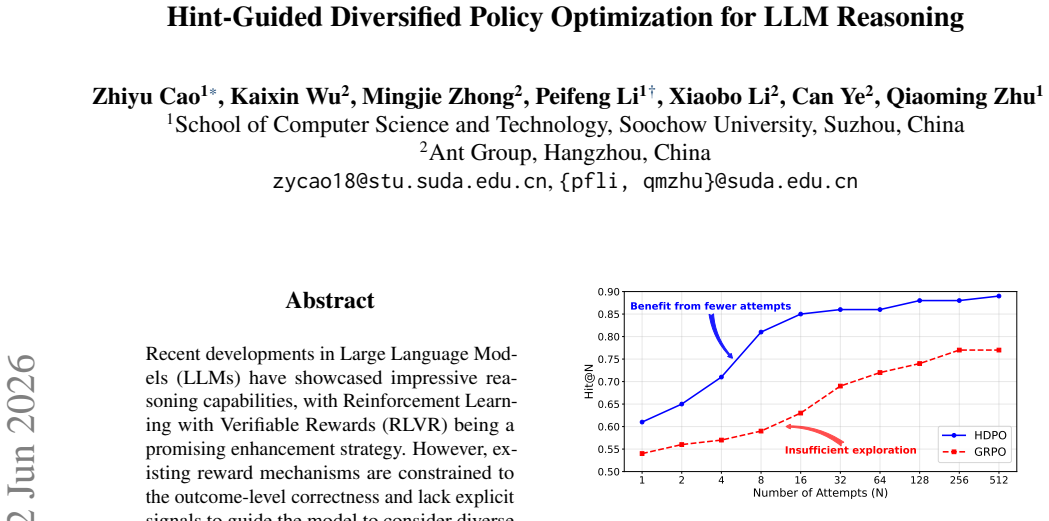
- [Figure 1] The Hit@N curves are not described in the caption: how many problems, what sampling temperature, and what is the policy used for each curve? Add these details to make the figure interpretable.
Circularity Check
No derivation-level circularity; one auxiliary diversity analysis reduces to the reward's own operand.
-
self definitional
[Section 3.4, Eq. (8); Section 4.4, Figure 4]
"rdiv = µ(1−αsim)·sin(π/2 · max(0, t−twp)/(tmax − twp)) ... We compared the trend of diversity of candidate solutions and the accuracy of answers during the training process before and after adding diversity rewards. (Figure 4 y-axis: 'Diversity (1 sim)')"
The diversity metric plotted in Figure 4 is exactly the core operand of the diversity reward being ablated: r_div is proportional to (1−α_sim) and the figure plots 'Diversity (1 sim)' against training steps. Thus showing that HDPO (with the diversity reward) has higher 'diversity (1 sim)' than 'w/o Div' is a check that optimizing the reward increases the reward's own operand, not an independent measurement of solution-space diversity. This is a minor, auxiliary analysis; the main benchmark conclusions do not depend on it.
full rationale
The central HDPO claim is an empirical training recipe evaluated on external benchmarks; it is not a formal derivation, and the headline gains are measured against ground-truth answers. There are no self-citations, no imported uniqueness theorems, and no fitted parameter that is later relabeled as a prediction. The reliability reward uses token entropy as a proxy, and the paper explicitly concedes this in the Limitations section ('HDPO employs the confidence of candidate solutions to estimate reliability'), making it a validity/correctness caveat rather than a circularity. Table 4's use of the same Section 3.3 lightweight-sampled accuracy that defined cold-start reliability does limit the independence of that particular internal validation, but the optimized signal (entropy ranking) and the validation metric (π_s accuracy) are distinct and only empirically correlated (Table 3). The only concrete construction-level circularity is Figure 4, whose diversity metric is the same (1−sim) term that the diversity reward directly optimizes; that is a small, non-load-bearing internal consistency check. Overall score is therefore low.
Assumptions & free parameters
free parameters (7)
- Diversity reward strength μ =
0.5
- Training schedule endpoints tmax, twp =
tmax=200, twp=20
- Maximum candidate solutions M =
5
- Rollout group size G =
8
- Reliability sampling count L =
10
- Format reward r_fmt =
0.1
- Embedding model for diversity =
Qwen3-Embedding-0.6B
assumptions (5)
- domain assumption Teacher Qwen3-235B-A22B-Instruct-2507 produces high-quality 'propose-select-think' trajectories, and Qwen3-1.7B sampled accuracy measures their reliability.
- domain assumption Token-level entropy of a candidate outline is a valid proxy for reliability.
- domain assumption Cosine similarity of embedding representations captures method-level diversity of candidate solutions.
- domain assumption GRPO/RLVR with verifiable rewards improves LLM reasoning.
- domain assumption DAPO-Math-17k + DeepScaleR datasets and pass@3 with 16 samples are adequate for training and evaluation.
Cite this review
Pith. "Pith review of Hint-Guided Diversified Policy Optimization for LLM Reasoning." pith.science (2026). https://pith.science/paper/PWK3NMHM
@misc{pith2026260603021,
  author       = {Pith},
  title        = {Pith review of: Hint-Guided Diversified Policy Optimization for LLM Reasoning},
  year         = {2026},
  howpublished = {\url{https://pith.science/paper/PWK3NMHM}},
  note         = {Machine review of arXiv:2606.03021}
}
read the original abstract
Recent developments in Large Language Models (LLMs) have showcased impressive reasoning capabilities, with Reinforcement Learning with Verifiable Rewards (RLVR) being a promising enhancement strategy. However, existing reward mechanisms are constrained to the outcome-level correctness and lack explicit signals to guide the model to consider diverse solutions. In contrast, human problem solving typically involves evaluating multiple potential approaches and selecting the most reliable solution, a cognitive process that current RLVR frameworks do not explicitly incentivize. Inspired by this, we propose Hint-Guided Diversified Policy Optimization (HDPO), allowing the model to first list all potential candidate solution outlines as hints and then select the most reliable one for further reasoning. HDPO comprises two stages of Cold Start for Structured Reasoning and Hint-Guided Diversified Reinforcement Learning to incentivize the model to generate diverse and reliable solutions following the ``propose-select-think'' trajectory. Experimental results show that HDPO effectively boosts LLM reasoning and enhances the diversity of candidate solutions as well as the LLM's ability to identify reliable solutions.
Figures
Figures from the paper (9 more)

Reference graph
Works this paper leans on
-
[1]
It should only elaborate on the high-level strategies and concepts, without going into specific calculations
The overview of the solution should be as concise as possible, containing 1 to 5 sentences. It should only elaborate on the high-level strategies and concepts, without going into specific calculations
-
[2]
Different candidate solutions should exist differences at the method level, so do not output similar solution overviews
-
[3]
Do not use line breaks within the same candidate solution overview, and use “\n\n” to separate different candidate solutions
-
[4]
Qwen3 technical report.arXiv preprint arXiv:2505.09388. An Yang, Beichen Zhang, Binyuan Hui, Bofei Gao, Bowen Yu, Chengpeng Li, Dayiheng Liu, Jianhong Tu, Jingren Zhou, Junyang Lin, and 1 others. 2024. Qwen2. 5-math technical report: Toward mathe- matical expert model via self-improvement.arXiv preprint arXiv:2409.12122. Shunyu Yao, Dian Yu, Jeffrey Zhao,...
arXiv 2024
-
[5]
propose-select-think
Use polynomial interpolation and optimization: since the polynomial is bounded on [0,1], consider the values at three points (e.g., 0, 1/2, 1) and use the resulting system to express coefficients, then apply bounds and optimization techniques to maximize the sum of absolute values. </Candidate Solutions> <selected>[4]</selected> <thinking> We are given th...
-
[6]
OpenReview.net. 11 Methods AIME 25 Math Olympiad GPQA HDPO (0.6B) 31.69 93.28 64.76 69.89 HDPO (4B) 32.12 93.85 65.54 70.26 HDPO (bge-m3) 31.24 92.73 64.48 69.31 HDPO (B&R) 29.76 92.01 62.81 67.76 HDPO (LLM-Div) 32.51 92.14 64.22 70.47 Table 6: Comparison of different diversity measurement methods. A Prompt for Structured Reasoning We provide the prompt u...
arXiv 2024
-
[7]
as representative baseline algorithms for eval- uation. As shown in Table 8, integrating HDPO into each baseline algorithm yielded consistent per- formance improvements, thereby establishing the generalizability of our approach across diverse pol- icy optimization frameworks. G Impact of Maximum Number of Candidates To enhance the diversity of solutions e...
2023
-
[8]
ex- plore–evaluate–select
paradigms that rely on repeated model calls, explicit tree expansion, or post-hoc vot- ing during inference, HDPO internalizes the “ex- plore–evaluate–select” cognitive cycle directly into the policy network. This design preserves the fault- tolerance benefits of multi-path reasoning while eliminating the linear-to-exponential latency over- head inherent ...
2025
Show all 35 references
-
[12]
[1]”, “[2]
You can propose 1 to 5 candidate solutions, each preceded by the serial number enclosed in square brackets, such as “[1]”, “[2]”, “[3]”, etc. Each candidate solution overview is a core summary of the proposed solution. After thinking through the candidate solution overviews, c...
-
[13]
They use the same branch of mathematics or specific theorem
-
[14]
Yes", otherwise output
They rely on the same underlying logical dependencies, although the expressions may differ. If the two candidate solutions are the same, output "Yes", otherwise output "No", do not output redundant content. Question: {question} Candidate Solution 1: {candidate solution 1} Cand...
-
[15]
Atx= 0, we have|c| ≤1
-
[16]
Atx= 1, we have|a+b+c| ≤1
-
[17]
We need to find the values ofa,b, andcthat maximize|a|+|b|+|c|while satisfying these constraints
Atx= 1 2, we have| a 4 + b 2 +c| ≤1. We need to find the values ofa,b, andcthat maximize|a|+|b|+|c|while satisfying these constraints. Let’s consider the possible values forc. Since|c| ≤1, we can setc= 1orc=−1 to maximize the sum. Let’s start withc= 1. Then we have: 1.|a+b+ 1|...
-
[18]
Then express a, b, c in terms of these values and use linear programming or symmetry arguments to maximize |a| + |b| + |c|
Use the fact that the quadratic polynomial is bounded by 1 in absolute value on [0,1], and evaluate it at key points such as x=0, x=1, and x=0.5 to derive constraints on a, b, c. Then express a, b, c in terms of these values and use linear programming or symmetry arguments to ...
-
[19]
Apply the method of Lagrange multipliers to maximize the linear functional |a| + |b| + |c| subject to the quadratic constraint
Consider the polynomial as a function in a finite-dimensional space and use the extreme values of the polynomial on [0,1] to form a system of inequalities. Apply the method of Lagrange multipliers to maximize the linear functional |a| + |b| + |c| subject to the quadratic constraint
-
[20]
However, this may miss the global maximum if the optimal polynomial is not symmetric or has non-zero a and b
Assume symmetry or specific forms (e.g., a=0, or b=0) to reduce complexity and test boundary cases. However, this may miss the global maximum if the optimal polynomial is not symmetric or has non-zero a and b
-
[21]
Scale and shift the Chebyshev polynomial to satisfy the bound|P(x)| ≤1and compute the coefficients to find the maximum of |a| + |b| + |c|
Use Chebyshev polynomials, which are known to be extremal with respect to maximum deviation from zero, and map the standard Chebyshev polynomial on [-1,1] to the interval [0,1]. Scale and shift the Chebyshev polynomial to satisfy the bound|P(x)| ≤1and compute the coefficients ...
-
[23]
- PointPis 4 units away from the circle, so the distance fromPto the centerOis6 + 4 = 10
**Understand the Geometry:** - CircleOhas a radius of 6. - PointPis 4 units away from the circle, so the distance fromPto the centerOis6 + 4 = 10. - Chord ABis parallel to ← →OPand the distance between ABand ← →OPis 2
-
[24]
But sincePis 4 units away from the circle and AB is parallel to ← →OP, the perpendicular distance fromOto ABmust be 4 (as 8 would place AB outside the circle)
**Find the Length of Chord AB:** - Since ABis parallel to ← →OPand the distance between them is 2, the perpendicular distance fromOto ABis6−2 = 4or6 + 2 = 8. But sincePis 4 units away from the circle and AB is parallel to ← →OP, the perpendicular distance fromOto ABmust be 4 (...
-
[25]
- The chord ABis parallel to the x-axis and 2 units below the x-axis (since the distance from Oto ABis 4)
**Find the Coordinates:** - Place the circle centered atO(0,0)and pointPat(10,0). - The chord ABis parallel to the x-axis and 2 units below the x-axis (since the distance from Oto ABis 4). - So, the coordinates ofAandBcan be(−2 √ 5,−2)and(2 √ 5,−2)respectively
-
[26]
**CalculateP A2 andP B2:** - Using the distance formula, we get: P A2 = (10−(−2 √ 5))2 + (0−(−2)) 2 = (10 + 2 √ 5)2 + 22 = 100 + 40 √ 5 + 20 + 4 = 124 + 40 √ 5 P B2 = (10−2 √ 5)2 + (0−(−2)) 2 = (10−2 √ 5)2 + 22 = 100−40 √ 5 + 20 + 4 = 124−40 √ 5 - AddingP A2 andP B2: P A2 +P B...
-
[27]
19 Case 2 (Generation Model: Qwen2.5-Math-7B-HDPO) Question: CircleOhas radius 6
= 248 So, the final answer is: 248 </thinking> 248 ✘Correct Answer:272 Figure 10: The output produced by Qwen2.5-Math-7B following GRPO training with standard chain-of-thought reasoning in the second test case. 19 Case 2 (Generation Model: Qwen2.5-Math-7B-HDPO) Question: Circl...
-
[28]
SinceABis parallel toOP and the distance between them is 2, the perpendicular distance fromOtoABis either4 + 2 = 6 or4−2 = 2
Use geometric symmetry and properties of circles and chords. SinceABis parallel toOP and the distance between them is 2, the perpendicular distance fromOtoABis either4 + 2 = 6 or4−2 = 2. This approach relies on parameterizing the circle and solving systems of equations
-
[29]
Use vector geometry: represent pointsAandBon the circle withABparallel to vector ⃗OP, and the perpendicular distance between the lines is 2
-
[30]
Since chordABis parallel to ← →OP, it is horizontal, and the distance betweenAB and ← →OPis 2, soABis either aty= 2ory=−2
Use coordinate geometry by placing the center of circleOat the origin and pointPalong the x-axis. Since chordABis parallel to ← →OP, it is horizontal, and the distance betweenAB and ← →OPis 2, soABis either aty= 2ory=−2. </Candidate Solutions> <selected>[3]</selected> <thinkin...
-
[31]
propose-select-think
= 136 + 136 = 272 The √ 2terms cancel out. Thus, the answer is272 </thinking> 272 ✓ Figure 11: The output produced by Qwen2.5-Math-7B following HDPO training using “propose-select-think” structured reasoning in the second test case. 20 Case 3 (Generation Model: Qwen2.5-Math-7B...
-
[32]
Then apply the sum of cosine series formula for angles in arithmetic sequence, simplifying the resulting expression using symmetry and periodicity of the cosine function
Use the identitysin 2 θ= 1−cos 2θ 2 to rewrite each term in the sum. Then apply the sum of cosine series formula for angles in arithmetic sequence, simplifying the resulting expression using symmetry and periodicity of the cosine function
-
[33]
However, this approach lacks precision and relies on approximation, making it unsuitable for exact computation
Interpret the sum as a discrete approximation of an integral ofsin 2 xover a interval, and use numerical methods or symmetry to estimate the value. However, this approach lacks precision and relies on approximation, making it unsuitable for exact computation
-
[34]
Use complex exponentials to expresssin 2 θand convert the sum into a sum of powers of roots of unity, then apply properties of Gauss sums or Fourier analysis on finite groups
-
[35]
</Candidate Solutions> <selected>[1]</selected> <thinking> We are given the sum: sin2 4◦ + sin2 8◦ + sin2 12◦ +· · ·+ sin2 176◦ This is a sum ofsin 2 θforθ= 4k ◦ wherek= 1,2,
Use a recursive or computational algorithm to evaluate each term numerically and sum them, but this is impractical for exact mathematical reasoning and lacks elegance and precision. </Candidate Solutions> <selected>[1]</selected> <thinking> We are given the sum: sin2 4◦ + sin2...
-
[2022]
Training language models to follow instruc- tions with human feedback. InAdvances in Neural Information Processing Systems 35: Annual Confer- ence on Neural Information Processing Systems 2022, NeurIPS 2022, New Orleans, LA, USA, November 28 - December 9, 2022. David Rein, Bet...
2022 arXiv
-
[2023]
Tree of thoughts: Deliberate problem solving with large language models. InAdvances in Neural Information Processing Systems 36: Annual Confer- ence on Neural Information Processing Systems 2023, NeurIPS 2023, New Orleans, LA, USA, December 10 - 16, 2023. Qiying Yu, Zheng Zhan...
2023 arXiv
-
[2024]
InThe Twelfth 10 International Conference on Learning Representa- tions, ICLR 2024, Vienna, Austria, May 7-11, 2024
Text2reward: Reward shaping with language models for reinforcement learning. InThe Twelfth 10 International Conference on Learning Representa- tions, ICLR 2024, Vienna, Austria, May 7-11, 2024. OpenReview.net. Jianhao Yan, Yafu Li, Zican Hu, Zhi Wang, Ganqu Cui, Xiaoye Qu, Yu ...
2024 arXiv
-
[2025]
5: Scaling reinforcement learning with llms.arXiv preprint arXiv:2501.12599
Kimi k1. 5: Scaling reinforcement learning with llms.arXiv preprint arXiv:2501.12599. Xiaoxuan Wang, Ziniu Hu, Pan Lu, Yanqiao Zhu, Jieyu Zhang, Satyen Subramaniam, Arjun R. Loomba, Shichang Zhang, Yizhou Sun, and Wei Wang. 2024a. Scibench: Evaluating college-level scientific ...
2024 arXiv
Reviewed August 2, 2026 · model on record in the stance chip above.
Discussion (0). Continue with ORCID to comment.