REVIEW 4 major objections 6 minor 33 references
Pixel-Resolved Long-Context Learning for Turbulence at Exascale: Resolving Small-scale Eddies Toward the Viscous Limit
T0 review · 4 major / 6 minor · reviewed 2026-08-06 · deepseek-v4-flash
Pith's one-line read This paper claims that a pixel-resolved transformer with a multi-fidelity hierarchy and RingX parallel attention can reproduce turbulence statistics down to the dissipative range, a first for AI models.
desk verdict RingX is a genuinely useful systems result and the scaling numbers are strong, but the one-step HIT validation lacks a persistence baseline and temporal-spacing details, so the 'first to resolve the dissipative range' claim is not yet established. read the letter →
The pith
A machine-rendered reading of the paper's core claim, the machinery that carries it, and where it could break.
The reading
What carries the argument
The argument rests on two mechanisms. The first is the Turbulence Transformer, which decomposes a full-resolution field into three fidelity branches: a globally Gaussian-filtered low-fidelity branch for long-range large-scale physics, a mid-fidelity branch that filters and crops an intermediate subdomain, and a high-fidelity branch that attends to a local subdomain at full pixel resolution, mirroring the RANS/LES/DNS decomposition in computational fluid dynamics. This cuts the token sequence from billions to roughly one to four million while preserving pixel-level information where it matters. The second mechanism is RingX parallel attention, which computes the exact softmax attention of Eq. (1) by splitting the sequence across GPUs and using the associativity of the log-sum-exp trick, Eq. (5), to combine partial outputs. Two variants, RingXa (broadcast/reduce) and RingXb (allgather/reduce-scatter), replace the point-to-point KV ring exchanges of Ring Attention with collective communication on HPC interconnects and overlap communication with computation. The combination of the two mechanisms is what makes pixel-resolved long-context training practical at million-token sequences.
What would settle it
Run a persistence baseline that predicts the current frame as the last input snapshot on the same held-out JHTDB test samples, and compute the high-wavenumber energy spectrum and enstrophy/dissipation PDFs; also report the physical time step between successive JHTDB snapshots used for training. If the persistence baseline matches Matey-Medium's dissipative-range spectrum or the snapshot interval is comparable to the Kolmogorov time scale, the claim that the model resolves small-scale dynamics is not supported.
Extended reading notes
Core claim
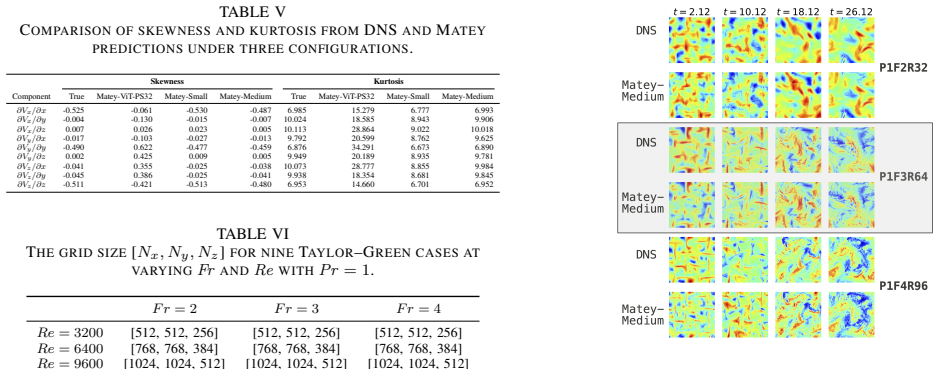
The central claim is that a pixel-resolved transformer with patch size $1^{3}$, trained on 100 sequences of $1024^{3}$ forced homogeneous isotropic turbulence data, can learn small-scale eddy dynamics well enough to reproduce, on held-out frames, the energy spectrum down to the dissipative range, the probability distributions of enstrophy and dissipation, the joint enstrophy–dissipation distribution, and the skewness and kurtosis of velocity gradients. The same medium model, without retuning, is claimed to capture the laminar-to-turbulence transition and the subsequent decay of kinetic and potential energy in stratified Taylor–Green flow across a matrix of Froude and Reynolds numbers. The paper presents these results as the first instance of a deep-learning model resolving all relevant scales in three-dimensional high-Reynolds-number turbulence, with the large-patch Matey-ViT-PS32 baseline failing on the same metrics.
Load-bearing premise
The load-bearing premise is that the four consecutive input snapshots are separated in time enough that the small-scale eddies in the target frame are not simply carried forward from the inputs, so the model's dissipative-range accuracy reflects learned scale dynamics rather than persistence of nearly frozen fields.
Editorial extensions
If this is right
- A transformer with patch size 1^3 can replace large-patch vision transformers for turbulence surrogate modeling, recovering the high-wavenumber statistics that patch-based models miss.
- The RingX attention kernel is a drop-in replacement for exact softmax attention and scales near-linearly with GPU count, so other long-context transformer applications can adopt it without changing their attention-layer design.
- Training at full DNS resolution becomes practical: the reported 1.1 exaflops at 94% scaling efficiency implies a viable path toward turbulence foundation models trained on trillions of grid points.
- The multi-fidelity decomposition is claimed to transfer to stratified Taylor–Green flow, indicating the approach is not limited to isotropic turbulence.
Reading between the lines
- Beyond the paper: the 'first to resolve the dissipative range' claim depends on the physical time step between the four input snapshots. Reporting that interval and comparing against a persistence baseline (using the last input frame as the prediction) would show whether the high-wavenumber agreement reflects learned dynamics or simply carried-forward structures.
- Beyond the paper: the fixed Gaussian filter sizes and subdomain crops are chosen from physical intuition; in flows without clear scale separation the same decomposition would need learned or adaptive filter parameters, a natural extension of the method.
- Beyond the paper: the Taylor–Green transfer results suggest the model may generalize across Froude and Reynolds numbers, but the paper does not report uncertainty or error bars on the energy curves; a quantitative per-case error metric would sharpen the claim.
Editorial analysis
A structured set of objections, weighed in public.
Referee Report
Summary. The paper presents two contributions: a new parallel attention scheme (RingX) and a multiscale hierarchical transformer architecture (Matey) designed to train on full-resolution 3D turbulence data. Scaling experiments on Frontier report up to 1.1 EFLOPS on 32,768 GPUs with 94% scaling efficiency. For scientific evaluation, the paper trains Matey on forced homogeneous isotropic turbulence (HIT) from JHTDB, making one-step predictions from previous snapshots, and reports agreement with DNS for the energy spectrum, enstrophy/dissipation PDFs, and velocity-gradient skewness/kurtosis, concluding that the model is the first to capture small-scale eddies down to the dissipative range. A second experiment on stratified Taylor-Green flows tests generalized prediction of energy evolution across unseen parameter combinations.
Significance. If sustained, the scientific claim would be significant: an ML model reproducing dissipative-range statistics in 3D HIT at Re_lambda about 433 would be a clear advance over prior turbulence ML studies, and the system-level result of efficient exact-attention training at exascale is valuable in its own right. The paper's strengths include the measured kernel speedups over Ring Attention, the communication/memory analysis in Table I, the careful scaling measurements up to 32,768 GPUs, and the physically motivated multi-fidelity decomposition. The comparison against a patch-32 ViT is a useful control showing that patch resolution matters. However, the evidence for the flagship scientific claim is incomplete: the one-step evaluation lacks temporal controls, baselines, and error bars, and the fusion mechanism that produces the full-resolution output is unspecified. These are fixable with additional experiments and details, so the result is defensible but not yet established.
major comments (4)
- [§V-B, Figs. 11–13, Table V] The central claim that Matey-Medium 'captures the full spectral range down toward the viscous limit' is based on single-step predictions, but the paper does not report the time interval dt between successive JHTDB snapshots or the Kolmogorov time scale tau_eta. If dt is a small fraction of tau_eta, the dissipative-range structures in the target frame are already present in the most recent input frame, and a persistence baseline (Y_{t+1}=Y_t) or linear interpolation of the input frames would reproduce the energy spectrum, PDF tails, and high-order moments without learning the nonlinear cascade. Please report dt/tau_eta, add persistence and linear-interpolation baselines, and ideally include multi-step rollout errors to establish that the model actually learns small-scale dynamics.
- [§V-B, data split] The paper states that 96 samples from 100 JHTDB sequences were split 80/20 into training and test sets, but it does not state whether the split is temporally disjoint (e.g., by sequence) or random over overlapping frames. If training and test samples share nearby snapshots, temporal correlation can leak target information into training and inflate the reported accuracy. Please specify how the 100 sequences were constructed, the temporal overlap between samples, and the split criterion, and report per-test-sample statistics or error bars for the metrics in Figs. 11–13 and Table V.
- [§III-B and §V-B] The fusion mechanism of the three fidelity branches is not described. The input decomposition into F1(Y), F2(C2(Y)), and C3(Y) is specified, but the manuscript never explains how the model combines the low-, mid-, and high-fidelity predictions into the full 1024^3 output field from which the energy spectra, PDFs, and moments are computed. Without this specification, the reader cannot determine whether the resolved small scales come from the learned high-fidelity branch or from the reconstruction/post-processing. Please provide the exact output fusion algorithm and clarify the role of each branch in producing the final field.
- [§V-B vs. Table III] The configuration of Matey-Medium used in the HIT experiment differs from the one listed in Table III. In §V-B, the authors state that for Matey-Medium they increased input steps from 2 to 4 and adjusted the filter size to [1,8,16] and mode size ratio to [16x,2x,1x] to keep the sequence length at 1M, while Table III lists Matey-Medium with filter (1,4,8), mode size ratio (8x,2x,1x), and 2 time steps. Please clarify which configuration produced the results in Figs. 11–13 and Table V, and update the table or the text so that the evaluated model is unambiguously reproducible.
minor comments (6)
- [Fig. 4 caption] The caption contains the typo 'squence length'; it should read 'sequence length'.
- [§V-A] The text contains the typo 'accomodate'; it should read 'accommodate'.
- [Eq. (6)] The notation Y_{t+t_lead} with a lead time parameter t_lead is not used in the HIT experiment, which predicts Y_{n+1} from the previous M snapshots; please clarify the relationship between the general formulation and the experimental setup.
- [§V-B, Figs. 11–13] The text refers to 'a test sample' in Fig. 10, but it is unclear whether the spectra and PDFs in Figs. 11–13 are computed from a single test sample or aggregated over all test samples; please state this explicitly.
- [§V-B and Eq. (7)] The statement that for fixed data and model sizes the training FLOPs are independent of sequence length when S is comparable to h is not immediately obvious from Eq. (7), since the first term 4bS^2h depends on S even with bS fixed; please rephrase or provide the intended derivation.
- [References] Reference [16] is titled 'MATEY' and the present work uses the same model name; the relationship between the two papers and the specific novel contributions of this manuscript should be clarified.
Circularity Check
No significant circularity: the predictions are supervised outputs on held-out DNS frames, and no load-bearing result reduces to its own input.
full rationale
The paper's derivation chain is a supervised-learning benchmark, not an analytical derivation. Equation (6) defines the task as learning f_w mapping M input flow states to a future state; the reported quantities (energy spectrum, enstrophy/dissipation PDFs, skewness, kurtosis) are computed from predicted fields on a held-out 20% test split and compared to JHTDB DNS, so they are not reused as training inputs or fit targets. The multi-fidelity tokenization hyperparameters (filter sizes and mode-size ratios) are architectural choices justified by physics and computational constraints, not fitted to the reported dissipative-range statistics, and the RingX attention algorithm computes the exact attention of Eq. (1). There is a self-citation to the authors' prior MATEY work [16] in the related-work discussion, but it is not load-bearing: the Turbulence Transformer architecture and its evaluation are described and tested in this paper against external DNS, with no uniqueness theorem or equation imported from [16]. The strongest reservations—unreported JHTDB snapshot spacing, absence of a persistence baseline, and unspecified temporal split—are threats to the validity of the scientific claim but are not circularity, because the prediction target is not defined as, nor reduced to, its input frames. No equation-level circular step was found.
Assumptions & free parameters
free parameters (3)
- Turbulence Transformer hyperparameters (filter sizes k1,k2,k3, mode size ratios, patch sizes) =
Small: (1,4,8) and (8x,2x,1x). Medium: (1,8,16) and (16x,2x,1x)
- Subdomain location [xc,yc,zc] =
uniformly random sampling
- Training hyperparameters (learning rate, epochs, loss weights, optimizer) =
not reported
assumptions (5)
- domain assumption JHTDB DNS data at 1024^3 resolution is an accurate ground truth for turbulence statistics at Re_lambda approximately 433.
- domain assumption Energy spectrum, enstrophy and dissipation PDFs, and velocity-gradient moments are the appropriate metrics for determining whether small scales are resolved.
- ad hoc to paper The three-branch multi-fidelity decomposition (coarse global, mid, local high-res) can represent the full 1024^3 field without loss of small-scale information.
- domain assumption The train/test split ensures that test samples are independent of training samples.
- standard math Flash Attention computes the same attention scores as Eq. (1) within numerical rounding.
Cite this review
Pith. "Pith review of Pixel-Resolved Long-Context Learning for Turbulence at Exascale: Resolving Small-scale Eddies Toward the Viscous Limit." pith.science (2026). https://pith.science/paper/PWNWD7EG
@misc{pith2026250716697,
  author       = {Pith},
  title        = {Pith review of: Pixel-Resolved Long-Context Learning for Turbulence at Exascale: Resolving Small-scale Eddies Toward the Viscous Limit},
  year         = {2026},
  howpublished = {\url{https://pith.science/paper/PWNWD7EG}},
  note         = {Machine review of arXiv:2507.16697}
}
read the original abstract
Turbulence plays a crucial role in multiphysics applications, including aerodynamics, fusion, and combustion. Accurately capturing turbulence's multiscale characteristics is essential for reliable predictions of multiphysics interactions, but remains a grand challenge even for exascale supercomputers and advanced deep learning models. The extreme-resolution data required to represent turbulence, ranging from billions to trillions of grid points, pose prohibitive computational costs for models based on architectures like vision transformers. To address this challenge, we introduce a multiscale hierarchical Turbulence Transformer that reduces sequence length from billions to a few millions and a novel RingX sequence parallelism approach that enables scalable long-context learning. We perform scaling and science runs on the Frontier supercomputer. Our approach demonstrates excellent performance up to 1.1 EFLOPS on 32,768 AMD GPUs, with a scaling efficiency of 94%. To our knowledge, this is the first AI model for turbulence that can capture small-scale eddies down to the dissipative range.
Figures


Figures from the paper (10 more)



Reference graph
Works this paper leans on
-
[1]
S. B. Pope, Turbulent Flows . Cambridge University Press, 2000
work page 2000
-
[2]
Paradigms in turbulent combustion research,
R. Bilger, S. Pope, K. Bray, and J. Driscoll, “Paradigms in turbulent combustion research,” Proc. Combust. Inst. , vol. 30, no. 1, pp. 21–42, 2005
work page 2005
-
[3]
Electromagnetic effects on plasma microturbulence and transport,
P. Snyder and G. Hammett, “Electromagnetic effects on plasma microturbulence and transport,” Phys. Plasma , vol. 8, no. 3, pp. 744–749, 2001
work page 2001
-
[4]
P. Yeung, K. Ravikumar, S. Nichols, and R. Uma- Vaideswaran, “GPU-enabled extreme-scale turbulence simulations: Fourier pseudo-spectral algorithms at the ex- ascale using OpenMP offloading,” Comput. Phys. Com- mun., vol. 306, p. 109364, 2025
work page 2025
-
[5]
Climax: A foundation model for weather and climate,
T. Nguyen, J. Brandstetter, A. Kapoor, J. K. Gupta, and A. Grover, “Climax: A foundation model for weather and climate,” arXiv preprint arXiv:2301.10343 , 2023
arXiv 2023
-
[6]
A foundation model for the earth system,
C. Bodnar et al. , “A foundation model for the earth system,” arXiv preprint arXiv:2405.13063 , 2024
arXiv 2024
-
[7]
ORBIT: Oak Ridge Base Foundation Model for Earth System Predictability,
X. Wang et al. , “ORBIT: Oak Ridge Base Foundation Model for Earth System Predictability,” in SC24: Inter- national Conference for High Performance Computing, Networking, Storage and Analysis , 2024, pp. 1–11
work page 2024
-
[8]
Y . Li et al. , “A public turbulence database cluster and applications to study lagrangian evolution of velocity increments in turbulence,” J. Turbul., no. 9, p. N31, 2008
work page 2008
Show all 33 references
-
[9]
System optimizations for enabling training of extreme long sequence transformer models,
S. A. Jacobs et al. , “System optimizations for enabling training of extreme long sequence transformer models,” in Proceedings of the 43rd ACM Symposium on Princi- ples of Distributed Computing , 2024, p. 121–130
2024
-
[10]
Efficient Large-Scale Language Model Training on GPU Clusters Using Megatron-LM,
D. Narayanan et al. , “Efficient Large-Scale Language Model Training on GPU Clusters Using Megatron-LM,” in Proceedings of the International Conference for High Performance Computing, Networking, Storage and Anal- ysis, 2021
2021
-
[11]
RingAttention with Blockwise Transformers for Near-Infinite Context,
H. Liu, M. Zaharia, and P. Abbeel, “RingAttention with Blockwise Transformers for Near-Infinite Context,” in The Twelfth International Conference on Learning Rep- resentations, 2024
2024
-
[12]
The Llama 3 Herd of Models,
A. Grattafiori et al. , “The Llama 3 Herd of Models,” arXiv preprint arXiv:2407.21783 , 2024
2024 arXiv
-
[13]
Llama3 with 1M Context Length,
Gradient, “Llama3 with 1M Context Length,” https:// www.gradient.ai/, 2024, accessed: 2025-03-26
2024
-
[14]
Optimiza- tion of collective communication operations in MPICH,
R. Thakur, R. Rabenseifner, and W. Gropp, “Optimiza- tion of collective communication operations in MPICH,” Int. J. High Perform. Comput. Appl. , vol. 19, no. 1, pp. 49–66, 2005
2005
-
[15]
Multiple physics pretraining for phys- ical surrogate models,
M. McCabe et al., “Multiple physics pretraining for phys- ical surrogate models,” arXiv preprint arXiv:2310.02994, 2023
2023 arXiv
-
[16]
MATEY: multiscale adaptive founda- tion models for spatiotemporal physical systems,
P. Zhang et al. , “MATEY: multiscale adaptive founda- tion models for spatiotemporal physical systems,” arXiv preprint arXiv:2412.20601, 2024
2024 arXiv
-
[17]
Super-resolution reconstruction of turbulent flows with machine learning,
K. Fukami, K. Fukagata, and K. Taira, “Super-resolution reconstruction of turbulent flows with machine learning,” J. Fluid Mech. , vol. 870, pp. 106–120, 2019
2019
-
[18]
From zero to turbulence: Generative modeling for 3D flow simulation,
M. Lienen, D. L ¨udke, J. Hansen-Palmus, and S. G ¨unnemann, “From zero to turbulence: Generative modeling for 3D flow simulation,” arXiv preprint arXiv:2306.01776, 2023
2023 arXiv
-
[19]
A transformer-based convolutional method to model inverse cascade in forced two-dimensional turbulence,
H. Li, J. Xie, C. Zhang, Y . Zhang, and Y . Zhao, “A transformer-based convolutional method to model inverse cascade in forced two-dimensional turbulence,” J. Com- put. Phys., vol. 520, p. 113475, 2025
2025
-
[20]
Towards physics-informed deep learning for turbulent flow prediction,
R. Wang, K. Kashinath, M. Mustafa, A. Albert, and R. Yu, “Towards physics-informed deep learning for turbulent flow prediction,” in Proc. 26th ACM SIGKDD International Conference on Knowledge Discovery & Data Mining, 2020, pp. 1457–1466
2020
-
[21]
Single-snapshot machine learn- ing for super-resolution of turbulence,
K. Fukami and K. Taira, “Single-snapshot machine learn- ing for super-resolution of turbulence,” J. Fluid Mech. , vol. 1001, p. A32, 2024
2024
-
[22]
A multi-scale hybrid attention swin- transformer-based model for the super-resolution recon- struction of turbulence,
X. Liu et al. , “A multi-scale hybrid attention swin- transformer-based model for the super-resolution recon- struction of turbulence,” Nonlinear Dyn., pp. 1–30, 2025
2025
-
[23]
Concerning the use of turbu- lent flow data for machine learning,
M. Sardar et al. , “Concerning the use of turbu- lent flow data for machine learning,” arXiv preprint arXiv:2412.06050, 2024
2024 arXiv
-
[24]
Swin transformer v2: Scaling up capacity and resolution,
Z. Liu et al., “Swin transformer v2: Scaling up capacity and resolution,” in Proc. IEEE Comput. Soc. Conf. Com- put. Vis. Pattern Recognit. , 2022, pp. 12 009–12 019
2022
-
[25]
Horovod: fast and easy distributed deep learning in tensorflow,
A. Sergeev and M. D. Balso, “Horovod: fast and easy distributed deep learning in tensorflow,” arXiv preprint arXiv:1802.05799, 2018
2018 arXiv
-
[26]
DISTFLASHATTN: Distributed memory- efficient attention for long-context LLMs training,
D. Li et al. , “DISTFLASHATTN: Distributed memory- efficient attention for long-context LLMs training,” in First Conference on Language Modeling , 2024
2024
-
[27]
Tree Attention: Topology-aware Decod- ing for Long-Context Attention on GPU clusters,
V . Shyamet al., “Tree Attention: Topology-aware Decod- ing for Long-Context Attention on GPU clusters,” arXiv preprint arXiv:2408.04093, 2024
2024 arXiv
-
[28]
FlashAt- tention: Fast and memory-efficient exact attention with IO-awareness,
T. Dao, D. Fu, S. Ermon, A. Rudra, and C. R ´e, “FlashAt- tention: Fast and memory-efficient exact attention with IO-awareness,” Adv. Neural Inf. Process. Syst. , vol. 35, pp. 16 344–16 359, 2022
2022
-
[29]
Johns Hopkins Turbulence Databases (JHTDB),
T. T. D. Group, “Johns Hopkins Turbulence Databases (JHTDB),” accessed: 2025-04-15. [Online]. Available: https://turbulence.pha.jhu.edu
2025
-
[30]
Dissipation, enstrophy and pressure statistics in turbulence simula- tions at high Reynolds numbers,
P. Yeung, D. Donzis, and K. Sreenivasan, “Dissipation, enstrophy and pressure statistics in turbulence simula- tions at high Reynolds numbers,” J. Fluid Mech. , vol. 700, pp. 5–15, 2012
2012
-
[31]
Petascale direct numerical simulation of turbulent combustion—fundamental insights towards pre- dictive models,
J. H. Chen, “Petascale direct numerical simulation of turbulent combustion—fundamental insights towards pre- dictive models,” Proc. Combust. Inst., vol. 33, no. 1, pp. 99–123, 2011
2011
-
[32]
Dynamics of tur- bulence strongly influenced by buoyancy,
J. J. Riley and S. M. de Bruyn Kops, “Dynamics of tur- bulence strongly influenced by buoyancy,” Phys. Fluids, vol. 15, no. 7, pp. 2047–2059, 2003
2003
-
[33]
Green500 list – November 2023,
TOP500 Project, “Green500 list – November 2023,” https://www.top500.org/lists/green500/2023/11/, Nov. 2023, accessed: 2025-04-11
2023
Reviewed August 6, 2026 · model on record in the stance chip above.
Discussion (0). Sign in to comment.