Leveraging Correlated Decoding for Bias-Tailored Compass Codes
Pith reviewed 2026-06-29 16:47 UTC · model grok-4.3
The pith
Correlated decoding produces larger threshold gains for compass codes with asymmetric stabilizers under biased dephasing noise.
A machine-rendered reading of the paper's core claim, the machinery that carries it, and where it could break.
Core claim
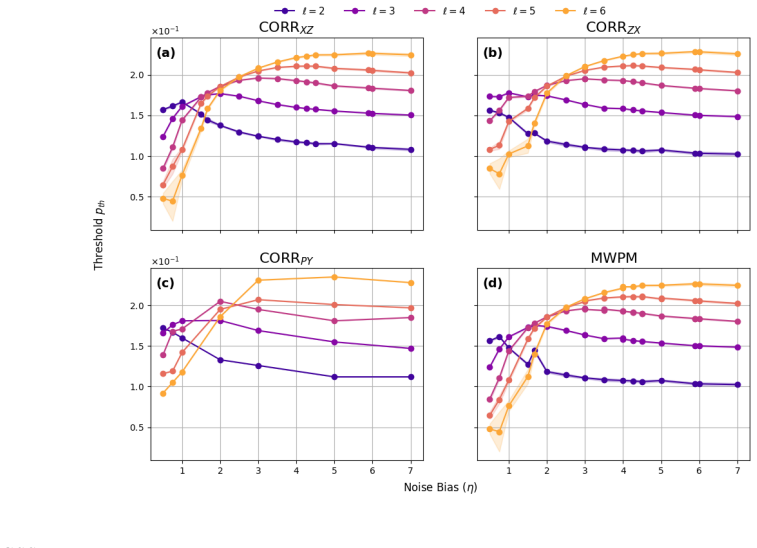
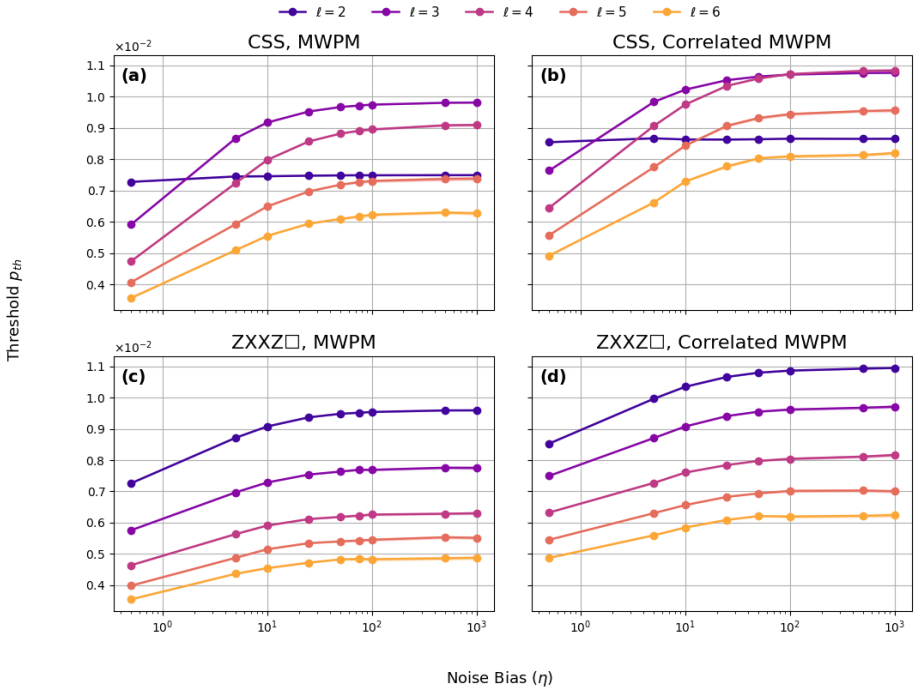
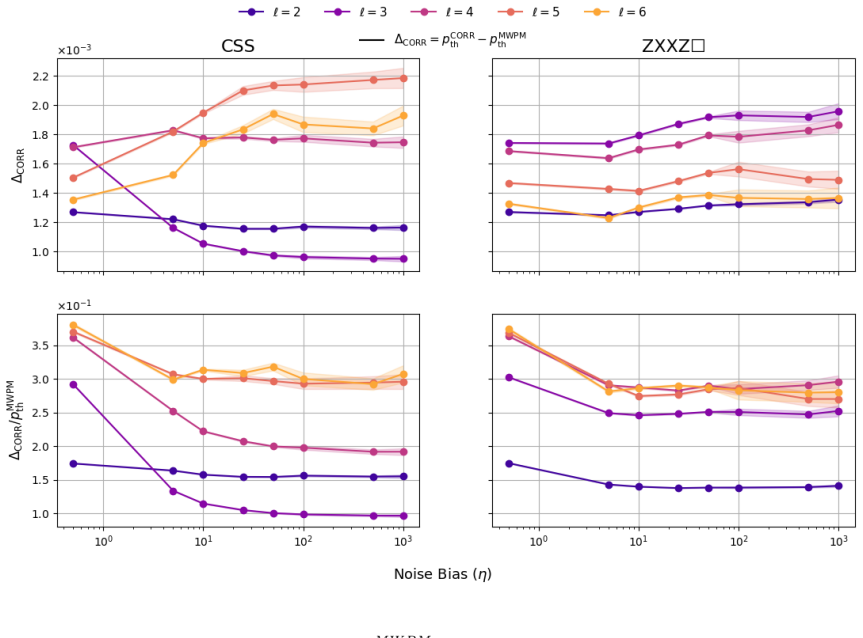
When Clifford-deformed elongated compass codes are decoded with correlated MWPM under circuit-level biased noise, thresholds exceed those obtained with standard MWPM for every bias value examined, and the relative gain is greater for codes whose stabilizers are asymmetric than for those with symmetric stabilizers.
What carries the argument
Correlated minimum-weight perfect matching decoder that incorporates circuit-induced error correlations when applied to Clifford-deformed compass codes.
If this is right
- Thresholds rise for all tested noise biases when correlated decoding is used.
- The relative improvement is larger for codes whose stabilizers break symmetry.
- Performance gains appear without any change to the underlying code lattice or stabilizers.
- The same decoder upgrade applies across a range of bias strengths.
Where Pith is reading between the lines
- Hardware teams running biased-noise devices might obtain better logical error rates by upgrading the decoder rather than redesigning the code.
- The approach could be tested on other families of bias-tailored surface-code variants to check whether asymmetric stabilizers consistently benefit more from correlation-aware decoding.
- If the gain persists at larger code distances, it would reduce the physical qubit overhead required to reach a target logical error rate.
Load-bearing premise
The chosen circuit-level noise model together with the specific implementation of correlated MWPM faithfully reproduces the performance that real hardware would exhibit under biased dephasing.
What would settle it
Executing the same elongated compass codes on physical hardware with independently measured bias and observing whether the measured threshold difference between correlated and standard MWPM matches the simulated gap.
Figures
read the original abstract
Quantum error correction (QEC) is often implemented on hardware that experiences biased noise, where dephasing errors occur more frequently than other errors. This has motivated many recent efforts to develop bias-tailored QEC codes, such as the Clifford-deformed compass codes: a family of codes that achieve high thresholds under biased dephasing noise. We perform circuit-level simulations of the Clifford-deformed elongated compass codes under a biased noise model and evaluate code thresholds using standard minimum weight perfect matching (MWPM) and correlated MWPM. We find that correlated decoding enhances thresholds for all noise biases relative to standard MWPM under circuit-level noise. Our results demonstrate that correlated decoding leads to a higher relative gain in thresholds compared to standard MWPM when applied to codes with asymmetric stabilizers under biased noise.
Editorial analysis
A structured set of objections, weighed in public.
Referee Report
Summary. The paper performs circuit-level simulations of Clifford-deformed elongated compass codes under a biased dephasing noise model. It compares code thresholds obtained via standard minimum-weight perfect matching (MWPM) against those from a correlated MWPM decoder, reporting that the correlated decoder improves thresholds for all bias values and produces a larger relative gain when applied to codes possessing asymmetric stabilizers.
Significance. If the numerical results are reproducible, the work supplies concrete evidence that decoder correlations can be leveraged to amplify the advantage of bias-tailored stabilizer asymmetry under realistic circuit noise. This supplies a practical, decoder-level route to improving thresholds without altering the code family itself.
major comments (2)
- [Abstract / §3] Abstract and §3 (Simulation Setup): the central claim rests on reported threshold values, yet the text supplies no numerical values for circuit depth, the precise biased Pauli error rates (including the bias parameter η and the total physical error rate p), the number of Monte Carlo samples per data point, or the fitting procedure used to extract thresholds. Without these parameters the quantitative gains cannot be assessed or reproduced.
- [§4] §4 (Results): the statement that correlated decoding yields a 'higher relative gain' for asymmetric-stabilizer codes is presented without tabulated threshold numbers, error bars, or the exact definition of 'relative gain' (e.g., (p_th^correlated – p_th^MWPM)/p_th^MWPM). This prevents verification that the reported ordering is statistically significant.
minor comments (2)
- [Figures 2–4] Figure captions and axis labels should explicitly state the bias values η and the circuit-level noise model (e.g., whether idling errors or measurement errors are included).
- [§2.3] The implementation details of the correlated MWPM (e.g., which error pairs are treated as correlated and how the matching graph is augmented) are referenced but not given an explicit algorithmic description or pseudocode.
Simulated Author's Rebuttal
We thank the referee for their careful reading and constructive comments on our manuscript. We address each major comment below and will revise the manuscript to improve reproducibility and clarity.
read point-by-point responses
-
Referee: [Abstract / §3] Abstract and §3 (Simulation Setup): the central claim rests on reported threshold values, yet the text supplies no numerical values for circuit depth, the precise biased Pauli error rates (including the bias parameter η and the total physical error rate p), the number of Monte Carlo samples per data point, or the fitting procedure used to extract thresholds. Without these parameters the quantitative gains cannot be assessed or reproduced.
Authors: We agree that these simulation parameters are essential for reproducibility. In the revised manuscript we will expand §3 (Simulation Setup) to explicitly state the circuit depth, the values of the bias parameter η and physical error rate p, the number of Monte Carlo samples per data point, and the fitting procedure used to extract thresholds. revision: yes
-
Referee: [§4] §4 (Results): the statement that correlated decoding yields a 'higher relative gain' for asymmetric-stabilizer codes is presented without tabulated threshold numbers, error bars, or the exact definition of 'relative gain' (e.g., (p_th^correlated – p_th^MWPM)/p_th^MWPM). This prevents verification that the reported ordering is statistically significant.
Authors: We agree that tabulated values and an explicit definition would strengthen the presentation. In the revised §4 we will add a table listing threshold values (with error bars) for both decoders across bias values, explicitly define relative gain as (p_th^correlated – p_th^MWPM)/p_th^MWPM, and include a short discussion of statistical significance. revision: yes
Circularity Check
No significant circularity; claims rest on explicit simulation comparisons
full rationale
The paper reports empirical thresholds obtained from circuit-level Monte Carlo simulations of Clifford-deformed elongated compass codes under a stated biased dephasing noise model. Thresholds are extracted by comparing logical error rates for two decoders (standard MWPM versus correlated MWPM) on identical code instances and noise realizations. No equations, fitted parameters, or first-principles derivations are presented whose outputs are algebraically identical to their inputs by construction. No self-citation is invoked as a load-bearing uniqueness theorem or ansatz. The central result is therefore a direct numerical comparison whose validity is independent of any internal redefinition or self-referential fitting.
Axiom & Free-Parameter Ledger
axioms (1)
- domain assumption Circuit-level noise models with independent Pauli errors at each location are representative of hardware behavior.
Reference graph
Works this paper leans on
-
[1]
Fault-tolerant quantum computation with constant error,
D. Aharonov and M. Ben-Or, “Fault-tolerant quantum computation with constant error,” inProceedings of the twenty-ninth annual ACM symposium on Theory of computing, 1997, pp. 176–188
1997
-
[2]
Resilient quantum computa- tion,
E. Knill, R. Laflamme, and W. H. Zurek, “Resilient quantum computa- tion,”Science, vol. 279, no. 5349, pp. 342–345, 1998
1998
-
[3]
Gottesman,Stabilizer codes and quantum error correction
D. Gottesman,Stabilizer codes and quantum error correction. Califor- nia Institute of Technology, 1997
1997
-
[4]
Quantum computation and quantum information,
M. A. Nielsen and I. L. Chuang, “Quantum computation and quantum information,”Phys. Today, vol. 54, no. 2, p. 60, 2001
2001
-
[5]
Topological quantum memory,
E. Dennis, A. Kitaev, A. Landahl, and J. Preskill, “Topological quantum memory,”Journal of Mathematical Physics, vol. 43, no. 9, pp. 4452– 4505, 2002
2002
-
[6]
Confinement-higgs transition in a disordered gauge theory and the accuracy threshold for quantum memory,
C. Wang, J. Harrington, and J. Preskill, “Confinement-higgs transition in a disordered gauge theory and the accuracy threshold for quantum memory,”Annals of Physics, vol. 303, no. 1, pp. 31–58, 2003
2003
-
[7]
Good quantum error-correcting codes exist,
A. R. Calderbank and P. W. Shor, “Good quantum error-correcting codes exist,”Phys. Rev. A, vol. 54, no. 2, p. 1098, 1996
1996
-
[8]
Fault-tolerant computing with biased-noise superconducting qubits: a case study,
P. Aliferis, F. Brito, D. P. DiVincenzo, J. Preskill, M. Steffen, and B. M. Terhal, “Fault-tolerant computing with biased-noise superconducting qubits: a case study,”New J. of Physics., vol. 11, no. 1, p. 013061, 2009
2009
-
[9]
Exponential suppression of bit-flips in a qubit encoded in an oscillator,
R. Lescanne, M. Villiers, T. Peronnin, A. Sarlette, M. Delbecq, B. Huard, T. Kontos, M. Mirrahimi, and Z. Leghtas, “Exponential suppression of bit-flips in a qubit encoded in an oscillator,”Nature (London), vol. 16, no. 5, pp. 509–513, 2020
2020
-
[10]
Stabilization and operation of a kerr-cat qubit,
A. Grimm, N. E. Frattini, S. Puri, S. O. Mundhada, S. Touzard, M. Mir- rahimi, S. M. Girvin, S. Shankar, and M. H. Devoret, “Stabilization and operation of a kerr-cat qubit,”Nature (London), vol. 584, no. 7820, pp. 205–209, 2020
2020
-
[11]
One hundred sec- ond bit-flip time in a two-photon dissipative oscillator,
C. Berdou, A. Murani, U. Reglade, W. C. Smith, M. Villiers, J. Palomo, M. Rosticher, A. Denis, P. Morfin, M. Delbecqet al., “One hundred sec- ond bit-flip time in a two-photon dissipative oscillator,”PRX Quantum, vol. 4, no. 2, p. 020350, 2023
2023
-
[12]
Quantum control of a cat-qubit with bit-flip times exceeding ten seconds,
A. Bocquet, Z. Leghtas, U. Reglade, R. Gautier, J. Cohen, A. Marquet, E. Albertinale, N. Pankratova, M. Hallén, F. Rautschkeet al., “Quantum control of a cat-qubit with bit-flip times exceeding ten seconds,”Bulletin of the American Physical Society, 2024
2024
-
[13]
Hardware-efficient, fault-tolerant quantum computation with rydberg atoms,
I. Cong, H. Levine, A. Keesling, D. Bluvstein, S.-T. Wang, and M. D. Lukin, “Hardware-efficient, fault-tolerant quantum computation with rydberg atoms,”Phys. Rev. X, vol. 12, no. 2, p. 021049, 2022
2022
-
[14]
Erasure conversion for fault-tolerant quantum computing in alkaline earth rydberg atom arrays,
Y . Wu, S. Kolkowitz, S. Puri, and J. D. Thompson, “Erasure conversion for fault-tolerant quantum computing in alkaline earth rydberg atom arrays,”Nature (London), vol. 13, no. 1, p. 4657, 2022
2022
-
[15]
Quantum error correction with metastable states of trapped ions using erasure conversion,
M. Kang, W. C. Campbell, and K. R. Brown, “Quantum error correction with metastable states of trapped ions using erasure conversion,”PRX Quantum, vol. 4, no. 2, p. 020358, 2023
2023
-
[16]
Erasure qubits: Overcoming the t 1 limit in superconducting circuits,
A. Kubica, A. Haim, Y . Vaknin, H. Levine, F. Brandão, and A. Retzker, “Erasure qubits: Overcoming the t 1 limit in superconducting circuits,” Physical Review X, vol. 13, no. 4, p. 041022, 2023
2023
-
[17]
Dual- rail encoding with superconducting cavities.(2022),
J. D. Teoh, P. Winkel, H. K. Babla, B. J. Chapman, J. Claes, S. J. de Graaf, J. W. Garmon, W. D. Kalfus, Y . Lu, A. Maitiet al., “Dual- rail encoding with superconducting cavities.(2022),”arXiv preprint arXiv:2212.12077, 2022
-
[18]
Ultrahigh error threshold for surface codes with biased noise,
D. K. Tuckett, S. D. Bartlett, and S. T. Flammia, “Ultrahigh error threshold for surface codes with biased noise,”Phys. Rev. Lett., vol. 120, no. 5, p. 050505, 2018
2018
-
[19]
Tailoring surface codes for highly biased noise,
D. K. Tuckett, A. S. Darmawan, C. T. Chubb, S. Bravyi, S. D. Bartlett, and S. T. Flammia, “Tailoring surface codes for highly biased noise,” Phys. Rev. X, vol. 9, no. 4, p. 041031, 2019
2019
-
[20]
High-threshold topo- logical quantum error correction against biased noise,
A. M. Stephens, W. J. Munro, and K. Nemoto, “High-threshold topo- logical quantum error correction against biased noise,”Phys. Rev. A, vol. 88, no. 6, p. 060301, 2013
2013
-
[21]
Fault-tolerant thresholds for the surface code in excess of5%under biased noise,
D. K. Tuckett, S. D. Bartlett, S. T. Flammia, and B. J. Brown, “Fault-tolerant thresholds for the surface code in excess of5%under biased noise,”Phys. Rev. Lett., vol. 124, p. 130501, Mar 2020. [Online]. Available: https://link.aps.org/doi/10.1103/PhysRevLett.124.130501
-
[22]
J. Etxezarreta Martinez, P. Schnabl, J. Oliva del Moral, R. Dastbasteh, P. M. Crespo, and R. M. Otxoa, “Leveraging biased noise for more efficient quantum error correction at the circuit level with two-level qubits,”Phys. Rev. Appl., vol. 25, p. 014021, Jan 2026. [Online]. Available: https://link.aps.org/doi/10.1103/q7w6-nljp
-
[23]
The xzzx surface code,
J. P. Bonilla Ataides, D. K. Tuckett, S. D. Bartlett, S. T. Flammia, and B. J. Brown, “The xzzx surface code,”Nature Commun., vol. 12, no. 1, p. 2172, 2021
2021
-
[24]
2d compass codes,
M. Li, D. Miller, M. Newman, Y . Wu, and K. R. Brown, “2d compass codes,”Phys. Rev. X, vol. 9, no. 2, p. 021041, 2019
2019
-
[25]
Clifford-deformed surface codes,
A. Dua, A. Kubica, L. Jiang, S. T. Flammia, and M. J. Gullans, “Clifford-deformed surface codes,”PRX Quantum, vol. 5, p. 010347, Mar 2024. [Online]. Available: https://link.aps.org/doi/10.1103/ PRXQuantum.5.010347
2024
-
[26]
Tailoring dynamical codes for biased noise: Thex 3z3 floquet code,
F. Setiawan and C. McLauchlan, “Tailoring dynamical codes for biased noise: Thex 3z3 floquet code,”arXiv preprint arXiv:2411.04974, 2024
-
[27]
Tailored cluster states with high threshold under biased noise,
J. Claes, J. E. Bourassa, and S. Puri, “Tailored cluster states with high threshold under biased noise,”npj Quantum Information, vol. 9, no. 1, p. 9, 2023
2023
-
[28]
Tailoring fusion-based error correction for high thresholds to biased fusion failures,
K. Sahay, J. Claes, and S. Puri, “Tailoring fusion-based error correction for high thresholds to biased fusion failures,”Physical Review Letters, vol. 131, no. 12, p. 120604, 2023
2023
-
[29]
A cellular automaton decoder for a noise-bias tailored color code,
J. F. San Miguel, D. J. Williamson, and B. J. Brown, “A cellular automaton decoder for a noise-bias tailored color code,”Quantum, vol. 7, p. 940, 2023
2023
-
[30]
Heterogeneous quantum error-correcting codes,
O. Khosravani, E.-A. Guillermo, K. R. Brown, and M. Gutier- rez, “Heterogeneous quantum error-correcting codes,”arXiv preprint arXiv:2603.06817, 2026
-
[31]
Fault-tolerant compass codes,
S. Huang and K. R. Brown, “Fault-tolerant compass codes,”Phys. Rev. A, vol. 101, no. 4, p. 042312, 2020
2020
-
[32]
Gauge color codes: optimal transversal gates and gauge fixing in topological stabilizer codes,
H. Bombín, “Gauge color codes: optimal transversal gates and gauge fixing in topological stabilizer codes,”New J. of Physics., vol. 17, no. 8, p. 083002, 2015
2015
-
[33]
Universal fault-tolerant quantum computation with only transversal gates and error correction,
A. Paetznick and B. W. Reichardt, “Universal fault-tolerant quantum computation with only transversal gates and error correction,”Phys. Rev. Lett., vol. 111, no. 9, p. 090505, 2013
2013
-
[34]
Clifford-Deformed Compass Codes
J. A. Campos and K. R. Brown, “Clifford deformed compass codes,” arxiv preprint arXiv:2412.03808v1, 2025
work page internal anchor Pith review Pith/arXiv arXiv 2025
-
[35]
Paths, trees, and flowers,
J. Edmonds, “Paths, trees, and flowers,”Canadian Journal of mathemat- ics, vol. 17, pp. 449–467, 1965
1965
-
[36]
Pymatching: A python package for decoding quantum codes with minimum-weight perfect matching,
O. Higgott, “Pymatching: A python package for decoding quantum codes with minimum-weight perfect matching,”ACM Transactions on Quantum Computing, vol. 3, no. 3, pp. 1–16, 2022
2022
-
[37]
Stim: a fast stabilizer circuit simulator,
C. Gidney, “Stim: a fast stabilizer circuit simulator,”Quantum, vol. 5, p. 497, Jul. 2021. [Online]. Available: https://doi.org/10.22331/ q-2021-07-06-497
2021
-
[38]
Low-distance surface codes under realistic quantum noise,
Y . Tomita and K. M. Svore, “Low-distance surface codes under realistic quantum noise,”Phys. Rev. A, vol. 90, no. 6, p. 062320, 2014
2014
-
[39]
Improved decoding of circuit noise and fragile boundaries of tailored surface codes,
O. Higgott, T. C. Bohdanowicz, A. Kubica, S. T. Flammia, and E. T. Campbell, “Improved decoding of circuit noise and fragile boundaries of tailored surface codes,”Phys. Rev. X, vol. 13, p. 031007, Jul
-
[40]
Available: https://link.aps.org/doi/10.1103/PhysRevX
[Online]. Available: https://link.aps.org/doi/10.1103/PhysRevX. 13.031007
-
[41]
A decoding algorithm for css codes using the x/z correlations,
N. Delfosse and J.-P. Tillich, “A decoding algorithm for css codes using the x/z correlations,” in2014 IEEE International Symposium on Information Theory, 2014, pp. 1071–1075
2014
-
[42]
Optimal complexity correction of correlated errors in the surface code
A. Fowler, “Optimal complexity correction of correlated errors in the surface code,”arXiv preprint arXiv:1310.0863, 2013
work page internal anchor Pith review Pith/arXiv arXiv 2013
-
[43]
Pipelined correlated minimum weight perfect matching of the surface code,
A. Paler and A. G. Fowler, “Pipelined correlated minimum weight perfect matching of the surface code,”Quantum, vol. 7, p. 1205, Dec
-
[44]
Available: https://doi.org/10.22331/q-2023-12-12-1205
[Online]. Available: https://doi.org/10.22331/q-2023-12-12-1205
-
[45]
Bias-aware bp decoding of quantum codes via directional degeneracy,
M. Rowshan, “Bias-aware bp decoding of quantum codes via directional degeneracy,”arXiv preprint arXiv:2601.07240, 2026
-
[46]
Multiple-particle interference and quantum error correction,
A. Steane, “Multiple-particle interference and quantum error correction,” Proceedings of the Royal Society of London. Series A: Mathematical, Physical and Engineering Sciences, vol. 452, no. 1954, pp. 2551–2577, 1996
1954
-
[47]
Quantum compass model on the square lattice,
J. Dorier, F. Becca, and F. Mila, “Quantum compass model on the square lattice,”Phys. Rev. B, vol. 72, no. 2, p. 024448, 2005
2005
-
[48]
Optimal resources for topo- logical two-dimensional stabilizer codes: Comparative study,
H. Bombín and M. A. Martin-Delgado, “Optimal resources for topo- logical two-dimensional stabilizer codes: Comparative study,”Physical Review A—Atomic, Molecular , and Optical Physics, vol. 76, no. 1, p. 012305, 2007
2007
-
[49]
Optimizing stabilizer parities for improved logical qubit memories,
D. M. Debroy, L. Egan, C. Noel, A. Risinger, D. Zhu, D. Biswas, M. Cetina, C. Monroe, and K. R. Brown, “Optimizing stabilizer parities for improved logical qubit memories,”Physical Review Letters, vol. 127, no. 24, p. 240501, 2021
2021
-
[50]
Data from: Leveraging correlated decoding for bias-tailored clifford deformed compass codes
A. Meinking, “Data from: Leveraging correlated decoding for bias-tailored clifford deformed compass codes.” [Online]. Available: http://research.repository.duke.edu/record/515
-
[51]
Correlated decoding for clifford deformed compass codes (version 1.0.0),
——, “Correlated decoding for clifford deformed compass codes (version 1.0.0),” 2026. [Online]. Available: https://github.com/acatspirit/ correlated_decoding_cd_compass_codes
2026
-
[52]
Yoked surface codes,
C. Gidney, M. Newman, P. Brooks, and et al., “Yoked surface codes,” Nature Communications, 2024
2024
- [53]
discussion (0)
Sign in with ORCID, Apple, or X to comment. Anyone can read and Pith papers without signing in.