REVIEW 2 major objections 4 minor 52 references
Spectral density of correlated random matrices and nonmonotonic stability in hetero-associative memory networks
T0 review · 2 major / 4 minor · reviewed 2026-08-15 · deepseek-v4-flash
Pith's one-line read For products of correlated Gaussian matrices, the paper derives the exact spectral density, unifies the Marchenko-Pastur and elliptic laws, and predicts nonmonotonic stability in hetero-associative memory networks.
desk verdict Eq. (9) is a genuinely useful closed-form density for a two-parameter correlated product ensemble, and the stability story is clean, but the printed alpha->infinity 'elliptic law' limit is over-normalized by a factor 1/(1-tau^4), which is a real error in the paper's central unification claim, though a fixable one. read the letter →
The pith
A machine-rendered reading of the paper's core claim, the machinery that carries it, and where it could break.
The reading
What carries the argument
The central object is the correlated product ensemble $J=UV^\top/\sqrt{NM}$ with the joint Gaussian law of Eq. (2). The argument is carried by the potential function $\Phi(\omega)=-\frac{1}{N}\langle\log\det((\omega^*I-J^\top)(\omega I-J))\rangle$, whose derivative with respect to $\omega$ gives the disorder-averaged resolvent, and whose $\omega^*$ derivative gives the density. Evaluating the averaged determinant by a saddle-point approximation yields two branches: inside an ellipse the saddle-point solution has $\sigma\sim\sqrt{\varepsilon}$, and the Green's function develops $\omega^*$-dependence that produces the explicit density; outside, the Green's function depends only on $\omega$, so the density vanishes. The two parameters $\tau$ and $\alpha$ interpolate between the classical laws: $\tau\to1$ degenerates the ellipse onto the real axis and yields Marchenko-Pastur, while $\alpha\to\infty$ flattens the density into the elliptic law.
What would settle it
Draw one large realization of the ensemble, for example $N=4000$, $M=2000$, and $\tau=0.8$, and compare the empirical eigenvalue histogram with Eq. (9) inside the predicted ellipse and with zero outside; the claimed $1/\sqrt{k^2+x^2+y^2}$ profile, with $k=(1-\tau^2)(\beta-1/\beta)/2$, and the sharp elliptical cutoff are the direct check. In parallel, measure the largest real-part eigenvalue for several $\beta$ and compare it with $\tau(\beta+1/\beta)+1+\tau^2$ to test the nonmonotonic stability prediction.
Extended reading notes
Core claim
The central discovery is a closed-form bulk spectral density for $J=UV^\top/\sqrt{NM}$, where $U$ and $V$ are $N\times M$ standard Gaussian matrices with $\langle U_{ij}V_{ij}\rangle=\tau$. Writing $\omega=x+iy$, $\alpha=M/N$, and $\beta=\sqrt{\alpha}$, the density is $$ \rho_b(\omega)=\frac{\$\beta$}{2\pi(1-\$tau^{2}$)}\left[\left(\frac{1-\$tau^{2}$}{2}\left(\$\beta$-\frac{1}{\$\beta$}\right)\right)^2+$x^{2}$+$y^{2}$\right]^{-1/2} $$ inside the ellipse $$ \left(\frac{x-\tau(\$\beta$+1/\$\beta$)}{1+\$tau^{2}$}\right)^2+\left(\frac{y}{1-\$tau^{2}$}\right)^2<1, $$ and zero outside. When $\alpha<1$, the remaining $N-M$ eigenvalues are exactly zero, producing an additional delta peak. The paper derives this density from the disorder-averaged log-determinant potential through a saddle-point approximation, validates it against numerical diagonalization, and reads off the spectral edge to obtain a linear-stability condition for a recurrent tanh network.
Load-bearing premise
The load-bearing premise is that, for this correlated product ensemble, the ensemble average of the log-determinant can be replaced by the log of the averaged determinant in the large-system limit; that interchange, taken from earlier random-matrix work, is not proved for the correlated case here, and if it fails the explicit density and the stability threshold derived from it do not follow.
Editorial extensions
If this is right
- At finite size the spectrum of a single matrix already follows the predicted elliptical bulk, so the ensemble is self-averaging and Eq. (9) is a direct numerical prediction.
- When $\alpha=M/N<1$, the matrix has exactly $N-M$ zero eigenvalues; the bulk formula accounts for the remaining $M$ eigenvalues, and its integral is $\min(1,\alpha)$.
- Taking $\tau\to1$ collapses the support onto the real axis and recovers the Marchenko-Pastur density, while $\alpha\to\infty$ recovers the elliptic law; the Wigner semicircle and circular laws follow from these limits as further special cases.
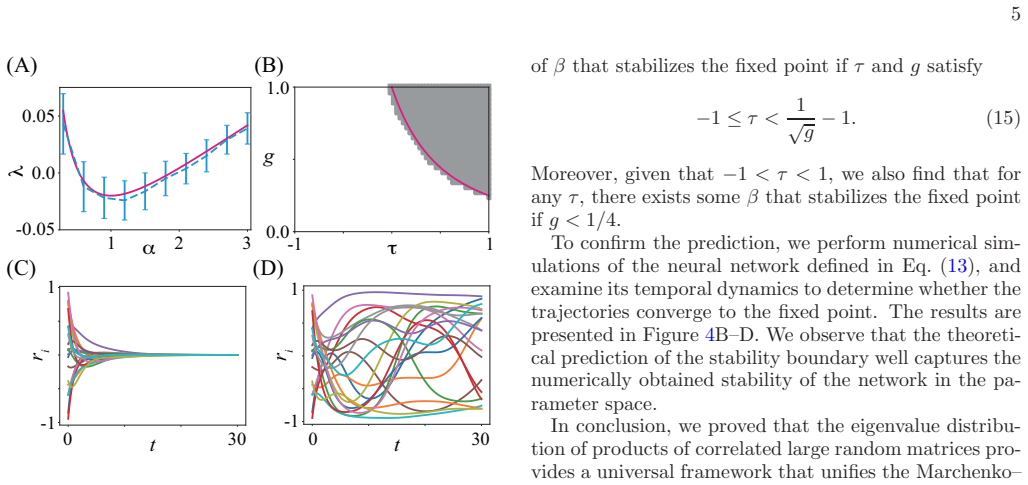
- For the recurrent network in Eq. (13), the largest real part in the spectrum is $\tau(\beta+1/\beta)+1+\tau^2$, so the fixed point is stable when $g\tau(\beta+1/\beta)+g(1+\tau^2)-1<0$; for fixed $\tau>0$ this holds only in a finite range of $\beta$, and for $\tau<0$ it holds outside a finite range.
- If $g<1/4$, for every correlation $\tau$ there exists some number of stored patterns that makes the trivial fixed point stable.
Reading between the lines
- In a linear-attention layer, the effective weight matrix has the same product-of-correlated-factors form as $J$, so Eq. (9) predicts the bulk spectrum of finite-width attention; this could be tested on the weight matrices of trained attention models.
- Near $\alpha=1$, the squared offset $k^2$ in the density vanishes, so the spectrum becomes strongly concentrated near the origin; in a recurrent network this implies slow transients in memory retrieval around the capacity sweet spot, a consequence the paper does not develop.
- Because the sign of $\tau$ reverses the direction of nonmonotonic stability, anti-correlated key-value pairs should make the network unstable for intermediate memory loads but stable at small and large loads; this is a numerical prediction for small recurrent circuits.
Signed reviews
Editorial analysis
A structured set of objections, weighed in public.
Referee Report
Summary. The paper introduces the ensemble J = UV^T/sqrt(NM) with correlated Gaussian N x M factors U,V, and derives the limiting bulk spectral density rho_b(omega) shown in Eq. (9). The authors argue that this single formula unifies the Marchenko-Pastur law (tau -> 1) and the elliptic law (alpha -> infinity), and they apply the support edge to determine the linear stability of a hetero-associative memory network, yielding a nonmonotonic stability condition in the pattern number M. The main formula is checked against direct numerical diagonalization, and the stability boundary is compared to simulations of the network dynamics.
Significance. If Eq. (9) is correct, this is a valuable contribution: it gives a closed-form spectral density for a correlated product ensemble that interpolates between two cornerstone laws of random matrix theory, and it makes a falsifiable prediction for the stability of a recurrent neural network storing correlated key-value pairs. The numerical tests of Eq. (9) are genuine and independent, and the derivation in the supplement is coherent enough to reproduce the known product-Ginibre and Marchenko-Pastur limits. However, the advertised elliptic-law limit contains a normalization error as printed, and the replica-decoupling step that underpins the derivation is asserted rather than proved for this ensemble; these issues prevent the current version from fully establishing the headline unification claim.
major comments (2)
- [Eq. (12) and Supplementary Eq. (54)] The displayed limit to the elliptic law is over-normalized. Taking beta -> infinity in Eq. (9) at the interior point x=0,y=0 of the shifted support gives beta / [2 pi (1-tau^2)] * 1 / sqrt( ((1-tau^2) beta / 2)^2 + (tau beta)^2 ) -> 1/[pi(1-tau^4)], not 1/[pi(1-tau^4)^2]. Since the support ellipse in Eq. (12) has area pi(1-tau^4), the printed constant integrates to 1/(1-tau^4) > 1 for tau != 0; the stated 'elliptic law' is therefore not a probability density. This is a load-bearing error because the unification with the elliptic law is a central advertised result. Please correct the prefactor in Eq. (12) and Eq. (54) and re-check any text or figures that rely on the numerical value of this constant.
- [Supplementary A.1, Eqs. (16)-(29)] The derivation of Eq. (9) depends on interchanging the ensemble average and the logarithm, which the text justifies by asserting that 'replicas decouple in this limit' and citing references [8,15,16,38-42]. This is a genuinely load-bearing step for the correlated product ensemble defined by Eq. (2); if replica decoupling fails for the U-V correlation structure, Eq. (9) and the subsequent stability edge Eq. (14) do not follow. The manuscript should supply the replica calculation for this ensemble or state precisely which hypotheses of the cited results are satisfied here.
minor comments (4)
- [Supplementary B, Eq. (49)] The marginalization formula appears to contain a spurious factor (1+tau^2). Direct integration of Eq. (45) gives beta/[pi(1-tau^2)] * tanh^{-1}(Y/sqrt(k^2+x^2+Y^2)), not beta(1+tau^2)/[pi(1-tau^2)] times the same factor. The later Jacobian in Eq. (50) appears to compensate for this, but the printed formula should be corrected to make the derivation reproducible.
- [Main text near Eq. (9)] The sentence 'the density function is symmetric about the origin, whereas its boundary contour is determined by an ellipse that is not necessarily centered at the origin' is confusing: the algebraic expression is centrally symmetric, but since the support is a shifted ellipse, the full density including its support is not symmetric about the origin. Please reword.
- [Eq. (12) and Fig. 3B caption] The phrase 'the ellipse is shifted by tau beta from the origin' is confusing in the context of Eq. (12), where the displayed support is centered at the origin; the shift refers to the original coordinates of Eq. (9). Please clarify the coordinate convention.
- [Reference [37]] Reference [37] is cited as 'in preparation'; if the paper relies on this work, please provide a preprint or remove the citation.
Circularity Check
No significant circularity: Eq. (9) is derived from the Gaussian definition of U and V via saddle-point evaluation, with no parameters fitted to numerical spectra or stability data.
full rationale
The central result Eq. (9) is obtained by a self-contained saddle-point evaluation of the disorder-averaged potential for the ensemble defined in Eqs. (1) and (2); the only cited input is the standard replica/replica-symmetric decoupling step (Supplementary A.1, citing refs. [8,15,16,38-42]), which is not authored by the present authors and is independent support rather than a self-citation. The numerical eigenvalue histograms and network stability simulations in Figs. 2-4 are genuinely independent checks: no parameter is fitted from these simulations into Eq. (9) or Eq. (14). The Marchenko-Pastur limit (Eqs. (11)/(52)-(53)) and the elliptic-law limit (Eqs. (12)/(54)-(55)) are presented as limiting reductions of the derived formula, and the formula itself is not defined in terms of those limiting laws. The only self-reference, ref. [37] ('in preparation'), is peripheral to the derivation and not load-bearing. The apparent normalization issue in the stated elliptic-law limit, Eq. (12) vs. Eq. (54), is a mathematical correctness concern rather than circularity: if anything, it makes the claimed reduction to the elliptic law fail as written, which is the opposite of a construction that smuggles that law in as an input. Therefore no circular step is exhibited.
Assumptions & free parameters
assumptions (5)
- domain assumption Interchange of ensemble average and logarithm in the large-N limit (replica decoupling).
- ad hoc to paper The epsilon to 0+ saddle-point branches, sigma to 0 inside the ellipse and sigma greater than 0 outside, exhaust the bulk spectrum.
- domain assumption U and V are jointly Gaussian with the covariance structure in Eq. (2), independent across pattern index p.
- domain assumption Linear stability of the network is set by the largest real part of eigenvalues of gJ at the trivial fixed point.
- standard math Gaussian integral manipulations, the Hubbard-Stratonovich transformation, and contour integration are valid for the determinant representation.
Cite this review
Pith. "Pith review of Spectral density of correlated random matrices and nonmonotonic stability in hetero-associative memory networks." pith.science (2026). https://pith.science/paper/PWU6WLSM
@misc{pith2026250511948,
  author       = {Pith},
  title        = {Pith review of: Spectral density of correlated random matrices and nonmonotonic stability in hetero-associative memory networks},
  year         = {2026},
  howpublished = {\url{https://pith.science/paper/PWU6WLSM}},
  note         = {Machine review of arXiv:2505.11948}
}
read the original abstract
Random matrix theory, which characterizes spectral distributions of infinitely large matrices, plays a central role across diverse fields, including high-dimensional data analysis, ecology, neuroscience, and machine learning. Among its key results, the Marchenko-Pastur law and the elliptic law have provided theoretical foundations for numerous applications. However, despite their importance, the relationship between these two laws has not yet been fully understood. Here, we develop a novel derivation of the spectral density for a correlated random matrix ensemble that unifies the Marchenko-Pastur and elliptic laws as special cases. Interestingly, matrices from this ensemble can be naturally interpreted as connectivity matrices of hetero-associative memory networks, which, from a modern neural network perspective, are essentially equivalent to the linear attention architecture, a variant of the attention layer in the Transformer. Using this result, we find that the stability of the network depends non-monotonically on the number of memorized patterns. By uncovering a nontrivial property of high-dimensional correlated systems, this work deepens our understanding of asymmetric interactions across various scientific fields.
Figures


Figures from the paper (1 more)
Reference graph
Works this paper leans on
-
[1]
Random- matrix physics: spectrum and strength fluctuations
T´ omas A Brody, Jorge Flores, J Bruce French, Pier A Mello, Akhilesh Pandey, and Samuel SM Wong. Random- matrix physics: spectrum and strength fluctuations. Re- views of Modern Physics , 53(3):385, 1981
work page 1981
-
[2]
Madan Lal Mehta. Random matrices, volume 142. Else- vier, 2004
work page 2004
-
[3]
Topics in random matrix theory , volume
Terence Tao. Topics in random matrix theory , volume
-
[4]
This yields the Green’s function as G(ω ) = τ β − Eω ∗ σE + 1 − τ2
using the saddle-point approxima- tion [ 43]. This yields the Green’s function as G(ω ) = τ β − Eω ∗ σE + 1 − τ2 . (7) 3 0 2 Re 0 2 Re 0 2 Re 0 -1 1 Im 0 1 20.0 0.8 0.4 -1 10.0 0.8 0.4 0 0 1 20.0 2.0 1.0 -1 10.0 3.0 1.5 0 (A) (D) (E) (B) (C) FIG. 2. Spectrum distribution of a product of large correlat ed random matrices. (A) Eigenvalues obtained numerical...
-
[5]
DISTRIBUTION OF EIGENVALUES FOR SOME SETS OF RANDOM MA- TRICES
V A Marˇ cenko and L A Pastur. DISTRIBUTION OF EIGENVALUES FOR SOME SETS OF RANDOM MA- TRICES. Mathematics of the USSR-Sbornik , 1(4):457– 483, April 1967
work page 1967
-
[6]
Vyacheslav L Girko. Circular law. Theory of Probability & Its Applications , 29(4):694–706, 1985
work page 1985
-
[7]
Eugene P. Wigner. On the Distribution of the Roots of Certain Symmetric Matrices. The Annals of Mathemat- ics, 67(2):325, March 1958
work page 1958
-
[8]
H. J. Sommers, A. Crisanti, H. Sompolinsky, and Y. Stein. Spectrum of Large Random Asymmetric Ma- trices. Physical Review Letters , 60(19):1895–1898, May 1988
work page 1988
Show all 52 references
-
[9]
elliptic law
over y recovers the Marchenko– Pastur law: lim τ →1 ∫ ρb(ω )dy = β 2πx √ (a+ − x) (x − a−) if a− < x < a + 0 otherwise , (11) where a± = (β ± 1)2/β . The validity of this convergence is confirmed in Figure 3A. As another case, consider α → ∞, where the number of embedded ...
-
[10]
Elliptic law
VL Girko. Elliptic law. Theory of Probability & Its Ap- plications, 30(4):677–690, 1986
1986
-
[11]
Nonlinear ran- dom matrix theory for deep learning
Jeffrey Pennington and Pratik Worah. Nonlinear ran- dom matrix theory for deep learning. Advances in neural information processing systems , 30, 2017
2017
-
[12]
High-dimensional statistics: A non-asymptotic viewpoint , volume 48
Martin J Wainwright. High-dimensional statistics: A non-asymptotic viewpoint , volume 48. Cambridge uni- versity press, 2019
2019
-
[13]
Karl Pearson. Liii. on lines and planes of closest fit to systems of points in space. The London, Edinburgh, and Dublin philosophical magazine and journal of sci- ence, 2(11):559–572, 1901. 6
1901
-
[14]
Sompolinsky, A
H. Sompolinsky, A. Crisanti, and H. J. Sommers. Chaos in Random Neural Networks. Physical Review Letters , 61(3):259–262, July 1988
1988
-
[15]
A random matrix perspective on mixtures of nonlinear- ities in high dimensions
Ben Adlam, Jake A Levinson, and Jeffrey Pennington. A random matrix perspective on mixtures of nonlinear- ities in high dimensions. In International Conference on Artificial Intelligence and Statistics , pages 3434–3457. PMLR, 2022
2022
-
[16]
Characteristics of random nets of ana - log neuron-like elements
Shun-Ichi Amari. Characteristics of random nets of ana - log neuron-like elements. IEEE Transactions on systems, man, and cybernetics , SMC-2(5):643–657, 1972
1972
-
[17]
The spectrum of covari- ance matrices of randomly connected recurrent neuronal networks with linear dynamics
Yu Hu and Haim Sompolinsky. The spectrum of covari- ance matrices of randomly connected recurrent neuronal networks with linear dynamics. PLoS computational bi- ology, 18(7):e1010327, 2022
2022
-
[18]
Kanaka Rajan and L. F. Abbott. Eigenvalue Spectra of Random Matrices for Neural Networks. Physical Review Letters, 97(18):188104, November 2006
2006
-
[19]
Baron and Tobias Galla
Joseph W. Baron and Tobias Galla. Dispersal-induced instability in complex ecosystems. Nature Communica- tions, 11(1):6032, November 2020
2020
-
[20]
S.-I. Amari. Learning patterns and pattern sequences b y self-organizing nets of threshold elements. IEEE Trans- actions on Computers , C-21(11):1197–1206, 1972
1972
-
[21]
Breakdown of random-matrix uni- versality in persistent lotka-volterra communities
Joseph W Baron, Thomas Jun Jewell, Christopher Ry- der, and Tobias Galla. Breakdown of random-matrix uni- versality in persistent lotka-volterra communities. Phys- ical Review Letters , 130(13):137401, 2023
2023
-
[22]
Correlation Matrix Memories
Teuvo Kohonen. Correlation Matrix Memories. IEEE Transactions on Computers , C-21(4):353–359, April 1972
1972
-
[23]
Sequential as- sociative memory with nonuniformity of the layer sizes
Jun-nosuke Teramae and Tomoki Fukai. Sequential as- sociative memory with nonuniformity of the layer sizes. Physical Review E—Statistical, Nonlinear, and Soft Mat- ter Physics , 75(1):011910, 2007
2007
-
[24]
Neural networks and physical systems with emergent collective computational abilities
John J Hopfield. Neural networks and physical systems with emergent collective computational abilities. Pro- ceedings of the national academy of sciences , 79(8):2554– 2558, 1982
1982
-
[25]
Temporal association in asymmetric neural networks
Haim Sompolinsky and Ido Kanter. Temporal association in asymmetric neural networks. Physical review letters , 57(22):2861, 1986
1986
-
[26]
Long sequence hopfield memory
Hamza Tahir Chaudhry, Jacob A Zavatone-Veth, Dmitry Krotov, and Cengiz Pehlevan. Long sequence hopfield memory. Journal of Statistical Mechanics: Theory and Experiment, 2024(10):104024, 2024
2024
-
[27]
Sequential state generation by model neural networks
David Kleinfeld. Sequential state generation by model neural networks. Proceedings of the National Academy of Sciences, 83(24):9469–9473, 1986
1986
-
[28]
Robust retrieval of dynamic sequences through interaction mod- ulation
Lukas Herron, Pablo Sartori, and BingKan Xue. Robust retrieval of dynamic sequences through interaction mod- ulation. PRX Life , 1(2):023012, 2023
2023
-
[29]
Generalized hetero-associative neural networks
Elena Agliari, Andrea Alessandrelli, Adriano Barra, Mar- tino Salomone Centonze, and Federico Ricci-Tersenghi. Generalized hetero-associative neural networks. Jour- nal of Statistical Mechanics: Theory and Experiment , 2025(1):013302, 2025
2025
-
[30]
Dynamic control of sequential retrieval speed in networks with heterogeneous learning rules
Maxwell Gillett and Nicolas Brunel. Dynamic control of sequential retrieval speed in networks with heterogeneous learning rules. Elife, 12:RP88805, 2024
2024
-
[31]
Recall tempo of hebbian sequences depends on the interplay of hebbian kernel with tutor signal timing
Matthew Farrell and Cengiz Pehlevan. Recall tempo of hebbian sequences depends on the interplay of hebbian kernel with tutor signal timing. Proceedings of the Na- tional Academy of Sciences , 121(32):e2309876121, 2024
2024
-
[32]
Coherent chaos in a recurrent neural network with structured con- nectivity
Itamar Daniel Landau and Haim Sompolinsky. Coherent chaos in a recurrent neural network with structured con- nectivity. PLoS computational biology , 14(12):e1006309, 2018
2018
-
[33]
Multiple- timescale neural networks: generation of history- dependent sequences and inference through autonomous bifurcations
Tomoki Kurikawa and Kunihiko Kaneko. Multiple- timescale neural networks: generation of history- dependent sequences and inference through autonomous bifurcations. Frontiers in computational neuroscience , 15:743537, 2021
2021
-
[34]
Sta- tistical mechanics of temporal association in neural net- works with transmission delays
Andreas VM Herz, Z Li, and JL Van Hemmen. Sta- tistical mechanics of temporal association in neural net- works with transmission delays. Physical review letters , 66(10):1370, 1991
1991
-
[35]
Birth of a transformer: A memory viewpoint
Alberto Bietti, Vivien Cabannes, Diane Bouchacourt, Herve Jegou, and Leon Bottou. Birth of a transformer: A memory viewpoint. Advances in Neural Information Processing Systems, 36:1560–1588, 2023
2023
-
[36]
Processing of temporal sequences in neural networks
H Gutfreund and M Mezard. Processing of temporal sequences in neural networks. Physical Review Letters , 61(2):235, 1988
1988
-
[37]
Attention is all you need
Ashish Vaswani, Noam Shazeer, Niki Parmar, Jakob Uszkoreit, Llion Jones, Aidan N Gomez, /suppress Lukasz Kaiser, and Illia Polosukhin. Attention is all you need. Advances in neural information processing systems , 30, 2017
2017
-
[38]
Statistics of complex lev- els of random matrices for decaying systems
Fritz Haake, Felix Izrailev, Nils Lehmann, Dirk Saher, and Hans-J¨ urgen Sommers. Statistics of complex lev- els of random matrices for decaying systems. Zeitschrift f¨ ur Physik B Condensed Matter, 88(3):359–370, October 1992
1992
-
[39]
Transient Dynamics ver- sus Fixed Points in Odor Representations by Locust An- tennal Lobe Projection Neurons
Ofer Mazor and Gilles Laurent. Transient Dynamics ver- sus Fixed Points in Odor Representations by Locust An- tennal Lobe Projection Neurons. Neuron, 48(4):661–673, 2005
2005
-
[40]
in preparation
Arata Tomoto and Jun-nosuke Teramae. in preparation
-
[41]
Eigenvalues of random matrices with generalized correlations: A path integral approach
Joseph W Baron, Thomas Jun Jewell, Christopher Ry- der, and Tobias Galla. Eigenvalues of random matrices with generalized correlations: A path integral approach. Physical Review Letters , 128(12):120601, 2022
2022
-
[42]
Eigenvalue spectra of large correlated random matrices
Alexander Kuczala and Tatyana O Sharpee. Eigenvalue spectra of large correlated random matrices. Physical Review E, 94(5):050101, 2016
2016
-
[43]
Joseph W. Baron. Eigenvalue spectra and stability of directed complex networks. Physical Review E , 106(6):064302, December 2022
2022
-
[44]
Non-reciprocal phase transitions
Michel Fruchart, Ryo Hanai, Peter B Littlewood, and Vincenzo Vitelli. Non-reciprocal phase transitions. Na- ture, 592(7854):363–369, 2021
2021
-
[45]
Lyle Poley, Tobias Galla, and Joseph W. Baron. Eigen- value spectra of finely structured random matrices. Phys- ical Review E , 109(6):064301, June 2024
2024
-
[46]
See Supplementary Materials
-
[48]
Phase transition to chaos in complex ecosystems with nonreciprocal species-resource interactions
Emmy Blumenthal, Jason W Rocks, and Pankaj Mehta. Phase transition to chaos in complex ecosystems with nonreciprocal species-resource interactions. Physical re- view letters , 132(12):127401, 2024
2024
-
[49]
Nonreciprocal ising model
Yael Avni, Michel Fruchart, David Martin, Daniel Seara, and Vincenzo Vitelli. Nonreciprocal ising model. Physical Review Letters, 134(11):117103, 2025. 7 SUPPLEMENTAR Y MATERIALS A. Analytical derivation of the bulk spectral density In this section, we explain the derivation o...
2025
-
[50]
(4) in the main text) require s taking the ensemble average of a logarithmic function, which is generally difficult to compute
Ensemble average Evaluating the potential function (Eq. (4) in the main text) require s taking the ensemble average of a logarithmic function, which is generally difficult to compute. Fortunately, howev er, previous studies have shown that, in the context of the present problem,...
-
[51]
( 25) to Eq
Saddle-point approximation Substituting the average Eq. ( 25) to Eq. ( 16) gives: exp (N Φ ( ω )) = ∫ ∏ ij d2zidy2 j π 2 exp [ N { −εy∗y N − z∗z N + iω ∗ y∗z N + iω z∗y N }] 9 × exp [ −M log ( y∗y · z∗z N M + ( 1 + iτ y∗z√ N M )( 1 + iτ z∗y√ N M ))] = ∫ ∏ ij d2zidy2 j π 2 exp ...
-
[52]
( 31) give the relation ˆD A = ˆC B = ˆB C = ˆA D , which allows us to eliminate the hat variables ˆX from the equations
Solution of the saddle-point equations The right equations of the saddle-point equations Eq. ( 31) give the relation ˆD A = ˆC B = ˆB C = ˆA D , which allows us to eliminate the hat variables ˆX from the equations. Then, by eliminating B, C, and D using the left equations, we ...
-
[132]
American Mathematical Soc., 2012
2012
Reviewed August 15, 2026 · model on record in the stance chip above.
Discussion (0). Continue with ORCID to comment.