REVIEW 4 major objections 5 minor 81 references
Tetra-quadric CY Threefold and Assisted Fibre Inflation
T0 review · 4 major / 5 minor · reviewed 2026-08-14 · deepseek-v4-flash
Pith's one-line read Three Kähler moduli of a tetra-quadric Calabi-Yau orientifold can collectively drive fibre inflation, sharing a 5.7 M_p inflaton shift with each field moving only about 2.2 M_p.
desk verdict Real three-field assisted inflation on a concrete CY, but the mechanism rests on winding-loop corrections the authors admit the standard prescription would exclude. read the letter →
The pith
A machine-rendered reading of the paper's core claim, the machinery that carries it, and where it could break.
The reading
What carries the argument
The machinery is the perturbative large volume scenario (pLVS): the overall volume modulus $V$ is fixed at an exponentially large minimum by the BBHL $\alpha'^3$ correction plus log-loop string corrections, leaving three flat Kähler directions. Those directions are lifted by winding-type string-loop terms $V_W = -(\kappa |W_0|^2/V^3) \sum_\alpha C_W^\alpha / t_\alpha^{\cap}$, written in terms of the two-cycle volumes $t_\alpha^{\cap}$ of D7/O7 intersection curves, and by higher-derivative $F^4$ terms $V_{F_4} \propto -\lambda \kappa^2 |W_0|^4/(g_s^{3/2} V^4) \sum_\alpha \Pi_\alpha t_\alpha$. The $S_4$ symmetry of the tetra-quadric volume form $V = 2(t_1 t_2 t_3 + t_1 t_2 t_4 + t_1 t_3 t_4 + t_2 t_3 t_4)$ leaves a residual $S_3$ exchange symmetry among $t_2,t_3,t_4$, which makes isotropic minima and a flat inflationary track possible. The field-space metric in the $\{V,t_2,t_3,t_4\}$ basis has off-diagonal components that enter the distance integral $\Delta\Phi = \int \sqrt{2\epsilon_H(N)}\,dN$, which is why the three fields together cover $5.7\,M_p$ while each moves only $2.2\,M_p$.
What would settle it
A direct one-loop string computation of the Kähler-potential corrections for the tetra-quadric orientifold with $\sigma_i: x_i \to -x_i$ would settle the matter: if it gives $C_W^\alpha = 0$ for all $\alpha$, the potential in Eq. (5.1) no longer has the flat track that stabilizes $t_2,t_3,t_4$, and the claimed $\Delta\Phi \approx 5.7\,M_p$ with $\Delta\Phi_a \approx 2.2\,M_p$ would not be produced.
Extended reading notes
Core claim
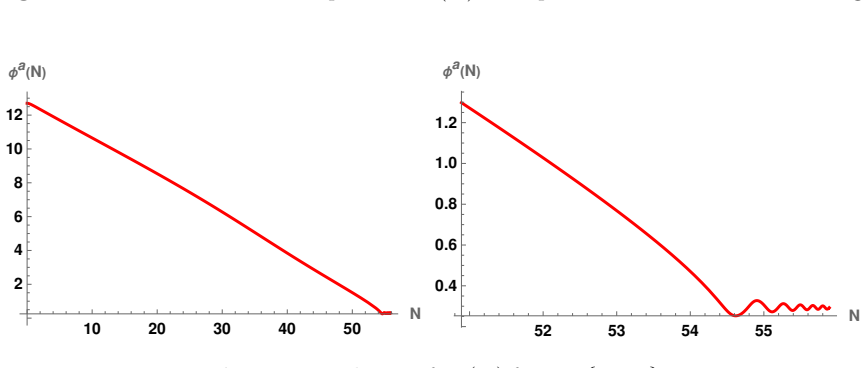
On its own terms, the paper claims that the tetra-quadric hypersurface in $P^2 \times P^2 \times P^2 \times P^2$, with $h^{1,1}=4$, all coordinate divisors K3, and intersection polynomial $2(D_1 D_2 D_3 + D_1 D_2 D_4 + D_1 D_3 D_4 + D_2 D_3 D_4)$, admits an orientifold involution $\sigma_i: x_i \to -x_i$ with O7-planes and no O3-planes. With the overall volume $V$ stabilized by BBHL and log-loop corrections at an exponentially large value, the sub-leading winding-type loop corrections together with higher-derivative $F^4$ corrections stabilize $t_2,t_3,t_4$ in an $S_3$-symmetric minimum. Numerically integrating the multi-field equations with $N=54$ e-folds for the benchmark Model B gives $P_s = 2.19\times 10^{-9}$, $n_s = 0.9733$, $\alpha_s = 1.56\times 10^{-4}$, $r = 7.44\times 10^{-3}$, an effective field excursion $\Delta\Phi = 5.71\,M_p$, and individual excursions $\Delta\Phi_a = 2.20\,M_p$ for $a=2,3,4$. The paper interprets the fact that $\Delta\Phi_a$ is smaller than $\Delta\Phi/\sqrt{3} \simeq 3.30\,M_p$ as evidence that the off-diagonal terms in the field-space metric make the assistance more effective than the canonical Pythagorean estimate.
Load-bearing premise
The whole construction depends on assuming that winding-type string-loop corrections of the assumed form $V_W = -(\kappa |W_0|^2/V^3) \sum_\alpha C_W^\alpha / t_\alpha^{\cap}$ appear for the chosen orientifold involutions, even though the usual prescription says none should appear; if they are absent or have a different field dependence, the flat inflationary track disappears.
Editorial extensions
If this is right
- Model B reproduces Planck-ACT/DESI-compatible observables, $P_s \approx 2.2\times 10^{-9}$, $n_s \approx 0.973$, $\alpha_s \approx 1.6\times 10^{-4}$, and $r \approx 0.0074$, without invoking any non-perturbative superpotential.
- Individual canonical displacements of about $2.2\,M_p$ keep each field below the naive single-field trans-Planckian threshold, so the $5.7\,M_p$ effective shift is obtained without a single modulus crossing a super-Planckian range.
- The same perturbative potential fixes all four Kähler moduli simultaneously, so the assisted-inflation mechanism does not rely on exceptional divisors or non-perturbative instantons.
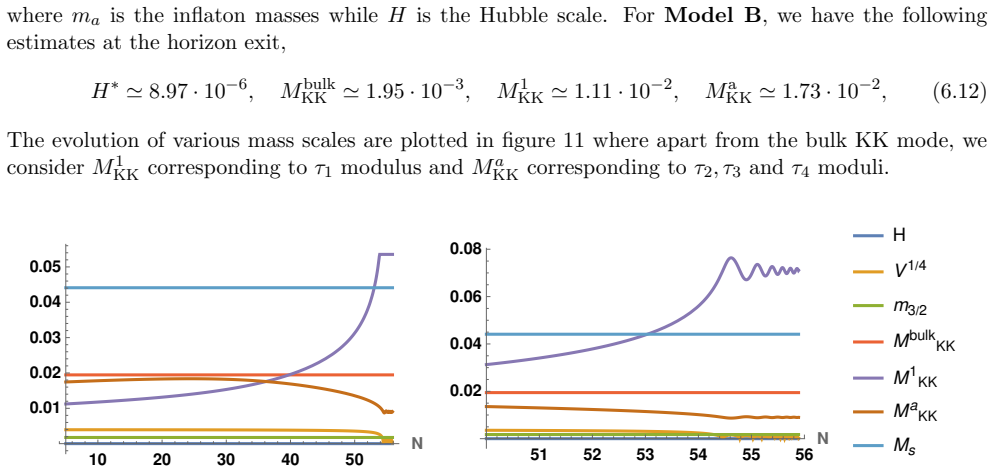
- The mass hierarchy $m_a < H < V^{1/4} < m_{3/2} < M_{KK} < M_s < M_p$ is maintained throughout inflation, supporting the decoupling of the heavy overall-volume mode.
- Because the assistance beats the $\Delta\Phi/\sqrt{n}$ Pythagorean estimate, the effective excursion in a multi-field model is not the right quantity for judging swampland-distance or EFT control; the individual excursions are.
Reading between the lines
- A natural next test is to scan other Calabi-Yau orientifolds with $h^{1,1} > 4$ and larger discrete symmetries; if the off-diagonal metric effect grows with the number of moduli, individual excursions could fall well below $2\,M_p$.
- The load-bearing assumption that winding-type corrections are present despite the stated absence under the standard prescription could be checked by an explicit one-loop string computation; if the coefficients vanish, the model would need a different sub-leading effect to create the flat track.
- The authors' own observation that a KK scale approaches the string scale near the minimum suggests a concrete robustness test: check whether higher-order $\alpha'$ corrections or open-string states modify the potential in the last few e-folds, which would change the predicted $n_s$ and $r$.
- The 'better than $\sqrt{n}$' behaviour implies the Pythagorean estimate used in earlier assisted-inflation arguments is not a fundamental bound; a model with larger off-diagonal metric entries might achieve near-equal sharing with even smaller per-field displacements.
Editorial analysis
A structured set of objections, weighed in public.
Referee Report
Summary. The paper constructs a global type IIB orientifold model of assisted fibre inflation on the tetra-quadric Calabi-Yau threefold, which has h^{1,1}=4 and an S_4 permutation symmetry. The overall volume modulus is stabilized in the perturbative large-volume scenario using BBHL alpha'-corrections and log-loop terms, while the remaining three Kähler moduli t_2, t_3, t_4 are claimed to drive assisted fibre inflation through sub-leading winding-type string-loop and F^4 corrections. Two benchmark models are presented, with moduli stabilized numerically and inflationary dynamics evolved in a three-field system; the resulting power spectrum amplitude P_s, spectral index n_s, running alpha_s, and tensor-to-scalar ratio r are compared with Planck and ACT data. The central headline claim is that an effective inflaton shift of about 5.7 M_p can be achieved with individual shifts of only about 2.2 M_p for each of the three inflaton moduli, improving on the naive sqrt(3) Pythagorean estimate.
Significance. If the construction is valid, the paper would be a valuable explicit global embedding of assisted inflation in string theory, showing that multiple Kähler moduli can collectively source the large effective field excursion needed for fibre inflation while keeping each individual field sub-Planckian. The work is technically substantial: it uses concrete Calabi-Yau data, computes the field-space metric and connections, performs four-field moduli stabilization, and gives a full numerical inflationary evolution with mass hierarchy checks. The benchmark observables are in reasonable ranges and the two models illustrate both Planck-compatible and ACT-compatible parameter choices. The main significance, however, is conditional on the presence of the assumed winding-type string-loop corrections, a point that the paper itself flags as not following from the standard prescription for the chosen involutions. The headline assistance effect is therefore an interesting proposal whose microphysical basis remains to be established.
major comments (4)
- [§4.3, Eq. (4.15)] The winding-type loop correction V_W = -(κ|W0|^2/V^3) Σ C_W^α / t_α^∩ is the load-bearing ingredient of the model, entering the benchmark potential (5.1), the moduli VEVs (5.6), and the inflationary dynamics of Section 6. Yet the text states explicitly that for the involutions σ_i 'there should be no Winding-type contributions a la prescription of [23,25-27,56]', and the corrections are included only on the basis of generic arguments from [24,28,57]. For a global orientifold model claiming to realize assisted fibre inflation, the presence and moduli dependence of these corrections must be derived or at least explicitly justified for this brane setting; citing generic expectations is not sufficient. If these corrections are absent, the three remaining moduli stay flat, the benchmark minima of Section 5.2 disappear, and the assisted-inflation mechanism does not operate.
- [§5.2, Tables 4 and 5] The benchmark models depend on a substantial set of freely chosen parameters: C_w, C̃_w, λ, W_0, g_s, C_up, and the horizon-exit values t_a*. The paper does not demonstrate that these values are realizable by flux choices satisfying D3/D7 tadpole cancellation and flux quantization in the tetra-quadric orientifold. Consequently the agreement with Planck/ACT data is a demonstration of compatibility rather than a prediction. This tuning alone does not invalidate the construction, but it should be stated more carefully in the conclusions, where the results are described as reproducing observational constraints.
- [§6.3, Table 5] The headline reduction of individual field excursions is based on the quantities ΔΦ_a computed 'by considering the motion of one modulus while keeping the other two at their respective minima', whereas ΔΦ is computed along the actual multi-field trajectory using Eq. (6.6). These are conceptually different measures: ΔΦ_a is a single-field distance at fixed other fields, not the displacement of that field during the assisted evolution. The paper should clarify whether the individual displacements along the actual trajectory are indeed about 2.2 M_p, or whether that number is only a single-field estimate at fixed companions.
- [§6.4 and §7] The authors note that towards the minimum one of the KK scales becomes comparable to the string mass and conclude that the EFT description 'may not be as clean and robust as one would like it to be'. Since the whole point of the construction is to avoid trans-Planckian individual excursions while retaining a controlled EFT, the paper should quantify the degree of control during the last 50 e-folds: for example, give the ratios M_KK/H, M_s/H, and m_3/2/H over the full observable range, and specify where the KK-string crossover occurs relative to the end of inflation. As written, the validity of the supergravity approximation at the relevant scales is asserted rather than demonstrated.
minor comments (5)
- [§4.1] The text refers to the 'Kreutzer-Skarke' database; the standard name is Kreuzer-Skarke.
- [§3.2, Eq. (3.17)] The notation in the canonical field definitions is inconsistent: the third line mixes φ_3 and ϕ_3, and the second line uses ϕ_3 as well. Please unify the symbol φ vs ϕ throughout the paper.
- [§5.1, Eq. (5.6)] The expression for ⟨t_a⟩ drops the e^{K_cs} factor contained in κ = g_s e^{K_cs}/2. If this factor is absorbed into the definition of W_0 or λ, that convention should be stated explicitly, since it affects the numerical benchmark values.
- [§6] There is a typo 'symetry' in the sentence introducing the residual symmetry 2↔3↔4.
- [Figures 4-9] Several figure axes are difficult to interpret: for example, Fig. 4 plots 'V(N)·10^10' but the vertical axis label reads '1.6 1.8 2.0 2.2 2.4' without units, and Fig. 9 has an axis labeled 'αs' with values 0.00-0.04, which appears inconsistent with the running values reported in Table 4. Please add clear axis labels and legends.
Circularity Check
No circular derivation: the assisted-shift and cosmological numbers are computed from an explicit potential, not restated inputs; the acknowledged winding-loop assumption is an unverified premise, not a circular step.
full rationale
The paper's central derivation chain is self-contained. The benchmark scalar potential in Eq. (5.1) is an explicit function of the Kähler moduli, the moduli VEVs and Hessian in Eqs. (5.6)-(5.7) follow from minimization of that potential, and the inflationary trajectories are obtained by numerically integrating the multi-field equations (6.1) with the field-space metric and connections given in Appendix A. The headline numbers in Table 5 are computed from the path-length integral ΔΦ = ∫ sqrt(2ϵ_H) dN in Eq. (6.6) and from the individual-distance estimate defined in Section 6.3; they are not restatements of the input parameters C_W, λ, W0, or Cup. The cosmological observables in Table 4 are evaluated from the standard formulas in Eq. (2.26) after the benchmark parameters are selected, and the paper describes them as 'reproduces' rather than as independent forecasts; that is a fitting/model-compatibility caveat, not a circular reduction. The main physical weakness is the winding-type loop potential in Eq. (4.15): Section 4.3 explicitly says that for the chosen involutions 'there should be no Winding-type contributions a la prescription of [23,25-27,56]' and that the terms are included only on generic arguments. This is a load-bearing assumption and a correctness risk, but it is an input assumption, not a claim that reduces to its own output. The heavy reliance on prior work by the same authors, especially [33] and [71], supplies the pLVS and assisted-fibre-inflation framework, but the four-field computation performed here is explicit and does not reduce to those citations. Overall, no step in the derivation is circular by construction.
Assumptions & free parameters
free parameters (8)
- string coupling g_s =
0.24 (Model A), 0.29 (Model B)
- flux superpotential W0 =
2.3 (Model A), 4.0 (Model B)
- winding-loop coefficient C_w =
0.13 (Model A), 0.027 (Model B)
- winding-loop coefficient tilde C_w =
-0.001 (Model A), -0.0043 (Model B)
- F4 coefficient lambda =
-0.001 (Model A), -0.0001 (Model B)
- log-loop parameters eta0 and sigma0 =
eta0=8, sigma0=-6 (both models)
- uplift coefficient C_up =
0.481727 (Model A), 1.99996 (Model B)
- horizon-exit field values t_a* (a=2,3,4) =
9.15 (Model A), 12.7 (Model B)
assumptions (7)
- standard math The F-term scalar potential V = e^K (K^{AB} D_A W D_B W - 3|W|^2) and the no-scale structure hold at leading order.
- standard math The multi-field inflaton dynamics are governed by the second-order equations with non-trivial field-space metric and Hubble friction.
- domain assumption The perturbative LVS potential V_pLVS = C1/V^3 (xi + 2 eta ln V - 8 eta + 2 sigma) fixes the overall volume.
- ad hoc to paper Winding-type loop corrections contribute V_W = -(kappa |W0|^2/V^3) sum C_W^alpha / t_alpha^cap, although the standard brane-setting prescription for the chosen involution predicts no such corrections.
- domain assumption F4 higher-derivative corrections take the form V_F4 = -(lambda kappa^2 |W0|^4)/(g_s^{3/2} V^4) sum Pi_alpha t_alpha with Pi_alpha = 24 for all K3 divisors.
- domain assumption The tree-level Kähler potential K = -2 ln V is used for the field-space metric and connections; sub-leading corrections to the metric are neglected when computing distances.
- domain assumption The complex structure moduli and axio-dilaton are flux-stabilized with W0 as an input; an explicit flux realization of W0=2.3 or 4.0 is assumed to exist.
Cite this review
Pith. "Pith review of Tetra-quadric CY Threefold and Assisted Fibre Inflation." pith.science (2026). https://pith.science/paper/PWV2JPRT
@misc{pith2026260810082,
  author       = {Pith},
  title        = {Pith review of: Tetra-quadric CY Threefold and Assisted Fibre Inflation},
  year         = {2026},
  howpublished = {\url{https://pith.science/paper/PWV2JPRT}},
  note         = {Machine review of arXiv:2608.10082}
}
abstract
In the context of type IIB superstring compactification, we demonstrate the assisted fibre inflation proposal for a four-field model realized using the orientifold of a tetra-quadric Calabi-Yau (CY) threefold. This CY threefold has an underlying permutation symmetry $S_4$ and belongs to both the list of CY threefolds, namely the Kreuzer-Skarke (KS) database as well as the Complete Intersection Calabi-Yau (CICY) database. After fixing the overall volume modulus of the CY threefold using the framework of perturbative large volume scenario, there are three K\"ahler moduli which remain flat and assist in driving fibre inflation via sub-leading corrections. In a particular benchmark model, we show that the effective inflaton shift of around $5.7$ M$_p$, as needed for driving fibre inflation, can be successfully shared by three inflaton moduli which need to be individually shifted by nearly $2.2$ M$_p$ only ! The main motivation for the work is to show that the effective large field excursions of the inflaton field is possible without the need of pushing the individual volume moduli towards a large super-Planckian excursion or close to the boundary of the K\"ahler cone which may create various subsequent challenges for the effective field theory and supergravity approximations, especially in Swiss-Cheese based models of fibre inflation.
Figures


Figures from the paper (8 more)



Reference graph
Works this paper leans on
-
[33]
G. K. Leontaris and P. Shukla,Assisted Fibre Inflation in perturbative L VS,JCAP10(2025) 070, [2506.22630]
arXiv 2025
-
[1]
A. A. Starobinsky,A New Type of Isotropic Cosmological Models Without Singularity,Phys. Lett. B91(1980) 99–102
1980
-
[2]
A. H. Guth,The Inflationary Universe: A Possible Solution to the Horizon and Flatness Problems,Phys. Rev. D23(1981) 347–356
1981
-
[3]
A. D. Linde,A New Inflationary Universe Scenario: A Possible Solution of the Horizon, Flatness, Homogeneity, Isotropy and Primordial Monopole Problems,Phys. Lett. B108(1982) 389–393
1982
- [4]
-
[5]
V. Balasubramanian, P. Berglund, J. P. Conlon and F. Quevedo,Systematics of moduli stabilisation in Calabi-Yau flux compactifications,JHEP03(2005) 007, [hep-th/0502058]
arXiv 2005
-
[6]
K. Dasgupta, G. Rajesh and S. Sethi,M theory, orientifolds and G - flux,JHEP08(1999) 023, [hep-th/9908088]
arXiv 1999
- [7]
Show all 81 references
-
[8]
T. R. Taylor and C. Vafa,R R flux on Calabi-Yau and partial supersymmetry breaking,Phys.Lett. B474(2000) 130–137, [hep-th/9912152]
2000 arXiv
-
[9]
Blumenhagen, D
R. Blumenhagen, D. Lust and T. R. Taylor,Moduli stabilization in chiral type IIB orientifold models with fluxes,Nucl.Phys.B663(2003) 319–342, [hep-th/0303016]
2003 arXiv
-
[10]
Becker, M
K. Becker, M. Becker, M. Haack and J. Louis,Supersymmetry breaking and alpha-prime corrections to flux induced potentials,JHEP06(2002) 060, [hep-th/0204254]
2002 arXiv
-
[11]
Witten,Nonperturbative superpotentials in string theory,Nucl
E. Witten,Nonperturbative superpotentials in string theory,Nucl. Phys. B474(1996) 343–360, [hep-th/9604030]
1996 arXiv
-
[12]
M. B. Green and P. Vanhove,D instantons, strings and M theory,Phys. Lett. B408(1997) 122–134, [hep-th/9704145]
1997 arXiv
-
[13]
Blumenhagen, M
R. Blumenhagen, M. Cvetic, S. Kachru and T. Weigand,D-Brane Instantons in Type II Orientifolds,Ann. Rev. Nucl. Part. Sci.59(2009) 269–296, [0902.3251]
2009 arXiv
-
[14]
Blumenhagen, V
R. Blumenhagen, V. Braun, T. W. Grimm and T. Weigand,GUTs in Type IIB Orientifold Compactifications,Nucl.Phys.B815(2009) 1–94, [0811.2936]
2009 arXiv
-
[15]
Bianchi, A
M. Bianchi, A. Collinucci and L. Martucci,Magnetized E3-brane instantons in F-theory,JHEP 12(2011) 045, [1107.3732]
2011 arXiv
-
[16]
Bianchi, A
M. Bianchi, A. Collinucci and L. Martucci,Freezing E3-brane instantons with fluxes,Fortsch. Phys.60(2012) 914–920, [1202.5045]
2012 arXiv
-
[17]
Louis, M
J. Louis, M. Rummel, R. Valandro and A. Westphal,Building an explicit de Sitter,JHEP10 (2012) 163, [1208.3208]
2012 arXiv
-
[18]
Antoniadis, Y
I. Antoniadis, Y. Chen and G. K. Leontaris,Perturbative moduli stabilisation in type IIB/F-theory framework,Eur. Phys. J.C78(2018) 766, [1803.08941]
2018 arXiv
-
[19]
Antoniadis, Y
I. Antoniadis, Y. Chen and G. K. Leontaris,Logarithmic loop corrections, moduli stabilisation and de Sitter vacua in string theory,1909.10525. 29
1909 arXiv
-
[20]
Antoniadis, Y
I. Antoniadis, Y. Chen and G. K. Leontaris,String loop corrections and de Sitter vacua,PoS CORFU2019(2020) 099
2020
-
[21]
G. K. Leontaris and P. Shukla,Stabilising all K¨ ahler moduli in perturbative L VS,JHEP07(2022) 047, [2203.03362]
2022 arXiv
-
[22]
G. K. Leontaris and P. Shukla,Perturbative L VS and Inflation: A Review of Volume Modulus and Fibre Scenarios,PoSCORFU2024(2025) 181, [2505.01246]
2025 arXiv
-
[23]
M. Berg, M. Haack and B. Kors,Loop corrections to volume moduli and inflation in string theory, Phys. Rev.D71(2005) 026005, [hep-th/0404087]
2005 arXiv
-
[24]
von Gersdorff and A
G. von Gersdorff and A. Hebecker,Kahler corrections for the volume modulus of flux compactifications,Phys. Lett. B624(2005) 270–274, [hep-th/0507131]
2005 arXiv
-
[25]
M. Berg, M. Haack and B. Kors,String loop corrections to Kahler potentials in orientifolds, JHEP11(2005) 030, [hep-th/0508043]
2005 arXiv
-
[26]
M. Berg, M. Haack and B. Kors,On volume stabilization by quantum corrections,Phys. Rev. Lett. 96(2006) 021601, [hep-th/0508171]
2006 arXiv
-
[27]
Cicoli, J
M. Cicoli, J. P. Conlon and F. Quevedo,Systematics of String Loop Corrections in Type IIB Calabi-Yau Flux Compactifications,JHEP01(2008) 052, [0708.1873]
2008 arXiv
-
[28]
X. Gao, A. Hebecker, S. Schreyer and G. Venken,Loops, local corrections and warping in the L VS and other type IIB models,JHEP09(2022) 091, [2204.06009]
2022 arXiv
-
[29]
Ciupke, J
D. Ciupke, J. Louis and A. Westphal,Higher-Derivative Supergravity and Moduli Stabilization, JHEP10(2015) 094, [1505.03092]
2015 arXiv
-
[30]
Cicoli, J
M. Cicoli, J. P. Conlon, A. Maharana, S. Parameswaran, F. Quevedo and I. Zavala,String cosmology: From the early universe to today,Phys. Rept.1059(2024) 1–155, [2303.04819]
2024 arXiv
-
[31]
McAllister and F
L. McAllister and F. Quevedo,Moduli Stabilization in String Theory,2310.20559
-
[32]
A. R. Liddle, A. Mazumdar and F. E. Schunck,Assisted inflation,Phys. Rev. D58(1998) 061301, [astro-ph/9804177]
1998 arXiv
-
[34]
Vafa,The String landscape and the swampland,hep-th/0509212
C. Vafa,The String landscape and the swampland,hep-th/0509212
-
[35]
Ooguri and C
H. Ooguri and C. Vafa,On the Geometry of the String Landscape and the Swampland,Nucl. Phys. B766(2007) 21–33, [hep-th/0605264]
2007 arXiv
-
[36]
Obied, H
G. Obied, H. Ooguri, L. Spodyneiko and C. Vafa,De Sitter Space and the Swampland, 1806.08362
-
[37]
S. K. Garg and C. Krishnan,Bounds on Slow Roll and the de Sitter Swampland,1807.05193
-
[38]
Ooguri, E
H. Ooguri, E. Palti, G. Shiu and C. Vafa,Distance and de Sitter Conjectures on the Swampland, Phys. Lett. B788(2019) 180–184, [1810.05506]
2019 arXiv
-
[39]
Blumenhagen, D
R. Blumenhagen, D. Kl¨ awer, L. Schlechter and F. Wolf,The Refined Swampland Distance Conjecture in Calabi-Yau Moduli Spaces,JHEP06(2018) 052, [1803.04989]
2018 arXiv
-
[40]
T. W. Grimm, E. Palti and I. Valenzuela,Infinite Distances in Field Space and Massless Towers of States,JHEP08(2018) 143, [1802.08264]. 30
2018 arXiv
-
[41]
Scalisi and I
M. Scalisi and I. Valenzuela,Swampland distance conjecture, inflation andα-attractors,JHEP08 (2019) 160, [1812.07558]
2019 arXiv
-
[42]
Bedroya, R
A. Bedroya, R. Brandenberger, M. Loverde and C. Vafa,Trans-Planckian Censorship and Inflationary Cosmology,Phys. Rev. D101(2020) 103502, [1909.11106]
2020 arXiv
-
[43]
N. B. Agmon, A. Bedroya, M. J. Kang and C. Vafa,Lectures on the string landscape and the Swampland,2212.06187
-
[44]
Cicoli, A
M. Cicoli, A. Schachner and P. Shukla,Systematics of type IIB moduli stabilisation with odd axions,JHEP04(2022) 003, [2109.14624]
2022 arXiv
-
[45]
Antoniadis, Y
I. Antoniadis, Y. Chen and G. K. Leontaris,Inflation from the internal volume in type IIB/F-theory compactification,Int. J. Mod. Phys.A34(2019) 1950042, [1810.05060]
2019 arXiv
-
[46]
Antoniadis, Y
I. Antoniadis, Y. Chen and G. K. Leontaris,Moduli stabilisation and inflation in type IIB/F-theory,PoSCORFU2018(2019) 068, [1901.05075]
2019 arXiv
-
[47]
Antoniadis, O
I. Antoniadis, O. Lacombe and G. K. Leontaris,Inflation near a metastable de Sitter vacuum from moduli stabilisation,Eur. Phys. J. C80(2020) 1014, [2007.10362]
2020 arXiv
-
[48]
Crin` o, F
C. Crin` o, F. Quevedo and R. Valandro,On de Sitter String Vacua from Anti-D3-Branes in the Large Volume Scenario,JHEP03(2021) 258, [2010.15903]
2021 arXiv
-
[49]
Cicoli, D
M. Cicoli, D. Ciupke, V. A. Diaz, V. Guidetti, F. Muia and P. Shukla,Chiral Global Embedding of Fibre Inflation Models,JHEP11(2017) 207, [1709.01518]
2017 arXiv
-
[50]
AbdusSalam, C
S. AbdusSalam, C. Crin` o and P. Shukla,On K3-fibred LARGE Volume Scenario with de Sitter vacua from anti-D3-branes,JHEP03(2023) 132, [2206.12889]
2023 arXiv
-
[51]
C. P. Burgess, R. Kallosh and F. Quevedo,De Sitter string vacua from supersymmetric D terms, JHEP10(2003) 056, [hep-th/0309187]
2003 arXiv
-
[52]
Achucarro, B
A. Achucarro, B. de Carlos, J. A. Casas and L. Doplicher,De Sitter vacua from uplifting D-terms in effective supergravities from realistic strings,JHEP06(2006) 014, [hep-th/0601190]
2006 arXiv
-
[53]
A. P. Braun, M. Rummel, Y. Sumitomo and R. Valandro,De Sitter vacua from a D-term generated racetrack potential in hypersurface Calabi-Yau compactifications,JHEP12(2015) 033, [1509.06918]
2015 arXiv
-
[54]
Cicoli, F
M. Cicoli, F. Quevedo and R. Valandro,De Sitter from T-branes,JHEP03(2016) 141, [1512.04558]
2016 arXiv
-
[55]
Cicoli, I
M. Cicoli, I. Garc ` ıa-Etxebarria, C. Mayrhofer, F. Quevedo, P. Shukla and R. Valandro,Global Orientifolded Quivers with Inflation,JHEP11(2017) 134, [1706.06128]
2017 arXiv
-
[56]
M. Berg, M. Haack and E. Pajer,Jumping Through Loops: On Soft Terms from Large Volume Compactifications,JHEP09(2007) 031, [0704.0737]
2007 arXiv
-
[57]
X. Gao, Z. Li and C. Wang,Fibre Inflation Beyond BHP: Constraints and a BHP-Free Regime, 2608.00376
-
[58]
T. W. Grimm, K. Mayer and M. Weissenbacher,One-modulus Calabi-Yau fourfold reductions with higher-derivative terms,JHEP04(2018) 021, [1712.07074]
2018 arXiv
-
[59]
Cicoli, M
M. Cicoli, M. Licheri, P. Piantadosi, F. Quevedo and P. Shukla,Higher derivative corrections to string inflation,JHEP02(2024) 115, [2309.11697]. 31
2024 arXiv
-
[60]
A. R. Liddle and S. M. Leach,How long before the end of inflation were observable perturbations produced?,Phys. Rev. D68(2003) 103503, [astro-ph/0305263]
2003 arXiv
-
[61]
Bhattacharya, K
S. Bhattacharya, K. Dutta, M. R. Gangopadhyay, A. Maharana and K. Singh,Fibre Inflation and Precision CMB Data,Phys. Rev. D102(2020) 123531, [2003.05969]
2020 arXiv
-
[62]
Cicoli and E
M. Cicoli and E. Di Valentino,Fitting string inflation to real cosmological data: The fiber inflation case,Phys. Rev. D102(2020) 043521, [2004.01210]. [63]Planckcollaboration, Y. Akrami et al.,Planck 2018 results. X. Constraints on inflation,Astron. Astrophys.641(2020) A10, [1...
2020 arXiv
-
[68]
Frolovsky and S
D. Frolovsky and S. V. Ketov,Are single-field models of inflation and PBH production ruled out by ACT observations?,2505.17514
-
[69]
Altman, J
R. Altman, J. Gray, Y.-H. He, V. Jejjala and B. D. Nelson,A Calabi-Yau Database: Threefolds Constructed from the Kreuzer-Skarke List,JHEP02(2015) 158, [1411.1418]
2015 arXiv
-
[70]
Gao and P
X. Gao and P. Shukla,On Classifying the Divisor Involutions in Calabi-Yau Threefolds,JHEP 1311(2013) 170, [1307.1139]
2013 arXiv
-
[71]
S. Bera, D. Chakraborty, G. K. Leontaris and P. Shukla,Inflating in perturbative L VS: global embedding and robustness,JCAP09(2024) 004, [2405.06738]
2024 arXiv
-
[72]
Blumenhagen, B
R. Blumenhagen, B. Jurke, T. Rahn and H. Roschy,Cohomology of Line Bundles: A Computational Algorithm,J. Math. Phys.51(2010) 103525, [1003.5217]
2010 arXiv
-
[73]
Blumenhagen, B
R. Blumenhagen, B. Jurke and T. Rahn,Computational Tools for Cohomology of Toric Varieties, Adv. High Energy Phys.2011(2011) 152749, [1104.1187]
2011 arXiv
-
[74]
Denef and M
F. Denef and M. R. Douglas,Distributions of nonsupersymmetric flux vacua,JHEP03(2005) 061, [hep-th/0411183]
2005 arXiv
-
[75]
Denef and M
F. Denef and M. R. Douglas,Distributions of flux vacua,JHEP05(2004) 072, [hep-th/0404116]
2004 arXiv
-
[76]
M. Berg, M. Haack and B. Kors,On the moduli dependence of nonperturbative superpotentials in brane inflation, inThemes in Unification. Proceedings: 10th International Symposium on particles, strings and cosmology, (PASCOS 2004), Pran Nath Festschrift. Part II: Boston, USA, Aug...
2004 arXiv
-
[77]
Carta, A
F. Carta, A. Mininno and P. Shukla,Divisor topologies of CICY 3-folds and their applications to phenomenology,JHEP05(2022) 101, [2201.02165]
2022 arXiv
-
[78]
Altman, J
R. Altman, J. Carifio, X. Gao and B. D. Nelson,Orientifold Calabi-Yau threefolds with divisor involutions and string landscape,JHEP03(2022) 087, [2111.03078]. 32
2022 arXiv
-
[79]
Green and T
P. Green and T. Hubsch,Calabi-yau Manifolds as Complete Intersections in Products of Complex Projective Spaces,Commun. Math. Phys.109(1987) 99
1987
-
[80]
Candelas, A
P. Candelas, A. M. Dale, C. A. Lutken and R. Schimmrigk,Complete Intersection Calabi-Yau Manifolds,Nucl. Phys. B298(1988) 493
1988
-
[81]
P. S. Green, T. Hubsch and C. A. Lutken,All Hodge Numbers of All Complete Intersection Calabi-Yau Manifolds,Class. Quant. Grav.6(1989) 105–124
1989
-
[82]
J. Gray, A. S. Haupt and A. Lukas,Topological Invariants and Fibration Structure of Complete Intersection Calabi-Yau Four-Folds,JHEP09(2014) 093, [1405.2073]
2014 arXiv
-
[83]
L. B. Anderson, X. Gao, J. Gray and S.-J. Lee,Fibrations in CICY Threefolds,JHEP10(2017) 077, [1708.07907]
2017 arXiv
-
[84]
J. P. Conlon,Moduli Stabilisation and Applications in IIB String Theory,Fortsch. Phys.55 (2007) 287–422, [hep-th/0611039]
2007 arXiv
-
[85]
K. R. Dienes and A. Mafi,Kaluza-Klein states versus winding states: Can both be above the string scale?,Phys. Rev. Lett.89(2002) 171602, [hep-ph/0207009]
2002 arXiv
-
[86]
G. K. Leontaris and P. Shukla,On Global Embedding of Assisted Fibre Inflation, 4, 2026, 2604.19250. 33
2026 arXiv
Reviewed August 14, 2026 · model on record in the stance chip above.
Discussion (0). Continue with ORCID to comment.