REVIEW 4 major objections 5 minor 35 references
Discretely-constrained deep network for weakly supervised segmentation
T0 review · 4 major / 5 minor · reviewed 2026-08-14 · deepseek-v4-flash
Pith's one-line read A CNN can be trained with discrete size and boundary-length constraints via ADMM, reaching near-fully-supervised Dice scores on weakly annotated medical images.
desk verdict A solid ADMM-based method for injecting discrete size and boundary priors into CNN training, with correct discrete solvers and consistent gains over penalty baselines, but the advertised 'near full supervision' result depends on giving the network the exact ground-truth foreground size. read the letter →
The pith
A machine-rendered reading of the paper's core claim, the machinery that carries it, and where it could break.
The reading
What carries the argument
The driving object is an ADMM-augmented Lagrangian with two auxiliary binary proposal vectors per image, $\hat{y}_i$ and $\tilde{y}_i$, tied to the network output by equality constraints $s_i(\theta)=\hat{y}_i$ and $s_i(\theta)=\tilde{y}_i$. The regularized proposal $\hat{y}_i$ is updated by minimizing a weighted Potts (boundary-length) energy with graph cuts, which is globally optimal for submodular pairwise terms; the size proposal $\tilde{y}_i$ is updated by solving a cardinality-constrained selection problem—pick between $S_{\min}$ and $S_{\max}$ pixels with largest utility—whose optimum is a simple ranking. The network parameters are updated by SGD, interpreted as a proximal ADMM update, and the multipliers are updated in the standard ADMM way. This machinery is what lets constraints act on hard labels rather than soft probabilities, avoiding gradient saturation and allowing large, optimal discrete steps.
What would settle it
Reset the size bounds to values derived from an independent anatomical prior rather than from the ground-truth volume and record the augmented Lagrangian after every epoch; if the Dice advantage over the penalty baseline disappears when the true size is unknown, or if the Lagrangian fails to decrease across epochs, the central claim is undermined.
Extended reading notes
Core claim
The central claim is that discrete size constraints and boundary-length regularization can be imposed on a CNN during training through an ADMM variable-splitting scheme, and that doing so beats the standard continuous penalty approach. Two binary proposal vectors are introduced for each image, one coupled to a pairwise boundary-length regularizer and one coupled to a constraint on the number of foreground pixels, with equality constraints to the network's soft predictions enforced through scaled Lagrange multipliers. Each proposal update is solved exactly: the regularized one as a submodular graph-cut and max-flow problem, the size-constrained one by sorting pixel utilities and selecting the top S_min up to S_max pixels. The network parameters are updated with ordinary mini-batch SGD, which the paper treats as a proximal ADMM step. The result, on left and right ventricle and prostate MRI with sparse seed annotations, is consistent gains over the penalty baseline in Dice, faster and more stable constraint satisfaction, and near-fully-supervised performance when the size bound is tight.
Load-bearing premise
The central claim rests on treating a fixed number of mini-batch SGD steps as a proximal ADMM update that decreases the augmented Lagrangian, and on computing the tightest reported size bounds from the exact ground-truth foreground volume, so the headline "weak" supervision includes the true target size.
Editorial extensions
If this is right
- If the central claim holds, weakly supervised cardiac and prostate segmentation can be trained from a few seeds per volume to within roughly 3 Dice points of full supervision on the left ventricle when the target size is known.
- The discrete ADMM formulation satisfies size constraints more stably than the continuous penalty method, with predicted-to-real size ratios staying inside the imposed bounds during training.
- Combining size constraints with boundary-length regularization is necessary for complex, narrow structures like the right ventricle, where size alone is insufficient and CRF regularization alone over-shrinks.
- The same variable-splitting recipe can be applied to other discrete priors without changing the network training loop, at small extra cost: one max-flow and one sort per image per epoch.
- The best validation accuracy occurs early in training, around epoch 50, before convergence, which suggests early stopping is beneficial for this scheme.
Reading between the lines
- An untested but natural extension is to replace the two proposal types with other discrete priors the paper cites, such as star-shape, compactness, or histogram constraints, provided each can still be solved to optimality in its proposal update.
- The headline epsilon=0 result uses bounds computed from the ground-truth foreground volume, so transferring the method to a genuinely unseen organ would require deriving bounds from population statistics; the reported 10-40% relaxation results suggest the method degrades gracefully as bounds loosen.
- Because the paper identifies oscillation risk when the ADMM penalty is large, adapting the penalty parameter per epoch, as standard ADMM allows, could stabilize training and is directly testable with the reported setup.
- The observed early-best validation peak hints that the discrete proposals act as a strong curriculum signal; a testable variant would anneal the proposal influence over training to retain the early boost while avoiding late-training instability.
Signed reviews
Editorial analysis
A structured set of objections, weighed in public.
Referee Report
Summary. The paper addresses weakly supervised medical image segmentation by training a CNN under two discrete priors: a lower/upper bound on foreground size and a boundary-length (weighted Potts) regularization term. Because these terms are non-differentiable and discrete, the authors split the training objective with ADMM (Eq. 8), introducing two binary 'proposal' vectors per image that are decoupled from the continuous network output. The network parameters are updated by mini-batch SGD (Section 3.4.1); the CRF-regularized proposal is updated by solving a submodular graph-cut problem (Section 3.4.2); and the size-constrained proposal is updated by ranking pixels, since the subproblem is an equal-weight knapsack (Section 3.4.3). Experiments on three tasks (cardiac LV and RV from ACDC; prostate from PROMISE12) compare 'CRF only', 'size only', and 'CRF+size' variants against the continuous penalty baseline of Kervadec et al. [10] and a fully supervised model, reporting Dice scores, constraint-satisfaction curves, and sensitivity to the ADMM penalty parameter. The central quantitative claim is that at tight size bounds (epsilon=0) the method approaches fully supervised performance (e.g., LV 0.901 vs 0.927).
Significance. If the results hold, the paper makes a useful methodological contribution: it is, to my knowledge, the first to plug exact discrete optimizers (submodular graph cuts and cardinality-constrained ranking) into CNN training through ADMM variable splitting, and the two proposal updates are derived cleanly in Eqs. (10)-(13), each with a polynomial-time solver that is globally optimal for the subproblem. The paper also reports a complete experimental protocol (architectures, learning schedules, grid-searched hyperparameters), including an ablation of the two priors (Tables 2-3) and a constraint-satisfaction analysis (Fig. 6), which is good for reproducibility and goes beyond single-configuration reporting. The main qualification is that the 'near full supervision' headline is achieved only when the size constraint encodes the exact per-volume ground-truth foreground size (epsilon=0), which is a strong annotation; at epsilon=10-40% the gains over the baseline are smaller but still consistent for the CRF+size variant.
major comments (4)
- [Section 4.1 / Table 2] The paper's strongest quantitative claim, 'performance near to full supervision,' is conditioned on epsilon=0, where the size bounds are [S_real, S_real], i.e., the exact per-volume ground-truth foreground size is supplied to the method at training time. This is a per-volume ground-truth quantity, not a weak prior; the same configuration drops to 0.884 (LV), 0.719 (RV), and 0.795 (prostate) at epsilon=10%, and to 0.879/0.691/0.771 at epsilon=40%. The abstract and conclusion should state this conditioning explicitly, and the discussion should be rebalanced around the epsilon=10-40% regime, where the contribution of the discrete formulation is still visible but more modest.
- [Section 3.4.1 / Algorithm 1] The text states that the mini-batch gradient-descent update of the network parameters 'corresponds to a proximal variant of ADMM' citing references [30,31], and Section 3.5 further claims that 'the only requirement for convergence is that the update of network parameters decreases the overall loss [29].' For the non-convex network objective, the conditions of the cited proximal-ADMM analyses (Lipschitz smoothness of the smooth part, sufficient decrease of the augmented Lagrangian) are not verified, and the authors themselves note in Section 6 that strong penalty parameters cause the discrete proposals to oscillate. Please either provide empirical convergence evidence (e.g., augmented-Lagrangian or constraint-violation curves over epochs) or explicitly frame the outer loop as a heuristic whose stability is demonstrated empirically in Figures 3 and 6.
- [Section 3.4.3, Eqs. (12)-(13)] There is a sign inconsistency in the size-constrained proposal update. Minimizing (1/2)||y_tilde - (s(theta) + u_tilde)||^2 over binary y_tilde, the problem stated in Eq. (12) and following from the augmented term in Eq. (8), is equivalent to maximizing sum_p (s_p(theta) + u_tilde_p - 1/2) y_tilde_p, not sum_p (s_p(theta) - u_tilde_p - 1/2) y_tilde_p as printed in Eq. (13). The printed sign also conflicts with the multiplier update u_tilde := u_tilde + (s - y_tilde) in Algorithm 1. Since the optimality of the size update is one of the two 'guarantee of solution optimality' claims of the paper, this inconsistency should be resolved (it may be a typo) rather than left as is.
- [Section 5 / Table 2] The reported numbers are single runs with no variance or significance tests, which does not by itself support the adjective 'significant' used in the summary of Section 5.1; moreover, the epsilon-sweep for the CRF+size variant is non-monotonic (RV 0.734 at epsilon=20% exceeds 0.730 at epsilon=0%, and prostate 0.809 at epsilon=20% exceeds 0.807 at epsilon=0%), which is unexplained. At minimum, the paper should report repeated runs or paired significance tests for the headline comparisons and add a sentence addressing the non-monotonicity.
minor comments (5)
- [Abstract] The arXiv abstract says experiments were run 'on a benchmark cardiac segmentation dataset,' while the full-text abstract and Section 4 describe two datasets (ACDC and PROMISE12); the abstracts should be aligned.
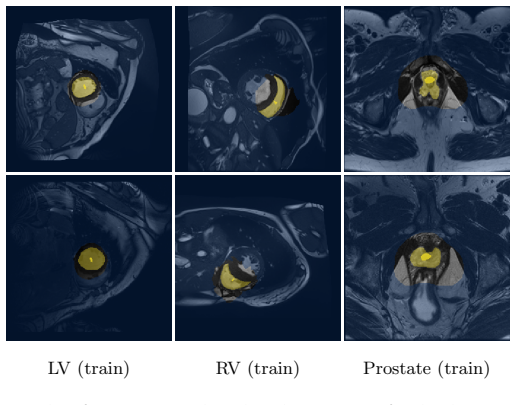
- [Section 4.1 / Figures 2-3] Figure numbering is inconsistent: a figure captioned with annotation examples is labeled Figure 2, but the text says 'Figure 3 shows examples of annotations and ground truth,' and Figure 3 is also used later for the validation Dice curves; please renumber the figures.
- [Section 5.1 / Algorithm 1] The training loop returns parameters after the final epoch, but Section 5.1 reports that the highest validation accuracy is obtained around epoch 50; please specify the model-selection rule used for the numbers in Table 2 (final epoch versus best validation epoch).
- [Section 4.1] There are minor typos in the dataset description: 'well-defined defined pathologies' and 'The images resolution ranges' should be corrected.
- [Section 3.5] The claim of 'negligible computational overhead' for the once-per-epoch proposal updates would be more convincing with a short empirical note on wall-clock training time, given that each CRF update is a max-flow solve on 256x256 images.
Circularity Check
No circularity: the central claim is an ADMM-based training method, and no predicted quantity reduces by construction to an input; the ε=0 size protocol is disclosed and is a strong annotation rather than a fitted prediction.
full rationale
I checked the derivation chain and found no step in which a claimed prediction or derived result is equivalent by construction to an input or to a self-citation. The potential concern is Section 4.1, where size bounds are defined as [Smin,Smax] = [(1−ε)×Sreal, (1+ε)×Sreal]; at ε=0 this is the exact per-volume ground-truth foreground count. This is a strong and disclosed training annotation, but it is an input to the constrained optimization, not a fitted parameter renamed as a prediction: the reported Dice still depends on localization and boundary recovery, and the same bounds are given to the penalty baseline. The ADMM splitting in Section 3.4 is a method contribution with exact discrete subproblem solves via max-flow and ranking, not a derivation that assumes its own conclusion. Section 3.4.1 explicitly admits that the network parameter update is only a proximal variant of ADMM and cites [30,31] without verifying sufficient-decrease or smoothness conditions; that is an unverified convergence assumption, a correctness risk rather than circularity. The Discussion's instability caveat for strong penalties is likewise a robustness limitation, not a circular dependency. Self-citations such as [10], [17], [25], and [28] appear as baselines or related work and are not load-bearing. The method is evaluated on external benchmarks (ACDC and PROMISE) against a fully supervised baseline and an existing penalty method, so the central empirical claims stand independently. Therefore no circular step is present, and the circularity score is 0.
Assumptions & free parameters
free parameters (3)
- lambda (CRF weight) =
100 (LV/RV), 1000 (prostate)
- sigma (edge weight scale) =
1e-4 (LV), 1e-5 (RV), 1e-6 (prostate)
- mu (ADMM penalty parameter) =
1 for CRF-only and size-only, 10 for CRF+size (best on validation)
assumptions (3)
- standard math The weighted Potts model is submodular, so the CRF-regularized proposal in Eq. (11) can be solved to a global optimum by graph cuts in polynomial time.
- ad hoc to paper Mini-batch SGD on network parameters is a valid proximal update for ADMM in the non-convex setting, and the conditions of references [30,31] hold.
- domain assumption Size bounds [Smin, Smax] for each image are known in advance and are derived from the true foreground size Sreal in the evaluation protocol.
Cite this review
Pith. "Pith review of Discretely-constrained deep network for weakly supervised segmentation." pith.science (2026). https://pith.science/paper/PWX7QNLL
@misc{pith2026190805770,
  author       = {Pith},
  title        = {Pith review of: Discretely-constrained deep network for weakly supervised segmentation},
  year         = {2026},
  howpublished = {\url{https://pith.science/paper/PWX7QNLL}},
  note         = {Machine review of arXiv:1908.05770}
}
read the original abstract
An efficient strategy for weakly-supervised segmentation is to impose constraints or regularization priors on target regions. Recent efforts have focused on incorporating such constraints in the training of convolutional neural networks (CNN), however this has so far been done within a continuous optimization framework. Yet, various segmentation constraints and regularization can be modeled and optimized more efficiently in a discrete formulation. This paper proposes a method, based on the alternating direction method of multipliers (ADMM) algorithm, to train a CNN with discrete constraints and regularization priors. This method is applied to the segmentation of medical images with weak annotations, where both size constraints and boundary length regularization are enforced. Experiments on a benchmark cardiac segmentation dataset show our method to yield a performance near to full supervision.
Figures


Figures from the paper (3 more)


Reference graph
Works this paper leans on
-
[10]
H. Kervadec, J. Dolz, M. Tang, E. Granger, Y. Boykov, I. Ben Ayed, Constrained-CNN losses for weakly supervised segmentation, Medical im- age analysis 54 (2019) 88–99
work page 2019
-
[29]
S. Boyd, N. Parikh, E. Chu, B. Peleato, J. Eckstein, et al., Distributed optimization and statistical learning via the alternating direction method of multipliers, Foundations and Trends® in Machine learning 3 (1) (2011) 1–122
2011
-
[1]
S. Liao, Y. Gao, A. Oto, D. Shen, Representation learning: a unified deep learning framework for automatic prostate MR segmentation, in: Interna- tional Conference on Medical Image Computing and Computer-Assisted Intervention, 2013, pp. 254–261
work page 2013
-
[2]
F. Milletari, N. Navab, S.-A. Ahmadi, V-net: Fully convolutional neural networks for volumetric medical image segmentation, in: 3D Vision (3DV), 2016 Fourth International Conference on, IEEE, 2016, pp. 565–571
work page 2016
-
[3]
P. Luc, N. Neverova, C. Couprie, J. Verbeek, Y. LeCun, Predicting deeper into the future of semantic segmentation, in: IEEE International Confer- ence on Computer Vision (ICCV), Vol. 1, 2017
work page 2017
-
[4]
Y. Yuan, M. Chao, Y.-C. Lo, Automatic skin lesion segmentation using deep fully convolutional networks with jaccard distance, IEEE Trans. Med. Imaging 36 (9) (2017) 1876–1886
work page 2017
-
[5]
J. Dolz, C. Desrosiers, I. Ben Ayed, 3D fully convolutional networks for sub- cortical segmentation in MRI: A large-scale study, NeuroImage 170 (2018) 456–470
work page 2018
-
[6]
C. Szegedy, S. Ioffe, V. Vanhoucke, A. A. Alemi, Inception-v4, inception- resnet and the impact of residual connections on learning., in: AAAI, Vol. 4, 2017, p. 12
work page 2017
Show all 35 references
-
[7]
Litjens, T
G. Litjens, T. Kooi, B. E. Bejnordi, A. A. A. Setio, F. Ciompi, M. Ghafoo- rian, J. A. van der Laak, B. Van Ginneken, C. I. S´ anchez, A survey on deep learning in medical image analysis, Medical image analysis 42 (2017) 60–88
2017
-
[8]
P. O. Pinheiro, R. Collobert, Weakly supervised semantic segmentation with convolutional networks, in: Proceedings of the IEEE international conference on computer vision, Vol. 2, 2015, p. 6. 26
2015
-
[9]
Papandreou, L.-C
G. Papandreou, L.-C. Chen, K. P. Murphy, A. L. Yuille, Weakly-and semi- supervised learning of a deep convolutional network for semantic image segmentation, in: Proceedings of the IEEE international conference on computer vision, 2015, pp. 1742–1750
2015
-
[11]
Pathak, P
D. Pathak, P. Krahenbuhl, T. Darrell, Constrained convolutional neural networks for weakly supervised segmentation, in: Proceedings of the IEEE international conference on computer vision, 2015, pp. 1796–1804
2015
-
[12]
J. Dai, K. He, J. Sun, Boxsup: Exploiting bounding boxes to supervise convolutional networks for semantic segmentation, in: Proceedings of the IEEE International Conference on Computer Vision, 2015, pp. 1635–1643
2015
-
[13]
Rajchl, M
M. Rajchl, M. C. Lee, O. Oktay, K. Kamnitsas, J. Passerat-Palmbach, W. Bai, M. Damodaram, M. A. Rutherford, J. V. Hajnal, B. Kainz, et al., Deepcut: Object segmentation from bounding box annotations using con- volutional neural networks, IEEE transactions on medical imaging 36...
2017
-
[14]
D. Lin, J. Dai, J. Jia, K. He, J. Sun, Scribblesup: Scribble-supervised convolutional networks for semantic segmentation, in: Proceedings of the IEEE Conference on Computer Vision and Pattern Recognition, 2016, pp. 3159–3167
2016
-
[15]
Boykov, O
Y. Boykov, O. Veksler, R. Zabih, Fast approximate energy minimization via graph cuts, IEEE Transactions on pattern analysis and machine intelligence 23 (11) (2001) 1222–1239
2001
-
[16]
Veksler, Star shape prior for graph-cut image segmentation, in: Euro- pean Conference on Computer Vision, Springer, 2008, pp
O. Veksler, Star shape prior for graph-cut image segmentation, in: Euro- pean Conference on Computer Vision, Springer, 2008, pp. 454–467. 27
2008
-
[17]
J. Dolz, I. B. Ayed, C. Desrosiers, Unbiased shape compactness for seg- mentation, in: International Conference on Medical Image Computing and Computer-Assisted Intervention, Springer, 2017, pp. 755–763
2017
-
[18]
W. Bai, O. Oktay, M. Sinclair, H. Suzuki, M. Rajchl, G. Tarroni, B. Glocker, A. King, P. M. Matthews, D. Rueckert, Semi-supervised learn- ing for network-based cardiac MR image segmentation, in: International Conference on Medical Image Computing and Computer-Assisted Interven...
2017
-
[19]
Kervadec, J
H. Kervadec, J. Dolz, E. Granger, I. Ben Ayed, Curriculum semi-supervised segmentation, in: International Conference on Medical Image Computing and Computer-Assisted Intervention, 2019
2019
-
[20]
Z. Jia, X. Huang, I. Eric, C. Chang, Y. Xu, Constrained deep weak supervi- sion for histopathology image segmentation, IEEE Transactions on Medical Imaging 36 (11) (2017) 2376–2388
2017
-
[21]
Y. Zhou, Z. Li, S. Bai, C. Wang, X. Chen, M. Han, E. Fishman, A. Yuille, Prior-aware neural network for partially-supervised multi-organ segmenta- tion, arXiv preprint arXiv:1904.06346
1904 arXiv
-
[22]
L. A. Wolsey, G. L. Nemhauser, Integer and combinatorial optimization, John Wiley & Sons, 2014
2014
-
[23]
W. H. Cunningham, On submodular function minimization, Combinatorica 5 (3) (1985) 185–192
1985
-
[24]
Miksik, V
O. Miksik, V. Vineet, P. P´ erez, P. Torr, F. C. S´ evign´ e, Distributed non- convex ADMM-inference in large-scale random fields, in: British Machine Vision Conference (BMVC), Vol. 2, 2014
2014
-
[25]
J. Dolz, I. Ben Ayed, C. Desrosiers, DOPE: distributed optimization for pairwise energies, in: Proceedings of the IEEE Conference on Computer Vision and Pattern Recognition, 2017, pp. 6779–6788. 28
2017
-
[26]
Karnyaczki, C
S. Karnyaczki, C. Desrosiers, A sparse coding method for semi-supervised segmentation with multi-class histogram constraints, in: 2015 IEEE Inter- national Conference on Image Processing (ICIP), IEEE, 2015, pp. 3215– 3219
2015
-
[27]
Laude, J.-H
E. Laude, J.-H. Lange, J. Sch¨ upfer, C. Domokos, L. Leal-Taix´ e, F. R. Schmidt, B. Andres, D. Cremers, Discrete-continuous ADMM for transduc- tive inference in higher-order mrfs, in: Proceedings of the IEEE Conference on Computer Vision and Pattern Recognition, 2018, pp. 1614–1624
2018
-
[28]
Marin, M
D. Marin, M. Tang, I. B. Ayed, Y. Boykov, Beyond gradient descent for regularized segmentation losses, in: IEEE conference on Computer Vision and Pattern Recognition (CVPR), 2019
2019
-
[30]
B. He, F. Ma, Convergence study on the proximal alternating direction method with larger step size, Optimization online
-
[31]
Zhang, Z.-Q
J. Zhang, Z.-Q. Luo, A proximal alternating direction method of mul- tiplier for linearly constrained nonconvex minimization, arXiv preprint arXiv:1812.10229
-
[32]
P. C. Chu, J. E. Beasley, A genetic algorithm for the multidimensional knapsack problem, Journal of heuristics 4 (1) (1998) 63–86
1998
-
[33]
Bernard, A
O. Bernard, A. Lalande, C. Zotti, F. Cervenansky, X. Yang, P.-A. Heng, I. Cetin, K. Lekadir, O. Camara, M. A. G. Ballester, et al., Deep learning techniques for automatic MRI cardiac multi-structures segmentation and diagnosis: Is the problem solved?, IEEE transactions on medi...
2018
-
[34]
Litjens, R
G. Litjens, R. Toth, W. van de Ven, C. Hoeks, S. Kerkstra, B. van Gin- neken, G. Vincent, G. Guillard, N. Birbeck, J. Zhang, et al., Evaluation of prostate segmentation algorithms for MRI: the PROMISE12 challenge, Medical image analysis 18 (2) (2014) 359–373
2014
-
[35]
Paszke, A
A. Paszke, A. Chaurasia, S. Kim, E. Culurciello, Enet: A deep neural network architecture for real-time semantic segmentation, arXiv preprint arXiv:1606.02147. 30
Reviewed August 14, 2026 · model on record in the stance chip above.
Discussion (0). Continue with ORCID to comment.