REVIEW 3 major objections 6 minor 108 references
Efficient utilization of imaginarity in quantum steering
T0 review · 3 major / 6 minor · reviewed 2026-08-15 · deepseek-v4-flash
Pith's one-line read Imaginarity can certify quantum steering from just four real parameters of a two-qubit state, via a new steering inequality that any local hidden state model must satisfy, with violation detected by simple Pauli witness operators.
desk verdict Candid take: the 2-measurement imaginarity steering inequality is a real and useful variant of NAQC/NAQI, the central algebra checks out, but the paper has proof-presentation gaps and an incomplete noise comparison. read the letter →
The pith
A machine-rendered reading of the paper's core claim, the machinery that carries it, and where it could break.
The reading
What carries the argument
The engine is the imaginarity-steering functional $I_2(\rho_{AB})$ together with the qubit complementarity relation $I^x_R(\rho)+I^y_R(\rho)\le\sqrt{2}$ for the robustness of imaginarity $I_R(\rho)=\tfrac12\|\rho-\rho^T\|_1$. The complementarity bound is applied to Bob's conditional states under Alice's $x$- and $y$-measurements; averaging over the hidden states in a local-hidden-state model converts it into the steering inequality. Convexity and compactness of the free set of states then turn the inequality into witness operators built from the Pauli terms $\mathbb{1}\otimes\sigma_x$, $\mathbb{1}\otimes\sigma_y$, $\sigma_x\otimes\sigma_x$, and $\sigma_y\otimes\sigma_y$, so a violation is read off as a negative expectation value.
What would settle it
Run a semidefinite-programming feasibility search for a local-hidden-state model on the four-parameter family with $I_2(\rho_{AB})>\sqrt{2}$; the theorem is settled by whether any such model reproduces the $x/y$ measurement statistics, and a positive example for the visibility-mixed singlet at $v=0.75$ would directly contradict the paper's prediction.
Extended reading notes
Core claim
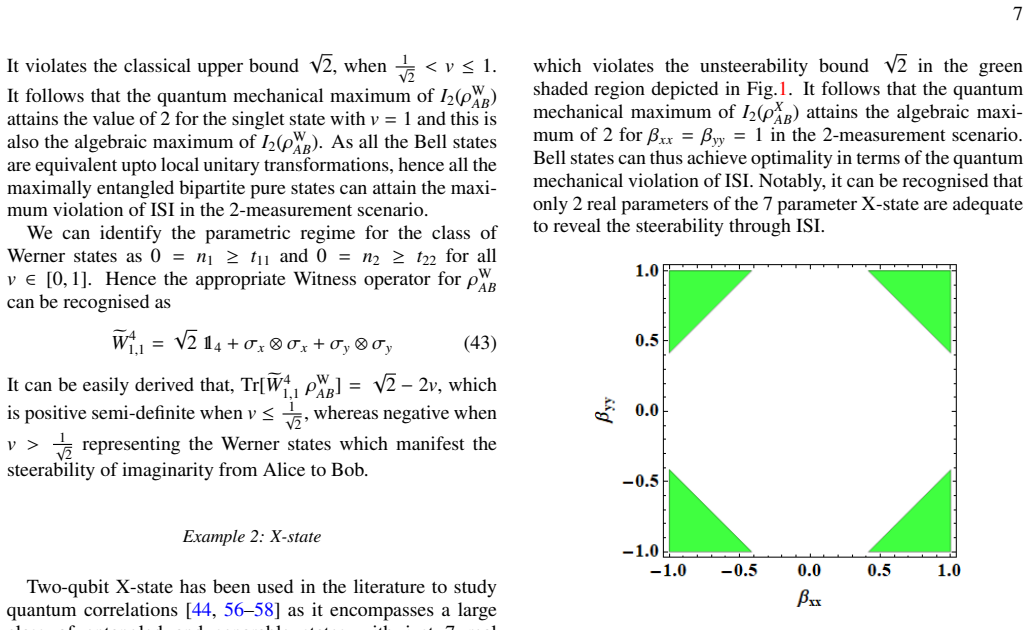
The paper's central claim is Theorem 2: for any bipartite qubit state, Alice can steer Bob's local imaginarity whenever $$I_2(\rho_{AB})=\tfrac12\big(|n_1-t_{11}|+|n_1+t_{11}|+|n_2-t_{22}|+|n_2+t_{22}|\big)>\sqrt{2}.$$ The quantity is derived from a complementarity relation for the robustness of imaginarity in two mutually unbiased bases, $I^x_R(\rho)+I^y_R(\rho)\le\sqrt{2}$, applied to Bob's conditional states. The proof shows every separable state satisfies the inequality, and it constructs witness operators $\widetilde{W}^k_{i,j}=\sqrt{2}\,\mathbb{1}_4-W^k_{i,j}$ whose negative expectation values flag the violation, establishing that no local hidden state model can reproduce the two-measurement statistics. The paper also proves the monogamy trade-off $I_2(\rho_{AB})+I_2(\rho_{AC})\le 2\sqrt{2}$ for tripartite pure states, and compares the inequality with two earlier partial-information steering criteria, finding a larger noise tolerance for the visibility-mixed singlet family.
Load-bearing premise
The load-bearing premise is that when Alice's cheating strategy averages hidden states, the imaginarity of the averaged state is no larger than the weighted average of the imaginarities of the individual hidden states; if mixing could concentrate imaginarity, the $\sqrt{2}$ ceiling on $I_2$ would not follow.
Editorial extensions
If this is right
- Any two-qubit state with $I_2(\rho_{AB})>\sqrt{2}$ is steerable from Alice to Bob, so steering can be certified from four parameters instead of full state tomography.
- The witness operators require only spin measurements in the $x$- and $y$-bases, with eight local projectors in the decomposition given in the paper.
- In a tripartite pure state, Alice cannot simultaneously steer the imaginarity of both Bob and Charlie; one of the two reduced states must satisfy the inequality.
- For white-noise-mixed singlet states the violation starts at $v>1/\sqrt{2}$, below the $v>0.815$ and $v>0.745$ thresholds quoted for the coherence-based and imaginarity-based three-measurement tests; the same $1/\sqrt{2}$ threshold applies to unsharp measurement sharpness.
Reading between the lines
- Because the witness needs only two bases per side and four parameters, a direct estimator that extracts these marginals from raw coincidence counts without reconstructing the full density matrix is a natural next step; the paper does not construct such an estimator.
- The inequality is sufficient but not necessary for steering, so there is a gap between the region detected by $I_2$ and the full steerable region; mapping that gap could show how much steering is missed by partial-information tests.
- The monogamy trade-off suggests a quantitative bound for one-sided device-independent tasks such as key distribution or self-testing, since all maximally entangled states saturate the maximal violation; quantifying how the violation magnitude converts into a security parameter is not done here.
Signed reviews
Editorial analysis
A structured set of objections, weighed in public.
Referee Report
Summary. The paper introduces an imaginarity steering inequality (ISI) for bipartite qubit states. By exploiting the robustness of imaginarity and a complementarity relation between two mutually unbiased bases, the authors derive a steering bound of √2 for local hidden state models. They express the left-hand side I2(ρAB) in terms of only four parameters (n1, n2, t11, t22), construct witness operators whose negative expectation values detect violations, illustrate the criterion on Werner states, X states, and MEMS, prove a monogamy inequality for pure tripartite states, and compare noise robustness and unsharp-measurement tolerance with NAQC and NAQI criteria.
Significance. The central steering certificate is attractive because it uses only two measurement settings per party and a partial tomographic description of the state. I verified the key algebraic reductions: the LHS bound in Eq. (15), the four-parameter formula in Eqs. (21)-(24), the Werner and X-state evaluations, and the equivalence I2 = 2λ under unsharp measurements are internally consistent. The witness family in Eqs. (35)-(40) is also a valid subgradient construction: its maximum over the Pauli-pair expectations equals I2(ρAB). If the proof gaps identified below are repaired, this would be a useful addition to the steering literature.
major comments (3)
- [Section III B, Eq. (10)] The equality I_R(σ_{a|A}) = Σ_λ p(λ)p(a|A,λ) I_R(ρ_λ) is not valid for the robustness of imaginarity: the trace norm is subadditive, not additive, so only ≤ holds in general. The subsequent derivation needs only the ≤ direction, so the steering bound in Eq. (15) survives, but the manuscript must replace the equality by an inequality and adjust the accompanying text, which currently attributes additivity to homogeneity of the norm.
- [Section IV, Lemma 2, Eqs. (33)-(34)] The norm estimate ∥Σ_{i,j}[(σ_i⊗I)+(I⊗σ_i)+(σ_i⊗σ_j)]∥ = √15/2 is not justified and appears numerically incorrect. The continuity of I2 can be proven by a simpler direct Lipschitz bound because n1, n2, t11, t22 are linear functions of ρ and | |a|-|b| | ≤ |a-b|, but the current proof should be corrected before the compactness argument for the separating witness is accepted.
- [Section V, Theorem 4, Eq. (66)] The proof jumps from the explicit expressions in Eqs. (62)-(65) to the claimed inequality I2(ρAB)+I2(ρAC) ≤ 2√2 without supplying the required algebra or optimization. The assertion that the maximum is attained at η0 = 1/√2, η1 = η4 = 0, η2 = η3 = 1/2 is stated but not demonstrated. Since monogamy is a headline result, the derivation must be completed or replaced by a valid argument.
minor comments (6)
- [Abstract] There is a typo: 'unhsarp' should be 'unsharp'.
- [Section III B, Eq. (11)] The notation I_R(ρ_{λ_max}) is used before λ_max is defined; please define it explicitly.
- [Section IV C, Eqs. (54)-(57)] The kets such as |0x0x⟩ are not defined; please add a sentence explaining the tensor-product shorthand, e.g. |ab⟩ = |a⟩⊗|b⟩.
- [Section IV A, Eq. (35)] The notation I2(ρAB) = { ±n1±n2, ... } is nonstandard; it should be written as the maximum over the displayed expressions, since the witness construction relies on I2 = max(|n1|,|t11|) + max(|n2|,|t22|).
- [Section VI A, Table I] The sentence 'The same bounds are obtained if Alice performs unsharp measurements with parameter v' is confusing because v denotes visibility in the table; please clarify whether the table's entries apply to the sharpness parameter λ.
- [Section III B, Eq. (10) versus Theorem 1, Eq. (18)] Theorem 1 correctly uses subadditivity and homogeneity, which is inconsistent with the equality claimed in Eq. (10); harmonizing these derivations would improve the paper.
Circularity Check
No significant circularity: central ISI bound is derived self-contained from LHS model and qubit imaginarity complementarity.
full rationale
The claimed steering certificate is not circular. The central inequality (15) is derived from the LHS ansatz (1) by bounding Bob's conditional-state imaginarity with the maximum over hidden states and then invoking the qubit complementarity relation I_x^R(ρ)+I_y^R(ρ)≤√2 (9); neither step contains a fitted constant or assumes the target violation. The equality in Eq. (10) is stronger than the convexity of robustness of imaginarity actually guarantees, but the derivation needs only subadditivity in that direction, and replacing (10) by ≤ leaves inequalities (11)–(15) intact, so it is a proof-presentation defect rather than a circular reduction. Theorem 2's four-parameter formula (21) is obtained by direct algebra from the conditional Bloch vectors (22)–(23), with no parameter tuned to force a prediction. The witness family (35)–(40) is a linear reformulation of the same convex criterion: because max_{k,i,j} Tr[W^k_{i,j}ρ] equals I2(ρAB), the witnesses are mathematically equivalent to the inequality; this is a valid detection reformulation and not a separate fitted prediction. Noise and unsharpness comparisons use externally published NAQC/NAQI thresholds [40,41] and analytical evaluations of I2; no parameter is fitted to force the stated robustness conclusions. Self-citations by the authors appear only in contextual references and future-directions discussion, not as the load-bearing justification of the inequality. Some algebraic steps in Lemma 2 and Theorem 4 are omitted, but omitted algebra is a completeness defect, not circularity.
Assumptions & free parameters
assumptions (5)
- domain assumption Robustness of imaginarity has the closed form I_R(ρ) = (1/2)||ρ - ρ^T||_1 and is a convex, homogeneous resource measure.
- standard math Subadditivity of the trace norm, ||Σ_i M_i||_1 ≤ Σ_i ||M_i||_1, and absolute homogeneity, ||cM||_1 = |c| ||M||_1.
- domain assumption The LHS model (Eqs 1-2) with Bob's hidden states ρ_λ restricted to qubit states.
- domain assumption The generalized Schmidt decomposition of 3-qubit pure states in Eq (59) covers all pure tripartite states up to local unitaries.
- domain assumption The published NAQC bound γ_g and NAQI bound γ_g' from Refs [40,41] and their Werner-state thresholds v > 0.815 and v > 0.745.
Cite this review
Pith. "Pith review of Efficient utilization of imaginarity in quantum steering." pith.science (2026). https://pith.science/paper/PXELLTMK
@misc{pith2026250817140,
  author       = {Pith},
  title        = {Pith review of: Efficient utilization of imaginarity in quantum steering},
  year         = {2026},
  howpublished = {\url{https://pith.science/paper/PXELLTMK}},
  note         = {Machine review of arXiv:2508.17140}
}
read the original abstract
We illustrate the role of complex numbers in quantum information processing through the phenomenon of quantum steering. Exploiting partial knowledge of a qubit in terms of imaginarity, we formulate a steering criterion for bipartite qubit systems, which requires two dichotomic measurements at the untrusted side and two mutually unbiased bases at the trusted side. We show that quantum correlations embodied through our proposed imaginarity steering inequality can be witnessed by suitably constructed Hermitian operators that depend on fewer state parameters and require measurement of a lesser number of observables than for witnessing other forms of quantum nonlocal correlations. The monogamy of such correlations is also demonstrated. We further underscore the steering of imaginarity as an efficient nonlocal resource in the presence of white noise and under unhsarp measurements, showing the robustness of imaginarity steering compared to certain other steering criteria.
Figures
Reference graph
Works this paper leans on
-
[1]
Batle, A
J. Batle, A. Plastino, M. Casas, and A. Plastino, On the entan- glement properties of two-rebits systems, Phys. Lett. A 298, 301 (2002)
2002
-
[2]
Thus a state,ϱAB can be found which is witnessed by such an operator, thus allowing to witness the imaginarity steering criterion. A. Construction of a Witness Operator By using Eq.(24), a Hermitian operator eW can always be constructed which obeys the conditions, (i) Tr[ eWρAB] ≥ 0 for the states ρAB which satisfy inequality(15), and (ii) Tr[eWρAB] < 0 f...
-
[3]
The violation is maximal when there is no unsharpness in the measurement. We can observe that the conditional state,ρB|Ea|A obtained at Bob’s side after Alice’s unsharp measurement on her part of the singlet state is equivalent to that derived using projective measurement done by Alice on her subsystem of the initially chosen Werner state with visibilityλ...
-
[4]
Prasannan, S
N. Prasannan, S. De, S. Barkhofen, B. Brecht, C. Silberhorn, and J. Sperling, Experimental entanglement characterization of two-rebit states, Phys. Rev. A 103, L040402 (2021)
2021
-
[5]
W. K. Wootters, Entanglement sharing in real-vector-space quantum theory, Found. Phys. 42, 19 (2012)
2012
-
[6]
W. K. Wootters, The rebit three-tangle and its relation to two- qubit entanglement, Jour. Phys. A: Math. Theo. 47, 424037 (2014)
2014
-
[7]
Araki, On a characterization of the state space of quantum mechanics, Comm
H. Araki, On a characterization of the state space of quantum mechanics, Comm. Math. Phys. 75, 1 (1980)
1980
-
[8]
McKague, M
M. McKague, M. Mosca, and N. Gisin, Simulating quantum systems using real hilbert spaces, Phys. Rev. Lett.102, 020505 (2009)
2009
Show all 108 references
-
[9]
D. E. Koh, M. Y . Niu, and T. J. Yoder, Quantum simulation from the bottom up: the case of rebits, Jour. Phys. A: Math. and Theo. 51, 195302 (2018)
2018
-
[10]
Aleksandrova, V
A. Aleksandrova, V . Borish, and W. K. Wootters, Real-vector- space quantum theory with a universal quantum bit, Phys. Rev. A 87, 052106 (2013)
2013
-
[11]
Hardy and W
L. Hardy and W. K. Wootters, Limited holism and real-vector- space quantum theory, Found. Phys. 42, 454 (2012)
2012
-
[12]
J. C. Baez, Division algebras and quantum theory, Found. Phys. 42, 819 (2012)
2012
-
[13]
Zhu, Hiding and masking quantum information in com- plex and real quantum mechanics (2020), arXiv:2010.07843 [quant-ph]
H. Zhu, Hiding and masking quantum information in com- plex and real quantum mechanics (2020), arXiv:2010.07843 [quant-ph]
2020 arXiv
-
[14]
W. K. Wootters, Optimal information transfer and real-vector- space quantum theory, Quantum Theory: Informational Foun- dations and Foils, edited by G. Chiribella and R. W. Spekkens 181, 21 (2015)
2015
-
[15]
Q. Liu, T. J. Elliott, F. C. Binder, C. Di Franco, and M. Gu, Optimal stochastic modeling with unitary quantum dynamics, Phys. Rev. A 99, 062110 (2019)
2019
-
[16]
K.-D. Wu, T. V . Kondra, S. Rana, C. M. Scandolo, G.-Y . Xi- ang, C.-F. Li, G.-C. Guo, and A. Streltsov, Operational re- source theory of imaginarity, Phys. Rev. Lett. 126, 090401 (2021)
2021
-
[17]
Zhang, Z
R.-Q. Zhang, Z. Hou, Z. Li, H. Zhu, G.-Y . Xiang, C.-F. Li, and G.-C. Guo, Experimental masking of real quantum states (2021), arXiv:2107.01589 [quant-ph]
2021 arXiv
-
[18]
Hickey and G
A. Hickey and G. Gour, Quantifying the imaginarity of quan- tum mechanics, J. Phys. A: Math. Theor. 51, 414009 (2018)
2018
-
[19]
Zhang, N
Z. Zhang, N. Li, and S. Luo, Broadcasting of imaginarity, Phys. Rev. A 110, 052439 (2024)
2024
-
[20]
K.-D. Wu, T. V . Kondra, S. Rana, C. M. Scandolo, G.-Y . Xi- ang, C.-F. Li, G.-C. Guo, and A. Streltsov, Resource theory of imaginarity: Quantification and state conversion, Phys. Rev. A 103, 032401 (2021)
2021
-
[21]
K.-D. Wu, T. V . Kondra, C. Scandolo, S. M. Rana, G.-Y . Xi- ang, C.-F. Li, G.-C. Guo, and A. Streltsov, Resource theory of imaginarity in distributed scenarios, Comm. Phys. 7, 171 (2024)
2024
-
[22]
Einstein, B
A. Einstein, B. Podolsky, and N. Rosen, Can quantum- mechanical description of physical reality be considered com- plete?, Phys. Rev. 47, 777 (1935)
1935
-
[23]
Zhu, Hiding and masking quantum information in com- plex and real quantum mechanics, Phys
H. Zhu, Hiding and masking quantum information in com- plex and real quantum mechanics, Phys. Rev. Res. 3, 033176 (2021)
2021
-
[24]
Batle, T
J. Batle, T. Białecki, T. Rybotycki, J. Tworzydło, and A. Bed- norz, Efficient discrimination between real and complex quan- tum theories, Quantum 9, 1595 (2025)
2025
-
[25]
Schr ¨odinger, Discussion of probability relations between separated systems, Mathematical Proceedings of the Cam- bridge Philosophical Society 31, 555–563 (1935)
E. Schr ¨odinger, Discussion of probability relations between separated systems, Mathematical Proceedings of the Cam- bridge Philosophical Society 31, 555–563 (1935)
1935
-
[26]
J. S. Bell, On the einstein podolsky rosen paradox, Physics Physique Fizika 1, 195 (1964)
1964
-
[27]
J. F. Clauser, M. A. Horne, A. Shimony, and R. A. Holt, Pro- posed experiment to test local hidden-variable theories, Phys. Rev. Lett. 23, 880 (1969)
1969
-
[28]
S. J. Jones, H. M. Wiseman, and A. C. Doherty, Entangle- ment, einstein-podolsky-rosen correlations, bell nonlocality, and steering, Phys. Rev. A 76, 052116 (2007)
2007
-
[29]
E. G. Cavalcanti, C. J. Foster, M. Fuwa, and H. M. Wiseman, Analog of the clauser-horne-shimony-holt inequality for steer- ing, J. Opt. Soc. Am. B 32, A74 (2015)
2015
-
[30]
H. M. Wiseman, S. J. Jones, and A. C. Doherty, Steering, en- tanglement, nonlocality, and the einstein-podolsky-rosen para- dox, Phys. Rev. Lett. 98, 140402 (2007)
2007
-
[31]
R. Uola, A. C. S. Costa, H. C. Nguyen, and O. G ¨uhne, Quan- tum steering, Rev. Mod. Phys. 92, 015001 (2020)
2020
-
[32]
ˇSupi´c and J
I. ˇSupi´c and J. Bowles, Self-testing of quantum systems: a review, Quantum 4, 337 (2020)
2020
-
[33]
Z. Bian, A. S. Majumdar, C. Jebarathinam, K. Wang, L. Xiao, X. Zhan, Y . Zhang, and P. Xue, Experimental demonstration of one-sided device-independent self-testing of any pure two- qubit entangled state, Phys. Rev. A 101, 020301(R) (2020)
2020
-
[35]
M. D. Reid, Demonstration of the einstein-podolsky-rosen paradox using nondegenerate parametric amplification, Phys. Rev. A 40, 913 (1989)
1989
-
[36]
Schneeloch, C
J. Schneeloch, C. J. Broadbent, S. P. Walborn, E. G. Caval- canti, and J. C. Howell, Einstein-podolsky-rosen steering in- equalities from entropic uncertainty relations, Phys. Rev. A 87, 062103 (2013)
2013
-
[37]
Maassen and J
H. Maassen and J. B. M. U ffink, Generalized entropic uncer- tainty relations, Phys. Rev. Lett. 60, 1103 (1988)
1988
-
[38]
A. G. Maity, S. Datta, and A. S. Majumdar, Tighter einstein-podolsky-rosen steering inequality based on the sum- uncertainty relation, Phys. Rev. A 96, 052326 (2017)
2017
-
[39]
Heisenberg, ¨Uber den anschaulichen inhalt der quantenthe- oretischen kinematik und mechanik, Zeitschrift f¨ur Physik 43, 172 (1927)
W. Heisenberg, ¨Uber den anschaulichen inhalt der quantenthe- oretischen kinematik und mechanik, Zeitschrift f¨ur Physik 43, 172 (1927)
1927
-
[40]
Mondal, T
D. Mondal, T. Pramanik, and A. K. Pati, Nonlocal advantage of quantum coherence, Phys. Rev. A 95, 010301 (2017)
2017
-
[41]
Oppenheim and S
J. Oppenheim and S. Wehner, The uncertainty principle de- termines the nonlocality of quantum mechanics, Science 330, 1072 (2010)
2010
-
[42]
Pati and P
A. Pati and P. Sahu, Sum uncertainty relation in quantum the- ory, Phys. Lett. A 367, 177 (2007)
2007
-
[43]
R. F. Werner, Quantum states with einstein-podolsky-rosen correlations admitting a hidden-variable model, Phys. Rev. A 40, 4277 (1989). 13
1989
-
[44]
Wei and S.-M
Z.-W. Wei and S.-M. Fei, Nonlocal advantages of quantum imaginarity, Phys. Rev. A110, 052202 (2024)
2024
-
[45]
Bengtsson, Three ways to look at mutually unbi- ased bases, AIP Conference Proceedings 889, 40 (2007), https://aip.scitation.org/doi/pdf/10.1063/1.2713445
I. Bengtsson, Three ways to look at mutually unbi- ased bases, AIP Conference Proceedings 889, 40 (2007), https://aip.scitation.org/doi/pdf/10.1063/1.2713445
2007 doi
-
[46]
H. S. Dhar, A. K. Pal, D. Rakshit, A. Sen(De), and U. Sen, Monogamy of quantum correlations - a review, in Lectures on General Quantum Correlations and their Applications , edited by F. F. Fanchini, D. d. O. Soares Pinto, and G. Adesso (Springer International Publishing, Cham,...
2017
-
[47]
A. R. P. Rau, Algebraic characterization of x-states in quantum information, J. Phys. A: Math. Theor. 42, 412002 (2009)
2009
-
[48]
Ac ´ın, A
A. Ac ´ın, A. Andrianov, L. Costa, E. Jan ´e, J. I. Latorre, and R. Tarrach, Generalized schmidt decomposition and classifi- cation of three-quantum-bit states, Phys. Rev. Lett. 85, 1560 (2000)
2000
-
[49]
Winter and D
A. Winter and D. Yang, Operational resource theory of coher- ence, Phys. Rev. Lett. 116, 120404 (2016)
2016
-
[50]
Baumgratz, M
T. Baumgratz, M. Cramer, and M. B. Plenio, Quantifying co- herence, Phys. Rev. Lett. 113, 140401 (2014)
2014
-
[51]
Girolami, Observable measure of quantum coherence in finite dimensional systems, Phys
D. Girolami, Observable measure of quantum coherence in finite dimensional systems, Phys. Rev. Lett. 113, 170401 (2014)
2014
-
[52]
Horodecki, P
R. Horodecki, P. Horodecki, and M. Horodecki, Violating bell inequality by mixed spin-12 states: necessary and su fficient condition, Phys. Lett. A 200, 340 (1995)
1995
-
[53]
F. G. S. L. Brand ˜ao and G. Gour, Reversible framework for quantum resource theories, Phys. Rev. Lett. 115, 070503 (2015)
2015
-
[54]
Fano, Pairs of two-level systems, Rev
U. Fano, Pairs of two-level systems, Rev. Mod. Phys. 55, 855 (1983)
1983
-
[55]
Rudin, Principles of mathematical analysis , 3rd ed
W. Rudin, Principles of mathematical analysis , 3rd ed. (New York: McGraw-Hill, 1976)
1976
-
[56]
Horodecki, M
R. Horodecki, M. Horodecki, and P. Horodecki, Teleportation, bell’s inequalities and inseparability, Phys. Lett. A 222, 21 (1996)
1996
-
[57]
R. B. Holmes, Geometric Functional Analysis and its Applica- tions, 1st ed., Graduate Texts in Mathematics (Springer Verlag, 1975)
1975
-
[58]
Kelleher, F
C. Kelleher, F. Holweck, P. L ´evay, and M. Saniga, X-states from a finite geometric perspective, Results in Physics 22, 103859 (2021)
2021
-
[59]
Yu and J
T. Yu and J. H. Eberly, Evolution from entanglement to de- coherence of bipartite mixed ”x” states, Quantum Information and Computation 7, 459 (2007)
2007
-
[60]
M. Ali, A. R. P. Rau, and G. Alber, Quantum discord for two- qubit x states, Phys. Rev. A 81, 042105 (2010)
2010
-
[61]
Ishizaka and T
S. Ishizaka and T. Hiroshima, Maximally entangled mixed states under nonlocal unitary operations in two qubits, Phys. Rev. A 62, 022310 (2000)
2000
-
[62]
W. J. Munro, D. F. V . James, A. G. White, and P. G. Kwiat, Maximizing the entanglement of two mixed qubits, Phys. Rev. A 64, 030302 (2001)
2001
-
[63]
Bose and V
S. Bose and V . Vedral, Mixedness and teleportation, Phys. Rev. A 61, 040101 (2000)
2000
-
[64]
Fernandes, R
C. Fernandes, R. Wagner, L. Novo, and E. F. Galv˜ao, Unitary- invariant witnesses of quantum imaginarity, Phys. Rev. Lett. 133, 190201 (2024)
2024
-
[65]
Verstraete, K
F. Verstraete, K. Audenaert, and B. De Moor, Maximally en- tangled mixed states of two qubits, Phys. Rev. A 64, 012316 (2001)
2001
-
[67]
Bourennane, M
M. Bourennane, M. Eibl, C. Kurtsiefer, S. Gaertner, H. We- infurter, O. G ¨uhne, P. Hyllus, D. Bruß, M. Lewenstein, and A. Sanpera, Experimental detection of multipartite entangle- ment using witness operators, Phys. Rev. Lett. 92, 087902 (2004)
2004
-
[68]
Zhang and N
L. Zhang and N. Li, On imaginarity witnesses, Physics Letters A 530, 130135 (2025)
2025
-
[69]
G ¨uhne, P
O. G ¨uhne, P. Hyllus, D. Bruß, A. Ekert, M. Lewenstein, C. Macchiavello, and A. Sanpera, Detection of entangle- ment with few local measurements, Phys. Rev. A 66, 062305 (2002)
2002
-
[70]
Hyllus, Witnessing entanglement in qudit systems (PhD Thesis, University of Hannover, 2005)
P. Hyllus, Witnessing entanglement in qudit systems (PhD Thesis, University of Hannover, 2005)
2005
-
[71]
Barbieri, F
M. Barbieri, F. De Martini, G. Di Nepi, P. Mataloni, G. M. D’Ariano, and C. Macchiavello, Detection of entanglement with polarized photons: Experimental realization of an entan- glement witness, Phys. Rev. Lett. 91, 227901 (2003)
2003
-
[72]
Ganguly, S
N. Ganguly, S. Adhikari, A. S. Majumdar, and J. Chatter- jee, Entanglement witness operator for quantum teleportation, Phys. Rev. Lett. 107, 270501 (2011)
2011
-
[73]
Toner, Monogamy of non-local quantum correlations, Proc
B. Toner, Monogamy of non-local quantum correlations, Proc. R. Soc. A. 465, 59 (2008)
2008
-
[74]
Coffman, J
V . Coffman, J. Kundu, and W. K. Wootters, Distributed entan- glement, Phys. Rev. A 61, 052306 (2000)
2000
-
[75]
Toner and F
B. Toner and F. Verstraete, Monogamy of bell correlations and tsirelson’s bound (2006), arXiv:quant-ph/0611001 [quant-ph]
2006 arXiv
-
[76]
Milne, S
A. Milne, S. Jevtic, D. Jennings, H. Wiseman, and T. Rudolph, Quantum steering ellipsoids, extremal physical states and monogamy, New J. Phys. 16, 083017 (2014)
2014
-
[77]
Kurzy ´nski, T
P. Kurzy ´nski, T. Paterek, R. Ramanathan, W. Laskowski, and D. Kaszlikowski, Correlation complementarity yields bell monogamy relations, Phys. Rev. Lett. 106, 180402 (2011)
2011
-
[78]
M. D. Reid, Monogamy inequalities for the einstein-podolsky- rosen paradox and quantum steering, Phys. Rev. A88, 062108 (2013)
2013
-
[79]
Kurzy ´nski, A
P. Kurzy ´nski, A. Cabello, and D. Kaszlikowski, Fundamen- tal monogamy relation between contextuality and nonlocality, Phys. Rev. Lett. 112, 100401 (2014)
2014
-
[80]
Lee and J
S. Lee and J. Park, Monogamy of entanglement and teleporta- tion capability, Phys. Rev. A79, 054309 (2009)
2009
-
[81]
Ramanathan, A
R. Ramanathan, A. Soeda, P. Kurzy´nski, and D. Kaszlikowski, Generalized monogamy of contextual inequalities from the no-disturbance principle, Phys. Rev. Lett.109, 050404 (2012)
2012
-
[82]
X.-K. Song, T. Wu, and L. Ye, The monogamy relation and quantum phase transition in one-dimensional anisotropic xxz model, 12, 3305–3317 (2013)
2013
-
[83]
G. L. Giorgi, Monogamy properties of quantum and classical correlations, Phys. Rev. A 84, 054301 (2011)
2011
-
[84]
Allegra, P
M. Allegra, P. Giorda, and A. Montorsi, Quantum discord and classical correlations in the bond-charge hubbard model: Quantum phase transitions, off-diagonal long-range order, and violation of the monogamy property for discord, Phys. Rev. B 84, 245133 (2011)
2011
-
[85]
Pramanik, M
T. Pramanik, M. Kaplan, and A. S. Majumdar, Fine-grained einstein-podolsky-rosen–steering inequalities, Phys. Rev. A 90, 050305 (2014)
2014
-
[86]
Kumar, S
A. Kumar, S. Singha Roy, A. K. Pal, R. Prabhu, A. Sen(De), and U. Sen, Conclusive identification of quantum channels via monogamy of quantum correlations, Phys. Lett. A 380, 3588 (2016)
2016
-
[87]
Gisin, G
N. Gisin, G. Ribordy, W. Tittel, and H. Zbinden, Quantum cryptography, Rev. Mod. Phys.74, 145 (2002)
2002
-
[88]
D ¨ur, G
W. D ¨ur, G. Vidal, and J. I. Cirac, Three qubits can be entangled in two inequivalent ways, Phys. Rev. A62, 062314 (2000). 14
2000
-
[89]
Datta, S
S. Datta, S. Goswami, T. Pramanik, and A. Majumdar, Preser- vation of a lower bound of quantum secret key rate in the pres- ence of decoherence, Phys. Lett. A 381, 897 (2017)
2017
-
[90]
D. M. Greenberger, M. A. Horne, A. Shimony, and A. Zeilinger, Bell’s theorem without inequalities, Am. J. Phys. 58, 1131–1143 (1990)
1990
-
[91]
S. Xue, J. Guo, P. Li, M. Ye, and Y . Li, Quantification of resource theory of imaginarity, Quant. Inf. Process. 20, 383 (2021)
2021
-
[92]
Ac ´ın, D
A. Ac ´ın, D. Bruß, M. Lewenstein, and A. Sanpera, Classifica- tion of mixed three-qubit states, Phys. Rev. Lett. 87, 040401 (2001)
2001
-
[93]
J. V . Neumann, Mathematical F oundations of Quantum Me- chanics (Princeton University Press, 1955)
1955
-
[94]
Brunner, D
N. Brunner, D. Cavalcanti, S. Pironio, V . Scarani, and S. Wehner, Bell nonlocality, Rev. Mod. Phys.86, 419 (2014)
2014
-
[95]
Q. Chen, T. Gao, and F. Yan, Measures of imaginarity and quantum state order, Sci. China Phys. Mech. Astron. 66, 280312 (2023)
2023
-
[96]
M. A. Nielsen and I. L. Chuang, Quantum Computation and Quantum Information: 10th Anniversary Edition (Cambridge University Press, 2010)
2010
-
[97]
S. Mal, A. S. Majumdar, and D. Home, Sharing of nonlocality of a single member of an entangled pair of qubits is not pos- sible by more than two unbiased observers on the other wing, Mathematics 4, 48 (2016)
2016
-
[98]
Cavalcanti and P
D. Cavalcanti and P. Skrzypczyk, Quantum steering: a review with focus on semidefinite programming, Rep. Prog. Phys.80, 024001 (2016)
2016
-
[99]
Busch, P
P. Busch, P. J. Lahti, and P. Mittelstaedt, The quantum theory of measurement, V ol. 2 (Springer Science & Business Media: Berlin, Germany, 1996)
1996
-
[100]
Passaro, D
E. Passaro, D. Cavalcanti, P. Skrzypczyk, and A. Ac ´ın, Op- timal randomness certification in the quantum steering and prepare-and-measure scenarios, New J. Phys. 17, 113010 (2015)
2015
-
[101]
F. G. S. L. Brand ˜ao, Quantifying entanglement with witness operators, Phys. Rev. A 72, 022310 (2005)
2005
-
[102]
Z. Cai, R. Babbush, S. C. Benjamin, S. Endo, W. J. Huggins, Y . Li, J. R. McClean, and T. E. O’Brien, Quantum error miti- gation, Rev. Mod. Phys. 95, 045005 (2023)
2023
-
[103]
Mondal and C
D. Mondal and C. Mukhopadhyay, Steerability of quantum coherence in accelerated frame (2015), arXiv:1510.07556 [quant-ph]
2015 arXiv
-
[104]
ˇSupic and M
I. ˇSupic and M. J. Hoban, Self-testing through epr-steering, New J. of Phys. 18, 075006 (2016)
2016
-
[105]
Goswami, B
S. Goswami, B. Bhattacharya, D. Das, S. Sasmal, C. Jebarat- nam, and A. S. Majumdar, One-sided device-independent self- testing of any pure two-qubit entangled state, Phys. Rev. A98, 022311 (2018)
2018
-
[106]
Datta and A
S. Datta and A. S. Majumdar, Sharing of nonlocal advantage of quantum coherence by sequential observers, Phys. Rev. A 98, 042311 (2018)
2018
-
[107]
Hu and H
M.-L. Hu and H. Fan, Nonlocal advantage of quantum co- herence in high-dimensional states, Phys. Rev. A 98, 022312 (2018)
2018
-
[108]
Sasmal, D
S. Sasmal, D. Das, S. Mal, and A. S. Majumdar, Steering a single system sequentially by multiple observers, Phys. Rev. A 98, 012305 (2018)
2018
-
[110]
Gupta, A
S. Gupta, A. G. Maity, D. Das, A. Roy, and A. S. Majumdar, Genuine einstein-podolsky-rosen steering of three-qubit states by multiple sequential observers, Phys. Rev. A 103, 022421 (2021)
2021
-
[112]
Therefore, ISI turns out to be the most resilient against unsharp measure- ments done by Alice to obtain steerability using incomplete knowledge of Bob’s local hidden state (LHS)
It hence follows that the optimum range of sharpness pa- rameter for which the quantum mechanical violation of ISI, NAQC and NAQI occur respectively, are indeed the same as those displayed in the Table I (replacing v by λ). Therefore, ISI turns out to be the most resilient aga...
Reviewed August 15, 2026 · model on record in the stance chip above.
Discussion (0). Continue with ORCID to comment.