REVIEW 4 major objections 6 minor 47 references
Reduction of Outflow Boundary Influence on Aerodynamic Performance using Neural Networks
T0 review · 4 major / 6 minor · reviewed 2026-08-07 · deepseek-v4-flash
Pith's one-line read A neural network trained on one cylinder flow can reconstruct outflow boundary data well enough to keep drag, lift, and vortex-shedding accurate on sharply truncated simulation domains.
desk verdict Two new NN-based outflow treatments for LBM, with a surprisingly transferable direct reconstruction but a CBC tuner whose headline number is weakened by training and evaluating on the same benchmark. read the letter →
The pith
A machine-rendered reading of the paper's core claim, the machinery that carries it, and where it could break.
The reading
What carries the argument
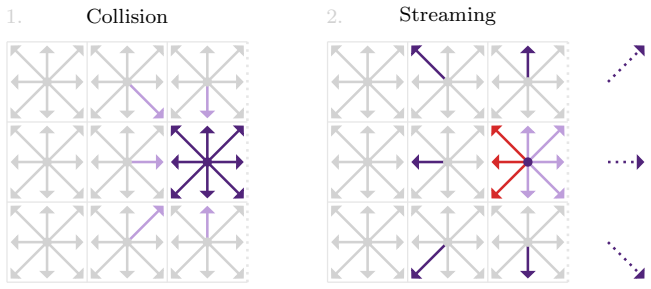
Two mechanisms carry the argument. The first is a shallow network with two hidden layers of 20 neurons that maps the nine distribution functions at the layer x=L−1 to corrections for the three unknown boundary populations at x=L, trained by MSE against the next layer of a large-domain cylinder solution. The second is a network with the same width that takes local spatial and temporal derivatives of pressure and velocity as inputs and outputs the CBC tuning parameters sigma and kappa2 after a sigmoid scaling. Its job is to convert layer-to-layer kinetic structure, and local wave-derivative structure, into boundary prescriptions that do not reflect artificial waves.
What would settle it
Perform the same truncated-domain cylinder simulation at Re=100 with the neural outflow condition and compare the wake velocity profile and Strouhal number against the literature: if the deviation grows with truncation instead of staying small, the transferability claim fails. Likewise, if the neural-tuned CBC on the convected vortex shows an L2 density error above the best fixed-parameter CBC once the vortex center crosses the boundary, the adaptive-parameter claim would be refuted.
Extended reading notes
Core claim
The central claim is that the unknown particle distributions at an outflow boundary can be recovered from the neighbouring lattice layer with a small neural network, and that this learned mapping—trained on a single cylinder-flow snapshot—controls boundary-induced error better than the analytic Zou & He reconstruction on shorter domains. A second claim is that a neural network can learn to set the two free parameters of a characteristic boundary condition, sigma and kappa2, as functions of local pressure and velocity derivatives, so that the boundary adapts to each passing wave instead of using a fixed global value. The paper demonstrates the first claim on cylinder and airfoil force coefficients and the second on the L2 density error of a convected vortex exiting the domain.
Load-bearing premise
The load-bearing assumption is that a network trained on a single converged snapshot of Re=200, Mach=0.1 cylinder flow in a large domain continues to work at other Reynolds numbers, other Mach numbers, with a different collision operator, and on a different geometry, without retraining or error bars.
Editorial extensions
If this is right
- Truncating a cylinder domain to 28–30 diameters downstream still yields drag, lift, and Strouhal numbers close to literature when the neural outflow condition is used, whereas Zou & He degrades on the same domains.
- The same trained reconstruction transfers to a NACA0012 airfoil at Re=1000 with a different collision operator, keeping lift and drag accurate down to an outflow located half a chord behind the trailing edge.
- A neural-tuned CBC outperforms fixed (sigma, kappa2) settings on the convected vortex benchmark, particularly as the main vortex exits the domain.
- Because the CBC parameters vary in space and time, the boundary can treat a pressure wave and a vortex differently, which no single fixed parameter set can do.
- These results imply a route to smaller simulation domains and lower computational cost for aerodynamic and aeroacoustic LBM studies.
Reading between the lines
- If the layer-to-layer mapping really is transferable across Reynolds number, Mach number, and collision operator, the network may be approximating a local kinetic relation that is nearly independent of the far field; the paper does not test this on turbulence, so an extension would be to apply the same trained condition to a turbulent wake or a higher-Re separated flow.
- The NN-CBC training scheme uses short segments of a differentiable simulation, so it could in principle be extended to learn boundary parameters for other benchmark flows—or to tune the direct reconstruction against a far-field pressure, a direction the paper itself names as future work.
- A natural testable extension is to use the direct reconstruction network in three dimensions or on a rectangular lattice, which would show whether the learned correction is stencil-specific or a general kinetic feature.
Editorial analysis
A structured set of objections, weighed in public.
Referee Report
Summary. The manuscript proposes two neural-network-based outflow boundary conditions for the lattice Boltzmann method. The first (Section 3) trains a shallow network to reconstruct the three unknown populations at a right outflow boundary from the nine populations at the adjacent interior layer, using data from a single large-domain cylinder-flow snapshot. The resulting boundary condition is evaluated on truncated cylinder wakes at Re=10-200 and on a NACA0012 airfoil with a 0.5-chord wake. The second (Section 4) uses a neural network to set the parameters sigma and kappa_2 of a characteristic boundary condition in space and time, and is evaluated on a 2D convected vortex benchmark. The authors report that the NN-based conditions outperform the standard Zou-He condition (first approach) and fixed-parameter CBCs (second approach), with the direct reconstruction also improving aerodynamic force predictions on the airfoil.
Significance. If the claimed improvements are robust, the work is a useful contribution to LBM open-boundary treatment: it demonstrates a data-driven route to reducing domain lengths and to adapting CBC parameters dynamically, with potential savings in aerodynamic and aeroacoustic simulations. The direct-reconstruction idea is simple and the comparison against Zou-He is a natural baseline. The paper also makes a commendable effort to test generalization to a different geometry. However, the evidence is incomplete: the direct-reconstruction network is trained on a single snapshot and its transfer to the airfoil is confounded by a change in collision operator; the CBC tuner is evaluated on the same benchmark used for training. The paper would be strengthened by hold-out evaluations, control experiments, uncertainty quantification, and release of code and data.
major comments (4)
- [Section 3.1, Eqs. (16)-(17)] The regression target for the direct reconstruction network is the distribution at the next interior layer (Eq. 17), and the boundary update uses f^b_i(L)=f_i(L-1)+s^nn_i (Eq. 16). For a right outflow boundary, the unknown populations f_3, f_6, f_7 at x=L are those streamed from outside the domain, not from x=L-1; the mapping learned from adjacent interior layers is therefore not obviously the correct closure for the missing incoming populations. The paper does not establish that this adjacent-layer extrapolation reproduces the true boundary populations. I ask the authors to provide a large-domain validation showing that the learned correction matches the actual f_i(L) in an extended simulation, and to discuss the physical basis for using an interior layer-to-layer relation as a boundary condition.
- [Section 3.2, Figure 8] The transfer experiment on the NACA0012 changes two simulation ingredients simultaneously: the geometry (cylinder to airfoil) and the collision operator (BGK to MRT, as stated in Section 3.2). Since the network was trained on BGK data, the improved agreement in Figure 8 cannot be attributed solely to the learned boundary condition; it may partly reflect the different dissipation of MRT. A control experiment that changes only one factor at a time (e.g., NACA0012 with BGK, or cylinder with MRT) is required to support the generalization claim.
- [Section 4.2, Eq. (33), Figure 11] The CBC tuner is trained by minimizing the MSE of density and velocity against the extended-domain reference of the same 2D convected vortex configuration that is later used for the evaluation in Figure 11 (Eq. 33, Section 4.2). The reported advantage over fixed-parameter CBCs is therefore an in-sample result. To establish the method, the authors should evaluate the trained tuner on a hold-out scenario (e.g., different Mach number, vortex strength, core radius, or initial condition) and compare against fixed CBC parameter sets on that same hold-out.
- [Section 3.1, Figure 6] The direct reconstruction network is trained on a single converged snapshot at Re=200, Ma=0.1 (Figure 5), and all comparisons in Figures 6 and 8 are single deterministic simulations without error bars, repeated runs, or uncertainty quantification. Because the cylinder wake is unsteady, the representativeness of a single snapshot and the statistical significance of the reported improvements are not established. At minimum, the authors should report variability across training snapshots (e.g., different phases of the shedding cycle) and across initial conditions.
minor comments (6)
- [Section 4.2] The scaling and shift coefficients that map the network outputs s0 and s1 to sigma and kappa_2 are described as predetermined but never reported; please provide these values or the full post-processing formula.
- [Figures 6 and 8] The force-coefficient comparisons would be easier to assess quantitatively in a table; the current plots do not report numerical values, which makes the claimed improvement hard to verify from the figures alone.
- [Overall] The manuscript does not include a data or code availability statement; for a computational methods paper, releasing the trained network weights, training data, and the TCLB/lettuce scripts would substantially improve reproducibility.
- [Section 3.1] The description 'Each layer of the selected training domain is treated as a single batch, resulting in a total of 1500 batches' is unclear; please specify the spatial extent of the training and validation regions in lattice units and the number of samples per batch.
- [Figure 11] The axis labels contain placeholder symbols (e.g., '1e□4'); please ensure the math mode renders correctly in the final version.
- [Eq. (29)] The corrected zero-velocity distribution g0 is introduced without defining all symbols in the expression; please add a sentence defining rho, u, rho_0, and rho_+ in this context.
Circularity Check
Neural-enhanced CBC 'prediction' is the optimized training objective on the same convected-vortex benchmark (Eq. 33 vs Fig. 11); the direct-reconstruction claim is not circular, though its NACA transfer evidence is confounded by the BGK-to-MRT switch.
-
fitted input called prediction
[Section 4.2, Eq. (33) (training loss) vs. Section 4.2, Fig. 11 (evaluation); Abstract]
"The neural network for tuning the CBC parameters (σ and κ2) is trained by minimizing a loss function based on the Mean Squared Error (MSE). This loss quantifies the discrepancy between the simulated density ρsim and velocity Usim fields and the target reference fields (ρref and Uref). The reference data were sourced from pre-computed simulations of the 2D convected vortex benchmark on an extended domain. ... The error is calculated by comparing the simulation results against a reference solution obtained from a simulation with an extended domain, designed to be free of reflections."
Eq. (33) trains the tuner by minimizing MSE(ρsim, ρref) + MSE(Usim, Uref) in the boundary-adjacent strip Ωs; ρref/Uref come from the extended-domain 2D convected vortex simulation, and the 110 training fields span steps 1–550 of that reference — the same pressure-wave (t≈65) and vortex-exit (t≈200–300) events plotted in Fig. 11. Fig. 11 evaluates the NN-CBC by the L2 density error against that same reference. The reported advantage over fixed (σ, κ2) CBCs is the optimized value of the objective used to fit the network, measured on the training events: an in-sample optimization outcome, not an independent prediction. The abstract's 'superior performance in minimizing density errors' restates the training loss, so the result reduces to the fit.
full rationale
The paper presents two neural-network boundary treatments, and only one of the two central claims exhibits circularity. The direct-reconstruction network is a supervised fit mapping the nine distributions at layer x−1 to the three reconstructed distributions at layer x (Eqs. 16–17), trained on a single snapshot of the large-domain Re=200 cylinder flow. Its evaluation — drag, lift, and Strouhal on truncated cylinder domains across Re=10–200 and on a NACA0012 airfoil — concerns emergent macroscopic quantities that are not training targets, and its baseline (Zou & He) is not involved in training. That claim is not circular; the open generalization questions (single-training-snapshot, Mach drift under diffusive scaling, and the simultaneous BGK-to-MRT and geometry change in the NACA test) are confounds and extrapolation risks, not reductions of the result to its inputs. Self-citations are tool citations only: [33] (lettuce) and [45] (TCLB) describe the software used, and the CBC formula is adopted from Wissocq et al. [28], an external source. No uniqueness theorem or load-bearing self-citation appears. The circular step is the neural-enhanced CBC. The tuner is trained by minimizing MSE in density and velocity against an extended-domain reference of the 2D convected vortex benchmark (Eq. 33), with training initial fields taken from steps 1–550 of that same reference simulation. The evaluation (Fig. 11) reports the L2 density error against that same reference on that same benchmark, and the paper's own summary claims 'superior performance in minimizing density errors.' The reported advantage over fixed-parameter CBCs is therefore the outcome of fitting exactly the quantity being measured — an in-sample optimization result presented as a demonstrated capability. Because the training segments (up to 50 steps) are shorter than the evaluation horizon (600 steps) and the loss is restricted to the boundary strip Ωs, the equivalence is not exact, so this is partial circularity rather than a fully forced result. No limitation statement about this in-sample evaluation appears in the manuscript. Overall: one of two headline predictions reduces to its fit, while the other claim is independently tested; score 6.
Assumptions & free parameters
free parameters (4)
- Weights and biases of direct reconstruction network =
Not reported
- Weights and biases of CBC tuning network =
Not reported
- Sigmoid scaling and shift coefficients for sigma and kappa2 =
Not reported
- Segment durations n_t for CBC training =
5, 10, 25, and 50 in a sensitivity test
assumptions (6)
- standard math The discrete Boltzmann equation with BGK or MRT collision is an adequate model for the 2D flows tested.
- ad hoc to paper Reference distribution functions at the next layer in the large training domain are the correct ground truth for outflow reconstruction.
- ad hoc to paper A single snapshot of Re=200, Mach=0.1 cylinder flow is representative enough to train a boundary condition used at Re=10-200 and for a NACA0012 airfoil.
- domain assumption The extended-domain convected vortex simulation is a sufficiently reflection-free reference solution to serve as training target and error metric.
- standard math Zou and He reconstruction can map the characteristic-updated macroscopic variables back into distribution space without introducing inconsistency beyond the f0 correction.
- ad hoc to paper The BGK-trained direct reconstruction network remains valid when the collision operator is changed to MRT in the NACA0012 tests.
Cite this review
Pith. "Pith review of Reduction of Outflow Boundary Influence on Aerodynamic Performance using Neural Networks." pith.science (2026). https://pith.science/paper/PXFN4QMB
@misc{pith2026250605293,
  author       = {Pith},
  title        = {Pith review of: Reduction of Outflow Boundary Influence on Aerodynamic Performance using Neural Networks},
  year         = {2026},
  howpublished = {\url{https://pith.science/paper/PXFN4QMB}},
  note         = {Machine review of arXiv:2506.05293}
}
read the original abstract
The accurate treatment of outflow boundary conditions remains a critical challenge in computational fluid dynamics when predicting aerodynamic forces and/or acoustic emissions. This is particularly evident when employing the lattice Boltzmann method (LBM) as the numerical solution technique, which often suffers from inaccuracies induced by artificial reflections from outflow boundaries. This paper investigates the use of neural networks (NN) to mitigate these adverse boundary effects and enable truncated domain requirements. Two distinct NN-based approaches are proposed: (1) direct reconstruction of unknown particle distribution functions at the outflow boundary; and (2) enhancement of established characteristic boundary conditions (CBC) by dynamically tuning their parameters. The direct reconstruction model was trained on data generated from a 2D flow over a cylindrical obstruction. The drag, lift, and Strouhal number were used to test the new boundary condition. We analyzed results for various Reynolds numbers and restricted domain sizes where it demonstrated significantly improved predictions when compared with the traditional Zou & He boundary condition. To examine the robustness of the NN-based reconstruction, the same condition was applied to the simulation of a NACA0012 airfoil, again providing accurate aerodynamic performance predictions. The neural-enhanced CBC were evaluated on a 2D convected vortex benchmark and showed superior performance in minimizing density errors compared to CBCs with fixed parameters. These findings highlight the potential of NN-integrated boundary conditions to improve accuracy and reduce computational expense of aerodynamic and acoustic emissions simulations with the LBM.
Figures


Figures from the paper (8 more)


Reference graph
Works this paper leans on
- [1]
-
[2]
R. Prosser, Improved boundary conditions for the direct numerical simulation of turbulent subsonic flows. i. inviscid flows, Journal of Computational Physics 207 (2) (2005) 736–768
work page 2005
-
[3]
R. Vichnevetsky, Propagation through numerical mesh refinement for hyperbolic equations, Mathematics and Computers in Simulation XXIII (1981) 344–353
work page 1981
-
[4]
R. Vichnevetsky, Wave Propagation and Reflection in Irregular Grids For Hyperbolic Equations, Applied Nu- merical Mathematics 3 (1987) 133–166
work page 1987
-
[5]
K.W.Thompson, TimeDependentBoundaryConditionsforHyperbolicSystems, J.Comput.Physics68(1987) 1–24
work page 1987
-
[6]
T. Poinsot, S. Lele, Characteristic boundary conditions, J. Comput. Phys. 101 (1992) 104
work page 1992
-
[7]
J.C.Strikwerda,Initialboundaryvalueproblemsforincompletelyparabolicsystems,Comm.ofPureandApplied Math. 30 (1977) 797–822
work page 1977
-
[8]
M.Baum,T.Poinsot,D.Thévenin,Accurateboundaryconditionsformulticomponentreactiveflows,J.Comput. Phys. 116 (1994) 247–261
work page 1994
Show all 47 references
-
[9]
Sesterhenn, A characteristic-type formulation of the Navier–Stokes equations for high order upwind schemes, Comput
J. Sesterhenn, A characteristic-type formulation of the Navier–Stokes equations for high order upwind schemes, Comput. Fluids 30 (2001) 37
2001
-
[10]
Sutherland, C
J. Sutherland, C. Kennedy, Improved boundary conditions for viscous, reacting, compressible flows, J. Comput. Physics 191 (2003) 502–524
2003
-
[11]
Colonius, Modeling Artificial Boundary Conditions for Compressibe Flow., Ann
T. Colonius, Modeling Artificial Boundary Conditions for Compressibe Flow., Ann. rev. Fluid. Mech. 36 (2004) 315–345
2004
-
[12]
M. Wang, J. B. Freund, S. K. Lele, Computational prediction of flow-generated sound, Annu. Rev. Fluid Mech. 38 (1) (2006) 483–512
2006
-
[13]
C. S. Yoo, H. G. Im, Characteristic boundary conditions for simulations of compressible reacting flows with multi-dimensional, viscous and reaction effects, Combustion Theory and Modelling 11 No. 2 (2007) 259–286
2007
-
[14]
G.Lodato,P.Domingo,L.Vervisch,Three-dimensionalboundaryconditionsfordirectandlarge-eddysimulation of compressible viscous flows, Journal of Computational Physics 227 (10) (2008) 5105 – 5143
2008
-
[15]
Albin, Y
E. Albin, Y. d’Angelo, L. Vervisch, Flow streamline based navier–stokes characteristic boundary conditions: modeling for transverse and corner outflows, Computers & fluids 51 (1) (2011) 115–126
2011
-
[16]
D.Marinc,H.Foysi,Investigationofacontinuousadjoint-basedoptimizationprocedureforaeroacousticcontrol of plane jets, International journal of heat and fluid flow 38 (2012) 200–212
2012
-
[17]
Tam, Advances in numerical boundary conditions for computational aeroacoustics., J
C. Tam, Advances in numerical boundary conditions for computational aeroacoustics., J. Comput. Acoust. 6 (1998) 377–402
1998
-
[18]
J. B. Freund, Proposed inflow/outflow boundary condition for direct computation of aerodynamic sound, AIAA journal 35 (4) (1997) 740–742
1997
-
[19]
D.Bodony,Analysisofspongezonesforcomputationalfluidmechanics.,J.ofComp.Phys.212(2005)681–702
2005
-
[20]
Physics 231 (2012) 704–716
A.Mani,Analysisandoptimizationofnumericalspongelayersasanonreflectiveboundarytreatment,J.Comput. Physics 231 (2012) 704–716. 17
2012
-
[21]
Schaupp, R
C. Schaupp, R. Friedrich, H. Foysi, Transverse injection of a plane-reacting jet into compressible turbulent channel flow, Journal of Turbulence 13 (24) (2012) 1–40
2012
-
[22]
H.Foysi,M.Mellado,S.Sarkar,Simulationandcomparisonofvariabledensityroundandplanejets.,International Journal of Heat & Fluid Flow 31 (2010) 307–314
2010
-
[23]
Zhang, C
Z. Zhang, C. Peng, C. Li, H. Zhang, T. Xian, L.-P. Wang, A highly-efficient locally encoded boundary scheme for lattice boltzmann method on gpu, Computer Physics Communications 298 (2024) 109119
2024
-
[24]
M.Daeian,P.Cheema,W.S.Smith,Z.Keshavarz-Motamed,Amulti-domainlatticeboltzmannmethodformesh refinement with curved boundary interfaces, Computer Physics Communications (2025) 109637
2025
-
[25]
Y.Wang,Y.Wu,Y.Zeng,M.Jiang,Z.Liu,Animmersedboundarylatticeboltzmannmethodonblock-structured adaptivegridsforthesimulationofparticle-ladenflowsoncpus/gpus,ComputerPhysicsCommunications(2025) 109674
2025
-
[26]
S.Izquierdo,N.Fueyo,Characteristicnonreflectingboundaryconditionsforopenboundariesinlatticeboltzmann methods, Phys. Rev. E 78 (2008)
2008
-
[27]
N. Jung, H. W. Seo, C. S. Yoo, Two-dimensional characteristic boundary conditions for open boundaries in the lattice boltzmann methods, Journal of Computational Physics 302 (2015) 191–199
2015
-
[28]
Wissocq, N
G. Wissocq, N. Gourdain, O. Malaspinas, A. Eyssartier, Regularized characteristic boundary conditions for the lattice-boltzmann methods at high reynolds number flows, Journal of Computational Physics 331 (2017) 1–18
2017
-
[29]
T.Gianoli,J.-f.Boussuge,P.Sagaut,J.deLaborderie,Developmentandvalidationofnavier–stokescharacteristic boundary conditions applied to turbomachinery simulations using the lattice boltzmann method, International Journal for Numerical Methods in Fluids 95 (4) (2023) 528–556
2023
-
[30]
Y. Feng, S. Guo, J. Jacob, P. Sagaut, Solid wall and open boundary conditions in hybrid recursive regularized lattice boltzmann method for compressible flows, Physics of Fluids 31 (12) (2019)
2019
-
[31]
Wilde, A
D. Wilde, A. Krämer, M. Bedrunka, D. Reith, H. Foysi, Cubature rules for weakly and fully compressible off-lattice boltzmann methods, Journal of Computational Science 51 (2021) 101355
2021
-
[32]
D.Wilde,A.Krämer,D.Reith,H.Foysi,High-ordersemi-lagrangiankineticschemeforcompressibleturbulence, Physical Review E 104 (2) (2021) 025301
2021
-
[33]
M.C.Bedrunka,D.Wilde,M.Kliemank,D.Reith,H.Foysi,A.Krämer,Lettuce: Pytorch-basedlatticeboltzmann framework, in: High Performance Computing: ISC High Performance Digital 2021 International Workshops, Frankfurt am Main, Germany, June 24–July 2, 2021, Revised Selected Papers 36, S...
2021
-
[34]
Corbetta, A
A. Corbetta, A. Gabbana, V. Gyrya, D. Livescu, J. Prins, F. Toschi, Toward learning lattice boltzmann collision operators, The European Physical Journal E 46 (3) (2023) 10
2023
-
[35]
J.T.Horstmann,M.C.Bedrunka,H.Foysi,Latticeboltzmannmethodwithartificialbulkviscosityusinganeural collision operator, Computers & Fluids 272 (2024) 106191
2024
-
[36]
Ataei, H
M. Ataei, H. Salehipour, Xlb: A differentiable massively parallel lattice boltzmann library in python, Computer Physics Communications (2024) 109187
2024
-
[37]
Q. Zou, X. He, On pressure and velocity boundary conditions for the lattice boltzmann bgk model, Physics of fluids 9 (6) (1997) 1591–1598
1997
-
[38]
D.J.Tritton,Experimentsontheflowpastacircularcylinderatlowreynoldsnumbers,JournalofFluidMechanics 6 (4) (1959) 547–567. 18
1959
-
[39]
Weiselsberger, New data on the laws of fluid resistance, Tech
C. Weiselsberger, New data on the laws of fluid resistance, Tech. rep., NTRS - NASA Technical Report Server (1922)
1922
-
[40]
S. F. Hoerner, Fluid-dynamic drag: practical information on aerodynamic drag and hydrodynamic resistance, 2nd Edition, Hoerner Fluid Dynamics, 1965, OCLC: 840398191
1965
-
[41]
Roshko, On the development of turbulent wakes from vortex streets, Tech
A. Roshko, On the development of turbulent wakes from vortex streets, Tech. Rep. 2913, NACA, California Institute of Technology (1953)
1953
-
[42]
C.Norberg,Fluctuatingliftonacircularcylinder: reviewandnewmeasurements,JournalofFluidsandStructures 17 (1) (2003) 57–96
2003
-
[43]
C. H. Williamson, Oblique and parallel modes of vortex shedding in the wake of a circular cylinder at low reynolds numbers, Journal of Fluid Mechanics 206 (1989) 579–627
1989
-
[44]
C. Shu, N. Liu, Y.-T. Chew, A novel immersed boundary velocity correction–lattice boltzmann method and its applicationtosimulateflowpastacircularcylinder,JournalofComputationalPhysics226(2)(2007)1607–1622
2007
-
[45]
Łaniewski-Wołłk, J
L. Łaniewski-Wołłk, J. Rokicki, Adjoint lattice boltzmann for topology optimization on multi-gpu architecture, Computers & Mathematics with Applications 71 (3) (2016) 833–848
2016
-
[46]
D. F. Kurtulus, On the unsteady behavior of the flow around naca 0012 airfoil with steady external conditions at re= 1000, International journal of micro air vehicles 7 (3) (2015) 301–326
2015
-
[47]
URLhttps://turbmodels.larc.nasa.gov/naca0012_val.html 19
NASA Langley Research Center Turbulence Modeling Resource, Naca 0012 airfoil validation case (jul 2023). URLhttps://turbmodels.larc.nasa.gov/naca0012_val.html 19
2023
Reviewed August 7, 2026 · model on record in the stance chip above.
Discussion (0). Continue with ORCID to comment.