REVIEW 4 major objections 6 minor 83 references
Vision Transformer Neural Architecture Search for Out-of-Distribution Generalization: Benchmark and Insights
T0 review · 4 major / 6 minor · reviewed 2026-08-10 · deepseek-v4-flash
Pith's one-line read The paper's central claim is that for Vision Transformers, architecture design—especially embedding dimension—drives out-of-distribution generalization as much as training-time robustness methods, and that standard in-distribution…
desk verdict A genuinely useful benchmark resource whose central scientific claims rest on an unvalidated weight-sharing assumption; worth serious refereeing, but with major revision required. read the letter →
The pith
A machine-rendered reading of the paper's core claim, the machinery that carries it, and where it could break.
The reading
What carries the argument
The machinery is one-shot NAS weight sharing: three AutoFormer supernets (Tiny, Small, and Base) are trained once, and 3,000 subnets are extracted by letting them inherit the supernet weights, which makes large-scale OoD evaluation computationally feasible. The analysis tools are Kendall's $\tau$ rank correlation for ID-versus-OoD and proxy-versus-OoD comparisons, plus a frequency-filtering experiment that removes high-frequency components at radius $r$ and measures the accuracy change to test whether larger embedding dimensions improve OoD by learning more high-frequency components. This machinery is load-bearing because every benchmark insight is a range or ranking computed on weight-sharing subnets.
What would settle it
Take a random sample of 30 architectures from the benchmark, train each one from scratch under the standard ImageNet protocol, and measure OoD accuracy on ImageNet-R and ImageNet-C; if their rankings correlate weakly with the weight-sharing subnet scores, or if the embedding-dimension advantage reverses, the paper's central insights fail.
Extended reading notes
Core claim
On the paper's own terms, the discovery is that OoD generalization in ViTs is much more architecture-dependent than previous studies of a handful of human-designed models could show, and that the dependency has a clear direction: among AutoFormer's searchable attributes, embedding dimension is the strongest and most consistent lever, with an ablation correlation around Kendall's $\tau = 0.65$ when other attributes are held fixed. ID accuracy correlates only weakly with OoD accuracy on most shifts, and the ID-Pareto architectures are usually not the OoD-Pareto architectures. Nine training-free NAS scores, including recent ViT-specific ones, rank architectures worse than #Params or #FLOPs for OoD (best $\tau \approx 0.36$ for #Params versus $0.33$ for AutoProx), and all proxies fail on ImageNet-D. The paper frames this as evidence that architecture design itself should be a first-class object of OoD research, not a proxy for training methods.
Load-bearing premise
The load-bearing premise is that a subnetwork that inherits weights from a shared supernet behaves, for out-of-distribution accuracy, like the same architecture trained on its own; the paper only cites evidence for this equivalence on in-distribution accuracy.
Editorial extensions
If this is right
- If the claims hold, NAS for ViTs should benchmark OoD accuracy directly rather than rely on ID accuracy, because the two rankings diverge.
- New training-free NAS proxies for ViT OoD accuracy must beat #Params and #FLOPs; the paper sets those simple counts as the bar.
- Architects can improve OoD generalization by widening the embedding dimension, potentially more cheaply than compound scaling of depth, heads, and MLP ratio.
- The benchmark's 3,000 scored architectures across eight shift types enable future studies of which components drive robustness on specific corruption or natural shift types.
Reading between the lines
- Because the benchmark uses weight-sharing subnets, its rankings may not fully transfer to standalone-trained ViTs; the paper's cited evidence for equivalence concerns ID accuracy only, so the embedding-dimension rule should be re-tested with independent training before being treated as a design law. This is an extension of the paper's own caveat, not a claim it tests.
- The high-frequency-component explanation suggests a testable intervention: if larger embedding dimensions help by preserving high-frequency content, then high-frequency-emphasizing augmentation during training might reproduce part of the OoD gain at constant architecture size, something the paper does not try.
- The uniform failure of all proxies on ImageNet-D hints that diffusion-generated OoD shifts may need a fundamentally different architectural response than corruption or natural shifts, an avenue the paper leaves open.
- The finding that OoD accuracy spread widens with shift severity implies that architecture design will matter more as deployment shifts get harder, so the 11.85% spread figure is likely a lower bound for harder future benchmarks.
Editorial analysis
A structured set of objections, weighed in public.
Referee Report
Summary. The paper introduces OoD-ViT-NAS, a benchmark of 3,000 ViT architectures sampled from the AutoFormer one-shot supernets (Tiny/Small/Base) and evaluated on 8 ImageNet-scale OoD datasets (IN-C, IN-P, IN-A, IN-O, IN-R, IN-Sketch, Stylized-IN, IN-D). Using this benchmark, the authors investigate (i) the range of OoD accuracy across architectures, (ii) the correlation between ID and OoD accuracy, (iii) the ability of nine training-free NAS proxies to predict OoD accuracy versus simple #Param/#Flops, and (iv) the impact of ViT architectural attributes, concluding that embedding dimension is the most important attribute and that increasing it generally improves OoD generalization. The authors also present a frequency-based explanation and a small human-designed ViT study in the appendix to support the embedding-dimension finding.
Significance. If the benchmark's ranking of architectures is trustworthy, this would be a valuable community resource: it is the first large-scale ViT NAS benchmark targeting OoD generalization, and the released data/code are likely to catalyze future work. The paper also makes concrete, falsifiable claims about the limits of training-free NAS proxies for OoD prediction and about the importance of embedding dimension. However, the benchmark's reliance on weight-sharing supernet subnets, without validation that OoD rankings transfer to independently trained ViTs, places a major asterisk on every insight. The statistical evidence for the training-free NAS comparison is also weaker than the text suggests. The human-designed ViT experiment (Appx 8) provides some partial support for the embedding-dimension conclusion, but it is on a different scale and does not cover the full benchmark.
major comments (4)
- [Sec. 3, Protocol] The benchmark evaluates only weight-sharing subnets extracted from AutoFormer supernets; the paper justifies this by citing [20, 6] for the claim that subnet performance is comparable to independently trained architectures. Those citations support ID accuracy only. No experiment in the paper validates that the OoD accuracy ranking of subnets matches the ranking of the same architectures trained from scratch. This is load-bearing because every downstream analysis (the 11.85% OoD spread, the ID-OoD decoupling in Sec. 4.2, the training-free NAS comparison in Sec. 4.3, and the embedding-dimension claim in Sec. 4.4) is computed from these subnet evaluations. If OoD behavior is more sensitive to weight-sharing artifacts than ID behavior, the conclusions could be artifacts. The authors should either (a) train a representative subset of the 3,000 architectures independently and show that the OoD rankings correlate with the subnet rankings, or (b) explicitly reframe all claims as being about one-shot supernet subnets rather than ViT architectures in general. The current wording in the Abstract and Sec. 1 overstates the scope.
- [Sec. 4.3, Table 2] The claim that simple proxies like #Param and #Flops 'surprisingly outperform' complex training-free NAS is not justified by the reported statistics. The Kendall tau values are presented as means with standard deviations (e.g., #Param 0.3600±0.2321 vs AutoProx-A 0.3303±0.2384; #Flops 0.3537±0.2327 vs DSS 0.3421±0.2365). These differences are far smaller than the quoted standard deviations and are not tested for significance. Given the large uncertainty, the paper cannot support the superlative conclusion in the Abstract and Sec. 4.3. The authors should run a paired significance test (e.g., bootstrap over search spaces/datasets) and report confidence intervals, or temper the claim to a descriptive observation.
- [Sec. 4.1 and Table 3] The comparison of the OoD accuracy range (e.g., 3.80%/4.86%/2.74%) with a 1.9% improvement from the SOTA training method [30] is not apples-to-apples: the former is a spread between the best and worst architecture in the search space, not an improvement over a baseline achieved by a method. Additionally, Table 3 compares an architecture trained on IN-100 (labelled 'Ours') with ViT-B-32 and ViT-L-32 without stating that the baselines were evaluated under the same training protocol; the table likely mixes IN-100-trained results with ImageNet-scale reference numbers. This makes the claim that the embedding-dimension insight yields architectures that 'outperform' well-established human-designed ViTs unsupported. The authors need to clarify the training/evaluation protocol for all models in Table 3 and, if the baselines were not trained identically, remove the direct comparison.
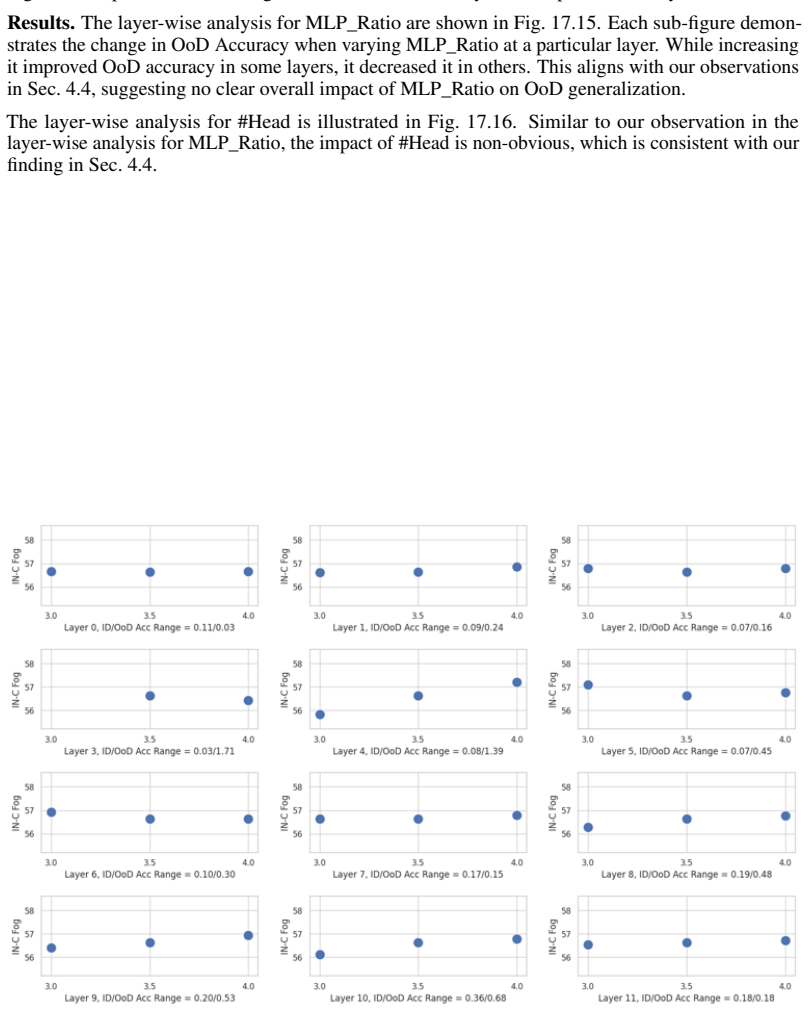
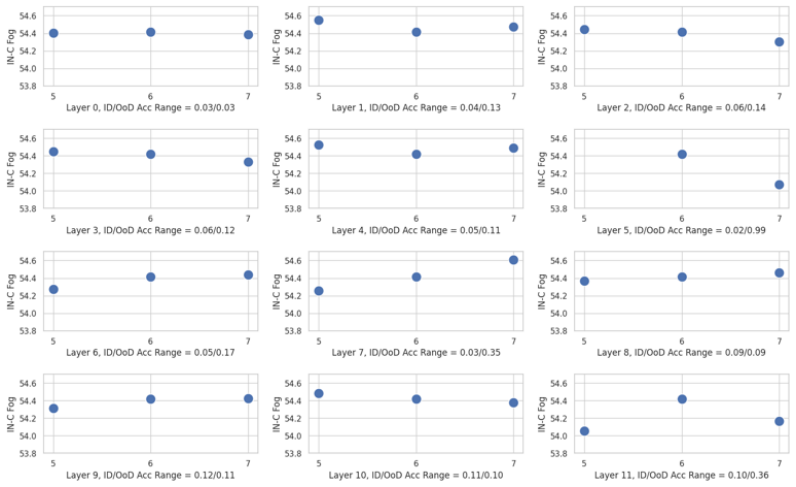
- [Sec. 4.4 and Appx 17.1] The ablation in Appx 17.1 claims to fix all other architectural attributes when varying embedding dimension, but it does so by restricting to architectures with mean #Head = 6±0.05 and mean MLP_Ratio = 3.5±0.05. This is not a controlled ablation because the per-layer values of heads and MLP ratio still vary within the small range, and the selection of architectures by these means may introduce confounding with other unobserved variables. The layer-wise analysis (Appx 17.2) is a useful complement, and the human-designed ViT experiment (Appx 8) provides partial independent evidence, but the main-benchmark correlation in Fig. 1-c is computed over all 3,000 architectures without such controls. The causal language 'increasing embedding dimensions generally enhances performance' should be softened to 'is positively associated with OoD accuracy in this benchmark' unless a rigorous controlled study is added.
minor comments (6)
- [Abstract and Sec. 1] The phrase 'with up to 11.85% improvement for some OoD shifts' is ambiguous: is this a range between two architectures, an improvement over a baseline, or something else? Please clarify in the text and define the quantity precisely when it is first used.
- [Sec. 4.1] There is a duplicated phrase: 'analyzing 1,000 architectures from the Autoformer-Small search space within our OoD-ViT-NAS benchmark for1, 000 architectures in Autoformer-Small search space within our benchmark on IN-C.' The sentence should be rewritten.
- [Appx 10.1, Table 10.2] The rows for Supernet-Tiny appear to have Max and Min reversed (Max 192 vs Min 240), and the stated ranges with step sizes are inconsistent with typical AutoFormer settings. Please check and correct the table.
- [Sec. 4.3, Fig. 1-b] The claim that all training-free methods 'consistently fail to predict IN-D performance' is based on near-zero negative correlations (e.g., -0.03 to -0.09 in Appx Table 15.5). This is better described as a lack of predictive power rather than 'failure'; negative values may also indicate a peculiarity of the IN-D dataset that deserves discussion.
- [Sec. 4.4] The statement 'Our comprehensive OoD-ViT-NAS benchmark sheds light on a previously unknown relationship' is too strong; several prior works (e.g., [13,15]) have noted dependencies between ViT capacity and robustness. Please soften the novelty claim.
- [Throughout] The manuscript contains many typos and awkward phrases (e.g., 'MLP_Ration', 'MLP_Tatio', 'ration' for 'ratio', inconsistent notation in Appx 11, and duplicated sentences in Sec. 4.1). A thorough proofreading pass is needed.
Circularity Check
No circularity: OoD-ViT-NAS is an external empirical benchmark, and the main debatable assumption (weight-sharing subnet evaluation) is a validity concern, not a derivation that reduces to its own inputs.
full rationale
OoD-ViT-NAS is an empirical benchmark: all 3,000 entries are measured on external datasets (IN-C, IN-A, IN-O, IN-P, IN-D, IN-R, IN-Sketch, Stylized-IN), not derived from the paper's own equations. The central claims—architecture affects OoD accuracy, ID-OoD decoupling, training-free NAS weakness, #Param/#Flop strength, and the embedding-dimension benefit—are correlational summaries of these external measurements. The only load-bearing methodological choice is the evaluation of weight-sharing subnets sampled from AutoFormer supernets (Sec. 3 Protocol). The paper justifies this by citing [20,6] (BigNAS and AutoFormer), which are prior external works by other authors; this is not a self-citation chain. Whether subnet OoD rankings transfer to independently trained ViTs is a validity/transfer concern, not circularity: even if the rankings were artifacts of weight sharing, the paper's claims would be false, but they would not be true by definition. The embedding-dimension insight is first observed in-sample on the 3,000-subnet benchmark, but Appx. 8 independently trains human-designed ViT configurations on IN-100 and evaluates on IN-R, providing separate evidence that partially checks the transfer concern. No fitted parameter is renamed as a prediction, no conclusion is assumed in its own premise, and no equation reduces the target result to an input. Therefore no specific circular step can be exhibited, and the honest finding is no significant circularity.
Assumptions & free parameters
free parameters (1)
- Ablation attribute values (mean #Head = 6 ± 0.05, mean MLP_Ratio = 3.5 ± 0.05, Embed_Dim = 384, Depth = 13) =
6 ± 0.05 heads, 3.5 ± 0.05 MLP ratio, 384 embedding dim, 13 depth
assumptions (3)
- domain assumption Subnets sampled from AutoFormer supernets inherit weights whose performance is comparable to standalone training, even under OoD shifts.
- domain assumption The AutoFormer search space and its attribute ranges are representative enough to support general conclusions about ViT architecture-OoD relationships.
- domain assumption OoD accuracy and AUPR computed on the 8 chosen datasets capture the intended notion of OoD generalization.
Cite this review
Pith. "Pith review of Vision Transformer Neural Architecture Search for Out-of-Distribution Generalization: Benchmark and Insights." pith.science (2026). https://pith.science/paper/PXOT7PPQ
@misc{pith2026250103782,
  author       = {Pith},
  title        = {Pith review of: Vision Transformer Neural Architecture Search for Out-of-Distribution Generalization: Benchmark and Insights},
  year         = {2026},
  howpublished = {\url{https://pith.science/paper/PXOT7PPQ}},
  note         = {Machine review of arXiv:2501.03782}
}
read the original abstract
While ViTs have achieved across machine learning tasks, deploying them in real-world scenarios faces a critical challenge: generalizing under OoD shifts. A crucial research gap exists in understanding how to design ViT architectures, both manually and automatically, for better OoD generalization. To this end, we introduce OoD-ViT-NAS, the first systematic benchmark for ViTs NAS focused on OoD generalization. This benchmark includes 3000 ViT architectures of varying computational budgets evaluated on 8 common OoD datasets. Using this benchmark, we analyze factors contributing to OoD generalization. Our findings reveal key insights. First, ViT architecture designs significantly affect OoD generalization. Second, ID accuracy is often a poor indicator of OoD accuracy, highlighting the risk of optimizing ViT architectures solely for ID performance. Third, we perform the first study of NAS for ViTs OoD robustness, analyzing 9 Training-free NAS methods. We find that existing Training-free NAS methods are largely ineffective in predicting OoD accuracy despite excelling at ID accuracy. Simple proxies like Param or Flop surprisingly outperform complex Training-free NAS methods in predicting OoD accuracy. Finally, we study how ViT architectural attributes impact OoD generalization and discover that increasing embedding dimensions generally enhances performance. Our benchmark shows that ViT architectures exhibit a wide range of OoD accuracy, with up to 11.85% improvement for some OoD shifts. This underscores the importance of studying ViT architecture design for OoD. We believe OoD-ViT-NAS can catalyze further research into how ViT designs influence OoD generalization.
Figures


Figures from the paper (31 more)




Reference graph
Works this paper leans on
-
[30]
HYPO: Hyperspherical out-of-distribution generalization
Haoyue Bai, Yifei Ming, Julian Katz-Samuels, and Yixuan Li. HYPO: Hyperspherical out-of-distribution generalization. In The Twelfth International Conference on Learning Representations, 2024
work page 2024
-
[1]
An image is worth 16x16 words: Transformers for image recognition at scale
Alexey Dosovitskiy, Lucas Beyer, Alexander Kolesnikov, Dirk Weissenborn, Xiaohua Zhai, Thomas Unterthiner, Mostafa Dehghani, Matthias Minderer, Georg Heigold, Sylvain Gelly, et al. An image is worth 16x16 words: Transformers for image recognition at scale. arXiv preprint arXiv:2010.11929, 2020
arXiv 2010
-
[2]
Maxvit: Multi-axis vision transformer
Zhengzhong Tu, Hossein Talebi, Han Zhang, Feng Yang, Peyman Milanfar, Alan Bovik, and Yinxiao Li. Maxvit: Multi-axis vision transformer. In European conference on computer vision, pages 459–479. Springer, 2022
2022
-
[3]
Swin transformer: Hierarchical vision transformer using shifted windows
Ze Liu, Yutong Lin, Yue Cao, Han Hu, Yixuan Wei, Zheng Zhang, Stephen Lin, and Baining Guo. Swin transformer: Hierarchical vision transformer using shifted windows. In Proceedings of the IEEE/CVF international conference on computer vision, pages 10012–10022, 2021
2021
-
[4]
Exploring plain vision transformer backbones for object detection
Yanghao Li, Hanzi Mao, Ross Girshick, and Kaiming He. Exploring plain vision transformer backbones for object detection. In European Conference on Computer Vision, pages 280–296. Springer, 2022
2022
-
[5]
Bowen Zhang, Zhi Tian, Quan Tang, Xiangxiang Chu, Xiaolin Wei, Chunhua Shen, et al. Segvit: Semantic segmentation with plain vision transformers.Advances in Neural Information Processing Systems, 35:4971– 4982, 2022
work page 2022
-
[6]
Autoformer: Searching transformers for visual recognition
Minghao Chen, Houwen Peng, Jianlong Fu, and Haibin Ling. Autoformer: Searching transformers for visual recognition. In Proceedings of the IEEE/CVF international conference on computer vision, pages 12270–12280, 2021
work page 2021
-
[7]
Prenas: Preferred one-shot learning towards efficient neural architecture search
Haibin Wang, Ce Ge, Hesen Chen, and Xiuyu Sun. Prenas: Preferred one-shot learning towards efficient neural architecture search. In International Conference on Machine Learning, pages 35642–35654. PMLR, 2023
work page 2023
Show all 83 references
-
[8]
Vitas: Vision transformer architecture search
Xiu Su, Shan You, Jiyang Xie, Mingkai Zheng, Fei Wang, Chen Qian, Changshui Zhang, Xiaogang Wang, and Chang Xu. Vitas: Vision transformer architecture search. In European Conference on Computer Vision, pages 139–157. Springer, 2022
2022
-
[9]
Elasticvit: Conflict-aware supernet training for deploying fast vision transformer on diverse mobile devices
Chen Tang, Li Lyna Zhang, Huiqiang Jiang, Jiahang Xu, Ting Cao, Quanlu Zhang, Yuqing Yang, Zhi Wang, and Mao Yang. Elasticvit: Conflict-aware supernet training for deploying fast vision transformer on diverse mobile devices. In Proceedings of the IEEE/CVF International Confere...
2023
-
[10]
Training-free transformer architecture search
Qinqin Zhou, Kekai Sheng, Xiawu Zheng, Ke Li, Xing Sun, Yonghong Tian, Jie Chen, and Rongrong Ji. Training-free transformer architecture search. In Proceedings of the IEEE/CVF Conference on Computer Vision and Pattern Recognition, pages 10894–10903, 2022
2022
-
[11]
Training-free transformer architecture search with zero-cost proxy guided evolution
Qinqin Zhou, Kekai Sheng, Xiawu Zheng, Ke Li, Yonghong Tian, Jie Chen, and Rongrong Ji. Training-free transformer architecture search with zero-cost proxy guided evolution. IEEE Transactions on Pattern Analysis and Machine Intelligence, 2024
2024
-
[12]
Nasvit: Neural architecture search for efficient vision transformers with gradient conflict-aware supernet training
Chengyue Gong and Dilin Wang. Nasvit: Neural architecture search for efficient vision transformers with gradient conflict-aware supernet training. ICLR Proceedings 2022, 2022
2022
-
[13]
Understanding Robustness of Transformers for Image Classification
Srinadh Bhojanapalli, Ayan Chakrabarti, Daniel Glasner, Daliang Li, Thomas Unterthiner, and Andreas Veit. Understanding Robustness of Transformers for Image Classification. InProceedings of the IEEE/CVF International Conference on Computer Vision (ICCV), pages 10231–10241, oct 2021
2021
-
[14]
Robustart: Benchmarking robustness on architecture design and training techniques
Shiyu Tang, Ruihao Gong, Yan Wang, Aishan Liu, Jiakai Wang, Xinyun Chen, Fengwei Yu, Xianglong Liu, Dawn Song, Alan Yuille, et al. Robustart: Benchmarking robustness on architecture design and training techniques. arXiv preprint arXiv:2109.05211, 2021
2021 arXiv
-
[15]
Out of distribution performance of state of art vision model
Salman Rahman and Wonkwon Lee. Out of distribution performance of state of art vision model. arXiv preprint arXiv:2301.10750, 2023
2023 arXiv
-
[16]
Searching the search space of vision transformer
Minghao Chen, Kan Wu, Bolin Ni, Houwen Peng, Bei Liu, Jianlong Fu, Hongyang Chao, and Haibin Ling. Searching the search space of vision transformer. Advances in Neural Information Processing Systems, 34:8714–8726, 2021
2021
-
[17]
Auto-prox: Training-free vision transformer architecture search via automatic proxy discovery
Zimian Wei, Peijie Dong, Zheng Hui, Anggeng Li, Lujun Li, Menglong Lu, Hengyue Pan, and Dongsheng Li. Auto-prox: Training-free vision transformer architecture search via automatic proxy discovery. In Proceedings of the AAAI Conference on Artificial Intelligence, number 14, pag...
2024
-
[18]
Hr-nas: Searching efficient high-resolution neural architectures with lightweight transformers
Mingyu Ding, Xiaochen Lian, Linjie Yang, Peng Wang, Xiaojie Jin, Zhiwu Lu, and Ping Luo. Hr-nas: Searching efficient high-resolution neural architectures with lightweight transformers. In Proceedings of the IEEE/CVF conference on computer vision and pattern recognition, pages ...
2021
-
[19]
Uninet: Unified architecture search with convolution, transformer, and mlp
Jihao Liu, Xin Huang, Guanglu Song, Hongsheng Li, and Yu Liu. Uninet: Unified architecture search with convolution, transformer, and mlp. In European Conference on Computer Vision, pages 33–49. Springer, 2022
2022
-
[20]
Bignas: Scaling up neural architecture search with big single-stage models
Jiahui Yu, Pengchong Jin, Hanxiao Liu, Gabriel Bender, Pieter-Jan Kindermans, Mingxing Tan, Thomas Huang, Xiaodan Song, Ruoming Pang, and Quoc Le. Bignas: Scaling up neural architecture search with big single-stage models. In Computer Vision–ECCV 2020: 16th European Conference...
2020
-
[21]
All tokens matter: Token labeling for training better vision transformers
Zi-Hang Jiang, Qibin Hou, Li Yuan, Daquan Zhou, Yujun Shi, Xiaojie Jin, Anran Wang, and Jiashi Feng. All tokens matter: Token labeling for training better vision transformers. Advances in neural information processing systems, 34:18590–18602, 2021
2021
-
[22]
Crossvit: Cross-attention multi-scale vision transformer for image classification
Chun-Fu Richard Chen, Quanfu Fan, and Rameswar Panda. Crossvit: Cross-attention multi-scale vision transformer for image classification. InProceedings of the IEEE/CVF international conference on computer vision, pages 357–366, 2021
2021
-
[23]
Pre-trained image processing transformer
Hanting Chen, Yunhe Wang, Tianyu Guo, Chang Xu, Yiping Deng, Zhenhua Liu, Siwei Ma, Chunjing Xu, Chao Xu, and Wen Gao. Pre-trained image processing transformer. In Proceedings of the IEEE/CVF conference on computer vision and pattern recognition, pages 12299–12310, 2021
2021
-
[24]
Benchmarking neural network robustness to common corruptions and perturbations
Dan Hendrycks and Thomas Dietterich. Benchmarking neural network robustness to common corruptions and perturbations. arXiv preprint arXiv:1903.12261, 2019
1903 arXiv
-
[25]
Natural adversarial examples
Dan Hendrycks, Kevin Zhao, Steven Basart, Jacob Steinhardt, and Dawn Song. Natural adversarial examples. In Proceedings of the IEEE/CVF conference on computer vision and pattern recognition, pages 15262–15271, 2021
2021
-
[26]
Imagenet-d: Benchmarking neural network robustness on diffusion synthetic object
Chenshuang Zhang, Fei Pan, Junmo Kim, In So Kweon, and Chengzhi Mao. Imagenet-d: Benchmarking neural network robustness on diffusion synthetic object. arXiv preprint arXiv:2403.18775, 2024
2024 arXiv
-
[27]
The many faces of robustness: A critical analysis of out-of-distribution generalization
Dan Hendrycks, Steven Basart, Norman Mu, Saurav Kadavath, Frank Wang, Evan Dorundo, Rahul Desai, Tyler Zhu, Samyak Parajuli, Mike Guo, et al. The many faces of robustness: A critical analysis of out-of-distribution generalization. In Proceedings of the IEEE/CVF international c...
2021
-
[28]
Learning robust global representations by penalizing local predictive power
Haohan Wang, Songwei Ge, Zachary Lipton, and Eric P Xing. Learning robust global representations by penalizing local predictive power. Advances in Neural Information Processing Systems, 32, 2019
2019
-
[29]
Imagenet-trained cnns are biased towards texture; increasing shape bias improves accuracy and robustness
Robert Geirhos, Patricia Rubisch, Claudio Michaelis, Matthias Bethge, Felix A Wichmann, and Wieland Brendel. Imagenet-trained cnns are biased towards texture; increasing shape bias improves accuracy and robustness. arXiv preprint arXiv:1811.12231, 2018
2018 arXiv
-
[31]
Invariant risk minimization
Martin Arjovsky, Léon Bottou, Ishaan Gulrajani, and David Lopez-Paz. Invariant risk minimization. arXiv preprint arXiv:1907.02893, 2019
1907 arXiv
-
[32]
Domain generalization for object recognition with multi-task autoencoders
Muhammad Ghifary, W Bastiaan Kleijn, Mengjie Zhang, and David Balduzzi. Domain generalization for object recognition with multi-task autoencoders. In Proceedings of the IEEE international conference on computer vision, pages 2551–2559, 2015
2015
-
[33]
Domain generalization using causal matching
Divyat Mahajan, Shruti Tople, and Amit Sharma. Domain generalization using causal matching. In International conference on machine learning, pages 7313–7324. PMLR, 2021
2021
-
[34]
Domain generalization via invariant feature representation
Krikamol Muandet, David Balduzzi, and Bernhard Schölkopf. Domain generalization via invariant feature representation. In International conference on machine learning, pages 10–18. PMLR, 2013
2013
-
[35]
Fishr: Invariant gradient variances for out-of- distribution generalization
Alexandre Rame, Corentin Dancette, and Matthieu Cord. Fishr: Invariant gradient variances for out-of- distribution generalization. In International Conference on Machine Learning, pages 18347–18377. PMLR, 2022
2022
-
[36]
Invariant models for causal transfer learning
Mateo Rojas-Carulla, Bernhard Schölkopf, Richard Turner, and Jonas Peters. Invariant models for causal transfer learning. Journal of Machine Learning Research, 19(36):1–34, 2018. 12
2018
-
[37]
Gradient matching for domain generalization
Yuge Shi, Jeffrey Seely, Philip HS Torr, N Siddharth, Awni Hannun, Nicolas Usunier, and Gabriel Synnaeve. Gradient matching for domain generalization. arXiv preprint arXiv:2104.09937, 2021
2021 arXiv
-
[38]
Distributionally robust neural networks for group shifts: On the importance of regularization for worst-case generalization.arXiv preprint arXiv:1911.08731, 2019
Shiori Sagawa, Pang Wei Koh, Tatsunori B Hashimoto, and Percy Liang. Distributionally robust neural networks for group shifts: On the importance of regularization for worst-case generalization.arXiv preprint arXiv:1911.08731, 2019
1911 arXiv
-
[39]
Learning to generate novel domains for domain generalization
Kaiyang Zhou, Yongxin Yang, Timothy Hospedales, and Tao Xiang. Learning to generate novel domains for domain generalization. In Computer Vision–ECCV 2020: 16th European Conference, Glasgow, UK, August 23–28, 2020, Proceedings, Part XVI 16, pages 561–578. Springer, 2020
2020
-
[40]
Explore and exploit the diverse knowledge in model zoo for domain generalization
Yimeng Chen, Tianyang Hu, Fengwei Zhou, Zhenguo Li, and Zhi-Ming Ma. Explore and exploit the diverse knowledge in model zoo for domain generalization. In International Conference on Machine Learning, pages 4623–4640. PMLR, 2023
2023
-
[41]
Model ratatouille: Recycling diverse models for out-of-distribution generalization
Alexandre Ramé, Kartik Ahuja, Jianyu Zhang, Matthieu Cord, Léon Bottou, and David Lopez-Paz. Model ratatouille: Recycling diverse models for out-of-distribution generalization. In International Conference on Machine Learning, pages 28656–28679. PMLR, 2023
2023
-
[42]
Test-time style shifting: Handling arbitrary styles in domain generalization
Jungwuk Park, Dong-Jun Han, Soyeong Kim, and Jaekyun Moon. Test-time style shifting: Handling arbitrary styles in domain generalization. In International Conference on Machine Learning , pages 27114–27131. PMLR, 2023
2023
-
[43]
Improved test-time adaptation for domain generalization
Liang Chen, Yong Zhang, Yibing Song, Ying Shan, and Lingqiao Liu. Improved test-time adaptation for domain generalization. In Proceedings of the IEEE/CVF Conference on Computer Vision and Pattern Recognition, pages 24172–24182, 2023
2023
-
[44]
Reducing domain gap by reducing style bias
Hyeonseob Nam, HyunJae Lee, Jongchan Park, Wonjun Yoon, and Donggeun Yoo. Reducing domain gap by reducing style bias. In Proceedings of the IEEE/CVF Conference on Computer Vision and Pattern Recognition, pages 8690–8699, 2021
2021
-
[45]
Self-supervised learning of adversarial example: Towards good generalizations for deepfake detection
Liang Chen, Yong Zhang, Yibing Song, Lingqiao Liu, and Jue Wang. Self-supervised learning of adversarial example: Towards good generalizations for deepfake detection. InProceedings of the IEEE/CVF conference on computer vision and pattern recognition, pages 18710–18719, 2022
2022
-
[46]
Selfreg: Self-supervised contrastive regularization for domain generalization
Daehee Kim, Youngjun Yoo, Seunghyun Park, Jinkyu Kim, and Jaekoo Lee. Selfreg: Self-supervised contrastive regularization for domain generalization. In Proceedings of the IEEE/CVF International Conference on Computer Vision, pages 9619–9628, 2021
2021
-
[47]
A simple feature augmentation for domain generalization
Pan Li, Da Li, Wei Li, Shaogang Gong, Yanwei Fu, and Timothy M Hospedales. A simple feature augmentation for domain generalization. In Proceedings of the IEEE/CVF International Conference on Computer Vision, pages 8886–8895, 2021
2021
-
[48]
Domain generalization with mixstyle
Kaiyang Zhou, Yongxin Yang, Yu Qiao, and Tao Xiang. Domain generalization with mixstyle. arXiv preprint arXiv:2104.02008, 2021
2021 arXiv
-
[49]
A fourier-based framework for domain generalization
Qinwei Xu, Ruipeng Zhang, Ya Zhang, Yanfeng Wang, and Qi Tian. A fourier-based framework for domain generalization. In Proceedings of the IEEE/CVF conference on computer vision and pattern recognition, pages 14383–14392, 2021
2021
-
[50]
Improve unsupervised domain adaptation with mixup training
Shen Yan, Huan Song, Nanxiang Li, Lincan Zou, and Liu Ren. Improve unsupervised domain adaptation with mixup training. arXiv preprint arXiv:2001.00677, 2020
2001 arXiv
-
[51]
Metanorm: Learning to normalize few-shot batches across domains
Yingjun Du, Xiantong Zhen, Ling Shao, and Cees GM Snoek. Metanorm: Learning to normalize few-shot batches across domains. In International Conference on Learning Representations, 2020
2020
-
[52]
Open domain generalization with domain-augmented meta-learning
Yang Shu, Zhangjie Cao, Chenyu Wang, Jianmin Wang, and Mingsheng Long. Open domain generalization with domain-augmented meta-learning. In Proceedings of the IEEE/CVF conference on computer vision and pattern recognition, pages 9624–9633, 2021
2021
-
[53]
An investigation of why overparam- eterization exacerbates spurious correlations
Shiori Sagawa, Aditi Raghunathan, Pang Wei Koh, and Percy Liang. An investigation of why overparam- eterization exacerbates spurious correlations. In International Conference on Machine Learning, pages 8346–8356. PMLR, 2020
2020
-
[54]
The lottery ticket hypothesis: Finding sparse, trainable neural networks
Jonathan Frankle and Michael Carbin. The lottery ticket hypothesis: Finding sparse, trainable neural networks. arXiv preprint arXiv:1803.03635, 2018
2018 arXiv
-
[55]
Can subnetwork structure be the key to out-of-distribution generalization? In International Conference on Machine Learning, pages 12356–12367
Dinghuai Zhang, Kartik Ahuja, Yilun Xu, Yisen Wang, and Aaron Courville. Can subnetwork structure be the key to out-of-distribution generalization? In International Conference on Machine Learning, pages 12356–12367. PMLR, 2021. 13
2021
-
[56]
Training debiased subnetworks with contrastive weight pruning
Geon Yeong Park, Sangmin Lee, Sang Wan Lee, and Jong Chul Ye. Training debiased subnetworks with contrastive weight pruning. In Proceedings of the IEEE/CVF Conference on Computer Vision and Pattern Recognition, pages 7929–7938, 2023
2023
-
[57]
Nas- ood: Neural architecture search for out-of-distribution generalization
Haoyue Bai, Fengwei Zhou, Lanqing Hong, Nanyang Ye, S-H Gary Chan, and Zhenguo Li. Nas- ood: Neural architecture search for out-of-distribution generalization. In Proceedings of the IEEE/CVF International Conference on Computer Vision, pages 8320–8329, 2021
2021
-
[58]
Alphanet: Improved training of supernets with alpha-divergence
Dilin Wang, Chengyue Gong, Meng Li, Qiang Liu, and Vikas Chandra. Alphanet: Improved training of supernets with alpha-divergence. In International Conference on Machine Learning, pages 10760–10771. PMLR, 2021
2021
-
[59]
Attentivenas: Improving neural architecture search via attentive sampling
Dilin Wang, Meng Li, Chengyue Gong, and Vikas Chandra. Attentivenas: Improving neural architecture search via attentive sampling. In Proceedings of the IEEE/CVF conference on computer vision and pattern recognition, pages 6418–6427, 2021
2021
-
[60]
Meco: Zero-shot nas with one data and single forward pass via minimum eigenvalue of correlation
Tangyu Jiang, Haodi Wang, and Rongfang Bie. Meco: Zero-shot nas with one data and single forward pass via minimum eigenvalue of correlation. Advances in Neural Information Processing Systems, 36, 2024
2024
-
[61]
Neural architecture design and robustness: A dataset
Steffen Jung, Jovita Lukasik, and Margret Keuper. Neural architecture design and robustness: A dataset. arXiv preprint arXiv:2306.06712, 2023
2023 arXiv
-
[62]
Generalizable lightweight proxy for robust nas against diverse perturbations
Hyeonjeong Ha, Minseon Kim, and Sung Ju Hwang. Generalizable lightweight proxy for robust nas against diverse perturbations. Advances in Neural Information Processing Systems, 36, 2024
2024
-
[63]
Robust nas under adversarial training: benchmark, theory, and beyond
Yongtao Wu, Fanghui Liu, Carl-Johann Simon-Gabriel, Grigorios G Chrysos, and V olkan Cevher. Robust nas under adversarial training: benchmark, theory, and beyond. arXiv preprint arXiv:2403.13134, 2024
2024 arXiv
-
[64]
Glit: Neural architecture search for global and local image transformer
Boyu Chen, Peixia Li, Chuming Li, Baopu Li, Lei Bai, Chen Lin, Ming Sun, Junjie Yan, and Wanli Ouyang. Glit: Neural architecture search for global and local image transformer. In Proceedings of the IEEE/CVF International Conference on Computer Vision, pages 12–21, 2021
2021
-
[65]
Shiftnas: Improving one-shot nas via probability shift
Mingyang Zhang, Xinyi Yu, Haodong Zhao, and Linlin Ou. Shiftnas: Improving one-shot nas via probability shift. In Proceedings of the IEEE/CVF International Conference on Computer Vision, pages 5919–5928, 2023
2023
-
[66]
Mdl-nas: A joint multi-domain learning framework for vision transformer
Shiguang Wang, Tao Xie, Jian Cheng, Xingcheng Zhang, and Haijun Liu. Mdl-nas: A joint multi-domain learning framework for vision transformer. In Proceedings of the IEEE/CVF Conference on Computer Vision and Pattern Recognition, pages 20094–20104, 2023
2023
-
[67]
Efficient multimodal fusion via interactive prompting
Yaowei Li, Ruijie Quan, Linchao Zhu, and Yi Yang. Efficient multimodal fusion via interactive prompting. In Proceedings of the IEEE/CVF conference on computer vision and pattern recognition, pages 2604–2613, 2023
2023
-
[68]
Imagenet: Constructing a large-scale image database
Li Fei-Fei, Jia Deng, and Kai Li. Imagenet: Constructing a large-scale image database. Journal of vision, 9(8):1037–1037, 2009
2009
-
[69]
Accuracy on the line: on the strong correlation between out-of- distribution and in-distribution generalization
John P Miller, Rohan Taori, Aditi Raghunathan, Shiori Sagawa, Pang Wei Koh, Vaishaal Shankar, Percy Liang, Yair Carmon, and Ludwig Schmidt. Accuracy on the line: on the strong correlation between out-of- distribution and in-distribution generalization. In Marina Meila and Tong...
2021
-
[70]
Benjamin Recht, Rebecca Roelofs, Ludwig Schmidt, and Vaishaal Shankar. Do ImageNet classifiers generalize to ImageNet? In Kamalika Chaudhuri and Ruslan Salakhutdinov, editors, Proceedings of the 36th International Conference on Machine Learning , volume 97 of Proceedings of Ma...
2019
-
[71]
Id and ood performance are sometimes inversely correlated on real-world datasets
Damien Teney, Yong Lin, Seong Joon Oh, and Ehsan Abbasnejad. Id and ood performance are sometimes inversely correlated on real-world datasets. In A. Oh, T. Neumann, A. Globerson, K. Saenko, M. Hardt, and S. Levine, editors, Advances in Neural Information Processing Systems, vo...
2023
-
[72]
Assaying Out-Of-Distribution Generalization in Transfer Learning
Florian Wenzel, Andrea Dittadi, Peter Gehler, Carl-Johann Simon-Gabriel, Max Horn, Dominik Zietlow, David Kernert, Chris Russell, Thomas Brox, Bernt Schiele, Bernhard Schölkopf, and Francesco Locatello. Assaying Out-Of-Distribution Generalization in Transfer Learning. In S Koy...
2022
-
[73]
Snip: Single-shot network pruning based on connection sensitivity
Namhoon Lee, Thalaiyasingam Ajanthan, and Philip HS Torr. Snip: Single-shot network pruning based on connection sensitivity. arXiv preprint arXiv:1810.02340, 2018
2018 arXiv
-
[74]
Picking winning tickets before training by preserving gradient flow
Chaoqi Wang, Guodong Zhang, and Roger Grosse. Picking winning tickets before training by preserving gradient flow. arXiv preprint arXiv:2002.07376, 2020
2002 arXiv
-
[75]
Dsrna: Differentiable search of robust neural architectures
Ramtin Hosseini, Xingyi Yang, and Pengtao Xie. Dsrna: Differentiable search of robust neural architectures. In Proceedings of the IEEE/CVF Conference on Computer Vision and Pattern Recognition, pages 6196– 6205, 2021
2021
-
[76]
A new measure of rank correlation
Maurice G Kendall. A new measure of rank correlation. Biometrika, 30(1/2):81–93, 1938
1938
-
[77]
Improving vision transform- ers by revisiting high-frequency components
Jiawang Bai, Li Yuan, Shu-Tao Xia, Shuicheng Yan, Zhifeng Li, and Wei Liu. Improving vision transform- ers by revisiting high-frequency components. In European Conference on Computer Vision, pages 1–18. Springer, 2022
2022
-
[78]
On the adversarial robustness of vision transformers
Rulin Shao, Zhouxing Shi, Jinfeng Yi, Pin-Yu Chen, and Cho-Jui Hsieh. On the adversarial robustness of vision transformers. arXiv preprint arXiv:2103.15670, 2021
2021 arXiv
-
[79]
Can biases in imagenet models explain generalization? In Proceedings of the IEEE/CVF Conference on Computer Vision and Pattern Recognition, pages 22184–22194, 2024
Paul Gavrikov and Janis Keuper. Can biases in imagenet models explain generalization? In Proceedings of the IEEE/CVF Conference on Computer Vision and Pattern Recognition, pages 22184–22194, 2024
2024
-
[80]
High-frequency component helps explain the generalization of convolutional neural networks
Haohan Wang, Xindi Wu, Zeyi Huang, and Eric P Xing. High-frequency component helps explain the generalization of convolutional neural networks. In Proceedings of the IEEE/CVF conference on computer vision and pattern recognition, pages 8684–8694, 2020
2020
-
[81]
Arbitrary style transfer in real-time with adaptive instance normalization
Xun Huang and Serge Belongie. Arbitrary style transfer in real-time with adaptive instance normalization. In Proceedings of the IEEE international conference on computer vision, pages 1501–1510, 2017
2017
-
[82]
cat", "airplane
Robin Rombach, Andreas Blattmann, Dominik Lorenz, Patrick Esser, and Björn Ommer. High-resolution image synthesis with latent diffusion models. In Proceedings of the IEEE/CVF conference on computer vision and pattern recognition, pages 10684–10695, 2022. 15 6 Appendix Overview...
2022
-
[83]
These examples could be distorted or unrealistic in object- background placements
and only hard examples are kept. These examples could be distorted or unrealistic in object- background placements. We visualize a few examples of OoD datasets in Fig. 10.1. For ImageNet-C, we provide the visualization of different OoD shift severity in Fig. 10.3. 19 Figure 10...
Reviewed August 10, 2026 · model on record in the stance chip above.
Discussion (0). Continue with ORCID to comment.