Resonant shortcuts for adiabatic rapid passage with only z-field control
Pith reviewed 2026-05-25 15:13 UTC · model grok-4.3
The pith
On-off z-field pulse sequences achieve perfect fidelity adiabatic rapid passage for every duration longer than π/Ω with constant x-field.
A machine-rendered reading of the paper's core claim, the machinery that carries it, and where it could break.
Core claim
Using 'on-off-on-...-on-off-on' pulse-sequences with appropriate amplitude, timing, and number of pulses in the rescaled time, perfect fidelity can be obtained for every duration larger than the limit π/Ω, where Ω is the constant transverse x-field. The corresponding control z-field varies continuously and monotonically in the original time.
What carries the argument
The derivative of the total field polar angle with respect to rescaled time as control input in the adiabatic reference frame, enabling composite pulse sequences for resonant shortcuts.
If this is right
- Perfect ARP is achievable at any duration above the lower limit π/Ω.
- The z-field control remains continuous and monotonic in original time despite on-off sequences in rescaled time.
- Equations determine the required amplitude, timing, and pulse number for given durations.
- The method supports high-fidelity mapping to controlled-phase gates under z-only control.
- The approach applies beyond quantum information to other adiabatic rapid passage uses.
Where Pith is reading between the lines
- These resonant shortcuts may shorten gate times in systems where full transverse control is unavailable.
- The method could extend to multi-qubit operations or other restricted-control quantum platforms.
- Practical tests near the π/Ω limit would show how abrupt z-changes affect hardware implementation.
- The continuous monotonic z-variation may combine with existing pulse-shaping techniques for hybrid controls.
Load-bearing premise
The qubit remains a perfect two-level system whose dynamics are exactly described by the rescaled polar angle derivative after the adiabatic frame transformation, without leakage to higher levels or loss from the constant transverse field.
What would settle it
Numerical simulation or experiment showing fidelity below 1 for a duration just above π/Ω when using the calculated on-off sequence characteristics, or failure to reach unit fidelity at the resonant times for constant pulses.
Figures



read the original abstract
In this work we derive novel ultrafast shortcuts for adiabatic rapid passage for a qubit where the only control variable is the longitudinal $z$-field, while the transverse $x$-field remains constant. This restrictive framework is pertinent to some important tasks in quantum computing, for example the design of a high fidelity controlled-phase gate can be mapped to the adiabatic quantum control of such a qubit. We study this problem in the adiabatic reference frame and with appropriately rescaled time, using as control input the derivative of the total field polar angle (with respect to rescaled time). We first show that a constant pulse can achieve perfect adiabatic rapid passage at only specific times, corresponding to resonant shortcuts to adiabaticity. We next show that, by using "on-off-on-...-on-off-on" pulse-sequences with appropriate characteristics (amplitude, timing, and number of pulses), a perfect fidelity can be obtained for every duration larger than the limit $\pi/\Omega$, where $\Omega$ is the constant transverse $x$-field. We provide equations from which these characteristics can be calculated. The proposed methodology for generalized resonant shortcuts exploits the advantages of composite pulses in the rescaled time, while the corresponding control $z$-field varies continuously and monotonically in the original time. Of course, as the total duration approaches the lower limit, the changes in the control signal become more abrupt. These results are not restricted only to quantum information processing applications, but is also expected to impact other areas, where adiabatic rapid passage is used.
Editorial analysis
A structured set of objections, weighed in public.
Referee Report
Summary. The paper derives resonant shortcuts to adiabatic rapid passage for a qubit with constant transverse x-field Ω and only longitudinal z-field control. In the adiabatic frame with rescaled time τ, the control input is dθ/dτ. A constant pulse achieves perfect passage only at specific resonant times; on-off-on-... sequences with calculated amplitude, timing, and pulse number are claimed to yield unit fidelity for every total duration T > π/Ω. Equations for the sequence parameters are provided, and the z-control remains continuous and monotonic in original time.
Significance. If the central mapping and fidelity claims hold, the work supplies an explicit, parameter-free construction for perfect control under a restrictive Hamiltonian relevant to certain two-qubit gates. The composite-pulse approach in rescaled time is a concrete advance over single-pulse resonant shortcuts.
major comments (2)
- [Abstract, rescaled-time control section] Abstract and rescaled-time control paragraph: the claim that the transformed Schrödinger equation reduces exactly to a controllable two-level rotation (with no residual non-commuting terms from constant Ω_x at switching instants) is load-bearing for the perfect-fidelity assertion. The skeptic concern is not resolved by the provided abstract alone; the manuscript must exhibit the explicit post-rescaling Hamiltonian and verify that piecewise-constant dθ/dτ produces exact rotations without leftover coupling.
- [Abstract] The statement that 'equations from which these characteristics can be calculated' exist is made, yet the abstract supplies neither the explicit formulas nor an error analysis confirming that the on-off construction remains exact for arbitrary T > π/Ω. A concrete derivation or verification step (e.g., explicit solution of the rescaled dynamics for a two-pulse sequence) is required to support the central claim.
minor comments (1)
- [rescaled-time control paragraph] Clarify the precise definition of the rescaling factor and confirm that it fully absorbs all Ω-dependent terms when dθ/dτ is piecewise constant.
Simulated Author's Rebuttal
We thank the referee for the careful reading and constructive feedback. We address the two major comments point by point below. The manuscript already contains the derivations referenced, but we agree that greater explicitness in the abstract and rescaled-time section will strengthen clarity, and we will revise accordingly.
read point-by-point responses
-
Referee: [Abstract, rescaled-time control section] Abstract and rescaled-time control paragraph: the claim that the transformed Schrödinger equation reduces exactly to a controllable two-level rotation (with no residual non-commuting terms from constant Ω_x at switching instants) is load-bearing for the perfect-fidelity assertion. The skeptic concern is not resolved by the provided abstract alone; the manuscript must exhibit the explicit post-rescaling Hamiltonian and verify that piecewise-constant dθ/dτ produces exact rotations without leftover coupling.
Authors: The rescaled-time transformation is derived in Section II of the manuscript. After moving to the adiabatic frame and rescaling time by the instantaneous field magnitude, the effective Hamiltonian reduces exactly to H(τ) = (dθ/dτ) σ_y / 2 (in units ħ=1), with the constant Ω_x term absorbed into the frame choice and time rescaling; no residual non-commuting terms remain at switching instants because the control enters only through the y-rotation generator. Piecewise-constant dθ/dτ therefore generates exact SU(2) rotations. To address the referee's concern about explicit display, we will add the full post-rescaling Hamiltonian expression and a short verification paragraph (including the two-level rotation operator for a sample on-off sequence) to both the abstract-adjacent paragraph and Section II in the revised version. revision: yes
-
Referee: [Abstract] The statement that 'equations from which these characteristics can be calculated' exist is made, yet the abstract supplies neither the explicit formulas nor an error analysis confirming that the on-off construction remains exact for arbitrary T > π/Ω. A concrete derivation or verification step (e.g., explicit solution of the rescaled dynamics for a two-pulse sequence) is required to support the central claim.
Authors: The explicit algebraic equations for pulse amplitudes, durations, and the required number of on-off segments (derived from the condition that the composite rotation angle equals π in the rescaled frame) appear in Section III, Eqs. (8)–(14). These guarantee unit fidelity for any T > π/Ω by construction, with no approximation. The abstract is space-limited, but we will revise it to cite the specific equations and add a brief explicit two-pulse example (solving the rescaled dynamics to show the total rotation is exactly π) in the main text to make the exactness transparent. revision: yes
Circularity Check
Derivation from rescaled adiabatic-frame model is self-contained with no reduction to inputs
full rationale
The abstract and provided text present the central results as direct mathematical consequences of transforming to the adiabatic frame, rescaling time so that dθ/dτ becomes the sole control input, and then solving the resulting two-level dynamics for constant and composite on-off sequences. No quoted step defines a quantity in terms of itself, renames a fitted parameter as a prediction, or relies on a self-citation chain for the uniqueness or exactness of the mapping. The claim that perfect fidelity is achievable for T > π/Ω follows from explicit construction of pulse sequences satisfying the transformed Schrödinger equation, without the output being forced by the input definitions. This is the normal case of an independent derivation.
Axiom & Free-Parameter Ledger
axioms (2)
- domain assumption The system is a two-level qubit with constant transverse x-field Ω and control applied only via the z-component.
- domain assumption The adiabatic reference frame and time rescaling allow the polar-angle derivative to serve as the sole control input without additional dynamical corrections.
Lean theorems connected to this paper
-
Cost/FunctionalEquationwashburn_uniqueness_aczel unclear?
unclearRelation between the paper passage and the cited Recognition theorem.
We study this problem in the adiabatic reference frame and with appropriately rescaled time, using as control input the derivative of the total field polar angle (with respect to rescaled time).
-
Foundation/AlexanderDualityalexander_duality_circle_linking unclear?
unclearRelation between the paper passage and the cited Recognition theorem.
by using on-off-on-...-on-off-on pulse-sequences with appropriate characteristics... perfect fidelity can be obtained for every duration larger than the limit π/Ω
What do these tags mean?
- matches
- The paper's claim is directly supported by a theorem in the formal canon.
- supports
- The theorem supports part of the paper's argument, but the paper may add assumptions or extra steps.
- extends
- The paper goes beyond the formal theorem; the theorem is a base layer rather than the whole result.
- uses
- The paper appears to rely on the theorem as machinery.
- contradicts
- The paper's claim conflicts with a theorem or certificate in the canon.
- unclear
- Pith found a possible connection, but the passage is too broad, indirect, or ambiguous to say the theorem truly supports the claim.
Reference graph
Works this paper leans on
-
[1]
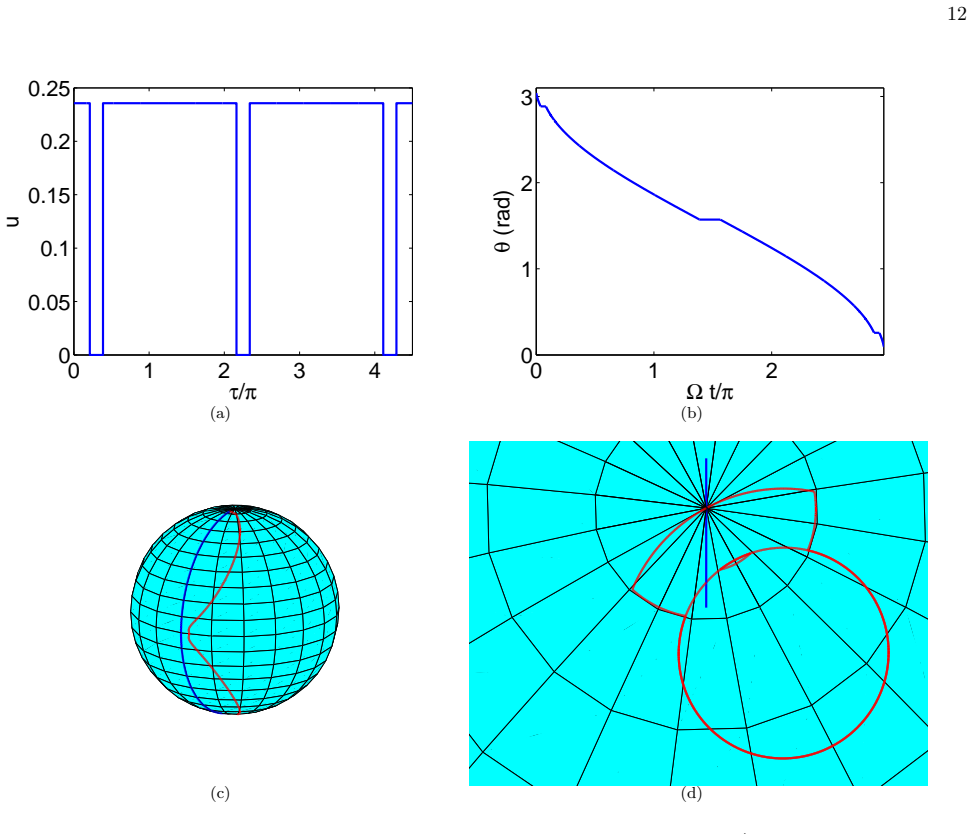
195π/ Ω of the first resonance. In Fig. 1(b) we show the corresponding evolution of the total field angle θ(t) in the original time t. In Fig. 1(c) we plot with red solid line the corresponding state trajectory on the Bloch sphere and in the original reference frame. The blue solid line on the meridian indicates the change in the total field angleθ. Finally,...
-
[2]
off” pulses, thus it has the form “on-off-on
(42) 7 For these values of the initial and final angles we obtain from Eq. (17b) T ′ 1 = 1. 77π, T ′ 2 = 3. 89π, T ′ 3 = 5. 93π. (43) A. On-Off-On We first find the pulse sequence with total duration T ′ = 1. 5π in the rescaled time τ. Since T ′ 0<T ′<T ′ 1, the pulse sequence contains m = 1 “off” pulses, thus it has the form “on-off-on”. Only for this special ...
-
[3]
773436, which is also the solution of the transcendental equation ay,1 = 0. The durations τ1,τ 2 can be obtained from Eq. (44), (27), respectively. We explain how to obtain the corre- sponding durations t1,t 2 in the original time t. Observe that during the initial “on” pulse the evolution of angle θ in the rescaled and original times is given by Eqs. (18...
- [4]
-
[5]
S.J. Glaser, U. Boscain, T. Calarco, C.P. Koch, W. K¨ ockenberger, R. Kosloff, I. Kuprov, B. Luy, S. Schirmer, T. Schulte-Herbr¨ uggen, D. Sugny, and F.K. Wilhelm, Eur. Phys. J. D 69, 279 (2015). 13 0 0.5 1−10 −5 0 5 10 Ω t/π ∆/Ω (a) 0 0.5 1 1.5−10 −5 0 5 10 Ω t/π ∆/Ω (b) 0 1 2−10 −5 0 5 10 Ω t/π ∆/Ω (c) FIG. 9. (Color online) Detuning ∆( t) in the origina...
work page 2015
-
[6]
N.V. Vitanov, T. Halfmann, B.W. Shore, and K. Bergmann, Annu. Rev. Phys. Chem. 52, 763 (2001)
work page 2001
- [7]
- [8]
- [9]
-
[10]
F. Motzoi, J.M. Gambetta, P. Rebentrost, and F.K. Wil- helm, Phys. Rev. Lett. 103, 110501 (2009)
work page 2009
-
[11]
X. Chen, A. Ruschhaupt, S. Schmidt, A. del Campo, D. Gu´ ery-Odelin, and J. G. Muga, Phys. Rev. Lett. 104, 063002 (2010)
work page 2010
- [12]
- [13]
-
[14]
X. Chen, I. Lizuain, A. Ruschhaupt, D. Gu´ ery-Odelin, and J.G. Muga, Phys. Rev. Lett. 105, 123003 (2010)
work page 2010
-
[15]
X. Chen, E. Torrontegui, and J.G. Muga, Phys. Rev. A 83, 062116 (2011)
work page 2011
- [16]
-
[17]
N. Malossi, M.G. Bason, M. Viteau, E. Arimondo, R. Mannella, O. Morsch, and D. Ciampini, Phys. Rev. A 87, 012116 (2013)
work page 2013
-
[18]
A. Ruschhaupt, X. Chen, D. Alonso, and J.G. Muga, New J. Phys. 14, 093040 (2012)
work page 2012
- [19]
- [20]
- [21]
- [22]
-
[23]
J. Kelly, A. Megrant, A. Veitia, D. Sank, E. Jeffrey, T.C. White, J. Mutus, A.G. Fowler, B. Campbell, Y. Chen, Z. Chen, B. Chiaro, A. Dunsworth, C. Neill, P. O’Malley, P. Roushan, A. Vainsencher, J. Wenner, A.N. Korotkov, A.N. Cleland, and J.M. Martinis, Nature 508, 500 (2014)
work page 2014
- [24]
- [25]
-
[26]
J. Zeng, X.-H. Deng, A. Russo, and E. Barnes, New J. Phys. 20, 033011 (2018)
work page 2018
- [27]
-
[28]
J. Fischer, D. Basilewitsch, C.P. Koch, D. Sugny, Phys. Rev. A 99, 033410 (2019)
work page 2019
- [29]
- [30]
- [31]
-
[32]
B.T. Torosov, S. Gu´ erin, and N.V. Vitanov, Phys. Rev. Lett. 106, 233001 (2011)
work page 2011
- [33]
- [34]
- [35]
- [36]
- [37]
- [38]
-
[39]
N.V. Vitanov, A.A. Rangelov, B.W. Shore, and K. Bergmann, Rev. Mod. Phys. 89, 015006 (2017)
work page 2017
- [40]
- [41]
- [42]
-
[43]
U. Boscain, G. Charlot, J.-P. Gauthier, S. Guerin, and H.-R. Jauslin, J. Math. Phys. 43, 2107 (2002)
work page 2002
-
[44]
D. Stefanatos, H. Schaettler, and J.-S. Li, SIAM J. Con- trol Optim. 49, 2440 (2011)
work page 2011
-
[45]
D. Stefanatos and J.-S. Li, IEEE Trans. Automat. Contr. 59, 733 (2014). 14
work page 2014
- [46]
- [47]
- [48]
discussion (0)
Sign in with ORCID, Apple, or X to comment. Anyone can read and Pith papers without signing in.