REVIEW 4 major objections 5 minor 31 references
Routing object similarity through a compact room lexicon makes zero-shot object navigation more successful.
Reviewed by Pith at T0; open to challenge. T0 means a machine referee read the full paper against a public rubric. the ladder, T0–T4 →
T0 review · deepseek-v4-flash
2026-08-01 02:23 UTC pith:PY3HS2FM
load-bearing objection A clean, honest, incremental idea whose headline gain is confounded because the comparison changes perception and scoring simultaneously; worth refereeing, but the mechanism needs an ablation that isolates the co-occurrence scoring. the 4 major comments →
Room-Mediated Co-occurrence for Zero-Shot Object-Centric Semantic Navigation via Frontier Scoring
The pith
A machine-rendered reading of the paper's core claim, the machinery that carries it, and where it could break.
Core claim
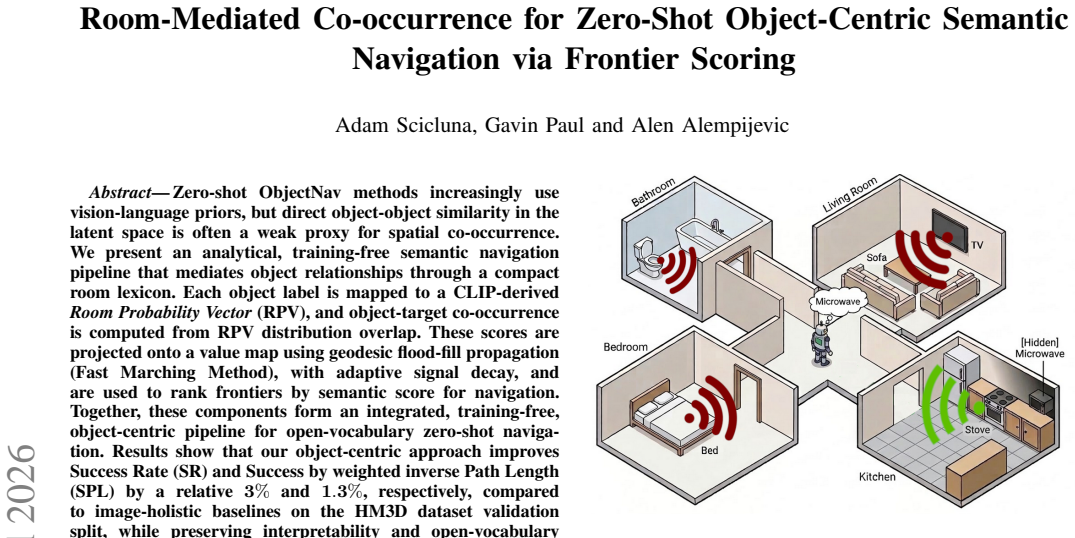
The central claim is that mediating object-object similarity through a compact room lexicon yields better frontier rankings than comparing whole images or raw object embeddings. Concretely: each object label is mapped to a Room Probability Vector by a temperature-scaled softmax over cosine similarities to nine room names; the co-occurrence score is the dot product of target and detected-object RPVs, interpreted as the joint probability that both objects belong to the same room; and this score is propagated as a spatially decaying signal along geodesic distances, with high-co-occurrence objects given wider influence. The paper reports that this pipeline reaches a success rate of 0.539 and SPL
What carries the argument
The load-bearing object is the Room Probability Vector (RPV): a K-dimensional distribution over room types obtained by softmax-normalised CLIP text similarity between an object label and each room name. The co-occurrence score is the RPV dot product, which suppresses weak overlaps and peaks on shared room assignments. The second piece is the value map: signals from detected objects are propagated by a Fast Marching Method flood-fill with an adaptive Gaussian spread, scaling the sigma by the square root of the co-occurrence score, so walls block signals and reachable frontiers accumulate evidence. Frontier selection then picks the region with the highest median value.
Load-bearing premise
The load-bearing premise is that RPV dot products reflect real physical room co-occurrence; the paper's own Section VI concedes that this analytic estimate does not strongly correlate with ground-truth data, so if that premise fails the navigation gains are not explained by the proposed mechanism.
What would settle it
Run the same pipeline with co-occurrence scores replaced by random permutations of the RPV rankings, and separately by inverted rankings; if success rate and SPL do not drop materially, the room-mediation signal is not doing the work. A direct offline check: compare RPV dot-product top-5 anchors against ground-truth room co-occurrence across a large multi-room corpus and require Recall@5 well above the chance level for 21 candidate classes.
If this is right
- Zero-shot object navigation becomes training-free and open-vocabulary: any natural-language target can be searched without fine-tuning, as long as its RPV can be formed.
- Frontier rankings are more reliable when driven by object-level room priors than by whole-image similarity, because image-level vectors conflate many objects and backgrounds.
- Geodesic propagation prevents semantic signals from leaking through walls, suppressing spurious frontier scores in adjacent rooms.
- The same pipeline can be deployed with a substitute room lexicon, such as domain-specific or abstract room categories, without retraining.
- Because the scoring is deterministic and interpretable, failure cases can be traced to specific object detections and room-prior weights.
Where Pith is reading between the lines
- If the reported gain is real and attributable to room mediation, then replacing the dot product with entropy-aware weighting could widen the margin, since high-entropy objects like chairs currently dilute signals.
- The room-lexicon mechanism suggests a transferable test: use the same RPV dot product for a different embodied task, such as room-type prediction or object search from language queries, and check whether the ranking quality carries over.
- A stronger validation would measure navigation performance against baselines that use the same detection and segmentation stack but different scoring, isolating the RPV contribution from perception gains.
- The paper's own weak correlation between RPV scores and ground-truth co-occurrence leaves open the possibility that the navigation gain partly comes from generic exploration; an ablation with shuffled co-occurrence scores would resolve this.
Editorial analysis
A structured set of objections, weighed in public.
Referee Report
Summary. The paper proposes RPV-SemNav, a training-free, open-vocabulary ObjectNav pipeline. Object labels are embedded with CLIP text encoders and converted into Room Probability Vectors (RPVs) via a temperature-scaled softmax over a compact room lexicon (Eq. 1–2). Co-occurrence between a detected object and the target is scored by the RPV dot product (Eq. 3), propagated through free space by FMM geodesic flood-fill with adaptive amplitude and spread (Eq. 4–6), and used to rank frontiers (Eq. 7–8). The method is evaluated on HM3D validation in Habitat. The paper reports SR 0.539 and SPL 0.307 for RPV-V2, a relative +3% SR and +1.3% SPL over a locally re-evaluated VLFM baseline, and an internal ablation (RPV-V1 vs RPV-V2) showing a small gain from FMM over Gaussian propagation. The authors also validate RPV co-occurrence against HM3D ground-truth conditional probabilities in Fig. 5, where the dot product achieves full-row Spearman ρ=0.329, Top-5 Spearman ρ=0.319, Recall@5 0.524, and NDCG@5 0.715.
Significance. If the proposed mechanism is actually responsible for the reported gains, the paper would make a useful contribution: it offers a simple, interpretable, training-free way to inject spatial priors into zero-shot semantic navigation, with an open-vocabulary formulation and no learned navigation policy. The mathematical pipeline is transparent, the FMM-vs-Gaussian propagation comparison is a sensible controlled component, and the code is promised. However, the evidence as presented does not yet isolate the room-mediated co-occurrence mechanism from the concurrent switch to an object-centric perception stack, and the paper’s own co-occurrence validation is weak. The headline gains are small in absolute terms and are reported without variance or statistical testing. The central claim is therefore plausible but not yet supported at the level required for a journal publication.
major comments (4)
- [§V-B, Table I; §IV-B] The central claim—that room-mediated co-occurrence improves SR/SPL over image-holistic baselines—is not isolated by the reported experiments. RPV-V2 differs from VLFM† in two major ways: (1) the perception front end (YOLOE + SAM3 with background masking vs BLIP-2 image embeddings) and (2) the frontier-scoring rule (Eq. 3 RPV dot product vs image-text cosine similarity). The only internal ablation, RPV-V1 vs RPV-V2, changes FMM vs Gaussian propagation while keeping the RPV scoring fixed. Therefore the +0.016 SR (0.523→0.539) and +0.003 SPL improvements cannot be attributed to the RPV dot product. I request an ablation that holds perception and propagation fixed and compares Eq. 3 against a raw CLIP object-label cosine similarity (or an equivalent non-room-mediated object-centric scorer). Without this, the manuscript’s main contribution, the room lexicon as mediator, remains untested.
- [§V-A, Fig. 5; §VI] The paper’s own validation of the core co-occurrence measure is weak: the RPV dot product has full-row Spearman ρ=0.329, and the conclusion states that the analytical co-occurrence estimate “does not strongly correlate with ground truth data.” This is load-bearing because the navigation mechanism assumes that high RPV overlap tracks physical co-occurrence. A weak correlation does not by itself disprove the mechanism, but it means the relatively small navigation gains could arise from generic exploration, from the richer object-centric perception stack, or from the geometric propagation rather than from room-mediated semantics. Please provide per-target analyses (e.g., correlation between RPV ranking quality and per-category SR/SPL), or a direct comparison showing that RPV scoring beats raw CLIP similarity in ranking quality and in navigation with all else fixed. At a minimum, discuss wha
- [§III-C2, §III-D2] The method has several hand-set parameters that are load-bearing for the RPV distributions and the value map: softmax temperature τ=0.03, σ_min=1.0 m, σ_max=5.0 m, and frontier clustering radius r=0.5 m. No sensitivity analysis is provided. The dot product of softmax-normalized RPVs is highly sensitive to τ, since τ controls the sharpness and hence the overlap between distributions; the claimed navigation improvements are small, so parameter sensitivity could determine whether the effect survives. Please report a sensitivity study over τ and at least one of the σ parameters, with SR/SPL and ideally the Fig. 5 validation metrics.
- [§V-B, Table I] All navigation results are reported as point estimates without error bars, confidence intervals, or repeated-seed variance. The absolute differences at the center of the paper are small: RPV-V2 vs VLFM† is +0.016 SR and +0.004 SPL, and RPV-V2 vs RPV-V1 is +0.005 SR and +0.003 SPL. Given the acknowledged 14.6% of episodes that cannot be solved due to the single-floor assumption, it is important to show that these differences are not within run-to-run or episode-sampling noise. Please report variance over multiple evaluation runs or episode subsets, at least for the methods compared in Table I.
minor comments (5)
- [Abstract] Typo: “Room Probability V ector” should be “Room Probability Vector.”
- [§V-A, Fig. 5] The caption says “at K=5”, but the full-row Spearman correlation is not a top-5 measure. Please clarify which panels correspond to full-row vs Top-5 evaluation.
- [§III-C3] The dot product in Eq. 3 is the probability that two independent categorical variables take the same room value under the RPV model; it is not the conditional probability P(target|object) defined in Eq. 9. The text should more carefully distinguish the modeled joint-match probability from the ground-truth conditional used for validation.
- [§III-D1, Eq. 4] The value map definition divides by |O_x|, which is undefined when O_x is empty. Please state the convention for cells not reached by any signal.
- [§IV-B, Table I] DTG is reported for some methods but not for UIAP-OGN or PIRLNav; please state why or add the missing values.
Circularity Check
No significant circularity: RPVs are frozen-CLIP derived, no parameter is fit to navigation success, and the central comparison is against an external benchmark.
full rationale
The paper's derivation chain—CLIP text embeddings to RPVs (Eqs. 1-2), dot-product co-occurrence (Eq. 3), geodesic flood-fill value map (Eq. 4), and frontier ranking (Eqs. 7-8)—does not reduce to a fitted target. RPVs are computed from frozen CLIP embeddings of raw object and room labels; Eq. 3 is a modeling definition, but the paper tests whether RPV dot products approximate physical co-occurrence against HM3D ground-truth conditional probabilities in Section V-A and concedes the correlation is weak in Section VI. That is external empirical validation, not circularity. The room lexicon and evaluation both use HM3D, but the RPV probabilities are not read off HM3D annotations; the overlap is a dataset-scope concern, not equivalence by construction. Hand-set parameters tau=0.03 and sigma_min/sigma_max are not fitted to SR/SPL, so the navigation results are not statistically forced. The lack of an ablation isolating Eq. 3 from the perception stack (RPV-V2 vs VLFM changes detector and segmenter as well) is a confounding/attribution weakness, not circularity: the improvement is not identical to the inputs by definition. There are no load-bearing self-citations in the reference list. Under the hard rules, a confounded but independently evaluated result is a correctness risk, not a circularity, so the score is 0.
Axiom & Free-Parameter Ledger
free parameters (4)
- softmax temperature tau =
0.03
- sigma_min =
1.0 m
- sigma_max =
5.0 m
- frontier clustering radius r =
0.5 m
axioms (4)
- domain assumption CLIP text embeddings capture meaningful room-object associations.
- domain assumption The nine-room lexicon R is adequate for household target objects.
- domain assumption P(t|o) computed from HM3D annotations is an appropriate ground truth.
- domain assumption FMM geodesic distance approximates navigability in the single-floor episodes.
read the original abstract
Zero-shot ObjectNav methods increasingly use vision-language priors, but direct object-object similarity in the latent space is often a weak proxy for spatial co-occurrence. We present an analytical, training-free semantic navigation pipeline that mediates object relationships through a compact room lexicon. Each object label is mapped to a CLIP-derived Room Probability Vector (RPV), and object-target co-occurrence is computed from RPV distribution overlap. These scores are projected onto a value map using geodesic flood-fill propagation (Fast Marching Method), with adaptive signal decay, and are used to rank frontiers by semantic score for navigation. Together, these components form an integrated, training-free, object-centric pipeline for open-vocabulary zero-shot navigation. Results show that our object-centric approach improves Success Rate (SR) and Success by weighted inverse Path Length (SPL) by a relative 3% and 1.3%, respectively, compared to image-holistic baselines on the HM3D dataset validation split, while preserving interpretability and open-vocabulary flexibility. Code is available at: uts-ri.github.io/RPV-SemNav.
Figures


Reference graph
Works this paper leans on
-
[1]
ObjectNav Revisited: On Evaluation of Embodied Agents Navigating to Objects,
D. Batra, A. Gokaslan, A. Kembhavi, O. Maksymets, R. Mottaghi, M. Savva, A. Toshev, and E. Wijmans, “ObjectNav Revisited: On Evaluation of Embodied Agents Navigating to Objects,” Aug. 2020, arXiv:2006.13171 [cs]
Pith/arXiv arXiv 2020
-
[2]
Auxiliary tasks and exploration enable objectgoal navigation,
J. Ye, D. Batra, A. Das, and E. Wijmans, “Auxiliary tasks and exploration enable objectgoal navigation,” inProceedings of the IEEE/CVF International Conference on Computer Vision (ICCV), 2021, arXiv:2104.04112
Pith/arXiv arXiv 2021
-
[3]
Habitat-matterport 3d dataset (hm3d): 1000 large-scale 3d environments for embodied ai,
S. K. Ramakrishnan, A. Gokaslan, E. Wijmans, O. Maksymets, A. Clegg, J. Turner, E. Undersander, W. Galuba, A. Westbury, A. X. Chang, M. Savva, Y . Zhao, and D. Batra, “Habitat-matterport 3d dataset (hm3d): 1000 large-scale 3d environments for embodied ai,” arXiv preprint arXiv:2109.08238, 2021
Pith/arXiv arXiv 2021
-
[4]
Gibson env: Real-world perception for embodied agents,
F. Xia, A. R. Zamir, Z. He, A. Sax, J. Malik, and S. Savarese, “Gibson env: Real-world perception for embodied agents,” in2018 IEEE/CVF Conference on Computer Vision and Pattern Recognition, 2018, pp. 9068–9079
2018
-
[5]
Matterport3d: Learning from rgb-d data in indoor environments,
A. Chang, A. Dai, T. Funkhouser, M. Halber, M. Niessner, M. Savva, S. Song, A. Zeng, and Y . Zhang, “Matterport3d: Learning from rgb-d data in indoor environments,”International Conference on 3D Vision (3DV), 2017
2017
-
[6]
Vlfm: Vision-language frontier maps for zero-shot semantic navigation,
N. Yokoyama, S. Ha, D. Batra, J. Wang, and B. Bucher, “Vlfm: Vision-language frontier maps for zero-shot semantic navigation,” arXiv preprint arXiv:2312.03275, 2023
Pith/arXiv arXiv 2023
-
[7]
Learning transferable visual models from natural language supervi- sion,
A. Radford, J. W. Kim, C. Hallacy, A. Ramesh, G. Goh, S. Agarwal, G. Sastry, A. Askell, P. Mishkin, J. Clark, G. Krueger, and I. Sutskever, “Learning transferable visual models from natural language supervi- sion,” inProceedings of the International Conference on Machine Learning (ICML), 2021, arXiv:2103.00020
Pith/arXiv arXiv 2021
-
[8]
BLIP-2: Bootstrapping language- image pre-training with frozen image encoders and large language models,
J. Li, D. Li, S. Savarese, and S. Hoi, “BLIP-2: Bootstrapping language- image pre-training with frozen image encoders and large language models,” inProceedings of the 40th International Conference on Machine Learning, ser. Proceedings of Machine Learning Research, vol. 202. PMLR, 23–29 Jul 2023, pp. 19 730–19 742
2023
-
[9]
A frontier-based approach for autonomous exploration,
B. Yamauchi, “A frontier-based approach for autonomous exploration,” inProceedings of IEEE International Symposium on Computational Intelligence in Robotics and Automation (CIRA), 1997
1997
-
[10]
How To Not Train Your Dragon: Training-free Embodied Object Goal Navigation with Semantic Frontiers,
J. Chen, G. Li, S. Kumar, B. Ghanem, and F. Yu, “How To Not Train Your Dragon: Training-free Embodied Object Goal Navigation with Semantic Frontiers,” inRobotics: Science and Systems XIX. Robotics: Science and Systems Foundation, Jul. 2023
2023
-
[11]
Habitat: A platform for embodied AI research,
M. Savva, A. Kadian, O. Maksymets, Y . Zhao, E. Wijmans, B. Jain, J. Straub, J. Liu, V . Koltun, J. Malik, D. Parikh, and D. Batra, “Habitat: A platform for embodied AI research,” inProceedings of the IEEE/CVF International Conference on Computer Vision (ICCV), 2019, arXiv:1904.01201
Pith/arXiv arXiv 2019
-
[12]
Object goal navigation using goal-oriented semantic exploration,
D. S. Chaplot, D. Gandhi, A. Gupta, K. Gupta, and R. Salakhutdinov, “Object goal navigation using goal-oriented semantic exploration,” in Advances in Neural Information Processing Systems (NeurIPS), 2020
2020
-
[13]
Poni: Potential functions for objectgoal navigation with interaction-free learning,
S. K. Ramakrishnan, D. S. Chaplot, Z. Al-Halah, J. Malik, and K. Grauman, “Poni: Potential functions for objectgoal navigation with interaction-free learning,” inProceedings of the IEEE/CVF Confer- ence on Computer Vision and Pattern Recognition (CVPR), 2022, arXiv:2201.10029
Pith/arXiv arXiv 2022
-
[14]
Stubborn: A Strong Baseline for Indoor Object Navigation,
H. Luo, A. Yue, Z.-W. Hong, and P. Agrawal, “Stubborn: A Strong Baseline for Indoor Object Navigation,” in2022 IEEE/RSJ Interna- tional Conference on Intelligent Robots and Systems (IROS), Oct. 2022, pp. 3287–3293, iSSN: 2153-0866
2022
-
[15]
PIRLNav: Pre- training with Imitation and RL Finetuning for OBJECTNA V ,
R. Ramrakhya, D. Batra, E. Wijmans, and A. Das, “PIRLNav: Pre- training with Imitation and RL Finetuning for OBJECTNA V ,” in2023 IEEE/CVF Conference on Computer Vision and Pattern Recognition (CVPR). Vancouver, BC, Canada: IEEE, Jun. 2023, pp. 17 896– 17 906
2023
-
[16]
Uncertainty- Informed Active Perception for Open V ocabulary Object Goal Nav- igation,
U. Bajpai, J. R ¨uckin, C. Stachniss, and M. Popovi ´c, “Uncertainty- Informed Active Perception for Open V ocabulary Object Goal Nav- igation,” in2025 European Conference on Mobile Robots (ECMR), Sep. 2025, pp. 1–7
2025
-
[17]
CoWs on Pasture: Baselines and Benchmarks for Language-Driven Zero-Shot Object Navigation,
S. Y . Gadre, M. Wortsman, G. Ilharco, L. Schmidt, and S. Song, “CoWs on Pasture: Baselines and Benchmarks for Language-Driven Zero-Shot Object Navigation,” in2023 IEEE/CVF Conference on Computer Vision and Pattern Recognition (CVPR), Jun. 2023, pp. 23 171–23 181, iSSN: 2575-7075
2023
-
[18]
L3mvn: Leveraging large language models for visual target navigation,
B. Yu, H. Kasaei, and M. Cao, “L3mvn: Leveraging large language models for visual target navigation,”arXiv preprint arXiv:2304.05501, 2023
Pith/arXiv arXiv 2023
-
[19]
Esc: exploration with soft commonsense constraints for zero- shot object navigation,
K. Zhou, K. Zheng, C. Pryor, Y . Shen, H. Jin, L. Getoor, and X. E. Wang, “Esc: exploration with soft commonsense constraints for zero- shot object navigation,” inProceedings of the 40th International Conference on Machine Learning, ser. ICML’23. JMLR.org, 2023
2023
-
[20]
Ad- vancing object-goal navigation through llm-enhanced object affinities transfer,
M. Lin, S. Liu, D. Zhang, Y . Chen, Z. Wang, H. Li, and D. Zhao, “Ad- vancing object-goal navigation through llm-enhanced object affinities transfer,” in2025 IEEE/RSJ International Conference on Intelligent Robots and Systems (IROS), 2025, pp. 18 458–18 465
2025
-
[21]
BERT: pre-training of deep bidirectional transformers for language understanding,
J. Devlin, M. Chang, K. Lee, and K. Toutanova, “BERT: pre-training of deep bidirectional transformers for language understanding,” in Proceedings of the 2019 Conference of the North American Chapter of the Association for Computational Linguistics: Human Language Technologies, NAACL-HLT 2019, Minneapolis, MN, USA, June 2-7, 2019, Volume 1 (Long and Short ...
2019
-
[22]
Seek: Semantic reasoning for object goal navigation in real world inspection tasks,
M. F. Ginting, S.-K. Kim, D. D. Fan, M. Palieri, M. J. Kochenderfer, and A.-a. Agha-mohammadi, “Seek: Semantic reasoning for object goal navigation in real world inspection tasks,” inProceedings of Robotics: Science and Systems (RSS), Delft, Netherlands, July 2024
2024
-
[23]
Masked-attention mask transformer for universal image seg- mentation,
B. Cheng, I. Misra, A. G. Schwing, A. Kirillov, and R. Gird- har, “Masked-attention mask transformer for universal image seg- mentation,” inProceedings of the IEEE/CVF Conference on Com- puter Vision and Pattern Recognition (CVPR), 2022, pp. 1290–1299, arXiv:2112.01527
Pith/arXiv arXiv 2022
-
[24]
Scene parsing through ade20k dataset,
B. Zhou, H. Zhao, X. Puig, S. Fidler, A. Barriuso, and A. Torralba, “Scene parsing through ade20k dataset,”Proceedings of the IEEE Conference on Computer Vision and Pattern Recognition (CVPR), pp. 633–641, 2017, arXiv:1608.05442
Pith/arXiv arXiv 2017
-
[25]
Deep residual learning for image recognition,
K. He, X. Zhang, S. Ren, and J. Sun, “Deep residual learning for image recognition,” inProceedings of the IEEE Conference on Computer Vision and Pattern Recognition (CVPR), 2016, pp. 770– 778, arXiv:1512.03385
Pith/arXiv arXiv 2016
-
[26]
Yoloe: Real-time seeing anything,
A. Wang, L. Liu, H. Chen, Z. Lin, J. Han, and G. Ding, “Yoloe: Real-time seeing anything,”arXiv preprint arXiv:2503.07465, 2025
arXiv 2025
-
[27]
LVIS: A dataset for large vocabulary instance segmentation,
A. Gupta, P. Doll ´ar, and R. Girshick, “LVIS: A dataset for large vocabulary instance segmentation,”arXiv preprint arXiv:1908.03195, 2019
Pith/arXiv arXiv 1908
-
[28]
SAM 3: Segment anything with concepts,
N. Carion, L. Gustafson, Y .-T. Hu, S. Debnath, R. Hu, D. Suris, C. Ryali, K. V . Alwala, H. Khedr, A. Huang, J. Lei, T. Ma, B. Guo, A. Kalla, M. Marks, J. Greer, M. Wang, P. Sun, R. R ¨adle, T. Afouras, E. Mavroudi, K. Xu, T.-H. Wu, Y . Zhou, L. Momeni, R. Hazra, S. Ding, S. Vaze, F. Porcher, F. Li, S. Li, A. Kamath, H. K. Cheng, P. Doll´ar, N. Ravi, K. ...
Pith/arXiv arXiv 2025
-
[29]
Fast marching methods,
J. A. Sethian, “Fast marching methods,”SIAM Review, vol. 41, no. 2, pp. 199–235, 1999
1999
-
[30]
Habitat-matterport 3d semantics dataset,
K. Yadav, R. Ramrakhya, S. K. Ramakrishnan, T. Gervet, J. Turner, A. Gokaslan, N. Maestre, A. X. Chang, D. Batra, M. Savva et al., “Habitat-matterport 3d semantics dataset,”arXiv preprint arXiv:2210.05633, 2022
Pith/arXiv arXiv 2022
-
[31]
On evaluation of embodied navigation agents,
P. Anderson, A. Chang, D. S. Chaplot, A. Dosovitskiy, S. Gupta, V . Koltun, J. Kosecka, J. Malik, R. Mottaghi, M. Savva, and A. R. Zamir, “On evaluation of embodied navigation agents,”arXiv preprint arXiv:1807.06757, 2018
Pith/arXiv arXiv 2018
discussion (0)
Sign in with ORCID, Apple, or X to comment. Anyone can read and Pith papers without signing in.