REVIEW 4 major objections 5 minor 4 references
FairyGen: Storied Cartoon Video from a Single Child-Drawn Character
T0 review · 4 major / 5 minor · reviewed 2026-08-06 · deepseek-v4-flash
Pith's one-line read This paper claims that a single child's drawing, run through FairyGen's decoupled pipeline of story planning, style propagation, and 3D-proxy-driven motion adaptation, yields multi-shot cartoon videos that keep the drawing's identity.
desk verdict A coherent systems paper whose motion-learning pipeline depends on a 3D proxy that the authors admit can fail, with evaluation too thin to cover that failure. read the letter →
The pith
A machine-rendered reading of the paper's core claim, the machinery that carries it, and where it could break.
The reading
What carries the argument
Three load-bearing components carry the argument. A storyboard planner uses an MLLM to turn the drawing into a global narrative plus shot-level annotations for background, action, and camera, which drive later cropping and view synthesis. A style propagation adapter trains a DoRA-style low-rank adapter on foreground-masked tokens and applies it to background tokens at inference, so SDXL with BrushNet inpaints scenes that inherit the character's brushstroke, palette, and line density. A two-stage motion adapter learns identity from temporally shuffled frames with dropout on the low-rank identity matrix, then learns a motion residual on ordered frames with identity frozen, using a sigmoid-transformed Gaussian distribution biased toward high-noise timesteps. The 3D proxy, reconstructed by DrawingSpinUp from the single sketch, is what makes the motion stage possible, because it gives riggable geometry from which motion sequences are retargeted.
What would settle it
Run FairyGen on a corpus of child drawings with deliberately non-standard anatomy, such as figures with no separable limbs, fused bodies, or extreme foreshortening, and check whether the 3D proxy reconstruction still yields plausible geometry and whether the final video preserves the drawing's identity. A second check is to disable the 3D-proxy branch and compare motion quality; if the outputs stay equally good, the proxy is not doing the load-bearing work the paper assigns to it.
Extended reading notes
Core claim
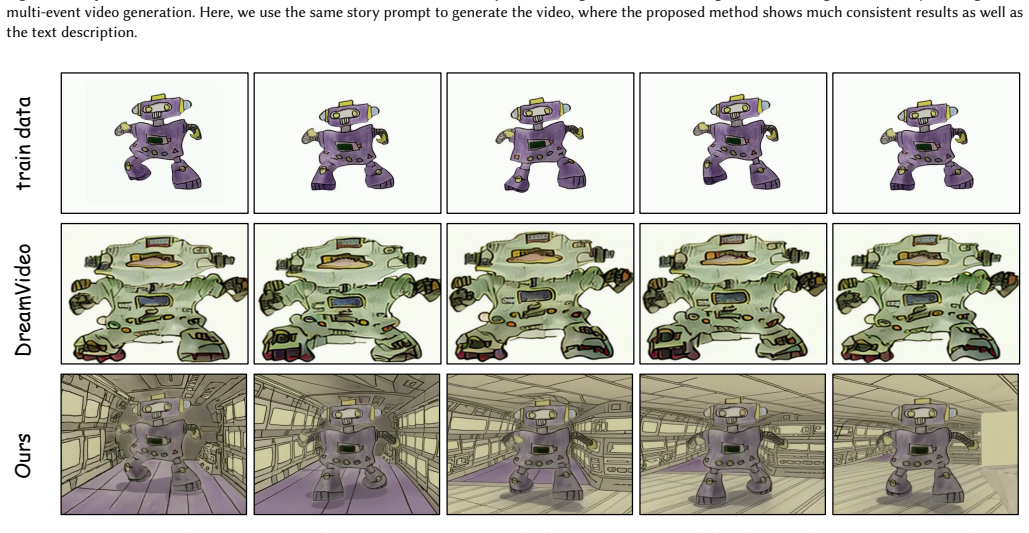
On its own terms, the paper's contribution is a decoupled generation system that converts a single child's sketch into a coherent multi-shot cartoon video. The central claim is that character identity, background style, and motion can be handled independently yet recombined without visual fracture: identity is captured in the input drawing and reinforced by identity LoRA training on shuffled frames; background style is generated by propagating the foreground's visual traits through a masked low-rank adapter; and motion is learned from a rigged 3D proxy of the sketch rather than from the video model's weak priors, then transferred through a motion residual adapter trained with late-biased timestep sampling. FairyGen's experiments aim to show that this decomposition yields better style alignment, subject consistency, motion smoothness, and user preference than generic multi-event video generators and subject-and-motion customization baselines.
Load-bearing premise
Everything depends on DrawingSpinUp correctly reconstructing a usable 3D proxy from the child's drawing; if the proxy is wrong, the motion sequences used to train the video model are wrong, and the paper itself notes this failure mode in Section 5.4.
Editorial extensions
If this is right
- A child or parent could upload one sketch and receive a multi-shot animated story whose protagonist is recognizably the original drawing, with backgrounds built from the same brushstroke and color language.
- Because motion and identity live in separate low-rank adapters, the same character can be placed in a new story by reusing the identity stage and swapping in a different motion stage.
- Style-consistent scenes are produced without collecting any dataset of child-drawn backgrounds, since the foreground character itself supplies the style signal.
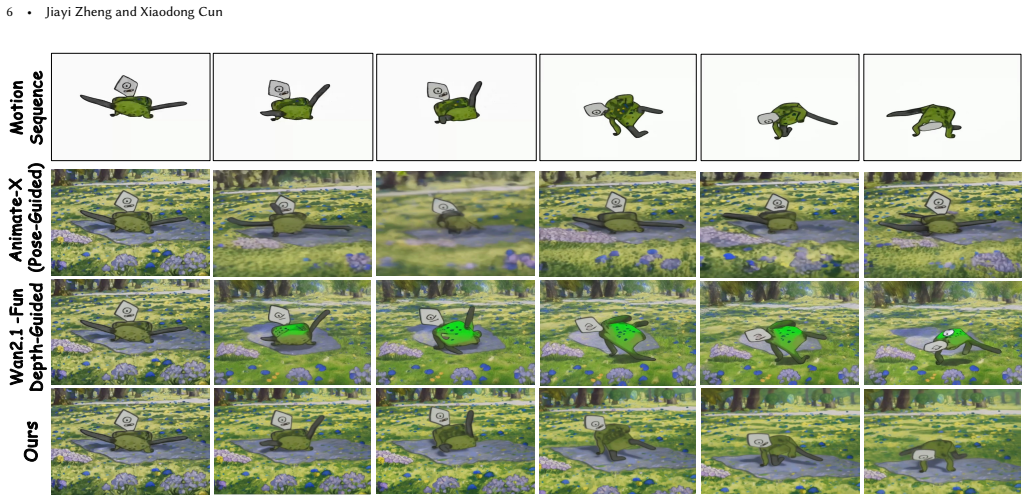
- Complex actions such as jumping, running, and landing are derived from a rigged 3D proxy rather than hallucinated by the video model, which the paper quantifies as improved motion smoothness and subject consistency.
- The same decoupled pipeline should extend from single characters to multiple characters by adding one 3D proxy per subject, as the paper's limitation section notes.
Reading between the lines
- An implication the authors leave implicit is that the timestep-shift bias is a general training technique for video-diffusion customization, so it could be worth testing beyond child drawings wherever motion learning underweights high-noise steps.
- The style propagation adapter suggests a broader pattern of subject-to-scene style transfer: a single logo, mascot, or toy photograph could drive consistent branded or narrative backgrounds without separate style references.
- A quantitative extension would be measuring proxy-reconstruction failure rates on non-human and limbless drawings; if those failures track motion quality, the 3D-proxy branch, not the video model, is the actual bottleneck.
- The paper mentions multi-character extension as easy, but inter-character interaction would require shared spatial layout and contact reasoning that the current single-character storyboard format does not enforce.
Editorial analysis
A structured set of objections, weighed in public.
Referee Report
Summary. FairyGen proposes a multi-stage automatic pipeline that takes a single child-drawn character image and produces story-driven cartoon videos. The pipeline consists of: (i) an MLLM-based storyboard planner that generates shot-level descriptions of setting, action, and camera; (ii) a style propagation adapter based on SDXL/DoRA that learns character style from foreground tokens and applies it to background inpainting; (iii) a 3D proxy reconstruction step via DrawingSpinUp that is rigged and retargeted to produce motion sequences; and (iv) a two-stage LoRA-based motion customization adapter for an MMDiT image-to-video diffusion model, using a timestep-shift sampling strategy. Experiments compare stylization and motion against methods such as B-LoRA, DreamBooth, InstantStyle, Animate-X, Wan2.1, and DreamVideo, with ablations on the style adapter, the two-stage motion adapter, and the timestep shift.
Significance. If the system works as claimed, it is a potentially useful contribution to personalized children's-story animation: it explicitly decouples foreground/background modeling, grounds motion in a 3D proxy, and introduces a two-stage adapter design plus a timestep-shift sampling strategy. The paper ships with a project page and a code release link, which is a strength. However, the central claims are empirical, and the current evaluation is too thin to support them quantitatively: the test set is small, metrics lack error bars and significance tests, the key timestep-shift ablation is only qualitative, and the load-bearing 3D proxy fidelity is never directly measured. These are fixable with additional experiments that are within the manuscript's scope.
major comments (4)
- [§5.1–5.2, Tables 1–2] The quantitative evaluation is under-powered for the strength of the claims. Only 24 style images and 12 motion videos are used, all apparently from the AnimatedDrawings dataset, and no standard deviations, confidence intervals, or significance tests are reported. The text says the method is “significantly better” and that users “consistently prefer” it, but the numbers as presented cannot support that. In addition, the reported number of user opinions (3360) does not match the stated protocol (24 users × 24 style sets × 2 aspects plus 24 users × 12 motion sets × 2 aspects gives 1728, while per-method counts give other totals); please clarify the protocol and report per-item results.
- [§4.3–§4.4 and §5.4] The 3D proxy is load-bearing: all motion training data is derived from the DrawingSpinUp reconstruction, so any mismatch between the proxy and the child's flat 2D drawing is inherited by the two-stage LoRA motion adapter. The paper itself admits in §5.4 that “the foreground character (or animal) may not always be correctly reconstructed by the 3D proxy,” yet no experiment checks proxy fidelity (e.g., rendering the proxy from the input view and measuring identity/style similarity against the original drawing, or reporting failure cases). Because the evaluation uses mostly human-like AnimatedDrawings figures, the non-humanoid failure mode is not covered. Please add a direct proxy-fidelity check and a failure analysis.
- [§4.4 and §5.3.3, Eq. (6), Fig. 12] The timestep-shift strategy is described as critical, but its definition is ambiguous and its validation is only qualitative. Eq. (6) maps z ~ N(μ, σ²) through a sigmoid to a value in (0,1) without specifying how that value is scaled to the diffusion timestep range {1,...,T}, and the text says “μ closer to T” even though μ is the mean of the Gaussian in z-space, not in timestep space. The ablation in Fig. 12 is a single example with no quantitative metric, no variance across motions, and no sensitivity analysis over σ or over the choice of μ=6. Please provide quantitative motion metrics over several sequences, with variance, for uniform sampling and for at least μ=-6, 0, 6.
- [§5.1 and Table 1] The style metrics are not defined clearly enough to be interpretable. The text says “CLIP distance” is used as a style alignment score, but Table 1 reports “Style Align” with the proposed method highest, which would be the wrong direction if lower distance is better. Also, the proposed method's “Visual Quality” (0.3251) is below B-LoRA's (0.3429), which complicates the claim of “consistently prefer” and “faithfully preserving style.” Please clarify which columns are objective (and their direction), which come from the user study, and discuss the B-LoRA trade-off more carefully, ideally with example images.
minor comments (5)
- [§3 heading] The heading “3 PRELIMINARIRES” contains a typo; it should be “PRELIMINARIES”.
- [Eq. (6)] The symbol σ is used both for the sigmoid function and for the standard deviation of the Gaussian, which is confusing; please rename one of them.
- [§4.4, Eq. (5)] The notation for the motion adapter is unclear: the text says a “motion-specific adapter B_motion” is introduced, but Eq. (5) shares A_id between identity and motion. Please clarify whether B_motion is a separate low-rank matrix or a residual on the same shared basis, and report the ranks and dropout probabilities used in implementation.
- [§5.2] The user-study description appears after Table 2, but Table 1 already contains user-study columns; please reorder or annotate the tables so it is clear which numbers are objective and which are subjective.
- [Throughout] There are several typos and formatting issues, including “Emiting” in Fig. 1, “trainning” in §4, “stategy” in §4.4, and duplicate reference entries for Rombach et al. 2022a/2022b; a careful proofread is needed.
Circularity Check
No significant circularity: FairyGen is an empirical system assembly, not a derivation, and no load-bearing claim reduces to its inputs; the only caveat is a self-referential motion evaluation, not a circular derivation.
full rationale
The derivation chain in FairyGen is an engineering pipeline, not a mathematical derivation: an MLLM produces a storyboard, a LoRA/DoRA adapter on SDXL propagates style, DrawingSpinUp creates a 3D proxy, and a two-stage LoRA on an MMDiT video model learns motion. None of the paper's equations (Eqs. 1-6) define the output in terms of the claim, and no fitted parameter is renamed as an independent prediction. Self-citations to co-authored prior works (TaleCrafter, Animate-A-Story, VideoCrafter, CustomTTT, Inserting Anybody) appear only as related work and are not load-bearing. DrawingSpinUp and DynamicConcept are external priors, not author-imposed uniqueness theorems. The nearest issue is evaluative rather than derivational: Section 4.4 states that motion sequences from the 3D proxy are used 'as train data to finetune the video diffusion model,' while Fig. 6 evaluates the result by showing it 'very similar to the original motion sequence.' That is a self-consistency check on the training set, not independent evidence of motion generalization, and Section 5.4 admits the proxy 'may not always be correctly reconstructed.' These are dependency and evaluation-rigor caveats, not circular steps in the claimed derivation. The central contribution—generating storyboard-driven, style-consistent video from a single child drawing—does not reduce to its inputs, and the method is also compared against external baselines. Score 2 reflects the minor self-referential evaluation caveat rather than a circular derivation.
Assumptions & free parameters
free parameters (4)
- timestep shift mean mu =
6
- timestep shift variance sigma =
not specified
- dropout probability p =
not specified
- LoRA ranks =
not specified
assumptions (5)
- domain assumption DrawingSpinUp can reconstruct a usable 3D proxy from a single arbitrary child drawing
- ad hoc to paper Masked LoRA/DoRA applied to foreground tokens learns character style that transfers to background tokens
- ad hoc to paper Late-biased timestep sampling improves motion learning
- domain assumption CLIP distance is a valid measure of style alignment
- domain assumption The MLLM-generated storyboard is semantically consistent and executable
Cite this review
Pith. "Pith review of FairyGen: Storied Cartoon Video from a Single Child-Drawn Character." pith.science (2026). https://pith.science/paper/PY7O4FEK
@misc{pith2026250621272,
  author       = {Pith},
  title        = {Pith review of: FairyGen: Storied Cartoon Video from a Single Child-Drawn Character},
  year         = {2026},
  howpublished = {\url{https://pith.science/paper/PY7O4FEK}},
  note         = {Machine review of arXiv:2506.21272}
}
read the original abstract
We propose FairyGen, an automatic system for generating story-driven cartoon videos from a single child's drawing, while faithfully preserving its unique artistic style. Unlike previous storytelling methods that primarily focus on character consistency and basic motion, FairyGen explicitly disentangles character modeling from stylized background generation and incorporates cinematic shot design to support expressive and coherent storytelling. Given a single character sketch, we first employ an MLLM to generate a structured storyboard with shot-level descriptions that specify environment settings, character actions, and camera perspectives. To ensure visual consistency, we introduce a style propagation adapter that captures the character's visual style and applies it to the background, faithfully retaining the character's full visual identity while synthesizing style-consistent scenes. A shot design module further enhances visual diversity and cinematic quality through frame cropping and multi-view synthesis based on the storyboard. To animate the story, we reconstruct a 3D proxy of the character to derive physically plausible motion sequences, which are then used to fine-tune an MMDiT-based image-to-video diffusion model. We further propose a two-stage motion customization adapter: the first stage learns appearance features from temporally unordered frames, disentangling identity from motion; the second stage models temporal dynamics using a timestep-shift strategy with frozen identity weights. Once trained, FairyGen directly renders diverse and coherent video scenes aligned with the storyboard. Extensive experiments demonstrate that our system produces animations that are stylistically faithful, narratively structured natural motion, highlighting its potential for personalized and engaging story animation. The code will be available at https://github.com/GVCLab/FairyGen
Figures


Figures from the paper (10 more)






Reference graph
Works this paper leans on
-
[2]
In Proceedings of the IEEE/CVF Conference on Computer Vision and Pattern Recognition
Multi-concept customization of text-to-image diffusion. In Proceedings of the IEEE/CVF Conference on Computer Vision and Pattern Recognition . 1931–1941. Bowen Li. 2022. Word-level fine-grained story visualization. In European conference on computer vision. Springer, 347–362. Yitong Li, Zhe Gan, Yelong Shen, Jingjing Liu, Yu Cheng, Yuexin Wu, Lawrence Car...
arXiv 2024
-
[3]
A Method for Animating Children’s Drawings of the Human Figure. ACM Trans. Graph. 42, 3, Article 32 (jun 2023), 15 pages. https://doi.org/10.1145/3592788 Kihyuk Sohn, Nataniel Ruiz, Kimin Lee, Daniel Castro Chin, Irina Blok, Huiwen Chang, Jarred Barber, Lu Jiang, Glenn Entis, Yuanzhen Li, et al. 2023. Styledrop: Text-to- image generation in any style. arX...
arXiv 2023
-
[2023]
TaleCrafter: Interactive Story Visualization with Multiple Characters. arXiv:2305.18247 [cs.CV] Huiguo He, Huan Yang, Zixi Tuo, Yuan Zhou, Qiuyue Wang, Yuhang Zhang, Zeyu Liu, Wenhao Huang, Hongyang Chao, and Jian Yin. 2024. Dreamstory: Open-domain story visualization by llm-guided multi-subject consistent diffusion. arXiv preprint arXiv:2407.12899 (2024)...
arXiv 2024
-
[2024]
International Journal of Computer Vision (2024), 1–22
AutoStory: Generating Diverse Storytelling Images with Minimal Human Efforts. International Journal of Computer Vision (2024), 1–22. Yujie Wei, Shiwei Zhang, Zhiwu Qing, Hangjie Yuan, Zhiheng Liu, Yu Liu, Yingya Zhang, Jingren Zhou, and Hongming Shan. 2024. Dreamvideo: Composing your dream videos with customized subject and motion. In Proceedings of the I...
arXiv 2024
Reviewed August 6, 2026 · model on record in the stance chip above.
Discussion (0). Sign in to comment.