REVIEW 4 major objections 5 minor 109 references
Sparfels: Fast Reconstruction from Sparse Unposed Imagery
T0 review · 4 major / 5 minor · reviewed 2026-08-16 · deepseek-v4-flash
Pith's one-line read Three unposed photos are enough for an accurate 3D mesh in under three minutes on a consumer GPU, using foundation-model-initialized, bundle-adjusted Gaussian splats with a color-variance penalty.
desk verdict A well-engineered sparse reconstruction pipeline with a genuinely new variance loss, but the headline SOTA claim rests on an unevaluated metric change. read the letter →
The pith
A machine-rendered reading of the paper's core claim, the machinery that carries it, and where it could break.
The reading
What carries the argument
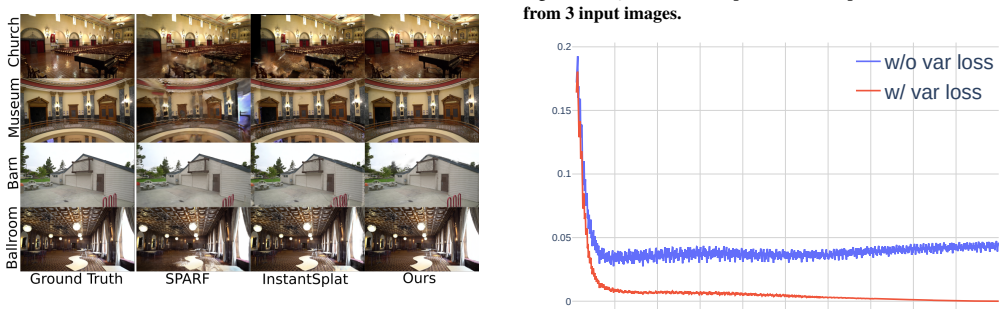
The central new object is the splatted color variance loss. Because $\alpha$-composited rendering computes the expected color along a ray, $C = \mathbb{E}_{t\sim p(t)}[c(t)] = \sum_i \alpha_i c_i \prod_{j<i}(1-\alpha_j)$, the color variance $\operatorname{Var}_{t\sim p(t)}[c(t)] = \mathbb{E}_{t\sim p(t)}[c(t)^2] - C^2$ is available at nearly the cost of rendering itself: a modified CUDA kernel outputs the summed squared colors alongside the summed colors. The paper justifies penalizing this variance via a worst-case robustness bound — the supremum of color error over small perturbations of the ray distribution is bounded by $L_1 + \eta\sqrt{\operatorname{Var}_p[c(t)]}$, using theorem 2 of [20] — so minimizing variance hedges against the geometric uncertainty inherent in sparse unposed views; a cosine-annealed weight $\lambda_{\mathrm{var}}(t)$ fades the loss out over training. Around that core sit the supporting mechanisms: global alignment of MASt3R's pairwise pointmaps and cameras (Eq. 4), initialization of each 2D Gaussian at a pointmap position with a PCA-derived normal and density-proportional scale, and a Huber-weighted correspondence reprojection through splatted depth (Eq. 5) that lets the cameras be bundle-adjusted during splat training.
What would settle it
Two concrete checks bound the claims. First, run the DTU 3-view protocol on image sets taken with two different cameras or focal lengths: the method averages focal lengths across views, so if the 'unposed sparse' claim is meant generally, mixed-focal input should not collapse the geometry — if it does, the single-camera assumption marks the method's boundary. Second, inject controlled synthetic noise into MASt3R's initial camera poses and sweep the noise amplitude, recording DTU Rel, NC, and ATE; since the paper's own limitations admit hard cases (texture-less, reflective, thin, semi-transparent structures), the size of the perturbation window over which refinement still recovers near-baseline accuracy quantifies exactly how load-bearing the initialization premise is.
Extended reading notes
Core claim
Sparfels' central claim is that sparse, unposed multi-view reconstruction can be solved with a deliberately simple pipeline: bootstrap a bundle-adjusting 2D Gaussian Splatting (2DGS) model from a single 3D foundation model, MASt3R, and drive the joint optimization of splat parameters and camera poses with two contributions. The first is a multi-view correspondence loss that reprojects MASt3R's dense matches through splatted depth, correcting the noisy initial cameras during training. The second, and the paper's key discovery, is that rendering can be read as an expectation of color along a ray, and that explicitly penalizing the variance of that color distribution — computable in one extra pass by rendering squared colors — steers the optimization toward ray-consistent, low-uncertainty geometry. In the authors' ablation this variance loss alone lowers DTU relative error from 7.03 to 6.79 and raises normal consistency to 0.834. In full combination the method reports the best numbers it compares against on DTU 3-view reconstruction, Tanks and Temples, MVImgNet, and MipNeRF360 novel view synthesis and pose estimation, within roughly 146 seconds of training on an A6000, with unposed reconstruction quality assessed in rigid-transform-invariant screen space (depth and normal rasterizations) rather than mesh Chamfer distance.
Load-bearing premise
The pipeline stands or falls on whether MASt3R's globally aligned point maps and camera estimates are close enough to the true scene geometry for the bundle-adjusting splat optimization to refine them into an accurate surface, and it also assumes all input images share one focal length, since intrinsics are averaged across views; the paper's own limitations (Fig. 14, Sec. 6) note that texture-less, reflective, thin, or semi-transparent structures remain hard.
Editorial extensions
If this is right
- Sparse unposed capture becomes a practical pipeline: with 3 to 12 casually taken photos and no COLMAP preprocessing, a user gets a clean textured mesh in roughly 146 seconds of GPU training, since the 2DGS surface representation allows direct TSDF mesh extraction from rendered depth.
- Camera poses come out nearly for free: Sparfels reports mean ATE of 0.0186 on the DTU 3-view protocol, a 13.1% reduction over the best baseline, so the same optimization doubles as a sparse-image pose estimator.
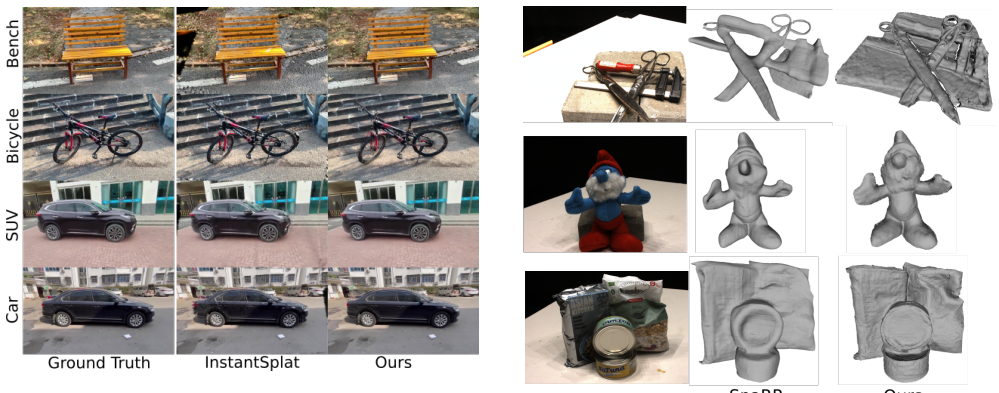
- At very sparse inputs, reconstruction quality no longer collapses: on DTU 3-view the relative error drops from 5.73 (InstantSplat2DGS) to 4.82, and normal consistency rises from 0.832 to 0.857, which translates into visibly sharper meshes in the paper's qualitative comparisons.
- Novel view synthesis from three unposed images improves substantially over prior pose-free splatting: SSIM on MVImgNet 3-view goes from 0.5628 to 0.8313, making quick 3D preview from a few phone photos a realistic use case.
- The pipeline is modular in its geometric prior: initializing with a different feed-forward model (VGGT) instead of MASt3R still yields successful reconstructions (supplementary Fig. 13), so future improvements in 3D foundation models should transfer directly.
Reading between the lines
- Because focal lengths are averaged across views (Sec. 3.2), the method as published assumes a single camera; a natural test is whether per-view focal refinement with a weak consistency prior rescues mixed-camera or zoom-varying inputs, and I would expect that gap to be the method's sharpest boundary.
- The variance loss is representation-agnostic: it only needs ray-composited colors and their squares, so it should transfer to other splatting or volumetric renderers (3DGS, Mip-Splatting, even NeRF-style volume renderers) as a generic low-cost robustness regularizer for sparse views; the same moment idea could be applied to depths or normals along rays.
- If the reported margins hold on casually captured handheld photos rather than benchmark scans, the near-term consequence is that rapid 3D capture for AR/VR preview, e-commerce, or documentation becomes a minutes-scale single-GPU operation, which is the regime the method's design targets.
- The risk profile is concentrated in the initialization: since MASt3R is the sole geometric prior, an active next-view selection strategy that adds views where the global alignment is most uncertain could extend the method to the failure cases the authors list (textureless, reflective, thin structures).
Signed reviews
Editorial analysis
A structured set of objections, weighed in public.
Referee Report
Summary. The paper presents Sparfels, a test-time optimization method for 3D reconstruction and novel view synthesis from sparse, unposed multi-view images. The pipeline uses MASt3R to obtain initial pointmaps, per-view camera estimates, and dense correspondences, then instantiates a bundle-adjusting 2D Gaussian Splatting model. The contributions are a correspondence-based reprojection loss for camera refinement, a splatted color variance reduction loss derived from a robust-optimization bound, and an efficient CUDA implementation of the variance term. The method is evaluated on DTU, BlendedMVS, MVImgNet, MipNeRF360, and Tanks and Temples, with claims of state-of-the-art reconstruction, novel view synthesis, and pose estimation within three minutes on a consumer GPU.
Significance. If the reported results hold, the paper would be a practical contribution: it combines a single 3D foundation model with a fast 2DGS optimization, avoids additional trained priors, and introduces a simple, efficiently computable variance loss. The derivation of the variance loss from a robust-optimization bound and the identity in Eqs. (10)-(11) is a genuine technical strength, as is the modified CUDA kernel for rendering color squares. The experimental scope is broad, with multiple datasets, baseline comparisons, and ablations supporting each component. However, the central reconstruction claim is not yet established because the DTU evaluation replaces the standard Chamfer-distance benchmark with screen-space Rel/NC metrics, and the speed claim is only partially supported. The paper is honest about failure cases in Section 6 and Figure 14, which is commendable, but these limitations also show the method's dependence on MASt3R initialization.
major comments (4)
- [Section 4.1, Tables 1-2] The DTU reconstruction evaluation replaces the standard Chamfer distance used by the DTU benchmark with screen-space Absolute Relative Error and Normal Consistency computed from rendered depth and normal maps. This is a load-bearing change: the paper's headline claim of state-of-the-art sparse reconstruction rests on Tables 1 and 2, yet the compared baselines (e.g., SparseNeuS, UfoRecon, Spurfies) were originally evaluated with Chamfer distance. Because the metrics appear to be evaluated from the training viewpoints, they are closely aligned with the photometric and depth-regularization objectives already optimized in Eq. (6), so a reconstruction that fits the three training views while being inaccurate elsewhere can score well. The authors should report standard DTU Chamfer distance using a best-effort rigid alignment (e.g., Horn/Umeyama on COLMAP cameras or ICP), along with per-scene variance across the two view sets, or explicitly restrict all reconstruction claims to these screen-space metrics.
- [Section 3.2, Eq. (4) and following paragraph] The method averages the MASt3R-estimated focal lengths across all training views, assuming a single-camera setup. This assumption is not stated in Section 6 as a limitation, and it is load-bearing for the paper's generality claim about 'sparse unposed imagery.' For mixed-camera inputs, the averaged intrinsics will silently degrade the geometry. The authors should either provide experiments with mixed intrinsic matrices or prominently restrict the method's scope to single-camera captures.
- [Abstract and Section 5] The claim of reconstruction 'within 3 minutes on a consumer grade GPU' is not supported by the reported timing. The 146s figure is training time only, measured on an NVIDIA A6000 (a workstation GPU, not a consumer GPU), and it excludes MASt3R inference, global alignment, TSDF mesh extraction, and the additional test-time camera optimization used for NVS. The authors should report end-to-end wall-clock time on a consumer GPU, including all preprocessing and postprocessing steps.
- [Section 4.3, Tables 5-6] The paper claims state-of-the-art camera pose estimation (Section 4.2, Table 3), but Table 5 shows that on MVImgNet 3-view the method's ATE is 0.0273 versus 0.0184 for InstantSplat-XL, i.e., notably worse pose estimation while NVS metrics are better. The paper does not discuss this discrepancy, nor does it disentangle the NVS gains from the additional test-time camera optimization step. This is relevant to the overall claim of superior performance in the sparse unposed setting, and it should be addressed explicitly.
minor comments (5)
- [Section 3.3, Eqs. (8)-(11)] The robust-optimization bound in Eq. (9) justifies minimizing L1 plus a variance term, not variance alone; the paper should state more explicitly that the variance loss is a heuristic motivated by this bound, and that the L1 photometric term remains essential.
- [Tables 1-2] The quantitative tables report mean values over 15 scenes and two view sets but no standard deviations or per-view-set breakdowns; given the small margins (e.g., 4.82 vs. 5.73 in Table 1), error bars or significance tests are needed to support the comparison.
- [Figure 6] The ablation over the number of views reports mean metrics but no variance; the claim that 'benefits are maintained, if not increased' is not quantitatively supported beyond the plotted mean curves.
- [Section 4.1, Implementation Details] The paper states that code will be made available at a URL, but no code repository or checkable artifacts are currently provided; including a reproducible implementation would strengthen the empirical claims.
- [Section 5] The comparison of training time with InstantSplat-XL is informative, but the 146s figure should be accompanied by the MASt3R preprocessing time and the total iteration count used for the reported reconstruction results, since different datasets use different iteration budgets (1k vs. 2k-4k).
Circularity Check
No significant circularity: the core losses and refinement pipeline are independently grounded; the DTU metric and NVS test-pose choices are evaluation-protocol concerns, not circular reductions.
full rationale
The paper's derivation chain is not circular. The scene is initialized from MASt3R pointmaps and camera estimates (Eq. 4), which are external foundation-model outputs, and then refined with a photometric loss (Eq. 6), a correspondence loss (Eq. 5), and a variance loss (Eqs. 8-11). The variance loss is derived from the mathematical identity C = E[c(t)] and an external robust-optimization upper bound from Duchi et al. [20]; it is not fitted to the target metric. The correspondence loss uses MASt3R correspondences, again external. The reported DTU reconstruction evaluation uses screen-space Rel/NC rather than Chamfer, and the NVS evaluation optimizes test cameras with an L1 photometric loss against the test views (Sec. 4.1); these are legitimate evaluation-protocol and generalization concerns, but they are not cases where a prediction equals an input by construction or where a fitted parameter is renamed as a prediction. The authors' self-citations, including SparseCraft and GeoTransfer, appear as baselines and related work, not as load-bearing justifications of the method. No uniqueness theorem or prior-work ansatz is invoked to force the architecture. The paper's own stated limitations (Sec. 6, Fig. 14) affect robustness claims but do not create circularity. Therefore no circular step meets the evidentiary bar set by the review instructions, and the appropriate finding is no significant circularity.
Assumptions & free parameters
free parameters (7)
- lambda_corr =
5e-5
- lambda_var schedule =
cosine from 1.0 to 0.0 over training
- optimization iterations =
1k (DTU), 2k-4k (other datasets)
- MASt3R resolution =
512 pixels
- opacity initialization =
0.8
- scale initialization =
proportional to local pointmap density
- PCA neighborhood k =
unspecified
assumptions (5)
- domain assumption MASt3R's globally aligned pointmaps and camera parameters (Eq. 4) are sufficiently accurate to initialize the 2DGS optimization.
- standard math The volume rendering integral can be interpreted as an expectation over ray termination probability p(t)=sigma(t)T(t) (Eq. 7), making color variance a well-defined quantity.
- standard math Duchi et al.'s robust optimization bound (theorem 2 in [20]) applies to the rendering loss, justifying the variance penalty as a surrogate for worst-case perturbation.
- domain assumption The input images come from a single camera with constant intrinsics.
- domain assumption Scenes are static with consistent lighting.
Cite this review
Pith. "Pith review of Sparfels: Fast Reconstruction from Sparse Unposed Imagery." pith.science (2026). https://pith.science/paper/PYDQH5DC
@misc{pith2026250502178,
  author       = {Pith},
  title        = {Pith review of: Sparfels: Fast Reconstruction from Sparse Unposed Imagery},
  year         = {2026},
  howpublished = {\url{https://pith.science/paper/PYDQH5DC}},
  note         = {Machine review of arXiv:2505.02178}
}
read the original abstract
We present a method for Sparse view reconstruction with surface element splatting that runs within 3 minutes on a consumer grade GPU. While few methods address sparse radiance field learning from noisy or unposed sparse cameras, shape recovery remains relatively underexplored in this setting. Several radiance and shape learning test-time optimization methods address the sparse posed setting by learning data priors or using combinations of external monocular geometry priors. Differently, we propose an efficient and simple pipeline harnessing a single recent 3D foundation model. We leverage its various task heads, notably point maps and camera initializations to instantiate a bundle adjusting 2D Gaussian Splatting (2DGS) model, and image correspondences to guide camera optimization midst 2DGS training. Key to our contribution is a novel formulation of splatted color variance along rays, which can be computed efficiently. Reducing this moment in training leads to more accurate shape reconstructions. We demonstrate state-of-the-art performances in the sparse uncalibrated setting in reconstruction and novel view benchmarks based on established multi-view datasets.
Figures


Figures from the paper (8 more)




Reference graph
Works this paper leans on
-
[1]
Large-scale data for multiple-view stereopsis.International Journal of Com- puter Vision, 120(2):153–168, 2016
Henrik Aanæs, Rasmus Ramsbøl Jensen, George V ogiatzis, Engin Tola, and Anders Bjorholm Dahl. Large-scale data for multiple-view stereopsis.International Journal of Com- puter Vision, 120(2):153–168, 2016. 2, 5, 6, 7, 14
2016
-
[2]
Neural point-based graph- ics
Kara-Ali Aliev, Artem Sevastopolsky, Maria Kolos, Dmitry Ulyanov, and Victor Lempitsky. Neural point-based graph- ics. InComputer Vision–ECCV 2020: 16th European Con- ference, Glasgow, UK, August 23–28, 2020, Proceedings, Part XXII 16, pages 696–712. Springer, 2020. 2
2020
-
[3]
Novel view synthesis in tensor space
Shai Avidan and Amnon Shashua. Novel view synthesis in tensor space. InProceedings of IEEE Computer Society Conference on Computer Vision and Pattern Recognition, pages 1034–1040. IEEE, 1997. 2
1997
-
[4]
Barron, Ben Mildenhall, Dor Verbin, Pratul P
Jonathan T. Barron, Ben Mildenhall, Dor Verbin, Pratul P. Srinivasan, and Peter Hedman. Mip-NeRF 360: Un- bounded Anti-Aliased Neural Radiance Fields.2022 IEEE/CVF Conference on Computer Vision and Pattern Recognition (CVPR), pages 5460–5469, 2022. 2
2022
-
[5]
Mip-nerf 360: Unbounded anti-aliased neural radiance fields
Jonathan T Barron, Ben Mildenhall, Dor Verbin, Pratul P Srinivasan, and Peter Hedman. Mip-nerf 360: Unbounded anti-aliased neural radiance fields. InProceedings of the IEEE/CVF conference on computer vision and pattern recognition, pages 5470–5479, 2022. 2, 5, 7, 8, 14
2022
-
[6]
Zip-nerf: Anti-aliased grid-based neural radiance fields
Jonathan T Barron, Ben Mildenhall, Dor Verbin, Pratul P Srinivasan, and Peter Hedman. Zip-nerf: Anti-aliased grid-based neural radiance fields. InProceedings of the IEEE/CVF International Conference on Computer Vision, pages 19697–19705, 2023. 2
2023
-
[7]
Jia-Wang Bian, Wenjing Bian, Victor Adrian Prisacariu, and Philip Torr. Porf: Pose residual field for accurate neural surface reconstruction.arXiv preprint arXiv:2310.07449,
-
[8]
Nope-nerf: Optimising neural radiance field with no pose prior
Wenjing Bian, Zirui Wang, Kejie Li, Jia-Wang Bian, and Victor Adrian Prisacariu. Nope-nerf: Optimising neural radiance field with no pose prior. InProceedings of the IEEE/CVF Conference on Computer Vision and Pattern Recognition, pages 4160–4169, 2023. 3, 5, 14
2023
Show all 109 references
-
[9]
Poco: Point con- volution for surface reconstruction
Alexandre Boulch and Renaud Marlet. Poco: Point con- volution for surface reconstruction. InProceedings of the IEEE/CVF Conference on Computer Vision and Pattern Recognition, pages 6302–6314, 2022. 3
2022
-
[10]
pixelsplat: 3d gaussian splats from im- age pairs for scalable generalizable 3d reconstruction
David Charatan, Sizhe Lester Li, Andrea Tagliasacchi, and Vincent Sitzmann. pixelsplat: 3d gaussian splats from im- age pairs for scalable generalizable 3d reconstruction. In Proceedings of the IEEE/CVF Conference on Computer Vi- sion and Pattern Recognition, pages 19457–19467...
2024
-
[11]
Entropy- sgd: Biasing gradient descent into wide valleys.Journal of Statistical Mechanics: Theory and Experiment, 2019(12): 124018, 2019
Pratik Chaudhari, Anna Choromanska, Stefano Soatto, Yann LeCun, Carlo Baldassi, Christian Borgs, Jennifer Chayes, Levent Sagun, and Riccardo Zecchina. Entropy- sgd: Biasing gradient descent into wide valleys.Journal of Statistical Mechanics: Theory and Experiment, 2019(12): 12...
2019
-
[12]
Unsuper- vised inference of signed distance functions from single sparse point clouds without learning priors
Chao Chen, Zhizhong Han, and Yu-Shen Liu. Unsuper- vised inference of signed distance functions from single sparse point clouds without learning priors. InProceed- ings of the IEEE/CVF Conference on Computer Vision and Pattern Recognition (CVPR), 2023. 2
2023
-
[13]
Mvsplat: Efficient 3d gaussian splatting from sparse multi-view images
Yuedong Chen, Haofei Xu, Chuanxia Zheng, Bohan Zhuang, Marc Pollefeys, Andreas Geiger, Tat-Jen Cham, and Jianfei Cai. Mvsplat: Efficient 3d gaussian splatting from sparse multi-view images. InEuropean Conference on Computer Vision, pages 370–386. Springer, 2025. 2, 3
2025
-
[14]
Neurbf: A neural fields rep- resentation with adaptive radial basis functions
Zhang Chen, Zhong Li, Liangchen Song, Lele Chen, Jingyi Yu, Junsong Yuan, and Yi Xu. Neurbf: A neural fields rep- resentation with adaptive radial basis functions. InProceed- ings of the IEEE/CVF International Conference on Com- puter Vision, pages 4182–4194, 2023. 2
2023
-
[15]
Lu-nerf: Scene and pose estimation by synchronizing local unposed nerfs
Zezhou Cheng, Carlos Esteves, Varun Jampani, Abhishek Kar, Subhransu Maji, and Ameesh Makadia. Lu-nerf: Scene and pose estimation by synchronizing local unposed nerfs. InProceedings of the IEEE/CVF International Con- ference on Computer Vision, pages 18312–18321, 2023. 3
2023
-
[16]
Gaussian activated neural radiance fields for high fidelity reconstruction and pose estimation
Shin-Fang Chng, Sameera Ramasinghe, Jamie Sherrah, and Simon Lucey. Gaussian activated neural radiance fields for high fidelity reconstruction and pose estimation. InEu- ropean Conference on Computer Vision, pages 264–280. Springer, 2022. 3
2022
-
[17]
Improving neu- ral implicit surfaces geometry with patch warping
Franc ¸ois Darmon, B ´en´edicte Bascle, Jean-Cl ´ement De- vaux, Pascal Monasse, and Mathieu Aubry. Improving neu- ral implicit surfaces geometry with patch warping. InPro- ceedings of the IEEE/CVF Conference on Computer Vision and Pattern Recognition, pages 6260–6269, 2022. 2
2022
-
[18]
Depth-supervised nerf: Fewer views and faster training for free.arXiv preprint arXiv:2107.02791, 2021
Kangle Deng, Andrew Liu, Jun-Yan Zhu, and Deva Ra- manan. Depth-supervised nerf: Fewer views and faster training for free.arXiv preprint arXiv:2107.02791, 2021. 2
2021 arXiv
-
[19]
Depth-supervised nerf: Fewer views and faster training for free
Kangle Deng, Andrew Liu, Jun-Yan Zhu, and Deva Ra- manan. Depth-supervised nerf: Fewer views and faster training for free. InProceedings of the IEEE/CVF Confer- ence on Computer Vision and Pattern Recognition, pages 12882–12891, 2022. 1
2022
-
[20]
Statis- tics of robust optimization: A generalized empirical likeli- hood approach, 2018
John Duchi, Peter Glynn, and Hongseok Namkoong. Statis- tics of robust optimization: A generalized empirical likeli- hood approach, 2018. 5
2018
-
[21]
A point set generation network for 3d object reconstruction from a single image
Haoqiang Fan, Hao Su, and Leonidas J Guibas. A point set generation network for 3d object reconstruction from a single image. InCVPR, 2017. 2
2017
-
[23]
Instantsplat: Sparse- view sfm-free gaussian splatting in seconds.arXiv preprint arXiv:2403.20309, 2024
Zhiwen Fan, Kairun Wen, Wenyan Cong, Kevin Wang, Jian Zhang, Xinghao Ding, Danfei Xu, Boris Ivanovic, Marco Pavone, Georgios Pavlakos, et al. Instantsplat: Sparse- view sfm-free gaussian splatting in seconds.arXiv preprint arXiv:2403.20309, 2024. 2, 3, 5, 6, 7, 8, 14
2024 arXiv
-
[24]
Large spatial model: 9 End-to-end unposed images to semantic 3d.arXiv preprint arXiv:2410.18956, 2024
Zhiwen Fan, Jian Zhang, Wenyan Cong, Peihao Wang, Renjie Li, Kairun Wen, Shijie Zhou, Achuta Kadambi, Zhangyang Wang, Danfei Xu, et al. Large spatial model: 9 End-to-end unposed images to semantic 3d.arXiv preprint arXiv:2410.18956, 2024. 2
-
[25]
Flashgs: Efficient 3d gaussian splatting for large-scale and high-resolution rendering.arXiv preprint arXiv:2408.07967, 2024
Guofeng Feng, Siyan Chen, Rong Fu, Zimu Liao, Yi Wang, Tao Liu, Zhilin Pei, Hengjie Li, Xingcheng Zhang, and Bo Dai. Flashgs: Efficient 3d gaussian splatting for large-scale and high-resolution rendering.arXiv preprint arXiv:2408.07967, 2024. 2
2024 arXiv
-
[26]
Sharpness-aware minimization for efficiently improving generalization.arXiv preprint arXiv:2010.01412, 2020
Pierre Foret, Ariel Kleiner, Hossein Mobahi, and Behnam Neyshabur. Sharpness-aware minimization for efficiently improving generalization.arXiv preprint arXiv:2010.01412, 2020. 16
2010 arXiv
-
[27]
Colmap-free 3d gaussian splat- ting.arXiv preprint arXiv:2312.07504, 2023
Yang Fu, Sifei Liu, Amey Kulkarni, Jan Kautz, Alexei A Efros, and Xiaolong Wang. Colmap-free 3d gaussian splat- ting.arXiv preprint arXiv:2312.07504, 2023. 3, 5, 14
2023 arXiv
-
[28]
Cascade cost volume for high- resolution multi-view stereo and stereo matching
Xiaodong Gu, Zhiwen Fan, Siyu Zhu, Zuozhuo Dai, Feitong Tan, and Ping Tan. Cascade cost volume for high- resolution multi-view stereo and stereo matching. InPro- ceedings of the IEEE/CVF conference on computer vision and pattern recognition, pages 2495–2504, 2020. 6, 7
2020
-
[29]
Flat minima
Sepp Hochreiter and J ¨urgen Schmidhuber. Flat minima. Neural computation, 9(1):1–42, 1997. 15, 16
1997
-
[30]
Pf3plat: Pose-free feed-forward 3d gaussian splatting
Sunghwan Hong, Jaewoo Jung, Heeseong Shin, Jisang Han, Jiaolong Yang, Chong Luo, and Seungryong Kim. Pf3plat: Pose-free feed-forward 3d gaussian splatting. arXiv preprint arXiv:2410.22128, 2024. 2
2024 arXiv
-
[31]
Shape from shading: A method for ob- taining the shape of a smooth opaque object from one view
Berthold KP Horn. Shape from shading: A method for ob- taining the shape of a smooth opaque object from one view
-
[32]
2d gaussian splatting for geometrically ac- curate radiance fields
Binbin Huang, Zehao Yu, Anpei Chen, Andreas Geiger, and Shenghua Gao. 2d gaussian splatting for geometrically ac- curate radiance fields. InACM SIGGRAPH 2024 Confer- ence Papers, pages 1–11, 2024. 1, 2, 3, 4, 5
2024
-
[33]
Neural kernel surface re- construction
Jiahui Huang, Zan Gojcic, Matan Atzmon, Or Litany, Sanja Fidler, and Francis Williams. Neural kernel surface re- construction. InProceedings of the IEEE/CVF Conference on Computer Vision and Pattern Recognition, pages 4369– 4379, 2023. 3
2023
-
[34]
Robust estimation of a location parameter
Peter J Huber. Robust estimation of a location parameter. In Breakthroughs in statistics: Methodology and distribution, pages 492–518. Springer, 1992. 4
1992
-
[35]
Putting nerf on a diet: Semantically consistent few-shot view synthesis
Ajay Jain, Matthew Tancik, and Pieter Abbeel. Putting nerf on a diet: Semantically consistent few-shot view synthesis. InProceedings of the IEEE/CVF International Conference on Computer Vision, pages 5885–5894, 2021. 2
2021
-
[36]
Neural mesh-based graphics
Shubhendu Jena, Franck Multon, and Adnane Boukhayma. Neural mesh-based graphics. InEuropean Conference on Computer Vision, pages 739–757. Springer, 2022. 2
2022
-
[37]
Geotransfer: Generalizable few-shot multi-view re- construction via transfer learning.arXiv preprint arXiv:2408.14724, 2024
Shubhendu Jena, Franck Multon, and Adnane Boukhayma. Geotransfer: Generalizable few-shot multi-view re- construction via transfer learning.arXiv preprint arXiv:2408.14724, 2024. 3
2024 arXiv
-
[38]
Sparsplat: Fast multi-view reconstruction with generalizable 2d gaussian splatting.arXiv, 2025
Shubhendu Jena, Shishir Reddy Vutukur, and Adnane Boukhayma. Sparsplat: Fast multi-view reconstruction with generalizable 2d gaussian splatting.arXiv, 2025. 3
2025
-
[39]
Self-calibrating neural radiance fields
Yoonwoo Jeong, Seokjun Ahn, Christopher Choy, Anima Anandkumar, Minsu Cho, and Jaesik Park. Self-calibrating neural radiance fields. InProceedings of the IEEE/CVF International Conference on Computer Vision, pages 5846– 5854, 2021. 3
2021
-
[40]
Sdfdiff: Differentiable rendering of signed dis- tance fields for 3d shape optimization
Yue Jiang, Dantong Ji, Zhizhong Han, and Matthias Zwicker. Sdfdiff: Differentiable rendering of signed dis- tance fields for 3d shape optimization. InProceedings of the IEEE/CVF conference on computer vision and pattern recognition, pages 1251–1261, 2020. 2
2020
-
[41]
Neural 3d mesh renderer
Hiroharu Kato, Yoshitaka Ushiku, and Tatsuya Harada. Neural 3d mesh renderer. InCVPR, 2018. 2
2018
-
[42]
Neural lumigraph ren- dering
Petr Kellnhofer, Lars C Jebe, Andrew Jones, Ryan Spicer, Kari Pulli, and Gordon Wetzstein. Neural lumigraph ren- dering. InProceedings of the IEEE/CVF Conference on Computer Vision and Pattern Recognition, pages 4287– 4297, 2021. 2
2021
-
[43]
3d gaussian splatting for real-time radiance field rendering.ACM Trans
Bernhard Kerbl, Georgios Kopanas, Thomas Leimk ¨uhler, and George Drettakis. 3d gaussian splatting for real-time radiance field rendering.ACM Trans. Graph., 42(4):139–1,
-
[44]
Adam: A method for stochastic optimization.arXiv preprint arXiv:1412.6980,
Diederik P Kingma and Jimmy Ba. Adam: A method for stochastic optimization.arXiv preprint arXiv:1412.6980,
-
[45]
Tanks and temples: Benchmarking large-scale scene reconstruction.ACM Transactions on Graphics (ToG), 36(4):1–13, 2017
Arno Knapitsch, Jaesik Park, Qian-Yi Zhou, and Vladlen Koltun. Tanks and temples: Benchmarking large-scale scene reconstruction.ACM Transactions on Graphics (ToG), 36(4):1–13, 2017. 2, 5, 7, 14
2017
-
[46]
The visual hull concept for silhouette- based image understanding.IEEE Transactions on pattern analysis and machine intelligence, 16(2):150–162, 1994
Aldo Laurentini. The visual hull concept for silhouette- based image understanding.IEEE Transactions on pattern analysis and machine intelligence, 16(2):150–162, 1994. 1
1994
-
[47]
Grounding image matching in 3d with mast3r.arXiv preprint arXiv:2406.09756, 2024
Vincent Leroy, Yohann Cabon, and J ´erˆome Revaud. Grounding image matching in 3d with mast3r.arXiv preprint arXiv:2406.09756, 2024. 1, 2, 3, 6, 7, 8, 15, 16
2024 arXiv
-
[48]
Learn- ing generalizable light field networks from few images
Qian Li, Franck Multon, and Adnane Boukhayma. Learn- ing generalizable light field networks from few images. InICASSP 2023-2023 IEEE International Conference on Acoustics, Speech and Signal Processing (ICASSP), pages 1–5. IEEE, 2023. 3
2023
-
[49]
Regu- larizing neural radiance fields from sparse rgb-d inputs
Qian Li, Franck Multon, and Adnane Boukhayma. Regu- larizing neural radiance fields from sparse rgb-d inputs. In 2023 IEEE International Conference on Image Processing (ICIP), pages 2320–2324. IEEE, 2023. 2
2023
-
[50]
Retr: Modeling rendering via transformer for generalizable neural surface reconstruction.Advances in Neural Information Processing Systems, 36, 2024
Yixun Liang, Hao He, and Yingcong Chen. Retr: Modeling rendering via transformer for generalizable neural surface reconstruction.Advances in Neural Information Processing Systems, 36, 2024. 3
2024
-
[51]
Barf: Bundle-adjusting neural radiance fields
Chen-Hsuan Lin, Wei-Chiu Ma, Antonio Torralba, and Si- mon Lucey. Barf: Bundle-adjusting neural radiance fields. InProceedings of the IEEE/CVF international conference on computer vision, pages 5741–5751, 2021. 3
2021
-
[52]
Fast generalizable gaussian splatting reconstruction from multi-view stereo.arXiv preprint arXiv:2405.12218,
Tianqi Liu, Guangcong Wang, Shoukang Hu, Liao Shen, Xinyi Ye, Yuhang Zang, Zhiguo Cao, Wei Li, and Ziwei Liu. Fast generalizable gaussian splatting reconstruction from multi-view stereo.arXiv preprint arXiv:2405.12218,
-
[53]
Sparseneus: Fast generalizable neural sur- face reconstruction from sparse views
Xiaoxiao Long, Cheng Lin, Peng Wang, Taku Komura, and Wenping Wang. Sparseneus: Fast generalizable neural sur- face reconstruction from sparse views. InEuropean Confer- ence on Computer Vision, pages 210–227. Springer, 2022. 1, 3, 5, 6, 7 10
2022
-
[54]
Scaffold-gs: Structured 3d gaussians for view-adaptive rendering
Tao Lu, Mulin Yu, Linning Xu, Yuanbo Xiangli, Limin Wang, Dahua Lin, and Bo Dai. Scaffold-gs: Structured 3d gaussians for view-adaptive rendering. InProceedings of the IEEE/CVF Conference on Computer Vision and Pattern Recognition, pages 20654–20664, 2024. 2
2024
-
[55]
Surface reconstruction from point clouds by learning predictive context priors
Baorui Ma, Yu-Shen Liu, Matthias Zwicker, and Zhizhong Han. Surface reconstruction from point clouds by learning predictive context priors. InProceedings of the IEEE/CVF conference on computer vision and pattern recognition, pages 6326–6337, 2022. 3
2022
-
[56]
A practical bayesian framework for backpropagation networks.Neural computation, 4(3):448– 472, 1992
David JC MacKay. A practical bayesian framework for backpropagation networks.Neural computation, 4(3):448– 472, 1992. 16
1992
-
[57]
Pro- gressively optimized local radiance fields for robust view synthesis
Andreas Meuleman, Yu-Lun Liu, Chen Gao, Jia-Bin Huang, Changil Kim, Min H Kim, and Johannes Kopf. Pro- gressively optimized local radiance fields for robust view synthesis. InProceedings of the IEEE/CVF Conference on Computer Vision and Pattern Recognition, pages 16539– 16548, 2023. 3
2023
-
[58]
Local light field fusion: Practical view syn- thesis with prescriptive sampling guidelines.ACM Trans- actions on Graphics (TOG), 38(4):1–14, 2019
Ben Mildenhall, Pratul P Srinivasan, Rodrigo Ortiz-Cayon, Nima Khademi Kalantari, Ravi Ramamoorthi, Ren Ng, and Abhishek Kar. Local light field fusion: Practical view syn- thesis with prescriptive sampling guidelines.ACM Trans- actions on Graphics (TOG), 38(4):1–14, 2019. 2
2019
-
[59]
Nerf: Representing scenes as neural radiance fields for view syn- thesis.Communications of the ACM, 65(1):99–106, 2021
Ben Mildenhall, Pratul P Srinivasan, Matthew Tancik, Jonathan T Barron, Ravi Ramamoorthi, and Ren Ng. Nerf: Representing scenes as neural radiance fields for view syn- thesis.Communications of the ACM, 65(1):99–106, 2021. 1, 2
2021
-
[60]
Uforecon: Generalizable sparse-view surface reconstruction from arbitrary and unfavorable sets
Youngju Na, Woo Jae Kim, Kyu Beom Han, Suhyeon Ha, and Sung-Eui Yoon. Uforecon: Generalizable sparse-view surface reconstruction from arbitrary and unfavorable sets. InProceedings of the IEEE/CVF Conference on Computer Vision and Pattern Recognition, pages 5094–5104, 2024. 3, 6, 7
2024
-
[61]
Differentiable volumetric rendering: Learning implicit 3d representations without 3d supervi- sion
Michael Niemeyer, Lars Mescheder, Michael Oechsle, and Andreas Geiger. Differentiable volumetric rendering: Learning implicit 3d representations without 3d supervi- sion. InProceedings of the IEEE/CVF Conference on Com- puter Vision and Pattern Recognition, pages 3504–3515,
-
[62]
Regnerf: Regularizing neural radiance fields for view syn- thesis from sparse inputs.arXiv preprint arXiv:2112.00724,
Michael Niemeyer, Jonathan T Barron, Ben Mildenhall, Mehdi SM Sajjadi, Andreas Geiger, and Noha Radwan. Regnerf: Regularizing neural radiance fields for view syn- thesis from sparse inputs.arXiv preprint arXiv:2112.00724,
-
[63]
Unisurf: Unifying neural implicit surfaces and radiance fields for multi-view reconstruction
Michael Oechsle, Songyou Peng, and Andreas Geiger. Unisurf: Unifying neural implicit surfaces and radiance fields for multi-view reconstruction. InProceedings of the IEEE/CVF International Conference on Computer Vision, pages 5589–5599, 2021. 2
2021
-
[64]
Few’zero level set’-shot learning of shape signed distance functions in fea- ture space
Amine Ouasfi and Adnane Boukhayma. Few’zero level set’-shot learning of shape signed distance functions in fea- ture space. InECCV, 2022. 3
2022
-
[65]
Mixing-denoising generalizable occupancy networks.3DV, 2024
Amine Ouasfi and Adnane Boukhayma. Mixing-denoising generalizable occupancy networks.3DV, 2024. 3
2024
-
[66]
Few-shot unsu- pervised implicit neural shape representation learning with spatial adversaries.arXiv preprint arXiv:2408.15114, 2024
Amine Ouasfi and Adnane Boukhayma. Few-shot unsu- pervised implicit neural shape representation learning with spatial adversaries.arXiv preprint arXiv:2408.15114, 2024. 2
2024 arXiv
-
[67]
Robustifying gen- eralizable implicit shape networks with a tunable non- parametric model.Advances in Neural Information Pro- cessing Systems, 36, 2024
Amine Ouasfi and Adnane Boukhayma. Robustifying gen- eralizable implicit shape networks with a tunable non- parametric model.Advances in Neural Information Pro- cessing Systems, 36, 2024. 3
2024
-
[68]
Unsupervised oc- cupancy learning from sparse point cloud
Amine Ouasfi and Adnane Boukhayma. Unsupervised oc- cupancy learning from sparse point cloud. InProceedings of the IEEE/CVF Conference on Computer Vision and Pat- tern Recognition, pages 21729–21739, 2024. 2
2024
-
[69]
Toward robust neural reconstruction from sparse point sets.arXiv preprint arXiv:2412.16361,
Amine Ouasfi, Shubhendu Jena, Eric Marchand, and Ad- nane Boukhayma. Toward robust neural reconstruction from sparse point sets.arXiv preprint arXiv:2412.16361,
-
[70]
Soft 3D Reconstruction for View Synthesis.ACM Transactions on Graphics (TOG), 36(6): 1–11, 2017
Eric Penner and Li Zhang. Soft 3D Reconstruction for View Synthesis.ACM Transactions on Graphics (TOG), 36(6): 1–11, 2017. 2
2017
-
[71]
Spurfies: Sparse surface recon- struction using local geometry priors.arXiv preprint arXiv:2408.16544, 2024
Kevin Raj, Christopher Wewer, Raza Yunus, Eddy Ilg, and Jan Eric Lenssen. Spurfies: Sparse surface recon- struction using local geometry priors.arXiv preprint arXiv:2408.16544, 2024. 1, 3, 6, 7
2024 arXiv
-
[72]
V olrecon: V olume rendering of signed ray distance functions for generalizable multi-view reconstruction
Yufan Ren, Tong Zhang, Marc Pollefeys, Sabine S¨usstrunk, and Fangjinhua Wang. V olrecon: V olume rendering of signed ray distance functions for generalizable multi-view reconstruction. InProceedings of the IEEE/CVF Confer- ence on Computer Vision and Pattern Recognition, page...
2023
-
[73]
Structure-from-motion revisited
Johannes L Schonberger and Jan-Michael Frahm. Structure-from-motion revisited. InProceedings of the IEEE conference on computer vision and pattern recognition, pages 4104–4113, 2016. 2, 6
2016
-
[74]
Structure-from-motion revisited
Johannes L Schonberger and Jan-Michael Frahm. Structure-from-motion revisited. InProceedings of the IEEE conference on computer vision and pattern recognition, pages 4104–4113, 2016. 1
2016
-
[75]
Pixelwise view selection for unstructured multi-view stereo
Johannes Lutz Sch ¨onberger, Enliang Zheng, Marc Polle- feys, and Jan-Michael Frahm. Pixelwise view selection for unstructured multi-view stereo. InEuropean Conference on Computer Vision (ECCV), 2016. 1
2016
-
[76]
Photorealistic Scene Reconstruction by V oxel Coloring, 2002
Steven M Seitz and Charles R Dyer. Photorealistic Scene Reconstruction by V oxel Coloring, 2002. US Patent 6,363,170. 2
2002
-
[77]
Lighthouse: Predicting Lighting V olumes for Spatially- Coherent Illumination
Pratul P Srinivasan, Ben Mildenhall, Matthew Tancik, Jonathan T Barron, Richard Tucker, and Noah Snavely. Lighthouse: Predicting Lighting V olumes for Spatially- Coherent Illumination. InProceedings of the IEEE/CVF Conference on Computer Vision and Pattern Recognition, pages 8...
2020
-
[78]
V olume render- ing digest (for nerf), 2022
Andrea Tagliasacchi and Ben Mildenhall. V olume render- ing digest (for nerf), 2022. 4
2022
-
[79]
Sparf: Neural radiance fields from sparse and noisy poses
Prune Truong, Marie-Julie Rakotosaona, Fabian Manhardt, and Federico Tombari. Sparf: Neural radiance fields from sparse and noisy poses. InProceedings of the IEEE/CVF Conference on Computer Vision and Pattern Recognition, pages 4190–4200, 2023. 2, 3, 4, 5, 14
2023
-
[80]
Sparsenerf: Distilling depth ranking for few-shot 11 novel view synthesis.arXiv preprint arXiv:2303.16196,
Guangcong Wang, Zhaoxi Chen, Chen Change Loy, and Zi- wei Liu. Sparsenerf: Distilling depth ranking for few-shot 11 novel view synthesis.arXiv preprint arXiv:2303.16196,
-
[81]
Vggt: Visual geometry grounded transformer
Jianyuan Wang, Minghao Chen, Nikita Karaev, Andrea Vedaldi, Christian Rupprecht, and David Novotny. Vggt: Visual geometry grounded transformer. InProceedings of the Computer Vision and Pattern Recognition Conference, pages 5294–5306, 2025. 15
2025
-
[82]
Pixel2mesh: Generating 3d mesh models from single rgb images
Nanyang Wang, Yinda Zhang, Zhuwen Li, Yanwei Fu, Wei Liu, and Yu-Gang Jiang. Pixel2mesh: Generating 3d mesh models from single rgb images. InECCV, 2018. 2
2018
-
[83]
Neus: Learning neural implicit surfaces by volume rendering for multi-view re- construction.arXiv preprint arXiv:2106.10689, 2021
Peng Wang, Lingjie Liu, Yuan Liu, Christian Theobalt, Taku Komura, and Wenping Wang. Neus: Learning neural implicit surfaces by volume rendering for multi-view re- construction.arXiv preprint arXiv:2106.10689, 2021. 1, 2
2021 arXiv
-
[84]
Dust3r: Geometric 3d vision made easy
Shuzhe Wang, Vincent Leroy, Yohann Cabon, Boris Chidlovskii, and Jerome Revaud. Dust3r: Geometric 3d vision made easy. InProceedings of the IEEE/CVF Confes- rence on Computer Vision and Pattern Recognition, pages 20697–20709, 2024. 1, 2, 3, 5
2024
-
[85]
Hf-neus: Improved surface reconstruction using high- frequency details.Advances in Neural Information Pro- cessing Systems, 35:1966–1978, 2022
Yiqun Wang, Ivan Skorokhodov, and Peter Wonka. Hf-neus: Improved surface reconstruction using high- frequency details.Advances in Neural Information Pro- cessing Systems, 35:1966–1978, 2022. 1
1966
-
[86]
Image quality assessment: from error visibility to structural similarity.IEEE transactions on image pro- cessing, 13(4):600–612, 2004
Zhou Wang, Alan C Bovik, Hamid R Sheikh, and Eero P Simoncelli. Image quality assessment: from error visibility to structural similarity.IEEE transactions on image pro- cessing, 13(4):600–612, 2004. 5
2004
-
[87]
Nerf–: Neural radiance fields without known camera parameters
Zirui Wang, Shangzhe Wu, Weidi Xie, Min Chen, and Vic- tor Adrian Prisacariu. Nerf–: Neural radiance fields without known camera parameters. 2021. 3, 5, 14
2021
-
[88]
Photometric method for determining surface orientation from multiple images.Optical engineer- ing, 19(1):139–144, 1980
Robert J Woodham. Photometric method for determining surface orientation from multiple images.Optical engineer- ing, 19(1):139–144, 1980. 1
1980
-
[89]
Reconfu- sion: 3d reconstruction with diffusion priors.arXiv preprint arXiv:2312.02981, 2023
Rundi Wu, Ben Mildenhall, Philipp Henzler, Keunhong Park, Ruiqi Gao, Daniel Watson, Pratul P Srinivasan, Dor Verbin, Jonathan T Barron, Ben Poole, et al. Reconfu- sion: 3d reconstruction with diffusion priors.arXiv preprint arXiv:2312.02981, 2023. 2
2023 arXiv
-
[90]
V oxurf: V oxel- based efficient and accurate neural surface reconstruction
Tong Wu, Jiaqi Wang, Xingang Pan, Xudong Xu, Chris- tian Theobalt, Ziwei Liu, and Dahua Lin. V oxurf: V oxel- based efficient and accurate neural surface reconstruction. InICLR, 2023. 1
2023
-
[91]
Sparsegs: Real- time 360 sparse view synthesis using gaussian splatting
Haolin Xiong, Sairisheek Muttukuru, Rishi Upadhyay, Pradyumna Chari, and Achuta Kadambi. Sparsegs: Real- time 360 sparse view synthesis using gaussian splatting. arXiv preprint arXiv:2312.00206, 2023. 3
2023 arXiv
-
[92]
Sparp: Fast 3d object reconstruc- tion and pose estimation from sparse views
Chao Xu, Ang Li, Linghao Chen, Yulin Liu, Ruoxi Shi, Hao Su, and Minghua Liu. Sparp: Fast 3d object reconstruc- tion and pose estimation from sparse views. InEuropean Conference on Computer Vision, pages 143–163. Springer,
-
[93]
Sinnerf: Training neural radiance fields on complex scenes from a single im- age
Dejia Xu, Yifan Jiang, Peihao Wang, Zhiwen Fan, Humphrey Shi, and Zhangyang Wang. Sinnerf: Training neural radiance fields on complex scenes from a single im- age. InEuropean Conference on Computer Vision, pages 736–753. Springer, 2022. 2
2022
-
[94]
Depthsplat: Connecting gaussian splatting and depth.arXiv preprint arXiv:2410.13862, 2024
Haofei Xu, Songyou Peng, Fangjinhua Wang, Hermann Blum, Daniel Barath, Andreas Geiger, and Marc Pollefeys. Depthsplat: Connecting gaussian splatting and depth.arXiv preprint arXiv:2410.13862, 2024. 2
2024 arXiv
-
[95]
Point- nerf: Point-based neural radiance fields
Qiangeng Xu, Zexiang Xu, Julien Philip, Sai Bi, Zhixin Shu, Kalyan Sunkavalli, and Ulrich Neumann. Point- nerf: Point-based neural radiance fields. InProceedings of the IEEE/CVF conference on computer vision and pattern recognition, pages 5438–5448, 2022. 2
2022
-
[96]
Freenerf: Im- proving few-shot neural rendering with free frequency reg- ularization
Jiawei Yang, Marco Pavone, and Yue Wang. Freenerf: Im- proving few-shot neural rendering with free frequency reg- ularization. InProceedings of the IEEE/CVF Conference on Computer Vision and Pattern Recognition, pages 8254– 8263, 2023. 2
2023
-
[97]
Blendedmvs: A large-scale dataset for generalized multi-view stereo net- works
Yao Yao, Zixin Luo, Shiwei Li, Jingyang Zhang, Yufan Ren, Lei Zhou, Tian Fang, and Long Quan. Blendedmvs: A large-scale dataset for generalized multi-view stereo net- works. InProceedings of the IEEE/CVF conference on computer vision and pattern recognition, pages 1790–1799,
-
[98]
Multiview neu- ral surface reconstruction by disentangling geometry and appearance.Advances in Neural Information Processing Systems, 33:2492–2502, 2020
Lior Yariv, Yoni Kasten, Dror Moran, Meirav Galun, Matan Atzmon, Basri Ronen, and Yaron Lipman. Multiview neu- ral surface reconstruction by disentangling geometry and appearance.Advances in Neural Information Processing Systems, 33:2492–2502, 2020. 2
2020
-
[99]
V olume rendering of neural implicit surfaces.Advances in Neural Information Processing Systems, 34:4805–4815,
Lior Yariv, Jiatao Gu, Yoni Kasten, and Yaron Lipman. V olume rendering of neural implicit surfaces.Advances in Neural Information Processing Systems, 34:4805–4815,
-
[100]
Sparsecraft: Few-shot neural reconstruction through stere- opsis guided geometric linearization
Mae Younes, Amine Ouasfi, and Adnane Boukhayma. Sparsecraft: Few-shot neural reconstruction through stere- opsis guided geometric linearization. InEuropean Confer- ence on Computer Vision, pages 37–56. Springer, 2024. 2, 6, 7
2024
-
[101]
pixelnerf: Neural radiance fields from one or few images
Alex Yu, Vickie Ye, Matthew Tancik, and Angjoo Kanazawa. pixelnerf: Neural radiance fields from one or few images. InProceedings of the IEEE/CVF Conference on Computer Vision and Pattern Recognition, pages 4578– 4587, 2021. 2
2021
-
[102]
Mvimgnet: A large-scale dataset of multi-view images
Xianggang Yu, Mutian Xu, Yidan Zhang, Haolin Liu, Chongjie Ye, Yushuang Wu, Zizheng Yan, Chenming Zhu, Zhangyang Xiong, Tianyou Liang, et al. Mvimgnet: A large-scale dataset of multi-view images. InProceedings of the IEEE/CVF conference on computer vision and pat- tern recogni...
2023
-
[103]
Monosdf: Exploring monocu- lar geometric cues for neural implicit surface reconstruc- tion.Advances in neural information processing systems, 35:25018–25032, 2022
Zehao Yu, Songyou Peng, Michael Niemeyer, Torsten Sat- tler, and Andreas Geiger. Monosdf: Exploring monocu- lar geometric cues for neural implicit surface reconstruc- tion.Advances in neural information processing systems, 35:25018–25032, 2022. 1
2022
-
[104]
Mip-splatting: Alias-free 3d gaussian splatting
Zehao Yu, Anpei Chen, Binbin Huang, Torsten Sattler, and Andreas Geiger. Mip-splatting: Alias-free 3d gaussian splatting. InProceedings of the IEEE/CVF Conference on Computer Vision and Pattern Recognition, pages 19447– 19456, 2024. 2
2024
-
[105]
Gaussian opacity fields: Efficient and compact surface reconstruction 12 in unbounded scenes.arXiv preprint arXiv:2404.10772,
Zehao Yu, Torsten Sattler, and Andreas Geiger. Gaussian opacity fields: Efficient and compact surface reconstruction 12 in unbounded scenes.arXiv preprint arXiv:2404.10772,
-
[106]
Rade-gs: Ras- terizing depth in gaussian splatting.arXiv preprint arXiv:2406.01467, 2024
Baowen Zhang, Chuan Fang, Rakesh Shrestha, Yixun Liang, Xiaoxiao Long, and Ping Tan. Rade-gs: Ras- terizing depth in gaussian splatting.arXiv preprint arXiv:2406.01467, 2024. 2
2024 arXiv
-
[107]
Nerf++: Analyzing and improving neural radiance fields.arXiv preprint arXiv:2010.07492, 2020
Kai Zhang, Gernot Riegler, Noah Snavely, and Vladlen Koltun. Nerf++: Analyzing and improving neural radiance fields.arXiv preprint arXiv:2010.07492, 2020. 15
2010 arXiv
-
[108]
The unreasonable effectiveness of deep features as a perceptual metric
Richard Zhang, Phillip Isola, Alexei A Efros, Eli Shecht- man, and Oliver Wang. The unreasonable effectiveness of deep features as a perceptual metric. InProceedings of the IEEE conference on computer vision and pattern recogni- tion, pages 586–595, 2018. 5
2018
-
[109]
Open3d: A modern library for 3d data processing.arXiv preprint arXiv:1801.09847, 2018
Qian-Yi Zhou, Jaesik Park, and Vladlen Koltun. Open3d: A modern library for 3d data processing.arXiv preprint arXiv:1801.09847, 2018. 3, 6
2018 arXiv
-
[110]
Fsgs: Real-time few-shot view synthesis using gaus- sian splatting.arXiv preprint arXiv:2312.00451, 2023
Zehao Zhu, Zhiwen Fan, Yifan Jiang, and Zhangyang Wang. Fsgs: Real-time few-shot view synthesis using gaus- sian splatting.arXiv preprint arXiv:2312.00451, 2023. 1, 3, 6, 14 13 Sparfels: Fast Reconstruction from Sparse Unposed Imagery – Supplementary Material – Shubhendu Jena*...
2023 arXiv
Reviewed August 16, 2026 · model on record in the stance chip above.
Discussion (0). Continue with ORCID to comment.