REVIEW 3 major objections 4 minor 32 references
A Mulching Proposal
T0 review · 3 major / 4 minor · reviewed 2026-08-14 · deepseek-v4-flash
Pith's one-line read This paper argues that full compliance with the Fairness, Accountability, and Transparency framework can coexist with an algorithm whose purpose is to kill and process elderly people, making FAT insufficient as an ethical guarantee.
desk verdict A sharp satirical reductio that makes a real point about FAT audits, though its central inference relies on a narrow reading of FAT that the paper itself concedes. read the letter →
The pith
A machine-rendered reading of the paper's core claim, the machinery that carries it, and where it could break.
The reading
What carries the argument
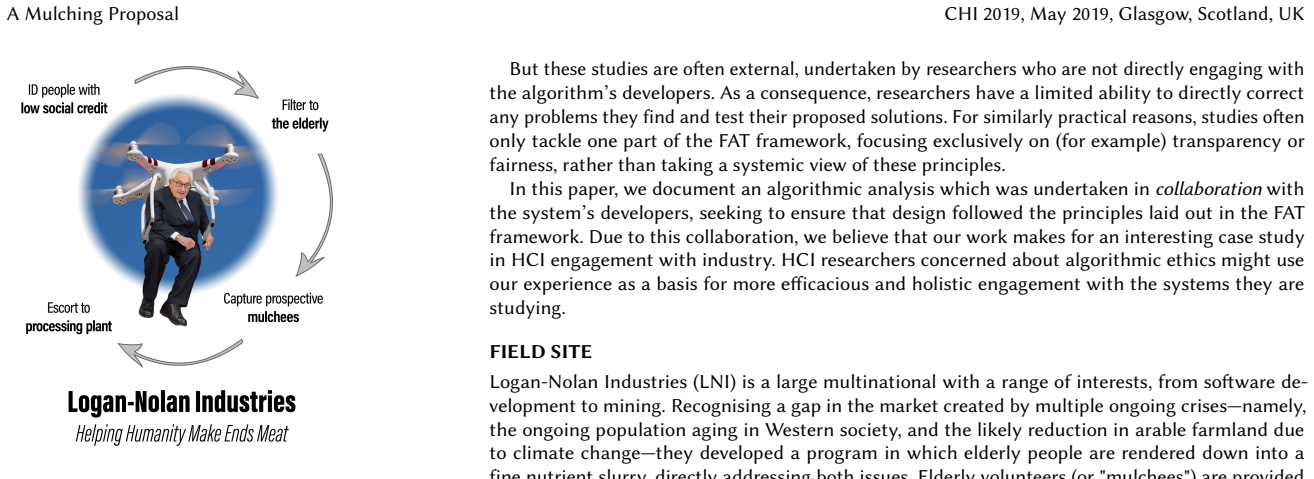
The device that carries the argument is the operationalization of FAT as a set of checklists: fairness equals demographic parity in classification rates, accountability equals user-facing appeal and feedback mechanisms, and transparency equals disclosure of variables, decisions, and model access. Each of these is technically satisfiable for any system whose inputs, outputs, or interfaces can be adjusted, no matter what the system is for. The satirical algorithm itself—a pipeline from social-credit scoring and age classification to drone collection and rendering—serves as the test object that exposes the gap between checklist compliance and ethical permissibility.
What would settle it
One would falsify the paper's central claim by showing that FAT, properly interpreted, would not accept the mulching algorithm even after the audit—for example, if a recognized fairness or accountability criterion required an assessment of whether the decision itself (to render a person into food) is legitimate, or gave affected people the power to halt the system rather than merely appeal a classification. If the framework's own standards reject the system at the outset, the satire would demonstrate only that a narrow checklist interpretation of FAT is insufficient.
Extended reading notes
Core claim
On the paper's own terms, the discovery is that every requirement a standard algorithmic-ethics evaluation would ask for can be met while the system under evaluation remains an apparatus for mass murder. Fairness is achieved by rebalancing training data to eliminate demographic disparities in who is mulched. Accountability is achieved by giving potential mulchees a ten-second window to contest their classification, connecting them to a human operator, and offering next of kin a thirty-day appeal after the fact. Transparency is achieved by having drones announce their reasoning and variables, posting warning signage, letting third-party researchers audit the software, and publishing an open website where anyone can test the model. The authors conclude that if this checklist-compliant system is still ethically unacceptable, then the checklist itself—FAT as commonly practiced—is insufficient, and they explicitly flag the deeper objection: the frame treats ethics as resolvable through input data and deployment rather than asking whether killing the elderly is wrong in principle.
Load-bearing premise
The argument hinges on equating the FAT framework with a checklist of demographic-parity, transparency, and appeal mechanisms; if FAT instead required an evaluation of whether a system's purpose is morally legitimate, the satirical system would not count as FAT-compliant and the insufficiency claim would not follow.
Editorial extensions
If this is right
- A system can pass standard algorithmic-ethics audits while killing people, so passing such audits cannot certify that a system is morally acceptable.
- Ethics work that confines itself to balancing data, adding explanations, and creating appeal channels may end up legitimizing systems whose core purpose is harmful.
- The decisive ethical question becomes whether a system should exist at all, not merely how its decisions are distributed, explained, or appealed.
- Fields that evaluate algorithms from outside would need to move from post-hoc auditing to questioning system purpose before design and deployment.
Reading between the lines
- Editorial extension: the same argument would apply to any checklist-style ethics regime that uses measurable proxies for fairness, accountability, or transparency, so FAT's insufficiency here is best read as an instance of a more general limit of proxy-based ethics.
- Editorial extension: one could test the generalization directly by running a similar satirical audit on a real system with an obviously harmful function—for example a debt-collection or eviction-scheduling algorithm—and asking whether standard audits would certify it as compliant.
- Editorial extension: the paper implies a practical remedy not spelled out: a 'purpose review' that asks whether the end itself is permissible, conducted before model building, would be a necessary complement to any algorithmic audit.
Signed reviews
Editorial analysis
A structured set of objections, weighed in public.
Referee Report
Summary. Using a satirical case study, Keyes et al. describe an algorithmic system developed by the fictitious Logan-Nolan Industries that identifies socially isolated elderly people and renders them into food products. The authors apply a set of standard FAT-inspired audits: they measure demographic fairness in the form of equalized mulching probabilities across race and gender groups, add pre- and post-mulching accountability mechanisms (a ten-second drone-side appeal and a 30-day next-of-kin complaint window), and disclose feature-level scores. After these interventions, the system exhibits near-uniform mulching probabilities across groups, leading the authors to claim that the algorithm now adheres to FAT. In the Discussion and Conclusion, however, they state that this adherence does not make the system ethical, and they conclude that ‘if this framing is insufficient ... that would imply FAT itself were insufficient.’ The paper includes audit data that are presented without any methodology, dataset, or code, and it explicitly concedes in the Discussion that the framing treats ethics as heuristic checkboxes and ignores whether mulching the elderly is morally obscene in principle.
Significance. The piece is a useful provocation: it coherently illustrates how checkbox-driven algorithmic ethics can be satisfied by a morally grotesque system, and it preemptively engages objections in the Discussion. It also draws on a real corpus of FAT literature, and the authors are explicit about the limitations of their own frame. As a scholarly contribution, however, the empirical apparatus is entirely illustrative rather than reproducible, and the load-bearing inference from ‘this framing is insufficient’ to ‘FAT itself is insufficient’ is not defended. If the authors reposition the piece as an explicitly conditional thought experiment rather than an empirical case study, its core observation retains value; as stated, the central claim is only conditionally supported.
major comments (3)
- [Discussion, final paragraph] The central inference, ‘If this framing is insufficient, well: that would imply FAT itself were insufficient,’ conflates the specific operationalization used in the Findings (demographic parity, drone-side appeals, feature-score disclosure) with the broader FAT definitions cited in the paper. Neyland [22] frames accountability as ‘accountable witnessing’ of an ethical system, Diakopoulos [9] ties accountability to answerability for broader consequences, and FATML [21] treats fairness as a substantive value. Each of these broader readings would plausibly fail the post-audit mulching system, since its explicit purpose is to kill people selected by age and social isolation. The conclusion therefore demonstrates, at most, the insufficiency of one checklist-style operationalization; the stronger claim about FAT itself is unsupported.
- [Tables 1 and 2 (Findings)] These tables are presented as results of a formal audit (‘Our results can be seen in table 1’), but no dataset, annotation protocol, model version, or code is provided, and the numbers cannot be independently verified. The paper does not state that the values are simulated. Because the claim that the system ‘drastically increase[s]’ FAT adherence depends on these numbers, the empirical foundation of the case study is missing. Add an explicit statement that the audit is illustrative and satirical, or provide the underlying materials.
- [Findings (Fairness)] Fairness is operationalized solely as approximate demographic parity in mulching probability; the paper does not consider error-rate parity, calibration, or the fact that a system whose entire purpose is violent extraction cannot be ‘fair’ in any ordinary sense. The later Discussion critiques this operationalization, but the paper never resolves the tension for the reader; the concluding inference assumes the critique away rather than confronting it.
minor comments (4)
- [Abstract and Conclusion] The abstract and conclusion celebrate the system, while the Discussion offers strong caveats; consider flagging the satirical character of the work explicitly in the abstract so that the reader does not mistake the empirical framing for genuine advocacy.
- [Findings, sidebar user feedback] The unlabeled user-feedback quotations in the Accountability section are part of a fabricated audit narrative; label them as illustrative quotes so they are not confused with reported real data.
- [References] Reference [15] (Greene, Hoffmann, and Stark) is cited as ‘[n. d.]’ with no venue or year; please supply full bibliographic information.
- [Table 1 and Table 2] The tables lack a note explaining that the numbers are fictional and illustrative; adding such a note would make the rhetorical status of the audit clear without weakening the satire.
Circularity Check
The central conclusion equates the authors' checkbox operationalization of FAT with FAT itself, making the reductio's final inference definitional rather than demonstrated.
-
self definitional
[Discussion, final paragraph; Definitions in Introduction; Findings/Fairness]
"Such a frame of ethics ignores whether murdering the elderly might be morally obscene in principle. ... If this framing is insufficient, well: that would imply FAT itself were insufficient."
The paper's central inference is that because the authors' audit-and-fix 'framing' leaves the mulching system morally obscene, FAT itself is insufficient. But the framing was constructed by the authors: fairness is operationalized as demographic parity ('we chose... to look specifically for demographic fairness'), accountability as pre- and post-mulching user feedback and appeal windows, and transparency as disclosure of feature scores. The cited FAT literature supports broader readings: Neyland's 'accountable witnessing', Diakopoulos's answerability for consequences, and FATML's substantive fairness. Under those readings, the post-intervention mulching system would still fail FAT because it deliberately targets people by age and is not answerable for its fundamental purpose.
full rationale
Most of the paper is a self-contained satirical case study: the demographic audit tables, user-feedback quotes, appeal mechanisms, and transparency disclosures are internal to the fictional setting and are not circular. No fitted parameter is renamed as a prediction, and the self-citation to Keyes's The Misgendering Machines is peripheral and does not support the central claim. The one load-bearing circular step is the Discussion's move from the insufficiency of the authors' own operationalization to the insufficiency of FAT itself. That move requires equating 'this framing' with 'FAT itself,' an equation the paper asserts rather than derives. Because the cited FAT sources include broader definitions under which the mulching system still fails, the reductio only goes through if FAT is defined as the narrow checkbox procedures the authors chose to implement. The paper's own admission that this framing 'ignores whether murdering the elderly might be morally obscene in principle' confirms that the conclusion is a definitional consequence of the chosen operationalization, not an independent result about the FAT framework. This is a partial circularity: the demonstration that the mulching system can satisfy the authors' audit criteria is genuine, but the inference from that demonstration to 'FAT itself were insufficient' reduces by construction.
Assumptions & free parameters
assumptions (3)
- domain assumption The FAT framework is adequately represented by the three principles as stated and by demographic parity audits in practice.
- ad hoc to paper An algorithm that identifies and mulches elderly people is the kind of system to which FAT audits are applied.
- domain assumption Improving demographic parity and adding accountability mechanisms increases an algorithm's compliance with FAT.
invented entities (5)
-
Logan-Nolan Industries (LNI) mulching algorithm
-
Social credit score based on phone logs
-
Drone with accountability mechanisms
-
Food products (Grandmash, Nanas, Fauxghee)
-
Mulchme.com
Cite this review
Pith. "Pith review of A Mulching Proposal." pith.science (2026). https://pith.science/paper/PYFHYPQX
@misc{pith2026190806166,
  author       = {Pith},
  title        = {Pith review of: A Mulching Proposal},
  year         = {2026},
  howpublished = {\url{https://pith.science/paper/PYFHYPQX}},
  note         = {Machine review of arXiv:1908.06166}
}
read the original abstract
he ethical implications of algorithmic systems have been much discussed in both HCI and the broader community of those interested in technology design, development and policy. In this paper, we explore the application of one prominent ethical framework - Fairness, Accountability, and Transparency - to a proposed algorithm that resolves various societal issues around food security and population ageing. Using various standardised forms of algorithmic audit and evaluation, we drastically increase the algorithm's adherence to the FAT framework, resulting in a more ethical and beneficent system. We discuss how this might serve as a guide to other researchers or practitioners looking to ensure better ethical outcomes from algorithmic systems in their line of work.
Figures
Reference graph
Works this paper leans on
-
[22]
Daniel Neyland. 2015. Bearing Account-able Witness to the Ethical Algorithmic System. Science, Technology, & Human Values 41, 1 (Sept. 2015), 50–76
work page 2015
-
[9]
Nicholas Diakopoulos. 2016. Accountability in algorithmic decision making. Commun. ACM 59, 2 (Jan. 2016), 56–62
work page 2016
-
[21]
FAT ML. 2018. Fairness, Accountability, and Transparency in Machine Learning. Retrieved December 24, 2018 from http://www.fatml.org/
work page 2018
-
[1]
Robert Brauneis and Ellen P Goodman. 2018. Algorithmic transparency for the smart city. Yale JL & Tech. 20 (2018), 103
work page 2018
-
[2]
Simone Browne. 2015. Dark Matters. Duke University Press
work page 2015
-
[3]
Joy Buolamwini and Timnit Gebru. 2018. Gender Shades: Intersectional Accuracy Disparities in Commercial Gender Classification. Conference on Fairness, Accountability and Transparency 81 (2018), 1–15
work page 2018
-
[4]
Matt Burgess. 2018. Twitter. Retrieved December 24, 2018 from https://twitter.com/mattburgess1/status/ 1074731539030786048
work page 2018
-
[5]
Le Chen, Ruijun Ma, Anikó Hannák, and Christo Wilson. 2018. Investigating the Impact of Gender on Rank in Resume Search Engines. In the 2018 CHI Conference. ACM Press, New York, New York, USA, 1–14. A Mulching Proposal CHI 2019, May 2019, Glasgow, Scotland, UK
work page 2018
Show all 32 references
-
[6]
Le Chen, Alan Mislove, and Christo Wilson. 2015. Peeking Beneath the Hood of Uber. In the 2015 ACM Conference. ACM Press, New York, New York, USA, 495–508
2015
-
[7]
Sam Corbett-Davies and Sharad Goel. 2018. The measure and mismeasure of fairness: A critical review of fair machine learning. arXiv preprint arXiv:1808.00023 (2018)
2018 arXiv
-
[8]
Microsoft Corporation. 2018. Our Approach to AI. Retrieved December 19, 2018 from https://www.microsoft.com/en-us/ ai/our-approach-to-ai
2018
-
[10]
Jagadish, Kris Unsworth, Arnaud Sahuguet, Suresh Venkatasubramanian, Christo Wilson, Cong Yu, and Bendert Zevenbergen
Nicholas Diakopoulos, Sorelle Friedler, Marcelo Arenas, Solon Barocas, Michael Hay, Bill Howe, H.V. Jagadish, Kris Unsworth, Arnaud Sahuguet, Suresh Venkatasubramanian, Christo Wilson, Cong Yu, and Bendert Zevenbergen. 2018. Principles for Accountable Algorithms and a Social I...
2018
-
[11]
Virginia Eubanks. 2018. Automating Inequality. St. Martin’s Press
2018
-
[12]
ACM FAT. 2018. ACM Conference on Fairness, Accountability, and Transparency (ACM FAT*). Retrieved December 19, 2018 from https://www.fatconference.org/
2018
-
[13]
James Foulds and Shimei Pan. 2018. An Intersectional Definition of Fairness. arXiv preprint arXiv:1807.08362 (2018)
2018 arXiv
-
[14]
Ben Green. 2018. Data Science as Political Action - Grounding Data Science in a Politics of Justice. CoRR 1811 (2018), arXiv:1811.03435
2018 arXiv
-
[15]
Daniel Greene, Anna Lauren Hoffmann, and Luke Stark. [n. d.]. Better, Nicer, Clearer, Fairer: A Critical Assessment of the Movement for Ethical Artificial Intelligence and Machine Learning
-
[16]
Os Keyes. 2018. The Misgendering Machines: Trans/HCI Implications of Automatic Gender Recognition. Proceedings of the ACM on Human-Computer Interaction 2, CSCW (2018), 88
2018
-
[17]
Min Kyung Lee and Su Baykal. 2017. Algorithmic Mediation in Group Decisions. In ACM Conference on Computer Supported Cooperative Work. ACM Press, New York, New York, USA, 1035–1048
2017
-
[18]
Bruno Lepri, Nuria Oliver, Emmanuel Letouzé, Alex Pentland, and Patrick Vinck. 2017. Fair, Transparent, and Accountable Algorithmic Decision-making Processes. (Aug. 2017), 1–17
2017
-
[19]
Rishabh Mehrotra, Ashton Anderson, Fernando Diaz, Amit Sharma, Hanna Wallach, and Emine Yilmaz. 2017. Auditing search engines for differential satisfaction across demographics. In Proceedings of the 26th International Conference on World Wide Web Companion. International World...
2017
-
[20]
Shira Mitchell, Eric Potash, and Solon Barocas. 2018. Prediction-Based Decisions and Fairness: A Catalogue of Choices, Assumptions, and Definitions. arXiv.org (Nov. 2018), arXiv:1811.07867. arXiv:1811/1811.07867
2018 arXiv
-
[23]
Safiya Umoja Noble. 2018. Algorithms of Oppression. New York University Press
2018
-
[24]
Cathy O’Neill. 2017. The Ivory Tower Can’t Keep Ignoring Tech. Retrieved January 3, 2019 from https://www.nytimes. com/2017/11/14/opinion/academia-tech-algorithms.html
2017
-
[25]
Sundar Pichai. 2018. AI at Google: our principles. Retrieved December 19, 2018 from https://www.blog.google/technology/ ai/ai-principles/
2018
-
[26]
Emilee Rader, Kelley Cotter, and Janghee Cho. 2018. Explanations as Mechanisms for Supporting Algorithmic Transparency. In the 2018 CHI Conference. ACM Press, New York, New York, USA, 1–13
2018
-
[27]
Ronald E Robertson, David Lazer, and Christo Wilson. 2018. Auditing the Personalization and Composition of Politically- Related Search Engine Results Pages. In the 2018 World Wide Web Conference. ACM Press, New York, New York, USA, A Mulching Proposal CHI 2019, May 2019, Glasg...
2018
-
[28]
Casey Ross and Ike Swetlitz. 2018. IBMâĂŹs Watson Recommended âĂŸunsafe and IncorrectâĂŹ Cancer Treatments. Retrieved December 17, 2018 from https://www.statnews.com/2018/07/25/ ibm-watson-recommended-unsafe-incorrect-treatments/
2018
-
[29]
Singh and Isha Ghosh
Vivek K. Singh and Isha Ghosh. 2017. Inferring Individual Social Capital Automatically via Phone Logs. Proc. ACM Hum.-Comput. Interact. 1, CSCW, Article 95 (Dec. 2017), 12 pages. https://doi.org/10.1145/3134730
2017 doi
-
[30]
Unity Technologies. 2018. Introducing Unity’s Guiding Principles for Ethical AI. Retrieved December 19, 2018 from https://blogs.unity3d.com/2018/11/28/introducing-unitys-guiding-principles-for-ethical-ai/
2018
-
[31]
Daisuke Wakabayashi. 2018. Self-Driving Uber Car Kills Pedestrian in Arizona, Where Robots Roam. Retrieved December 17, 2018 from https://www.nytimes.com/2018/03/19/technology/uber-driverless-fatality.html
2018
-
[32]
Rebecca Wexler. 2018. Life, liberty, and trade secrets: Intellectual property in the criminal justice system. Stan. L. Rev. 70 (2018), 1343
2018
Reviewed August 14, 2026 · model on record in the stance chip above.
Discussion (0). Continue with ORCID to comment.