REVIEW 4 major objections 5 minor 49 references
Nuclear response at zero and finite temperature
T0 review · 4 major / 5 minor · reviewed 2026-08-14 · deepseek-v4-flash
Pith's one-line read This paper claims that adding two-phonon (2q⊗2phonon) correlations to nuclear response theory brings computed giant dipole resonance cross sections in 42,48Ca closer to experiment, and that the finite-temperature version predicts…
desk verdict A short proceedings paper with a genuinely new 2q⊗2phonon kernel and first Ca dipole results, but the central improvement is visually assessed and the derivation is deferred; worth a referee, not yet a definitive result. read the letter →
The pith
A machine-rendered reading of the paper's core claim, the machinery that carries it, and where it could break.
The reading
What carries the argument
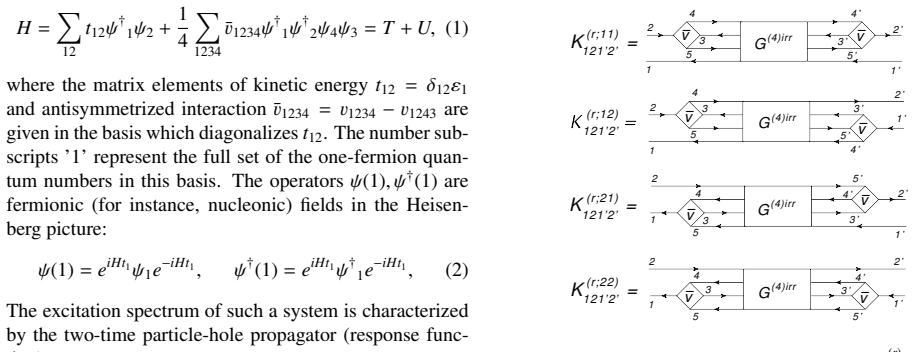
The central object is the two-time particle-hole propagator $R(12,1'2';t-t')$, whose Fourier transform obeys the Dyson-type equation $R=R^{(0)}+R^{(0)}K R$. The interaction kernel $K$ splits into an instantaneous part $K^{(0)}$ (the phonon-mean-field term, carrying the two-fermion density) and a time-dependent part $K^{(r)}$ built from the two-particle-two-hole Green function $G^{(4)}$. The load-bearing step is the non-perturbative approximation of Refs. [11,37,38] that factorizes $G^{(4)}$ into products of particle-hole ($ph$) and particle-particle ($pp$) correlation functions, turning the infinite EOM chain into a closed system for $\hat R=\{R^{(ph)},R^{(hp)},R^{(pp)},R^{(hh)}\}$. Iterating this closed system and mapping it onto relativistic quantum hadrodynamics yields the EOM/RQTBA3 kernel with 2q⊗2phonon configurations. For finite temperature, the machinery is the imaginary-time version with a 'soft blocking' prescription that keeps a single frequency variable in the Bethe-Salpeter equation. This machinery provides a systematically extendable, beyond-mean-field dressing of the particle-hole propagator, so that each additional rung of the hierarchy adds fragmentation and spreading of the strength distribution.
What would settle it
Compute the dipole response of 42Ca and 48Ca with the same EOM/RQTBA3 kernel but with a bare chiral interaction instead of NL3, and also compute the next rung of the hierarchy (2q⊗3phonon); if the added fragmentation and spreading largely disappear in either case, the paper's claim that these six-fermion correlations fix the GDR width is not robust. Experimentally, the finite-temperature prediction would be checked by looking for the predicted enhancement of low-energy E1 strength in hot nuclei produced, for example, in heavy-ion fusion reactions, where no such enhancement is found.
Extended reading notes
Core claim
On the paper's own terms, the central claim is that the hierarchy of equations of motion for the two-time particle-hole propagator can be truncated at a level that retains 2q⊗2phonon configurations, and that this truncation captures enough beyond-mean-field correlation to correct a known deficiency of the relativistic quasiparticle time blocking approximation (RQTBA), which underestimates both the width and the high-energy tail of the giant dipole resonance in medium-heavy nuclei. Comparing the EOM/RQTBA3 dipole cross sections of 42,48Ca with evaluated data, the paper reports improved agreement in both the low- and high-energy sectors. For finite temperature, the paper claims that the same kernel structure, implemented with a soft blocking in the imaginary-time formalism, produces a dipole response in 68Ni that keeps strong spreading even at high temperature and develops significant low-energy strength as temperature rises; the spin-isospin response is reported to be even more temperature-sensitive. These temperature effects, if correct, would feed into modeling of the r-process and core-collapse supernovae.
Load-bearing premise
The calculation works only if the four-fermion Green function can indeed be replaced by products of two-fermion correlation functions (the paper gives no test of how accurate that truncation is), and only if the effective NL3 interaction stands in faithfully for the bare nucleon-nucleon interaction the formalism claims as its input.
Editorial extensions
If this is right
- If EOM/RQTBA3's dipole results hold, photoabsorption cross sections of medium-heavy nuclei can be predicted with 2q⊗2phonon correlations included, without introducing any new parameter beyond the effective NL3 Lagrangian.
- The finite-temperature strength functions computed with FT-RTBA provide a temperature-dependent input for r-process and supernova simulations, where low-energy dipole and spin-isospin strength are presently poorly constrained.
- The mapping of the EOM hierarchy onto particle-vibration coupling shows that the phenomenological phonon-coupling vertices of nuclear field theory emerge from the underlying fermionic interaction rather than being added by hand.
- Because the hierarchy is extendable in principle (3q⊗3phonon, etc.), the same formalism offers a route to systematically improvable response calculations, with the next rung testable against the present one.
Reading between the lines
- If the factorization closure is reliable, the same EOM machinery could be applied to charge-exchange (spin-isospin) responses at finite temperature, where the paper reports even stronger temperature sensitivity; a direct prediction would be an enhanced Gamow-Teller strength in hot stellar environments, affecting weak-interaction rates.
- A natural test of the bare-interaction claim would be to re-run EOM/RQTBA3 with a chiral two- plus three-nucleon force; if the improvement over RQTBA persists, the six-fermion correlations are robust, but if it vanishes, the effective interaction is doing the work.
- The soft-blocking finite-temperature formulation may connect to other many-body methods that use imaginary-time Green functions, suggesting that the single-frequency reduction could be exploited in non-relativistic calculations and in other meson-exchange models.
Signed reviews
Editorial analysis
A structured set of objections, weighed in public.
Referee Report
Summary. The manuscript presents an equation-of-motion (EOM) approach to the nuclear response function, extended to include high-order correlations in the dynamical kernel beyond the standard particle-vibration coupling. At zero temperature the authors introduce EOM/RQTBA3, in which the four-fermion Green function entering the kernel is approximated by products of two-fermion correlation functions, leading to a closed system of equations (Eq. (8)) and to configurations of the 2q⊗2phonon type. The central numerical claim is that the first EOM/RQTBA3 calculations of the dipole response in 42,48Ca show 'important improvements' relative to R(Q)RPA and R(Q)TBA when compared with evaluated data. The manuscript also summarizes a finite-temperature extension, FT-RTBA, applied to 68Ni and low-energy dipole and spin-isospin strength, and discusses implications for astrophysics.
Significance. If the central claim is established, the EOM/RQTBA3 framework would be an important, systematically improvable beyond-mean-field response theory, with correlations involving up to six fermions and a promising mechanism for both low- and high-energy spreading of the giant dipole resonance. The finite-temperature results, if confirmed, are relevant for astrophysical modeling. The paper's conceptual mapping between the EOM hierarchy and phenomenological particle-vibration coupling approaches is potentially valuable. However, the paper's own evidence for the central claim is currently qualitative, and a key derivation is deferred to a companion paper in preparation; the numerical implementation uses an effective interaction rather than the bare interaction advertised in the abstract. The genuinely new numerical content is therefore limited to the unquantified comparison in Fig. 4.
major comments (4)
- [Formalism, Eq. (8)] The closed system of equations (8) is asserted rather than derived: the text states that G(4) is treated as a superposition of products of two-fermion ph and pp correlation functions, and refers to the in-preparation Ref. [39] for details. Since this factorization is the load-bearing approximation that generates the 2q⊗2phonon kernel, the manuscript should either provide the explicit derivation for the iteration order used (n=2) or at least state the factorization in enough detail that the neglected irreducible part of G(4) is identified. In addition, no convergence test or error estimate for the iterative solution of Eq. (8) is given; the claim that 'one iteration is usually sufficient' is not quantified for the cases shown.
- [Abstract and Numerical implementation (page 2, 'Formalism and calculations')] The abstract states that the general theory is formulated 'with the only input from the bare nucleon-nucleon interaction,' but the numerical implementation replaces the static part K(0) by the effective NL3 meson-nucleon interaction whose parameters are adjusted to ground-state properties. This discrepancy matters because the central comparison of Fig. 4 therefore tests the combination of the effective interaction and the new kernel, not the bare-interaction theory promised in the abstract. The manuscript should clarify the status of the numerical results (a model study of the correlation sector) and, ideally, provide a calculation or explicit argument isolating the effect of the new kernel from the choice of effective interaction.
- [Fig. 4 and Summary] The central claim of 'important improvements' in the dipole response of 42,48Ca is supported only by a visual comparison of curves. No quantitative measures are reported: there is no centroid, integrated cross section, width, residual to evaluated data, or uncertainty. The reader cannot assess whether EOM/RQTBA3 is statistically or physically better than RQTBA, nor whether the agreement is meaningful given the effective interaction and the absence of error estimates. The authors should provide quantitative diagnostics (e.g., energy-weighted moments, chi-squared or residuals over the plotted range, and spread of the GDR) for all three theoretical curves and the data.
- [Finite-temperature section and Summary] The finite-temperature part of the paper, including Fig. 5, is presented as 'another recent extension' and explicitly refers to Refs. [47,48] for details; these results were published previously. The genuinely new numerical evidence for the 'novel microscopic approach' is therefore the zero-temperature EOM/RQTBA3 comparison in Fig. 4. The paper should state the incremental novelty relative to Refs. [47,48] and avoid implying that the finite-temperature results are new unless they are recalculated with the EOM/RQTBA3 kernel.
minor comments (5)
- [Abstract] The abstract contains the typo 'mason-nucleon Lagrangian'; this should read 'meson-nucleon Lagrangian'.
- [Formalism, page 1] The phrase 'strongy-coupled systems' should read 'strongly-coupled systems'.
- [Fig. 3 and notation] The symbols 2q⊗phonon and 2q⊗2phonon are used repeatedly but are not defined at first use; a brief definition (two quasiparticles coupled to one or two phonons) would improve readability.
- [Fig. 4] The figure caption would benefit from a statement of the energy binning or smoothing used for both the calculated and experimental cross sections, since the comparison is visual and the data are evaluated rather than raw.
- [References] The paper relies heavily on Ref. [39], which is 'in preparation'; given that Eq. (8) and the diagrammatic mapping are central, the authors should indicate whether a preprint or supplementary material is available, or clearly mark these parts as deferred.
Circularity Check
No fitted-to-data circularity in the dipole comparison, but the central EOM closure is delegated to an in-preparation self-citation.
-
self citation load bearing
[Formalism and calculations, between Eqs. (7) and (8); Ref. [39]]
"Alternatively, efficient truncation schemes have been suggested, for instance, in Refs. [11, 37, 38], where G(4) is treated as a superposition of products of two-fermion particle-hole (ph) correlation functions (3) and particle-particle (pp) ones. As discussed in detail in Ref. [39], in this non-perturbative approximation the problem reduces to the closed system of equations:"
Equation (8) is the load-bearing closed system for the new EOM/RQTBA3 kernel and for the claimed first calculations of the dipole response. The manuscript does not derive this reduction; it delegates the derivation to Ref. [39], which the reference list identifies as 'E. Litvinova, P. Schuck, in preparation (2019)' - an unpublished work by the same two authors. The claimed first-principles derivation chain therefore reduces, at its key step, to a self-citation whose content is not exhibited or externally verified. This is not a fit-to-data circularity, but it is a load-bearing self-citation in the central derivation.
full rationale
The dipole cross sections in Fig. 4 are compared with evaluated NNDC data; the NL3 effective interaction was adjusted to ground-state properties at the Hartree level (Refs. [40,43]), not to the GDR observables, so the predicted low- and high-energy improvements are not statistically forced by fitted target data. The finite-temperature results are extensions previously published in Refs. [47,48], and the new numerical evidence is the zero-temperature GDR comparison. The main circularity concern is the delegation of Eq. (8) - the closed EOM system on which the key claim rests - to Ref. [39], an in-preparation work by the same authors; the topological equivalence between (RQ)TBA and the EOM kernel is likewise assigned to Ref. [39]. Because the central numerical claim still has independent external content, the score is moderate (4) rather than high. The unquantified visual comparison and the uncontrolled G(4) factorization are correctness risks, not circularity.
Assumptions & free parameters
free parameters (1)
- NL3 meson-nucleon coupling constants and meson masses =
As defined by Lalazissis, Koenig, and Ring, Phys. Rev. C 55, 540 (1997); not reproduced in this paper
assumptions (3)
- domain assumption The EOM hierarchy for the particle-hole propagator can be closed by factorizing G(4) into products of two-fermion correlation functions.
- domain assumption The effective NL3 meson-exchange interaction can approximate the static part K(0) of the exact interaction kernel.
- domain assumption The soft-blocking procedure in the imaginary-time formalism yields a single-frequency Bethe-Salpeter equation of the same form as Eq. (8).
Cite this review
Pith. "Pith review of Nuclear response at zero and finite temperature." pith.science (2026). https://pith.science/paper/PYJQFJKE
@misc{pith2026190802437,
  author       = {Pith},
  title        = {Pith review of: Nuclear response at zero and finite temperature},
  year         = {2026},
  howpublished = {\url{https://pith.science/paper/PYJQFJKE}},
  note         = {Machine review of arXiv:1908.02437}
}
abstract
We present some recent developments on the nuclear many-body problem, such as the treatment of high-order correlations and finite temperature in the description of in-medium two-nucleon propagators. In this work we discuss two-time propagators of the particle-hole type, which describe the response of finite nuclei to external probes without nucleon transfer. The general theory is formulated in terms of the equation of motion method for these propagators with the only input from the bare nucleon-nucleon interaction. The numerical implementation was performed on the basis of the effective mason-nucleon Lagrangian in order to study the energy-dependent kernels of different complexity. The finite-temperature extension of the theory with $ph\otimes phonon$ configurations is applied to a study of the multipole response of medium-mass nuclei.
Figures


Reference graph
Works this paper leans on
- [39]
-
[1]
Tanihata, Nuclear Physics News 8, 4 (1998)
I. Tanihata, Nuclear Physics News 8, 4 (1998)
work page 1998
-
[2]
T. Glasmacher, B. Sherrill, W. Nazarewicz, et al. , Nuclear Physics News 27, 28 (2017)
work page 2017
- [3]
-
[4]
G. Bertsch, P. Bortignon, R. Broglia, Reviews of Modern Physics 55, 287 (1983)
work page 1983
-
[5]
V . Soloviev, Theory of Atomic Nuclei: Quasiparti- cles and Phonons (Institute of Physics Publishing, 1992)
work page 1992
-
[6]
Rowe, Review of Modern Physics 40, 153 (1968)
D.J. Rowe, Review of Modern Physics 40, 153 (1968)
work page 1968
-
[7]
Schuck, Zeitschrift für Physik A 279, 31 (1976)
P. Schuck, Zeitschrift für Physik A 279, 31 (1976)
work page 1976
Show all 49 references
-
[8]
Adachi, P
S. Adachi, P. Schuck, Nuclear Physics A496, 485 (1989)
1989
-
[9]
Dukelsky, G
J. Dukelsky, G. Röpke, P. Schuck, Nuclear Physics A628, 17 (1998)
1998
-
[10]
Storozhenko, P
A. Storozhenko, P. Schuck, J. Dukelsky, G. Ropke, A. Vdovin, Annals of Physics 307, 308 (2003)
2003
-
[11]
Schuck, M
P. Schuck, M. Tohyama, European Physical Journal A 52, 307 (2016)
2016
-
[12]
Litvinova, P
E. Litvinova, P. Ring, Physical Review C 73, 044328 (2006)
2006
-
[13]
Litvinova, P
E. Litvinova, P. Ring, V . Tselyaev, Physical Review C 75, 064308 (2007)
2007
-
[14]
Litvinova, P
E. Litvinova, P. Ring, V . Tselyaev, Physical Review C 78, 014312 (2008)
2008
-
[15]
Litvinova, P
E. Litvinova, P. Ring, V . Tselyaev, Physical Review Letters 105, 022502 (2010)
2010
-
[16]
Litvinova, P
E. Litvinova, P. Ring, V . Tselyaev, Physical Review C 88, 044320 (2013)
2013
-
[17]
Afanasjev, E
A.V . Afanasjev, E. Litvinova, Physical Review C92, 044317 (2015)
2015
-
[18]
Litvinova, Physics Letters B 755, 138 (2016)
E. Litvinova, Physics Letters B 755, 138 (2016)
2016
-
[19]
Robin, E
C. Robin, E. Litvinova, European Physical Journal A 52, 205 (2016)
2016
-
[20]
Robin, E
C. Robin, E. Litvinova, Physical Review C 98, 051301 (2018)
2018
-
[21]
Tselyaev, Physical Review C88, 054301 (2013)
V .I. Tselyaev, Physical Review C88, 054301 (2013)
2013
-
[22]
Tselyaev, N
V . Tselyaev, N. Lyutorovich, J. Speth,et al., Physical Review C 94, 034306 (2016)
2016
-
[23]
Y . Niu, Z. Niu, G. Colò, E. Vigezzi, Physical Review Letters 114, 142501 (2015)
2015
-
[24]
Y . Niu, Z. Niu, G. Colò, E. Vigezzi, Physics Letters B 780, 325 (2018)
2018
-
[25]
Endres, E
J. Endres, E. Litvinova, D. Savran, et al. , Physical Review Letters 105, 212503 (2010)
2010
-
[26]
Massarczyk, R
R. Massarczyk, R. Schwengner, F. Dönau, et al. , Physical Review C 86, 014319 (2012)
2012
-
[27]
Poltoratska, R
I. Poltoratska, R. Fearick, A. Krumbholz, et al. , Physical Review C 89, 054322 (2014)
2014
-
[28]
Lanza, A
E. Lanza, A. Vitturi, E. Litvinova, D. Savran, Physi- cal Review C 89, 041601 (2014)
2014
-
[29]
Özel-Tashenov, J
B. Özel-Tashenov, J. Enders, H. Lenske, et al., Phys- ical Review C 90, 024304 (2014)
2014
-
[30]
Kamerdzhiev, G.Ya
S.P. Kamerdzhiev, G.Ya. Tertychny, V .I. Tselyaev, Physics Letters B267, 12 (1991)
1991
- [31]
-
[32]
Tselyaev, N
V . Tselyaev, N. Lyutorovich, J. Speth, P.G. Reinhard, Physical Review C 97, 044308 (2018)
2018
-
[33]
Litvinova, Physical Review C 91, 034332 (2015)
E. Litvinova, Physical Review C 91, 034332 (2015)
2015
-
[34]
Ponomarev, P.F
V .Yu. Ponomarev, P.F. Bortignon, R.A. Broglia, V .V . V oronov, Nuclear PhysicsA687, 170 (2001)
2001
-
[35]
Andreozzi, F
F. Andreozzi, F. Knapp, N. Lo Iudice, A. Porrino, J. Kvasil, Physical Review C 78, 054308 (2008)
2008
-
[36]
Tselyaev, Soviet Journal of Nuclear Physics 50, 780 (1989)
V . Tselyaev, Soviet Journal of Nuclear Physics 50, 780 (1989)
1989
-
[37]
Olevano, J
V . Olevano, J. Toulouse, P. Schuck, Journal of Chem- ical Physics 150, 084112 (2018)
2018
-
[38]
Schuck, M
P. Schuck, M. Tohyama, Physical Review B 93, 165117 (2016)
2016
-
[40]
Vretenar, A.V
D. Vretenar, A.V . Afanasjev, G.A. Lalazissis, P. Ring, Physics Reports 409, 101 (2005)
2005
-
[41]
Litvinova, V
E. Litvinova, V . Tselyaev, Physical Review C 75, 054318 (2007)
2007
-
[42]
Tselyaev, Physical Review C75, 024306 (2007)
V .I. Tselyaev, Physical Review C75, 024306 (2007)
2007
-
[43]
Lalazissis, J
G.A. Lalazissis, J. König, P. Ring, Physical Review C 55, 540 (1997)
1997
-
[44]
Egorova, E
I.A. Egorova, E. Litvinova, Physical Review C 94, 034322 (2016)
2016
-
[45]
Erokhova, M.A
V .A. Erokhova, M.A. Yolkin, A.V . Izotova, et al. , Bull. Rus. Acad. Sci. Physics 67, 1636 (2003)
2003
-
[46]
National Nuclear Data Center, https://www.nndc.bnl.gov (NNDC)
-
[47]
Litvinova, H
E. Litvinova, H. Wibowo, Physical Review Letters 121, 082501 (2018)
2018
-
[48]
Wibowo, E
H. Wibowo, E. Litvinova, Physical Review C 100, 024307 (2019)
2019
- [49]
Reviewed August 14, 2026 · model on record in the stance chip above.
Discussion (0). Continue with ORCID to comment.