REVIEW 3 major objections 4 minor 3 cited by
Chromatic Quantum Contextuality
T0 review · 3 major / 4 minor · reviewed 2026-08-10 · deepseek-v4-flash
Pith's one-line read This paper proves that the Yu-Oh configuration — 13 vectors in R³ forming a 3-uniform orthogonality hypergraph — cannot be classically colored with 3 outcomes per context, since its chromatic number is 4, establishing chromatic…
desk verdict The chromatic contextuality idea is worth discussing, but the Yu-Oh example does not hold up: the Figure 1 hypergraph is not the orthogonality graph of the 13 listed vectors. read the letter →
The pith
A machine-rendered reading of the paper's core claim, the machinery that carries it, and where it could break.
The reading
What carries the argument
The central object is the n-uniform hypergraph model of a quantum logic, where each hyperedge is a context (a maximal observable, an orthonormal basis) and each vertex is an outcome projection. An admissible coloring is an assignment of colors to vertices such that every hyperedge contains all n colors and no two vertices in the same hyperedge share a color; the chromatic number is the minimum number of colors for such an assignment. The argument's load-bearing step is the aggregation mapping: any n-coloring can be folded into a two-valued state by declaring one color to be 1 and all others 0, but the converse fails. The paper's new bounds for the house, pentagon, and pentagram hypergraphs come from a parity argument: on an odd cycle of contexts, the middle-vertex two-valued state (e.g., Wright's ω₀) cannot arise from any n-coloring, so omitting it from the correlation-polytope Hull computation tightens the Boole-Bell inequalities.
What would settle it
Exhibit a proper 3-coloring of the Yu-Oh hypergraph of Figure 1 — three colors, each context getting all three once — or show that one of the orthogonality triples of the 13 vectors is missing from the hypergraph; either would undercut the claim that its chromatic number is 4. For the pentagram claim, find a physical or methodological setting in which the excluded middle-centered two-valued state is realizable, which would invalidate the aggregation restriction.
Extended reading notes
Core claim
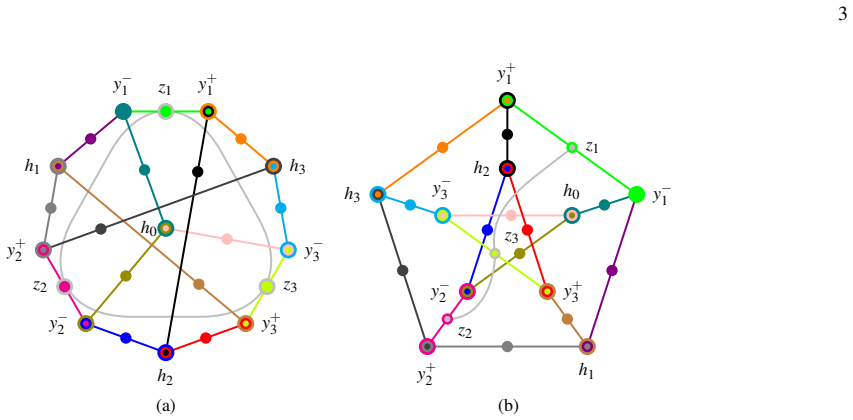
On the paper's own terms, the discovery is that a 3-uniform quantum hypergraph associated with the Yu-Oh setup cannot be colored with three colors, although it can be colored with four. The proof is a case analysis on the hypergraph depicted in Figure 1, which encodes the orthogonality structure of 13 vectors in R³. Assuming a 3-coloring exists, one fixes the color of the central vertex h0 and traces forced color choices through the intertwining contexts; each of the two possible assignments for the three vertices y⁻₁, y⁻₂, y⁻₃ leads to a vertex (h2 in Case 1, h1 in Case 2) that is adjacent to one vertex of each of the three colors, making its color impossible. Since a 4-coloring is exhibited, the chromatic number is exactly 4; the configuration retains 24 two-valued states, so the nonclassicality appears only at the level of n-ary (maximal-resolution) outcomes.
Load-bearing premise
The refined bounds for the house, pentagon and pentagram rest on the suggestion, stated without derivation, that only two-valued states formed by aggregating a full n-coloring are physically admissible when evaluating Bell-type inequalities; if a non-aggregated two-valued state is allowed, the tighter bounds do not follow.
Editorial extensions
If this is right
- Chromatic contextuality is a test that can certify nonclassicality of quantum observables even when two-valued states exist and separate all vertices, which Kochen-Specker arguments cannot do.
- The Yu-Oh configuration provides an explicit 13-vector, 25-projection proof in dimension 3 that a maximal-resolution classical model must use more outcomes per context than quantum mechanics allows.
- Every n-coloring of an n-uniform hypergraph yields n two-valued states via aggregation, but the pentagon example shows the reverse is false; at least one two-valued state (the middle-centered one) is not aggregation-derived.
- If only aggregation-derived two-valued states are counted, the house-pentagon-pentagram inequalities tighten to 1 ≥ A₁₃ + A₃₅ + A₅₇ + A₇₉ + A₉₁ ≥ −3, refining earlier constraints.
- The framework suggests a new principle for classical truth values: two-valued measures that cannot be extended to n-ary colorings should be excluded from physical correlations.
Reading between the lines
- One could search systematically for smaller or lower-dimensional n-uniform quantum hypergraphs whose chromatic number exceeds n; the Yu-Oh example shows dimension 3 suffices, but a minimal example might be found by computer enumeration.
- If the aggregation postulate is right, a Klyachko-type experiment that observes correlations violating the usual pentagram inequality but respecting the new bound 1 ≥ A₁₃ + A₃₅ + A₅₇ + A₇₉ + A₉₁ ≥ −3 would be direct evidence for chromatic contextuality.
- The chromatic criterion might connect to computational hardness: deciding whether a hypergraph's chromatic number exceeds its uniformity is a hard combinatorial problem, which could make some contextuality witnesses exponentially hard to find.
- The paper leaves open whether nonseparability by two-valued states implies chromatic nonseparability; testing this on known Kochen-Specker logics would map the relation between the two witnesses.
Editorial analysis
A structured set of objections, weighed in public.
Referee Report
Summary. The paper introduces 'chromatic quantum contextuality' as a nonclassicality criterion: an n-uniform hypergraph that admits a faithful orthogonal representation in dimension n but whose chromatic number exceeds n cannot be realized by n-outcome noncontextual assignments per context. The central example is the Yu-Oh hypergraph, claimed to have chromatic number 4 and to be realized by 13 vectors in R3. The paper also proposes that only two-valued states obtainable by aggregating an n-coloring are physically relevant, and on this basis claims refined bounds for the house, pentagon, and pentagram hypergraphs.
Significance. The chromatic-number criterion is a clean and potentially useful weakening of Kochen-Specker contextuality: it separates the absence of two-valued states from the absence of n-ary colorings, and the Yu-Oh case is a concrete candidate for this separation. The proof of the 3-coloring impossibility is a self-contained, parameter-free case analysis, and the paper correctly notes that separating two-valued states do not imply the existence of an n-coloring. However, the advertised quantum realization of the Yu-Oh hypergraph is not established as written, and the new bounds for house/pentagon/pentagram are conditional on an unproven physical postulate. If the realization gap can be repaired and the 4-coloring explicitly exhibited, the chromatic contextuality concept would be a worthwhile contribution.
major comments (3)
- [Section IV, Figure 1 caption] The claimed R3 realization is not faithful to the hypergraph used in the coloring proof. The caption lists 13 vectors, but a direct computation of orthogonal triples among these vectors yields only {z1,z2,z3}, {z1,y-1,y+1}, {z2,y-2,y+2}, and {z3,y-3,y+3}. In particular, the proof's adjacency claims involving h2 are not supported: while h2 is orthogonal to y+3, y-2, and y+1 individually, no listed third vector is orthogonal to both members of any of those pairs, so no hyperedge of the 13-vertex hypergraph contains these pairs together with a third listed vertex. Also, {h0,y-1,z1} is not an orthogonal triple because h0·z1 = 1. Thus the case analysis in Section IV applies to an abstract hypergraph that does not match the vector realization, and the advertised 'explicit example of a four-colorable quantum logic in dimension three' is unsupported. Please provide the complete set of projections and all contexts, or revise the claim to state that the hypergraph is purely combinatorial and not yet shown to be quantum-representable.
- [Section IV (4-coloring claim)] The statement 'It is not difficult to work out a coloring of the Yu-Oh hypergraph with four colors. Therefore, its chromatic number is 4' does not supply the required upper bound. A proof that the chromatic number is 4 needs both the lower bound (no 3-coloring, which the case analysis addresses) and an explicit 4-coloring of the hypergraph. The 4-coloring is not exhibited, so the claim that the chromatic number equals 4 is incomplete as written. Please provide the coloring explicitly, or a reference where it appears.
- [Section V (aggregation postulate)] The new bounds for the house, pentagon, and pentagram hypergraphs depend on the postulate that 'only two-valued states that are derived through aggregation should be considered when deriving, for instance, Boole-Bell-type inequalities.' This postulate is introduced with 'For physical reasons we suggest' and 'should be considered'; no derivation, independent justification, or empirical argument is provided. Consequently, the abstract's claim to 'establish new bounds' overstates the status of these results: they are conditional refinements whose validity stands or falls with an unproven physical assumption. Please either prove the postulate from a stated principle, or explicitly label these results as conditional on the aggregation assumption.
minor comments (4)
- [Figure 1 caption] The caption says the logic has a realization consisting of 'the 25 projections', but then lists only 13 vectors. Clarify whether the logic has 13, 25, or another number of vertices, and explain the relationship between the 13 vectors and the 25 projections.
- [Section II] There is a duplicated word: 'we might hope to find find' should read 'we might hope to find'.
- [Section IV] The phrase 'all y+3, y-2, and y+1 are adjacent to h2' should be accompanied by the explicit hyperedges that realize these adjacencies; as written, the reader cannot verify them from the figure or the vector list.
- [Section V] The phrase 'color-fobidden middle-center' contains a typo; it should be 'color-forbidden'.
Circularity Check
No significant circularity: the Yu-Oh chromatic-number proof is self-contained, self-citations are supporting rather than load-bearing, and the new bounds rest on an explicitly stated extra postulate rather than on a circular derivation.
full rationale
The central derivation, the proof that the Yu-Oh hypergraph has chromatic number 4, is self-contained: it fixes h0 as red, exhaustively splits on the colors of y-1, y-2, y-3, z1, z2, and z3, derives contradictions in each case, and exhibits a four-coloring. No parameter is fitted to data, and no equation is identified with the conclusion by construction. The frequent citations to reference [11] (Shekarriz and Svozil) supply definitions, the G32 example, and background on two-valued states, but the Yu-Oh coloring argument itself does not depend on those citations; hence the self-citations are not load-bearing. The new house, pentagon, and pentagram bounds are conditional on the explicitly stated postulate in Section V that only two-valued states derived through aggregation should enter the Hull computation; this is a stated physical assumption, not a disguised reuse of the conclusion, and it is not presented as following from the chromatic-number result itself. The possible infidelity of the 13-vector realization to Figure 1's hypergraph, e.g. the context {h0, y-1, z1} not being pairwise orthogonal, is a correctness concern about the quantum realizability of the example; it does not make the derivation circular, since the coloring argument operates directly on the drawn hypergraph as its input. Overall, no step reduces to its own input, and the paper warrants only a minimal circularity score.
Assumptions & free parameters
assumptions (4)
- standard math Chromatic number of an n-uniform hypergraph is the minimum number of colors for an exclusive coloring.
- domain assumption Every n-uniform hypergraph edge corresponds to a maximal observable (orthonormal basis), and an exclusive and complete coloring represents a possible n-outcome measurement assignment.
- domain assumption The adjacency relations of the Yu-Oh hypergraph are exactly those depicted in Figure 1, including h0 adjacent to y1-, y2-, y3-, zi adjacent to yi+ and yi-, h2 adjacent to y1+, y2-, y3+, etc.
- ad hoc to paper Only two-valued states obtainable by aggregating an n-coloring are physically relevant for Boole-Bell-type inequalities.
Cite this review
Pith. "Pith review of Chromatic Quantum Contextuality." pith.science (2026). https://pith.science/paper/PZIU6VEM
@misc{pith2026250115261,
  author       = {Pith},
  title        = {Pith review of: Chromatic Quantum Contextuality},
  year         = {2026},
  howpublished = {\url{https://pith.science/paper/PZIU6VEM}},
  note         = {Machine review of arXiv:2501.15261}
}
abstract
Chromatic quantum contextuality is a criterion of quantum nonclassicality based on (hyper)graph coloring constraints. If a quantum hypergraph requires more colors than the number of outcomes per maximal observable (context), it lacks a classical realization with n-uniform outcomes per context. Consequently, it cannot represent a "completable" non-contextual set of coexisting n-ary outcomes per maximal observable. This result serves as a chromatic analogue of the Kochen-Specker theorem. We present an explicit example of a four-colorable quantum logic in dimension three. Furthermore, chromatic contextuality suggests a novel restriction on classical truth values, thereby excluding two-valued measures that cannot be extended to $n$-ary colorings. Using this framework, we establish new bounds for the house, pentagon, and pentagram hypergraphs, refining previous constraints.
Figures


Forward citations
Cited by 3 Pith papers
-
Chromatic Completeness and the Independence of Geometric Obstruction
Strong chromatic number exceeding dimension blocks only chromatic completeness, not faithful orthogonal ray representations; completed Yu–Oh has χ=4 with an R³ FOR while Greechie G₃₂ has χ=4 with none in C³.
-
Which Classicality? Incidence, Simplex, and Product-Rule Tests in Finite Quantum Logics
Classicality of finite quantum logics is bookkeeping-dependent: incidence, simplex-embedding, and product-rule tests diagnose different retained structures, with GHZ classical as one Boolean context and fragment-speci...
-
Construction of Kochen-Specker Sets from Mutually Unbiased Bases
A systematic MUB-based enumeration yields a 69-ray 50-context KS nucleus unifying known constructions, plus forcing gadgets in D=4 and D=5 that enforce maximal unbiasedness.
Reference graph
Works this paper leans on
-
[1]
Zeilinger, Foundations of Physics 29, 631 (1999), URL https://doi.org/10.1023/A:1018820410908
A. Zeilinger, Foundations of Physics 29, 631 (1999), URL https://doi.org/10.1023/A:1018820410908
-
[2]
J. von Neumann, Annalen der Mathematik (An- nals of Mathematics) 32, 191 (1931), URL https://doi.org/10.2307/1968185
-
[3]
P . R. Halmos, Finite-Dimensional V ector Spaces , Un- dergraduate Texts in Mathematics (Springer, New Y ork, 1958), ISBN 978-1-4612-6387-6,978-0-387-90093-3, URL https://doi.org/10.1007/978-1-4612-6387-6
-
[4]
A. Bretto, Hypergraph theory , Mathematical En- gineering (Springer, Cham, Switzerland, 2013), ISBN 978-3-319-00079-4; 978-3-319-00080-0, URL https://doi.org/10.1007/978-3-319-00080-0
-
[5]
R. J. Greechie, Journal of Combinato- rial Theory. Series A 10, 119 (1971), URL https://doi.org/10.1016/0097-3165(71)90015-X
-
[6]
M. Navara and V . Rogalewicz, Mathema- tische Nachrichten 154, 157 (1991), URL https://doi.org/10.1002/mana.19911540113
-
[7]
B. D. McKay, N. D. Megill, and M. Paviˇ ci´ c, International Journal of Theoretical Physics 39, 2381 (2000), quant-ph/0009039, URL https://doi.org/10.1023/a:1026476701774
work page Pith review arXiv 2000
-
[8]
Graph Approach to Quantum Systems
M. Paviˇ ci´ c, B. D. McKay, N. D. Megill, and K. Fresl, Journal of Mathematical Physics 51, 102103 (2010), arXiv:1004.0776, URL https://doi.org/10.1063/1.3491766
work page Pith review arXiv 2010
Show all 34 references
-
[9]
Lov´ asz, IEEE Transactions on Information Theory 25, 1 (1979), ISSN 0018-9448, URL https://doi.org/10.1109/TIT.1979.1055985
L. Lov´ asz, IEEE Transactions on Information Theory 25, 1 (1979), ISSN 0018-9448, URL https://doi.org/10.1109/TIT.1979.1055985
1979
- [10]
-
[11]
M. H. Shekarriz and K. Svozil, Journal of Mathemati- cal Physics 63, 032104 (2022), arXiv:2105.08520, URL https://doi.org/10.1063/5.0062801
2022 arXiv
-
[12]
Berlov, Journal of Mathemati- cal Sciences 196, 733 (2014), URL https://doi.org/10.1007/s10958-014-1689-2
S. Berlov, Journal of Mathemati- cal Sciences 196, 733 (2014), URL https://doi.org/10.1007/s10958-014-1689-2
2014 doi
-
[13]
D. A. Meyer, Physical Review Letters 83, 3751 (1999), arXiv:quant-ph/9905080, URL https://doi.org/10.1103/PhysRevLett.83.3751
1999 arXiv
-
[14]
Cabello, S
A. Cabello, S. Severini, and A. Winter, (non-)contextuality of physical theories as an axiom (2010), arXiv:1010.2163, URL https://arxiv.org/abs/1010.2163
2010 arXiv
-
[15]
Svozil, Physical Review A 110, 012215 (2024), arXiv:2404.15793, URL https://doi.org/10.1103/PhysRevA.110.012215
K. Svozil, Physical Review A 110, 012215 (2024), arXiv:2404.15793, URL https://doi.org/10.1103/PhysRevA.110.012215
2024 arXiv
-
[16]
Svozil, Physical Review A 103, 022204 (2021), arXiv:2006.11396, URL https://doi.org/10.1103/PhysRevA.103.022204
K. Svozil, Physical Review A 103, 022204 (2021), arXiv:2006.11396, URL https://doi.org/10.1103/PhysRevA.103.022204
2021 arXiv
-
[17]
Kochen and E
S. Kochen and E. P . Specker, Journal of Mathemat- ics and Mechanics (now Indiana University Mathe- matics Journal) 17, 59 (1967), ISSN 0022-2518, URL https://doi.org/10.1512/iumj.1968.17.17004
1967 doi
-
[18]
S. S. Holland, in The Logico-Algebraic Approach to Quan- tum Mechanics: V olume I: Historical Evolution , edited by C. A. Hooker (Springer Netherlands, Dordrecht, The Nether- lands, 1975), pp. 437–496, ISBN 978-94-010-1795-4, URL https://doi.org/10.1007/978-94-010-1795-4_25
1975 doi
-
[19]
M. K. Bennett, SIAM Review 12, 267 (1970), URL https://doi.org/10.1137/1012047
1970 doi
-
[20]
R. J. Greechie, Synthese 29, 113 (1974), URL https://doi.org/10.1007/bf00484954
1974 doi
-
[21]
R. J. Greechie, in Logic and Probability in Quantum Mechanics, edited by P . Suppes (Springer Netherlands, Dordrecht, The Netherlands, 1976), pp. 105–119, URL https://doi.org/10.1007/978-94-010-9466-5_6
1976 doi
-
[22]
Y u and C
S. Y u and C. H. Oh, Physical Review Let- ters 108, 030402 (2012), arXiv:1109.4396, URL https://doi.org/10.1103/PhysRevLett.108.030402
2012 arXiv
-
[23]
Svozil, Physical (A)Causality , vol
K. Svozil, Physical (A)Causality , vol. 192 of Fun- damental Theories of Physics (Springer Inter- national Publishing, Cham, Switzerland, 2018), ISBN 978-3-319-70815-7,978-3-319-70814-0, URL https://doi.org/10.1007/978-3-319-70815-7
2018 doi
-
[24]
Cabello, J
A. Cabello, J. M. Estebaranz, and G. Garc´ ıa- 7 Alcaine, Physics Letters A 218, 115 (1996), URL https://doi.org/10.1016/0375-9601(96)00457-4
1996 doi
-
[25]
A. A. Abbott, C. S. Calude, and K. Svozil, Journal of Math- ematical Physics 56, 102201 (2015), arXiv:1503.01985, URL https://doi.org/10.1063/1.4931658
2015 arXiv
-
[26]
Ramanathan, npj Quantum Information 10 (2024), URL https://doi.org/10.1038/s41534-024-00895-w
R. Ramanathan, npj Quantum Information 10 (2024), URL https://doi.org/10.1038/s41534-024-00895-w
2024 doi
-
[27]
E. R. Gerelle, R. J. Greechie, and F. R. Miller, in Physical Reality and Mathematical Description , edited by C. P . Enz and J. Mehra (D. Reidel Publish- ing Company, Springer Netherlands, Dordrecht, The Netherlands, 1974), pp. 167–192, ISBN 978-94-010- 2274-3,978-90-277-0513-...
1974 doi
-
[28]
Wright, in Mathematical F oundations of Quantum Theory, edited by A
R. Wright, in Mathematical F oundations of Quantum Theory, edited by A. R. Marlow (Academic Press, New Y ork, 1978), pp. 255–274, ISBN 9780323141185, URL https://doi.org/10.1016/B978-0-12-473250-6.50015-7
1978 doi
-
[29]
A. A. Klyachko, M. A. Can, S. Binicio˘ glu, and A. S. Shumovsky, Physical Review Let- ters 101, 020403 (2008), arXiv:0706.0126, URL https://doi.org//10.1103/PhysRevLett.101.020403
2008 arXiv
-
[30]
Bub and A
J. Bub and A. Stairs, Foundations of Physics 39, 690 (2009), arXiv:0903.1462, URL https://doi.org/10.1007/s10701-009-9307-8
2009 arXiv
-
[31]
Froissart, Il Nuovo Cimento B (11, 1971-
M. Froissart, Il Nuovo Cimento B (11, 1971-
1971
-
[32]
Pitowsky, Journal of Mathematical Physics 27, 1556 (1986), ISSN 0022-2488, URL https://doi.org/10.1063/1.527066
I. Pitowsky, Journal of Mathematical Physics 27, 1556 (1986), ISSN 0022-2488, URL https://doi.org/10.1063/1.527066
1986 doi
-
[33]
Cabello, J
A. Cabello, J. R. Portillo, A. Sol´ ıs, and K. Svozil, Physi- cal Review A 98, 012106 (2018), arXiv:1805.00796, URL https://doi.org/10.1103/PhysRevA.98.012106
2018 arXiv
-
[1996]
64, 241 (1981), ISSN 0369-3554, URL https://doi.org/10.1007/BF02903286
1981 doi
Reviewed August 10, 2026 · model on record in the stance chip above.
Discussion (0). Continue with ORCID to comment.