Temperature-Induced Crossover of Coherent Phonon Mechanisms in Chiral 2D Perovskites
Pith reviewed 2026-06-28 00:19 UTC · model grok-4.3
The pith
Temperature drives a crossover from ISRS to DECP in coherent phonons of chiral 2D perovskites by increasing lattice compliance.
A machine-rendered reading of the paper's core claim, the machinery that carries it, and where it could break.
Core claim
The excited-state structural reconfiguration in two-dimensional metal-halide perovskites is explicitly temperature-evolving and governed by lattice compliance. In a chiral framework with large bond angle variance, phase-resolved resonant impulsive stimulated Raman scattering shows a temperature-induced crossover from momentum-driven ISRS at low temperatures to coordinate-driven DECP at higher temperatures, as the lattice softens and excitons access more anharmonic PES regions.
What carries the argument
Lattice compliance in the chiral 2D perovskite framework, which enables the temperature-induced crossover between impulsive stimulated Raman scattering (ISRS) and displacive excitation of coherent phonons (DECP) in excited-state dynamics.
If this is right
- Excitons sample steeper, more anharmonic regions of the excited-state PES at higher temperatures.
- Temperature actively modulates the excited-state structural coordinates accessed by excitons.
- Momentum-driven ISRS pathways give way to population-driven DECP pathways with rising thermal energy.
- This crossover offers a strategy to tune exciton-lattice interactions in chiral optoelectronics.
Where Pith is reading between the lines
- The temperature-driven mechanism switch may appear in other flexible 2D frameworks with high structural compliance.
- Temperature could serve as a design parameter for controlling anharmonicity in excited-state dynamics of optoelectronic materials.
- Thermal softening might qualitatively alter excitation pathways in a wider class of hybrid perovskites.
Load-bearing premise
The chosen chiral perovskite framework has an exceptionally large, temperature-dependent bond angle variance that maximizes structural compliance and enables the observed mechanism crossover.
What would settle it
Coherent phonon measurements in a similar perovskite lacking large temperature-dependent bond angle variance that show no crossover from ISRS to DECP would indicate lattice compliance is not the driver.
Figures
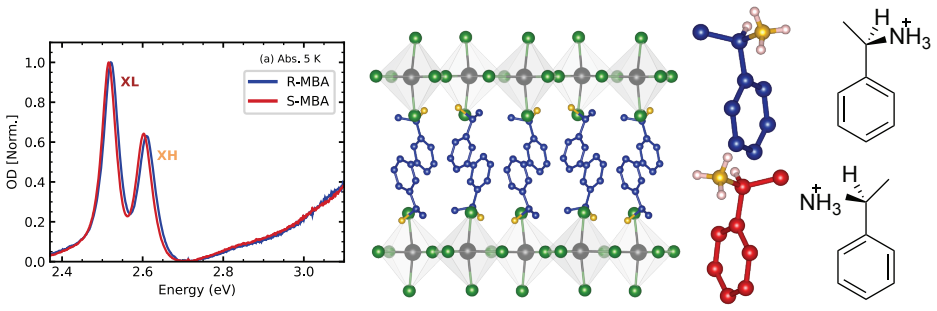
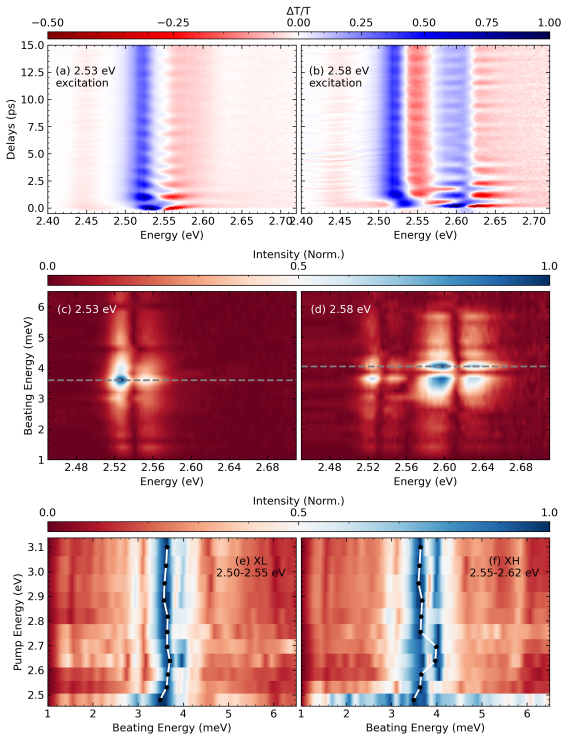
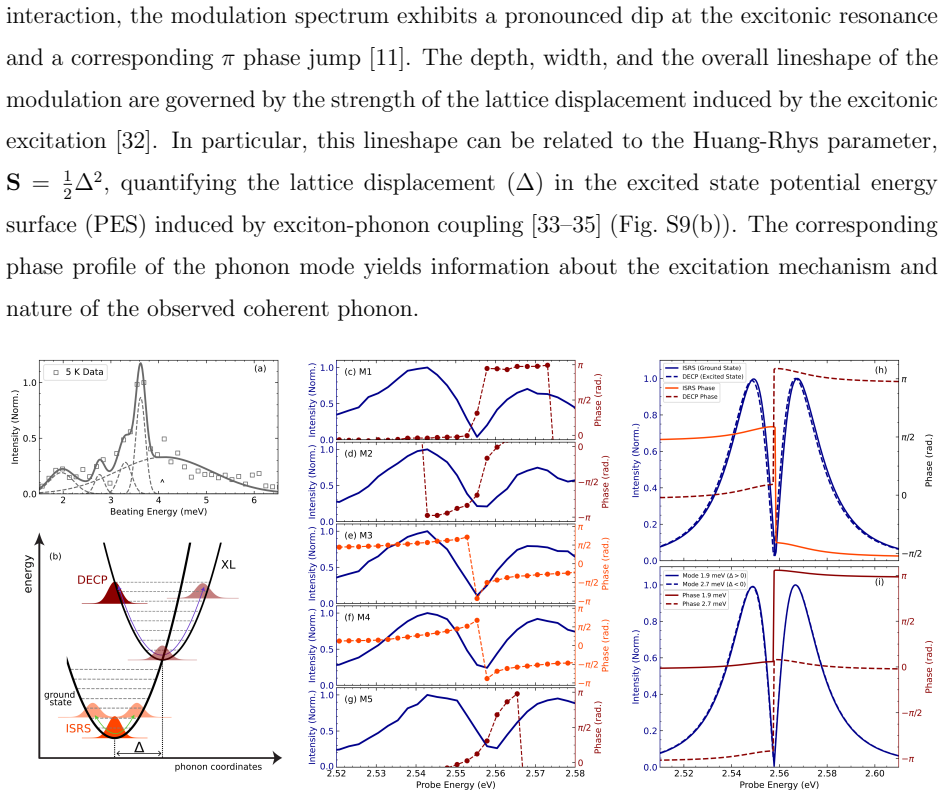
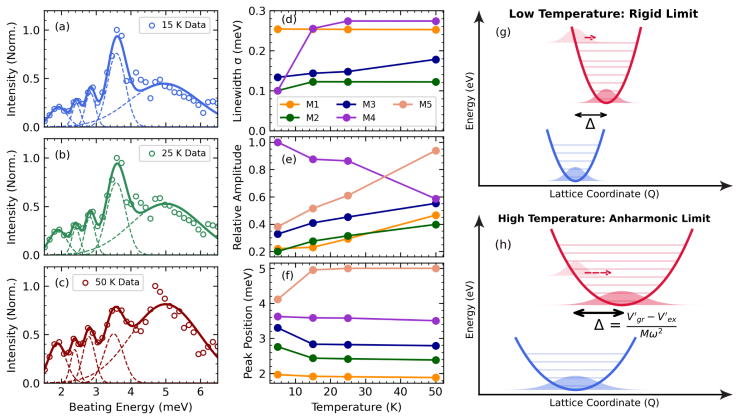
read the original abstract
The coupling between electronic excitations and lattice degrees of freedom fundamentally dictates the optoelectronic functionality of hybrid perovskites. While the potential energy surfaces (PESs) of the electronic excited states are typically considered static, albeit modulated by thermal disorder, the exact nature of their structural evolution with temperature remains elusive. Here, we demonstrate that the excited-state structural reconfiguration in two-dimensional metal-halide perovskites is explicitly temperature-evolving, governed by lattice compliance. We select a chiral perovskite framework with an exceptionally large, temperature-dependent bond angle variance to maximize the structural compliance. Through phase-resolved resonant impulsive stimulated Raman scattering, we measure the coherent phonon dynamics and resolve the real-time structural pathways of exciton-lattice dressing. We observe a temperature-induced crossover from field-driven Impulsive Stimulated Raman Scattering (ISRS) to population-driven Displacive Excitation of Coherent Phonons (DECP). While momentum-driven ISRS pathways dominate at low temperatures, increasing thermal energy softens the lattice and enhances coordinate-driven displacive pathways, allowing excitons to sample steeper, highly anharmonic regions of the excited-state PES. Our results show that temperature can actively modulate the excited-state structural coordinates of flexible 2D frameworks, offering a practical strategy to tune exciton-lattice interactions in chiral optoelectronics.
Editorial analysis
A structured set of objections, weighed in public.
Referee Report
Summary. The manuscript reports an experimental investigation of coherent phonon dynamics in a deliberately selected chiral 2D metal-halide perovskite using phase-resolved resonant impulsive stimulated Raman scattering (ISRS). It claims to observe a temperature-driven crossover from momentum-driven, field-driven ISRS to population-driven displacive excitation of coherent phonons (DECP), attributed to increased lattice compliance that allows excitons to access steeper anharmonic regions of a temperature-evolving excited-state potential energy surface (PES). The framework is chosen for its large, temperature-dependent bond-angle variance to maximize structural flexibility.
Significance. If the phase-resolved measurements and mechanism assignment hold, the work establishes temperature as an active modulator of excited-state structural coordinates in compliant 2D frameworks. This provides a concrete experimental route to tune exciton-lattice coupling in chiral optoelectronics, with the phase-resolved ISRS technique serving as a useful tool for distinguishing field-driven versus population-driven pathways.
minor comments (2)
- Abstract: the phrase 'exceptionally large, temperature-dependent bond angle variance' is presented without quantitative benchmarks against other 2D perovskites; a brief comparison (e.g., variance values or reference to supplementary structural data) would strengthen the selection rationale.
- The abstract refers to 'real-time structural pathways of exciton-lattice dressing' but does not specify how the phase information quantitatively maps onto coordinate changes; a short methods paragraph or figure caption clarifying the conversion from phase to displacement would improve clarity.
Simulated Author's Rebuttal
We thank the referee for their positive summary of our work on the temperature-induced crossover from ISRS to DECP mechanisms in chiral 2D perovskites, and for recommending minor revision. We are pleased that the significance of the phase-resolved measurements and the role of lattice compliance were recognized.
Circularity Check
No significant circularity; experimental observation paper
full rationale
The manuscript reports temperature-dependent coherent phonon dynamics measured via phase-resolved resonant impulsive stimulated Raman scattering in a selected chiral 2D perovskite. No equations, fitted parameters, or derivation steps are present that could reduce the observed ISRS-to-DECP crossover to a self-referential definition or fitted input. The central claim rests on direct experimental distinction of field-driven versus population-driven pathways, with framework selection justified by its measured structural properties rather than by any self-citation chain or ansatz. This is a self-contained experimental result with no load-bearing mathematical reductions.
Axiom & Free-Parameter Ledger
Reference graph
Works this paper leans on
-
[1]
A.; Quarti, C.; Cortecchia, D.; Bargigia, I.; Beljonne, D.; Petrozza, A.; Silva, C.; Srimath Kandada, A
Thouin, F.; Valverde-Ch´ avez, D. A.; Quarti, C.; Cortecchia, D.; Bargigia, I.; Beljonne, D.; Petrozza, A.; Silva, C.; Srimath Kandada, A. R. Phonon coherences reveal the polaronic character of excitons in two-dimensional lead halide perovskites.Nature materials2019,18, 349–356
-
[2]
R.; Silva, C
Srimath Kandada, A. R.; Silva, C. Exciton polarons in two-dimensional hybrid metal-halide perovskites.The Journal of Physical Chemistry Letters2020,11, 3173–3184
-
[3]
F.; Seferos, D
Biswas, S.; Zhao, R.; Alowa, F.; Zacharias, M.; Sharifzadeh, S.; Coker, D. F.; Seferos, D. S.; Scholes, G. D. Exciton polaron formation and hot-carrier relaxation in rigid Dion–Jacobson- type two-dimensional perovskites.Nature Materials2024,23, 937–943
-
[4]
J.; Zarrabi, N.; Wolff, C
Zeiske, S.; Sandberg, O. J.; Zarrabi, N.; Wolff, C. M.; Raoufi, M.; Pe˜ na-Camargo, F.; Gutierrez-Partida, E.; Meredith, P.; Stolterfoht, M.; Armin, A. Static disorder in lead halide perovskites.The Journal of Physical Chemistry Letters2022,13, 7280–7285
-
[5]
M.; Zhang, N.; Surrente, A.; Maude, D.; Andaji-Garmaroudi, Z.; Stranks, S.; Plochocka, P
Baranowski, M.; Urban, J. M.; Zhang, N.; Surrente, A.; Maude, D.; Andaji-Garmaroudi, Z.; Stranks, S.; Plochocka, P. Static and dynamic disorder in triple-cation hybrid perovskites.The Journal of Physical Chemistry C2018,122, 17473–17480
-
[6]
T.; Asbury, J
Munson, K. T.; Asbury, J. B. Influence of dynamic disorder and charge–lattice interactions on optoelectronic properties of halide perovskites.The Journal of Physical Chemistry C2021, 125, 5427–5435
-
[7]
T.; Kennehan, E
Munson, K. T.; Kennehan, E. R.; Doucette, G. S.; Asbury, J. B. Dynamic disorder dominates delocalization, transport, and recombination in halide perovskites.Chem2018,4, 2826–2843
-
[8]
R.; Li, H.; Bittner, E
Srimath Kandada, A. R.; Li, H.; Bittner, E. R.; Silva-Acu˜ na, C. Homogeneous optical line widths in hybrid Ruddlesden–Popper metal halides can only be measured using nonlinear spectroscopy.The Journal of Physical Chemistry C2022,126, 5378–5387
-
[9]
2D hybrid perovskites: from static and dynamic structures to potential applications
Duan, J.; Li, J.; Divitini, G.; Cortecchia, D.; Yuan, F.; You, J.; Liu, S.; Petrozza, A.; Wu, Z.; Xi, J. 2D hybrid perovskites: from static and dynamic structures to potential applications. Advanced Materials2024,36, 2403455
-
[10]
G.; Lemmerer, A
Billing, D. G.; Lemmerer, A. Synthesis and crystal structures of inorganic–organic hybrids incorporating an aromatic amine with a chiral functional group.CrystEngComm2006,8, 686–695. 16
-
[11]
A new class of chiral semiconductors: chiral-organic-molecule-incorporating organic–inorganic hybrid perovskites.Materials Hori- zons2017,4, 851–856
Ahn, J.; Lee, E.; Tan, J.; Yang, W.; Kim, B.; Moon, J. A new class of chiral semiconductors: chiral-organic-molecule-incorporating organic–inorganic hybrid perovskites.Materials Hori- zons2017,4, 851–856
-
[12]
P.; Haque, M
Dong, Y.; Hautzinger, M. P.; Haque, M. A.; Beard, M. C. Chirality-induced spin selectivity in hybrid organic-inorganic perovskite semiconductors.Annual Review of Physical Chemistry 2025,76, 519–537
2025
-
[13]
Chiral perovskites for next-generation photonics: From chirality transfer to chiroptical activity.Advanced Materials2021,33, 2005760
Ma, S.; Ahn, J.; Moon, J. Chiral perovskites for next-generation photonics: From chirality transfer to chiroptical activity.Advanced Materials2021,33, 2005760
-
[14]
Li, H.; Sarker, P.; Zhang, X.; Terban, M. W.; Ghose, S.; Dursun, I.; Cotlet, M.; Li, M.; Zhang, Y.; Xu, Y.; others Enhancing Chiroptoelectronic Activity in Chiral 2D Perovskites via Chiral–Achiral Cation Mixing.Advanced Optical Materials2024,12, 2401782
-
[15]
E.; Levin, A.; Brunecky, R.; Berry, J
Lu, H.; Xiao, C.; Song, R.; Li, T.; Maughan, A. E.; Levin, A.; Brunecky, R.; Berry, J. J.; Mitzi, D. B.; Blum, V.; Beard, M. C. Highly distorted chiral two-dimensional tin iodide perovskites for spin polarized charge transport.Journal of the American Chemical Society 2020,142, 13030–13040
2020
-
[16]
P.; Pan, X.; Hayden, S
Hautzinger, M. P.; Pan, X.; Hayden, S. C.; Ye, J. Y.; Jiang, Q.; Wilson, M. J.; Phillips, A. J.; Dong, Y.; Raulerson, E. K.; Leahy, I. A.; others Room-temperature spin injection across a chiral perovskite/III–V interface.Nature2024,631, 307–312
-
[17]
A.; Grieder, A.; Harvey, S
Haque, M. A.; Grieder, A.; Harvey, S. P.; Brunecky, R.; Ye, J. Y.; Addison, B.; Zhang, J.; Dong, Y.; Xie, Y.; Hautzinger, M. P.; others Remote chirality transfer in low-dimensional hybrid metal halide semiconductors.Nature Chemistry2025,17, 29–37
-
[18]
A.; Zhou, C.; Li, Y.; Chen, D.; Bennett, J
Li, S.; Xu, X.; Kocoj, C. A.; Zhou, C.; Li, Y.; Chen, D.; Bennett, J. A.; Liu, S.; Quan, L.; Sarker, S.; others Large exchange-driven intrinsic circular dichroism of a chiral 2D hybrid perovskite.Nature Communications2024,15, 2573
-
[19]
K.; Baumberg, J
Valev, V. K.; Baumberg, J. J.; Sibilia, C.; Verbiest, T. Chirality and chiroptical effects in plasmonic nanostructures: fundamentals, recent progress, and outlook.Advanced Materials 2013,25, 2517–2534
2013
-
[20]
Recent progress of chiral perovskites: materials, synthesis, and properties.Advanced Materials2021,33, 2008785
Ma, J.; Wang, H.; Li, D. Recent progress of chiral perovskites: materials, synthesis, and properties.Advanced Materials2021,33, 2008785
-
[21]
K.; Song, R.; Liu, H.; Khanal, D
Jana, M. K.; Song, R.; Liu, H.; Khanal, D. R.; Janke, S. M.; Zhao, R.; Liu, C.; Valy Var- deny, Z.; Blum, V.; Mitzi, D. B. Organic-to-inorganic structural chirality transfer in a 2D 17 hybrid perovskite and impact on Rashba-Dresselhaus spin-orbit coupling.Nature communica- tions2020,11, 4699
-
[22]
U.; Walsh, A.; Moon, J
Ma, S.; Jung, Y.-K.; Ahn, J.; Kyhm, J.; Tan, J.; Lee, H.; Jang, G.; Lee, C. U.; Walsh, A.; Moon, J. Elucidating the origin of chiroptical activity in chiral 2D perovskites through nano- confined growth.Nature communications2022,13, 3259
-
[23]
Structure-guided approaches for enhanced spin- splitting in chiral perovskite.JACS Au2024,4, 1263–1277
Ding, Z.; Chen, Q.; Jiang, Y.; Yuan, M. Structure-guided approaches for enhanced spin- splitting in chiral perovskite.JACS Au2024,4, 1263–1277
-
[24]
A.; Nelson, K
Dhar, L.; Rogers, J. A.; Nelson, K. A. Time-resolved vibrational spectroscopy in the impulsive limit.Chemical Reviews1994,94, 157–193
-
[25]
T.; Rosca, F.; Widom, A.; Champion, P
Kumar, A. T.; Rosca, F.; Widom, A.; Champion, P. M. Investigations of amplitude and phase excitation profiles in femtosecond coherence spectroscopy.The Journal of Chemical Physics 2001,114, 701–724
2001
-
[26]
B.; Hurtado Parra, S.; Iotov, N.; Gebhardt, J.; Rappe, A
Straus, D. B.; Hurtado Parra, S.; Iotov, N.; Gebhardt, J.; Rappe, A. M.; Subotnik, J. E.; Kikkawa, J. M.; Kagan, C. R. Direct observation of electron–phonon coupling and slow vibra- tional relaxation in organic–inorganic hybrid perovskites.Journal of the American Chemical Society2016,138, 13798–13801
-
[27]
K.; Loi, M
Dyksik, M.; Beret, D.; Baranowski, M.; Duim, H.; Moyano, S.; Posmyk, K.; Mlayah, A.; Adjokatse, S.; Maude, D. K.; Loi, M. A.; others Polaron vibronic progression shapes the optical response of 2D perovskites.Advanced Science2024,11, 2305182
-
[28]
A.; Gomez-Dominguez, M.; Rojas-Gatjens, E
Koch, K. A.; Gomez-Dominguez, M.; Rojas-Gatjens, E. E.; Evju, A.; Ucer, K. B.; Correa- Baena, J.-P.; Kandada, A. R. R. S. Structure-property relationships for exciton polarons in organic-inorganic hybrid materials.Journal of Materials Chemistry C2025,
-
[29]
Berera, R.; van Grondelle, R.; Kennis, J. T. Ultrafast transient absorption spectroscopy: principles and application to photosynthetic systems.Photosynthesis research2009,101, 105– 118
-
[30]
Transient Absorption Spectroscopy: Probing the Ultrafast Dynamics in Nanomaterial Complex Systems.Royal Society of Chem- istry2024,
Jia, M.; Kong, J.; Zhou, H.; Chen, J.; Zhang, S.; Zhou, M. Transient Absorption Spectroscopy: Probing the Ultrafast Dynamics in Nanomaterial Complex Systems.Royal Society of Chem- istry2024,
-
[31]
Generating coherent THz phonons with light pulses.Solid state communications 1997,102, 207–220
Merlin, R. Generating coherent THz phonons with light pulses.Solid state communications 1997,102, 207–220. 18
1997
-
[32]
T.; Mathies, R
Pollard, W. T.; Mathies, R. A. Analysis of femtosecond dynamic absorption spectra of non- stationary states.Annual Review of Physical Chemistry1992,43, 497–523
-
[33]
S.; Huff, J
Barclay, M. S.; Huff, J. S.; Pensack, R. D.; Davis, P. H.; Knowlton, W. B.; Yurke, B.; Dean, J. C.; Arpin, P. C.; Turner, D. B. Characterizing mode anharmonicity and Huang– Rhys factors using models of femtosecond coherence spectra.The Journal of Physical Chem- istry Letters2022,13, 5413–5423
-
[34]
B.; Arpin, P
Turner, D. B.; Arpin, P. C. Basis set truncation further clarifies vibrational coherence spectra. Chemical Physics2020,539, 110948
-
[35]
C.; Turner, D
Arpin, P. C.; Turner, D. B. Signatures of vibrational and electronic quantum beats in fem- tosecond coherence spectra.The Journal of Physical Chemistry A2021,125, 2425–2435
-
[36]
Pulse shaping and coherent Raman spectroscopy in condensed phases
Yan, Y.; Mukamel, S. Pulse shaping and coherent Raman spectroscopy in condensed phases. The Journal of chemical physics1991,94, 997–1005
-
[37]
J.; Fried, L
Yan, Y. J.; Fried, L. E.; Mukamel, S. Ultrafast pump-probe spectroscopy: femtosecond dy- namics in Liouville space.The Journal of Physical Chemistry1989,93, 8149–8162
-
[38]
Femtosecond optical spectroscopy: a direct look at elementary chemical events
Mukamel, S. Femtosecond optical spectroscopy: a direct look at elementary chemical events. Annual Review of Physical Chemistry1990,41, 647–681
-
[39]
J.; Mukamel, S
Yan, Y. J.; Mukamel, S. Femtosecond pump-probe spectroscopy of polyatomic molecules in condensed phases.Physical Review A1990,41, 6485
-
[40]
G.; Shikano, Y.; Kayanuma, Y
Nakamura, K. G.; Shikano, Y.; Kayanuma, Y. Influence of pulse width and detuning on coherent phonon generation.Physical Review B2015,92, 144304
-
[41]
R.; Silva, C
Thouin, F.; Cortecchia, D.; Petrozza, A.; Srimath Kandada, A. R.; Silva, C. Enhanced screen- ing and spectral diversity in many-body elastic scattering of excitons in two-dimensional hybrid metal-halide perovskites.Physical Review Research2019,1, 032032
-
[42]
M.; Tisdale, W
Mauck, C. M.; Tisdale, W. A. Excitons in 2D organic–inorganic halide perovskites.Trends in Chemistry2019,1, 380–393
-
[43]
R.; Sri- math Kandada, A
Rojas-Gatjens, E.; Li, H.; Vega-Flick, A.; Cortecchia, D.; Petrozza, A.; Bittner, E. R.; Sri- math Kandada, A. R.; Silva-Acu˜ na, C. Many-exciton quantum dynamics in a Ruddlesden– Popper tin iodide.The Journal of Physical Chemistry C2023,127, 21194–21203
-
[44]
Rojas-Gatjens, E.; Silva-Acu˜ na, C.; Kandada, A. R. S. Peculiar anharmonicity of Ruddlesden Popper metal halides: temperature-dependent phonon dephasing.Materials Horizons2022, 9, 492–499. 19
-
[45]
Applications of Huang–Rhys theory in semiconductor optical spectroscopy.Journal of Semiconductors2019,40, 091102
Zhang, Y. Applications of Huang–Rhys theory in semiconductor optical spectroscopy.Journal of Semiconductors2019,40, 091102
-
[46]
Principles of Nonlinear Optical Spectroscopy
Mukamel, S. Principles of Nonlinear Optical Spectroscopy. 1995
1995
-
[47]
Z.; Egger, D
Yaffe, O.; Guo, Y.; Tan, L. Z.; Egger, D. A.; Hull, T.; Stoumpos, C. C.; Zheng, F.; Heinz, T. F.; Kronik, L.; Kanatzidis, M. G.; others Local polar fluctuations in lead halide perovskite crystals. Physical review letters2017,118, 136001
-
[48]
A.; Selig, O.; Bakker, H
Bakulin, A. A.; Selig, O.; Bakker, H. J.; Rezus, Y. L.; Muller, C.; Glaser, T.; Lovrincic, R.; Sun, Z.; Chen, Z.; Walsh, A.; others Real-time observation of organic cation reorientation in methylammonium lead iodide perovskites.The journal of physical chemistry letters2015,6, 3663–3669
-
[49]
Lattice Chirality Prolongs Exciton Spin Depolarization in 2D Perovskites by Enhanced Exciton-Phonon Coupling.Advanced Optical Materials2026, e03363
Yang, Y.; Su, W.; Jiang, X.; Zhang, P.; Zhang, W. Lattice Chirality Prolongs Exciton Spin Depolarization in 2D Perovskites by Enhanced Exciton-Phonon Coupling.Advanced Optical Materials2026, e03363
-
[50]
20 Supplementary Information: Temperature-Induced Crossover of Coherent Phonon Mechanisms in Chiral 2D Perovskites VIII
Toyozawa, Y.Optical processes in solids; Cambridge University Press, 2003. 20 Supplementary Information: Temperature-Induced Crossover of Coherent Phonon Mechanisms in Chiral 2D Perovskites VIII. SAMPLE PREPARATION A. Growth of (R/S–MBA) 2PbI4 single crystals PbI4 (413 mg, 0.895 mmol, 99.99% TCI) was dissolved in 5.5 mL of HI (57 wt% in H2O, Beantown Chem...
2003
-
[51]
Theoretical Framework & Complex Susceptibility To model the spectrally resolved pump-probe amplitude and phase profiles across the electronic resonance window, we employ the vibronic model pioneered by Champion and 31 co-workers. This approach evaluates the differential transmission or absorption by treating the coherent phonon as a macroscopic nuclear wa...
-
[52]
Wavepacket Generation & Temporal Phase Orthogonality (ISRS vs. DECP) The interaction of an ultrashort pump pulse with the system projects the ground-state nuclear wavepacket into initial phase-space coordinates designated by a coordinate dis- placementQ g0 and an impulsive momentum “kick”P g0. These initial moments are eval- uated numerically by taking th...
-
[53]
This non-perturbative framework accounts for multi-quantum transitions driven by the large- amplitude coherent state
Spectrally Resolved Bessel Expansion & Resonance Phase Jumps The total differential signal detected at a given probe energy is modeled using a sum- over-states expansion weighted by ordinary Bessel functions of the first kind (J n). This non-perturbative framework accounts for multi-quantum transitions driven by the large- amplitude coherent state. The co...
-
[54]
This uniform phase shift is explicitly derived from the mathematical parity properties of ordinary Bessel functions under sign inversion, whereJ n(−x) = (−1) nJn(x)
Structural Phase Shifts: Structural Inversion (∆ 1 >0vs.∆ 1 <0) When comparing modes that correspond to opposing structural pathways along the lattice coordinates—such as a lattice expansion mode (∆ 1 >0) versus a lattice contraction mode (∆1 <0)—the phase profiles reveal a flat, parallel separation of exactlyπradians across the entire probe window. This ...
-
[55]
K.; Song, R.; Liu, H.; Khanal, D
Jana, M. K.; Song, R.; Liu, H.; Khanal, D. R.; Janke, S. M.; Zhao, R.; Liu, C.; Valy Var- deny, Z.; Blum, V.; Mitzi, D. B. Organic-to-inorganic structural chirality transfer in a 2D hybrid perovskite and impact on Rashba-Dresselhaus spin-orbit coupling.Nature communica- tions2020,11, 4699
-
[56]
Schmitt-Rink, S.; Chemla, D.; Miller, D. A. Theory of transient excitonic optical nonlinearities in semiconductor quantum-well structures.Physical Review B1985,32, 6601
-
[57]
Basic mechanisms of the optical nonlinearities of semiconductors near the band edge.Journal of the optical society of America B1985,2, 1135–1142
Haug, H.; Schmitt-Rink, S. Basic mechanisms of the optical nonlinearities of semiconductors near the band edge.Journal of the optical society of America B1985,2, 1135–1142
-
[58]
W.; Keldysh, L
Haug, H.; Koch, S. W.; Keldysh, L. V. Quantum theory of the optical and electronic properties of semiconductors. 1994
1994
-
[59]
A.; Liu, M
Liu, X.; Zeng, P.; Chen, S.; Smith, T. A.; Liu, M. Charge Transfer Dynamics at the Interface of CsPbX3 Perovskite Nanocrystal-Acceptor Complexes: A Femtosecond Transient Absorption Spectroscopy Study.Laser & Photonics Reviews2022,16, 2200280
-
[60]
T.; Wu, X.; Niesner, D.; Zhu, X.-Y
Trinh, M. T.; Wu, X.; Niesner, D.; Zhu, X.-Y. Many-body interactions in photo-excited lead iodide perovskite.Journal of Materials Chemistry A2015,3, 9285–9290
-
[61]
G.; Curry, R
Saran, R.; Heuer-Jungemann, A.; Kanaras, A. G.; Curry, R. J. Giant bandgap renormalization and exciton–phonon scattering in perovskite nanocrystals.Advanced Optical Materials2017, 5, 1700231
-
[62]
K.; Z¨ urch, M.; Kraus, P
Cushing, S. K.; Z¨ urch, M.; Kraus, P. M.; Carneiro, L. M.; Lee, A.; Chang, H.-T.; Kaplan, C. J.; Leone, S. R. Hot phonon and carrier relaxation in Si (100) determined by transient extreme ultraviolet spectroscopy.Structural Dynamics2018,5
-
[63]
Transient changes of optical properties in semicon- ductors in response to femtosecond laser pulses.Applied Sciences2016,6, 238
Tkachenko, V.; Medvedev, N.; Ziaja, B. Transient changes of optical properties in semicon- ductors in response to femtosecond laser pulses.Applied Sciences2016,6, 238
-
[64]
Time-resolved obser- vation of band-gap shrinking and electron-lattice thermalization within X-ray excited gallium arsenide.Scientific reports2015,5, 18068
Ziaja, B.; Medvedev, N.; Tkachenko, V.; Maltezopoulos, T.; Wurth, W. Time-resolved obser- vation of band-gap shrinking and electron-lattice thermalization within X-ray excited gallium arsenide.Scientific reports2015,5, 18068
-
[65]
A.; Quarti, C.; Cortecchia, D.; Bargigia, I.; Beljonne, D.; Petrozza, A.; Silva, C.; Srimath Kandada, A
Thouin, F.; Valverde-Ch´ avez, D. A.; Quarti, C.; Cortecchia, D.; Bargigia, I.; Beljonne, D.; Petrozza, A.; Silva, C.; Srimath Kandada, A. R. Phonon coherences reveal the polaronic character of excitons in two-dimensional lead halide perovskites.Nature materials2019,18, 37 349–356
-
[66]
A.; Gomez-Dominguez, M.; Rojas-Gatjens, E
Koch, K. A.; Gomez-Dominguez, M.; Rojas-Gatjens, E. E.; Evju, A.; Ucer, K. B.; Correa- Baena, J.-P.; Kandada, A. R. R. S. Structure-property relationships for exciton polarons in organic-inorganic hybrid materials.Journal of Materials Chemistry C2025, 38
discussion (0)
Sign in with ORCID, Apple, or X to comment. Anyone can read and Pith papers without signing in.