REVIEW 2 major objections 4 minor 4 cited by
Fates of Rotating Supergiants from Stellar Mergers and the Landscape of Transients upon Core-collapse
T0 review · 2 major / 4 minor · reviewed 2026-08-05 · deepseek-v4-flash
Pith's one-line read Blue supergiants forged in post-main-sequence binary mergers are viable progenitors of SN 1987A-like supernovae, ultra-long gamma-ray bursts, and a subset of fast luminous transients.
desk verdict A credible rotating-merger stellar grid whose transient landscape is a plausible but less-tested extension; worth a serious referee with a focus on the merger prescription and disk parameters. read the letter →
The pith
A machine-rendered reading of the paper's core claim, the machinery that carries it, and where it could break.
The reading
What carries the argument
Three pieces carry the argument. (1) A one-dimensional merger prescription: when the expanded primary reaches 50 solar radii, the secondary's mass is added at 10^-2 solar masses per year carrying the full specific angular momentum of the binary orbit, j_acc = M1 sqrt(G R_*/(M1+M2)) (Eq. 2), with added gas set to the primary's surface entropy and composition. (2) An angular-momentum transport model based on the Tayler instability — magnetic field amplification that drives nearly rigid rotation in radiative zones — which fixes the rotation profile that survives to collapse. (3) A death criterion: comparing the envelope's specific angular momentum with j_ISCO (Eq. 9), the threshold for material
What would settle it
A three-dimensional hydrodynamic simulation of an early Case B merger at mass ratio q ≈ 0.5–0.8, checking whether the full orbital angular momentum of Eq. (2) is retained, how much of the secondary is actually kept, and whether helium-core material reaches the surface. Large deviations in any of these would shift or erase the mapped transient classes. Observationally, measuring a fast-rotating, helium/nitrogen-enriched envelope in a nearby SN 1987A-like progenitor would confirm the channel, while finding none in a sample of a dozen such events would cap its contribution to the observed rate.
Extended reading notes
Core claim
On the paper's own terms, the discovery is a connected set of fates. Post-main-sequence binaries that merge with mass ratio roughly M2/M1 ≳ 0.5–0.6 die as blue supergiants, not red supergiants, and retain much of the merger's orbital angular momentum in their radiative envelopes until core collapse; lower-mass products rotate faster because weaker winds shed less angular momentum. A successful neutrino-driven explosion produces a long-rising light curve of SN 1987A morphology, at an estimated rate (≈2–4% of core collapses) matching the observed fraction of such supernovae. A failed explosion makes the envelope fall back over 10^3–10^5 seconds, circularizing 0.1–several solar masses into an a
Load-bearing premise
The whole landscape rests on treating a post-main-sequence binary merger as one-dimensional rapid accretion of the secondary's mass onto the primary, with no mass lost, the added gas given the primary's surface composition, and the full orbital angular momentum of Eq. (2) retained — a picture that ignores the secondary's helium-rich core and merger dredge-up, which would change the envelope composition, the blue-supergiant threshold, and the rotation profile powering every di
Editorial extensions
If this is right
- A single route — post-main-sequence binary mergers at sub-solar metallicity — can populate the observed landscape from SN 1987A-like supernovae to ultra-long gamma-ray bursts to fast luminous transients, tying together classes usually modeled separately.
- Fast-rotating blue supergiants can be produced at Large Magellanic Cloud-like metallicity, so ultra-long gamma-ray burst engines do not require the near-zero metallicities previously invoked.
- Failed collapse of the lower-mass merger products sustains accretion at 10^-6–10^-3 solar masses per second for hours, and the resulting jets break out of the stellar envelope before they shut off, making these stars workable collapsar engines.
- The channel's estimated rate (≈2–4% of core collapses) agrees with the observed fraction of 1987A-like supernovae, supporting the merger origin for that class.
- High-mass (25 solar mass) merger products that fail to explode yield week-long, ~10^44 erg/s wind-driven transients with hydrogen, helium, fast asymmetric ejecta, and little nickel — the hallmarks of AT2018cow-like fast blue optical transients.
Reading between the lines
- Because the one-dimensional prescription neglects the secondary's helium-rich core, a three-dimensional hydrodynamical simulation of an early Case B merger at q ≈ 0.5–0.8 is the cleanest test of whether the true blue-supergiant threshold and the retained angular momentum move; any shift there rescales all the quoted rates.
- If late-stage LBV-like mass loss is as strong as radio observations of fast blue optical transients imply, it could strip the rotating envelope and quench the very accretion that powers them — a self-limiting tension that wind prescriptions for the final centuries could settle.
- The predicted anti-correlation between black-hole spin and final black-hole mass offers a pathway to the massive, spinning black holes seen in gravitational-wave events, which hierarchical mergers struggle to produce.
- The predicted cocoon flash (near-UV, ~10^42–10^43 erg/s, peaking days after jet breakout, detectable to z ≈ 0.2) is a discriminator: prompt ultraviolet follow-up of a nearby fast transient could tell a blue-supergiant collapsar from a magnetar-powered engine.
Editorial analysis
A structured set of objections, weighed in public.
Referee Report
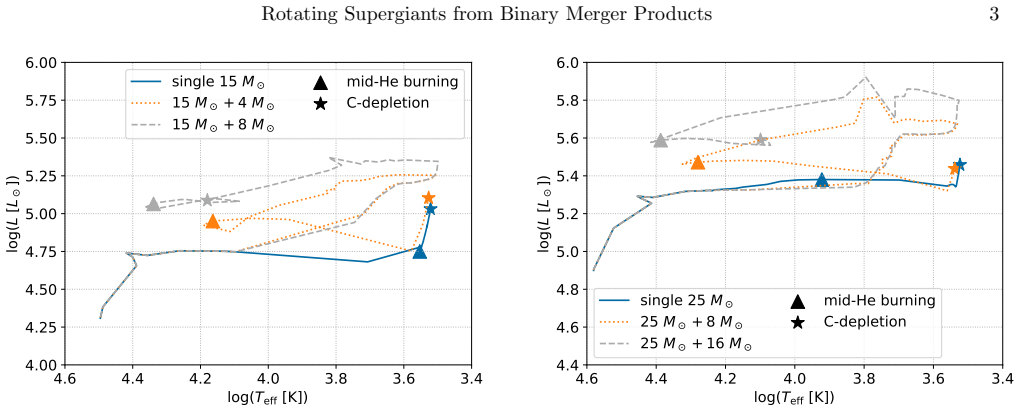
Summary. The paper constructs a MESA grid of 32 rotating supergiant models from post-main-sequence binary mergers, spanning four primary masses (10–25 Msun) and accreted masses up to 0.8 M1, at LMC-like metallicity. The key findings are that larger accreted mass favors blue supergiants (BSGs) at core collapse, that BSGs retain rapidly rotating outer envelopes (with lower-mass BSGs rotating faster), and that these rotation profiles lead to a landscape of transients: successful neutrino-driven explosions produce 1987A-like SNe with long-rising light curves, while failed explosions produce fallback-driven disk winds and possibly relativistic jets, proposed as progenitors of ultra-long GRBs and AT2018cow-like fast luminous transients. The paper includes light-curve calculations with SNEC, an accretion-disk model from Fuller & Lu (2022), and a jet-breakout model, and compares the resulting surface rotation rates to observed LMC BSGs.
Significance. If the main claims hold, this is a valuable unification: a single binary-merger channel produces a diversity of core-collapse transients, from ordinary Type II-P SNe to 1987A-like SNe, ultra-long GRBs, and fast optical transients. The paper's strengths include the systematic 32-model grid, the comparison to observed LMC BSG rotation (which provides an external anchor), the explicit sensitivity study in Appendix B showing that final mass, radius, and Teff vary by about 10% under altered physics, and the qualitatively reasonable fit to the observed rate of 1987A-like SNe. The modeling is state-of-the-art in using MESA with modern AM transport, and the authors are candid about the limitations of their 1D merger prescription. However, the central transient predictions inherit several untested assumptions, as detailed below, so the significance will be fully realized only after those assumptions are shown to be benign or are appropriately bracketed.
major comments (2)
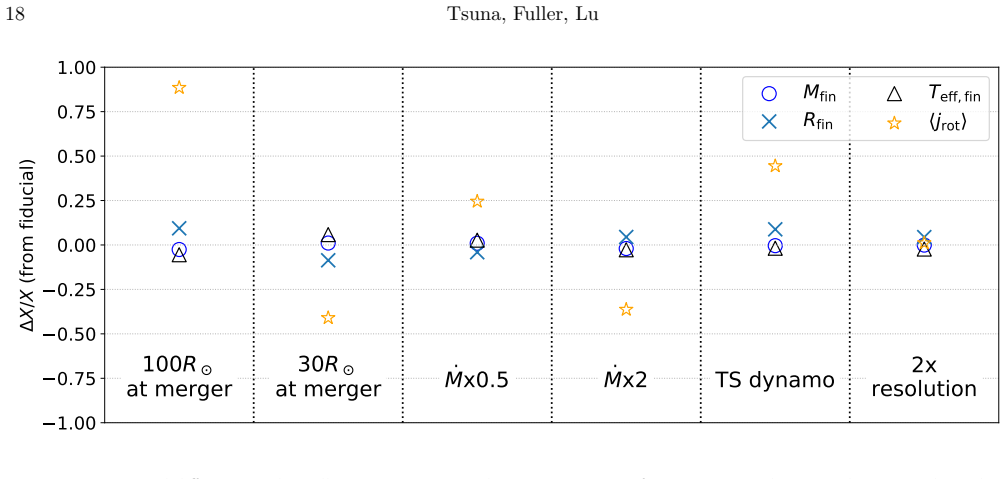
- [Section 2, Section 5, Appendix B] The merger is modeled as rapid accretion onto the primary at R* = 50 Rsun, with accreted material set to the primary's surface specific entropy and composition, no mass loss from the system, and jacc from Eq. (2). Section 5 explicitly concedes that this neglects the secondary's helium-rich core and dredge-up, which can affect envelope helium abundance and hence the BSG threshold. However, the sensitivity study in Appendix B varies merger radius, wind efficiency, AM transport scheme, and resolution, but not the entropy/composition structure of the accreted material. Since the final AM profile, and therefore the mass with j > jISCO (Table 1), directly controls Mcirc, Mdot, Ljet, and Lwind (Eqs. 14–16, Fig. 7), this untested variation is load-bearing. I request additional models (or a quantitative bounding argument) that vary the accreted material's entropy/composition, or include a He-rich
- [Section 4.2.1–4.2.2] The engine model adopts constant disk and jet parameters: theta_disk = 45 degrees, s = 0.5, eta_jet = 0.01, and Mej scaling from Ivanov & Fernandez (2021). No sensitivity tests or error bars are presented for any of these. The BH accretion rate (Eq. 16) and the wind/jet luminosities (Eqs. 14–15) scale directly with these choices; for instance, the disk mass is proportional to sin(theta_disk) ~ 0.7, and s determines the split between accretion and wind. Moreover, the jet efficiency eta_jet is taken from MAD simulations at accretion rates orders of magnitude higher than the 1e-6–1e-3 Msun/s rates in these models (Section 4.2.2). The identification of these models as viable ultra-long GRB and FBOT progenitors therefore needs either a parameter exploration or a clear statement of how the conclusions should be revised as these parameters vary.
minor comments (4)
- [Figure 6 caption] Typo: 'increaesd' should be 'increased'.
- [Section 1] Typo: 'throughtout' should be 'throughout' in the first paragraph.
- [Section 4.2.2] Missing space in 'thatthe' in the sentence 'If we assume thatthe efficiencies...'.
- [Table 1 and Figure 4] The notation 'Mj>jISCO,Sch' is used in the table, but the text sometimes refers to 'mass with j > jISCO'; please define consistently. Also, the gray region in Figure 4 would benefit from an explicit statement of the BH spin range that bounds it.
Circularity Check
No significant circularity: transient predictions are forward-modeled from explicit merger assumptions and compared to external data, not fitted to target observables.
full rationale
The derivation chain is self-contained. Merger products are constructed in MESA by rapid accretion with an explicitly prescribed specific AM (Eq. 2), and the resulting BSG/RSG dichotomy and rotation profiles emerge from stellar-structure evolution, not from tuning to the transient classes the paper claims to explain. The rotation outputs are checked against external LMC observations of BSG surface rotation (Eq. 4), an independent comparison. The transient modeling uses SNEC for light curves and the Fuller & Lu (2022) one-zone disk model for failed-explosion accretion; both are published tools used as forward models, and neither encodes the paper's conclusions as an input. The self-citations to Fuller et al. (2019) and Fuller & Lu (2022) are used as physical prescriptions for AM transport and disk evolution, respectively, and are not invoked as a uniqueness theorem or as a substitute for derivation. No fitted parameter is renamed as a prediction: the model grid spans M1 and M2 without calibration to the target SNe, ultra-long GRBs, or FBOTs. The limitations admitted in Section 5—neglect of the secondary's helium-rich core and dredge-up—are honest caveats about physical realism and do not constitute circularity, since the predictions are not defined in terms of those neglected effects. Overall, the central claims are independent of the inputs by construction and rest on standard stellar-evolution and accretion-disk modeling.
Assumptions & free parameters
free parameters (12)
- ZAMS surface rotation =
20% of critical velocity (~100 km/s)
- Dutch wind efficiency (Dutch_scaling_factor) =
0.5
- Semi-convection efficiency alpha_sc =
10
- Convective core overshoot (f, f0) =
(0.02, 0.005)
- Radius at onset of mass accretion =
50 R_sun
- Specific AM of accreted material jacc =
about 7e19 cm2/s (Eq. 2)
- Disk opening angle theta_disk =
45 degrees
- Disk wind index s =
0.5
- Jet efficiency eta_jet =
0.01
- Neutrino-driven ejected mass Mej scaling =
0.01 * xi_env^-1 M_sun
- 56Ni mass in SNEC explosions =
0.07 M_sun
- 56Ni mixing fraction =
90% in mass
assumptions (6)
- ad hoc to paper A post-main-sequence binary merger is represented by rapid accretion of the secondary's mass onto the primary with no mass loss from the system.
- domain assumption The Fuller et al. 2019 angular momentum transport prescription, with parameters adopted from Fuller & Lu 2022, captures AM evolution in radiative zones.
- domain assumption The one-zone disk model of Fuller & Lu 2022, with constant theta_disk = 45 degrees and s = 0.5, describes fallback accretion and wind/jet energetics.
- domain assumption Explosion outcomes are treated agnostically, and for the rate estimate a majority of BSGs are assumed to explode.
- ad hoc to paper Jet efficiency and BH spin-down results from magnetically arrested disk simulations apply at accretion rates several orders of magnitude lower than in long GRBs.
- domain assumption Statistical binary population assumptions for the rate estimate, including fbin = 50%, log-uniform separations, and flat mass ratio.
Cite this review
Pith. "Pith review of Fates of Rotating Supergiants from Stellar Mergers and the Landscape of Transients upon Core-collapse." pith.science (2026). https://pith.science/paper/Q25C24UA
@misc{pith2026250821116,
  author       = {Pith},
  title        = {Pith review of: Fates of Rotating Supergiants from Stellar Mergers and the Landscape of Transients upon Core-collapse},
  year         = {2026},
  howpublished = {\url{https://pith.science/paper/Q25C24UA}},
  note         = {Machine review of arXiv:2508.21116}
}
abstract
We present a grid of rotating supergiant models from post-main sequence binary merger products, constructed by the MESA stellar evolution code. We focus on the evolution of these stars until core-collapse, in addition to their rotation, which could influence their mass loss and explosion phenomenology. We find that (i) as in previous studies, larger mass gain by merger favors the production of blue supergiants (BSGs) over red supergiants, and (ii) merger products that end as BSGs at core collapse have rotating outer envelopes, with lower-mass BSGs having faster envelope rotation due to less wind mass loss. We model the expected transients from these BSGs upon core-collapse, considering cases where the neutrino-driven explosion is successful and unsuccessful. The successful explosions result in supernovae (SNe) with long-rising light curves of morphology similar to SN 1987A. Failed explosions of these BSGs result in envelope fallback of $\sim (0.1$- several) $~M_\odot$ over $10^3$-$10^5$ seconds that power strong ($10^{51}$-$10^{53}$ erg) accretion-driven outflows in winds and possibly jets, with relativistic jets (if formed) generally capable of breaking out of the BSG envelope. Our modeling points to these merger-origin BSGs as viable progenitors for SN 1987A-like SNe, ultra-long gamma-ray bursts, and some of the fast luminous transients found in high-cadence optical surveys.
Figures


Figures from the paper (9 more)


Forward citations
Cited by 4 Pith papers
-
The first radio view of a type Ibn supernova in SN 2023fyq: Understanding the mass-loss history in the last decade before the explosion
First radio observations of SN 2023fyq detect a dense circumstellar shell with mass-loss rate ~0.004 solar masses per year ejected 0.7-3 years before explosion, consistent with a merger origin.
-
Compact Objects Merging with Stars as an Origin of Ultra-Long Gamma-Ray Bursts and Luminous Fast Blue Optical Transients
SN 2011kl is broadly consistent with an LFBOT light-curve model and ULGRB hosts match LFBOT/LGRB environments, supporting a shared He-CO merger progenitor for a subset of both classes.
-
Formation of rotating supergiants via stellar mergers in dense clusters: Implications for black hole natal spins
Stellar mergers with mass ratio q≳0.3 in young clusters can produce blue-supergiant progenitors that leave black holes with dimensionless spins a≃0.5–0.8, reducing post-merger retention and hierarchical-merger rates.
-
Jittering jets promote dust formation in core-collapse supernovae
Jittering jets in core-collapse supernovae enhance dust formation and imprint jet-shaped morphologies on the dust in remnants, supporting the jittering jets explosion mechanism.
Reference graph
Works this paper leans on
-
[1]
Anders , E. H., Jermyn , A. S., Lecoanet , D., et al. 2022, , 928, L10, 10.3847/2041-8213/ac5cb5
-
[2]
2022, , 511, 176, 10.1093/mnras/stab3776
Antoni , A., & Quataert , E. 2022, , 511, 176, 10.1093/mnras/stab3776
-
[3]
2023, , 525, 1229, 10.1093/mnras/stad2328
---. 2023, , 525, 1229, 10.1093/mnras/stad2328
- [4]
-
[5]
2016, , 461, 51, 10.1093/mnras/stw1331
Beniamini , P., Nava , L., & Piran , T. 2016, , 461, 51, 10.1093/mnras/stw1331
-
[6]
Blandford , R. D., & Begelman , M. C. 1999, , 303, L1, 10.1046/j.1365-8711.1999.02358.x
arXiv 1999
-
[7]
Blandford , R. D., & Znajek , R. L. 1977, , 179, 433, 10.1093/mnras/179.3.433
-
[8]
2000, , 532, 1132, 10.1086/308588
Blinnikov , S., Lundqvist , P., Bartunov , O., Nomoto , K., & Iwamoto , K. 2000, , 532, 1132, 10.1086/308588
doi:10.1086/308588 2000
Show all 162 references
-
[9]
2024, , 110, 023007, 10.1103/PhysRevD.110.023007
Boccioli , L., & Fragione , G. 2024, , 110, 023007, 10.1103/PhysRevD.110.023007
2024 doi
-
[10]
J., & Chieffi , A
Boccioli , L., Roberti , L., Limongi , M., Mathews , G. J., & Chieffi , A. 2023, , 949, 17, 10.3847/1538-4357/acc06a
2023 doi
-
[11]
1995, , 297, 483
Braun , H., & Langer , N. 1995, , 297, 483
1995
-
[12]
2011, , 740, 100, 10.1088/0004-637X/740/2/100
Bromberg , O., Nakar , E., Piran , T., & Sari , R. 2011, , 740, 100, 10.1088/0004-637X/740/2/100
2011 doi
-
[13]
2023, , 957, 68, 10.3847/1538-4357/acfc1c
Burrows , A., Vartanyan , D., & Wang , T. 2023, , 957, 68, 10.3847/1538-4357/acfc1c
2023 doi
-
[14]
2014, , 570, L13, 10.1051/0004-6361/201425028
Castro , N., Fossati , L., Langer , N., et al. 2014, , 570, L13, 10.1051/0004-6361/201425028
2014 doi
-
[15]
Chen , W.-X., & Beloborodov , A. M. 2007, , 657, 383, 10.1086/508923
2007 doi
-
[16]
S., Su , K.-Y., Narayan , R., & Natarajan , P
Cho , H., Prather , B. S., Su , K.-Y., Narayan , R., & Natarajan , P. 2024, , 977, 200, 10.3847/1538-4357/ad9561
2024 doi
-
[17]
L., Margutti , R., Terreran , G., et al
Coppejans , D. L., Margutti , R., Terreran , G., et al. 2020, , 895, L23, 10.3847/2041-8213/ab8cc7
2020 doi
-
[18]
de Jager , C., Nieuwenhuijzen , H., & van der Hucht , K. A. 1988, , 72, 259
1988
-
[19]
E., Langer , N., Izzard , R
de Mink , S. E., Langer , N., Izzard , R. G., Sana , H., & de Koter , A. 2013, , 764, 166, 10.1088/0004-637X/764/2/166
2013 doi
-
[20]
2013, , 772, 30, 10.1088/0004-637X/772/1/30
Dexter , J., & Kasen , D. 2013, , 772, 30, 10.1088/0004-637X/772/1/30
2013 doi
-
[21]
2013, , 51, 269, 10.1146/annurev-astro-081710-102602
Duch \^e ne , G., & Kraus , A. 2013, , 51, 269, 10.1146/annurev-astro-081710-102602
2013 doi
-
[22]
R., Dufton , P
Dunstall , P. R., Dufton , P. L., Sana , H., et al. 2015, , 580, A93, 10.1051/0004-6361/201526192
2015 doi
-
[23]
2024, , 685, A58, 10.1051/0004-6361/202347646
Ercolino , A., Jin , H., Langer , N., & Dessart , L. 2024, , 685, A58, 10.1051/0004-6361/202347646
2024 doi
-
[24]
E., Petermann , I., et al
Farmer , R., Fields , C. E., Petermann , I., et al. 2016, , 227, 22, 10.3847/1538-4365/227/2/22
2016 doi
-
[25]
J., Groh , J
Farrell , E. J., Groh , J. H., Meynet , G., et al. 2019, , 621, A22, 10.1051/0004-6361/201833657
2019 doi
-
[26]
Fern \'a ndez , R., Quataert , E., Kashiyama , K., & Coughlin , E. R. 2018, , 476, 2366, 10.1093/mnras/sty306
2018 doi
- [27]
-
[28]
2022, , 511, 3951, 10.1093/mnras/stac317
Fuller , J., & Lu , W. 2022, , 511, 3951, 10.1093/mnras/stac317
2022 doi
-
[29]
L., & Jermyn , A
Fuller , J., Piro , A. L., & Jermyn , A. S. 2019, , 485, 3661, 10.1093/mnras/stz514
2019 doi
-
[30]
M., et al
Galbany , L., Stanishev , V., Mour \ a o , A. M., et al. 2016, , 591, A48, 10.1051/0004-6361/201528045
2016 doi
-
[31]
L., et al
Gendre , B., Stratta , G., Atteia , J. L., et al. 2013, , 766, 30, 10.1088/0004-637X/766/1/30
2013 doi
-
[32]
2013, , 558, A103, 10.1051/0004-6361/201322178
Georgy , C., Ekstr \"o m , S., Eggenberger , P., et al. 2013, , 558, A103, 10.1051/0004-6361/201322178
2013 doi
-
[33]
Glebbeek , E., Gaburov , E., Portegies Zwart , S., & Pols , O. R. 2013, , 434, 3497, 10.1093/mnras/stt1268
2013 doi
-
[34]
A., Jiang , Y.-F., & Bildsten , L
Goldberg , J. A., Jiang , Y.-F., & Bildsten , L. 2022 a , , 933, 164, 10.3847/1538-4357/ac75e3
2022 doi
-
[35]
2022 b , , 929, 156, 10.3847/1538-4357/ac5ab3
---. 2022 b , , 929, 156, 10.3847/1538-4357/ac5ab3
2022 doi
-
[36]
2021, , 908, L29, 10.3847/2041-8213/abdf5b
Gonz \'a lez , E., Kremer , K., Chatterjee , S., et al. 2021, , 908, L29, 10.3847/2041-8213/abdf5b
2021 doi
-
[37]
A., Kann , D
Greiner , J., Mazzali , P. A., Kann , D. A., et al. 2015, , 523, 189, 10.1038/nature14579
2015 doi
-
[38]
M., Quataert , E., & Kim , C.-G
Guo , M., Stone , J. M., Quataert , E., & Kim , C.-G. 2024, , 973, 141, 10.3847/1538-4357/ad5fe7
2024 doi
-
[39]
J., Janka , H
Hammer , N. J., Janka , H. T., & M \"u ller , E. 2010, , 714, 1371, 10.1088/0004-637X/714/2/1371
2010 doi
-
[40]
B., Gonzalez , R., & Martin , G
Hamuy , M., Suntzeff , N. B., Gonzalez , R., & Martin , G. 1988, , 95, 63, 10.1086/114613
1988 doi
-
[41]
2018, , 477, 2128, 10.1093/mnras/sty760
Harrison , R., Gottlieb , O., & Nakar , E. 2018, , 477, 2128, 10.1093/mnras/sty760
2018 doi
-
[42]
Henneco , J., Schneider , F. R. N., & Laplace , E. 2024, , 682, A169, 10.1051/0004-6361/202347893
2024 doi
-
[43]
1989, , 219, L3
Hillebrandt , W., & Meyer , F. 1989, , 219, L3
1989
-
[44]
Ho , A. Y. Q., Phinney , E. S., Ravi , V., et al. 2019, , 871, 73, 10.3847/1538-4357/aaf473
2019 doi
-
[45]
Ho , A. Y. Q., Perley , D. A., Kulkarni , S. R., et al. 2020, , 895, 49, 10.3847/1538-4357/ab8bcf
2020 doi
-
[46]
Ho , A. Y. Q., Margalit , B., Bremer , M., et al. 2022, , 932, 116, 10.3847/1538-4357/ac4e97
2022 doi
-
[47]
Ho , A. Y. Q., Perley , D. A., Gal-Yam , A., et al. 2023, , 949, 120, 10.3847/1538-4357/acc533
2023 doi
- [48]
-
[49]
J., Dufton , P
Hunter , I., Lennon , D. J., Dufton , P. L., et al. 2008, , 479, 541, 10.1051/0004-6361:20078511
2008 doi
-
[50]
W., Twum , A
Hutchinson-Smith , T., Everson , R. W., Twum , A. A., et al. 2024, , 977, 196, 10.3847/1538-4357/ad88f3
2024 doi
-
[51]
2016, , 833, 110, 10.3847/1538-4357/833/1/110
Ioka , K., Hotokezaka , K., & Piran , T. 2016, , 833, 110, 10.3847/1538-4357/833/1/110
2016 doi
-
[52]
M., Linial , I., Nakar , E., Piran , T., & Sari , R
Irwin , C. M., Linial , I., Nakar , E., Piran , T., & Sari , R. 2021, , 508, 5766, 10.1093/mnras/stab2705
2021 doi
-
[53]
2021, , 911, 6, 10.3847/1538-4357/abe59e
Ivanov , M., & Fern \'a ndez , R. 2021, , 911, 6, 10.3847/1538-4357/abe59e
2021 doi
-
[54]
2024, , 961, 212, 10.3847/1538-4357/ad02f0
Jacquemin-Ide , J., Gottlieb , O., Lowell , B., & Tchekhovskoy , A. 2024, , 961, 212, 10.3847/1538-4357/ad02f0
2024 doi
-
[55]
S., Bauer , E
Jermyn , A. S., Bauer , E. B., Schwab , J., et al. 2023, , 265, 15, 10.3847/1538-4365/acae8d
2023 doi
-
[56]
Justham , S., Podsiadlowski , P., & Vink , J. S. 2014, , 796, 121, 10.1088/0004-637X/796/2/121
2014 doi
-
[57]
A., Schady , P., Olivares , E
Kann , D. A., Schady , P., Olivares , E. F., et al. 2018, , 617, A122, 10.1051/0004-6361/201731292
2018 doi
-
[58]
2010, , 717, 245, 10.1088/0004-637X/717/1/245
Kasen , D., & Bildsten , L. 2010, , 717, 245, 10.1088/0004-637X/717/1/245
2010 doi
-
[59]
Kasen , D., & Woosley , S. E. 2009, , 703, 2205, 10.1088/0004-637X/703/2/2205
2009 doi
-
[60]
2013, , 770, 8, 10.1088/0004-637X/770/1/8
Kashiyama , K., Nakauchi , D., Suwa , Y., Yajima , H., & Nakamura , T. 2013, , 770, 8, 10.1088/0004-637X/770/1/8
2013 doi
-
[61]
2015, , 451, 2656, 10.1093/mnras/stv1164
Kashiyama , K., & Quataert , E. 2015, , 451, 2656, 10.1093/mnras/stv1164
2015 doi
-
[62]
Kawanaka , N., Piran , T., & Krolik , J. H. 2013, , 766, 31, 10.1088/0004-637X/766/1/31
2013 doi
-
[63]
2024, , 532, 3926, 10.1093/mnras/stae1681
Kinugawa , T., Horiuchi , S., Takiwaki , T., & Kotake , K. 2024, , 532, 3926, 10.1093/mnras/stae1681
2024 doi
-
[64]
1977, , 54, 539
Kippenhahn , R., & Meyer-Hofmeister , E. 1977, , 54, 539
1977
-
[65]
Kleiser , I. K. W., Poznanski , D., Kasen , D., et al. 2011, , 415, 372, 10.1111/j.1365-2966.2011.18708.x
2011
-
[66]
G., & Chruslinska , M
Klencki , J., Nelemans , G., Istrate , A. G., & Chruslinska , M. 2021, , 645, A54, 10.1051/0004-6361/202038707
2021 doi
-
[67]
G., & Pols , O
Klencki , J., Nelemans , G., Istrate , A. G., & Pols , O. 2020, , 638, A55, 10.1051/0004-6361/202037694
2020 doi
-
[68]
1998, , 497, 431, 10.1086/305452
Kozma , C., & Fransson , C. 1998, , 497, 431, 10.1086/305452
1998 doi
-
[69]
2020, , 903, 45, 10.3847/1538-4357/abb945
Kremer , K., Spera , M., Becker , D., et al. 2020, , 903, 45, 10.3847/1538-4357/abb945
2020 doi
-
[70]
2015, , 561, 1, 10.1016/j.physrep.2014.09.008
Kumar , P., & Zhang , B. 2015, , 561, 1, 10.1016/j.physrep.2014.09.008
2015 doi
-
[71]
Lau , M. Y. M., Hirai , R., Mandel , I., & Tout , C. A. 2024, , 966, L7, 10.3847/2041-8213/ad3d50
2024 doi
-
[72]
J., Tanvir , N
Levan , A. J., Tanvir , N. R., Starling , R. L. C., et al. 2014, , 781, 13, 10.1088/0004-637X/781/1/13
2014 doi
-
[73]
2014, , 783, 24, 10.1088/0004-637X/783/1/24
Lien , A., Sakamoto , T., Gehrels , N., et al. 2014, , 783, 24, 10.1088/0004-637X/783/1/24
2014 doi
-
[74]
I., & Nadezhin , D
Litvinova , I. I., & Nadezhin , D. K. 1983, , 89, 89, 10.1007/BF01008387
1983 doi
-
[75]
2015, , 218, 12, 10.1088/0067-0049/218/1/12
Liu , T., Hou , S.-J., Xue , L., & Gu , W.-M. 2015, , 218, 12, 10.1088/0067-0049/218/1/12
2015 doi
-
[76]
Lovegrove , E., & Woosley , S. E. 2013, , 769, 109, 10.1088/0004-637X/769/2/109
2013 doi
-
[77]
E., & Zhang , W
Lovegrove , E., Woosley , S. E., & Zhang , W. 2017, , 845, 103, 10.3847/1538-4357/aa7b7d
2017 doi
-
[78]
2024, , 960, 82, 10.3847/1538-4357/ad09af
Lowell , B., Jacquemin-Ide , J., Tchekhovskoy , A., & Duncan , A. 2024, , 960, 82, 10.3847/1538-4357/ad09af
2024 doi
- [79]
-
[80]
2019, , 488, 4338, 10.1093/mnras/stz2009
Ma , L., & Fuller , J. 2019, , 488, 4338, 10.1093/mnras/stz2009
2019 doi
- [81]
-
[82]
2014, , 794, 9, 10.1088/0004-637X/794/1/9
MacLeod , M., Goldstein , J., Ramirez-Ruiz , E., Guillochon , J., & Samsing , J. 2014, , 794, 9, 10.1088/0004-637X/794/1/9
2014 doi
-
[83]
Marchant , P., & Moriya , T. J. 2020, , 640, L18, 10.1051/0004-6361/202038902
2020 doi
-
[84]
D., Chornock , R., et al
Margutti , R., Metzger , B. D., Chornock , R., et al. 2019, , 872, 18, 10.3847/1538-4357/aafa01
2019 doi
-
[85]
Matzner , C. D. 2003, , 345, 575, 10.1046/j.1365-8711.2003.06969.x
2003
-
[86]
2017, , 469, 4649, 10.1093/mnras/stx818
Menon , A., & Heger , A. 2017, , 469, 4649, 10.1093/mnras/stx818
2017 doi
-
[87]
2019, , 482, 438, 10.1093/mnras/sty2647
Menon , A., Utrobin , V., & Heger , A. 2019, , 482, 438, 10.1093/mnras/sty2647
2019 doi
-
[88]
A., et al
Menon , A., Ercolino , A., Urbaneja , M. A., et al. 2024, , 963, L42, 10.3847/2041-8213/ad2074
2024 doi
-
[89]
D., et al
Migliori , G., Margutti , R., Metzger , B. D., et al. 2024, , 963, L24, 10.3847/2041-8213/ad2764
2024 doi
-
[90]
2016, , 817, 54, 10.3847/0004-637X/817/1/54
Moore , K., & Garaud , P. 2016, , 817, 54, 10.3847/0004-637X/817/1/54
2016 doi
- [91]
-
[92]
J., Nicholl , M., & Guillochon , J
Moriya , T. J., Nicholl , M., & Guillochon , J. 2018, , 867, 113, 10.3847/1538-4357/aae53d
2018 doi
-
[93]
L., Renzo , M., et al
Morozova , V., Piro , A. L., Renzo , M., et al. 2015, , 814, 63, 10.1088/0004-637X/814/1/63
2015 doi
-
[94]
2007, Science, 315, 1103, 10.1126/science.1136351
Morris , T., & Podsiadlowski , P. 2007, Science, 315, 1103, 10.1126/science.1136351
2007 doi
-
[96]
Nadezhin , D. K. 1980, , 69, 115, 10.1007/BF00638971
1980 doi
-
[97]
2013, , 778, 67, 10.1088/0004-637X/778/1/67
Nakauchi , D., Kashiyama , K., Suwa , Y., & Nakamura , T. 2013, , 778, 67, 10.1088/0004-637X/778/1/67
2013 doi
-
[98]
V., & Abramowicz , M
Narayan , R., Igumenshchev , I. V., & Abramowicz , M. A. 2003, , 55, L69, 10.1093/pasj/55.6.L69
2003 doi
-
[99]
J., Vigna-G \'o mez , A., Stevenson , S., et al
Neijssel , C. J., Vigna-G \'o mez , A., Stevenson , S., et al. 2019, , 490, 3740, 10.1093/mnras/stz2840
2019 doi
-
[100]
1977, , 29, 249
Neo , S., Miyaji , S., Nomoto , K., & Sugimoto , D. 1977, , 29, 249
1977
-
[101]
Neustadt , J. M. M., Kochanek , C. S., Stanek , K. Z., et al. 2021, , 508, 516, 10.1093/mnras/stab2605
2021 doi
-
[102]
Nugis , T., & Lamers , H. J. G. L. M. 2000, , 360, 227
2000
-
[103]
L., Navasardyan , H., et al
Pastorello , A., Pumo , M. L., Navasardyan , H., et al. 2012, , 537, A141, 10.1051/0004-6361/201118112
2012 doi
-
[104]
R., Lennon , D
Patrick , L. R., Lennon , D. J., Najarro , F., et al. 2025, , 698, A39, 10.1051/0004-6361/202452949
2025 doi
-
[105]
A., Pinsonneault , M
Patton , R. A., Pinsonneault , M. H., & Thompson , T. A. 2025, arXiv e-prints, arXiv:2505.05562, 10.48550/arXiv.2505.05562
2025 doi
-
[106]
2011, , 192, 3, 10.1088/0067-0049/192/1/3
Paxton , B., Bildsten , L., Dotter , A., et al. 2011, , 192, 3, 10.1088/0067-0049/192/1/3
2011 doi
-
[107]
2013, , 208, 4, 10.1088/0067-0049/208/1/4
Paxton , B., Cantiello , M., Arras , P., et al. 2013, , 208, 4, 10.1088/0067-0049/208/1/4
2013 doi
-
[108]
2015, , 220, 15, 10.1088/0067-0049/220/1/15
Paxton , B., Marchant , P., Schwab , J., et al. 2015, , 220, 15, 10.1088/0067-0049/220/1/15
2015 doi
-
[109]
B., et al
Paxton , B., Schwab , J., Bauer , E. B., et al. 2018, , 234, 34, 10.3847/1538-4365/aaa5a8
2018 doi
-
[110]
2019, , 243, 10, 10.3847/1538-4365/ab2241
Paxton , B., Smolec , R., Schwab , J., et al. 2019, , 243, 10, 10.3847/1538-4365/ab2241
2019 doi
-
[111]
2018, , 859, 48, 10.3847/1538-4357/aabcc1
Perna , R., Lazzati , D., & Cantiello , M. 2018, , 859, 48, 10.3847/1538-4357/aabcc1
2018 doi
-
[112]
P., Lyman , J
Pessi , T., Anderson , J. P., Lyman , J. D., et al. 2023, , 955, L29, 10.3847/2041-8213/acf7c6
2023 doi
-
[113]
Piro , A. L. 2013, , 768, L14, 10.1088/2041-8205/768/1/L14
2013 doi
- [114]
-
[115]
C., & Rappaport , S
Podsiadlowski , P., Joss , P. C., & Rappaport , S. 1990, , 227, L9
1990
-
[116]
Pols , O. R. 1994, , 290, 119
1994
-
[117]
Popov , D. V. 1993, , 414, 712, 10.1086/173117
1993 doi
-
[118]
F., Baumgardt , H., Hut , P., Makino , J., & McMillan , S
Portegies Zwart , S. F., Baumgardt , H., Hut , P., Makino , J., & McMillan , S. L. W. 2004, , 428, 724, 10.1038/nature02448
2004 doi
-
[119]
L., & Cosentino , S
Pumo , M. L., & Cosentino , S. P. 2025, , 538, 223, 10.1093/mnras/staf288
2025 doi
-
[120]
R., et al
Ramachandran , V., Hainich , R., Hamann , W. R., et al. 2018, , 609, A7, 10.1051/0004-6361/201731093
2018 doi
-
[121]
R., Oskinova , L
Ramachandran , V., Hamann , W. R., Oskinova , L. M., et al. 2019, , 625, A104, 10.1051/0004-6361/201935365
2019 doi
-
[122]
Rees , M. J. 1984, , 22, 471, 10.1146/annurev.aa.22.090184.002351
1984
-
[123]
A., Grichener , A., Gottlieb , O., & Cantiello , M
Renzo , M., Goldberg , J. A., Grichener , A., Gottlieb , O., & Cantiello , M. 2024, Research Notes of the American Astronomical Society, 8, 152, 10.3847/2515-5172/ad530e
2024 doi
-
[124]
K., Gupta , R., Aryan , A., et al
Ror , A. K., Gupta , R., Aryan , A., et al. 2024, , 971, 163, 10.3847/1538-4357/ad5554
2024 doi
- [125]
-
[126]
E., de Koter , A., et al
Sana , H., de Mink , S. E., de Koter , A., et al. 2012, Science, 337, 444, 10.1126/science.1223344
2012 doi
-
[127]
E., et al
Sana , H., de Koter , A., de Mink , S. E., et al. 2013, , 550, A107, 10.1051/0004-6361/201219621
2013 doi
-
[128]
B., Lacour , S., et al
Sana , H., Le Bouquin , J. B., Lacour , S., et al. 2014, , 215, 15, 10.1088/0067-0049/215/1/15
2014 doi
-
[129]
Schneider , F. R. N., Ohlmann , S. T., Podsiadlowski , P., et al. 2019, , 574, 211, 10.1038/s41586-019-1621-5
2019 doi
-
[130]
Schneider , F. R. N., Podsiadlowski , P., & Laplace , E. 2024, , 686, A45, 10.1051/0004-6361/202347854
2024 doi
-
[131]
J., & Wang , C
Schootemeijer , A., Langer , N., Grin , N. J., & Wang , C. 2019, , 625, A132, 10.1051/0004-6361/201935046
2019 doi
-
[132]
2024, , 691, A174, 10.1051/0004-6361/202450354
Sch \"u rmann , C., & Langer , N. 2024, , 691, A174, 10.1051/0004-6361/202450354
2024 doi
-
[133]
I., & Sunyaev , R
Shakura , N. I., & Sunyaev , R. A. 1973, , 24, 337
1973
-
[134]
2022, , 665, A148, 10.1051/0004-6361/202244245
Shenar , T., Sana , H., Mahy , L., et al. 2022, , 665, A148, 10.1051/0004-6361/202244245
2022 doi
-
[135]
1990, , 360, 242, 10.1086/169114
Shigeyama , T., & Nomoto , K. 1990, , 360, 242, 10.1086/169114
1990 doi
-
[136]
2024, , 964, 74, 10.3847/1538-4357/ad2704
Shvartzvald , Y., Waxman , E., Gal-Yam , A., et al. 2024, , 964, 74, 10.3847/1538-4357/ad2704
2024 doi
-
[137]
M., Tzanidakis , A., et al
Sit , T., Kasliwal , M. M., Tzanidakis , A., et al. 2023, , 959, 142, 10.3847/1538-4357/ad036f
2023 doi
-
[139]
2014, , 52, 487, 10.1146/annurev-astro-081913-040025
Smith , N. 2014, , 52, 487, 10.1146/annurev-astro-081913-040025
2014 doi
-
[140]
S., & de Koter , A
Smith , N., Vink , J. S., & de Koter , A. 2004, , 615, 475, 10.1086/424030
2004 doi
-
[141]
Spruit , H. C. 2002, , 381, 923, 10.1051/0004-6361:20011465
2002 doi
-
[142]
T., Kresse , D., et al
Stockinger , G., Janka , H. T., Kresse , D., et al. 2020, , 496, 2039, 10.1093/mnras/staa1691
2020 doi
-
[143]
E., & Quataert , E
Strubbe , L. E., & Quataert , E. 2009, , 400, 2070, 10.1111/j.1365-2966.2009.15599.x
2009
-
[144]
E., Brown , J
Sukhbold , T., Ertl , T., Woosley , S. E., Brown , J. M., & Janka , H. T. 2016, , 821, 38, 10.3847/0004-637X/821/1/38
2016 doi
-
[145]
2013, , 558, A143, 10.1051/0004-6361/201322276
Taddia , F., Sollerman , J., Razza , A., et al. 2013, , 558, A143, 10.1051/0004-6361/201322276
2013 doi
-
[146]
2016, , 588, A5, 10.1051/0004-6361/201527811
Taddia , F., Sollerman , J., Fremling , C., et al. 2016, , 588, A5, 10.1051/0004-6361/201527811
2016 doi
-
[147]
2016, , 460, 3447, 10.1093/mnras/stw1122
Tak \'a ts , K., Pignata , G., Bersten , M., et al. 2016, , 460, 3447, 10.1093/mnras/stw1122
2016 doi
-
[148]
Tchekhovskoy , A., Narayan , R., & McKinney , J. C. 2011, , 418, L79, 10.1111/j.1745-3933.2011.01147.x
2011
-
[149]
D., Pols , O
Temmink , K. D., Pols , O. R., Justham , S., Istrate , A. G., & Toonen , S. 2023, , 669, A45, 10.1051/0004-6361/202244137
2023 doi
-
[150]
Tsuna , D., Huang , X., Fuller , J., & Piro , A. L. 2025, , 979, 20, 10.3847/1538-4357/ad9bad
2025 doi
-
[151]
2021, , 922, L34, 10.3847/2041-8213/ac3997
Tsuna , D., Kashiyama , K., & Shigeyama , T. 2021, , 922, L34, 10.3847/2041-8213/ac3997
2021 doi
-
[152]
2018, , 473, L101, 10.1093/mnrasl/slx166
Urushibata , T., Takahashi , K., Umeda , H., & Yoshida , T. 2018, , 473, L101, 10.1093/mnrasl/slx166
2018 doi
-
[153]
1993, , 270, 249
Utrobin , V. 1993, , 270, 249
1993
-
[154]
P., Wongwathanarat , A., Janka , H
Utrobin , V. P., Wongwathanarat , A., Janka , H. T., & M \"u ller , E. 2015, , 581, A40, 10.1051/0004-6361/201425513
2015 doi
-
[155]
2013, , 552, A105, 10.1051/0004-6361/201321072
Vanbeveren , D., Mennekens , N., Van Rensbergen , W., & De Loore , C. 2013, , 552, A105, 10.1051/0004-6361/201321072
2013 doi
-
[156]
Vartanyan , D., Tsang , B. T. H., Kasen , D., et al. 2025, , 982, 9, 10.3847/1538-4357/adb1e4
2025 doi
-
[157]
S., de Koter , A., & Lamers , H
Vink , J. S., de Koter , A., & Lamers , H. J. G. L. M. 2001, , 369, 574, 10.1051/0004-6361:20010127
2001 doi
-
[158]
2010, , 406, 1944, 10.1111/j.1365-2966.2010.16787.x
Wanderman , D., & Piran , T. 2010, , 406, 1944, 10.1111/j.1365-2966.2010.16787.x
2010
-
[159]
Wang , T., Vartanyan , D., Burrows , A., & Coleman , M. S. B. 2022, , 517, 543, 10.1093/mnras/stac2691
2022 doi
-
[160]
M., Lauberts , A., Jorgensen , H
West , R. M., Lauberts , A., Jorgensen , H. E., & Schuster , H. E. 1987, , 177, L1
1987
- [161]
-
[162]
2025, , 980, L28, 10.3847/2041-8213/adaeb8
Wu , Z.-F., Damoulakis , M., Beniamini , P., & Giannios , D. 2025, , 980, L28, 10.3847/2041-8213/adaeb8
2025 doi
-
[163]
Yao , Y., Ho , A. Y. Q., Medvedev , P., et al. 2022, , 934, 104, 10.3847/1538-4357/ac7a41
2022 doi
-
[164]
2025, , 985, 21, 10.3847/1538-4357/adc993
Zheng , J.-H., Zhu , J.-P., Lu , W., & Zhang , B. 2025, , 985, 21, 10.3847/1538-4357/adc993
2025 doi
Reviewed August 5, 2026 · model on record in the stance chip above.
Discussion (0). Sign in to comment.